Feeds:
Posts
Comments

Archive for the ‘Technique/History’ Category

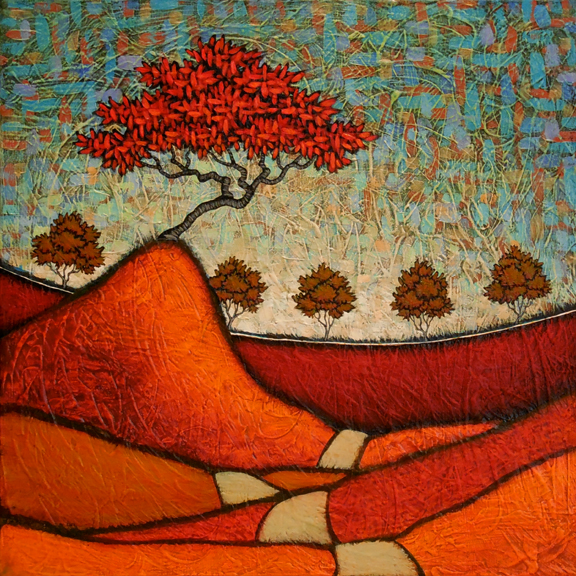
GC Myers -Simple Glory 2004I have a long list of things to be done this morning.  Since time is short, I thought I’d rerun a blog entry from back in early 2009.  It concerns the question of how long it takes to finish a painting, a question that has been asked of me many, many times. I usually tell the story of a commission I did for a Finnish diplomat a number of years back and how the work I did on that piece became the template or rehearsal for a larger piece soon after.

The answer that I gave in 2009 still pretty much applies although I have noticed that in recent years that it is taking me longer to finish paintings.  I tend to dwell on them a little longer now and am more apt to set them aside so that I can simply consider them before forging ahead.  But there’s even a variable in that– sometimes the energy and direction of a piece is so determined that there is a danger in losing its momentum by setting it aside.

So there is no one answer to the question.  Here’s what I wrote six years back:

I am asked this question at every opening and gallery talk:  How long does it takes to finish a painting?  

This is a question that I’ve answered a thousand times and I still have to stop and think about my answer. 

You see, there are so many variables in my painting technique at different times that sometimes the actual process can be much longer or shorter on any given painting.  Sometimes I can toil over a piece, every bit of  the process requiring time and thought.  There may be much time spent just looking at the piece trying to figure out where the next line or stroke goes, trying to weigh each move.  Then there are times when the painting drops out effortlessly and I’ll look up after a very short time and realize that it’s almost complete. Any more moves from me and the piece would be diminished.

I often cite an example from a number of years ago.  I had been working on a series of paintings, working with a particular color and compositional form.  Over the course of a month, I did several very similar paintings in several different sizes from very small up to a fairly large version.  Each had a very distinct and unique appearance and feel but the technique and color was done in very much the same way.

One morning at the end of this monthlong period, I got up early and was in the studio at 5 AM.  I had a very large panel prepared  and pulled it.  Immediately,  I started on the panel.  Every move, every decision was the result of the previous versions of this painting I had executed over the past month.  I was painting solely on muscle memory and not on a conscious decision making thought process.  I was painting very fast, with total focus, and I remember it as being a total whirl.  The piece always seemed near to disaster.  On an edge.  But having done this for a month I trusted every move and forced through potential problems.

Suddenly, it was done.  I looked over at the clock and realized it had only been two hours.  Surely, there must be so much more to do.  

But it was done.  It was fully realized and full of feeling and great rhythm.  I framed the piece and a few weeks later I took it to the Principle Gallery in Alexandria, VA. where I had shown my work for many years.  It found a new home within hours of arriving at the gallery.

I realized at that point that every version of that painting was a separate performance, a virtual rehearsal for that particular painting.  I had choreographed  every move in advance and it was just a matter of finding the right moment when plan and performance converge.

 It had taken a mere two hours but it was really painted over the course of hundreds of hours.

I hope you can see why I always have to think about this question…

[ The painting at the top is titled Simple Glory from 2004 ]

Read Full Post »

GC Myers From Out of the Blue smIn yesterday’s blogpost, I talked a bit about the influence that stained glass had on my work.  Deep color, the luminosity  and lines defining the forms within are all attributes that have found their way into my work.  It was never a conscious decision, one where I said to myself that I was going to try to emulate the look and effect of stained glass.  It was just one of those things that I took in and integrated into my personal aesthetic. Just something I liked to look at.  And that somehow synthesized into the work.

In fact, I wasn’t even aware of the similarity until a few years into my career when several people pointed it out to me, asking if stained glass was a big influence.  I think I always answered yes to the question.  I mean, I liked it a lot so it had to have been an influence on some basic level.

Looking around the studio at the group of new work that is growing for my upcoming June show, Native Voice,  at the Principle Gallery, there are a number of paintings that you can easily see the influence of stained glass.  The piece shown above, From Out of the Blue, really has that feel for me, with the geometry of its puzzle-like pieces in the foreground and the brightness of its sky.  I see that sky in glass as hundreds of small, sharp shards of varying sizes and colors, all radiating outward.

But maybe it being a painting and not stained glass is the attraction for me.  Each medium has its limitations and being able to borrow attributes from one medium and integrate them into the vocabulary and process of another is exciting in itself.  It is painting’s spontaneity that draws me to it, where instinctual moves can be made within moments that change the whole piece.  I don’t know that I could get that with glass and could easily see a piece like From Out of the Blue becoming a contrivance in stained glass.  Too thought out.  Too worked over.  Too clean.

Definitely not from out of the blue— which is how I like it.


Read Full Post »

There were some folks at the Gallery Talk the other day who told me that they were either signed up for or were planning to attend the two-day workshop I will be giving in September in the beautiful Finger Lakes.  I was really pleased to hear this and the fact that they were eager for the experience.  I told them I was a bit excited myself as this is the first time I’ve tried my hand at teaching but that I would  give them a real behind-the-scenes look at my process.  I promised that I would make it entertaining and that they will hopefully walk away with new ideas about how they use their materials and look at their own work.

Thinking about that this morning led me to consider what materials would be required for the workshop and the first thing that came to mind was my 1″ squirrel mop, a brush that is always near me when I am at my wet work.  This reminded me of a bog post back in 2009 where I wrote about my brushes and the Good Soldiers they are for me, sacrificing themselves for the good of a painting.  There’s a before and after photo that shows their sacrifice.

Thought I would share that post today:

GC Myers-brushesI was looking at the brush in my hand the other day and I realized how rough I am sometimes on my brushes.  It was a natural bristle brush that was new just a few weeks ago, when it looked like the brush to the far left in the photo.

Over those few weeks, I caressed paint on to canvas.  I also pushed paint into the canvas.  I ground the paint against the canvas, using a lot of force, to almost burnish the surface.  I stroked.  I poked.  And when I looked down the brush had turned into that poor guy shown second from the left.

I can be rough on my brushes.

For my normal wet technique I use a natural hair squirrel mop like the two shown on the right.  It’s a big, soft brush that holds a lot of paint and is a staple in my studio.  The brush on the left is new and the one on the right is obviously not.  This erosion of the bristles shown here represents about 6 or 7 months of use.

Hard use.

I like the way the bristles whittled themselves down to the angle my hand takes when I normally strike the painting surface.  Unfortunately, it has eroded to a point where its capacity to hold paint makes it a hindrance to my technique.  So he is put aside and maybe I will find a use for him at some point, so I keep him with my other spent brushes.  I could never throw such  loyal workers to the trash heap.

I have amassed quite a number of brushes, both well used and brand new, over the years.  I have tiny detail brushes that I go through quickly.  I have  some cheapy brushes that work perfectly well for certain techniques.  I have some of my favorite medium priced brushes that I have stockpiled because they’re no longer made.  I also have some pretty expensive brushes.  I have a set of beautiful Winsor & Newton Series 7  brushes that are handmade with soft, luxurious Kolinsky sable.  I’ve had them for about 13 years and have only used one or two of them for a few minutes.  They’re lovely in the hand but I never felt comfortable with them and just wouldn’t feel right grinding them roughly into the surface.

So they sit and wait for a day when I’m ready to put them in the game.

Maybe today?  Maybe… but probably not.

Read Full Post »

GC Myers- Away From the Chaos smI mentioned here earlier that I am giving a Gallery Talk next Saturday at the Kada Gallery in Erie.  When I give one of theses talks it is not uncommon for me to bring a small group of new work for the gallery. One of the pieces that is heading to Erie with me is this painting, a 24″ by 20″ canvas that is titled Away From the Chaos.

Actually, I should say that it was titled Away From the Chaos.

You see, this painting started its life several years ago in  a much different form.  It was a piece that showed just once for a very short stay in a gallery then moved to the wall of my studio where it has been ever since.  It was one of those pieces that seemed to be right  in the moment but was just missing that something which  kept me from making contact with it.  It was like a person who has experienced a stroke and has full cognizance with much to share but just can’t make the person in front of them understand.

And I was that person who couldn’t understand.  I could see there was something in it.  Life and emotion.  But  muted and totally restrained.  The colors of its sky felt pointy and sharp to me–a sickly yellow that  didn’t add depth in the image and gave the whole thing a green pallor that belied what I felt was the emotion behind the painting.

So for years, I would go into the room that held this painting and feel a sickening, uneasy pang whenever my eyes settled on it.  It made me sad that it seemed there physically but was so far away.

Finally, a week ago, I could take it no more and decided to either revive it or kill it.  The sky transformed in depth and color, becoming warmer and more giving.  The fields brightened.  The brightness of its color and the roof line of the barn changed as I altered one edge that always felt wrong to me– a small flaw but one that became larger when combined with the others.

And the Red Tree made its way to a central point where it truly became the welcoming symbol that I often see it as.  It suddenly felt so much more alive and complete.  It could reach out now and communicate to me.  And that’s a comforting thing for me.

The old title no longer seemed appropriate.  I settled on Making Contact.  Now it seems right.

Away From the Chaos -evoltion


This painting can be seen  at the Kada Gallery next Saturday, April 11, where I will be giving a Gallery Talk which begins at 1 PM.  If you can make it, please stop in– we will be having a free drawing for one of my original paintings and a few other goodies.  I am aiming for an entertaining and , hopefully, an enlightening talk. Hope to see you there.


Read Full Post »

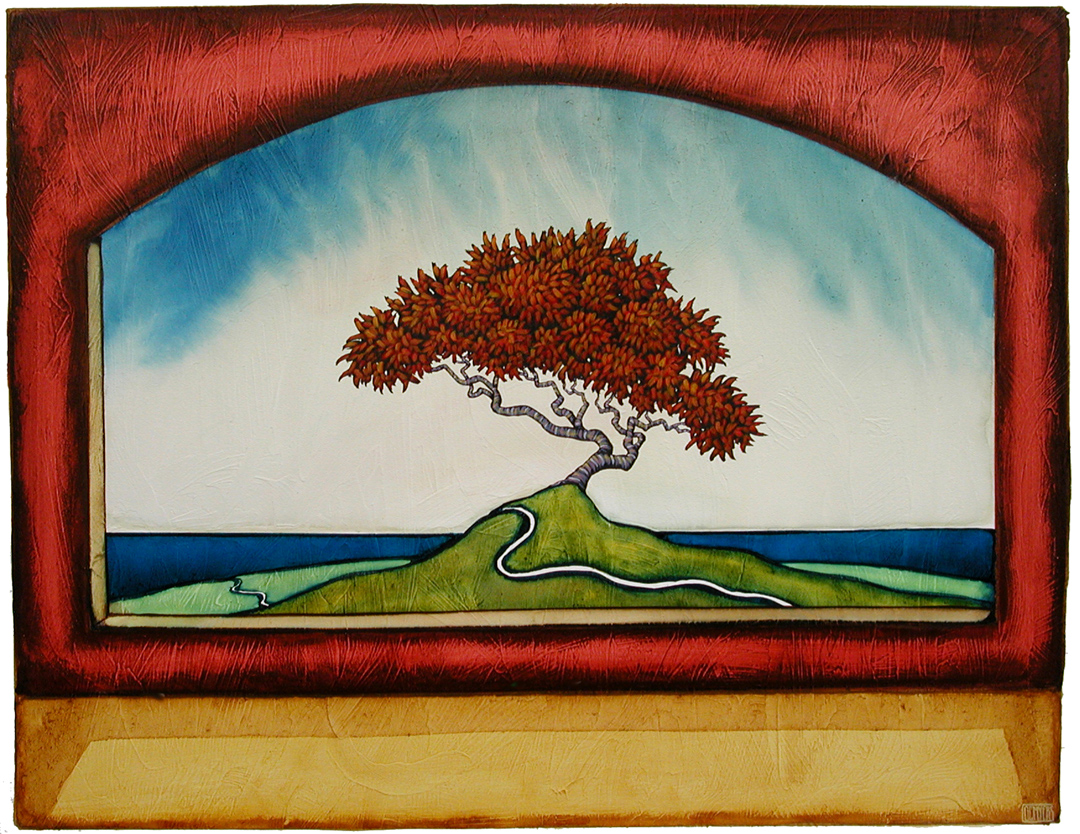
GC Myers-In the Window- Flower of DoreenI wasn’t going to do a re-post on the blog today but when I was going through some images I came across an image from a series that I did in 2005 called In the Window which had my typical landscapes with the Red Tree as seen through a window in various interiors.  This series was pretty well received but never found its way into my regular rotation of work.  It remains an isolated series from that time but is one that is very close to me personally.  I guess an example of this fondness might be that there is one piece in the series, the one above bears my late mother’s name.  Its title is In the Window: Flower of Doreen.

Seeing that her birthday is next week I felt like I should pay her a little tribute here.  She never witnessed my work in a gallery, never knew that I would find a career doing this.  But I think she would be pleased  by the fact that her name lives on in a painting and that the flowers she planted many years ago are doing well.

Here’s what I wrote several years back along with a few more examples from this series at the bottom:

GC Myers-  In the Window- EverpresentA question asked of me this weekend inspired me to go back into my archives and pull out the images of a few pieces done several years back.  I was asked if I used this time of the year as a starting point for new work and I said that I often did,  using it as a time to begin new ideas that I want to try.  I explained that it was important for me to continue trying new things as it excited me in the studio and that this excitement was important to all of my work.  This new work provides a vibrancy that permeates all my work and helps me find the new in compositions that I have painted in the past.

I explained that I liked to try new concepts in series in most years and that some are more embraced than others and become part of my regular painting vocabulary for years.  The Red Roof series is such a series.  I have painted examples in this series for several years and it has become ingrained.  The Archaeology series is another. 

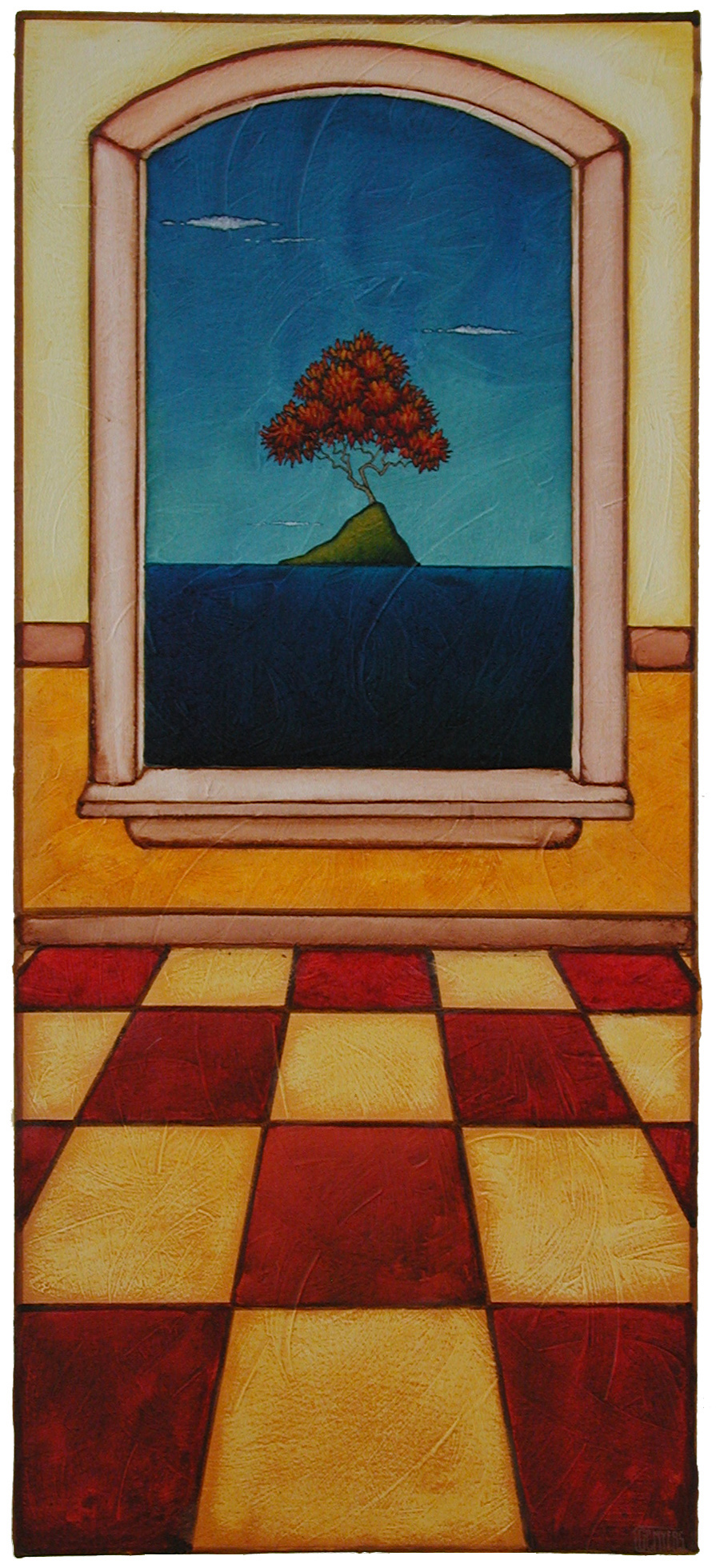
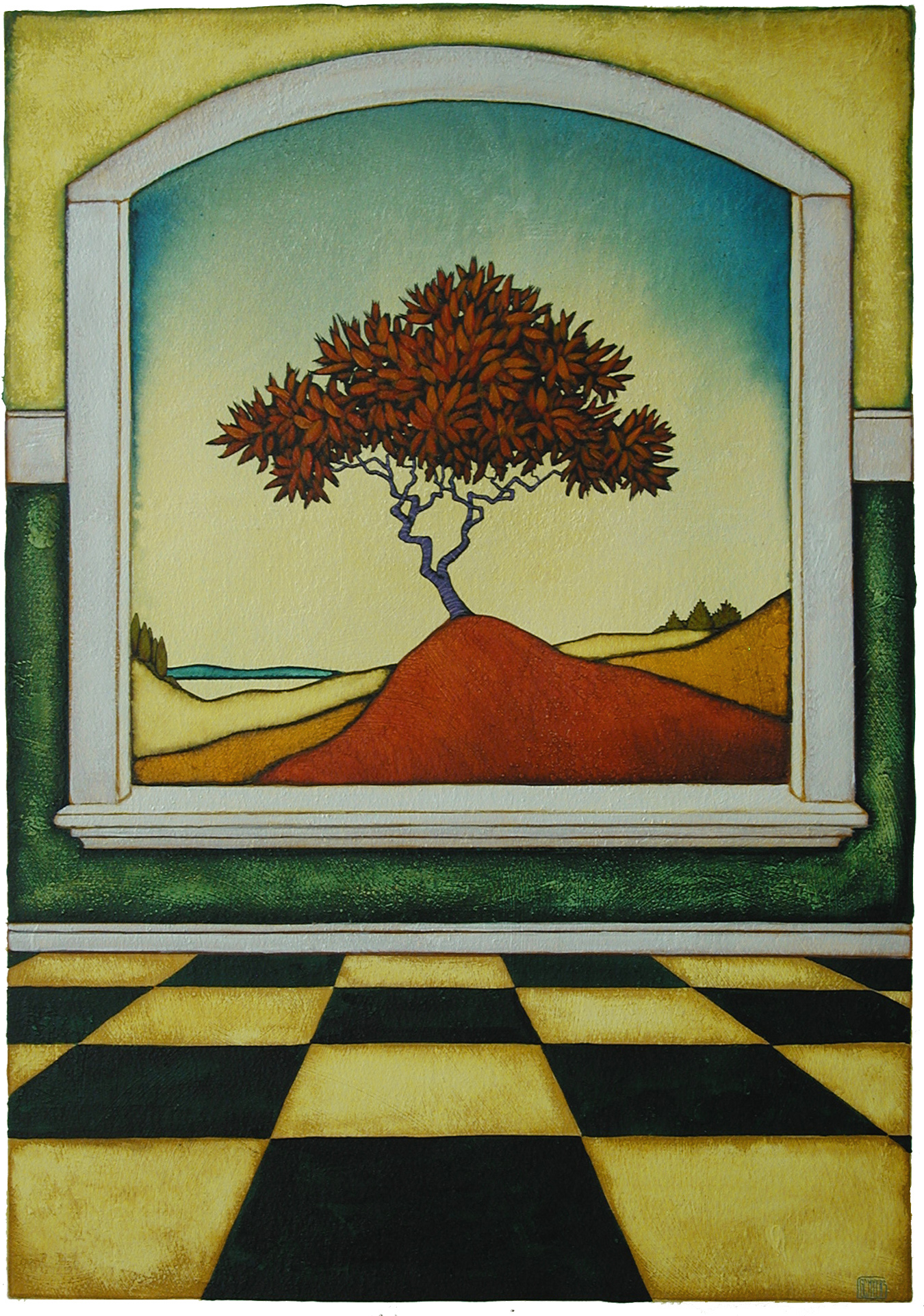
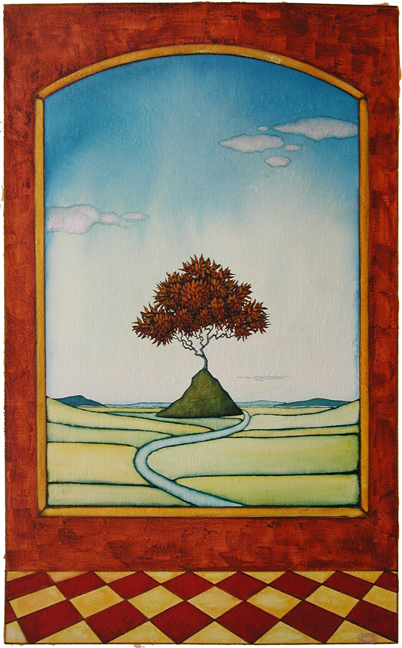
Other series last but a season.  While they may be popular from a sales standpoint,  they soon exit my routine.  The In the Window series is an example of such a series.  Done in 2005, they were a series of paintings that featured simple interior scenes with large windows that were highlighted by examples of my typical landscapes.  The idea was that the interior scene acted as a setting to show the landscapes in a different manner, much like the setting for a piece of  jewelry dictates how a gem is seen.  The gem here was  my landscape.

GC Myers- In the Window: Dream AwayThis painting shown on the left, In the Window: Dream Away, was the first piece.  It seemed to jump off the paper on which it was painted.  Very vibrant.  The setting of the window pushed the scene of the tree atop the mound overlooking the water out of the frame and seemed to intensify it.  I was immediately taken with the concept and a number of others soon followed, including the one at the top.  These pieces sold pretty well but they eventually lost steam for me from a creative standpoint.  While I still felt that they were vibrant , I sensed that I had done as much as I could with the concept and didn’t want it to become labored and tired.  My excitement was passing and I wanted to stop near a peak rather than at a low when the work was completely played out when I was viewing it as a toil rather than a joyous activity.

I still feel excitement personally when I see these pieces from this time and I know they are of a certain time for me.  I want them to stand as they are in my body of work.   As I described this this past weekend, I explained that the interesting thing about stopping a series is that it creates a finite number of pieces within it.  They become more distinctive over time, more representative of a certain time in my own artistic continuum.  So while these series, such as the In the Window series, are short-lived they have a longer viewpoint.

GC Myers-  In the Window- Full PotentialGC Myers- In The Window: Worlds Beckon GC Myers-  Inthe Window: The Searcher GC Myers-  In the Window:The Vigil GC Myers-  In the Window:Home Land

Read Full Post »

GC Myers- Secret of All TriumphsPerseverance, secret of all triumphs.

–Victor Hugo

**************

Sometimes sticking with a piece that is in trouble pays off.  The painting shown at the top, a 20″ by 20″ canvas that is yet to be titled, was started several weeks ago.  All of the major forms, including the deep blue sky, were blocked in the transparent colors that I use in my wet or reductive work–that is where the paint is put on thickly then absorbed off of the surface until it reaches a tone that fits my eye.  But it just didn’t ring out, had an awful flatness that just made the whole thing dull.  The colors in the foreground were muddied and blah.

I looked at it for weeks.  Actually, I didn’t look at it that often because it just didn’t have anything to pull me to it.  I got to the point that I avoided looking at it at all.  Finally, I decided to scrap the whole thing.  Paint it over in black and start with an empty slate.

Tabula Rasa.

So I took it down into the basement of my studio where I do apply my gesso and do other sloppy work.  I pulled out a thick brush of black paint and slapped it across the sky and worked it back a few times.  The strokes didn’t go into the lower sections of the painting, remaining only in the sky.  I stopped and took in it for a second, the black brush poised to swat across the center now.  The contrast of the black against the colors made the fields pop a bit, gave them a little life.

Just a little.  Maybe there was something there, a flower that could blossom if I just stuck with it a little longer.

So finished the sky in black and in a few days brought it back to the easel.  Each stroke of color that went against the black surface of the sky brought it more and more to life.  When the sky was close to being finished, I went back into the lower fields, glazing them with new layers of color that took away some of the dullness that had plagued them.  The sky had a pop now and the lower fields were catching up to it.  But the central field between the curved horizon and the large mound on which the Red Tree would stand was still an awfully dull green that sucked the life from both the top and bottom.  A sucking vortex.

Maybe this wasn’t going to work after all.  One element so out of kilter could kill the entire thing, break its fragile life force.

After a while I thought that the black had worked so well in the sky, why not break it out in that central field.  Go completely in a different direction with it– make it a red field that would pop in the center of the piece and give contrast to both top and bottom.  Instead of sucking life from it, it would now give it life. And sure enough, it brought everything together.  Even before the trees made an appearance, it was ebbing with life. And when they did appear, it felt complete and alive.  All that I can ask of it.

Now I can’t stop looking at this piece that once made me grimace.  Perseverance pays off in the end, as it usually does.

PS:  Now that I look at this piece after writing this, I believe I will title this painting Secret of All Triumphs. Thanks for the inspiration, Mr. Hugo.

Read Full Post »

2015 GC Myers WIPWhen I finished up in the studio yesterday, I was at this point in progress on a new painting.  It is a 20″ by 60″ canvas that was started with only the thought that it would be curtained in by two layers of tree trunks on each side.  The basic composition of the entire piece is laid in in an underpainting of red oxide and there are a numbers of layers of color in the sky, beginning to give shape to the tone of the painting.

It has definition and purpose now.  A forseeable destiny.

This is one of my favorite stages of my process.  The bones and form of the painting have been created, the decisions concerning composition made, and the painting begins to stir to life.  There is a keen sense of sharpness to it at this point, as though the essence of its being has been boiled down and captured in this layer of red oxide paint.

Like a revealing of its soul.

The layers that will follow will give detail and nuance to round out its wholeness.  It’s interesting  to watch it go from this sharply defined revelation of self through the series of transformations brought on by each subsequent layer of color.  There will be points when this sharpness will fade completely away, leaving the piece dull and flat–barely alive.

Sallow. Like a patient on a respirator.

At that point,  I sometimes finding myself questioning my prior decisions and asking if the piece will ever come back to life.  This comes near the end and, disheartening as it sometimes is,  would be my least favorite part of the process if not the fact that I have the knowledge of and confidence in what will soon take place on the canvas.

The layers of color come quicker and consist of fewer strokes but each small move now seems to bring more and more of a change to the piece.  The soul of the painting that once filled the canvas in the completed underpainting above now begins to reveal itself again in its fullest form.

Now, that being said, it what I hope happens.  Sometimes it just doesn’t.  But sometimes the soul of the piece is revealed so strongly at this point that it will not be denied.

And that’s what I believe will be the case with this piece.  At least, that is the hope.  We shall see…

Read Full Post »

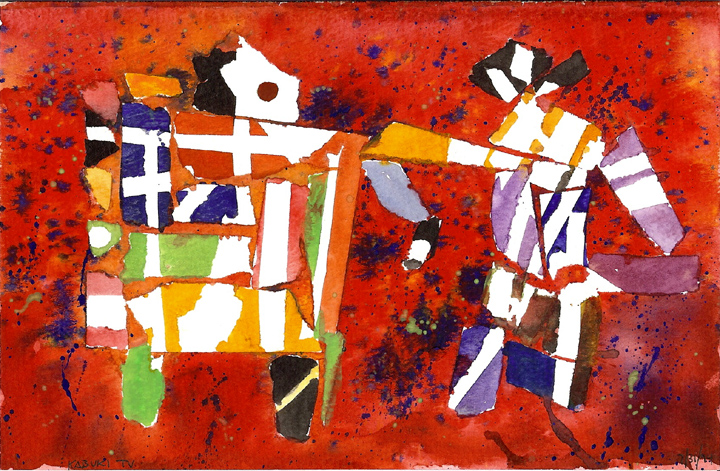
GC Myers Kabuki TV 1994Whenever I come across this little experiment from back in 1994, I linger over it for a few minutes and smile a little.  There’s a lot going on with plenty of bright colors and sharp angles but with a narrative element within it where I saw a person watching a Kabuki performance on their television.  But more than that I am reminded of the decision to move away from this experiment and continue in the direction that eventually led me here.

You see, I enjoyed doing this work, enjoyed the process and the final product.  I could have easily followed this path and been fairly happy.  But it lacked something that while I can’t really put a finger on it was found later in the work that I eventually produced in later years.

Heart?  Soul?  I can’t say.  But it was fun at the time and makes me smile now.  Plus the lesson in learning what you can and can’t be is beyond value.

I wrote a bit more on this subject, also set off from this little painting, back in 2010:

Just looking through some old things, mostly little pieces that are from the time when I first started painting, and I came across this.  At the time  I was playing around with color and masking, where you put something such as tape on the painting surface and paint over it then peel it away to reveal the unpainted surface underneath.  It can be a big part of traditional watercolor painting and I wanted to see if it fit with the way I thought and wanted to paint.  It didn’t.  But I did come up with this little abstraction that always catches my eye and makes my mind’s gears turn.

It’s always interesting to see these little pieces because it inevitably triggers memories of that time when every day was bringing new discoveries as I tried to learn more and more about color and different mediums.  Sometimes things clicked and it was revelatory to discover my strengths.  Other times, it was a struggle and the end product was muddled, labored.  But there was still something to be learned there.  Like identifying my weaknesses and learning how to strengthen these areas or, at least, downplay them.

I guess that this is the process for development in any area of your life,  playing up your strong suits and trying to cover your weaknesses.  Perhaps that is why I like to see these old experiments, to be reminded of my growth, artistically and personally, through the years. 

At least, what I perceive as growth.

Read Full Post »

Do not go where the path may lead, go instead where there is no path and leave a trail.

–Ralph Waldo Emerson

*************************

GC Myers- Trailblazer  I chose this little gem of advice from Emerson as the Quote of the Week because I thought it fit so well with the small painting above, a Little Gem itself.  It’s a small 4″ by 6″ painting that is called Trailblazer and is part of the Little Gems exhibit that opens tomorrow night at the West End Gallery in Corning.  I also chose it because those words fits so well for my own experience at the time I began showing my work for the first time, at this very same exhibit twenty years.

I was thrilled to have an outlet in which to show it publicly but was still in the process of finding a singular voice of my own–how my work would be styled.  Part of that process of finding this  was in determining what path I would follow with the work, whether I try to emulate the work of other painters I knew and admired.  That seemed like a natural path to follow, wide and well defined.

 But the path was also crowded.  Sometimes it was hard to distinguish yourself  and find a foothold among so many companions.  But if I set out on my own  that would not be the case.  On the the well-trodden path,  I would always be subject to comparison  and immediate critique.  Blazing my own trail would allow me to set my own pace and destination, define my own objectives.

Plus it would be my path alone.  And that was no small thing. In fact, it was a primary goal of  mine.   I had determined from my visits to museums that the work that stood out most for me was the work of artists who you could identify immediately from across the gallery space.  Looking at the shelves in front of me, most of the books are of the works of such artists, all who eventually set out on their own trails and created work from a world that was their’s alone.

I’m still on my path.  I’d like to think it departed from that wider, more traveled path sometime ago.  I can’t be the judge of that.  So I plug ahead with words of Emerson ringing in my ears and hope for the best.

Read Full Post »

I wrote this post several years ago describing how a certain composition from one artist can influence another, even though the results may seem light years away.  I often look at work of others in different ways, sometime focusing on the quality of the colors or how their handling of the paint.  But  often  I find myself looking at how the composition comes together, breaking away the the surface details in my mind to reveal the  bare bones or armature underneath.  Sometimes this sparks something and while looking at someone else’s work I will see a painting of my own growing over this armature.

I thought today I’d recall how this worked with a very famous piece:

WhistlerThis is James McNeil Whistler’s most famous piece, Arrangement in Grey and Black, No. 1:  Portrait of the Painter’s Mother.  It is, of course, better known as Whistler’s Mother.  It was a painting that I was casually familiar with as I grew up but it wasn’t until I looked more closely at it after I had started painting that I saw the brilliance of it’s composition.

Whistler always asserted that the painting was not about his mother but was more concerned with creating mood with color and composition, which the primary focus of almost all his work. This piece achieves it’s mood with beautiful diagonal lines formed by the woman’s form and contrasting verticals and horizontals that create great visual tension and energy.  The stark whiteness of the matted print on the wall behind shines like a full moon against the pale blue-gray sky that is the wall itself.  The head of the old woman seems to be almost lit by the light from the moon/print.

This is not a portrait of an old woman.  It’s a nocturnal landscape.  That’s what I saw when I looked at it as a painter trying to glean what I could from it for my own use.  This was a composition that had a geometry that just felt so right immediately.  It had such a sense of perfection in the way color and form combine with sheer simplicity that I knew I would have to use it for myself.

And I have, quite a few times over the years since I first really looked at it, sometimes with slight variations in the placement of the elements but still basically with the same compositional base.  And inevitably, they are pieces that have great immediacy in their impact, pieces that carry great mood whatever their subject matter.

The following day I wrote:

Yesterday I wrote about how I have often used in my own work the composition from the James McNeil Whistler painting popularly known as Whistler’s Mother.  I did so without illustrating the point so I thought I’d take quick moment to show how I might block in my own work with Whisyler’s composition.

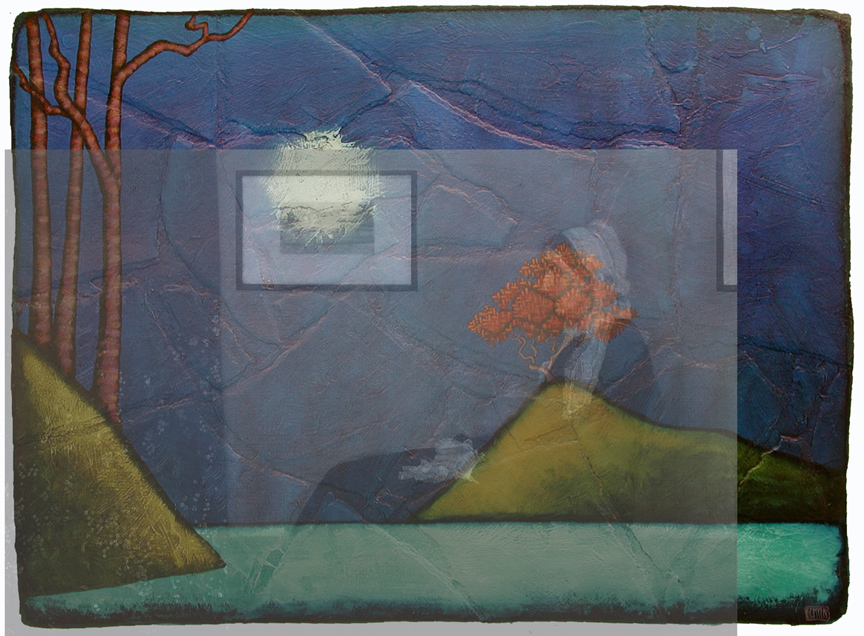
GC Myers - the-way-of-lightGoing into my archives, one of the first things I look at is a painting from a few years back, The Way of Light.  At first glimpse, this piece has nothing in common with the Whsitler piece.  First, it is not portraiture ( although I often view my trees as such) and it is a landscape.  It is obviously a different palette of color than that of Whistler and the elements are rendered in a less realistic fashion than you would see in Whistler’s work.

WhistlerBut if you put those differences aside and quickly take in the shape and form of each piece, you can begin to see the similarity.  The line of trees on the small mound of land in my piece take the place of Whistler’s dark curtain on the far left.  The water in mine becomes the floor of his. The body of his mother is replaced by my island and her head becomes my red tree.  The framed print is now my moon.

Here, I overlaid my piece with the Whistler piece to further illustrate the point.  Obviously, there are worlds of differences separating the two pieces, as I pointed out above.  But the composition and use of blocking and light help us each achieve a sense of mood that is the primary goal in both cases.  Like Whistler, I am often more concerned with the mood and emotion of a piece of work than the actual subject matter.  In this pursuit I have come to view much of my work as Whistler did his, as musical compositions rather than merely representative images.

In color and shape there is rhythm, tempo and tone.  The placement of the compositional elements of a piece are much like the placement of individual notes in music, each affecting and reacting with those around it.  All trying to evoke feeling, response.

Well, there’s my illustration of how Whsitler’s iconic piece fits in with what I try to do with my work.  Hope you can now see the connection…

Read Full Post »

« Newer Posts - Older Posts »