Feeds:
Posts
Comments

Archive for the ‘Uncategorized’ Category

Holiday Touchstones

gc-myers-archaeology-happy-holidays-2011-sm


We’re so caught up in our everyday lives that events of the past, like ancient stars that have burned out, are no longer in orbit around our minds. There are just too many things we have to think about every day, too many new things we have to learn. New styles, new information, new technology, new terminology … But still, no matter how much time passes, no matter what takes place in the interim, there are some things we can never assign to oblivion, memories we can never rub away. They remain with us forever, like a touchstone.

― Haruki Murakami, Kafka on the Shore


I certainly agree with the paragraph above from Murakami’s acclaimed novel. Over the years my ability to learn– or at least remember what I have attempted to learn– has diminished. I often read or see something new now and consciously try to register it into my memory. But once done, it seems to dilute and run into all the other factoids and processes and thises and thats that have been put there in recent times. It all becomes a dull blob from which I can discern barely anything.

Maybe that blob is the oblivion to which Murakami refers. Data goes in, nothing comes out.

But ask me about a Christmas 50 or 60 years ago and I can recall it well, often with details of aroma and sound and texture. The taste of a holiday goodie. The smell of the tree and the warm feeling from its light in the evening.

Maybe the occasion or the underlying feeling made it a touchstone for me. I don’t know. Memory is a funny thing. You can never tell what will imprint deeply on it, what will remain vivid many years later.

It is sometimes a gift, sometimes a curse. I tend to view those deep memories from holiday season past as a gift.

I hope you do as well. Or will make new memories that press themselves deep into your memory bank. New touchstones.

Have a good holiday. Here’s song that I played ten or eleven years back. It is a holiday song but one most likely not played on your local radio station this time of the year. It’s a beautiful version of the traditional A Child is Born done by the late jazz trumpet player Thad Jones with the Mel Lewis Jazz Orchestra.

A lovely and sumptuous song to slow down the moment so that maybe you can remember it later. Let that be a gift to you.


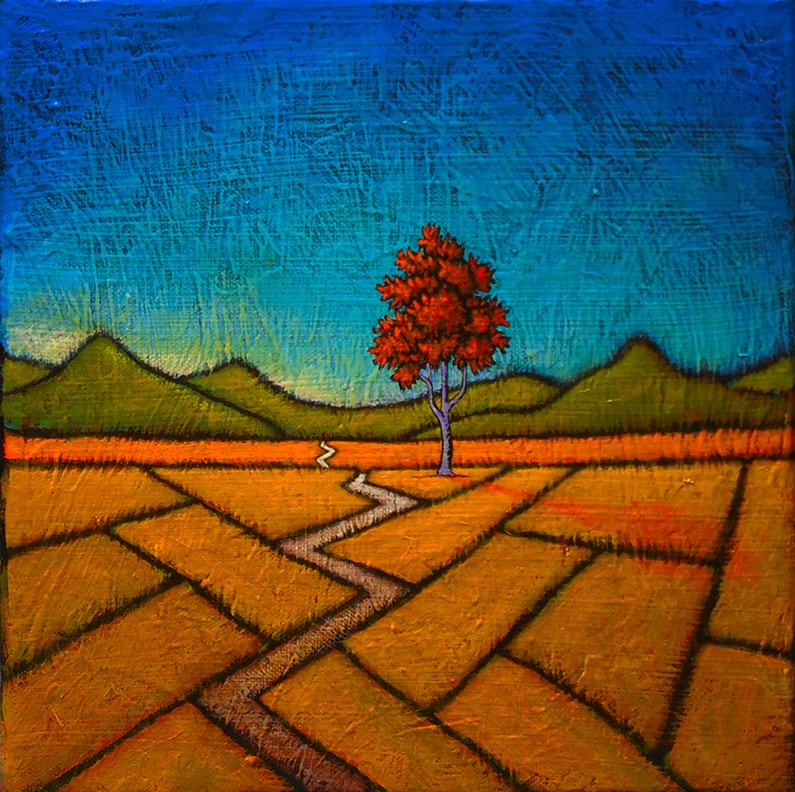

Read Full Post »

GC Myers- Archaeology- Déjà Vu sm

Archaeology: Déjà Vu— At Principle Gallery, Alexandria, VA


The fields are fair in autumn yet, and the sun’s still shining there,
But we bow our heads and we brood and fret, because of the masks we wear;
Or we nod and smile the social while, and we say we’re doing well,
But we break our hearts, oh, we break our hearts! for the things we must not tell

The Things We Dare Not Tell, Henry Lawson (1867-1922)


A video for this poem popped up in my YouTube feed for some algorithmic reason I can’t comprehend. I am glad it did.

I first encountered the Australian writer Henry Lawson (1867-1922) a few years back when I stumbled across a poem of his, The Wander-Light, that I shared here. It has been a pretty popular post, receiving a number of views on a daily basis. Doing some research back then, I found that Lawson is an Australian icon, considered to be perhaps the country’s greatest poet and short story writer.  He was a brilliant writer and storyteller but struggled with alcoholism and mental illness for much of his life until dying at the relatively young age of 55 from a cerebral hemorrhage.

Watching the reading of the poem below, I began to think about the secrets we all carry. Oh, we may claim or attempt to be transparent, but we all maintain words and deeds and beliefs that we share with no one. Some we don’t share because, to be honest, they are things nobody would care to hear. Some are too shameful or painful or embarrassing to release from our grip.

I probably share too much here and in my talks. More than most. Mainly because I believe that transparency has a liberating effect. But even so, there are things that will no doubt go unshared to my grave. Well, that is, if I ever decide to die. If I don’t, I might break my silence in a couple of hundred years or so.

It makes me wonder what secret things others will carry to their graves, the good and the bad. Will they ever reveal themselves to some future archaeologist or researcher? Are they hidden somewhere, like one of the artifacts in the Archaeology piece at the top, waiting to be unearthed then put together like a strange and wonderful jigsaw puzzle? Small bits that together tell a bigger story?

The other thing that comes to mind is the one line in Lawson’s poem that resonated most with me:

Oh, the world would be such a kindly world if all men’s hearts lay bare!

I believe it but wonder if that is true. Do secrets keep us apart? Would revelation of all things hidden somehow bring us together?

I don’t know the answer. My lack of answers is no secret, that’s for sure.

Maybe we need those secret things just to maintain that feeling of mystery that comes with not knowing everything about everyone. 

Might that mystery be the thing that drives all types of creativity?

Could be. I don’t really know.

Okay, got to run. I have secrets waiting to be buried as well as some to be shared. It’s the sorting out that counts.

Here’s the poem from Henry Lawson along with the whole poem below it.


The Things We Dare Not Tell

The fields are fair in autumn yet, and the sun’s still shining there,
But we bow our heads and we brood and fret, because of the masks we wear;
Or we nod and smile the social while, and we say we’re doing well,
But we break our hearts, oh, we break our hearts! for the things we must not tell.

There’s the old love wronged ere the new was won, there’s the light of long ago;
There’s the cruel lie that we suffer for, and the public must not know.
So we go through life with a ghastly mask, and we’re doing fairly well,
While they break our hearts, oh, they kill our hearts! do the things we must not tell.

We see but pride in a selfish breast, while a heart is breaking there;
Oh, the world would be such a kindly world if all men’s hearts lay bare!
We live and share the living lie, we are doing very well,
While they eat our hearts as the years go by, do the things we dare not tell.

We bow us down to a dusty shrine, or a temple in the East,
Or we stand and drink to the world-old creed, with the coffins at the feast;
We fight it down, and we live it down, or we bear it bravely well,
But the best men die of a broken heart for the things they cannot tell.

— Henry Lawson

Read Full Post »


GC Myers- Affirmation  2024

Affirmation— Now at Principle Gallery

Take refuge in silence. You can be here or there or anywhere. Fixed in silence, established in the inner ‘I’, you can be as you are. The world will never perturb you if you are well founded upon the tranquility within. Gather your thoughts within. Find out the thought centre and discover your Self-equipoise. In storm and turmoil be calm and silent. Watch the events around as a witness. The world is a drama. Be a witness, inturned and introspective.

– Ramana Maharshi


This time of year is one of stress for many, especially for those who are a bit withdrawn. There’s a lot of motion and sound surrounding the tension that comes with the obligation in trying to please others. The calming effect of silence is absent. Thinking about this brought me to the post below from back in 2013, one that I have never revisited. It seems to speak, in a way, to the need for that bit of quiet that might be missing in the season. 

Since this is the time for Sunday Morning Music and since it is the holiday season, I thought I’d share a Christmas song that is as calming as they come. It’s the late great Vince Guaraldi and his Christmastime is Here. This is the instrumental version without the chorus of kids. It’s a good listen anytime of the year.


[From 2013]

I often speak of seeking quiet, even absolute silence. I all too often come up short in my search, usually the victim of my own fears and shortcomings which cause me to fill the void around me with sound and chaos.

Silence is pushed aside.

It is only in those times when I allow myself to be pulled completely into my work that I feel the silence slowly creeping back in, stilling the fears and doubts that seem to wail around me like sirens at times. It is at these moments while painting that I feel in a small way as though I am like a witness that the great guru Ramana Maharsi advises us to be in the passage above.

I am then calm and silent. I watch and gather my inner thoughts as I feel myself melding with the colors and forms before me. It is absolute peace as I go deeper into this inner realm.

That’s as close as I can describe in words the feeling I have when I lose myself to painting. The painting shown here is an example of this feeling. It is a different painting than the one shown in the 2013 post. But like that painting, the one shown, Affirmation, is simple and quiet yet richly harmonious and full.

It feels outside of time, always in the present. It is both inward and outward looking, a silent witness that is not fearful of the future or regretful of the past. It is just as it is– quiet and placid.

All that I seek.


Read Full Post »

GC Myers- Absorbing Quiet

Absorbing Quiet— At West End Gallery


A world where beauty and logic, painting and analytic geometry, had become one.

–Aldous Huxley, After Many a Summer Dies the Swan, 1939


I am relatively sure that my use and interpretation of this passage from a novel by Aldous Huxley is a departure from its original context. The novel, which is considered by some to be the inspiration for Orson Welles’ Citizen Kane script, concerns an ultrawealthy movie mogul who lives with a Hollywood starlet in a vast estate where he displays the products– rare art, for example– of his unquenchable acquisitiveness.

The novel is mainly concerned with his desire to acquire the one thing he can’t have–immortality. The title of the novel is a line from Tithonus, a poem from Alfred Tennyson. which is about a king who asks the gods for immortality.  It is granted but the king has overlooked asking for eternal youth. As he ages, he grows ever physically older and frailer. His immortality becomes a horrible and never-ending burden.

The painting here, Absorbing Quiet, obviously has nothing to do with either novel or the poem. However, I felt that the line from Huxley above captured what I was seeing in this piece– beauty and geometry and maybe a little logic all coming together to create a moment of stillness. And the Red Tree at the center of this stillness, contentedly taking it all in.

Satisfied with what ii contained in that moment, not craving more. Not immortality nor youth. Not fame nor fortune.

Just content in its place in the geometry and beauty of the moment.

An immortal moment.

True wealth. 

You’ve probably had enough Christmas music at this point of the season so here’s a song to go along with the thought. It’s Baby You’re a Rich Man from the Beatles. It beats hearing Last Christmas for the umpteenth time from Wham! or the seemingly endless string of singers who have covered it.


Read Full Post »

GC Myers- Lux Templi

Lux Templi-At the West End Gallery


Do you sometimes want to wake up to the singularity
we once were?

— Marie Howe, The Singularity


Yesterday, I came across a post from about four years ago of this short animation of a poem from poet Marie Howe. The post and the poem had slipped my mind, but I was moved upon reading it again.

Her poem is titled Singularity and refers to the theory from Stephen Hawking, and others as well. The accepted theory is that when a star dies it collapses into itself until it is finally a single tiny point of zero radius, infinite density, and infinite curvature of spacetime at the heart of the black hole formed from the star’s collapse. A single point of immense mass and energy This was referred to as a singularity. 

Hawking looked at this singularity and wondered since this was the end point of star’s death could it not also be the starting point for future new universes that might emerge if this singularity were to explode outward– the Big Bang Theory.

The underlying thought is that the universe and all that it is was once a single thing before the Big Bang created all that we know the universe to be now.

We were all part of one thing.

No, we were that one thing.

That is as simple as I can put it and still understand it. I am not even sure that simple explanation is correct. Probably off by a large fraction, like the final garbled message in the old Telephone Game, where something is whispered in one kid’s ear at a table. They then whisper it into the kid next to them and so on. By the time the message gets to the final kid, the message usually only contains a small part of the original message. I am probably that kid near the end of this process.

 Admittedly, and much like Howe explains to her audience, my own grasp of advanced physics and most other great scientific theoretical concepts is limited. But the idea that we were once one and that we may all at some point become one again is somehow appealing to something inside me. It makes me think that maybe a form of singularity is the goal of all art– both an inward reduction of totality into a single tiny point as well as an outward explosion of this same totality.

Expressions of mortality and rebirth.

I don’t know for sure. This is just what the kid next to me whispered in my ear. If I’m way off base here, blame it on him. 

 The entire Marie Howe poem is below the video. Take a look then get the heck out of here. I got plans to either collapse or explode this morning. Not sure which it will be. Probably a theory on that somewhere.


SINGULARITY
by Marie Howe

(after Stephen Hawking)

Do you sometimes want to wake up to the singularity
we once were?

so compact nobody
needed a bed, or food or money —

nobody hiding in the school bathroom
or home alone

pulling open the drawer
where the pills are kept.

For every atom belonging to me as good
Belongs to you.
   Remember?

There was no   Nature.    No
them.   No tests

to determine if the elephant
grieves her calf    or if

the coral reef feels pain.    Trashed
oceans don’t speak English or Farsi or French;

would that we could wake up   to what we were
— when we were ocean    and before that

to when sky was earth, and animal was energy, and rock was
liquid and stars were space and space was not

at all — nothing

before we came to believe humans were so important
before this awful loneliness.

Can molecules recall it?
what once was?    before anything happened?

No I, no We, no one. No was
No verb      no noun
only a tiny tiny dot brimming with

is is is is is

All   everything   home

Read Full Post »

GC Myers- Time Patterns 2024

Time Patterns– At West End Gallery


I can hardly understand the importance given to the word research in connection with modern painting. In my opinion to search means nothing in painting. To find is the thing. Nobody is interested in following a man who, with his eyes fixed on the ground, spends his life looking for the purse that fortune should put in his path. The one who finds something no matter what it might be, even if his intention were not to search for it, at least arouses our curiosity, if not our admiration.

Pablo Picasso, “Picasso Speaks,” 1923


To find is the thing…

I often write here about searching for something with my work. It’s usually something I can’t describe in any way that helps myself or the reader. It’s just something that pulls me forward.

Well, that’s what I thought, for the most part.

Reading the passage above from Picasso recently set me thinking that perhaps it was not a search at all, at least not in the way I had portrayed it.

Perhaps I was driven onward because I had found something and felt the need to express and share it. Or perhaps to keep that feeling of discovery, that eureka! moment, alive within myself– and within others who sensed whatever I had found for themselves when they viewed the work.

I can’t say for sure. I am still wrangling with this. But it makes some sense to me. A painting begins as an exploration, a search, but as it progresses it moves toward a revelation of some sort. The search is in the process, not in the resulting work.

At least, for the artist. It may differ for the viewer. They may see it as a way toward something they need and seek. Something they may not even realize is needed or sought. Perhaps they will find that same thing in the final work that that I had found, that same thing that seems to somehow answer vague, unasked questions.

Who knows for sure? But this idea that the work in not so much a search as it is a revealing of what has been found satisfies something in me.

Maybe that what was I was looking for in the first place?

Or maybe this is all one of those dreams where everything you wonder about suddenly seems to make perfect sense and there is that momentary feeling of elation that is then suddenly and completely gone once your eyes open.

Could it be that?

I don’t know but here’s an old song from Todd Rundgren that came to mind while I was finishing up. I haven’t heard this tune in many years and Todd Rundgren is one of those artists who was very popular in the 70’s but has faded somewhat from the front of the public mind the in the decades that followed, though he still is actively recording and performing. Just on a smaller stage as the musical outlets    became narrower and more niched. This is I Saw the Light.


Read Full Post »


Santa Kidnapper Victorian“You can’t fool me—there ain’t no Sanity Clause!” 
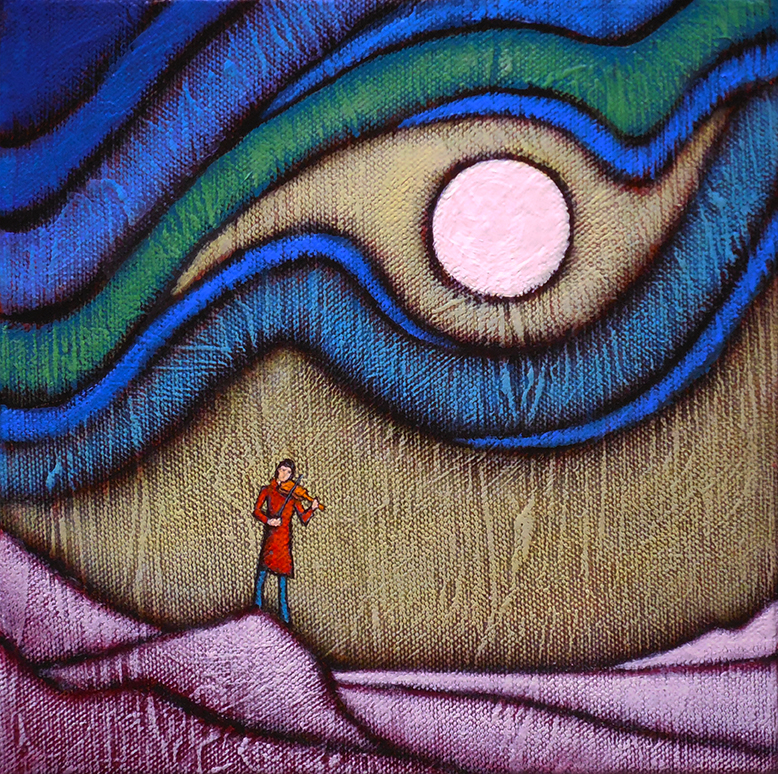
–Chico Marx, A Night at the Opera


Short on time today. Woke up later than usual with Bing Crosby‘s Hawaiian Christmas song, Mele Kalikimaka, playing in my head as I stumbled out of bed. It was more irritating than joyful though I do normally enjoy the song.

Anyway, I am hustling around this morning but still wanted to share something. Since I am a little ruffled and crusty this morning, what better way to mark the season than with one of those macabre Victorian holiday cards? In past years I have shared images from Victorian era cards of psychotic looking Christmas clowns, weird walking root vegetables that vaguely look like relatives of Mr. Peanut, one animal eating another while eating yet another, crying children jammed into teapots, a mouse riding a lobster, and a polar bear attacking an ice skater.

I don’t know that we will ever fully comprehend the zeitgeist— the defining spirit or mood of a particular period of history as shown by the ideas and beliefs of that era– of the Victorian era.  I often wonder what part of our era will be baffling to future generations in the same way. As you age, you begin to see it occurring as things that seemed normal in your childhood now receive startled reactions from younger generations when they first hear of them.

This Victorian card of a creepy Santa shoving an obviously bad kid into a sack with the simple greeting A Happy Christmas is one example from that era that so often feels weirdly strange to some of us. Yes, every happy Christmas I can remember entailed kidnapping children. But, hey, the kid should have thought of that earlier in the year when he was making those decisions to be naughty or nice.

Here’s a song from JD McPherson from his fun Christmas album, Socks, from several years back. This is Bad Kid. He might talk like a bad boy now but Santa is coming for him with a big empty sack.


Read Full Post »

GC Myers-  A Song For the Eye

A Song For the Eye— At West End Gallery


Out beyond ideas of wrongdoing
and rightdoing there is a field.
I’ll meet you there.

When the soul lies down in that grass
the world is too full to talk about.

― Rumi, 13th century Persian poet


Just wanted to share a triad of song, word and image this morning. The music is a piece from composer Ennio Morricone from the film Cinema Paradiso. The piece shown here is performed by violinist Renaud Capuçon.

I’ve been fortunate to see a number of what I consider memorable performances over the years but one of the most memorable was one from Renaud Capuçon when he was touring as guest violinist for the Bruckner Orchester Linz when the renowned orchestra somehow ended up performing at the Clemens Center in my hometown of Elmira. It was sometime around 2005.

It was marvelous concert with a full orchestra of about 100 players jammed the stage, creating a powerful sound. I am embarrassed to say that I don’t remember what pieces were performed that night. However, I remember vividly Capuçon’s performance. The sound from his violin was incredible. It is the same violin he plays in the video below, the famed “Panette“, a 1737 Guarneri del Gesu, that once belonged to Isaac Stern, with whom Capuçon studied.

One moment stood out for me. During his playing of one really dynamic section, one of the strings of this violin snapped. If you didn’t have your eyes on Capuçon at that moment you would have never known. During a tiny pause within the structure of the piece, he swung the violin to the first violinist, snatching away that person’s violin to resume playing. The only thing that gave a hint that there had been a problem or a change was in the tone of the newly acquired violin, which lacked the richness of the Guarneri.

Even so, Capuçon continued with a feverish intensity as the Guarneri quickly was passed along down the row from 1st violinist to 2nd and so on, each surrendering their violins to the prior violinist. When it reached the end of the row, that violinist hopped up and sped the Guarneri offstage. There was hardly a blip, if any, in the performance while all this was occurring. The thrill of the performance, which was already great, was enhanced by the mishap and how masterfully it was handled.

Here’s Capuçon and that same Guarneri violin. Below that is another performance at the recent opening of the restored Notre Dame Cathedral. The cellist is his brother, Gauthier Capuçon.


Read Full Post »

Wabi Sabi


“The tides of time should be able to imprint the passing of the years on an object. The physical decay or natural wear and tear of the materials used does not in the least detract from the visual appeal, rather it adds to it. It is the changes of texture and colour that provide the space for the imagination to enter and become more involved with the devolution of the piece. Whereas modern design often uses inorganic materials to defy the natural ageing effects of time, wabi sabi embraces them and seeks to use this transformation as an integral part of the whole. This is not limited to the process of decay but can also be found at the moment of inception, when life is taking its first fragile steps toward becoming.”

― Andrew Juniper, Wabi Sabi: The Japanese Art of Impermanence


The post below is from four years back. It got a bunch of hits yesterday and when I went to see what it had to say (I often forget what I’ve written) I was struck by the image at the top of the post. The whiskey-brown color just grabbed me and at the bottom of the image I noticed wear around an exposed knothole that reminded me of a wave. Maybe Hokusai’s Great Wave in wood? I began to see the image as a painting, something I had not done before. Anyway, I read the post and liked it a lot, which pleased me. I am sometimes surprised when I read something from years ago and am impressed with it, like I was reading it for the first time. As I’ve added to my own patina in the past four years, I thought this would be worth replaying.

I added a song at the bottom that is kind of about wabi sabi. It’s called The Wino and I know from Jimmy Buffett. It’s from his 1974 album, Living and Dying in 3/4 Time, long before there were Parrotheads or Margaritaville. Hard to believe I bought it about 50 years ago. This song has been a favorite of mine for that long.


The photo at the top is the floor of our garden shed. It’s a simple structure that we bought new probably 35 [ about 40 now] years ago. Over the years, the once pristine plywood floor has darkened, taking on a smooth rich patina on the parts that have not pitted or worn away from decades of comings and goings.

It’s a beautiful thing and I often find myself stopping while I’m in there, which is every day, just to take some small pleasure in looking at its worn surface. The fact that it took a long period of time and innumerable footsteps, along with the mud, snow, grass trimmings, and oil that come along for the ride, to smooth and wear down the surface adds to my appreciation. It’s not something that could be replicated easily. Oh, you could try but it would lose that organic depth that comes with time.

Just a bit of the wabi-sabi of things around us. That’s the Japanese concept of finding beauty in the imperfection and natural wear shown by things.

And I guess that applies to people, as well. I know I am fascinated in seeing how folks age, how their faces and bodies reflect the life they have lived. There is beauty in the lines on the face or the graying of one’s hair.

Of course, I am talking about other people. I don’t find any beauty at all in my wrinkles or my whitened and thinning hair. In fact, I close my eyes now when I walk past my bathroom mirror out of the fear that some old man will jump out of it at me.

Nah, that’s not true. As much as I would sometimes like to have the smooth skin and the darker, fuller head of hair of my youth, I am satisfied, even pleased, in seeing the wear and tear written on my features. I see a small scar high on my forehead and remember the wound that left it so well.

It was many years ago and I was playing with my Magpie– her name was actually Maggie Blackwater–our highly charged husky-shepherd, chasing her around our yard. As I pursued her, I went through some low hanging branches on a birch tree next to the deck I was building off the back of our home. Midway through, as I ducked my head lower to avoid the sweep of the branches, I slammed it suddenly into a deck board that I had not yet cut off. I was knocked on my back and could feel the instant throb of pain on my forehead from the blow.

Maggie was on me in an instant, licking and urging me to get up and play some more. I laid there on the ground on my back and just laughed as hard as I could while the blood trickled down my forehead. I tend to laugh at my own misfortune, especially when it is of my own doing, which is almost always the case.

Maybe there is a bit of wabi-sabi in our laughter? Maybe it comes from the recognition of our imperfections, our humanness, in those moments?

And even while I was there on the ground, that same garden shed was not far away, its floor not yet so deeply darkened or worn. It didn’t yet have the accumulated memory of its being written on its surfaces. It was newer but it certainly wasn’t as beautiful.

And maybe that’s the attraction of this concept of wabi-sabi for me, that the wear and tear that appears is evidence of our being here, that we existed in this place and in this time. It’s much the same way in which I view my work, my paintings. Evidence that I was here, that my hand made these things and in some way my voice was heard.

That I, like that garden shed and its floor, had a purpose in this world.

Appreciate and enjoy the wabi-sabi in your own life.


Read Full Post »

Into the Real World

GC Myers-All Embracing sm

All Embracing— At the Principle Gallery


I built a shrine in my heart it wasn’t pretty to see
Made out of fool’s gold memory and tears cried
Now I’m headin’ over the rise
I’m searchin’ for one clear moment of love and truth
I still got a little faith
But what I need is some proof tonight
I’m lookin’ for it in your eyes
Ain’t no church bells ringing
Ain’t no flags unfurled
Just me and you and the faith we’re bringing
Into the real world
Into the real world

Real World, Bruce Springsteen


Quiet time this morning. Just a song and a painting today. The song, this week’s Sunday Morning Selection, is a live 1990 performance from Bruce Springsteen. Just him and his piano. A fine and powerful version of an underrated song.

The image at the top is All Embracing, a large painting– 30″ by 48″–currently at the Principle Gallery in Alexandria, VA. Something in it speaks to me of the same redemptive power of love that I sense in the song. The kind of love that elevates us carries us through the real world when we have been feeling pushed around and small.


Read Full Post »

« Newer Posts - Older Posts »