Feeds:
Posts
Comments

Archive for the ‘Uncategorized’ Category


GC Myers- Monde Parfait

Monde Parfait— At West End Gallery

In order for the wheel to turn, for life to be lived, impurities are needed, and the impurities of impurities in the soil, too, as is known, if it is to be fertile. Dissension, diversity, the grain of salt and mustard are needed: Fascism does not want them, forbids them, and that’s why you’re not a Fascist; it wants everybody to be the same, and you are not.

–Primo Levi, The Periodic Table (1975)


Love this passage from Primo Levi, the famed chemist/writer and Holocaust survivor, especially with the growing stench of fascism lingering in the air.

I think it succinctly sums up the strength of this country: fertility.

Not fertility in the human reproductive sense of the word. More like when analogizing the country to its soil and its ability to gain strength from diversity, absorbing everything beneficial from the impurities that are blended into it, becoming more fertile and productive.

Without this diversity and the ensuing impurities, the soil becomes sterile and fruitless.

A simple analogy, of course. That doesn’t take away from its point– that the conformity and purity that fascism demands are antithetical to the individual and to humanity.

The fascist society requires absolute obedience and compliance. They desire a homogenous population that is easily dictated to and compliant in their response. Purity and conformity.

There can be only one viewpoint, that of whoever stands at the head of the governing body.  The government is then that person, subject to the whims, beliefs, and aims of that person alone.

That sounds pretty goddamn un-American to most folks. We are not a one-size-fits-all country. There is practically no single unifying factor to this nation except a belief that we can say whatever the hell we want to say whenever we want to say it, that we alone can set our own course and make the important decisions in our life, and that our individuality counts for something.

We don’t like being told we have to be something other than what we are. Or being told what we have to do.

We are a contrarian place in many ways. But that somehow works here. We like the idea of the underdog, the David versus Goliath story of the little guy taking on the bully. Right over might.

Fascism is the opposite of that. It is might over everything, even right. Goliath would smash David to bits in their telling of the story. Fascists hate individuality, anything that veers from the uniform lockstep of their march forward.

Clean and compliant.

But in the end, that’s not who we are as a nation. We are messy and loud, sometimes stupid and wrong. But that’s just because, in theory, we try to give everyone an opportunity to follow their dreams and imagination. That’s the fertile part of it. In that crazy, diverse mix we have often found something that works for us, something that suits most of us in a fair way.

We are at our best when we celebrate the individuals, the oddballs, the non-conformists. When we recognize and respect the many diverse voices and viewpoints, not the commands of one rich old white guy who has exploited every one of the many advantages he has been given in life.

The end of that final sentence– that’s why you’re not a Fascist; it wants everybody to be the same, and you are not– might be the best argument for rejecting the current form of fascism being seen as a solution by a sizable number of folks.

Some will not have a problem adhering to what is expected of them but many, when seeing how they will be limited and controlled, will flinch at the thought. But it will be too late at that point. Once it has taken hold, it won’t let go except by the physical force of the people uniting against it.

And it will do any and everything to prevent that. That means sterilizing the soil through the elimination of any impurities.

We all know what that means. Some will scoff at the mere suggestion. Some will feel they are safe– they already fit the mold that others will be forced into. I fit that mold– an older white guy who has lived a life of being able to blend in easily on the surface, often going unnoticed. But I certainly wouldn’t feel safe because I know that in my heart of hearts that I will never be part of that group. In any way.

I don’t want to be the same nor do I want that for anyone else. I want people to be the singular beings they should be, to celebrate their differences while still respecting and appreciating the differences of others.

I want the fertile soil that America alone can offer.

That’s a lot this morning, I know. Thank you for sticking with me to this point today. I apologize if you came here to be soothed. I can only offer that this–clarifying where I stand– serves as a check valve, helping to release the pressure of my own anxieties. Holding it in only serves to make it worse.

Here’s an all-time favorite song from the Kinks that I last shared a couple of years back. It’s title really speaks to the subject at hand: I’m Not Like Everybody Else. This is one of my favorite versions, a performance from their 1994 live album, To the Bone.


Read Full Post »

Lotte Laserstein- Evening Over Potsdam (Abend Uber Potsdam) 1930

Lotte Laserstein- Evening Over Potsdam (Abend Uber Potsdam) 1930


I steer my bark with hope in the head, leaving fear astern. My hopes indeed sometimes fail, but not oftener than the forebodings of the gloomy.

–Thomas Jefferson, Letter to John Adams, 8 April 1816


With two weeks to go until the election, I am bouncing between hope and fear. The consequences for this election seem to have a magnitude far beyond any past presidential race and there are days when I feel as though there is a bit of hope and light that the American people will not roll willingly into an autocracy that will forever change our nation’s future and character.

But there are also darker days when we seem destined to that path, that too many of us don’t recognize the peril or think it won’t affect their lives in any way. They are like sleepwalkers trudging in the dark.

Jefferson’s words give me a tiny bit of comfort. Hopefully, that feeling of black foreboding that sometimes fills me these days will drift away behind us as we sail into the bright light of the future, never to bother us again.

These feelings reminded me of a German painting from the 1930’s. I wrote about it here back in 2014 and it feels like a fit for today. It is slightly edited from that earlier post.


While looking up some the artwork that was branded as being entarete kunst, or degenerate art, by the Nazis in 1930’s Germany, I came across a number of amazing works, many by well-known artists but some from artists who were unknown to me. Many of these were Germans who were well on their way to establishing big careers as important artists before the war and its buildup but never really regained their momentum after the war. That is, if they even survived.

Lotte Laserstein at work on "Evening Over Potsdam"

Lotte Laserstein at work on “Evening Over Potsdam”

The painting shown above, Abend Über Potsdam, or Evening Over Potsdam, by German-born artist Lotte Laserstein , stopped me in my tracks when I stumbled across it. It is a large painting that speaks volumes with just a glance. At first, all I could see was a sort of classic Last Supper type arrangement as if it had been painted by Norman Rockwell while he was in the deepest depths of despair.

It was big and brilliant, over 43 inches high by 80 inches wide. The facial expressions and the body language evoke a mood that is beautiful and tragic at once, perhaps filled with the foreboding of what was to come for these people and that city and that nation.

Perhaps the dog, a sleeping German Shepherd, is symbolic of the German people being unaware of what is ahead, an omen of what might be lost when the shepherd is not vigilant.

This was painted in 1930, just as the Nazis were beginning to make their fateful move to take over the German government. I can only that imagine someone with the keen perceptive powers of an artist such as Laserstein could easily imagine what might be coming for the German people in those dark clouds massing over that German city.

Lotte Laserstein- In Gasthaus ( In the Restaurant)Laserstein grew up in Prussia and was trained as an artist in the creative whirlwind that was post- WW I Berlin. Art in all forms was flourishing, fueled by the desperation and fatalism of living in a post-war world. There was change in the air. Women were becoming bolder and more empowered, and modernity was pushing away the conventions of the past. Laserstein embraced this life, typifying the image of the single, self-sufficient New Woman. The painting shown to the right, her Im Gasthaus (In the Restaurant), is a great example of that time, showing a single woman with bobbed hair and fashionable clothes sitting alone in a restaurant. The hands are strong and the expression is pensive, thoughtful. It’s a great piece and a wonderful document of the time.

Laserstein was gaining stature at this point but in 1933 was marked as being Jewish and her career began to stall in Germany. In 1937, the same year as the famous Entarete Kunst exhibit put on by the Nazis where they displayed and mocked artwork labeled as being degenerate then destroyed much of it (a story worthy of another post), Laserstein was invited to have a show in Sweden. She traveled there for the exhibit and stayed until her death in 1993.

After the war she basically fell off the radar, although she was active until the end of her life. However, her work after the beginning of World War II lacked the fire of her earlier Berlin work. It was good work but it was less full, less expressive. No doubt the war had sapped away a great part of her. Her earlier work was rediscovered in her late 80’s and had a retrospective at a London gallery and in 2003, ten years after her death, she returned to Berlin, in the form of her paintings, with a large retrospective.

There were many victims of that horrible time.  Lotte Laserstein survived and did produce work for half a century but was a victim, nonetheless.  As with many surviving victims, there was something, some part of themselves, lost. We will never know fully where her work might have taken her without the war. As it is, she has left us some wonderful work to appreciate.

And in Evening Over Potsdam, to serve as a warning to stay forever vigilant.

Read Full Post »

Riviera Paradise

GC Myers- The Omnipresence  2024

The Omnipresence— Now at West End Gallery


To each his suff’rings: all are men,
Condemn’d alike to groan,
The tender for another’s pain;
Th’ unfeeling for his own.
Yet ah! why should they know their fate?
Since sorrow never comes too late,
And happiness too swiftly flies.
Thought would destroy their paradise.
No more; where ignorance is bliss,
‘Tis folly to be wise.

–Thomas Gray, Ode on a Distant Prospect of Eton College (1742)


There was a lot I wanted to write this morning. I was up extra early, like 4:30, and my mind was racing. But after trudging to the studio and sitting here in the dark with only the laptop’s light in my face, I decided I didn’t want to say anything.

If I did, it would most likely be unproductive so why bother? 

Instead, I am just going to sit here and watch as the morning light breaks through the trees. Maybe just let things be for a bit. Maybe listen to some music, something that will slow me down, something that soothe.

Here’s a favorite, Riviera Paradise, that can achieve just that. It’s from the late great Stevie Ray Vaughan. Hard to believe he’s been gone for 34 years now. 

You can sit in with me to listen, if you’d like. Just keep quiet, okay?


Read Full Post »


GC Myers- Deep Right Field

Deep Right Field- At Principle Gallery

I said: “Baseball is the hurrah game of the republic!” He was hilarious: “That’s beautiful: the hurrah game! well — it’s our game: that’s the chief fact in connection with it: America’s game: has the snap, go fling, of the American atmosphere — belongs as much to our institutions, fits into them as significantly, as our constitutions, laws: is just as important in the sum total of our historic life.”

–Horace Traubel, conversation with Walt Whitman (4 July 1889)


I wrote recently about the anxiety I have been experiencing from my concerns over the upcoming election and its implications. One would think a good way to alleviate the stress would be to divert one’s attention somehow, maybe watching a leisurely game of baseball.

One would be wrong.

The NY Yankees defeated the feisty Cleveland Guardians last night to move on to this year’s World Series, winning four of five games in the best of seven series. That is kind of misleading, making it sound like they had an easy time with the Guardians.

It was anything but that.

After winning the first two games in New York, the series moved to Cleveland for the next three games. Each of the three games there were absolute classics. Two were decided in the 10th inning, including last night when Juan Soto hit a decisive three-run homer for the Yankees to drop the final curtain on the Guardian’s season.

Each game was tight and stressful, the outcome of each coming as the result of one or two plays. A great pitch. A bobbled ball. A long and loud home run. The Guardians could have easily won all three. They certainly deserved to win. The stress of watching these last three games was extreme. I took to doomscrolling political posts on social media during the games– it produced less angst!

But in the end, the Yankees prevailed, much to the dismay of Guardians fans and Yankee-haters everywhere. You might think that I’d be happy. I am, of course. However, now the next two weeks will have the stress of what promises to be a very difficult World Series stacked on top of the gut churning anxiety of the election.

I don’t know if my gut can take it. I can only hope that in a little over two weeks that I will be able to celebrate, one way or another. It might be sacrilege to other Yankee fans, but I would easily trade a World Series victory for the Yanks for an abject beatdown at the ballot box for that other New Yorker.

Though a humiliating loss for him and a Yankee victory would be the best hurrah of all.

Okay. For this week’s Sunday Morning Music selection, I am going for some real stress relief. This is one of my favorite compositions, Gymnopédie #1, from Erik Satie. I may have to listen to it a lot over the next couple of weeks…


Read Full Post »

GC Myers- And the River Flows 2024

And the River Flows– At the West End Gallery


That time
we all heard it,
cool and clear,
cutting across the hot grit of the day.
The major Voice.
The adult Voice
forgoing Rolling River,
forgoing tearful tale of bale and barge
and other symptoms of an old despond.
Warning, in music-words
devout and large,
that we are each other’s
harvest:
we are each other’s
business:
we are each other’s
magnitude and bond.

–Gwendolyn Brooks, Paul Robeson


I had come across part of the poem above from Gwendolyn Brooks before, those last three lines: …we are each other’s harvest: we are each other’s business: we are each other’s magnitude and bond. These are strong lines, sentiments that always speak loudly to me, ones that I hope will more people would realize and take to heart.

Unfortunately, I hadn’t taken the time to search out where it had come from in her work.  I was pleased when I finally came across the whole poem and found that it was titled Paul Robeson, about someone who I consider one of the most fascinating people of the last century.

Paul Robeson (1898-1976) was a star athlete, a lead actor and headlining singer– the bright light in any sky in which his star appeared. He was also a scholar– valedictorian for the 1919 class at Rutgers where he was the only black student. He went on to graduate from Columbia Law School and worked for a time as lawyer. But his performing talents were undeniable and they brought him worldwide acclaim. But beyond all this, Robeson was throughout his life a ceaseless champion of the labor and civil rights movements, here and abroad. If you don’t know much about Robeson, please look him up.

He is best known to most folks for his performance of Old Man River in the musical Showboat. I thought the song would be a fitting companion to the painting at the top, And the River Flows. It’s a piece that keeps drawing me back to look a little deeper. I feel there’s something beyond the surface, a message or story in the river rolling by or in a lit room in one of those buildings that overlook it. I might never know that message or hear those stories but just knowing that the river keeps rolling it good enough this morning.

All I need to know…


Read Full Post »

9924132 Passing Through Blue sm

Passing Through Blue– At West End Gallery


Sweet moonlight, shining full and clear,
Why do you light my torture here?
How often have you seen me toil,
Burning last drops of midnight oil.
On books and papers as I read,
My friend, your mournful light you shed.
If only I could flee this den
And walk the mountain-tops again,
Through moonlit meadows make my way,
In mountain caves with spirits play –
Released from learning’s musty cell,
Your healing dew would make me well!

― Johann Wolfgang von Goethe, Faust


Maybe there is something to that line: Your healing dew would make me well! The moon last night (and this early morning, for that matter) was full and bright in the clear night sky. A glorious supermoon.

Though the full moon is often associated with madness– lunatics and lunacy, for example– there is also a great calming effect in standing under it.

Maybe it’s the polarity of it making you feel both insignificant and significant. You feel small compared to the magnitude of a universe where the gigantic moon that looms over us is miniscule by comparison. Yet in the bright moonlight, you are illuminated and made to feel larger as you cast a long shadow on the ground.

Or maybe it is just the moon’s symbolic nature, still and steady as it serves an essential service to humanity in the way it reflects the hidden sunlight into our dark nights.

Not a bad example to emulate– quietly steady and bringing light to others…

Here’s a classic from Frank Sinatra, Fly Me to the Moon. I never actually wanted to go the moon, never ached to travel in space, but I have often wanted to be transported there in the way this song describes. And fortunately, I’ve made that journey many times.


Read Full Post »

GC Myers- The Angst

GC Myers- The Angst


Anxiety is the handmaiden of creativity.


I don’t like starting posts with quotes where I am unsure of the attribution, but I like this one regardless of who spoke it first. It is most attributed to either the poet W.H. Auden or legendary animator Chuck Jones. Quite a gap there as far as gravitas is concerned. That makes me believe it was probably from Chuck Jones. Those who liked the sentiment most likely wanted it to be from someone with a little more intellectual weight and Auden did write a Pulitzer Prize winning poem, The Age of Anxiety.

During a quick search I couldn’t find anything that corroborated the Auden or Jones connections. I’ll leave it up to you. My money is on Chuck.

Let’s get back to the quote:  Anxiety is the handmaiden of creativity.

I can only speak for my experience, of course, but I tend to believe that my better work has sometimes emerged from periods of anxiety, times which have often been deep and dark for me. Maybe it is because my mind become sort of hyperactive in those time. It’s bouncing around like a mouse trying to find a way out a box, racing around to examine every possible point of exit even when one doesn’t seem evident.

It’s uncomfortable, to say the least. Actually, excruciating is a better choice of words. But sometimes during these periods where the mind is freewheeling, this mouse finds a way out of the box. Finds something that wasn’t evident to me until I was forced to see it.

Can’t explain it fully and maybe this is all in my mind. Though I think much of the work produced as a result of these times is among my best, there is no objective proof that others see it the same way. As much as I would like others to see what I see in it, it’s okay with me that they don’t.

I know that not all art reveals itself immediately. Time will tell.

There is also a contradictory position to anxiety is the handmaiden of creativity and I am experiencing it at the moment. Sometimes the anxiety is more than the mouse can handle. The racing and searching suddenly stops. The mouse stops it racing and tries to find safety by pressing as deeply into a corner as possible.

I feel a little like the mouse today, frozen in its anxiety.

It is, of course, the anxiety of current events and an election in a couple of weeks that could alter our collective future in in two very different ways. You might say that I shouldn’t be othered by this. There are some out there, those indifferent few, that aren’t affected.

That’s not in my makeup, however. I am forever the mouse in the box. That is not necessarily a bad thing as sometimes good work is produced from it. And maybe eventually that will be the case from this particular time in the box.

But for the moment, I am pressed tightly into a corner of my box, frozen in place as I count down the days.

While we’re in this corner, let’s listen to a song while we wait. It’s a longtime favorite from The Kinks. It seems appropriate for this post. This is 20th Century Man.


Read Full Post »

GC Myers- Imitatio

Imitatio– At  West End Gallery, Corning NY


The opposite of love is not hate, it’s indifference. The opposite of art is not ugliness, it’s indifference. The opposite of faith is not heresy, it’s indifference. And the opposite of life is not death, it’s indifference.

-Elie Wiesel


With a presidential election only three weeks away, I am concerned with those who are indifferent to the potential consequences, many dark in nature by their very design, that might soon be upon us all. Maybe these folks believe they don’t have to engage because we have become so encapsulated in our own little bubbles that we believe that nothing can pierce these seemingly safe little spaces. They think that by staying disengaged they will be safe and can’t be held responsible in any way.

Unfortunately, the world doesn’t work that way. Indifference is like being asleep at the wheel. It enables all manner of bad behavior, from minor abuses to the deadliest crimes against humanity. We need to be engaged, to stop and examine what is happening in the moment.

I thought this would be a good time to replay a post that has appeared here every several years. I apologize for using my insignificant experience as any sort of comparison to the indifference to which Mr. Wiesel referred. I do try to explain below.


I’ve been sitting here for quite some time now, staring at the quote above from Elie Wiesel, the late Nobel Laureate and peace activist. I had planned on writing about how my work evolved as a response to the indifference of others but now, looking at those words and putting them into the context of Wiesel’s experience, I feel a bit foolish. Wiesel, who had survived the Holocaust and spent his life crusading so that it might never happen again, was eyewitness to indifference on a grand scale. It was indifference that ranged from those who were complicit or those who did not raise their voices in protest even though they knew what was happening to the personal indifference shown by his Nazi guards, as they turned a blind eye to the suffering and inhumanity directly before them on a daily basis, treating their innocent captives as though they were subhuman, nothing at all in their eyes.

The indifference of which he speaks is that which looks past you without any regard for your humanity. Or your mere existence, for that matter. It is this failure to engage, this failure to allow our empathy to take hold and guide us, that grants permission for the great suffering that takes place throughout our world.

So, you can see where writing about showing a picture as a symbolic battle against indifference might seem a bit trivial. It certainly does to me. But I do see in it a microcosm of the wider implications. We all want our humanity, our existence, recognized and for me this was a small way of raising my voice to be heard.

When I first started showing my work I was coming off of a period where I was at my lowest point for quite some time. I felt absolutely voiceless and barely visible in the world, dispossessed in many ways. In art I found a way to finally express an inner voice, my real humanity, that others could see and feel a reaction.

With this in mind, when my first opportunity to display my work came, at the West End Gallery in 1995, I went to the show with great trepidation.

For some, it was just a show of some nice paintings by some nice folks. For me, it was a test of my existence.

It was interesting as I stood off to the side, watching as people walked about the space. It was elating when someone stopped and looked at my small pieces. But that feeling of momentary glee was overwhelmed by the indifference shown by those who walked by with barely a glance, if that. It was as though my work wasn’t even there.

Those moments crushed me. I would have rather they had stopped and spit at my work on the wall than merely walk by dismissively. That, at least, would have made me feel heard.

Don’t get me wrong here. Some people walking by a painting that doesn’t move them are not Nazis nor are they bad folks in any way. I held no ill will toward them, even at that moment. I knew that I was the one who had placed so much importance on this moment, not them. They had no idea that they were playing part to an existential crisis. Now, I am even a bit grateful for their indifference that night because it made me vow that I would paint bolder, that I would make my voice be heard. Without that indifference I might have settled and not continued forward on my path.

But in this case, I knew that it was up to me to overcome their indifference.

Again, please excuse my use of Mr. Wiesel’s quote here. My little anecdote has little to do with the experience of those who suffered at the hands of evil people who were enabled by the indifference of those who might have stopped them. The point is that we all want to be heard, to be recognized on the most basic level for our own existence, our own individual selves. But too often, we all show indifference that takes that away from others, including those that we love. We all need to listen and hear, to look and see, to express our empathy with those we encounter.

We need to care.

Maybe in that small ways the greater effects of indifference of which Elie Wiesel spoke can be somehow avoided.

We can hope.

Read Full Post »

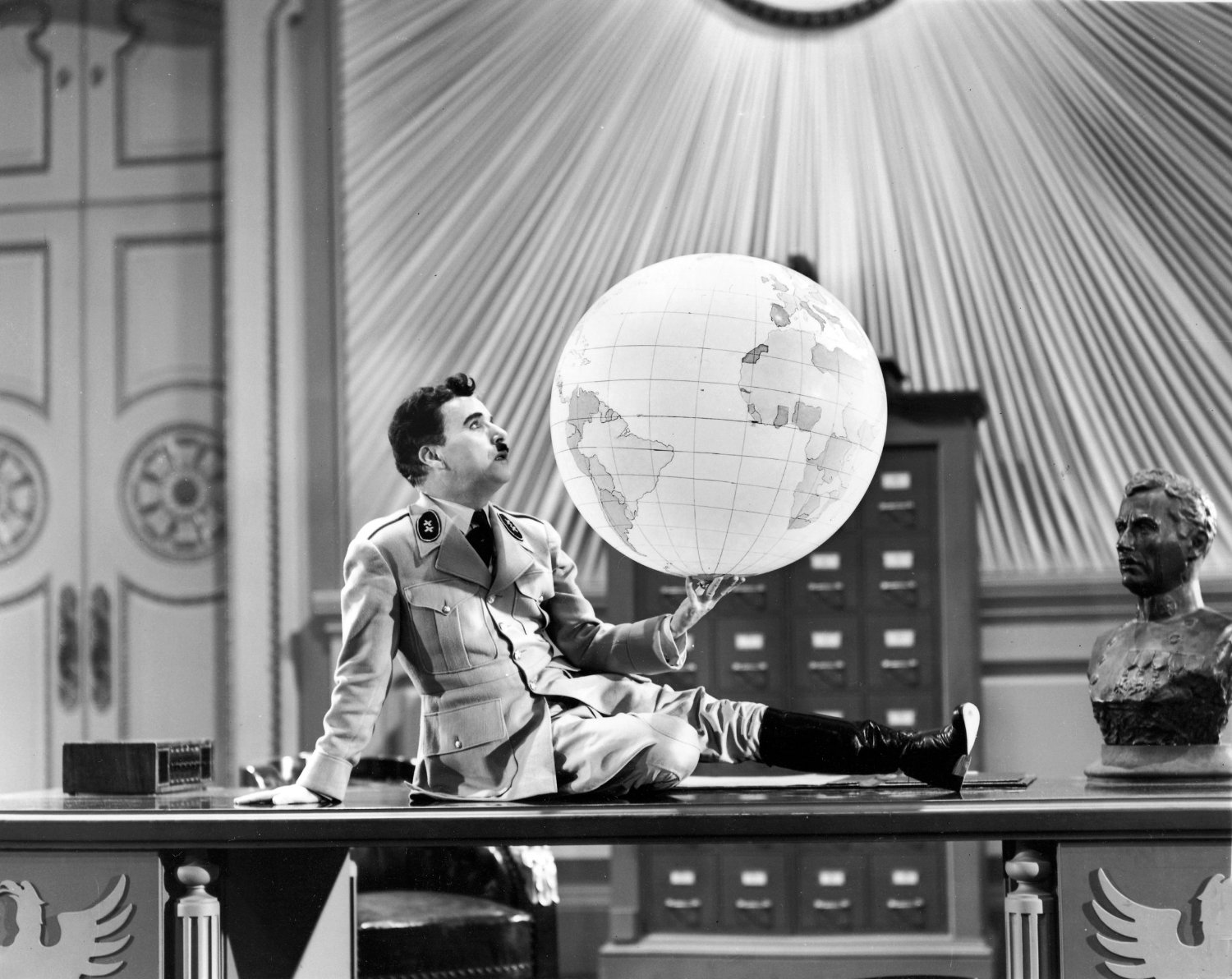
Charlie Chaplin The Great Dictator 1940

Charlie Chaplin- The Great Dictator, 1940


Our knowledge has made us cynical
Our cleverness, hard and unkind
We think too much, and feel too little
More than machinery, we need humanity
More that cleverness, we need kindness and gentleness
Without these qualities life will be violent, and all will be lost

— Charlie Chaplin, The Great Dictator Final Speech


The final speech in The Great Dictator the 1940 Charlie Chaplin film that brutally satirized the Naziism/Fascism that was then a dire threat to the entire world, feels very relevant to this moment in history.

The Great Dictator is about a Jewish barber in the fictional nation of Tomainia that is ruled by a ruthless dictator, Adenoid Hynkel. Without getting into the plot, Chaplin portrays both the Jewish barber and the Hitleresque Hynkel. At the film’s end, the barber is mistaken for Hynkel and is forced to make a speech, one in which delivers a message of hope to the world rather than the hateful rhetoric that was expected.  

It is a direct appeal to the people of the world to reject the brutalism of such dictatorships and fight for the humanity of mankind. It was controversial at the time and Chaplin’s friends and advisors tried to dissuade him from including it in the final cut, telling him that it would cause him to lose a million dollars, a vast sum in 1940. Chaplin responded that he didn’t care if it cost him 5 million.

It feels though we are at a similar point in time with a presidential candidate who threatens to unleash the military on US citizens who oppose him, to imprison his political rivals, to revoke the licenses of TV networks who displease him, to monitor and control pregnancies, and to first round up then mass deport millions of illegal immigrants along with many who are now legal. And so much more.

These are not inferred threats or hyperbole. These are his words. 

It is never wise to dismiss such threats. I hope enough people understand the peril we face.

Please take a few minutes to watch this final speech. It is inspiring in the context of history, then and now. If you get a chance, I urge you to see the whole film. It is both funny and heartbreaking on many levels and Chaplin exhibits his brilliance throughout. Jack Oakie is hysterical as the clownish Mussolini-like dictator, Benzino Napaloni, of the neighboring nation of Bacteria. He would have been a great choice to portray the current GOP candidate.

Anyway, here is the final speech from The Great Dictator:


Read Full Post »

GC Myers-  Something Beyond  2024

Something Beyond— At Principle Gallery


All human nature vigorously resists grace because grace changes us and the change is painful.

–Flannery O’Connor, The Habit of Being: Letters of Flannery O’Connor


Grace is such a wonderful word, yet it often eludes definition or understanding for many, me included. I think of it in terms of harmony, of being synchronized with the rhythm of the world and universe. There is a quality of smoothness in this, one that is accepting of the moment and place. Graceful in movement, gracious in manner.

And simple as that might sound, it eludes us mightily. And just when you think you might understand or recognize it, it seems to evaporate like morning mist in the sunlight.

Maybe it is as the author Flannery O’Connor wrote above. Maybe we live our lives out of rhythm and become comfortable in that way of being so that the idea of grace seems alien to us. To accept grace, to move towards it, would mean we would have to leave parts of ourselves behind in order to change.

And as we all know, change is dreaded by almost everyone. We often accept the misery we know in lieu of trying to change who and what and where we are.

That’s it for today. I am only throwing out that thought and may be wrong at that. Just a thought.

I will add that if you haven’t read any Flannery O’Connor, brace yourself. Her work presented a dark vision and place with residents who often both sought and rejected grace. Both heaven and hell are in the here and now and it is up to us to figure things out for ourselves. It might be our only chance, our only turn on the big prize wheel.

The paragraph below is a prime example of that, taken from her novel Wise Blood. It’s a tough and grim book to get through as was its film adaptation. But it certainly makes one think.

“Where you come from is gone, where you thought you were going to never was there, and where you are is no good unless you can get away from it. Where is there a place for you to be? No place.

Nothing outside you can give you any place,” he said. “You needn’t look at the sky because it’s not going to open up and show no place behind it. You needn’t to search for any hole in the ground to look through into somewhere else. You can’t go neither forwards nor backwards into your daddy’s time nor your children’s if you have them. In yourself right now is all the place you’ve got. If there was any Fall, look there, if there was any Redemption, look there, and if you expect any Judgment, look there, because they all three will have to be in your time and your body and where in your time and your body can they be?”

― Flannery O’Connor, Wise Blood

For this Sunday Morning Music, let’s continue with the theme of grace. Here’s a wonderful performance of the Paul Simon classic, Graceland, from Allison Krauss and Jerry Douglas.


Read Full Post »

« Newer Posts - Older Posts »