Sunday morning. Time for some music to fit the mood of the early day. It feels kind of bluesy today but in a quiet way, typical for many Sunday mornings. I immediately go to my default guy, John Lee Hooker and his 1991 collaboration, from his album Mr. Lucky, with another favorite, Van Morrison. The song is titled I Cover the Waterfront. While it shares a title, this song is not to be confused with the more well known song from the 30’s, most famously covered by the great Billie Holiday with a version that is also a fave of mine. I’m sure Holiday’s version influenced Hooker’s song if only in setting the emotional tone and pace.
Both are beautiful in their own ways. What the hell, I’ll put up both versions. Hope one of these sets the tone for a cool and easy Sunday for you.
It’s always interesting to discover something new — a few interesting facts or the true backstory — about things that have been in plain sight for most of your life. Take for instance the song Black and White, released in 1972 by the pop band Three Dog Night. The song went to #1 on the pop charts here and, with its pleasant beat and gentle message of racial equality, has been a staple of oldies radio for decades now.
I never really thought much about the song even though I’ve heard it hundreds of times over the years, even singing along with the lyrics that have been embossed in my synapses with repeated listening. It came on the radio in our car the other day and Cheri and I couldn’t agree on who had written the song. Three Dog Night didn’t write many of their own songs, most being penned by other, more notable songwriters– Hoyt Axton, Laura Nyro, Randy Newman, Harry Nilsson, Elton John and others. So whenever we hear one of their songs we try to identify the original songwriter. But we drew a blank with Black and White.
Looking it up, we were both surprised that it was written in 1954 by songwriters Earl Robinson and David Arkin, a blacklisted teacher and set-designer who was the father of actor Alan Arkin. This fact made sense to me because I knew that Alan Arkin was a folksinger in the 1950’s, scoring a hit that went to #4 on the charts with a version of the The Banana Boat Songwith his group, the Tarriers.
The song was written to celebrate the Supreme Court decision in the landmark case Brown v Board of Educationwhich outlawed segregation in public schools and was first recorded in 1956 by Pete Seeger. In the original version, which Seeger sang, the beginning lyrics are different than the ones that so many of us who know the song through the Three Dog Night version remember– the ink is black/the page is white/ together we learn to read and write. The original deals directly with the supreme court decision:
Their robes were black, Their heads were white,
The schoolhouse doors were closed so tight,
Nine judges all set down their names,
To end the years and years of shame.
The 1972 version that Three Dog Night recorded was based on one that was recorded a year before, in 1971, by a British group, Greyhound, that had a hit in the UK with it. The Greyhound hit did not use these original lines anywhere in their version and Three Dog Night merely copied this. Though it doesn’t greatly diminish the song, it would be nice to have these lines in the song. Perhaps by 1971 or 1972 they felt that the 1954 Supreme Court decision was no longer topical or relevant.
So, there you have it: a seemingly innocuous and pleasant song with some real history behind it.
Here’s a 1970 version from the Jamaican band The Maytones. I believe that Greyhound‘s version of the following year came from this one.
I thought that for a bit of Sunday morning music this week, I would stick with something that sort of fits with tomorrow’s St. Patrick’s Day observance. I say observance because while we often loudly celebrate it here with a little too much Guinness and more than enough Kelly green clothing, it is a more somber and religious holiday in Ireland. But that being said, I thought I would play a song that is more in the spirit of a raucous celebration.
This is Big Strong Manfrom the Irish band , The Wolfe Tones. They have been around for about 50 years and are primarily known for their repertoire of rebel songs. I am somewhat ambivalent about using them as I have a long-time friend who lives in County Armagh in Northern Ireland who has often described to me over the years the fatigue and the toll that this multi-generational conflict has taken on the people there. But this is a great and fun song that doesn’t take any political stand.
I was looking for a diversion from the cold and snowy weather that refuses to release its grip on us when I came across this short video that gives a brief (it’s only three minutes!) history of art. It’s obviously not comprehensive and done with tongue firmly in cheek so don’t be too critical if they miss an -ism or two along the way. All I know is that I would much rather be watching this than going out to plow, which is next on the agenda. So I am going to watch it again and put off putting on my boots for a bit.
The image I chose for this post is a commuter’s view of 5 Pointz in Long Island City, NY. It was an old factory complex that became a haven and showcase for graffiti artists until recently when developers took over and began transforming the space as the area undergoes gentrification. That is the short version of what has become the 5 Pointz controversy as graffiti artists and aficionados try to preserve this space and the art therein. I just thought the image was striking in the way the imagery changed and enlivened the whole feel of what was a dilapidated space. Such is the power of art.
Have a great day and enjoy a short journey through the history of art.
I finished this painting, a 10″ by 20″ canvas, over the weekend. Every piece has a different feel in process. Some are struggles, not wanting to show me a way through to the finish. Every decision and move must be really scrutinized. Some show me a way but leave me uneasy about my choices until near the end. And some, like this painting, open wide and invite me in, the process feeling almost effortless.
This painting felt right from the moment it went on the easel. The composition fell together easily and the colors meshed immediately which left me feeling as though I was simply along for the ride. Not painting but rather just observing it coming together. It’s an interesting feeling and one that is highly desirable, at least for me, as the resulting work usually feels naturally free and easy.
And for me this piece has this feel. It flows easily and the warmth of its colors and the rising elevation of it gives me a sense of joy, as though it represents a desired destination, an endpoint to a long journey. You always hope that your journey will end well and this piece is symbolic of that hope. I call it Happy Trails.
Some of you of a certain age will probably immediately associate this with the theme song of film and television cowboy Roy Rogers , written by his wife, cowgirl Dale Evans. Those of you of a slightly younger age will probably think of the song that Van Halen with David Lee Roth used to end its shows. And those of an even younger age will probably just think that its a catchy title. I fall into the first group, having watched reruns of the Roy Rogers Show on Saturday mornings as a kid, mainly because we only had a couple of channels. Plus, I did like Trigger and Roy’s sidekick, Gabby Hayes. And the theme song which ended every show.
It’s a catchy and pleasantly warm song. Its feel and title fit this painting well. Here’s a lovely version that I found online from a gentleman on a ukulele named Patrick HildebrandSr. from the Amazing Music Store in Pacific Palisades, California. The uke’s warm tones and his pleasant voice fit this song well.
I had this video, Strange Affair, on the blog about four years ago and just wanted to share it again. Good sound for a cold and quiet Sunday morning. Plus the image that I used to accompany the post (a painting that is, of course, titled Strange Affair) is one of those images that both sticks in my mind and meshes well with June Tabor’s beautiful interpretation ( accompanied by one of my favorites, Martin Simpson, on guitar) of the Richard Thompson song.
There’s something stark in both the song and the painting that appeals to my sensibilities. A sort of joy found in certain moments of melancholy. There was a moment like that last week when I was walking through the woods to the studio. It was extremely cold with the sky a flat gray slate and there hardly another sound other than the trudge of my footsteps in the snow. It seemed like such a bleak and sterile moment but then a single snowflake drifted down, dancing delicately in the air, and I was suddenly filled with a joy that I couldn’t quite put my finger on. It wasn’t happiness. Just the joy of feeling connected to the world in that moment.
Joyous melancholy. A paradox. A strange affair, to be sure.
So, pardon me for showing this image and this video again. It was four years ago after all. Enjoy and have a great Sunday.
It was on a Sunday evening on this date fifty years ago that a touchstone event took place here in the States, one that dramatically altered pop and rock music as well as popular culture. If you watch television or read newspapers, it has been hard recently to avoid seeing something about this 50th anniversary of the Beatles’ first appearance on The Ed Sullivan Show on this date back in 1964. For some, especially those later generations, this is probably a puzzlement as they have no context to put this event in any sort of historical context. They have no idea what a big moment this was or how it dramatically affected music and popular culture.
It’s always hard to describe something to someone who has only known the resulting change. I used to try to convince those nay-sayers, usually people born in the aftermath of the Beatles’ reign which would be post-1970, of the importance of the Beatles emergence and their music but it became too tiring. So now I just enjoy the music and marvel at their evolution over their short lifespan as a band. What an arc of creativity!
Their listeners might have mourned when they disbanded in 1970 but, realistically, they had completed their journey together, had strung together album after album of memorable and constantly evolving and growing sounds. They were at a peak with nothing more in front of them. Each went on to highly successful solo careers but none matched the true power of their combined efforts as the Beatles.
The legacy of their music has been so evident in the past few weeks. I’ve seen a number of lists from critics and other musicians of their favorite Beatles songs and each is so different from another. There is no consensus of which are their best songs and each list is truly valid as each contains a group, usually ten, of songs that are quite memorable. Even the list of the top ten underrated Beatles songs would qualify as someone’s best of the Beatles list. I sat down and tried to make a list of my Top Ten Beatles songs and had such a hard time. Just when I thought I had it I would remember another and couldn’t imagine it not being on the list. It is remarkable that they had so many songs that bound themselves so deeply into the fabric of ourselves.
Here’s what I came up with for my Top Ten, in no particular order:
A Day In the Life
Paperback Writer
Day Tripper
In My Life
Hello Goodbye
Norwegian Wood
Taxman
Tomorrow Never Knows
You’ve Got to Hide Your Love Away
Baby You’re a Rich Man
Sitting here now, I can think of twenty ( or forty or fifty) other songs that would fit seamlessly into this list, all songs that are my favorites when I am listening to them. Oh, well, there are no hard and fast rules here and this is not a very terrible problem to consider so I’ll just put lists aside and enjoy. Here’s one of my faves from the Fab Four.
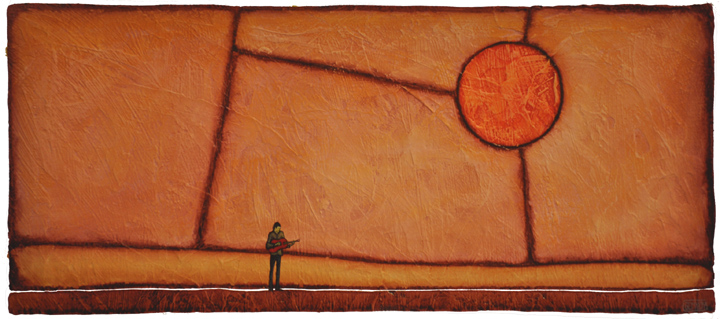
This is another of the pieces that are in the upcoming Little Gems exhibit at the West End Gallery in Corning. This little guy is titled Serenata Blue and is a just a bit larger that 2″ by 4″ on paper. It’s a continuation of the recent snow paintings as well as another of my solitary guitarist pieces, of which I do a handful each year.
There’s something very appealing to me in the solitary guitarist standing amidst open space as he cradles his guitar. It usually brings me a wistful, somewhat sad feeling. Not in a bad way sad. Just a slight existential melancholy. You know, the good kind.
I thought that there should be some appropriate musical accompaniment to this painting so I came up with a sad song. And I mean sad. This Nancy Griffith’s version of Tecumseh Valley. It’s an achingly beautiful and sad lament that tells the story of a poor mountain girl. To make this version even sadder, this is from a tribute show from the friends of the song’s writer, the great Townes Van Vandt, right after he passed away in 1997. But it is a haunting and lovely song so don’t be afraid to listen.
Pete Seeger died yesterday at the age of 94. He had a pretty remarkable life, using the power of music as a hammer to pound against the powers of social injustice. The thing that I admire most is his always evident conviction to whatever cause he was devoted. For as gentle and jovial a man as he appeared to be, there was no wishy-washiness in Pete Seeger. He always spoke the truth to power on the most pressing matters of the day– the labor movement, civil rights, the Viet Nam war and the environment.
Of course, anyone with such strong and visible views, wil have some controversy surrounding him and Seeger was no different. He was blacklisted in the 1950’s for his early affiliation with Communism and his slowness to finally condemn Stalin followed him through the years. But, to his credit, he did own up to his actions and admit mistakes when he felt they were made. Probably more so than most of those in power would be willing to admit.
Of course, the music is the legacy of Pete Seeger. Songs like If I Had a Hammer , Where Have All the Flowers Gone? and Turn! Turn! Turn! have all have been covered innumerable times, becoming so ingrained in the American songbook that it seems hard to believe that they weren’t written even longer ago than they were. Well, the lyrics of Turn! Turn! Turn! werea bit earlier as they use the words from Ecclesiastes in the Bible. I grew up with a single of the Byrds’ version of Turn! Turn! Turn! never far away from our old stereo console and I still get a chill when I hear those opening chords and a little teary when I listen to the lyrics..
So, for Pete Seeger, to every thing there is a season. Thank you.
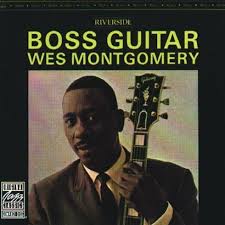
It’s a frigid winter morning with temperatures below zero and a fine gray mist of snow filling the view from my studio windows. It would be easy to mope around on a morning like this but I am in the mood for something light. Airy and alive. I flip around looking for something thta fits the bill and settle on a little Wes Montgomery, the late jazz guitarist who died way too early and was one of the most influential players ever, spurring on guitarists of many genres with his distinct playing.
You can easily see the unusual stance of his right hand as he plays, splayed out and set in one position against the body of the guitar while his ultra-flexible thumb does all the dancing on the strings. It was said that he had a corn-like callous on his thumb that acted as a pick, the hard parts of providing sharper tones and the softer parts the more mellow sounds. It’s the style of a self-taught artist, which I appreciate. That and the fact that he, much like BB King, could not read music. Amazing.
Wes Montgomery died in his home in Indianapolis from a heart attack in 1968. He was only 45 and at the peak of his career. Makes you want to take advantage of every moment, not knowing what you will leave undone when your time comes.
Here’s a track called Jingles from Wes Montgomery in 1965. Enjoy!
 Sunday morning. Time for some music to fit the mood of the early day. It feels kind of bluesy today but in a quiet way, typical for many Sunday mornings. I immediately go to my default guy, John Lee Hooker and his 1991 collaboration, from his album Mr. Lucky, with another favorite, Van Morrison. The song is titled I Cover the Waterfront. While it shares a title, this song is not to be confused with the more well known song from the 30’s, most famously covered by the great Billie Holiday with a version that is also a fave of mine. I’m sure Holiday’s version influenced Hooker’s song if only in setting the emotional tone and pace.





 Redtree Times