Feeds:
Posts
Comments

Archive for the ‘Video’ Category

Link Wray

I’ve got a lot on my plate this Friday morning as I’m in the last month before my annual show at the Principle Gallery so I thought I’d share a little music.  Wanted something with a bite today and I realized that I hadn’t written about Link Wray over the couple of years that I’ve maintained this blog.  Thought I had better rectify that oversight.

Link Wray, who died in 2005 at the age of 76,  was not part of my childhood and I don’t think his music made much of an impact on the AM radios of our region when he first emerged in the 1950’s.  I didn’t come across him until the late 70’s when he was in the midst of one of many career resurrections, gaining widespread popularity in Europe with his raw guitar instrumentals and with collaborations with other musicians such as Robert Gordon.  I read about him before I heard his music and was intrigued as one writer described how his music stood out from the other music of the 50’s.  This person described Wray’s guitar playing and music as being like long strings of profanity coming out of his radio as a teenager.  It was rough and rude and incendiary for that time.

By the time I heard him, the world had changed.  Wray’s aggressive playing had been adapted and transformed by other artists and he seemed a little in the past.  But listening to it with an eye to how it had contrasted with other contemporary music of its time, I could see the appeal. 

Here’s a clip from 1978 when I first came across him.

Read Full Post »

There is a documentary film out now that is being premiered locally here tonight called 300 Miles to Freedom.  It tells the story of John W. Jones, an African American born into slavery on a Leesburg, Virginia plantation in 1817.  Fearing his sale to another plantation owner known to be violent with his slaves, Jones and four other slaves escaped in June 0f 1844 and fled north.  After a harrowing journey they arrived in the Elmira area in July, 1844.  Jones made Elmira his home and remained there until his death in 1900.

Elmira was a major stop in the Underground Railroad of the per-Civil War era, the last major stop for many slaves before heading north towards St. Catherines in Ontario.  In 1851, Jones became an agent for the Undergound Railroad and was responsible for the successful passage of at least 860 slaves into freedom.  With the coming of the railroad lines in 1854, Jones made arrangements with rail employees that allowed him to stow the escaping slaves in early morning baggage cars which came to be known as the Freedom Baggage Cars.

In 1859, Jones became the sexton, or caretaker, of  Woodlawn Cemetery in Elmira.  In the next few  years, during the Civil War period, Jones was charged with the burial of the Confederate soldiers who died at the nearby prisoner of war camp, notoriously called Hellmira.  Nearly 3000 southern troops died at that time, all buried by Jones, who was recognized by the federal government for the care he took with these burials and with the precise records he kept for each soldier, eventually making the site a National Cemetery.  My mother and many other relatives are buried in that same cemetery that grew from Jones’ labor.

Jones was paid $2.50 for each burial which made him a tidy fortune which made him the wealthiest black man in the region.  While doing some genealogical research I came across some relatives of mine who lived a few houses away from the home that Jones bought and owned on College Avenue.  This home has been moved to a site across from the National Cemetery and is in the process of being made into a museum celebrating the life and work of John W. Jones.

I’ve always loved the story of John Jones life here in Elmira and am glad that it is being retold in a film.  Here’s the trailer for the film.

Read Full Post »

Happy Birthday

It’s my Dad’s birthday today.  That’s him on the right in an old photo,and one of my favorites, from about 50 years ago when he was working at a little used car  lot that my uncle used to run in Elmira.  I always loved this picture and that kind of cocky attitude of  it.  It really captures a particular time for me and I can almost smell the oily ground and the dusty interiors of those old  1950’s cars I used to play in and around.

The fellow on the other side of that sweet Chevy Impala  was Jesse Gardner, who also worked with my Dad at the Sheriff’s Department and actually played a small part in my beginning to show my work many years later.   Although I didn’t know it at the time, his son, Tom, a well known painter, was the owner of the West End Gallery in Corning.  I used to visit the gallery before I even started painting and often had long conversations with Tom that eventually led to him taking a look at my work and inviting me to show there.  When I learned that he was Jesse’s son I was surprised I hadn’t put it together before since the two had a strikingly similar appearance.

Growing up, I was a pretty constant companion to my Dad.  Being the youngest by several years, I probably spent more time alone with Dad than my sister or brother, especially as they moved into their late teens.  We spent a lot of time over the years at the Finger Lakes Race Track, a thoroughbred horse track  in Canandaigua.  Maybe not what most would consider an ideal place for impressionable kids but I enjoyed that world at the time and I enjoyed my time with Dad.  We would listen to country stations on the radio on the hour and a half drive there.  I particularly remember us  listening to the news from Paul Harvey with his distinctive take on the world and songs like A Boy Named Sue from Johnny Cash and many others.  Whenever I think of that ride, the song that comes to mind is Counting Flowers on the Wall from the Statler Brothers.  It seems like we heard that many times and we both seemed to enjoy it as we glided through that Finger Lakes landscape that was often filled with the smells of fresh cabbages in the fields.

Anyway, we don’t make a big deal out of birthdays in our family but I did want to say Happy Birthday to my old man down in Florida.  Have a great day, Dad.  Here’s a song for you.

Read Full Post »

I’m sitting here wondering if the birthers will finally go away now that President Obama has given them what they claimed they sought.  I know I shouldn’t wonder such things because it’s obvious that this was never about a birth certificate, never about where the man was born.  If it was as simple as that, the question was answered long ago.  No, this is about intolerance, about a group of people being willing to accept any contrivance of a story that delegitimizes the man that they cannot accept as president because  of his differences from them.  Differences like his ideology and his intellect, where he definitely differs from them.  Differences like the Muslim roots of his name.  Like the color of his skin. 

Though this has been a dark blot of shame on our country, I am sure it will not end even now.  The hatred of these people knows no reason and will find a new lie to rally around.  New conspiracies raised by the winking shepherds of this willing flock.  And the media will sit by, unquestioning as it allows the lie to build.

Ah, it’s frustrating to see such unchecked hatred and idiocy. 

Here’s a song, Shoot Out the Lights, from Richard Thompson.  It was the title song from a highly acclaimed 1982 album from him and his then wife, Linda, that acted as a document of the end of their marriage.  I’ve always liked the imagery the title brings to mind, of someone shooting out the lights to mark the finality of something ending.  Let’s shoot out the lights on this birther business.

Read Full Post »

I wasn’t going to post anything today but when I flipped on the television first thing this morning to check out the news an episode of “I Love Lucy” was on with Ricky singing a beautiful song called Similau.  I’ve seen every episode of the show many, many times over the years and am always amazed at how talented Lucille Ball and Desi Arnaz were.

Everyone knows about Lucy’s comedic sklils but it’s her dancing that I really admire.  She plays up the clumsiness in her  comedy dance routines creating bits that make me laugh every time I see them.  But periodically she flashes the grace and movement of a real dancer.  I don’t think a less talented dancer could create the comedic effect of her often failed dance attempts on the show.

Desi also flashed his wonderful talents on the show, both as a comedian and a real entertainer.  There are a number of his performances of songs on the show that I find really really fascinating with their Cuban beats that were popular in that time.  Of course, there was his signature Babalu but it’s songs like this one, Similau, that captivate me.  Not what you’d expect from one of the most popular sitcoms of all time.

I couldn’t find the version of the song from the show which featured a really interesting and more pronounced rhythmic counterpoint but this is an equally fine version taken from the Peggy Lee radio  show of that time. 

Read Full Post »

Blue II- Joan Miro

When I’m painting, which is most of the time, there are occasional shifts in the work from day to day.  Sometimes they just happen without any forethought, an adding of an element here or there to change the balance of a composition or the touch of a color that may have been absent from the palette for some time. 

 
Then there are conscious decisions made in advance of coming work, such as the decsion ot work in a certain size or medium.  I came across some older work lately in my archives that made me make such a consious decision.  It was a group of  mainly nocturnal scenes done in deep gem-like transparent  blues.  They have a stark and moody feel and, while I always have really thought highly of them, have been out of my repertoire for some time. I’ve got to make an effort to revisit this work and see what emerges.  There’s something different in approaching a painting as an examination of  solely color rather than as harmonizing a landscape’s composition.  The focus on color seems to create its own mood and drama, one that comes across off the wall even in the starkest of compositions.
 
We shall see.  For now, here’s a video that speaks to the subject for me.  It’s Dave Brubeck’s Bluette played over the wondeful work of Joan Miro.  Enjoy.


Read Full Post »

I was going to talk a little about one of Woody Guthrie’s songs about an incident that occurred in the formative years of the labor movement, the Ludlow Massacre of 1914

It’s a haunting song about a haunting event which happend in Colorado where striking miners who had formed a tent village were set upon by the National Guard on the orders of the Colorado governor.  They snuck in and soaked the outer tents with kerosene and set them ablaze then opened fire on the miners and their families as they fled.  20 were killed, including 11 children.  Just another of many incidents in our history that is practically unknown to the average man in the street, the person who doesn’t realize that the importance of protecting the working class against the avarice of those who would exploit them is rooted in such tragedies.  People who don’t realize the historical importance of the labor movement in this country and how it relates to the present standard of living.

There’s a lot more to be said, of course.  But it’s Sunday and the world deserves a rest.  You can find Guthrie’s Ludlow Massacre on YouTube, along with many of his classic documentations of working America.  I thought I would play a little less dark song by the great American troubador/poet/pot-stirrer instead.  Here’s So Long It’s Been Good to Know You. 

Read Full Post »

One of my favorite performances of live music came about 20 years ago in October of 1991.  It was at The Haunt in Ithaca.  There is a newer, larger Haunt in Ithaca now but the old one was tiny, tucked well off the street in an alley of sorts.  It held maybe a hundred or so people.  I went with a friend to see the legendary Buddy Guy and some opening act we’d never heard of before. John Campbell.  As we stood just off the edge of the very compact stage waiting this tall character with long hair appeared. He was very gaunt with a strange glow about him and and you couldn’t help but look at him as he passed.  He seemed very inward and serious.  A little scary, actually. 

We thought he was just  somebody heading backstage then he stepped up on the small stage with the three fellows following him and picked up a well worn Gibson acoustic guitar as the other three took up their instruments.  He started fingering a few notes, blues progressions then broke into a full fledged guitar attack with the rest of quartet.  The rest of that night was blues guitar nirvana in this little crowded club.  Buddy Guy, appearing afterward,  was, well, Buddy Guy, which is to say great.  A memorable performance  but Campbell was spectacular, belting out all sorts of blues including extraordinary slide moves on his National resonator guitar.  Having expected nothing it was like finding something new and wondeful, something you couldn’t believe had existed without your prior knowledge.

John Campbell died less than two years later at the age of 41.  He never achieved  huge fame although he was well known in the blues community.  But I will always remember being in that tiny club  that night, discovering a hidden treasure, which is what he remains.  Here’s a song he played that night:

Read Full Post »

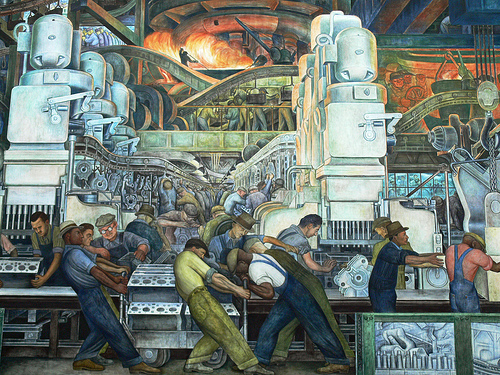
Yesterday, I wrote about the mural controversy in Maine where the work depicting the history of labor was removed from a state building.  It made me think of other murals and immediately brought to mind the work of Diego Rivera,who I have written briefly about here before and who was arguably the greatest muralist of recent history.  Rivera’s work often focused on the struggle of the worker. 

The Mexican Rivera (1886-1957) was an ardent Marxist who saw the mural as a way to to make expressive art available to the masses, away from the confines of museums and galleries which he saw as elitist.  But it took money to commission his masterpieces so he was often working with those powerful forces that he often eyed with suspicion.    There were episodes where the two sides bumped heads, the most famous coming when his mural at Rockefeller Plaza in NYC was destroyed because of his inclusion of Lenin in the mural and his subsequent refusal to remove it.

The work he considered his finest was centered around the worker and the industry of America.  In 1932-33, Rivera painted , under the auspices of Henry Ford (who is depicted in the mural) and at the height of the Great Depression, an epic mural at the Detroit Institute of Arts.  Covering more than 447 square yards, Detroit Industry is massive.  It is filled with vibrant imagery depicting the worker, in both a heroic and subservient manner, as integral cogs in the rhythmic throb of the busy industrial world.  It is a feast for the eyes.

I have always been drawn to Rivera’s work on a gut level, drawn in by his gorgeous color and exciting composition.  When I see his grand murals I am deeply humbled and this work is no different.  I am pleased that it has survived the changing tides of political favor without somebody suggesting it be painted over.  If anything, it should remain if only as a reminder of the part the worker has played in building the wealth of this country at a time when the American worker is quickly overlooked by industry in favor of cheaper, unregulated labor on distant shores.

Here’s a video showing the scope of Rivera’s work.  As an artist, I am both inspired and intimidated by the sheer amount of amazing work here. 

Read Full Post »

Batter Up!

Groucho, Chico and Harpo with Lou Gehrig

Baseball season is finally here! 

I consider it one of the best times of the year, when my routine starts to include reading boxscores and checking the standings.  There is nothing like the rhythm of baseball for me and the way it weaves together with the daily lives of people who follow the game.
.
One of the most vivid visual images of my youth are coming up the steps of Shea Stadium at night and suddenly having the bright green grass of  the diamond emerge before you.  Everything was rich and deeply colored.  The greens were dark, the dirt of the infield a warm clay red and the whites of the lines shining like lasers.  It felt like that moment in The Wizard of Oz where Dorothy opens the door and everything changes from a bland, colorless scene to one filled with powerful, vibrant colors.   I still get that same stir of  familiar excitement when I see scenes of a ballpark at night, ablaze in color.
.
So my marathon season begins and, as a fan, I am filled with optimism because my team has won its first game.  Everything is rosy until that inevitable first loss which tastes bitter going down.  Losing and failure, a subject I’ve discussed this week, is all part of the game and it’s how a team or player responds to failure that determines the direction of a season.  That is where the drama lays in baseball.  Can’t wait for the game today!
.
Here’s one of my favorite things, one that I showed here two years ago.  It’s Harpo Marx’s wonderful rendition,  from his appearance on I Love Lucy, of Take Me Out to the  Ballpark, one that strikes that ethereal chord I feel for the game.  Have a great Saturday!  Batter up!

Read Full Post »

« Newer Posts - Older Posts »