Feeds:
Posts
Comments

I Scare Myself

The Watcher in the Window– At West End Gallery


I scare myself and I don’t mean lightly
I scare myself it can get frightening
I scare myself to think what I could do
I scare myself it’s some kind of voodoo

I Scare Myself, Dan Hicks and his Hot Licks (1972)


Icy cold this morning. -1° with a wind chill of somewhere around -14°.

The big news around here is the coming storm with an expected snowfall of 12 to 18 inches. This has people all in a fearful tizzy. The supermarkets were packed yesterday as people rushed to stock up.

There was a sense of dread in the air so thick that created its own storm front.  I would like to think I am immune to it, that I will just shrug it off.

Whatcha gonna do? It is winter, after all, and if memory doesn’t fail me, we have had many bigger storms in the past. Seems like in those times I had a much more take-it-as-it-comes attitude. Today I find myself thinking about what needs to be done so that we are prepared and dreading the hours on the tractor it will take to clear our long driveways (a little over 1/4 mile in all) in supercold temps.

Maybe that is simply a product of aging, of knowing that I am dealing with much more limited energy resources at this moment. Definitely much less than twenty or thirty years ago. I feel tired a lot more since I began taking the meds and the cold seems to bite a bit more.

But I still have a bit of that take-it-as-it-comes in me, thank god, and sometimes still find myself laughing at the worries I feel from things like these storms. It’s a pain in the butt and I would obviously rather be doing something else than plowing or shoveling and shivering, but it’s part of the deal. I remind myself this when I find myself fretting over this kind of stuff, that just being able to do the things needed to survive the little perils that pop up in this world is actually a privilege.  A pleasure, in fact. Just part of being alive. Much better than the alternative.

It makes me stop scaring myself.

There are much more awful and dangerous things and people out there to fear than a little snow and subzero temperatures.

Now, I just have to convince myself that facing those other things is also a privilege and a pleasure.

Here’s a song, I Scare Myself, from Dan Hicks and his Hot Licks from his album Striking It Rich. I bought this album soon after it came out in 1972 and sometimes even now find myself absent-mindedly singing bits and pieces of the songs from it. This is one that often pops to mind. Maybe it serves as an unconscious reminder to stop scaring myself?

I don’t know. Why doesn’t really matter. I just enjoy revisiting the song.


Topophilia

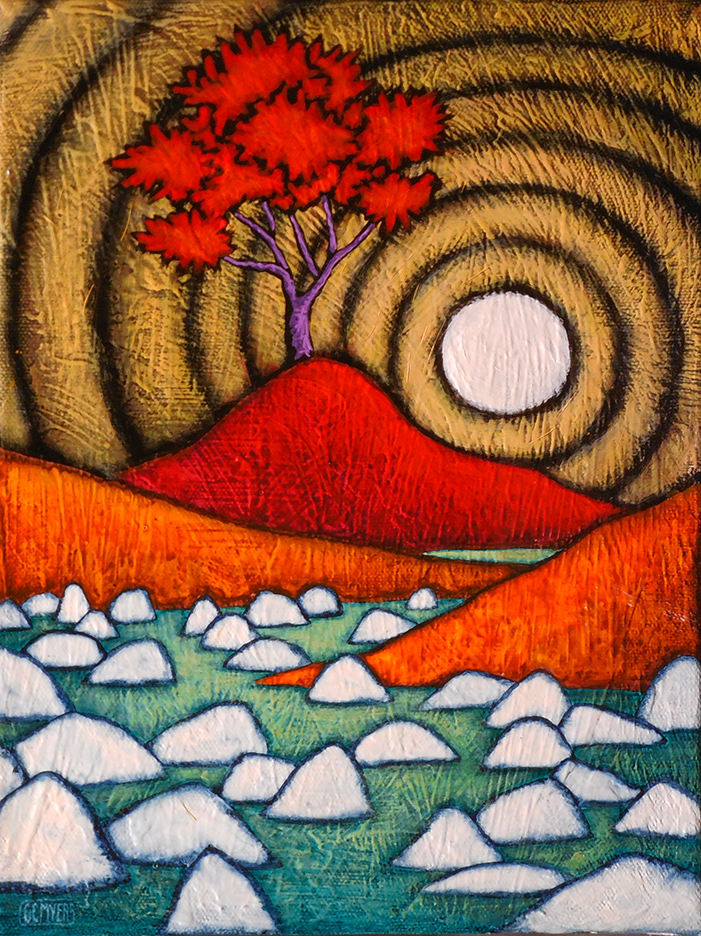
RedTree: Continuum— At West End Gallery


In contrast to the flux and muddle of life, art is clarity and enduring presence. In the stream of life, few things are perceived clearly because few things stay put. Every mood or emotion is mixed or diluted by contrary and extraneous elements. The clarity of art—the precise evocation of mood in the novel, or of summer twilight in a painting—is like waking to a bright landscape after a long fitful slumber, or the fragrance of chicken soup after a week of head cold.

–Yi-Fu Tuan, Passing Strange and Wonderful: Aesthetics, Nature, and Culture (1993)


I like this description of the restorative power of art from the late geographer Yi-Fu Tuan. Art has the ability to bring us to a place of clarity and stability that often seems far from, as he puts it, the flux and muddle of life. He also points out that our reactions to events in our everyday life are often conflicted and affected by many outside factors that cloud the moment and cause our feelings for it to sometimes change drastically over a short period of time. We are left with a gnawing sense of uncertainty in what we know and think.

The words from Yi-Fu Tuan pretty much lines up with how I see art. I have probably expressed just those sentiments here before. It was the phrase here, the clarity of art, that caught my attention. We live in such a turbulent world in which there is so much swirling around all the time that it is hard to have a clear vision or thought. There is always something in the way of us seeing or hearing or thinking clearly.

Art on the other hand is a clarifying agent. It often provides a clear and set focal point for our mind and feelings, a time and place apart from the flux and muddle.

A place to restore mind and soul.

Yi-Fu Tuan (1930-1922) knew a little about places. He was a prominent geographer, writer, and professor who was a major figure in the field of human geography, also known as anthropogeographywhich is the study of how people interact with place and environment. He was also one of the originators of humanistic or critical geography which studies how geography affects issues such as migration, inequality, injustice, and political and social movements.

He also coined the word topophilia which is “the strong emotional bond, affection, or love people feel for a specific place or environment, encompassing feelings like attachment, fascination, nostalgia, and belonging tied to a location.

It is that sense of home I often write of and hope to capture with my work.

Nice to know there is word for that.

Here’s a song that is very much about the relationship between humans and place. This is a version of the Woody Guthrie song This Land is Your Land. I’ve played Woody’s original here as well as a couple of other covers of it but was surprised I never played this live performance from Bruce Springsteen. It’s a fine version of the song that effectively captures both love of place and the sometime elegiac melancholy that comes in it not living up to its promise. This video has spectacular imagery of the American landscape that make for fine examples of topophilia.

Here’s a little info on the song from prior posts:

Guthrie wrote the song in the late 1930’s in response to the immense popularity at that time of the Kate Smith version of God Bless America, written by Irving Berlin. Guthrie saw the world coming apart due to the nationalistic extremism that had spread through Europe, producing fascist leaders such as Hitler in Germany, Mussolini in Italy and Franco in Spain.

The original intro to God Bless America had the lines:

While the storm clouds gather far across the sea / Let us swear allegiance to a land that’s free / Let us all be grateful that we’re far from there, / As we raise our voices in a solemn prayer.

That phrase that we’re far from there was later changed to for a land so fair.  Guthrie saw it as a call to an isolated form of nationalism, one that cast a blind eye to the perils lurking abroad that were beginning to spread here as well as our own problems at home. Problems like poverty and inequality of both wealth and justice.

Guthrie wanted to address these problems in his retort to Berlin’s song.  At first, Guthrie sarcastically called his song God Blessed America For Me before naming it This Land Is Your Land.

Below are the two verses in the original version of This Land Is Your Land that are always omitted from those cheery civic versions speak to the ills of this country as Guthrie saw them, most noticeably the greed which led to the great chasm of inequality between the wealthy and the poor of this land. He questioned how a land with so much wealth and beauty, one based on the equality of man, could tolerate the extreme poverty and injustice he saw in his travels across this land.

There was a big high wall there that tried to stop me.
The sign was painted, said ‘Private Property.’
But on the backside, it didn’t say nothing.
This land was made for you and me.

One bright sunny morning in the shadow of the steeple,
by the relief office I saw my people.
As they stood hungry,
I stood there wondering if God blessed America for me.

It’s an interesting song that speaks to this perilous time in the world as blind nationalism rises abroad and here in the USA.


River Without Time

A Matter of Perspective— At the West End Gallery


Have you also learned that secret from the river; that there is no such thing as time?” That the river is everywhere at the same time, at the source and at the mouth, at the waterfall, at the ferry, at the current, in the ocean and in the mountains, everywhere and that the present only exists for it, not the shadow of the past nor the shadow of the future.

― Hermann Hesse, Siddhartha (1922)


I was going to write about the absolute insanity we and the rest of the world are witnessing in the frantic and unhinged antics of the Mad King over the past few days. I even started writing it with a quote from Mahatma Gandhi at its beginning:

The only tyrant I accept in this world is the ‘still small voice’ within me. And even though I have to face the prospect of being a minority of one, I humbly believe I have the courage to be in such a hopeless minority.

I couldn’t go on with it though. I felt that I should spare you — and me, as well– the aggravation this morning. You know it. You see it. Everybody in the world can see it. My words nor those from anyone else, including the minions who attempt to make us disbelieve what we are witnessing, won’t change anything this morning.

I just need to be quiet this morning. I have work that needs to be done and need a clear mind. Need to shut things out for a while. Need to stop time, not fret about the past or worry about the future.

Just be.

Like Siddhartha’s river.

Here’s a cover of what might be my favorite Beatles song, Tomorrow Never Knows. One of the reasons it is a favorite, especially on a morning like this, comes in its first line: Turn off your mind, relax and float downstream…

It puts me instantly on Siddhartha’s river. And that’s where I need to be this morning.

This version is from the late blues singer Junior Parker. He is best known for his version of Mystery Train from the 1950’s that became an early hit for Elvis when he covered it. This is quite a departure from the blues for which he is best known. It appeared on his last album in 1971, the same year in which he died at the age of 39 from a brain tumor. Given the album title and its cover, which has that politically incorrect 1970’s feel, this is a surprisingly effective and restrained performance of the song, one that captures its essence and quietude. I still defer to the Beatles’ original version, but I found myself listening to Parker’s rendition several times this morning.

Turn off your mind, relax and float downstream…

It took me there.


Moon, Stone, Moment — At West End Gallery


From the very beginning almost I was deeply aware that there is no goal. I never hope to embrace the whole, but merely to give in each separate fragment, each work, the feeling of the whole as I go on, because I am digging deeper and deeper into life, digging deeper and deeper into past and future. With the endless burrowing a certitude develops which is greater than faith or belief. I become more and more indifferent to my fate, as a writer, and more and more certain of my destiny as man.

      – Henry Miller, Reflections on Writing


I’ve been writing a lot lately and thought I’d take a small break by sharing this post that originally ran here in 2009. I love the passage above from Henry Miller and instantly see my own feelings on my work and life in it. Trying to put the feel of the whole into the fragments that are my work is a fine summation of what I do, trying to make even the smallest, seemingly insignificant piece, which may seem at first glance to be a mere fragment, still contain a sense of fullness, of completion. Of wholeness.

Sounds like a lofty goal but it’s not. I just figure that every piece deserves my full attention and effort. If not, why even bother? Much like all lives, the life of a writer or an artist doesn’t consist of creating one grand opus or masterpiece. They come as a result of consistent attention to small things over a long time, over and over. Each fragment is a rehearsal, honing the mind and the eye so that one day something greater might emerge.

And if a singular masterpiece never comes, the work created over the years contains the same wholeness of one.

Okay, I have already written more than I intended. Below is the post from 2009, which seems like both yesterday and a thousand years ago. I have also added a version of the song You Keep Me Hanging On performed by the late folk singer Mary McCaslin. The Motown classic from the Supremes and the rock cover from Vanilla Fudge are both tremendous but McCaslin, an underappreciated but influential artist, seems to find new ground in the song with her interpretation, which was recorded in 1969.


[From 2009]

This is a fragment of an essay, Reflections on Writing, from a book of essays, The Wisdom of the Heart, by Henry Miller, the great and controversial author. When I was young his books such as Tropic of Cancer and Tropic of Capricorn were still being characterized as “smut” and many libraries didn’t have them on their shelves for fear the morality police would swoop in and raise a fuss. Probably many only know the existence and influence of his books from their use in a memorable Seinfeld episode, the one with Bookman the library cop whose hard-boiled dialogue still makes me hoot.

For me, I wasn’t so much attracted to his books by the raciness of the stories but rather by his way of speaking through his words and expressing views that I found at once to be compatible with my own. He observed and said the things that I wished I could say with a voice and power I wished I possessed. I can pick up one of his books and open to a page anywhere in the book and read and be fascinated without knowing the context of what I’m reading, just from the sheer strength of his writing’s voice.

I see a lot of things in this particular essay that translate as well for painting or any other form of creation. It opens:

Writing, like life itself, is a voyage of discovery. The adventure is a metaphysical one: it is a way of approaching life indirectly, of acquiring a total rather than a partial view of the universe. The writer lives between the upper and lower worlds: he takes the path in order to eventually become that path himself.

Substituting artist for writer, I was immediately pulled in. The path he refers to is the path I often refer to in my paintings, the path we all walk and struggle along on, trying to find the middle way between these upper and lower worlds.

It’s a good essay and one I recommend for anyone who creates in any form and struggles with the meaning of their work beyond its surface. For anyone seeking that path…


Speaking Truth to Power — Coming to West End Gallery


Throughout history, it has been the inaction of those who could have acted; the indifference of those who should have known better; the silence of the voice of justice when it mattered most; that has made it possible for evil to triumph.

–Haile Selassie I, the Emperor of Ethiopia, address to the United Nations General Assembly, October 4, 1963.


The Greek playwright Euripides first coined the word parrhesia in the fifth century B.C. It means to speak candidly and freely. It implies not only freedom of speech, but the obligation to speak for the common good, to speak the truth for those who are being unjustly treated by the powers that be, even when doing so entails personal risk.

In short, the concept of speaking truth to power has been with us for over 2500 years and has been the cornerstone of this country’s identity for the last 250 years.

Speaking truth to power has got folks through a lot of dark times, crystallizing the voice of the people to bring down tyrants and to secure and protect the hard-fought rights of the people.

The phrase itself, speak truth to power, was popularized by civil rights leader and Quaker Bayard Rustin in the 1940s, writing in the 1955 Quaker pamphlet Speak Truth to Power: A Quaker Search for an Alternative to Violence. Though it has been a concept that has come down through the ages, Rustin’s term became a modern rallying cry for non-violent resistance and human rights.

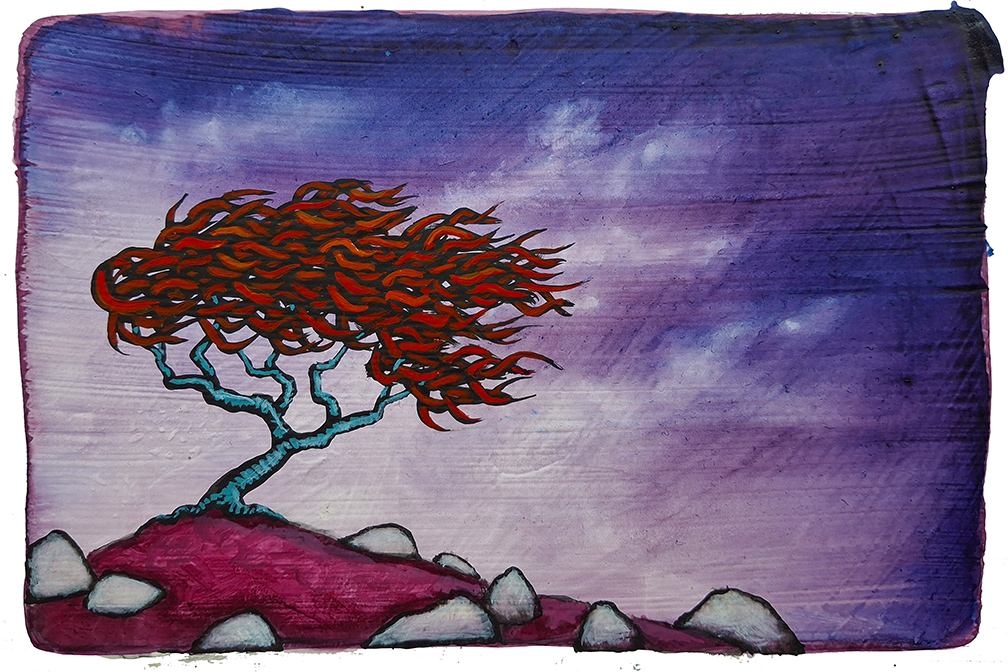
I often see the blowing Red Tree, such as the one in the new painting at the top, as a symbol of resistance. It represents those who stand tall and firm against the ill winds that sometimes beat down on us. It has a feeling of righteous strength and defiance that is willing to put itself in harm’s way because that is the right thing to do.

The only thing to do.

The painting here is titled, Speaking Truth to Power, of course. It is a small piece headed to the West End Gallery for the February Little Gems show. It may be small and simply constructed but it carries a lot of feeling in the play and tones of its colors and the arrangement of its few elements. Much like the truth, its simplicity is its strength and attraction. That’s something I am shooting for in much of my new work in the coming months. It is a painting that very much pleases a big part of me.

Let’s have a song that is about speaking truth to power. This is a rousing tune called Ya Bassa from the Scottish drum and pipe band Clanadonia. They play tunes that capture the tribal nature and rebel spirit of their Scottish ancestry.  Ya Bassa is a Glasgow derivation of the Scottish Gaelic phrase ‘Aigha Bàs’ which is a war cry that is roughly translated as ‘victory or death‘ or ‘joyous death.’

To my ear, it sounds like a Scotsman is saying ‘You bastard!‘ right before he takes a swing at me. Same energy and meaning, I guess.

Interestingly, there is a similar sounding Spanish phrase– ¡Ya basta! –that means Enough is Enough.’ This phrase has become a rallying cry for opposition forces in Latin America, Italy, and other countries.

If this tune doesn’t stir the leaves in your tree, doesn’t make you want to bring the next bully you encounter down to size, then I think you’re in the wrong place. If so, get out of here and don’t let the door hit you on the way out.

¡Ya basta!


FYI:  Speaking Truth to Power is 4″ by 6″ on paper, framed and matted at 8″ by 10″ and included in this year’s Little Gems exhibit at the West End Gallery. The exhibit opens Friday, February 6 with an Opening Reception that runs from 5-7 PM.


Isolation (1994) — Coming to West End Gallery


All art is autobiographical; the pearl is the oyster’s autobiography.

–Federico Fellini, The Atlantic (December 1965)


This morning, I am continuing the series of looking back at some of my earlier work. Most have never shown before for reasons that I often cannot remember. Sometimes it’s obvious that they just are not that good. Other times, I scratch my head now because I think they’re solid, unique pieces.

Perhaps my criteria for judging them at that time was different or maybe it has evolved and what I see now is different than what I saw then. I honestly don’t know.

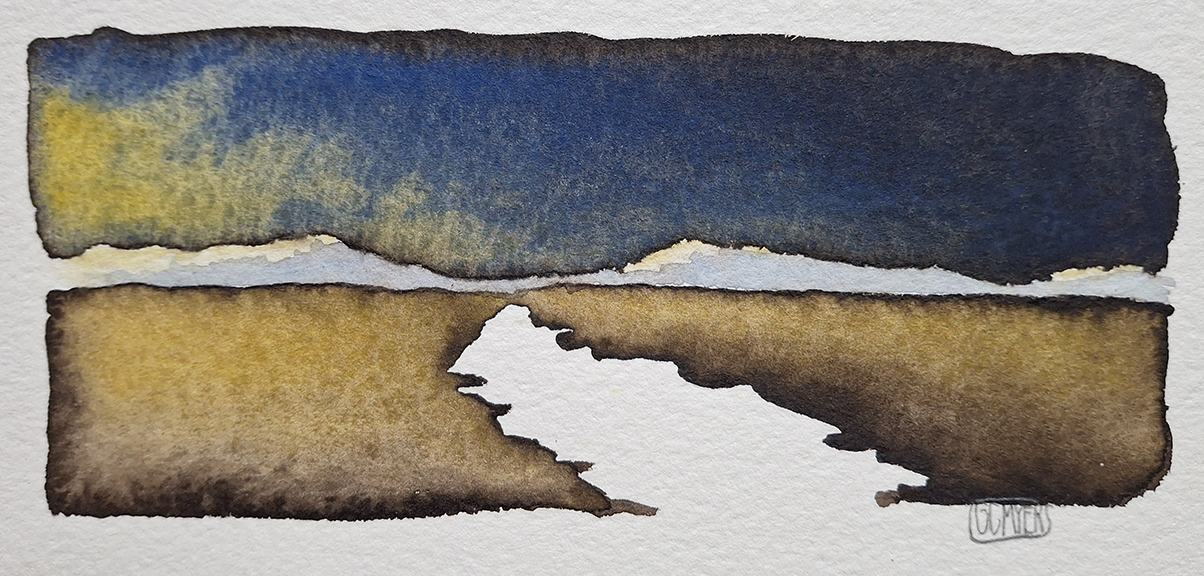
The piece above is titled Isolation and is from November of 1994. I had already experienced my Eureka! moment by that time where I recognized the direction in which my work would head. I have to laugh now when I see the signature done in pencil. It was still a few months before I would begin showing my work publicly for the first time at the West End Gallery and I was still refining the look and style of the work, even my signature.

The fact that it is signed but had never shown indicates that thought it was a coin toss at the time, that I thought it was worthy of going out on its own. Looking at it now, I think I erred in not showing it. I am not positive, but I believe that I was unsure about the cobalt blue in the sky. As a watercolor, it is a heavy, dense color that often leaves a lot of sediment on the surface, especially in the way I was using it. I was uncertain if that would be distracting or wrong. I still worried a bit then about what people might say. Now, that blue density in the sky is something I am thrilled to see, something I sometimes still to replicate and usually fall short in doing so.

The tone of the piece was like much of the work from that time in how it reflected what I was feeling back then. It was about quiet and distance. The colors all contrast off a dark base, much darker than most of my work at the time which another reason why I was unsure of it then.  I see it as a strength now. Probably the thing that attracts me most is the use of negative unpainted space in the path and in the distant hills, something I seldom employ now. The hills do have a thin transparent layer of paint but it still is much like the path when contrasted with dark, density of the fields and the sky.

I think it’s a strong piece now. Maybe it was more advanced than I gave it credit for at the time and  I needed to grow into it? Maybe.

Whatever the case, it definitely feels like a piece of me. It has an autobiographical feel. I tend to agree with the words above from Federico Fellini, that all art is autobiographical. That a certain point any person in the creative fields can look back and see their life embroidered throughout their work.

Here’s a song from an album, Lowe Country, that pays tribute to the songs of Nick Lowe. I chose it because the song, When I Write the Book, fits the autobiographical theme in more than one way. The song itself deals with the theme in a way but the album cover features one of my early paintings. It is from the pre-Red Tree era, back in 1998. The owner of the painting, an executive with Hollywood Records in California, bought the painting online from the West End Gallery around 2000. In the years after that he transitioned to Austin, Texas where he formed Fiesta Red Records in 2012. One of his first productions that year was the album featuring Americana artists performing Nick Lowe songs. The painting was favorite of his and became the album cover.

I didn’t find out until a while later when the son of the owner of Kada Gallery in Erie came across the album while living in California. He immediately recognized my work and called his mom who called me. Though they didn’t acquire permission initially, Fiesta Red had credited me on the album and we quickly worked things out to my satisfaction.

This version of Lowe’s song is from the Unsinkable Boxer, which is a collection of several of the artists from the album. The song and the album cover always make me happy now. The cover for the vinyl version looks great.

Feels a bit like a pearl of mine.


FYI: The small painting shown at the top, Isolation, is going to be included in this year’s Little Gems exhibit at the West End Gallery, that opens Friday, February 6.


Sun Lullaby— At West End Gallery


I am restless. I am athirst for faraway things.

My soul goes out in a longing to touch the skirt of the dim distance.

O Great Beyond, O the keen call of thy flute!

I forget, I ever forget, that I have no wings to fly, that I am bound in this spot evermore.

–Rabindranath Tagore, The Gardener (1915)


Sunday morning. I am going to keep it simple. Just and image, a few words, and a song. To be honest, I am not sure that I see any of this triad having any connection with one another. I probably could make a case that they do if I wanted to spend enough time weaving a story out of cowpies and hot air. 

I am too tired to do that this morning. I am sure that I will be weaving new stories soon enough. I have more than enough cowpies and hot air to share.

I do have to make one observation. Writing that last bit, I noticed that cowpie is such a nicer sounding word than bullshit. Cowpie sounds like something you might buy at an Amish farmstand.

“I tried some of that cowpie and it is yummy!”

Sounds like something you can’t get enough of. You wouldn’t say that with bullshit. With bullshit, you’ve always had your fill and don’t want any more. 

Sorry for pointing that out this morning. You probably didn’t need to hear that.

Moving on. If you made it this far, you’ve seen the image of my painting and read the passage from Tagore. Without further ado, here is this week’s Sunday Morning Music. It’s a lovely duet from Irish singers Lisa Hannigan and Loah, who teamed up for a performance of Hannigan’s song, Undertow, that is an absolute favorite of mine. This their version of the Bob Dylan classic, Girl from the North Country, performed at the stately residence of the US Ambassador to Ireland in 2021. as part of a celebration of Dylan’s music on his 80th birthday.

It is delicate and lushly harmonious, just the ticket for a cold, dark Sunday Morning. Makes me feel bad for bringing up cowpies…


Overseer— At West End Gallery in February


Time will say nothing but I told you so,
Time only knows the price we have to pay;
If I could tell you I would let you know.

If we should weep when clowns put on their show,
If we should stumble when musicians play,
Time will say nothing but I told you so.

-W.H. Auden, If I Could Tell You (1940)


Just a day or two more of painting before I begin prepping my work for this year’s Little Gems show at the West End Gallery. This group represents the first real effort I’ve put forth since my diagnosis in the fall. It felt good to get back into the mindspace I occupy when painting, though it took a while longer than I hoped to get there. But at least I remembered how to get there and finally made it in.

Mission accomplished.

I am kind of sad about having to leave that mindspace, even for a short time, in order to prep this work. Once you’re in that space, you don’t want to risk not being able to get back to it again.

Feels kind of like Dorothy getting whisked away to Oz, not sure she’ll ever make it back to Kansas. Don’t know if that is a good analogy. Wouldn’t you prefer the vivid color and beauty of Oz to the stark, monochromatic landscape of the Kansas depicted in the film?

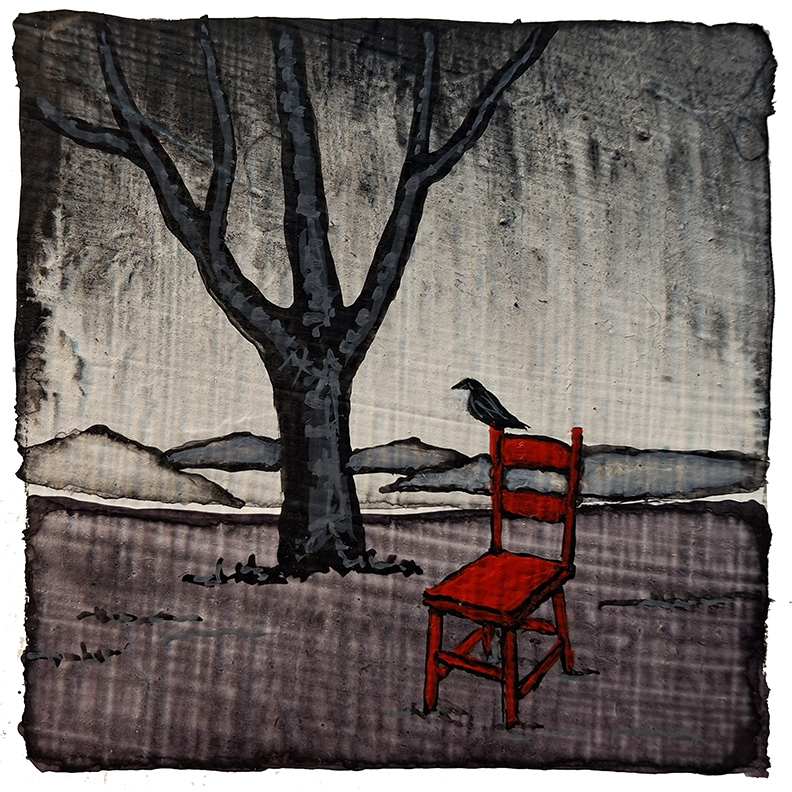
I don’t know about that. There are days when I am happy with either. That’s apparent in the group of new small work for this show. It’s a mix of both colorful work and work done in tones of gray and black, like the tiny piece shown at the top, Overseer.

There’s something in this little gem’s feel and tone that reminded me of a poem from W.H. Auden, If I Could Tell You. I came across a fine video with a reading of it by Tom O’Bedlam, whose readings I have featured here a number of times in the past.

Take a look if you are so inclined. I would stay but I have to get going or that ballon heading back to Kansas will leave without me. Or is it going to Oz this time?

Who knows? Not me, that’s for damn sure.


The annual Little Gems exhibit at the West End Gallery in Corning, NY opens Friday, February 6, with an Opening Reception that runs from 5-7 PM.


Faces From the Wood– 2019


The first point he wishes to make is that in order to be a scientist, an artist, a doctor, a lawyer, or what-have-you, one has first to be a human being.”

–W.H. Auden, in Introduction to The Star Thrower by Loren Eisley


One must think like a hero to behave like a merely decent human being.

–May Sarton, Journal of a Solitude (1973)


As one studies these preconditions, one becomes saddened by the ease with which human potentiality can be destroyed or repressed, so that a fully-human person can seem like a miracle, so improbable a happening as to be awe-inspiring. And simultaneously one is heartened by the fact that self-actualizing persons do in fact exist, that they are therefore possible, that the gauntlet of dangers can be run, that the finish line can be crossed.

–Abraham Maslow, Motivation and Personality (1954)


The way I see it now, we are all people. We’re all out there, eating and drinking and sleeping and working and procreating and doing all kinds of things that people do– and probably a lot of things we shouldn’t be doing. Most of it is done by habit and without much thought.

We are people, after all.

But then there are also human beings. Still people. But the title of human being denotes something beyond the flesh and blood biology we all share.

It comes in the form of the connection we display for all others– both human beings and people.

In the concern and compassion we hold for people other than ourselves.

In the understanding that we are but small parts of an immense world and universe.

In that serving and helping others is both a duty and a joy.

In knowing that love is ultimately the most powerful force in this world, much more so than hate.

I could go on and on, listing things such as caring, compassion, open-mindedness, thoughtfulness, and so on.

I think however, if I had to put it into one word, empathy might be at the top of any list of what it takes to move from people to human being. The ability and willingness to see yourself in others is at the core of what it takes to be a human being. That entails recognizing and understanding their pains and fears, in looking beyond the surface to the context of who they truly are and what has shaped their lives, so that you can allow them a space in which they can feel comfortable and safe.

Empathy might well serve as a one-word credo for Human Beings.

I have told students and wannabe artists in the past that one of the primary requisites for becoming an artist is to be a complete person, a Human Being. To develop an understanding and care for the world.

I don’t know that I am qualified to say who is and is not a Human Being. I would like to think I am a Human Being but maybe I am just one of the deluded people. I’ve witnessed too many people in that category in recent years, people who have little empathy or care for the hurt or misfortune of others. People who think that life is just a matter of grabbing and grabbing more even if it comes at the expense of others. Even if it comes from lying, cheating, and stealing.

The I-got-mine-and-don’t-give-a-damn-what-happens-to-you-or-anyone-else crowd.

It’s hard for me to see these people as human beings. That is a truly awful sentence and maybe I am wrong in even thinking it, let alone writing it down. Don’t get me wrong, I see them as people and want no harm to befall them. In most cases, I even wish them well so long their success doesn’t include harming, hindering, or excluding others.

I just think they have squandered or, at least, neglected their inborn potential as human beings.

And that is a shameful loss for the world because it needs all the Human Beings it can get right now.

Way too many people and not nearly enough Human Beings.

Some people who see may say I am being intolerant and judgmental or divisive. Hardly the actions of a Human Being. Maybe they are right. I don’t know. However, I will say that many people who do awful, nasty, and divisive things often defend themselves against criticism by saying that those who point out the wrongs being perpetrated by them are being intolerant.

Human Beings have tolerant hearts but tolerating the intolerable is never acceptable.

Hear that, people?

Here’s a song from the late great John Prine that is right in this groove. This is Some Humans Ain’t Human.


Follow the River— At West End Gallery


By failing to read or listen to poets, society dooms itself to inferior modes of articulation, those of the politician, the salesman, or the charlatan. In other words, it forfeits its own evolutionary potential. For what distinguishes us from the rest of the animal kingdom is precisely the gift of speech. Poetry is not a form of entertainment and in a certain sense not even a form of art, but it is our anthropological, genetic goal. Our evolutionary, linguistic beacon.

–Joseph Brodsky, opening remarks as United States Poet Laureate, October 1991


I think that Joseph Brodsky, the late Soviet-exiled poet who went on to become the US Poet Laureate, is spot on with the comments above. Poetry, and all the arts, represents our highest form of articulation and connects us with the underlying rhythm, melody, and grace of the universe, drawing us closer to our highest potential. Art in its truest form serves as a unifying force, a voice of and for all people. 

I think that the embrace and expanse of the arts — or the neglect or rejection of it– can be a true barometer of a nation’s progress and potential. I think of the controlling regime in this country at this moment and I ask myself a number of questions.

What and where is its poetry?

What art, music, or literature defines and expresses the hopes of all its citizens? 

Where is its beauty, its grace? 

I haven’t found an answer to any of these thus far. That doesn’t mean there is not an answer that might shatter my whole hypothesis. But nothing jumps out to this inquiring observer. It is a regime that sees any artform expressing a desire for the unity and freedom of all people as being a hostile action.

It has no poetry. No music. No art. No literature. No theater. No dance. No humor. 

It seems to exist as a culture without culture.

And that is a society that is not healthy, one that cannot last for too long, let alone aspire to empire.

Okay, that’s all I want to say right now. There’s certainly more that could be said but that is the crux of what I needed to say this morning. 

Let’s have some music.

This song has been in my head in recent days, and I’ve been waiting for a chance to share it. It is from the great Mavis Staples‘ new album, Sad and Beautiful World. I shared the title track not too long ago. This song is Beautiful Strangers. It has a poetry, grace, strength, and courage that fits the post and this moment.