Feeds:
Posts
Comments

Snow Quiet

The Heart Warms— Now at Principle Gallery, Alexandria


This morning of the small snow I count the blessings, the leak in the faucet which makes of the sink time, the drop of the water on water.

–Charles Olson, The Maximus Poems (1960)


Came out the door of the house a little before 5 this morning and was greeted by a couple of inches of snow I hadn’t been expecting. Guess I should pay more attention to the weather reports.

The snow was lovely though. It was light and fluffy and filled with frozen, shiny ice crystals, the kind that glimmer on the surface like gems in the moonlight.

When I walked it made a crunching sound under my foot. There was no wind nor even a breeze and the trees were quiet as though they intently listening. This made me aware of the surrounding absolute quiet that allowed me to hear the crunch of my footsteps.

Listening deeper now, I could hear the sound of falling snowflakes coming to rest on the ground.

It’s such a delicate sound. Hearing these tiny soft taps has a calming, slowing effect on me, allowing me to take a more relaxed stance that makes the cold feel less biting.

I no longer feel the need to hurry through the snow to the studio. Instead, I linger for a few precious moments in the woods and absorb the blessing of the snow quiet.

For that brief instance, I feel gloriously and placidly distant from the woes and worries of the world.

And I know in a flash of realization that is just what I needed this morning– an elixir to reset and resync the inner self that had been knocked out of rhythm in recent days.

There’s some sort of magic in the snow quiet.

I may not be certain about much in this world, but I am positive about this.

Let’s have a song for the first Sunday Morning Music of the New Year. I was planning on playing a different song from one of my favorites, the Irish singer/songwriter Lisa Hannigan, but this particular song and performance is such a natural partner for the words above that that other song will have to wait for another morning. This is her song Snow. It has that snow quiet feel. Just lovely.


Uncertain Times— At the West End Gallery


Government is either organized benevolence or organized madness; its peculiar magnitude permits no shading.

–John Updike, Buchanan Dying (1974)


I had planned on sharing and writing a bit about the combination of the verse   from Edgar Lee Masters’ Spoon River Anthology and a painting that seemed somewhat relevant to it. Both seem worthy of discussion.

However, coming into the studio before 5 AM I soon found out that the US was bombing Venezuela and that Venezuelan president Nicolás Maduro had reportedly been captured and, with his wife, whisked from that country.

I am not going to go into why this egregious act of war (without a declaration of war) is so wrong in my eyes and those of most of the world.

I am going to simply say that it created a great and turbulent ball of anxiety in my gut, a potent mixture of rage and dread.

It’s the feeling you might bet if you found yourself in your kitchen and an obviously imbalanced guy bursts through the door with an open 5-gallon can of gas and a Zippo. You want to bellow at him to get the fuck out of there, but you see that the Zippo is open and his finger is twitching on the flint’s wheel.

Your rage suddenly is tempered with the realization of what could happen if this madman in your presence flicks his thumb on that Zippo.

Questions race through your mind like wildfire.

What can I do now? Will he really blow up this place? Why would he do that? 

Is this how my house is destroyed and my world ended? 

It all brings back the question that haunted me in the early morning soon after the November election of 2024 standing outside the studio watching a strange and ominous sunrise: Is this who we are now?

For the moment it certainly seems that the answer is yes, even though I don’t think that answer is final in any way.

Can we change that answer?

I don’t know. We have responded in such a tepid manner collectively as a people to the atrocities set upon us and others this past year that I have begun to doubt our willingness to engage in the fight that is needed.

I say that with a great deal of sadness. And shame.

I truly thought we were better than this.

Okay, I have had my say for the time being. I am going to lock the kitchen door here in the studio in case that son of a bitch tries to get in here with his gas can and Zippo.

Ain’t gonna happen in my kitchen, if I have anything to say about it.

Here’s song that fits the mood I am feeling this morning. I last played it back in 2009 so you might have missed that post. It’s the classic murder ballad Dehlia from David Bromberg. I first encountered when I won 25 albums from a local radio station in 1972. They were all promotional albums sent to the station by record companies and almost all never saw a single track make it on air. Some were not good but there were a lot of gems in that group including David Bromberg’s self-titled first album. It has been a favorite of mine since 1972. His version of this song is special. Its refrain seems to fit this morning:

she’s all I got is gone


The Sky Is Always the Sky— September1995


Form is emptiness, emptiness is form.

–The Heart Sutra, Ancient Buddhist text


I finally started painting again this past week. I had been on a hiatus brought on by the distraction and uncertainty of dealing with my cancer. I just didn’t have the focus to work. At least effectively work. However, the treatment has gone well and has fallen into a predictable pattern that allows me to begin to focus on something other than the illness and what I can do to minimize its effects. That included getting back to focusing on new work.

So, as 2025 dwindled mercifully down, I finally picked up a brush again. It wasn’t easy. Any kind of break throws off my rhythm and flow. I think it has to do with how I paint. My process is constantly shifting and evolving. It never remains static. That’s one its attractions for me. But it is also daunting after a break since much of what was in my mind when I last worked– color combinations and even how I was applying the paint– has completely fled my mind.

The first weeks are a sort of refresher course. Kind of awkward and out of rhythm. I work small at first which is perfect since I am producing some new pieces for the annual Little Gems show at the West End Gallery in February. I also tend to begin with the transparent watercolor-like process with inks that marked my early work, often beginning with pieces that are rendered in shades of grays and black. Allows me to work with form. Color comes on in its own way later, the form dictating the colors for me.

It’s at this point that I often revisit my boxes of old work here in the studio, looking for something that will spark something– anything– that I can run with. There is a large assortment of small and tiny work from the first year or two years when I began painting after my accident. Most are from 1994 and 1995. 

So, at 5 AM this morning I am on my knees going through a box of old work. Some of it not good, maybe even awful, and should be destroyed. I never do that though, feeling that I learned something in doing it and it thus deserved to be spared the trash heap. And some of it jumps out at me, sometimes with an appreciation I didn’t have for it when it was painted. I almost always find something in these boxes that spurs me in a direction or form that I had veered from long ago. 

While I was going down memory lane this morning before the sun had even opened its eyes on this part of the world, a thought came to me. Why not feature an early piece of mine each week here on the blog? I’ll call it A Look Back and show and discuss those pieces that hold meaning for me as well as those that frustrated me then and now. 

I think I’ll do just that. The first in this series is actually a blog post from four years back about the early piece, The Sky is Always the Sky. It’s a small painting that was very representative of my early work, several years before the Red Tree made its first appearance. It has those qualities of quietness and empty open space that marked my early work. This early always makes me wish to make my work even simpler and sparer in form. The post below speaks of that.


[From 2021]

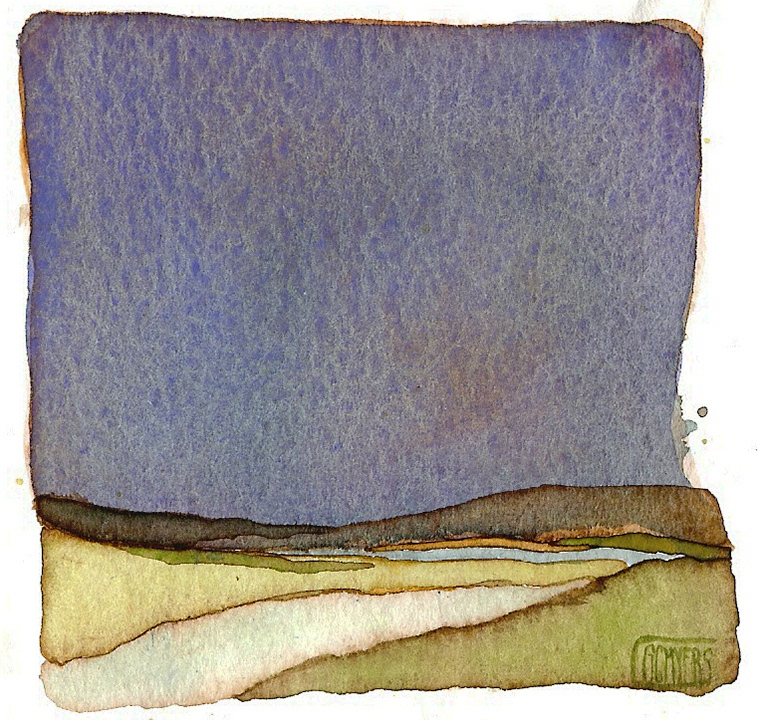
I’ve been looking at some early pieces lately, trying to differentiate in my mind how the work has changed over the years. I always come back to pieces like the one at the top, The Sky Is Always the Sky from back in September of 1995.

These early pieces focus on the emptiness of open spaces. I use the term emptiness because it seems to be devoid of all matter, save the space between the earth and sky. But I think a better term might be the Buddhist term sunyata which the Encyclopedia Brittanica defines as:

…the voidness that constitutes ultimate reality; sunyata is seen not as a negation of existence but rather as the undifferentiation out of which all apparent entities, distinctions, and dualities arise.

That infers that nothing — including human existence — has ultimate form or substance, which means that nothing is permanent and nothing is totally independent of everything else. Put in simple terms, everything in this world is interconnected and constantly changing, in a state of flux. To fully accept this concept of emptiness thereby saves us from the suffering caused by our egos, our earthly attachments, and our resistance and reaction to change and loss.

I think it was something close to this concept of sunyata that inspired early pieces like the one at the top even though I wasn’t aware to that term at the time. I do know that I felt there was more to the emptiness of vast space than met the eye, that there was meaning in the void.

As the Heart Sutra, the best known of the ancient Buddhist texts, states: Form is emptiness, emptiness is form.

Without knowing it at the time, I think this concept provided the strength in these early pieces. Their emptiness gave them form.

The reason I write about this today– and I have most likely wrote about this before as my memory is not what it once was– is that I was comparing work from back then and now and it has changed. Looking at this early work makes me realize that I was often more confident then than now. I wasn’t afraid to show emptiness with the thought that others would be able to see it as I did.

I don’t feel that I have that same confidence now.

And I wonder why this it is like this. It’s 26 years later [over 30 years here in 2026!] and I have made a career out of my work. Shouldn’t I be even more confident, more assured in my message and how it will be perceived?

I don’t know that there’s an answer. Not sure I want or deserve one.

Things change. That is the natural course for all things. To fight against this change is an attempt to fill the emptiness.

And that can’t be done.

I may be talking through my hat here. I am trying to think out loud about concepts that are far beyond my meager mental skillset. But maybe just wrestling with this idea for a while will spark something that will show itself in some new form that I can explore.

Maybe a new form of emptiness…

A New Year’s Wish

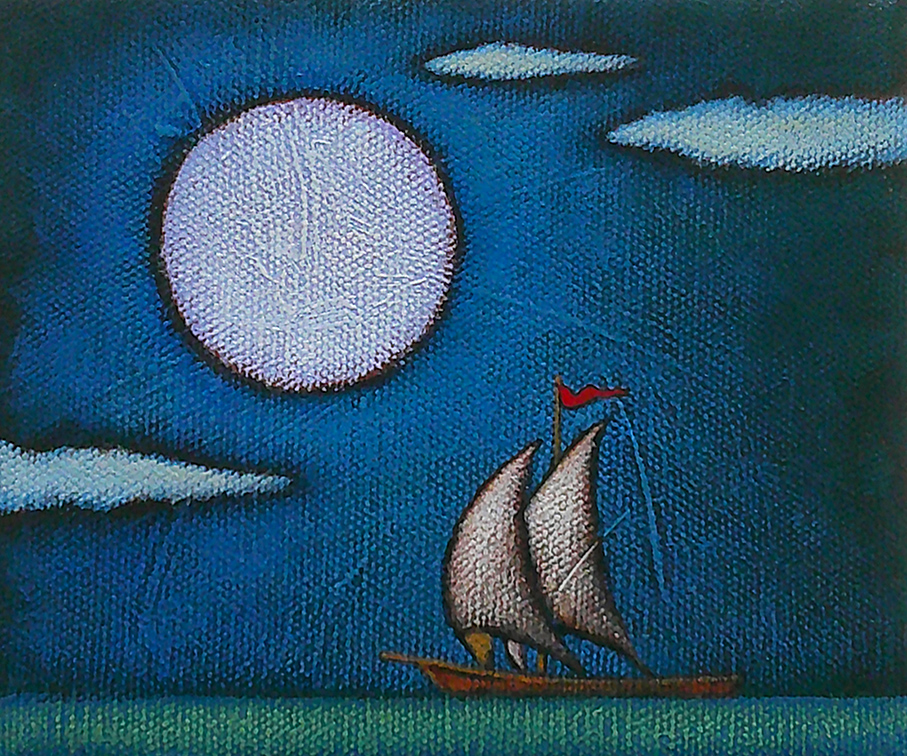
The Blue Moon Calls– At West End Gallery


I allow myself to hope that the world will emerge from its present troubles, that it will one day learn to give the direction of its affairs, not to cruel swindlers and scoundrels, but to men possessed of wisdom and courage. I see before me a shining vision: a world where none are hungry, where few are ill, where work is pleasant and not excessive, where kindly feeling is common, and where minds released from fear create delight for eye, ear and heart. Do not say this is impossible. It is not impossible. I do not say it can be done tomorrow, but l do say that it could be done within a thousand years, if only men would bend their minds to the achievement of the kind of happiness that should be distinctive of man.

— Bertrand Russell, Human Society in Ethics and Politics (1954)


a shining vision: a world where none are hungry, where few are ill, where work is pleasant and not excessive, where kindly feeling is common, and where minds released from fear create delight for eye, ear and heart…

That is my New Year’s wish. It may seem a naive request, especially given where we are as a country and species at this given moment. It might seem an impossible task but, as Russell states, it is not.

It may take much time to achieve, spanning many generations and even centuries. Maybe many centuries or even a thousand years as Russell wrote.

Unfortunately, we have become such creatures of instant gratification that anything that requires effort and time is viewed as impossible and not worth even the effort required to start since many of us will not live to see it through to completion nor reap its rewards.

That is, of course, a short-sighted view, one that discounts the incremental improvements in our world that might come as we progress along the long path towards the desired goals. There have been times in my lifetime when I have thought we were beginning to make real inroads toward this goal, that it well be possible in the near future.

But the cruel swindlers and scoundrels that Russell recognized over 70 years ago were never fully vanquished and, realizing that if the goal were to be achieved their ability to operate corruptly would be eliminated, plotted and worked feverishly to destroy any signs of progress. They knew that we are an impatient people, easily swayed by fears and the shine of empty promises.  They knew many would likely quickly throw up their hands in submission and our journey forward would stall and possibly fail.

That seems to be where we are today, at least as I see it. One man’s opinion.

But I hold fast to that goal as Russell described above as my New Year’s wish on this first day of 2026. We may not achieve it soon. Most likely will not in my lifetime. But let us be satisfied with being known as the people that had the resolve and willpower to put us back on that path of progress toward that goal.

Let us hope that history and future generations are able to view our efforts in this time not with scorn and revulsion but with kindness and gratitude.

Happy New Year.

As an example of what might be achieved with minds released from fear– Russell’s delight for eye, ear and heart– here is the late and legendary Flamenco guitarist Paco de Lucia with his Entre dos aguas from 1976. Interestingly, this song began as a recorded improvisation to fill out his first album. The album bombed badly and was pulled from circulation. But soon after this song took hold and the album was rediscovered, becoming the basis for a remarkable career.

His playing here seems impossible to most guitarists, but it has been done.

A lesson in there somewhere.


Like Every Other Night?


New Year’s eve is like every other night; there is no pause in the march of the universe, no breathless moment of silence among created things that the passage of another twelve months may be noted; and yet no man has quite the same thoughts this evening that come with the coming of darkness on other nights.

-Hamilton Wright Mabie, My Study Fire (1890)


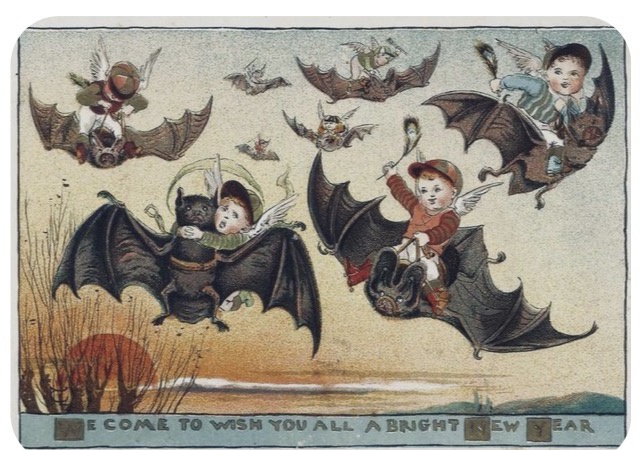
Toddlers flying at us on the back of bats on New Year’s Eve. I was going to say to say that those Victorians were just a little off then out of the dark a whole bunch of these bat-riding babies descended on me this morning. Getting a jump on the holiday, I guess.

I had never heard of Hamilton Wright Mabie before about 5 AM this morning– right after being accosted by those nasty urchins. I came across a group of quotes and passages from his work and found myself nodding in agreement to many of them. I was intrigued. It turns out he was an American essayist, editor, critic, and lecturer. Mabie published many books, including a series of children’s books called Every Child Should Know which included titles such as Heroes Every Child Should Know and others in that vein. Most of his other books were essay most of which dealt with literature or his personal observations on nature and life.

Even so, there’s little written about this fellow who died on this very day, December 31, back in 1916 at the age of 70. It appears that that New Year’s Eve was not like every other night for him.

Several of his other quotes caught my eye:

Nothing is lost upon a man who is bent upon growth; nothing wasted on one who is always preparing for – life by keeping eyes, mind and heart open to nature, men, books, experience – and what he gathers serves him at unexpected moments in unforeseen ways.

And this one which advises us to live life fully and take risks rather than sit idly by:

It is better to go down on the great seas which human hearts were made to sail than to rot at the wharves in ignoble anchorage.

There were more equally interesting passages, but it was one at the top that caught my eye. The natural world including the universe in its entirety takes no note of this particular day yet for we humans this transition from one year to the next holds a certain fascination.

Maybe it’s the memento mori aspect of it, that the change of the year moves us one calendar year closer to our ultimate demise.

Or maybe it’s the tabula rasa aspect, that the new year offers us a clean slate on which we can write our destinies.

I can’t think of any other applicable Latin phrases at the moment, so I guess I’m done with trying to figure out our fascination with the New Year.

I tend to agree with Mabie, that it is pretty much like every other night. But, of course, like everybody, I do take pause on this eve to recollect the past year, to note the changes and make an accounting of the gains and losses that took place.

To consider what I might do differently in this future year. To utter a hope or two for myself and others.

Like I said, it’s pretty much like every other night.

Except for the babies and bats.

Here’s song that has nothing to do with New Years on its face. But maybe it does. This is What a Difference a Day Makes from the great Dinah Washington.

Have a good New Year’s Eve. Just keep an eye out for bats, especially if there’s a menacing baby bat-jockey on board. Believe me, I know. One got tangled up in my hair and I think I might have to get a rabies shot.

It’s the same every New Year with these little punks and their pet bats. Damn this day.


Seeking Certitude

Moonrider— At West End Gallery


Objective evidence and certitude are doubtless very fine ideals to play with, but where on this moonlit and dream-visited planet are they found?

–William James, The Will to Believe (1897)


William James’ question above is, of course, about religious belief but reading through my own lens, I can extend it to our search for the elusive answer to that eternal question: Why are we here?

It’s a question that has no doubt been raised since our time began on this planet and our brains evolved to the point where they could ponder things beyond thinking about obtaining shelter and food. Most likely there came a day when Og felt that his family could be sufficiently fed and kept warm and that he was finally safe from the saber-toothed possum that had been terrorizing them for so long. I am sure one evening, standing by the fire. Og looked up at the stars and began to ask questions.

Why am I here? How did I get here? What does it all mean?

We still don’t know the answers to those questions though we have been on an unceasing search through the eons of time.

And maybe that is the point.

The search for answers, a meaning, and an understanding of our existence or purpose might be the answer in itself. That need to know more, to get closer to some form of certainty, might well be a primal urge within us, a driving force that is on equal footing with others, such as the need to procreate.

Without it, we might wither away as a species.

Psychoanalyst Carl Jung said just this in his 1967 book Alchemical Studies:

The serious problems in life are never fully solved. If ever they should appear to be so, it is a sure sign that something has been lost. The meaning and purpose of a problem seem to lie not in its solution but in our working at it incessantly. This alone preserves us from stultification and putrefaction.

Stultification and putrefaction. 

If you don’t want to get out the thesaurus or google the meaning, that means becoming stagnant, losing interest, and rotting.

Most of us know some folks that have went that way. People who have lost all interest in life and seem just erode as they wait for it all to end. They no longer have the energy to ask questions or seek answers.

Some think that they have found answer in their acceptance of the inertia they are experiencing. However, it is a concession or surrender, not an answer.

Perhaps the best gauge of our vitality and will to live is in our need to keeps asking questions?

I sure hope so because I have more questions than I can put a number on and have found anything that vaguely resembles an answer only geometrically raises a multitude of new questions.

It is like trying to climb up an inverted pyramid.

Just like life– challenging, seemingly impossible, and filled with uncertainty.

As it should be.

So, knowing that it will be unlikely that I ever find any degree of certitude, I will keep asking questions, seeking answers that I know will never come to me.

In the meantime, don’t ask me any questions for which think you need absolute answers. I only have questions and any answers that I might have are filled with uncertainty.

In that vein, here’s an old favorite of mine from Howlin’ Wind, the 1976 debut album from Graham Parker. Great album. This song is Don’t Ask Me Questions and has been a constant refrain in my head since that time, especially whenever I have those days where I am tired and don’t want to be bothered by questions and chit chat.

Like now. So, give a listen if you want then hit the bricks.


This Feeling

Land of Plenty– At West End Gallery


Negativism to the pain and ferocity of life is negativism to life.

We are not there until we can say “yea” to it all.

To take a righteous attitude toward anything is to denigrate it.

Awe is what moves us forward.

As you proceed through life, following your own path, birds will shit on you.

Don’t bother to brush it off.

Having a comedic view of your situation gives you spiritual distance. Having a sense of humor saves. 

— Joseph Campbell, A Joseph Campbell Companion: Reflections on the Art of Living (1991)


I thought about yesterday’s post for a long time after it went online and it kind of bothered me.  Even though it was not meant to be negative or woe-is-me, it still felt that way to me.

I felt that in it I was painting this past year with too dark a color, one that didn’t reflect the fact that even though it was a challenging year there were also joyful and illuminating moments that provided invaluable lessons.

Joseph Campbell expressed just this sentiment on the page before the one with the passage at the top in his Reflections on the Art of Living:

“Opportunities to find deeper powers within ourselves come when life seems most challenging.”

I know that this is the truth. Nearly every lesson that has ultimately benefited, directed, and shaped me thus far in this life has come as a result of some the most challenging moments in my life. I wouldn’t erase those moments of pain or suffering for fear that I would lose those lessons. The insight and experience I gained was worth far more to me than sparing myself the pain that it took to acquire these things. 

This year, though I call it awful, has provided me the opportunity to rediscover a belief in the goodness and kindness of people that had all but disappeared in recent years. It taught me to unconditionally accept kindness and love that was offered to me. It allowed me to understand that our burdens do not have to be shouldered alone, that there are more folks willing and wanting to take on some of the load.

It reinforced to me the point that our time here in this world is limited, maybe much more so than we would like to believe at any given moment. This limited time should not be spent not on grievance and complaint. It should be spent on appreciating and spreading whatever joy we can find in it.

There’s more, of course. But you get the gist. This past year has been challenging but those lessons alone have made it worthwhile.

I may occasionally curse the year 2025 but deep down I am thankful for it. It has been, as Campbell says, just some bird shit along the way.

Believe me, I know the feeling. While I was walking in the local cemetery a few years back, I had a crow take a dump on me as I passed underneath him as he sat on a tree branch six or seven feet above me. He gave such a satisfied caw just after its warm excrement hit and ran down the back of my neck that I burst out laughing. I think we both had pretty good laugh.

Campbell would approve; I am sure.

So, 2025, you can do your damnedest, but I am still going to wear it proudly. You might think you showered me with crap but I will find some gold in it, guaranteed

Here’s Brittany Howard and the Alabama Shakes with This Feeling. Good stuff in every way.


Come On Up to the House

The Wanderer’s Compass— At the Principle Gallery


Well, you’re high on top of your mountain of woe
Gotta come on up to the house
Well, you know you should surrender, but you can’t let it go
You gotta come on up to the house, yeah

Gotta come on up to the house
The world is not my home I’m just a-passing through
You gotta come on up to the house

— Tom Waits, Come On Up to the House (1999)


The last Sunday of 2025. Only a few more days and we can put this cursed year behind us.

I probably shouldn’t say that it is cursed or the profanity I opted not to use in its place. Maybe you don’t see this past year in the same way. I am sure there are some people out there who will remember 2025 as a banner year, filled with memorable moments and new highs. Maybe their best year ever.

Well, good for those folks because that hasn’t been the case for me this year. 

This is not a complaint, mind you. I have no right to bitch and moan. We all have to take a beatdown now and then. Nobody is exempt.

It’s all part of life’s sometimes strange and inexplicable wheel of fortune. Sometimes the wheel stops and you’re a winner. Sometimes, it passes you by and you lose.

But you never know what the next spin might bring. 

You got to stay in the game, graciously accept your losses, and humbly accept the rare wins that might come your way.

The wheel of fortune has passed over my number several times this past year.

But, hey, I am still in the game.

I am counting that as a win. Maybe that small win allows me to get out of this ugly year on a somewhat higher note. I will humbly accept that, knowing full well that it could have been much worse and I still have some chips to play.

What more could I ask?

Here is the last Sunday Morning Music selection for 2025. It is the Tom Waits song Come On Up to the House. I am sharing two covers of the song with two distinctly different interpretations. A great song (and art in general) has room in it for different interpretations. The first is from the clown with the golden baritone, Puddles Pity Party, with a rendition that is closer in tone to the Waits original. The second, for those of you with a fear of clowns, is a more upbeat version with a singalong element from Americana singer/songwriter Sarah Jarosz, from a 2010 performance on Austin City Limits

I think both are winners. And a win is a win anytime.

Now get out of here and take that wretched year with you. It’s beginning to stink…


Satisfied

Monde Parfait— At West End Gallery


Men can only be happy when they do not assume that the object of life is happiness.

–George Orwell, Critical Essays (1946)


I pause a bit anymore when I use the word happy, especially when referring to it in the context of anything long-term, such as it being a goal to be pursued. My feeling about this is much like that described by Orwell above, that you can’t actively pursue a short-lived reaction.

And as pleasant as it might be when we are happy, happiness is generally a temporary state of being.

Maybe I am arguing semantics here this morning. Probably. Maybe the word that better describes a similar feeling that might be pursued for the long-term is satisfied.

Satisfied encompasses those higher moments of happiness we experience while at the same time recognizing that things might have been better and worse. It indicates a level of contentment with things as they are. 

For example, I am often happy. But not always and seldom on some days. On the other hand, I am satisfied as a whole with where I am in life. I accept both the highs of happiness and the lows of sadness as a fact of life and am most content when I am in that middle ground between them.

Nowadays (what a great word!) I try to find moments of happiness to temper the angst and trepidation of this sometimes-maddening modern world. These temporary moments keep me in that middle ground.

Keeps me satisfied.

And that’s nothing to sneeze at.

Actually, this babble of me thinking out loud this morning is all a pretext for me wanting to share a version of Happy, the Pharrell Williams mega-hit from a while back, from Postmodern Jukebox featuring Swedish jazz musician/multi-instrumentalist/dancer Gunhild Carling. I shared this a couple of years ago and smiled when I came across it again this morning.  

Seeing Gunhild play three trumpets at one time, tap-dance and move seamlessly from instrument to instrument– 10 in all including the bagpipes!– made me happy in a very satisfying way.

All I can ask.

Clap along if you feel that happiness is the truth….


Freudenfreude

On the Sunny Side – At the West End Gallery


This is the true joy in life: the being used for a purpose recognized by yourself as a mighty one, the being thoroughly worn out before you are thrown on the scrap heap, the being a force of nature instead of a feverish selfish little clod of ailments and grievances complaining that the world will not devote itself to making you happy.

-George Bernard Shaw, Man and Superman (1903)


I came across a word I hadn’t heard the other day.

Freudenfreude. 

It is basically the opposite of the German word Schadenfreude which, as we all know all too well, is the act of taking joy in the misfortune of others.

Freudenfreude, on the other hand, means to take genuine pleasure or joy in witnessing the success, good fortune, or happiness of others.

I loved this idea of taking joy in the joy of others. I know and have experienced this feeling. I have tried to describe it to the folks who have attended my gallery talks over the years. but don’t know that I have did a good job in doing so. My words seem so weak compared to the actual feeling that feels like a burst of joy fills the heart. A good kind of heart attack.

It reminded me of a blogpost from back in 2016 that shared one instance of the Freudenfreude that I have been privileged to experience. The original blogpost has been reworked a bit and is below, followed by a jazzy version of On the Sunny Side of the Street from Esperanza Spalding. It’s from a 2015 White House performance and it showcases her virtuosity on the double bass. Nice version with a lot of joy in it.

I hope some of you have felt some freudenfreude for yourself during this holiday season. That would make me– and you– very happy.


Joyful Contentment was the phrase that first came to mind when I finished this painting, On the Sunny Side, a few years back. There was just a feeling of realized joy and uncomplaining contentedness throughout it, the kind that Shaw described above in his play Man and Superman.

I think the feeling he describes must be one of the greatest joys in this world: to find a purpose into which you can fully throw your whole being for all of your time on this planet.

A purpose that gives you a place to stand and rise above the selfishness and pettiness of those, including yourself, who would drag you down.

A purpose that allows you to tap into some greater force in order to gain energy for your toils.

A purpose that lets you deny the cynicism that sometimes shows up in abundance in this world.

A purpose that serves you endless joy in what seem to be empty moments.

A purpose that even finds the joy in tears.

I think there is a purpose for each of us. Finding it is not always a simple matter and some of us will never find the one purpose that is truly our own. We may not be willing to give enough of ourselves to something that is beyond our own needs and desires. We might still find some joy in our life but it will no doubt be short lived.

For me, it has been painting. At first, I found this surprising because I often viewed it as being selfish in nature. It was my perspectives. My emotions. It was even called self-expression.

But I found that there is purpose in it and that this came from having others find comfort and happiness in their reactions to my expression.

Their joy fed my joy, even more than my own satisfaction and joy from the work.

But there are days when I still find myself losing sight of this purpose, when it is a struggle both in the studio and in the outer world and I feel drawn back down to less positive feelings. But I will be somehow reminded of that purpose and that joyful feeling returns.

That happened the other day. A gallery owner called and told me of a person who had bought a painting of mine that they had desired for quite a long time. In fact, this person had come into the gallery for this painting and it was gone, having been returned to me. I immediately sent the piece back to the gallery and when the person returned to get it, they started crying in joy. I can’t even express how this makes me feel outside of saying again that their joy fed my joy, their tears became my tears.

Those moments make my time alone in the studio seem more special and filled with purpose. They make me that joyous one, if only for a while.

And that is good enough for me…