Feeds:
Posts
Comments
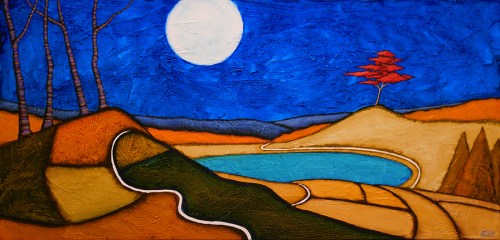
GCMyers-  Boxed In  2019

Boxed In, 2019


there is enough treachery, hatred violence absurdity in the average
human being to supply any given army on any given day

The Genius of the Crowd, Charles Bukowski


I have been watching current events closely for years and it seems like we are in a convergence of crazy at the moment. You’ve got the wife of a Supreme Court justice fomenting an insurrection, senators saying they would support overturning the law which made interracial marriage legal while spouting pure bigotry at the recent confirmation hearing for Ketanji Brown Jackson, truckers driving in circles around DC for god knows what reason, and on and on.

And that’s without even mentioning the horror show of Putin’s War.

I don’t want to go into any of that right now. It’s maddening and chaotic. Not the chaos of which I wrote yesterday, that which spawns creation.

This is an ugly sort that destroys order and creates even more chaos to fill the void.It brings to  mind the poem The Genius of the Crowd. Charles Bukowski (1920-1994) wrote this in 1966 and it speaks of the ugliness and dangers of populism.

I am not a huge Bukowski fan but this one always makes me think. In it, he warns of those who tell you how to live and behave but don’t practice what they preach. He also warns of playing down to the lowest common denominator because at that level imagination and creativity is absent. In their place, those without imagination replace it with their sole area of genius, their hatred.

Their perfect hatred.

That seems to fit this moment. The unimaginative have rallied around their hatreds, finding a twisted sort of order in the chaos it creates.

I am not going to go on further. I will just share a reading of the poem from Tom O’Bedlam and let it go at that.
GC Myers- The Garden Beyond Chaos

The Garden Beyond Chaos


“Disorder is inherent in stability. Civilized man doesn’t understand stability. He’s confused it with rigidity. Our political and economic and social leaders drool about stability constantly. It’s their favorite word, next to ‘power.’

‘Gotta stabilize the political situation in Southeast Asia, gotta stabilize oil production and consumption, gotta stabilize student opposition to the government’ and so forth.

Stabilization to them means order, uniformity, control. And that’s a half-witted and potentially genocidal misconception. No matter how thoroughly they control a system, disorder invariably leaks into it. Then the managers panic, rush to plug the leak and endeavor to tighten the controls. Therefore, totalitarianism grows in viciousness and scope. And the blind pity is, rigidity isn’t the same as stability at all.

True stability results when presumed order and presumed disorder are balanced. A truly stable system expects the unexpected, is prepared to be disrupted, waits to be transformed.”

Tom Robbins, Even Cowgirls Get the Blues


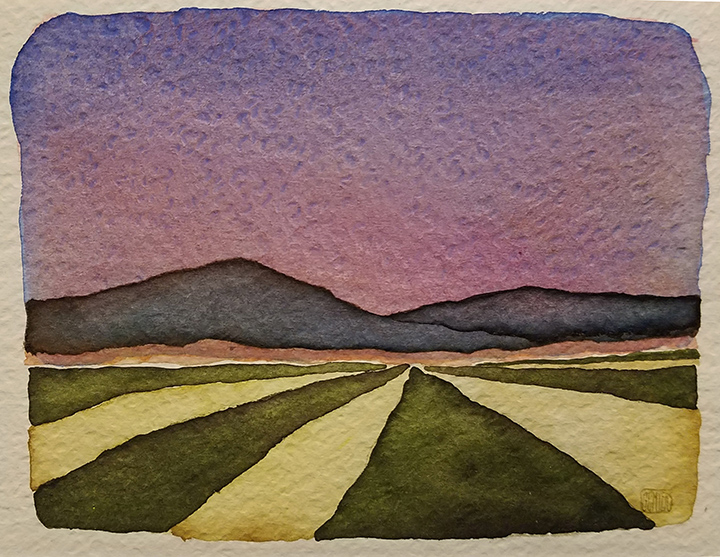
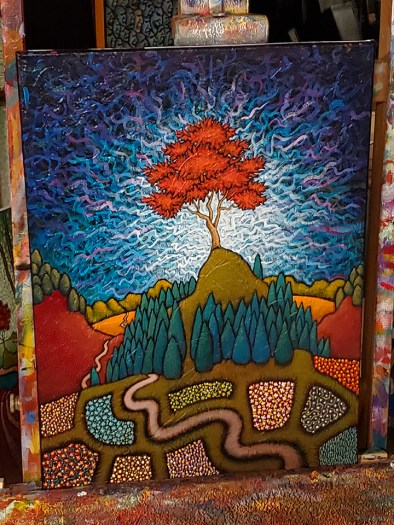
The new painting shown above is on my easel this morning, a piece that will be part of my June show at the Principle Gallery in Alexandria. It felt done at the end of yesterday’s session but this quick photo shows me a couple of small spots that need to be addressed this morning. Nothing big, nothing most folks would notice. Just a few little touches here and there.

There was a lot of energy in the painting of this piece. By that, I mean it moved quickly with little breaks in the process for me to ponder and make decisions. It felt like it was self-propelling.

That’s always a great feeling for me. Not just for the act of painting of the particular piece involved but because it usually translates to more energy in my work in the days ahead. Again, self-propelling.

Maybe the fact that this piece felt self-propelling gave me time to think about what meaning or symbolism it held for me. The paint strokes that make up the sky have a chaotic  energy that contrasts greatly with the order of the gardens of the foreground.

Chaos and order.

It’s this tension– and balance– between the two forces that make this piece work for me.

This is probably true for much of my work. And my life. And the rest of the world.

We need to have that balance of chaos and order. Chaos is the mother of creation and change in this world. Order makes sense of it, putting it in a stable, livable form.

The problems in our world and in ourselves come when we lose that balance between chaos and order and skew too far in either direction.

The excerpt above from Tom Robbins sums this up perfectly and much of what is taking place in the world serve as fine examples. An excess of chaos, either real or created, results in an overcompensation toward a more rigid form of order in the name of stability.

And as Robbins writes, rigidity isn’t the same as stability at all.

Finding that balance is the trick. We need both order and chaos. Maybe the purpose of art is to remind of this, to make us more tolerant of a little chaos and more wary of too much order.

It might just be me but I see this balance, this harmony, between the two forces, in this piece. And that’s all I can ask of it.

Liberte-Egalite-Fraternite-


Some have spoken of the “American Century.” I say that the century on which we are entering—the century which will come into being after this war—can be and must be the century of the common man.

Perhaps it will be America’s opportunity to—to support the Freedom[s] and Duties by which the common man must live. Everywhere, the common man must learn to build his own industries with his own hands in practical fashion. Everywhere, the common man must learn to increase his productivity so that he and his children can eventually pay to the world community all that they have received. No nation will have the God-given right to exploit other nations. Older nations will have the privilege to help younger nations get started on the path to industrialization, but there must be neither military nor economic imperialism.

–Vice-President Henry Wallace, May 8, 1942


The excerpt above is from a speech,  The Century of the Common Man, given by American Vice-President Henry Wallace to the International Free World Association, a diverse group of 33 nations from around the world including all the nations of Latin America. It took place in New York City in May of 1942, in the aftermath of the USA’s entry into World War II.

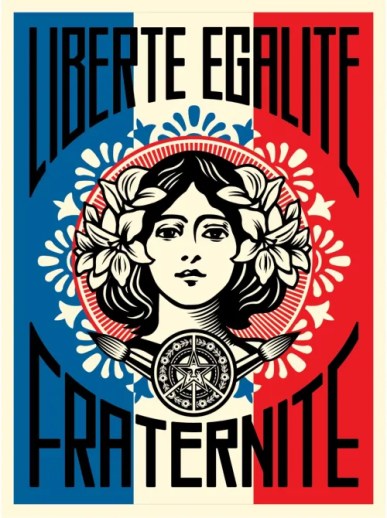
In his speech, which was widely and wildly celebrated, Wallace espoused a belief that the defeat of the invasive forces of fascism at that time would lead to a new century ahead in which the common man and woman would exist in a free world filled with the same liberté, égalité, fraternité liberty, equality, fraternitythose themes drove the  French Revolution.

Those particular forces of fascism were defeated and there are still about twenty years left in Wallace’s Century of the Common Man but I am not sure that we ever reached the heights to which he aspired. Fascism and authoritarianism have regained footholds around the world and there is less of the liberté, égalité, fraternité than we would like to believe.

But there is still time left in the Century of the Common Man and we are currently united in a struggle against fascist rulers and authoritarians.

Let’s hope Wallace was right after all.

One thing that came out of the speech was a request made by the conductor of the Cincinnati Symphony Orchestra, Eugene Goossens, to composer Aaron Copland. He asked Copland and several other composers to create fanfares to open the symphony concerts during that year, 1942, to mark our participation in the global conflict.

18 fanfares were written and performed but only Copland’s is remembered and still celebrated. It borrowed from the title and spirit of Wallace’s speech. It is his Fanfare for the Common Man.

I love this piece of music and am always moved greatly upon hearing it. Below is a sort of orchestral flash mob version from 2012 that took place in the Dublin Airport. It is performed by members of the RTÉ Concert Orchestra.

Watching it reminds me how much the world has changed in that short span of time and how little time we have to fulfill Wallace’s vision.


GC Myers- Soul Boat

Soul Boat, 2019


A sick man’s dreams are often extraordinarily distinct and vivid and extremely life-like. A scene may be composed of the most unnatural and incongruous elements, but the setting and presentation are so plausible, the details so subtle, so unexpected, so artistically in harmony with the whole picture, that the dreamer could not invent them for himself in his waking state, even if he were an artist like Pushkin or Turgenev. Such morbid dreams always make a strong impression on the dreamer’s already disturbed and excited nerves, and are remembered for a long time.

― Fyodor Dostoyevsky, Crime and Punishment


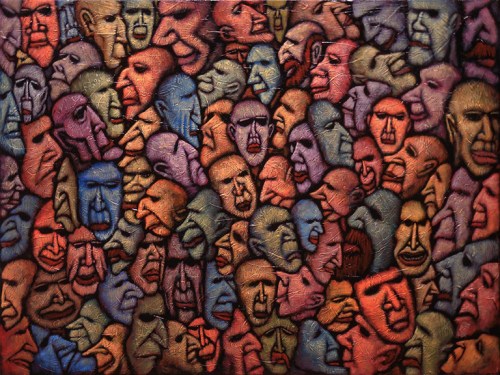
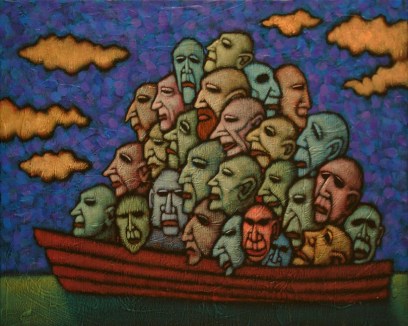
I came across the excerpt above from Crime and Punishment and it immediately sent me to the series that includes the painting above. The painting is Soul Boat from my Multitudes series from a few years back. The paintings consisted of crammed masses of black eyed –or eyeless, depending on how you see it– faces.

Many of the faces that pop up in this series have been living inside me for many years, maybe 50 or more. Reading Dostoyevsky‘s words made me wonder if they had lived on from nightmares, remnants of childhood fever dreams. I know that the other details in some of those dreams still feel as vivid as now as they did then.

Maybe that’s why these faces, as unpleasant as they often seem, have lived with me for most of my life.

It was an interesting series., one that was short lived. It emerged like a cloudburst, as though it had welled up and had to emerge. It hasn’t came back to me since that rather short period in 2019 but it’s still there.

Maybe welling up once more.

The piece at the top of this post, Soul Boat, now sits on a stand in front of my computer, never having found a home. It’s one of those paintings, like many in this series, where it truly feels fitting that it returns to me.

It has the feel of an uncomfortably personal piece, one that belongs only with me.

To be honest, for just that reason, I was surprised at how many of the pieces in this series found homes. With a few notable exceptions, the faces are not welcoming, pleasant, or sympathetic in any way. They often feel like tortured souls, perhaps representing the darker aspects that dwell in all of us.

Maybe that’s the purpose of these pieces, to serve as a reminder of those ugly parts of us that are never too far from the surface. Maybe even breaking the surface more often now.

I don’t know.

Emotionally, I like, maybe even love, these pieces and I don’t. Maybe I like them because they are part of me and, for that reason, I somewhat understand them on one hand even as I loathe them on another.

As I said, I don’t know if the series will ever continue or if it will be a prominent part of my work’s legacy, if there is one at all.

But the work haunts me enough that I felt the need to write about it today. Plus, I often find myself poring over one of these pieces, finding new details that escaped me even as I painted them. It sometimes fills me with an urge to start new ones, perhaps even larger.

But not quite yet. Perhaps there needs to be a little welling up. God knows that there is enough misery and trouble in this world to inspire such work.

Reason to Believe

992-095 Reason to Believe sm

GC Myers- Reason to Believe 2002


You never know how much you really believe anything until its truth or falsehood becomes a matter of life and death to you.

― C.S. Lewis


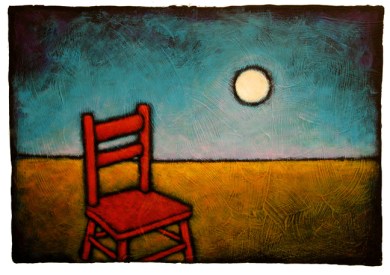
I was running through some old files and came across the image at the top. It stopped me because it reminded me of the Ukrainian flag that is front and center in recent times. The painting is from back in 2002 and is called Reason to Believe.

My own interpretation of the painting, using contemporary events, is that the sky and field represents Ukraine. The Red Chair, which normally for me represents family or memory, here symbolizes the Russian invasion. And the white sun represents the rest of the world watching from a distance.

I am sure that this is a different interpretation than the one that I held in 2002, though it was painted in the aftermath of 9/11 and all that came with it. Time of turmoil have an affect on many artists, myself included.

So, maybe the interpretations from both times are closer than I might recall. The title seems to indicate that.

We want to believe that there can be a peaceful world, one filled with sunlight and bountiful fields of grain. One where everyone is safe and without hunger.

Not want to believe. Need to believe in order to continue to get each morning and face the challenge of the new day.

And to do so we need a reminder, a reason to believe.

Maybe that is why the flag of Ukraine is such a potent and perfect symbol for the struggle that is taking place. The two fields of color represent the blue sky of peace and the yellow wheat fields of prosperity and abundance.

Reasons to believe. Reasons to live. Reasons to stand and fight.

The symbolism of that flag is simple and elegant, speaking volumes in a way that anyone can take in with a mere glance.

Given that context, my painting, simple as it is, seems superfluous and busy.

Here’s a song from Bruce Springsteen from his classic 1982 solo album, Nebraska. The title for the painting at the top came from this song, Reason to Believe. 


Acts of Kindness

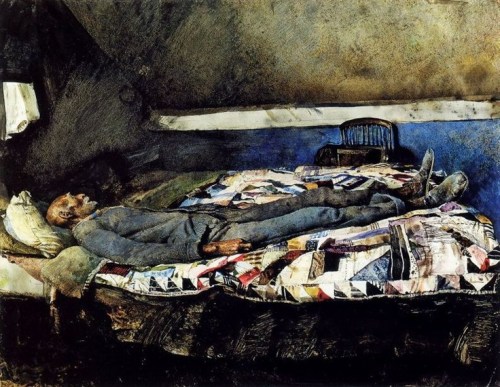
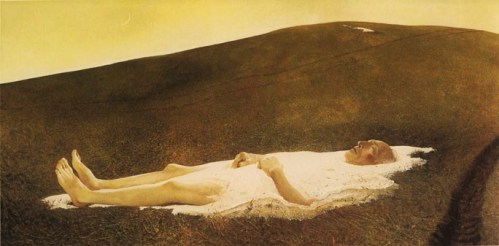
Andrew Wyeth Garret Room

Andrew Wyeth- Garret Room


Three things in human life are important: the first is to be kind; the second is to be kind; and the third is to be kind.

–Henry James


I first want to thank everyone who took part in the fundraiser for my friend Brian Pappalardo for the incredible kindness and generosity they exhibited. I know that Brian has been greatly moved by the outpouring from both friends and folks he has never met. Though I know he is both grateful and humbled, I can’t express his gratitude here.

I will, however, express, my own.

In recent years, with all that has taken place here and abroad, it has been all too easy for many of us, myself included, to fall prey to cynicism and misanthropy at the actions of humans. Cruelty, selfishness, rudeness, ignorance, and a total disregard for others appears to be the prevalent modus operandi for a lot of folks. I know that these are not new qualities, that they have always been present in our species.

They just seem to have taken center stage in recent times.

And I know that sounds cynical and misanthropic at a time when I am trying to be kind. I will tread lightly.

What I am trying to say is that it is both refreshing and gratifying to see caring human beings extending hands of help to others in need. I speak both of the recent outpouring of assistance that had been headed to the people of Ukraine on a larger scale and the help extended to Brian on a smaller scale.

Both are life affirming and hopeful.

That is a priceless thing.

And for that, to all of you have reached out to help Brian through the most difficult time in his life, I can only offer a simple “Thank You.”

Your generosity and kindness will not be forgotten.

I am running some images and from a post from about five years ago simply because I love the work of Andrew Wyeth and the accompanying video fills the bill both for showing Wyeth’s work and this week’s Sunday Morning Music.

It’s a lovely compilation of the work of Andrew Wyeth set to the gorgeous guitar of John Williams‘ version of Cavatina from British composer Stanley Myers. No relation to me. You might recognize the song from its prominent place in the film The Deer Hunter.

Please enjoy this beautiful group of paintings and the music that accompanies it below.

Again, many thanks. And if you haven’t done anything good for someone else lately, don’t waste another moment. As Marcus Aurelius stated in his Meditations:

Do not act as if you had ten thousand years to throw away. Death stands at your elbow. Be good for something while you live and it is in your power.

Enjoy your day.


“It has always seemed to me that so long as you produce your dramatic effect, accuracy of detail matters little. I have never striven for it and I have made some bad mistakes in consequence. What matter if I hold my readers?”

― Arthur Conan Doyle


Who would have thought that the creator of Sherlock Holmes would have some good advice to offer to artists?

The words above from Sir Arthur Conan Doyle about how he he would sacrifice accuracy of detail in order to gain greater dramatic effect in his work are very enlightening.

And reassuring.

I have been going through a lot of older work from over twenty plus years back when I was still in a formative stage with my painting. I hadn’t read these words from Doyle but one of the first conscious decisions I made about my work was that I would not be a slave to detail, that I would slash away as much detail as possible while still conveying a sense of what was being represented. Oh, I would use smaller details when they served the greater effect of the painting but the fewer the better.

One example from this early work is the piece at the top that is from around 1997. I was surprised when I came across this small painting in a file folder that I hadn’t examined in many years. It was a solid example of the work I was doing at the time, mainly in watercolor with the beginnings of my relationship with the acrylic artist inks that have long been a staple of my work.

It is sparsely detailed with little consideration to trying to replicate natural color. It just allows the colors and the shapes do what they will in communicating a sense of place and feeling. It works pretty well for what I want from it.

Over the years, I sometimes have strayed from this credo of sparseness but I always find my way back to it. There just seems to be more space for the expansion of feeling when details are cut away. It’s a good thing to keep in mind.

So, thanks for the reminder, Mr. Doyle. I can use all the help I can get.


I am busy this morning so I am replaying the post above from a few years back.

I have never been a slave to detail or absolute accuracy in my work. Or, for that matter, in most other things. I am reminded of this when I sometimes finish a painting and notice that there are shadows cast by some of the objects in the painting while there are none cast by others. It seldom bothers me except in those times when the absence creates a distraction within the composition that keeps me from focusing on the overall impact of the piece. And that’s pretty rare.

How the piece comes across as a whole is far more important to me than a misplaced or absent shadow or an error here and there in perspective or any of a thousand other small flaws and mistakes that you can find in my work. If anything, they are part and parcel of it, a defining aspect of the work.

To paraphrase Mr. Doyle: What matter if I hold my viewer?

Show Dates 2022

GC Myers- Clear Voice

Clear Voice— Now at Kada Gallery, Erie, PA


I announced the date of my annual show at the Principle Gallery the other day. I thought I should also give the dates for my other shows as well, since they are set and on my schedule. It includes, of course, my annual July show at the West End Gallery plus a highly anticipated return to the Kada Gallery after a two-year interval due to the pandemic and a change in gallery ownership.

As I mentioned the other day, we hope to resume some sort of Gallery Talk at each of the galleries but are not scheduling them at this time like we would normally. We will wait to see how the situation with the next variant of the coronavirus plays out before making any decisions on dates or format.

This year’s schedule goes like this:

  • Principle Gallery      Alexandria, VA  –  Opening Friday, June 3, 2022
  • West End Gallery     Corning, NY –  Opening Friday, July 22, 2022
  • Kada Gallery            Erie, PA-  Opening Friday, November 11, 2022

Of course, there will be previews of the new work in the coming months so I hope you’ll follow along and hopefully make it to one of the shows.


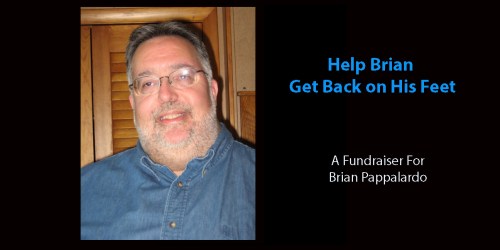
Please take a moment to visit the link below ( click on the image) for a fundraiser for a good friend of mine, Brian Pappalardo, who has been hospitalized for the past ten months. He has been waging a battle against severe illness on one front and against the financial strains of the costs of healthcare and disability on another. He’s a good and humble guy with a long road to recovery still ahead of him. He could use any help you can muster. Thanks!


Brian Pappalardo 2

The Galway Girl

Norah McGuinness River to the Sea

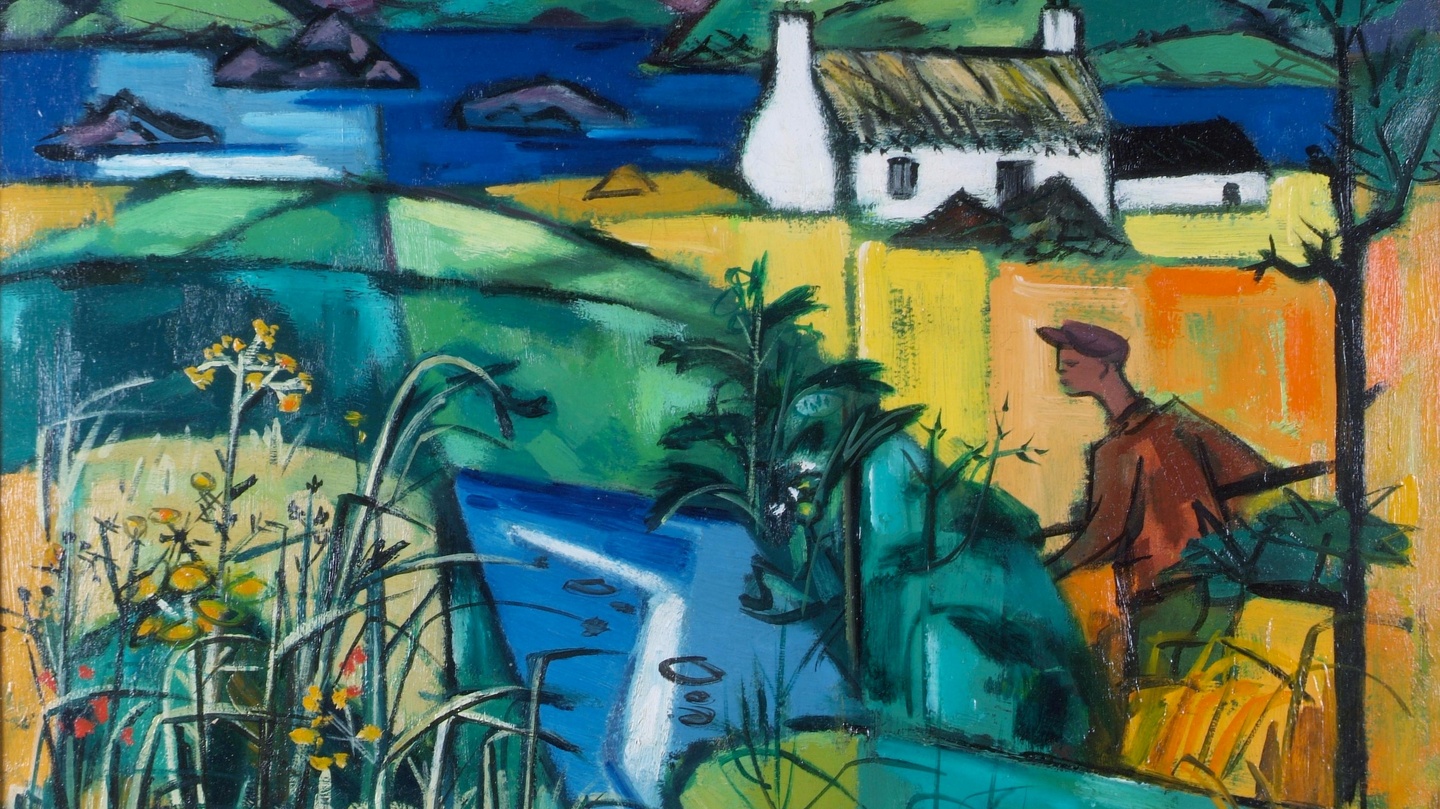
Norah McGuinness (Irish, 1901-1980)– River to the Sea, 1959


St. Patrick’s Day 2022. 

My thoughts on this holiday always go to my mom whose birthday fell on this date. She would have been 90 today. I grew up thinking we had Irish blood through my mom’s family. Many of them had an Irish sounding name, after all. Found out through genealogy that it was not Irish at all.

Actually, they were English. Very English.

Turns out that the Irish part of our family came through my dad’s side. Took many years to find much on it but with DNA testing and the greater access to records via the web, I found that these ancestors came out of Tipperary in Ireland around 1850 as a whole family unit, first settling in Rhode Island. Both parents died within months after landing here and their children, many of adult age, dispersed across the country in the expansion that took place in the second half of the 19th century.

The typical American story.

For this St. Paddy’s Day, I thought I would share a piece of art above from a well known Irish artist and illustrator of the 20th century, Norah McGuinness. I really liked– and felt a kinship with– her use of color and forms in this piece. She worked in a visual language that I can understand.

Also, let’s hear an Irish song. Well, it’s an Irish song written by an American that has become a very popular song in the Irish culture. It’s The Galway Girl from Steve Earle. The version below is from the Irish musician Mundy who had a hit with this song in Ireland in 2008 that topped the charts for several weeks. I think you can hear why it caught on so well.

Have an enthusiastic St. Paddy’s Day.


Before going, I would like to pass on a link to a GoFundMe fundraiser that we set up for a friend of mine, Brian Pappalardo. I am not going to get into the whole story here right now but Brian went into the hospital back in the first days of June, 2021 and has been hospitalized since that time. He will soon be into his 11th month in a hospital setting. Outside of being in ambulances, he has only been outside once in that time.

He was intubated and on a respirator for the better part of three months, much of that time semi-conscious. He was left unable to move his head, arms, hands, and legs and could barely speak because of the tracheotomy tube in his throat. He has been going through extensive therapy after finally landing at the excellent Cayuga Medical Center, after a tour of several other hospitals and a nightmare stay in a notorious nursing facility that will remain unnamed. He has regained most of the use of his arms and hands and can walk short distances with a walker but will be wheelchair bound for at least the near future. Maybe longer.

His insurance coverage is nearly exhausted and he is facing mounting expenses plus the possibility of being discharged to fend for himself. He will be dependent on disability payments and without his mother, with whom he lived and cared for, since she passed away a couple of months ago.

For those of you who know Brian, who was formerly an editor at the Elmira Star-Gazette and a freelance journalist after downsizing, you know that he is a kind, humble and self-effacing person. The kind of person who would do what they could to help someone else in need and who would never think to ask for help for himself.

Since he won’t ask, I will.

Brian needs help now while he faces mountains of physical and financial challenges for the coming months, if not years. Please check out the fundraiser link below and help if you can or share it with your friends.

Help Brian get back on his feet, literally and figuratively.

Thanks so much.

https://www.gofundme.com/f/5agn9-help-brian-get-back-on-his-feet

https://gofund.me/a25b2096


<div class="gfm-embed" data-url="https://www.gofundme.com/f/5agn9-help-brian-get-back-on-his-feet/widget/medium/"></div><script defer src="https://www.gofundme.com/static/js/embed.js"></script>

Depths and Light

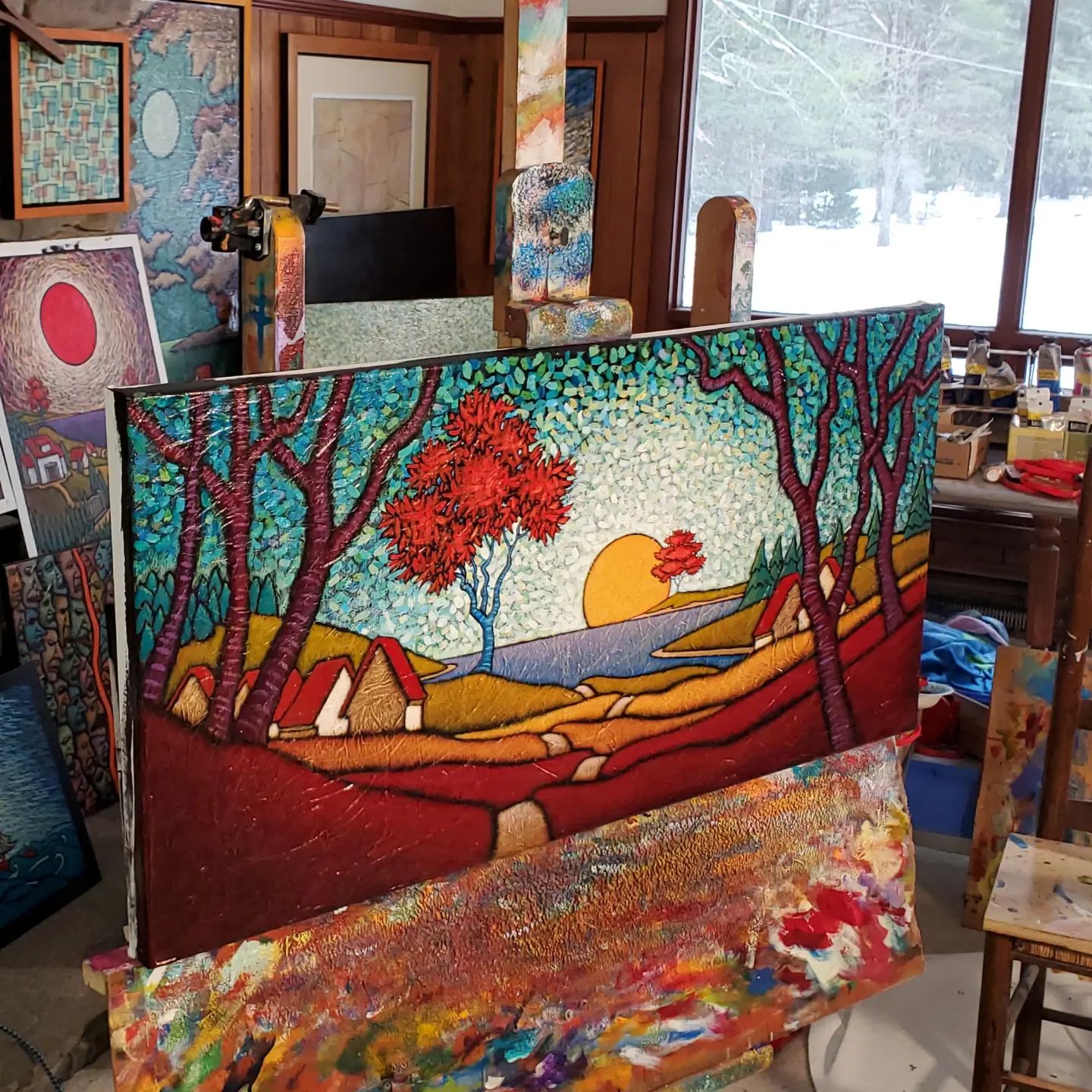
GC Myers- work on easel March 2022

Studio with new work on easel , March 2022


Say not, “I have found the truth,” but rather, “I have found a truth.”
Say not, “I have found the path of the soul.” Say rather, “I have met the soul walking upon my path.”
For the soul walks upon all paths.
The soul walks not upon a line, neither does it grow like a reed.
The soul unfolds itself, like a lotus of countless petals.

― Kahlil Gibran, The Prophet


Busy this morning but wanted to share info for this year’s annual solo show at the Principle Gallery in Alexandria, VA. This year will mark my 23rd solo show there. The exhibit opens on Friday, June 3, and is titled Depths and Light.

I am tentatively planning on being in attendance at the opening reception on June 3. We are still hoping for a gallery talk or similar event at the gallery later in the year. The last one there was in September of 2019. It would be good to talk with folks again.

Or maybe not, as I am way out of practice. Talking to Hobie, my studio cat, or the feral cats in my garage is not quite the same thing.

To sum up: Principle Gallery, Alexandria, June 3.