Feeds:
Posts
Comments
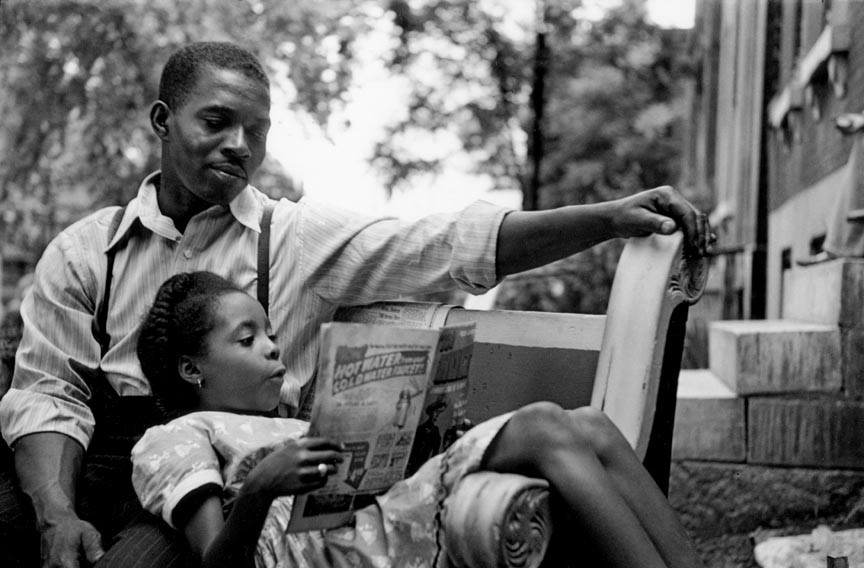
Gordon Parks Father Daughter St. Louis 1950

Gordon Parks- Father /Daughter, St. Louis, 1950


One of my favorite parts of writing this blog is the stream of consciousness part of it where I encounter something new. That part where I begin to research and one thing leads to another and another, wild tangent  to wild tangent. The result is that I end up learning of someone of whom I was previously unaware or some new concept or fact.

It often starts innocently. For example, this morning I stumbled across a short video from last night’s The Late Show with Stephen Colbert where the singer Dua Lipa turned the tables and asked Colbert about whether his comedy and his faith ever intersected. His answer was thoughtful and complete. I urge you to watch the clip at the bottom.

But in it, he invoked lines from the late poet Robert Hayden , from his 1970 book of poetry titled Words in the Mourning Time, that were very powerful and to the moment:

We must not be frightened nor cajoled
into accepting evil as deliverance from evil.
We must go on struggling to be human,
though monsters of abstraction
police and threaten us.

Words powerful enough that I immediately began looking up Hayden. I was a little embarrassed and ashamed that I didn’t know the name. His credits and the poems that I read were staggeringly impressive.

Hayden was an African-American born in Detroit in 1913 and died in 1980. He was the first African-American to hold the post Consultant in Poetry to the Library of Congress, which is now known as Poet Laureate.

Inspired by the poetry of W.H. Auden  and Stephen Vincent Benet, Hayden’s work often outlined the experience of the African-American throughout our history. But even so, Hayden rejected the idea of being called a black poet, referring to simply be recognized as a poet. This small distinction put him somewhat out of favor during the 1960’s with the black community though in essence his desire to be recognized without reference to his race represented one of the desired goals of the civil rights movement.

In fact, the whole of the verse from which Colbert quoted made just that point:

We must not be frightened nor cajoled
into accepting evil as deliverance from evil.
We must go on struggling to be human,
though monsters of abstraction
police and threaten us.

Reclaim now, now renew the vision of
a human world where godliness
is possible and man
is neither gook nigger honkey wop nor kike

but man

permitted to be man.

I am including a couple of his other poems below. One is Those Winter Sundays which movingly speaks of the simple duties of love carried out by parents that are often overlooked by their children. Powerful. The other is Frederick Douglass.

As I read this poem, I wondered as I have many time before how nobody had yet made a big biographical film about the life of Douglass, who I consider one of the most fascinating, impressive, and influential characters in our history. This led me to looking this up and it turns out that the production company formed by Barack and Michelle Obama have one currently in production based on the Pulitzer Prize winning biography, Frederick Douglass: Prophet of Freedom, from historian David Blight. Hope it brings his power and eloquence to the attention of a wider swath of Americans.

Glad I watched the video below and found out more about Robert Hayden. I feel a bit more complete now. And that’s always a good thing.


Those Winter Sundays

Sundays too my father got up early
and put his clothes on in the blueblack cold,
then with cracked hands that ached
from labor in the weekday weather made
banked fires blaze. No one ever thanked him.

I’d wake and hear the cold splintering, breaking.
When the rooms were warm, he’d call,
and slowly I would rise and dress,
fearing the chronic angers of that house,

Speaking indifferently to him,
who had driven out the cold
and polished my good shoes as well.
What did I know, what did I know
of love’s austere and lonely offices?


Frederick Douglass

When it is finally ours, this freedom, this liberty, this beautiful
and terrible thing, needful to man as air,
usable as earth; when it belongs at last to all,
when it is truly instinct, brain matter, diastole, systole,
reflex action; when it is finally won; when it is more
than the gaudy mumbo jumbo of politicians:
this man, this Douglass, this former slave, this Negro
beaten to his knees, exiled, visioning a world
where none is lonely, none hunted, alien,
this man, superb in love and logic, this man
shall be remembered. Oh, not with statues’ rhetoric,
not with legends and poems and wreaths of bronze alone,
but with the lives grown out of his life, the lives
fleshing his dream of the beautiful, needful thing.



Hasten to the Light

9922104 Hasten to the Light sm

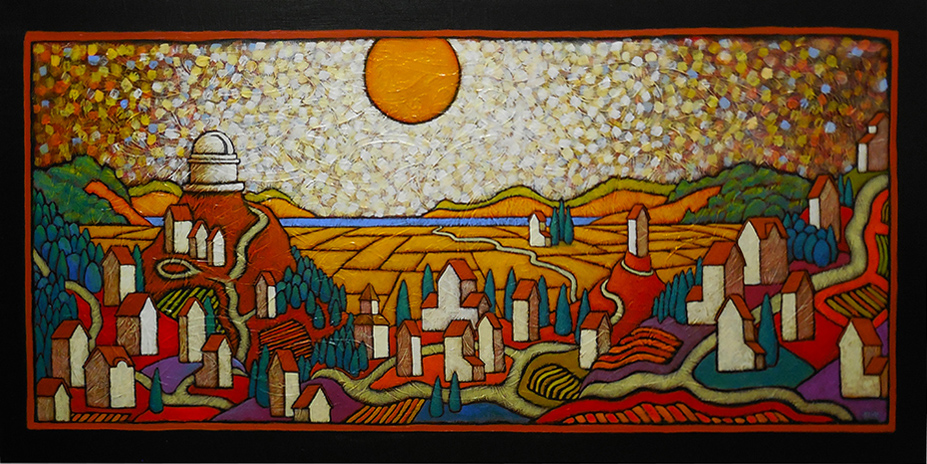
Hasten to the Light– Included in Little Gems at the West End Gallery


A bit of a mashup today with a new small painting, a Shel Silverstein poem and a Warren Zevon song.

The painting above is Hasten to the Light which is part of the annual Little Gems show at the West End Gallery in Corning. 


Shel Silverstein Needles and Pins

Shel Silverstein- Needles and Pins


The poem and illustration above is from the Shel Silverstein book, Falling Up.

The song below is Hasten Down the Wind from the late Warren Zevon with accompanying vocals from the also late Phil Everly. Zevon wrote the song but most folks associate it with Linda Ronstadt who made it the title track of a popular album in the 70’s.

The connecting thread between these three pieces is the expression of a restless desire. Oh, and the use of the term hasten in two of them. And the allusion to sail and sailing in two others.

I am sure there are other connections one can find in the three but let’s just leave it at these and enjoy all or some of the three, okay?


O Me! O Life!

GC Myers- The Restless Edge

The Restless Edge


Oh me! Oh life! of the questions of these recurring,
Of the endless trains of the faithless, of cities fill’d with the foolish,
Of myself forever reproaching myself, (for who more foolish than I, and who more faithless?)
Of eyes that vainly crave the light, of the objects mean, of the struggle ever renew’d,
Of the poor results of all, of the plodding and sordid crowds I see around me,
Of the empty and useless years of the rest, with the rest me intertwined,
The question, O me! so sad, recurring—What good amid these, O me, O life?

Answer.

That you are here—that life exists and identity,
That the powerful play goes on, and you may contribute a verse.

Walt Whitman, Leaves of Grass


There are mornings where I really need to hear some Walt Whitman. Today is one.

This is a verse that pretty much sums up my entire life’s motivation, that being a need to contribute my own individual verse to the book of life, to leave behind some lasting evidence of my short time on this earth.

This poem reminds me very much of the first drawing and poem of my own that I can remember. It no longer exists except in my memory but I believe I was in third grade, 8 or 9 years old. It was just a couple of lines called The Rat Race illustrated with a rough kid drawing of a tall skinny rat dressed as a runner with big sneakers.

Even at that age I felt what a constant grind life could be. Feeling small and voiceless, like most third-graders, I had already had a sense of how easily each of us might be overlooked in the crush of humanity and how it was on me to make my own mark.

In fact, it was a sense that our purpose in this life was to make that mark.

I still often feel like that small, voiceless third-grader. But I rest a bit easier now with the belief that my verse is somewhat written and that I have made some sort of small scratch of my own on the surface of this earth.

It might not be much but its mine.


Approaching Eminence

GC Myers- Approaching Eminence sm

Approaching Eminence– At the West End Gallery


From the very beginning almost I was deeply aware that there is no goal. I never hope to embrace the whole, but merely to give in each separate fragment, each work, the feeling of the whole as I go on, because I am digging deeper and deeper into life, digging deeper and deeper into past and future. With the endless burrowing a certitude develops which is greater than faith or belief. I become more and more indifferent to my fate, as a writer, and more and more certain of my destiny as man.

– Henry Miller, Reflections on Writing


The excerpt above from a Henry Miller essay on writing resonated with me when I read it many years ago. But  it has rings even louder for me today as I go further into my career as an artist.

The idea of not hoping to embrace the whole but showing bits of it in each work speaks to me. And the developing certitude of which he writes, one greater than faith or belief, is something of which I am just beginning to understand.

And his indifference to his fate as a writer reflects my own burgeoning recognition that while I have no control over how my work is perceived either now or in the future, I do have a certain amount of control over my destiny as a human.

I can choose my actions and reactions. I can choose love over hate. Compassion over antipathy. Kindness over cruelty. Generosity over stinginess.

And each of those choices is but a fragment that makes up the whole, similar to that which Miller refers. Each of those choices moves me closer to a certain wholeness as a human.

Do we ever arrive at that wholeness?

Maybe it doesn’t matter. Maybe each step on our journey comprises a wholeness in itself.

As is always the case, I don’t know.

My job here is to just ask questions. Answers, on the other hand, are often hard to come by, something which you usually have to find for yourself.

Let me know if you do.

The Circle Game

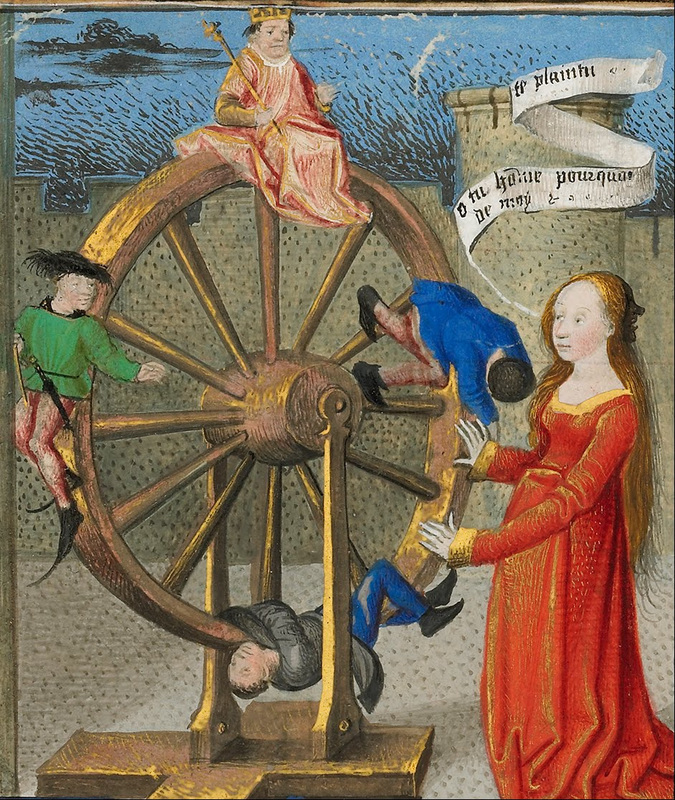
Rota Fortunae -Wheel of Fortune

Rota Fortunae— The Wheel of Fortune


You must read, you must persevere, you must sit up nights, you must inquire, and exert the utmost power of your mind. If one way does not lead to the desired meaning, take another; if obstacles arise, then still another; until, if your strength holds out, you will find that clear which at first looked dark.

― Giovanni Boccaccio, The Decameron


The excerpt above is from The Decameron from Giovanni Boccaccio. It was written in 1353 in the immediate aftermath of the Black Death that swept across and devastated Europe.

It tells of 10 citizens of Florence — 7 women and 3 men– who flee the plagued city for two weeks, settling in a country villa. Each of the ten people are required to tell one story per day though they refrain from doing so chore days or on the holy days. Thus, there are ten days of stories from ten people which brings the total of tales in The Decameron, whose title translates as ten days, to 100.

The stories deal with three primary themes: Fortune, Love and Ingenuity. The Wheel of Fortune plays  a large part in the storytelling. No, not the one with Pat and Vanna! We are talking about the wheel, Rota Fortunae, turned by Lady Fortune, on which kings and beggars both rise and fall.

It portrays the world as a turning wheel that sees each of us– and all of us– sometimes rising to or actually atop the wheel and sometimes sliding from the top toward the bottom of that same wheel. At that time, as the plague raged, they believed themselves to be at the bottom of the wheel.

It’s a fine metaphor for most times and most individual lives. We all have times when we feel that we are rising or falling with moments when we sense that we might be at the very top of our own wheel. And collectively, for all of us as a whole, the metaphor might be even more apt.

We all experience the ups and downs on the Rota Fortunae and, for the most part, we simply do our best to hang on because falling off means our time on the wheel is at an end.

And even so, it keeps spinning.

That’s my intro to this week’s Sunday Morning Music selection. It’s The Circle Game from Joni Mitchell. I thought I would play something from either Joni or Neil Young this week to highlight their decision to pull their catalogs of music from Spotify in protest of that streaming service’s commitment to carrying the Joe Rogan podcast, which has a large following and has been the source of a tremendous amount of misinformation, disinformation and conspiracy nonsense.

As an artist, I understand and agree with their decisions. Even though I believe that all viewpoints have a right to exist and be expressed, even those that are controversial and/or dangerous, that doesn’t mean that I have to share my work in that same space.

For example, if I showed my work at a gallery  and it began to display prominently work whose subject I found morally repulsive and counter to my own viewpoints and beliefs. Let’s say it was work that was filled with racist or misogynistic imagery that was spilled over with hatred and cruelty. I would certainly pull my work from that gallery if they chose to continue showing that work. I would not my name attached in any way to that work, even in the slightest tangential manner.

That is my right as well as my duty to my own moral compass and conscience.

So kudos to Neil Young and Joni Mitchell for exercising their rights. It must be noted that both are from Canada. It seems to me that sometimes those people who have been drawn to this country, the immigrants of all sorts, see things here a bit clearer than those of us who have been here forever. As a result, they often take the exercise of their rights ( and protecting the rights of others) more seriously.

Here is The Circle Game that deals with a wheel of fortune in a way, the wheel here being the carousel of life we all get on and off in an endless ride. Enjoy your ride.


Nirvana X 1000

Cesena Rockin 1000


Another cold, cold morning. Though it doesn’t reach the -18° of a week or so back, the breeze takes the wind chill down to somewhere around -10.

And this morning, the thrill and excitement of severe weather eludes me. It feels like a trudge walking to the studio and after taking care of the herd of cats that live around and with us now, I sit down with my first cup of coffee and begin looking for something that will take away my chill and glum.

One of the first things I come across is a video of a huge group of musicians in a stadium somewhere in Europe playing Nirvana’s Smells Like Teen Spirit. It is raucous and exuberant. You can see the joy in the musicians faces as they play, as though being in and part of such a sonic event is a form of bliss.

Nirvana, I guess.

And it makes me feel better this morning.

The group is the Rockin’ 1000 from Cesena, Italy. It was formed in 2015 as crowdsourced effort to attract Dave Grohl and the Foo Fighters to perform in their city. They eventually put together a show and have done several in the years since. I didn’t look up any stats or facts but it looks like they have about 200 or so each of drummers, guitarists and bass players and four or five hundred vocalists.

It’s quite a mob.

Below is the performance I first saw this morning from Cesena in 2016. Watching it, I realized that though it was only a little over five years ago, it was a completely different world at that moment.

At least, on its face. The divisions that rend us apart were there but still pushed down. Covid and a jump in authoritarian political activity and violence have altered us in many ways. We look at every situation and person through different lenses now.

It made me somewhat nostalgic for 2016, wishing that I could magically go back and somehow improbably alter the future that was to come.

But I can’t. You deal with what is in front of you. And this morning, thankfully, what is in front of me is a video of a 1000 joyful musicians.

Glumness gone.

Nirvana.


Where the Road Rises

GC Myers-  Where the Road Rises sm

Where the Road RisesLittle Gems show, West End Gallery


The artist is always beginning. Any work of art which is not a beginning, an invention, a discovery is of little worth.

― Ezra Pound


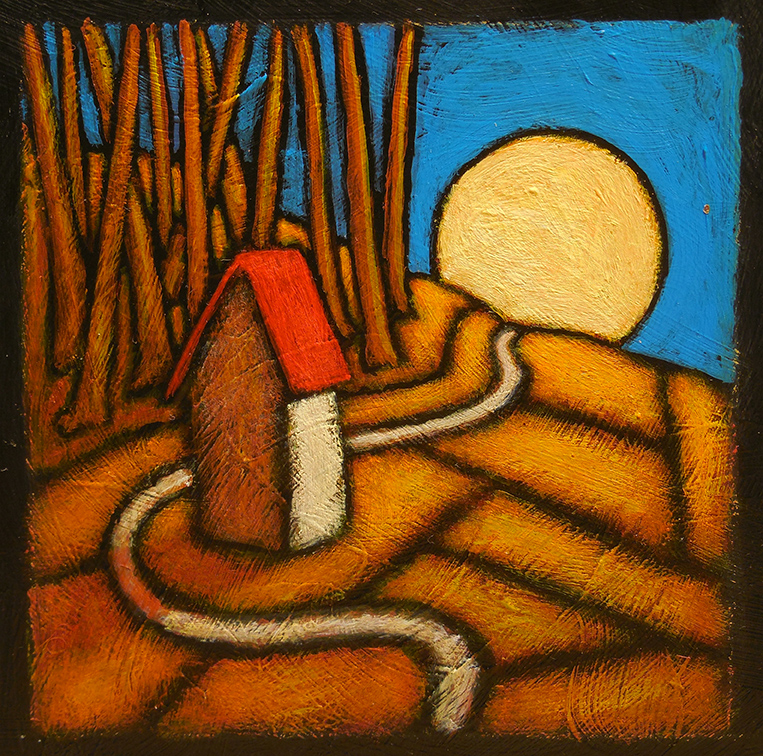
The small painting at the top is titled Where the Road Rises and is included in the upcoming Little Gems show opening in February at the West End Gallery.

I see it as being symbolic of the beginning of some sort of journey, one that might be physical, spiritual, artistic or any other type of endeavor one chooses to follow. A journey of discovery of some sort.

The Red Roof structure represents home or childhood here– the starting point. It is both a place of safety and a point from which we know we must move on, even if only symbolically.

The sun is symbolic of the desire that pulls one to the journey. It represents something we knw might well be unattainable that still sets us on a search to find it.

The rising road represents the path that requires effort to climb. The first steps away from safety often feel the steepest and most difficult.

The forest represents the hidden perils and distractions they must skirt as they begin their journey. Most journeys of discovery often fail before they really begin. Second thoughts on leaving the safety one knows and the prospect of hardships and difficult toil ahead keep most potential travelers in place.

The top of the rise, where one loses sight of safety once they pass that point, represents the unknowns– good and bad– that the trekker will face as they move further along.

But despite the fears that grip most of us, many do begin a journey of discovery. And regardless of the outcome, the mere act of beginning the journey is a triumph of some kind.

Perhaps if only in being able to say one tried for a brief time to reach the unattainable.

The title for this piece refers to the first line from the well-worn Irish Blessing below which offers best wishes and blessings for the traveler:

May the road rise to meet you,
May the wind be always at your back.
May the sun shine warm upon your face,
The rains fall soft upon your fields.
And until we meet again,
May God hold you in the palm of his hand.

The road rises to meet you but you must also move to meet the road and begin your journey of discovery.

Blessings to all you travelers out there.

Maus

Maus -Art Spiegelman


Thou shalt not be a victim, thou shalt not be a perpetrator, but, above all, thou shalt not be a bystander.

― Yehuda Bauer, Israeli Historian and Holocaust scholar


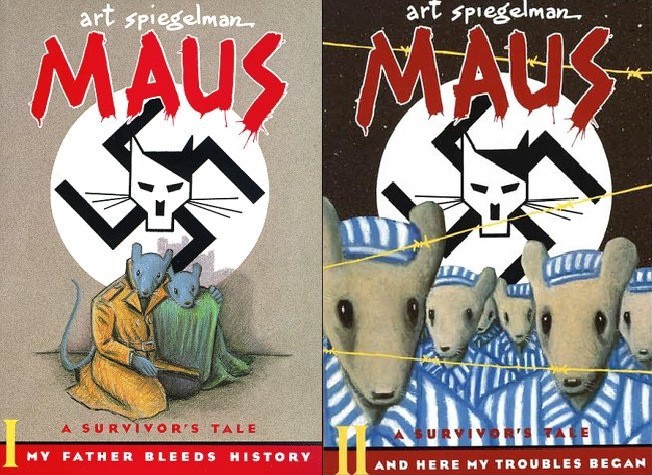
In a week when I write about current spate of book banning, it should come as no surprise that the news came out yesterday that a school board in McMinn County, Tennessee voted unanimously, 10-0, to ban the book Maus from its school libraries.

Maus is a graphic novel written and illustrated by American cartoonist Art Spiegelman. It details the experiences of his father, a Polish Jew and Holocaust survivor, during World War II. Employing an Animal Farm style of metaphoric storytelling, it depicts the Jews as mice, the Germans as cats, and other nationalities as a variety of other animals. Widely praised and banned in many countries under repressive regimes, it is the only graphic novel to ever win the Pulitzer Prize.

As small minded and dangerous as this school board’s decision was, there is also added callousness and insult in the action as it was done on the eve of today’s International Holocaust Remembrance Day, a day of dedicated to the memory of the millions of victims murdered at the hands of the Nazis during World War II.

Did they choose to do so on this day for a reason? Or was this simply a case of sheer ignorance of the timing?

I tend to lean towards ignorance– they are banning books, after all— but even if they were aware, I doubt it would alter their timing or their decision. They are simply part of a movement that seeks to erase history that they find uncomfortable or that might make their kids think.

I take no pleasure in writing about this subject and realize many of you who do read would prefer that I talk about art or music or anything other than a subject as uncomfortable as this. But we are at a time when these types of acts are rapidly stacking up and to avert our eyes now is to signal a sort of acceptance of these actions and the hatred, ignorance, and darkness that drives them.

On this day of remembrance, please do not look away. Pray that it should never happen again to any people anywhere. But unless we educate ourselves and our children to the possibility, it may very well occur once again.

Our silence normalizes atrocity. Callous ignorance breeds it anew.

Now is not a time for bystanders.

occhiolism

GC Myers- Imitatio

Imitatio– At the Principle Gallery, Alexandria, VA


occhiolism

–n. the awareness of the smallness of your perspective, by which you couldn’t possibly draw any meaningful conclusions at all, about the world or the past or the complexities of culture, because although your life is an epic and unrepeatable anecdote, it still only has a sample size of one, and may end up being the control for a much wilder experiment happening in the next room.

— The Dictionary of Obscure Sorrows


This definition from the Dictionary of Obscure Sorrows made me both chuckle and sigh a bit. I think that might be an indicator that it might have some actual truth in it.

Is it better to feel that everyone sees things and thinks just as you do, that your view represents most people? Or is better to believe that you are singular in your thinking, that it has no relevance to nor little effect on the wider world?

I tend to go with the latter, the one that has me aware of the smallness of my perspective, the one that doesn’t really represent everyone or everything. This way I am pleasantly surprised when I do come across someone who shares some of my views.

But maybe that’s just me. The crowd in the next room might be seeing something altogether different.

As usual.

The Book Burners

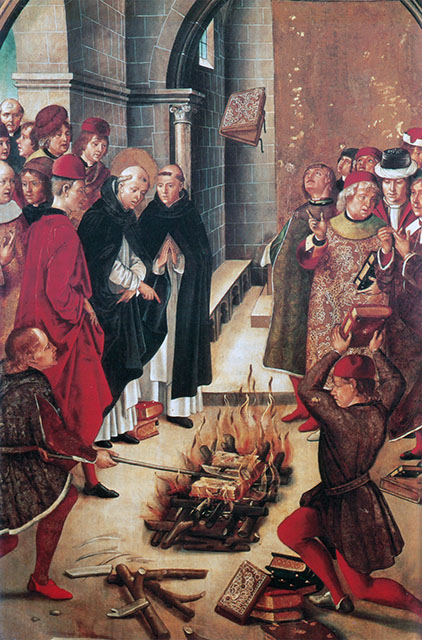
Book Burning Saint Dominic and the Albigenses (1480). A painting by Pedro Berruguete depicting Dominic, founder of the Inquisition, checking books for heresy with a trial by fire.

Saint Dominic and the Albigensians- Pedro Berruquete, 1480

We are witnessing a worrisome trend in this country , one that is an echo from every repressive, authoritarian regime throughout history.

The banning and burning of books. In fact, some places require that any book– any book— that is reported by a parent must be removed from school or or public libraries. Any book.

School districts and states threatening librarians and teachers with large fines, loss of employment and even prison. Constant reconnaissance of teachers in the classroom.

Banning the teaching of Critical Race Theory, a grad school level concept that has never been taught below the collegiate level, which in turns leads to banning anything that deals with race or civil rights. A seminar for high school educators led by a college professor dealing with MLK and the civil rights movement was cancelled recently for just this reason.

There is an attempt to eradicate huge swaths of history and literature because the sheer idea of it makes some weak-minded folks uncomfortable.


“Censorship is telling a man he can’t have a steak just because a baby can’t chew it.”

― Mark Twain


As I said, this is nothing new. Censorship, rewriting history, and attempting to control the thoughts and minds of citizens are tricks right out of the authoritarian handbook. It has been with us since somewhere around the beginning of time. It was no doubt first written on a cave wall somewhere.


“All these people talk so eloquently about getting back to good old-fashioned values. Well, as an old poop I can remember back to when we had those old-fashioned values, and I say let’s get back to the good old-fashioned First Amendment of the good old-fashioned Constitution of the United States — and to hell with the censors! Give me knowledge or give me death!”

― Kurt Vonnegut


The irony here is that the very people who employ these tactics have usually come to power as a result of freedom of thought and expression. In the society they envision, their type of antics would be squashed.

But they don’t see it that way, of course. Their belief system is very binary, black and white with no shades of gray at all. They cannot believe that free thought and expression is the defining characteristic of this nation, as imperfect as it is or has been.

It has shaped our history and by extension the history of the world. How many consequential things would we be without had our freedom to think and dream been restricted?

Everyone deserves to have their voice heard. And that includes the craziest and most conspiratorial of us. because in a free society one can express almost any idea. But, in a free society, others are able to freely protest and counter those ideas.

In a free society, you can say what you wish but do not expect to have it go unanswered. You can expect pushback, an argument and even repercussions.

In a society that bans thought and ideas, there are no longer two sides to any argument.


“There are worse crimes than burning books. One of them is not reading them.”

― Joseph Brodsky


If all the people trying to ban and burn books had ever read a book they would know how misguided and futile their efforts will be in the end. No nation that has stifled free thought and tried to eradicate history has persevered. All eventually fall.

And that is because ideas and thought and truths– the voices and souls of those books– do not burn.

They persist so long as one mind holds them.

And if we are lucky, these minds and ideas challenge us, making us question the limits of our worldview and expanding our mind to surpass those limits. They inspire greater dreams and aspirations, those that bring us progress and the betterment of all mankind. 


“Don’t join the book burners. Don’t think you’re going to conceal faults by concealing evidence that they ever existed. Don’t be afraid to go in your library and read every book…”

― Dwight D. Eisenhower


It’s a real sign of weakness when we attempt to stifle free thought. It signals that we don’t believe that our children or ourselves do not have the ability to comprehend new ideas and evaluate them without somehow tainting our values and beliefs.

The hallmark of a healthy, functioning society is one whose citizens have inquisitive minds that are open to all ideas and intellectually strong enough to distinguish between those that are right and those that are wrong.


“When truth is replaced by silence, the silence is a lie.”

― Yevgeny Yevtushenko


This book banning and these other extreme measures taking place currently can be quelled if we don’t just shrug it off and say that it’s none of our business what takes place in some county a thousand miles away. 

It will be our business at some point. Silence is always complicity. Our silence enables.


“Once a government is committed to the principle of silencing the voice of opposition, it has only one way to go, and that is down the path of increasingly repressive measures, until it becomes a source of terror to all its citizens and creates a country where everyone lives in fear.”

― Harry S. Truman, Message to the Congress on the Internal Security of the United States, August 8, 1950


Keep your eyes and ears open. Speak out against this type of censorship. The freedom to think and speak is not our enemy. No, it is our greatest asset and once lost it is not easily regained.

Controlling what one thinks or says is the true enemy of all mankind. It is an existential danger for reasons best summed up in the oft-used quote from the poet Heinrich Heine:


Those who burn books will in the end burn people.

— Heinrich Heine, Almansor