Feeds:
Posts
Comments

A Place to Stand


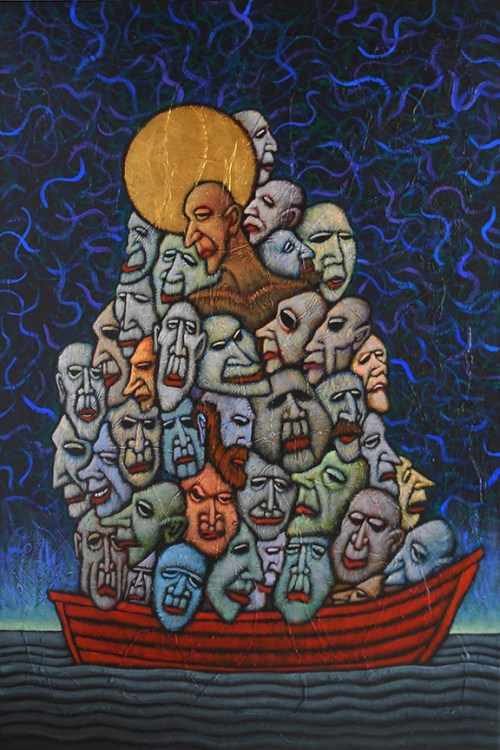
GC Myers- The Understanding 2021

The Understanding– At the Principle Gallery

Wherever we go, there seems to be only one business at hand—that of finding a workable compromise between the sublimity of our ideas and the absurdity of the fact of us.

― Annie Dillard, An Expedition to the Pole


In her essay, An Expedition to the Pole, Annie Dillard compares the search of her fellow Catholic worshippers to the great Polar expeditions of the late 19th/ early 20th century. Both were seeking an idea, a concept of something distant and barely imaginable.

She called it The Pole of Relative Inaccessibility.

Or in other words, the sublime.

But whatever one seeks, as Dillard points out above, there is always a constant rationalization between the power and beauty of our search and the reality of ourselves– what we truly are as humans and the limits of what we are capable of being. 

It’s a hard and cold calculation, this compromise. And it most likely differs for each of us.

For me, it comes down to finding a place on the earth where I can simply stand and feel no desire to search any longer. To simply be and have a comfortable acceptance of the place where I stand, an understanding that I am as near my own Pole of Relative Inaccessibility as I can ever be.

To feel at peace, to feel that I have pushed to the edges of my limits and my search has been worthwhile in simply knowing that I sought something in my time here on this planet.

In the end, perhaps we all need some our own Pole of Relative Inaccessibility.

I don’t know…


Avoiding the Dustbin

Elihu Vedder- The Questioner of the Sphinx

The Questioner of the Sphinx, Elihu Vedder, 1863


I met a traveller from an antique land,
Who said—“Two vast and trunkless legs of stone
Stand in the desert. . . . Near them, on the sand,
Half sunk a shattered visage lies, whose frown,
And wrinkled lip, and sneer of cold command,
Tell that its sculptor well those passions read
Which yet survive, stamped on these lifeless things,
The hand that mocked them, and the heart that fed;
And on the pedestal, these words appear:
My name is Ozymandias, King of Kings;
Look on my Works, ye Mighty, and despair!
Nothing beside remains. Round the decay
Of that colossal Wreck, boundless and bare
The lone and level sands stretch far away.

–Percy Bysshe Shelley, Ozymandias


If you have ever been to the Museum of Fine Arts in Boston, you have no doubt seen the painting above. I’ve only been there once and the image of this painting and its strong presence in the space really sticks in my mind. It was painted in 1863 by artist Elihu Vedder, an American expatriate who lived and worked in Italy for over 60 years.

Its title is The Questioner of the Sphinx and it shows a man listening intently at the lips of the ancient monument with the hope, no doubt, of hearing some eternal truth. The skull in the sand makes clear that the Sphinx will not easily relinquish its secrets. The kneeling listener is said to represent man’s futile desire to find immortality.

With the still sand covered Sphinx and the scattered toppled columns, the painting presents us with echoes from ancient history of once mighty empires that are long fallen and forgotten. It is reminiscent of Shelley’s great poem, Ozymandias, shown above, that speaks to the hubris and folly of those who think they can lord over this world.

This was painted at a time when the US was in the midst of the Civil War and there was great doubt as to whether the county would be able to endure the struggle. The US was not an empire at that point. It was still young and finding its way but we still represented a great triumph of democracy, a country ruled by its people and  not kings or dictators or despots– a rarity in the whole of history. But in that civil war we found ourselves in an existential crisis, a tipping point, that put us in peril of being consigned to the dustbin of history before we even grew into any form of our potential.

I write about this painting this morning because it feels to me that we are again at a tipping point, divided in many ways as a country. It feels like there is going to soon be some sort of revelation that is either going to set us on a course that will either allow us to continue to grow our American experiment or will cause us to plummet into a darker and much more dangerous future.

It all hinges on people who are ethical and principled standing up and doing what is right and exposing the truths of our time.

But in the meantime, I find myself feeling like that man with his ear anxiously pressed to the lips of Sphinx.


This post ran nearly four years ago in 2018. As close as I felt then that we were at the precipice of sliding into some form of autocratic or fascistic governance, I now realize that we could only see the edge back then. There was more treacherous ground to cover before we arrived at the true tipping point.

We certainly have covered much more of that ground in the past four years.

That precipice edge might be upon us at this moment. Over the next several days, as the House and Senate Democrats attempt to pass comprehensive election and voter rights legislation against the intransigence and obstruction of the GOP, we may well know the answer. 

It will not be bipartisan. It cannot be so, not when one of the two parties has set its sights solely on an anti-democratic form of minority rule. The GOP has a shrinking voter base and is determined to gain and hold power through ever increasing voter suppression and gerrymandering districts to favor their minority of voters in the Electoral College and in statewide elections.

They have no apparent policies to offer the American citizens outside of their manipulations of the electoral system and attempting to stop any legislation that threatens their plan. 

As I say, the next several days could be telling. If accomplished, it may be the most consequential act of Congress in our lifetimes or for generations to come. It may well keep us from that dark and violent slide into the dustbin of history.

Fingers crossed.
Working to Potential

gc-myers-1994

GC Myers- Early Work, 1994


He was justifying his existence, than which life can do no greater; for life achieves its summit when it does to the uttermost that which it was equipped to do.

–Jack London, White Fang


Much distracted lately, I needed a personal reminder that I had to apply myself a bit harder. This post from back in January of 2011might be just what I was looking for. It’s about reaching the furthest potentials of one’s talents and abilities but even if one wishes to attempt to do something for which they believe they have no real talent, it still applies. The hard work they put in will yield real progress and reward them with confidence and lessons that can be applied throughout the other aspects of their life.

From 2011:


I had a nice email from a gentleman who told me about a prize his 16 year old daughter had recently won for a painting she had submitted in a scholastic competition.

I took a look at the piece and responded to him, telling him it was a well done painting, nicely composed with strong lines and color. It was far ahead of anything I was doing at that age, especially by the virtue that it was complete. I could see this young person doing more with their talents in the future. I wrote him back and told him this but with my standard warning, one that I have written about here before: Potential must be actively pursued with constant efforts and a consistent pushing of one’s abilities.

I wrote him to tell him this, to let him know about some of the young talents I have seen come and go because they felt their talent was something that was innately within them and could be turned on and off with the flip of a switch.

I told him to tell her to look at the work required in the way a musician looks at rehearsals. Perhaps even look at their talents as being like those of a musician, talents that need constant exercise in order to stay sharp and strong. For instance, even if you have great innate talent, you can’t expect to play the violin like Itzhak Perlman if you don’t devote your talents in the same way as he does. A great part of his life is in nurturing his abilities.

I always feel like a sourpuss when I’m giving this advice. Nobody wants to hear that they need to work harder. Everyone wants to think that they have this great talent born within them and it will flow like a spigot whenever they so desire.

If only that were true.

I think you will find that those who succeed at the highest levels in any field are those who understand this need to constantly push and work their talents. I’m sure there are exceptions but none come immediately to mind. I wrote about this in a blog post when I first started this, over two years ago. I wrote about something author John Irving had said about his work habits. He saw himself competing as a writer in the same way as he did in his time competing as a wrestler.

To reach the potential as writer required  putting in the same levels of intense effort as those needed to compete as a wrestler or any other athlete on the Olympic level.

Hard work– it’s not glamorous especially in this world of instant gratification but it is a proven entity .

I’m showing the piece above to highlight this. It’s a small painting that I did before I was showing in any galleries, in 1994. At the time, it pleased me very much and I could have very easily kept painting in that style and been pretty happy, without much effort. But there was a little voice in me that kept saying to push ahead and work harder, to see what I could accomplish with greater effort. It became not an end but a stepping stone to move ahead.

That is how I hope this man’s daughter see her painting– as a stepping stone. She may think it is the best thing she has ever done but if she is willing to push ahead and put in the effort, she will look at it someday as a mere step in a journey to reach her true potential.

Feeding the Dog

GC Myers- Third Stone From the Sun 1994

GC Myers- Third Stone From the Sun, 1994


A Native American elder once described his own inner struggles in this manner: Inside of me there are two dogs. One of the dogs is mean and evil. The other dog is good. The mean dog fights the good dog all the time. When asked which dog wins, he reflected for a moment and replied, The one I feed the most.

― George Bernard Shaw


The piece above  was painted in my earliest days of painting back in 1994. It was strictly an experiment, an exploration of colors and shape.

My personal interpretation of it was shaped by the Jimi Hendrix song, Third Stone From the Sun, which I was most likely listening to around that time. I saw the Earth as a line-jumper trying to force its way ahead of Mercury and Venus to be nearer the Sun, as though by doing so the Sun might favor it somehow.

I was seeing the greedy human impulse, I guess.

But over time, this piece has come to represent the inner conflicts that we all experience.

Well, I think we all experience them. I am sure there are some who have a moral compass– for good or bad– that is unshakably set. I don’t whether to envy or pity those folks.

But for most of us, we struggle much like the Native American elder who Shaw referenced in the quip at the top. We all have a good and a bad dog within us fighting, trying to kill or gain dominance over the other.

Whichever we feed most will no doubt win.

Please feed your good dog today…

A Marvelous Victory


GC Myers-  Viva Nox (The Vivid Night) sm

Viva Nox (The Vivid Night)– At the West End Gallery


We need hope. An optimist isn’t necessarily a blithe, slightly sappy whistler in the dark of our time. To be hopeful in bad times is not being foolishly romantic. It is based on the fact that human history is a history not only of competition and cruelty but also of compassion, sacrifice, courage, kindness.

What we choose to emphasize in this complex history will determine our lives. If we see only the worst, it destroys our capacity to do something. If we remember those times and places-and there are so many-where people have behaved magnificently, it energizes us to act, and raises at least the possibility of sending this spinning top of a world in a different direction.

And if we do act, in however small a way, we don’t have to wait for some grand utopian future. The future is an infinite succession of presents, and to live now as we think human beings should live, in defiance of all that is bad around us, is itself a marvelous victory.

— Howard Zinn, A Marvelous Victory


“The future is an infinite succession of presents” is quite a line from an essay, A Marvelous Victory, from the late Howard Zinn. It is one that we should hold in our minds at all times.,

The form and content of our future will most likely not result from some cataclysmic event in the far flung reaches of the time ahead.

No, our future world is being shaped each and every day in small steps. These small actions create tiny, almost imperceptible, shifts and changes that push our future world in one way or another. Some of these small actions force us towards a crueler and darker future while others based on those attributes highlighted by Zinn– compassion, sacrifice, courage, kindness— push us towards one that is more inclusive and gentle.

More human. More livable.

This somewhat continues the thoughts from yesterday’s post. Like being a hero that looks out for others, to live each coming day in the succession of presents with compassion, sacrifice, courage, and kindness is a choice. It is the same choice, actually, because those are the attributes of real heroes.

It’s a pretty simple concept. Choosing to live each day with kindness and compassion moves the future of this world in a small but significant way.

Seems like a simple choice, right?

Wanted: Heroes

GC Myers-  Climb Ever Higher

Climb Ever Higher– At the West End Gallery, Corning, NY


Student: Unhappy is the land that breeds no hero.

Galileo: No, Andrea….unhappy is the land that needs a hero.

–Bertolt Brecht, Galileo


Wouldn’t it be wonderful to live a land that had no need for heroes?

A land with no hatred and racism. No injustice. No inequality.

A land without corruption, dishonesty, and greed A land without violence and conspiracies perpetrated by those who seek absolute power by any means.

A land without fear.

A land of cooperation and the acceptance of our responsibility for one another.

Wouldn’t it be great?

Unhappily, we live in a land in need of heroes.

And I don’t mean heroes in the way that we often use the word when speaking of celebrities or sports stars.

They have their place but here I am talking about the average people who put it on themselves to do the right things, day in and day out, so that this land might move even the tiniest bit toward being a land that no longer finds itself in need of heroes.

People who seek to help others in need without any thought of benefit or glorification for themselves. Who are willing to call out and fight ceaselessly against injustice, corruption, and hatred.

The interesting thing here is that anyone can be a hero. Happily, it’s a choice we can actually make.

Unfortunately, one can also choose to not be a hero. They can look out for themselves alone and not give a damn how others fare.

I’m just saying that we need a lot more heroes.

We have more than enough of those who have chosen otherwise. Way too many.

Okay, sermon over. Get up and get out, okay?

As you head for egresses, here’s some exit music for this Sunday Morning Music. Yesterday, I played a piece of music from a symphony by Philip Glass based on David Bowie’s Heroes album. I was unaware at that time that yesterday would have been Bowie’s 75th birthday. So, let’s honor him with a rendition of his song Heroes which is high among my favorite songs. This semi-acoustic performance is from the 1996 concert to benefit the Bridge School.

We can be heroes just for one day…


GC Myers- On the Fringe sm

On the Fringe– At the West End Gallery


Beyond the edge of the world there’s a space where emptiness and substance neatly overlap, where past and future form a continuous, endless loop. And, hovering about, there are signs no one has ever read, chords no one has ever heard.

― Haruki Murakami, Kafka on the Shore


Just doing another grouping of image, words, and music that are somewhat connected in theme or thought.

Well, at least, in how I view them.

The painting at the top is called On the Fringe, featuring three crows in a bare tree. Crows live in close proximity to us, always near and visible yet keeping their distance. There is something mysterious in their silent observation of us and when they do break that silence, one wonders if there is some bit of wisdom that they are attempting to pass on to us.

Crows, as I have indicated here in the past, are symbols of wisdom. In the book Kafka on the Shore from Haruki Murakami, uses crows in just this way, as symbolic  messengers of protection, advice, and warning to the story’s young protagonist, who calls himself Kafka, after the famed Czech author. The name Kafka translates as crow in the Czech language.

For the third part of this grouping, I have selected a piece from Philip Glass’ Heroes Symphony, done in collaboration with Brian Eno and David Bowie, based on Bowie’s album, Heroes. The music here is based on the song Sons of the Silent Age.

It definitely has a crow feel, at least in the way I see crows. Silence , thought, and movement. I think it’s a pretty good trio to kick off a frigid Saturday morning here in this corner of the great big world.


The Created Moment

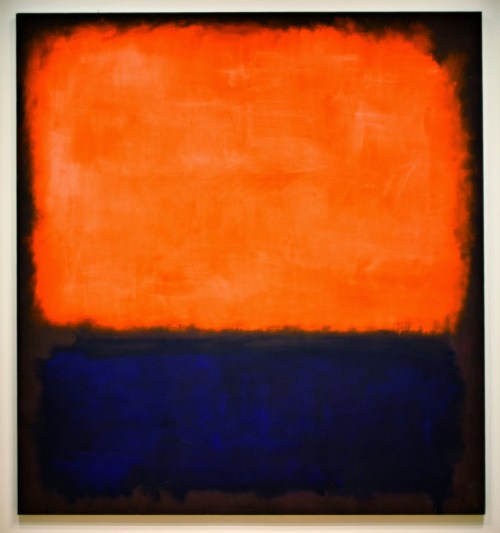
rothko-number-14

Mark Rothko- Number 14


A painting is not a picture of an experience, but is the experience.

—Mark Rothko


This a reworking of a post from a few years back. I chose it because it’s something I have been thinking about lately, this idea of not “capturing a moment” but instead “creating a moment.

I believe that the words above from Mark Rothko express that idea perfectly.

You hear a lot of artists talk about “capturing a moment” with their work. I am pretty sure those words have come out of my mouth when I am just blathering on. And there’s nothing wrong with that. Capturing a moment that the artist has experienced which moved them is not a bad thing. There are many examples of such work that is beautiful and lasting.

But my belief is that a piece of art works best when it causes the viewer (for visual artists) to feel as though they are experiencing something new in that moment when they stand in front of it.

Not a representation of a moment but a moment in itself.

Not capturing but creating the moment.

And that moment takes place when the viewer engages with the work of art, as though an arc of energy jumps from the art to the eyes and mind of the viewer, uniting the two in a unique moment.

Work like that is always in the present.

And maybe even that description doesn’t fully express the created moment. Maybe this singular moment is of its own time and place. Perhaps its own present, the created moment, that only exists in the space between the work and the viewer.

But how does the artist achieve that? Is it even something you can create with forethought?

Like so many things, I can’t really say for sure.

Maybe it comes in being totally honest and emotionally engaged during the creation of the work. Perhaps that moment of emotion becomes part of the piece and it is that which the viewer senses and experiences in the work.

Maybe that is the arc that emanates from the work.

Again, I don’t know the what’s or how’s or why’s of actually creating a moment.

Or if I have it in myself to achieve it or if I would even recognize it if I did.

But I do know that it is always lingering at the fringes of my mind when I stand in front of the easel. That might be the biggest part of the impulse to paint for me, to create a moment that exists beyond myself.

Time will once again be the revelator…


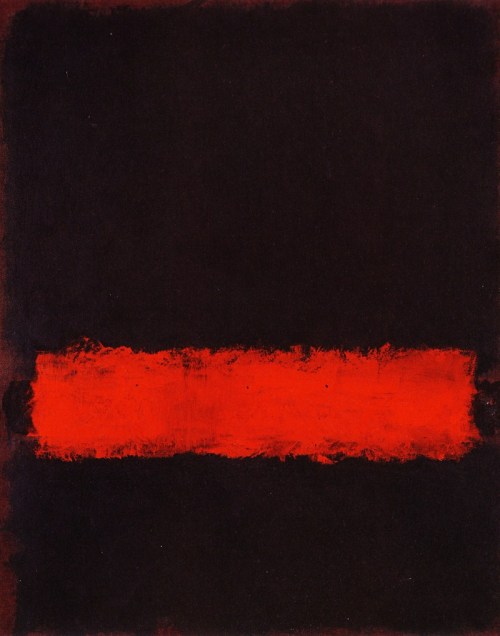
Mark Rothko-Red and Black-1968

Mark Rothko- Red and Black, 1968

This Masquerade

GC Myers -Saints and Sinners

Saints and Sinners


Are we really happy here
With this lonely game we play?
Looking for words to say
Searching but not finding understanding anywhere
We’re lost in this masquerade

–Leon Russell, This Masquerade


January 6, 2022. A year has passed.

No need for comment from me today. Let’s just let the day play out as it will and leave the commentary to others.

No, today’s a day to simply reflect on what has taken place and the challenges that face us going forward.

And to ponder what this country will be if we fail to face those challenges.

Here’s a song from the late great Leon Russell, released on his 1972 album, Carney. The song is This Masquerade.


A Little Diebenkorn

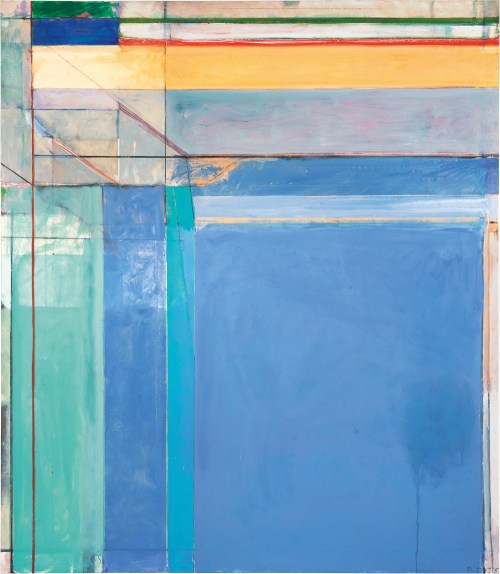
Richard Diebenkorn_Ocean Park 79_0

Richard Diebenkorn–Ocean Park #79


It is not a matter of painting life. It’s a matter of giving life to a painting.

-Richard Diebenkorn


Short on time this morning. I am heading out in a little while to drop off the two feral cats I trapped late yesterday for neutering and such at the SPCA. As I said in yesterday’s post, I thought I had little hope of capturing the Mom cat and her only female kitten, now about 8 months old. But I was wrong. Both were trapped at once and though I am sure they are super stressed out– I was and am a bit– seemed calm this morning. So, off to the vets. The Boys will go the next time.

Since time is short I am replaying a post from a few years back. It’s always pertinent for my work at this time of the year, even now as I feel a bit more positive than normal. Diebenkorn’s words about starting a dialogue with the canvas always helps me move ahead.

That interaction, that dialogue, is crucial to creating art. And doing just about anything worth doing.


I am going through a period where I am struggling to find focus. My ability to concentrate seems limited and everything, even small tasks, seem like huge distractions which I allow to take over much of my day. Even writing a short blog entry has become an epic struggle to complete, taking twice as long as normal to write a few lines that say little.

It’s frustrating and a little scary, with a nagging fear that this will become the new normal, that every task will become a struggle. I worry that the spark that has sustained me for the past two decades has somehow diminished.

I’ve been through these episodes before, as I’ve noted here in the past. I can’t say that this is any worse than any of those although it probably seems that way while I’m in the middle of it. I’ve always been able to muddle through it and have usually come out at the other end back in form, the spark in full blaze.

But part of me worries that this time might be a different thing. Maybe it’s watching my father living a shallow existence with his dementia in a local nursing home. I find myself worrying that my current lack of concentration might morph into the same short attention span that bedevils him.

I tell myself that this a baseless fear but when you’re running on a low spark, your confidence in your own beliefs and strengths becomes a bit strained. Fears, once unthinkable, become plausible.

So, trying to find inspiration, I spend some mornings looking at the work of other artists and reading a bit about how they perceived their work and how they coped with the struggles they faced. I’ve been a fan of Richard Diebenkorn’s work for some time, especially his Ocean Park series. Ocean Park #79 is shown at the top. I was looking at some of his work this morning and reading a few short quotes from him. The one at the top resonated because it reminds me of what I am trying to do.

Another, about the beginning of his process, also spoke to me: Of course, I don’t go into the studio with the idea of ‘saying’ something—that’s ludicrous. What I do is face the blank canvas, which is terrifying. Finally I put a few arbitrary marks on it that start me on some sort of dialogue. I need a dialogue to get going.

That is where I am right now. I am trying to start a dialogue, a conversation, with a blank surface. The problem is that on some recent mornings I feel as blank as the empty canvas. That doesn’t make for sparkling dialogue.

But I keep trying because it is what I do. And I have to believe that the spark is there, waiting to spring into a full blaze. Maybe it’s today…


Diebenkorn Ocean Park 67

Richard Diebenkorn- Ocean Park #67