We’re creators by permission, by grace as it were. No one creates alone, of and by himself. An artist is an instrument that registers something already existent, something which belongs to the whole world, and which, if he is an artist, he is compelled to give back to the world.
—Henry Miller, The Rosy Crucifixion Book I: Sexus (1949)
The words above from Henry Miller very much echo in several things I have written here in the past. An artist recreates in their own manner that which already exists, the seen and the unseen. It is created from a multitude of influences, experiences, and observations from this world.
As he says, this creation, being comprised of this world, belongs to the whole world. Art, though its message often feels targeted to us as individuals, is at its heart communal, meant to be shared.
I am not going anywhere with this statement this morning. I simply like the thought and thought it needed to be shared.
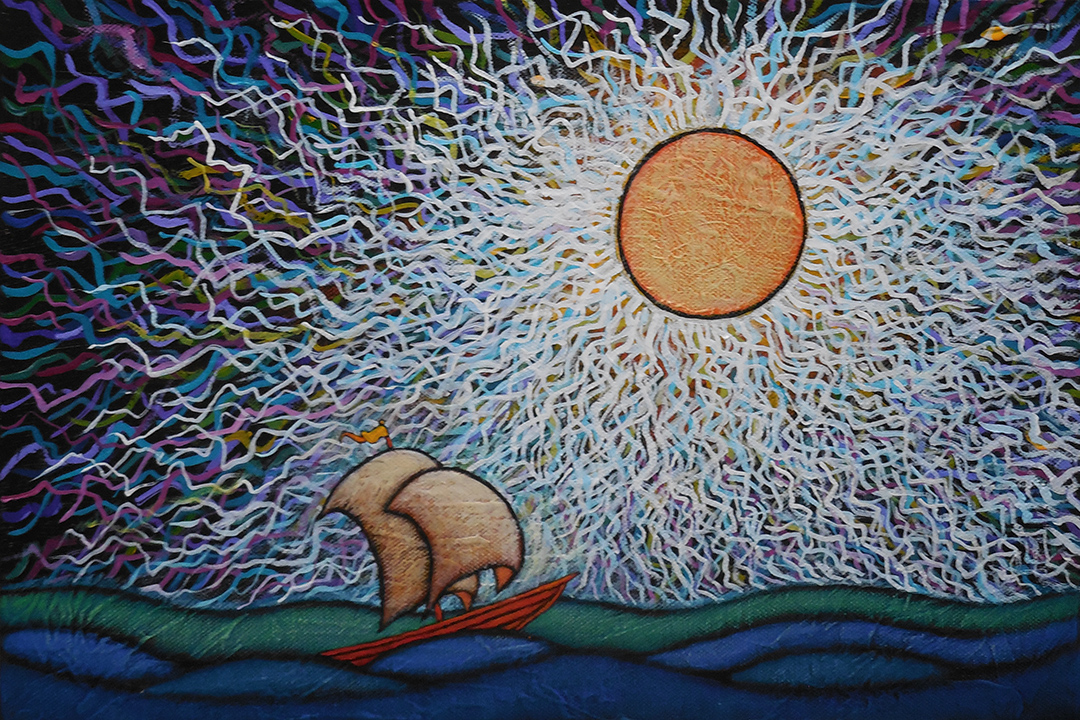
Now, here’s a song from a favorite of mine, guitarist Martin Simpson. It fits well with the painting at the top but most likely has nothing to do with Miller’s words. As it was with the Miller passage, I simply like it and wanted to share it. This is Granuaile from his 1991 album When I Was on Horseback. I believe it refers to Grace O’Malley, the head of the Irish O’Malley dynasty in the 16th century. She is often referred to as the Pirate Queen. and is known for a meeting she had late in her life with Queen Elizabeth to ask for the release of her sons who were being held captive by the English governor of Connacht.
make a poem that does not disturb the silence from which it came.
—Wendell Berry
I run the post below every five years or so. Since I’m busy this morning (trying to not disturb the silence) and it’s been five years, thought today would be as good a time as any to replay it.
Regardless of what we do, we all need a reminder now and then to heed the silence.
I came across this poem a while ago from poet/author Wendell Berry on Maria Popova‘s wonderful site, Brain Pickings. It’s a lovely rumination that could apply to any creative endeavor or to simply being a human being.
I particularly identified with the final verse that begins with the line: Accept what comes from silence and ends with the lines above. I’ve always thought there was great wisdom and power in silence, a source of self-revelation and creative energy. Perhaps that self-revelation is why so many of us shun the silence, fearing that it might reveal our true self to be something other than what we see in the mirror.
Berry’s words very much sum up how I attempt to tap into silence with my work, to find those little words that cone out of the silence, like prayers, and to find inner spaces to paint that are sacred to me and not yet desecrated by the din of the outside world.
At the bottom is a recording of Wendell Berry reading the poem which gives it even a little more depth, hearing his words in that rural Kentucky voice. It’s fairly short so please take a moment and give a listen.
HOW TO BE A POET (to remind myself)
Make a place to sit down. Sit down. Be quiet. You must depend upon affection, reading, knowledge, skill — more of each than you have — inspiration, work, growing older, patience, for patience joins time to eternity. Any readers who like your poems, doubt their judgment.
Breathe with unconditional breath the unconditioned air. Shun electric wire. Communicate slowly. Live a three-dimensioned life; stay away from screens. Stay away from anything that obscures the place it is in. There are no unsacred places; there are only sacred places and desecrated places.
Accept what comes from silence. Make the best you can of it. Of the little words that come out of the silence, like prayers prayed back to the one who prays, make a poem that does not disturb the silence from which it came.
Hope is like the sun, which, as we journey toward it, casts the shadow of our burden behind us.
–Samuel Smiles, Self-help, with Illustrations of Character and Conduct (1861)
I learned yesterday of the death of a friend, Stacy, this past week from cancer. I say friend but I didn’t know her well, to be honest. I didn’t know much about her life and only saw her once or twice a year at my openings or talks. When we did get to speak, it was only for few minutes at best. I am sure she probably knew me better than I her, from reading this blog and following my work over the years.
But even so, whenever I encountered her and her husband, Jeff, our eyes always met, and we would exchange a glance that said more than words. It was an acknowledgement by both of knowing one another, that we recognized and understood the common path we briefly shared.
Or maybe not so briefly. Stacy is continuing her journey now and perhaps at one time in the future– or past, however timelines for such journeys work– our paths will intersect once again, and we will then exchange that same knowing glance of recognition.
I have a constant reminder of the friendship that I shared with Stacy and Jeff here in the studio. A few years ago, they sent me the mounted photo of a red tree they had encountered, shown here on the right. They said it reminded them of me and my work. It’s a priceless treasure for me and reminds me of the friendship we share.
I am showing the photo at the top which is from my painting demo in June at the Principle Gallery. It was the last excursion that Stacy and Jeff made in the final weeks of her illness. I was heart-broken to see Stacy’s condition but was deeply touched that despite her struggles, she wanted to be there.
That weekend was a hard one in many ways but seeing her for what I knew would be one last time made it worthwhile, giving that time a much deeper meaning.
Peaceful journeys to you, Stacy. You will be missed.
I believe that is what I will call that painting from the demo– Peaceful Journey.
For this Sunday, here is a song that I have shared a number of times here on such occasions, which takes place quite often on our journey. This is the Harry Nilsson song Don’t Forget Me as performed by Neko Case on Austin City Limits.
Actions are held to be good or bad, not on their own merits, but according to who does them, and there is almost no kind of outrage — torture, the use of hostages, forced labour, mass deportations, imprisonment without trial, forgery, assassination, the bombing of civilians — which does not change its moral colour when it is committed by ‘our’ side.
–George Orwell, Notes on Nationalism (1945)
George Orwell wrote this several years before the publication of his classic 1984 in 1949. Eighty years later, the outrages he listed are still timely. And still outrageous.
As it is with nationalism and totalitarianism, some things never change.
We can certainly add to that list. A masked secret police force with unchecked authority. A justice system stacked with rank political loyalists to protect the wealthy at all costs and punish those without the wherewithal to protect themselves. The hamstringing and intimidation of a free and independent press.
The corruption and removal of data that doesn’t fall in line with narrative of the state. And the removal of those whose task is to compile that data when they present numbers that tell a hard and uncomfortable truth and replacing them with corrupt incompetents willing to make up whatever numbers satisfy the powers that be.
And that change of moral colour applies to moral failings of all sorts as well. When it is ‘our‘ side– not mine, mind you– people now find it acceptable to turn a blind eye to the blatant lying, outright corruption, unvarnished racism and misogyny, and perhaps human trafficking and even pedophilia. All which at one time would be cause for outrage among the so-called moral majority that now worships a golden idol.
I am sorry to veer off the art track this morning, but I can’t just sit by and not at least raise my voice in protest once in a while. Surely, the outrages must seem unbearable at some point for a majority of the citizens.
As William Faulkner wrote in his 1948 novel Intruder in the Dust:
Some things you must always be unable to bear. Some things you must never stop refusing to bear. Injustice and outrage and dishonor and shame. No matter how young you are or how old you have got. Not for kudos and not for cash: your picture in the paper nor money in the bank either. Just refuse to bear them.
It seems that if we are willing as a nation to bear the current outrages set upon us, we deserve all the shame and ruin that they will eventually produce.
Unfortunately, many refuse to remove their blinders and will glue themselves to their team even as it leads then over the cliff. As W.H. Auden wrote:
We would rather be ruined than changed We would rather die in our dread Than climb the cross of the moment And let our illusions die.
These words were written by poet W.H. Auden in the aftermath of World War II in his Pulitzer Prize winning poem The Age of Anxiety, a work that later was translated into music in the form of a highly acclaimed symphony by Leonard Bernstein and ballet by Jerome Robbins. Here is one piece, Masque, from that symphony, performed by pianist David Bar-Illan.
it was the kind of moon that I would want to send back to my ancestors and gift to my descendants
so they know that I too, have been bruised…by beauty.
― Sanober Khan, Tonight’s Moon
I have things to do this morning– work things for a change, not doctor appointments or tests — so I am reposting a post from about 8 years back that has been heavily reedited.
The poem above was taken from the book Turquoise Silence from contemporary Indian poet, Sanober Khan. I like the thought that beauty makes such a deep impression that it bruises us in a way. And that effect by the moon seems the perfect example as its beauty has been our most dependable companion since we first came to be here, whenever that might have been.
We often pay little attention to the moon as it rises and falls through all our nights. We fail to notice the path it traces across the sky and the light it reflects down on to our world as we remained focused on our earthly matters, always looking downward.
Yet, every so often, it refuses to be taken for granted and demands that we stop and take it in, to admire its cool and distant majesty. To make us consider that it has looked down on all that man has done in our relatively short time here, at least when compared the time that the Moon has looked down on our planet. To think that it has witnessed the building of the Great Pyramids, the conquests of Alexander the Great, the birth of Jesus, the explorations and sailors that circled the globe, and the rise and fall of empires, and so much more. It was even kind enough to welcome us as we came to visit it in the distant space it occupies.
It has witnessed us at our best and at our worst, stoically withholding judgement. It remains forever a true companion to the most and least among us. There is a raw element of beauty in the moon to those who appreciate it that almost leaves a mark behind, its memory serving as a bruise’s touch to remind you of the sensation.
It makes me wonder if that person who does not see the beauty in the moon even has the ability to see beauty in anything. It’s a thought that makes me sad because I can’t imagine what kind of person I would have to be to not feel the emotion that comes with witnessing the eternal and ageless beauty that the Moon brings us without fail.
Here’s a favorite song from Neko Case that I play here every few years. I think it’s been about four years now, so I guess it’s okay to share it again. This is I Wish I Was the Moon.
The universe is full of magical things patiently waiting for our wits to grow sharper.
― Eden Phillpotts, A Shadow Passes (1919)
Running very late today. Overslept for a change. But I wanted to share the quote above from British author/poet/dramatist Eden Phillpotts who lived a life, 1862 to 1960, that spanned a time period marked by huge changes in society, culture, and technology.
It was an amazing time period to be alive. But, as Dickens wrote in regard to a different era, it was both the best and worst of times. It was a time that saw huge advancements in science and medicine that brought relief to many who suffered. It was beginning of the Industrial Revolution with the huge technological shifts that advances brought such as the rise of the automobile, the airplane, radio, television along with the beginnings of space exploration and computerization. I am not always sure if the rise of the computer should go in the best or worst category. For this discussion, we will put it in the best.
But there were also two World Wars and multiple civil wars. Holocausts and ethnic cleansings. The rise of fascism and Nazism. The nuclear bomb was developed.
I am just spit-balling here off the top of my head and not even going into the cultural and societal shifts that occurred during that period. In short, it was an amazing time period.
But in that time period did our intelligence expand along with the knowledge that spawned such great change? Did our wits sharpen in any way to make us sense those magical things that surround us?
I can’t say. I doubt it. There is certainly little evidence of it taking place. Maybe that is why the bests and worsts of that era and our own run to the extremes. Maybe our wits are not yet developed enough to fully utilize the changes we have experienced as well as the magic that always surrounds us.
Hmm. That’s a lot to think about for a guy who just rolled out of bed and hasn’t even combed his hair or washed his face. Maybe I won’t even bother today. Maybe I will just focus on sharpening those wits. Mine have been dulled down lately and do need a touch up.
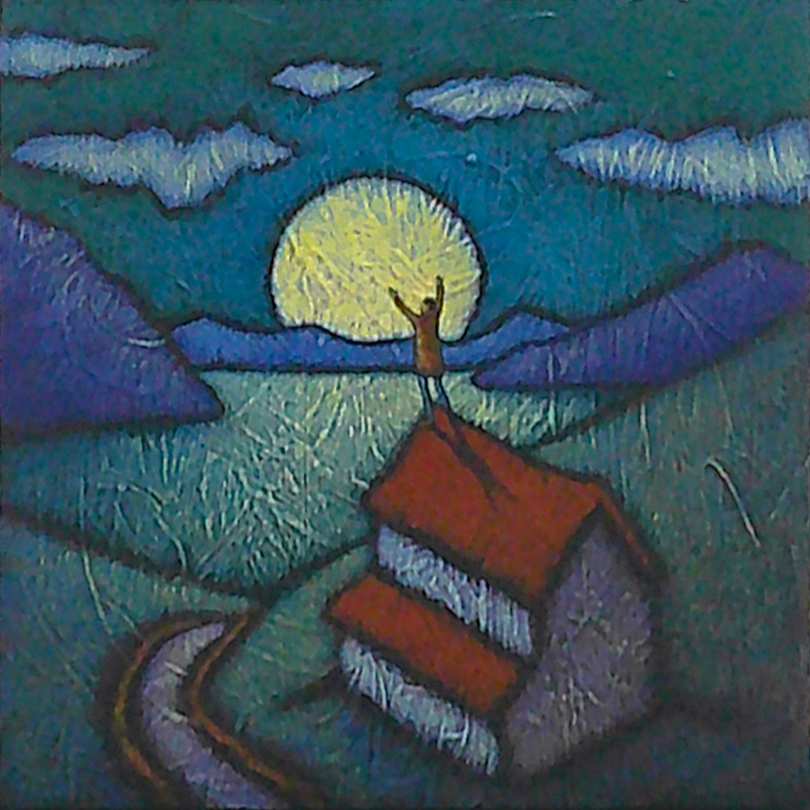
The painting at the top, Betwixt and Between, very much relates to the words of Phillpotts and the song below from Dave Brubeck. It is Sixth Sense from his 1964 album, Jazz Impressions of New York.
Strange as it may seem today to say, the aim of life is to live, and to live means to be aware, joyously, drunkenly, serenely, divinely aware. In this state of god-like awareness one sings; in this realm the world exists as poem. No why or wherefore, no direction, no goal, no striving, no evolving. Like the enigmatic Chinaman, one is rapt by the everchanging spectacle of passing phenomena. This is the sublime, the a-moral state of the artist, he who lives only in the moment, the visionary moment of utter, far-seeing lucidity. Such clear icy sanity that it seems like madness. By the force and power of the artist’s vision the static, synthetic whole which is called the world is destroyed. The artist gives back to us a vital, singing universe, alive in all is parts.
In a way the artist is always acting against the time-destiny movement. He is always a-historical. He accepts Time absolutely, as Whitman says, in the sense that any way he rolls (with tail in mouth) is direction; in the sense that any moment, every moment, may be the all; for the artist there is nothing but the present, the eternal here and now, the expanding infinite moment which is flame and song. And when he succeeds in establishing this criterion of passionate experience (which is what Lawrence meant by ‘obeying the Holy Ghost’) then, and only then, is he asserting his humanness. Then only does he live out his pattern as Man. Obedient to every urge — without distinction of morality, ethics, law, custom, etc.
— Henry Miller, The Wisdom of the Heart, 1941
I’ve had this passage from Henry Miller sitting in a draft file for a long time now. Maybe it was his use of the dated stereotype of the enigmatic Chinaman that kept me from using it. It sounds cringey, yes. Definitely not the preferred nomenclature today, as Walter from The Big Lebowski would be quick to point out.
But I understand that his reference is not a slur as he was referring to the wise and stoic sages such as Confucius and Lao Tzu. It was about artists acquiring a similar Zenlike state in their work one that transports them to the eternal here and now, as Miller put it.
The expanding infinite moment which is flame and song…
That is what struck me about this passage. It is something I understand and maybe the main reason I am a painter today. More so than any reasons based on practicality or talent.
It is that moment that comes while working on a painting when I am no longer in the studio on that particular day but instead find myself in the place and time of the painting on which I am working–the eternal here and now.
A different reality has taken hold then and its feeling is palpable. It is both liberating from and unifying with the world in which I live. Liberating in that the world outside my studio with its lies, hatred, corruption, and stupidity seems like a distant planet in that time and place. Unifying in that this act of creation, this other time and place, allows me to express a connection with humanity that I sometimes struggle to find on the outer world. Asserting my humanness, as Miller wrote.
Of course, this does not happen here in the studio every time I stand before my easel. No, it is a rare gem that is buried deep and has to be excavated. The world impinges further into the studio on some days and in recent weeks I have lacked the energy and mental clarity to be transported fully to that other place and time– the eternal here and now— for any extended visits.
But it’s getting better every day. Yesterday I was able to once again find that place and time for a spell and it was like a trip to a spa for me. As free and easy a day in the studio as I have had in well over a month. It didn’t last long but it felt good for the time I was there and not here.
I hope to find that place and time again today. And to stay a little longer.
Solitude is the profoundest fact of the human condition. Man is the only being who knows he is alone, and the only one who seeks out another. His nature – if that word can be used in reference to man, who has ‘invented’ himself by saying ‘no’ to nature – consists in his longing to realize himself in another. Man is nostalgia and a search for communion. Therefore, when he is aware of himself he is aware of his lack of another, that is, of his solitude.
–-Octavio Paz, The Labyrinth of Solitude (1950)
I employed this passage from Octavio Paz a few years back but felt that it conveyed the search for communion that I see in this painting, Finis Terrae (Land’s End). Currently at the Principle Gallery, it is one of those pieces that haunts me, lingering with me in a way that is always close at hand.
It was that way while I was painting it and in the short time I spent with it in the studio before made its way to the gallery. I couldn’t stop looking at it. It seemed to represent a search for something beyond that which one could experience with the five senses.
I struggled to identify what that thing might be and realized that the thing being sought was a sense of communion, a uniting with all from which we are comprised.
In this realization, I recognized that it presented a duality. I could see in this painting the ache that comes in the search, the desire to know that which is unknowable, while at the same time feeling a sense of peace.
That comes from understanding that the search is both a question asked in futility and its own answer.
It’s this duality that keeps me coming back to this painting in my mind.
It is both question and answer. And neither. A communion of both.
Don’t know if that will make sense to anyone but me this morning. Can’t tell if this is evidence of my mind getting sharper in response the antibiotics or evidence that it is still a bit lost in the fog.
Here’s a bit of music that I shared along with the words from Paz in that earlier post. It is a short classical violin piece from contemporary composer John Harbison. This is Song 2 from his 1985 work, Songs of Solitude. It seems to work for me as I look once more at this painting.
As I stand over the insect crawling amid the pine needles on the forest floor, and endeavoring to conceal itself from my sight, and ask myself why it will cherish those humble thoughts, and hide its head from me who might, perhaps, be its benefactor, and impart to its race some cheering information, I am reminded of the greater Benefactor and Intelligence that stands over me the human insect.
–Henry David Thoreau, Walden, or Life in the Woods (1854)
I live and work in the woods, every day trudging a path through the forest several times to my studio. For me it is ideal, and I wouldn’t have it any other way. It makes me feel apart from people and closer to what is wild, both in nature and in ourselves. It is sanctuary and classroom.
It is home.
Of course, there are some drawbacks in even the most seemingly idyllic setting. Every paradise has its own perils just to let you know that life is all about balance. Everything good is on a seesaw with something bad.
Here in my forest paradise, it is not the bear, coyote, or even the mountain lion that sometimes is rumored to be lurking. Or Bigfoot. No, here it is the deer tick.
I have mentioned a number of times over the past several weeks that I was feeling under the weather. It has been a rough ride marked by a persistent and odd sort of headache, fever and chills, dizziness, night sweats, foggy mindedness, and a tremendous feeling of fatigue. In recent days I have felt like my batteries were running at about 10% of their capacity. It’s insidious in that the loss of vigor creeps up on you gradually, making you believe that each downward step is just how you naturally feel.
Over the past five weeks I have seen my doctors a number of times and have had numerous blood tests along with several scans and x-rays. It has been a slow slog eliminating possible causes. Fortunately, my sister mentioned that my nephew had very similar symptoms in recent years that were caused by tick-borne illnesses.
Now, I had mentioned Lyme disease to one of my doctors as deer ticks are well known to me. I have been bit numerous times over the years and have had the telltale bulls-eye rings around some of the bites. Several years ago, Lyme was detected in one of the bands that are tested but it was not sufficient to be deemed Lyme disease. I still have three small scars on my thigh from two years ago when a single tick bit me before I realized he was there. For those of you who don’t know, you don’t feel their bite since they first inject a sort of anesthesia before they begin to feed.
I get tested for Lyme every year and each time I have to practically beg to be tested, describing in vivid detail that my existence has me in constant intimate contact with the verdant world of the deer tick. The doctors almost roll their eyes before begrudgingly consenting to order the test.
My mistake was in being ignorant of other tick-borne illnesses. My ignorance doesn’t excuse these doctors for not at least considering or mentioning the possibility of these other illnesses, especially after I have described the environment in which I live and work.
After speaking with my sister and nephew, I messaged my doctor and asked if they would at least consider the possibility that it might be a tick-borne illness other than Lyme disease. I specifically mentioned anaplasmosis in my message since its symptoms perfectly echoed my own.
A tick panel was finally ordered this past Monday and on Friday the results came back. It was indeed positive for anaplasmosis. I contacted my doctor before she was even aware of the results and pushed for prescription for antibiotics. I started a course on Friday evening.
Normally, you want to start antibiotics within a few days of the symptoms appearing. When this takes place, symptoms usually go away within 48 hours. Unfortunately, in my case it has been nearly five weeks since the first outburst. During this lag in treatment, several underlying condition may have been affected. Hopefully, none will be serious.
Yesterday, I could feel little energy in the afternoon, noticeably more than in the last several weeks, though it crashed in the evening. I ended up with night sweats again and a hard headache this morning. I still get very woozy and have to stop to hold onto something if I move or tune too quickly. But it feels like the antibiotics are making progress.
I hope to be able to get back into my full painting mode in the next few days. It has suffered greatly this past month or so.
I guess the lesson here is that we have to advocate for ourselves. Because without the info from my sister and nephew and my own begging for the test, my doctors would still be trying to eliminate potential causes even as the illness was doing more damage. As far as tick-borne illnesses, I would hope that doctors at least begin to consider their possibility when symptoms such as mine are presented, especially given where I live and work. I am not knocking doctors in any way here. It is something that is just overlooked too often and we shouldn’t have to be the ones to prod them to look into them.
Which is in the woods. With my deer, turkeys, foxes, raccoons, bears, possums, skunks, squirrels and so on.
Oh, and more deer ticks than you can imagine.
Thanks for listening to my tale of woe. I thought it was worth passing on just in case any of you have similar symptoms.
here’s this week’s Sunday Morning Music. It’s an old U2 song from way back in 1980. I can’t believe it’s been 45 years since this came out. Between this and my illness, I really feel old this morning. This is Shadows and Tall Trees.
The lonesome friends of science say “This world will end most any day” Well, if it does, then that’s okay ‘Cause I don’t live here anyway I live down deep inside my head Well, long ago I made my bed I get my mail in Tennessee My wife, my dog and my family
—John Prine, Lonesome Friends of Science (2018)
Another short post this morning. Not even the normal triad of word, image and song since the chorus from the song is serving as the word leg of the three-legged stool I am building here.
So, it’s a two-legged stool. Hope, it stands up.
At least for today.
The same goes for me.
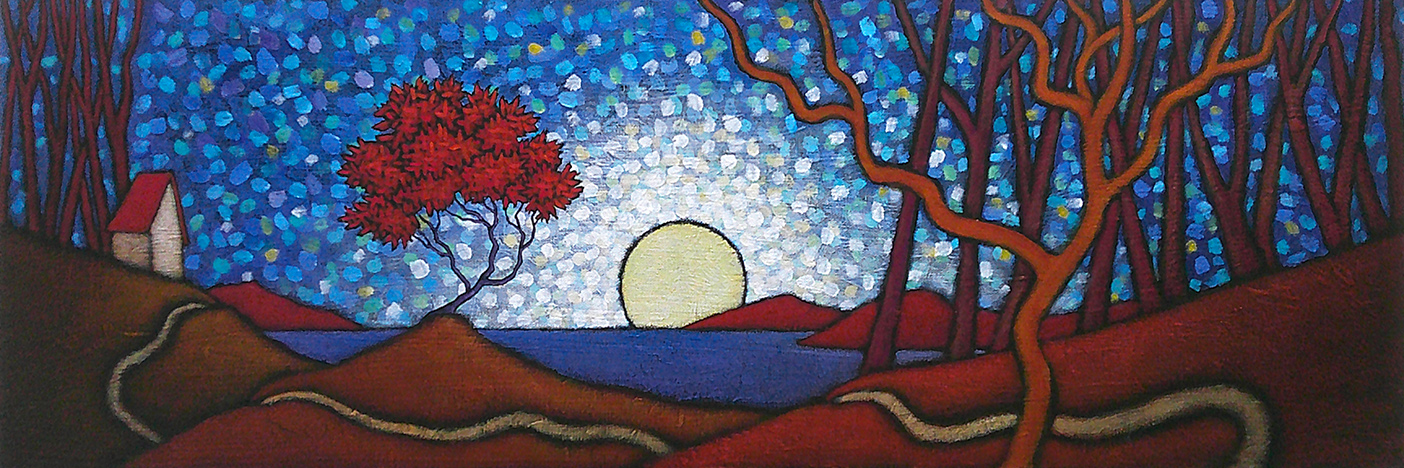
Here’s the song, Lonesome Friends of Science, from John Prine‘s last album, The Tree of Forgiveness, from 2018. As you might know, John Prine passed away in 2020 from covid. II am using the painting above, Echoes of Time, because this morning I am seeing it as that tree of forgiveness as John Prine put it.