Feeds:
Posts
Comments

Giving Thanks, Again

pooh-and-piglet-original-eh-shepard-drawing

**********************

Piglet noticed that even though he had a Very Small Heart, it could hold a rather large amount of Gratitude.

― A.A. Milne, Winnie-the-Pooh

*********************

Remember that every tiny heart has an infinite amount of room for gratitude.

And love.

And compassion.

Wishing you all a peaceful and quiet Thanksgiving Day…

Fiona’s Candle

***************

There are two ways of spreading light… To be the candle, or the mirror that reflects it.

–Edith Wharton

***************

This is a sort of new painting headed to the Principle Gallery for their upcoming Small Works show that opens next week. I say sort of new because it is a painting from a few years back that was changed in a way that made it a completely different piece.

Back then it was titled Candle and it was just as it is without the female figure and the boat. With its simplicity and color, it was a favorite of mine and it has been here in the studio for the last year or so, much to my delight. There has always been something in it that speaks to me.

But I have recently worked on a few paintings with small female figures in them and their presence has had a real impact in those compositions, adding a real layer of meaning and depth to those paintings. In the studio, I started to to look at this painting– without the figure– and began to see her there. I could see her adding a symbolism that would change and enrich the painting.

I wasn’t sure I wanted to change the original painting but day after day all I could see was a ghost of that figure in place. The original began to fade for me, began to seem lacking, as thought it had waited for me to add this figure and make it whole.

So, this what you have now.

I changed the title of this painting with another addition, becoming Fiona’s Candle. The Fiona comes, of course, from the British born US Diplomat Fiona Hill who testified in the recent Impeachment Hearings. Her strength, her intelligence, her straight forward approach, sense of purpose, and her unwillingness to suffer fools or alter her moral compass for them made a deep impression on me and many others.

We could use a few more Fiona Hills.

In this painting, I see the female figure as having those same characteristics. She is seeking, as Edith Wharton wrote above, to spread the light, to illuminate the truth– which I see here as the Sun, a set and constant thing– as either the candle or the mirror that reflects it.

I am usually averse to changing pieces that speak so strongly to me, that seem to already have a life force in them. But there are always exceptions and this painting, for me, seems to have been fortified, made stronger by one simple addition.


A Type of Gratitude

*********************

Sometimes you give birth to something or you’re part of a team that gives birth to an idea, and it grows and has a whole life of its own, and you feel grateful. It’s just so humbling.

–Glen Hansard

*********************

I understand the type of gratitude that singer/songwriter Glen Hansard is describing above. He was talking, I believe, about the life of Once, the movie that he, along with Markéta Irglová, starred in and wrote and performed the songs that made this little low budget film a hit in 2007. It then went on to be adapted for a stage production on Broadway in 2012. It was a hit there as well, winning 8 Tony awards.

Once— as an album, a movie and a play– definitely took on a life of its own and Hansard’s gratitude is understandable.

I know that feeling for myself, albeit on a much smaller scale. Every artist, I think, hopes their work will have meaning that reaches out to people in a way that it affects them deeply but that hope alone doesn’t make it happen. There is something beyond the intention and control of the artist.

That outcome is not predictable. It is a convergence of the work, time, tone, and the emotional perception of the person taking in the work.

In short, it is a small miracle.

To have a work go beyond my own understanding of it, to generate meaning that I never saw in it, and to become a real part of someone’s life is a certainly a wonder of sorts. And for me, there is nothing more gratifying than to be associated in any small way with such an occurrence.

I also feel humbled because, and I don’t know if this makes sense, it makes me feel my own smallness in the larger aspect of the work. I realize then that I only play a small part in whatever alchemy creates the miracle of art.

Hmm. Something to think about as we head into Thanksgiving.

Here’s Glen Hansard and Markéta Irglová peforming the Academy Award winning song Falling Slowly from Once.


***************

As an artist you have to find something that deeply interests you. It’s not enough to make art that is about art, to look at Matisse and Picasso and say, how can I paint like them? You have to be obsessed by something that can’t come out in any other way, then the other things – the skill and technique – will follow.

–Anselm Kiefer

***************

Anselm Kiefer (b. 1945) is one contemporary artist that continually fascinate me. His work often deals with history and how we in the present time are connected to it. One of his projects is a long term exhibit at the Massachusetts Museum of Contemporary Art that features 30 very large paintings, all about 6′ by 11′, assembled in one space. The exhibit is titled Velimir Chlebnikov based on a theory from the Russian Futurist of that name ( who died in 1922 at the age of 36) who believed that major naval battles happened every 317 years and had some sort of cosmic importance for the human race.

This group of paintings from Kiefer deal with nautical warfare and are built up on heavily textured grounds comprised of a variety of materials one doesn’t often associate with painting–dirt, sand, straw, rust and lead. It’s gritty and rough yet striking and somehow beautiful at the same time.

Now, I can’t comment on the theory. Maybe there is something in Chlebnikov’s metaphysical numerology. Who knows?

But I can comment on the impact of the assemblage and display of this group of work, this obsession of Kiefer. As an artist, I find it awe inspiring. It makes me want to push beyond my own creative inhibitions, to work on my own obsession in a way that makes a large statement.

Big work.

Bold work.

Work that pushes past what I know and how I work now.

Work that forces me in a direction I can’t foresee.

Work that changes me in some fundamental way.

It’s something to think about.

I guess that is one way in which art influences art.

Anselm Kiefer’s Velimir Chlebnikov, a series of 30 paintings devoted to the Russian philosopher who posited that war is inevitable, is on display at the Massachusetts Museum of Contemporary Art.


Decompressing and keeping it simple this morning. Something soothing perhaps.

I’ve been looking at some work recently from back in 2006 and have been struck by the tranquility and simple cleanness of design in many of the pieces from that time. It makes me feel like I should be backtracking a bit to revisit this work to see how it would emerge in the present time.

Would it have the same sort of placid quality or was that a product of my state of mind at that time? Is that something that can just be conjured up at any time?

Hmm. Something to think about but I’m not going to let it trouble my mind which brings me to this week’s Sunday morning music. It’s from Rhiannon Giddens and is her version of the old (first released in 1969) Dolly Parton classic, the beautifully written Don’t Let It Trouble Your Mind. Rhiannon delivers a great version, as she always does.

Give a listen, have a good Sunday and don’t let it trouble your mind.


What Is True

**********************

Darling remember, when you come to me
I’m the pretender; I’m not what I’m supposed to be
But who could know if I’m a traitor?
Time’s the revelator

–Gillian Welch, The Revelator

***********************

I came across an image of the painting at the top, a piece from 2006 called What Is True that holds a lot of meaning for me, and it set me thinking.

Truth is patient. It waits for the light of a sun that sometimes travels through the vastness of space and time, millions and millions of light years, to shine on it.

Time always finds truth at some point and when it shine its light upon it, there is revelation.

Every day is filled with revelation, so it seems.

Time and truth are coming together.

Here’s a favorite song of mine from Gillian Welch, The Revelator.

“You Could Be Next”

*******************

“Against legitimacy is arrayed usurpation; against modest,

single-minded, righteous, and brave resistance to encroachment

is arrayed boastful, double-tongued, selfish, and treacherous

ambition to possess. God defend the right!”


–Charlotte Bronte, Shirley and the Professor

**********************

I am perhaps more nervous than at any point in the past three years of watching the slow motion collapse, or rather dissembling, of our democracy. We are at a point where there is either going to be a price to be paid by the one person* who has abused the vast powers of the highest office in this land. In the idealized future world that our founders imagined, our system of checks and balances will hold and he will face severe consequences and democracy, as we know it, will continue in a direction that we all recognize.

If not, if this person ( I am being generous in the use of that term) is not punished, does not face grave punishment for his actions, the future is much less certain. If you think the past three years have been crazy and divisive, brace yourself for a future with a person who will then, as he already does, see himself as an emperor, a divine and untouchable being who can, with the tremendous and now unchecked powers of the presidency, operate with impunity.

This would not be a benevolent tyrant. You all know that. You can see it in the vengeful and punitive nature he so readily displays. He is not familiar with the concepts of generosity, of justice or fairness. No one will be safe from the whims of his addled brain. Opponents will be severely treated as will those who are perceived as being disloyal to him. The treatment of immigrant children, while horrific now, may well get worse. Environmental regulations will continue to be stripped away. White supremacy will force its way even more into our public lives.

Justice will have a new face and the scales she holds will be even more rigged for those with power and wealth. Your power to defend yourself will be limited.

Truth will not be truth, it will be something altogether different, dictated by those in power.

The president* will use every possible thing at his disposal– and his position gives him tools that are unimaginable to most of us– to maintain power, to strip away any oversight and to enrich and insulate himself. And we are all going to pay for it in awful ways that most of us can’t see coming down the tracks. Even my most generous imagining of a future where this man* holds onto power is bleak.

Sorry to spoil your coffee this morning and sorry for not staying in my lane, as they say. But this is not a game, not the genial “my side is better than your side” of politics of times past. It is a serious and potentially deadly business and if we don’t engage and take whatever actions we can to stem the tide, there will be dire consequences.

And I am desperately worried that we may not be able to do enough to turn the tide.

And to those of you who somehow and inexplicably support this person*, I say: Be careful what you wish for.

Below is an essay from award winning journalist/author Kurt Eichenwald that appeared yesterday in the form of a Twitter feed that sets out one possible scenario that could take place if there are no consequences for corruption and illegality. It is well worth a read.

***************************

“You could be next.”

The GOP has made it clear it has become a wholly-owned subsidiary of Russia/Trump, and no amount of evidence is enough to justify removal of a corrupt president. They will not protect Americans.

So key message from Dems should be: “You could be next“…the President of the United States attempted to compel a foreign nation – one he claims is corrupt – to investigate and possibly jail an American citizen.

If Trump believed a crime had been committed, he would have turned to the FBI. Instead, he tried to outsource to a foreign nation. Even if you are irrational enough to believe that there was no pressure on Ukraine, no attempt at extortion or bribery, that action is undeniable. He was taking an act with the ultimate outcome potentially being an American citizen and political rival locked up in a foreign prison.

This is *exactly* the kind of action taken by dictators, except they do not have to hide their actions by trying to engage in them in secret by pressing a foreign nation. This alone without any other facts is an impeachable abuse of power and the GOP, Lindsey Graham, Devin Nunes et al have all made it very clear that they “do not care” if a president outsources criminal investigations of Americans to foreign states.

Worse, they “do not care* if this is set up for “announcement first, defense someday” when you have an outsourcing of investigations, corruption is inevitable. Next, it could be me. It could be you. Do you really want to live the rest of your life in a Russian or Ukrainian or Syrian prison cell, simply because you angered Trump?

The GOP will not care given their willingness to avoid all evidence, people like Lindsey Graham will shrug as the Trump Administration extradites Americans overseas to be tried in corrupt foreign courts as the result of investigations instigated in other countries by our president if Trump wins reelection, which he might, the GOP senate has made it clear that no action, no crime, no corruption is off the table.

Will Trump send troops into the offices of the New York Times, or Amazon, or any other company that angers him to arrest his “enemies” and then extradite them to Siberia, in an investigation he instigated? Will he send “critics” he despises? Will he go after democrats as a whole unit? If acquitted by a party refusing to look at evidence there will be no limit to what Trump can do without consequence, will it be safe to be a prominent Trump critic or political opponent, given he has been freed to do anything?

Next time, it could be you.” That needs to be the phrase the Democrats need to deliver in every Senate and House election we are truly at the verge of a collapse of all checks and balances, with an Administration that believe it can tell Congress and the courts to go to hell, knowing that the most corrupt party in American history will cheer him for it.

Once the “see no evil” party sends the “all-clear” for any act of corruption, anything is possible.

Sound far fetched? It has already been done by the Republicans. In the 2000s, Americans falsely concluded that a Canadian citizen was a terrorist and asked for evidence from Syrian government. The Syrians brutally tortured another Canadian they held before he falsely said, “Yes, this other Canadian is a terrorist.”

The man, Maher Arar, was headed home to Canada, was seized by American authorities at JFK Airport and, because we had no basis on which to hold him, the US outsourced the investigation to Syria, a place the man had never been. He was shipped there, beaten, burned, raped, tortured in every horrible way imaginable.

And only after this man was wrecked, did we say “Oh. Maybe we’re wrong.” The Canadian government had to pay $10 million settlement to Arar, US government refused to pay, claiming “national security.” And no Republican cared.

Outsourcing of criminal investigations by Trump is corruption of the highest order. It puts every American who might criticize Trump in danger.

And, just like they did before when we outsourced the torture of a Canadian citizen, Lindsey Graham, the RNC and the Devin Nunes of the world will go on Fox and declare that Trump was right to rob us of our rights, to submit us to any abuse by pushing foreign nations for corrupt criminal prosecutions of critics and opponents. There is not a single Republican who will stand up for our rights, who will protect us, so long as they get tax cuts.

We are all in danger.

Next time, it could be you

Every house race, every senate race, where a Republican has argued that there is nothing abusive about the President of the United States attempting to get an American citizen charged with a crime and locked up simply because they are his opponent, needs to focus on the power the GOP has granted Trump to violate our every right.

Want your guns? Not in lots of overseas nations, where you might be sent.

Want a lawyer? Sorry – you’re not in the US anymore.

“Next time, it could be you.” And GOP will not protect us.

They all must be voted out and if you are “well, I don’t like this dem or that dem” – always remember that those who supported the most left-wing candidate in Hitler’s first national German elections. The supporters – as well as the candidate – died in a concentration camp because they didn’t think the other candidate was progressive enough.

Now, I am not saying Trump is Hitler or that we are heading into Nazi Germany. I am saying that our rights are at stake, we have no defense, and failing to fight back at the ballot box could be disastrous.

People always say, “It can’t happen here.”

It can. The president tried to secretly get American citizens locked up in a foreign nation on the basis of a conspiracy theory. It can happen, & the GOP will do nothing to stop it.

And next time, it could be you.

Vote them all out.

—–Kurt Eichenwald, Twitter, November 21, 2019

Below is a wonderful essay on what we can learn from listening to trees from Hermann Hesse. The late Nobel Prize winning writer included this in his 1920 book, Wandering: Notes and Sketches. There is a lot to like here but I was most struck by the line: Home is neither here nor there. Home is within you, or home is nowhere at all.

Give it a read for yourself:

For me, trees have always been the most penetrating preachers. I revere them when they live in tribes and families, in forests and groves. And even more I revere them when they stand alone. They are like lonely persons. Not like hermits who have stolen away out of some weakness, but like great, solitary men, like Beethoven and Nietzsche. In their highest boughs the world rustles, their roots rest in infinity; but they do not lose themselves there, they struggle with all the force of their lives for one thing only: to fulfill themselves according to their own laws, to build up their own form, to represent themselves. Nothing is holier, nothing is more exemplary than a beautiful, strong tree. When a tree is cut down and reveals its naked death-wound to the sun, one can read its whole history in the luminous, inscribed disk of its trunk: in the rings of its years, its scars, all the struggle, all the suffering, all the sickness, all the happiness and prosperity stand truly written, the narrow years and the luxurious years, the attacks withstood, the storms endured. And every young farmboy knows that the hardest and noblest wood has the narrowest rings, that high on the mountains and in continuing danger the most indestructible, the strongest, the ideal trees grow.

Trees are sanctuaries. Whoever knows how to speak to them, whoever knows how to listen to them, can learn the truth. They do not preach learning and precepts, they preach, undeterred by particulars, the ancient law of life.

A tree says: A kernel is hidden in me, a spark, a thought, I am life from eternal life. The attempt and the risk that the eternal mother took with me is unique, unique the form and veins of my skin, unique the smallest play of leaves in my branches and the smallest scar on my bark. I was made to form and reveal the eternal in my smallest special detail.

A tree says: My strength is trust. I know nothing about my fathers, I know nothing about the thousand children that every year spring out of me. I live out the secret of my seed to the very end, and I care for nothing else. I trust that God is in me. I trust that my labor is holy. Out of this trust I live.

When we are stricken and cannot bear our lives any longer, then a tree has something to say to us: Be still! Be still! Look at me! Life is not easy, life is not difficult. Those are childish thoughts. . . . Home is neither here nor there. Home is within you, or home is nowhere at all.

A longing to wander tears my heart when I hear trees rustling in the wind at evening. If one listens to them silently for a long time, this longing reveals its kernel, its meaning. It is not so much a matter of escaping from one’s suffering, though it may seem to be so. It is a longing for home, for a memory of the mother, for new metaphors for life. It leads home. Every path leads homeward, every step is birth, every step is death, every grave is mother.

So the tree rustles in the evening, when we stand uneasy before our own childish thoughts: Trees have long thoughts, long-breathing and restful, just as they have longer lives than ours. They are wiser than we are, as long as we do not listen to them. But when we have learned how to listen to trees, then the brevity and the quickness and the childlike hastiness of our thoughts achieve an incomparable joy. Whoever has learned how to listen to trees no longer wants to be a tree. He wants to be nothing except what he is. That is home. That is happiness.

*************************

MALONEY: Why do you have confidence that you can … tell your dad not to worry?

LT. COL. VINDMAN: Congressman, because this is America. This is the country I’ve served and defended. That all of my brothers have served. And here, right matters.

MALONEY: Thank you, sir.

Applause breaks out.

*********************

Those short few sentences above from the testimony of Lt. Col. Alexander Vindman during yesterday’s Congressional Impeachment Hearing pretty much sums up what the stakes are in this hearing.

This country, as a nation and each and every one of us as individuals, has to decide if he is correct in the statement that here in the United States, right still matters.

We have to ask ourselves a simple question: Do we want to live if a country that lives by the hardset and time honored values of rightness, of truth, of honor, of duty?

Or do we want to live in a country where those values are negotiable and subject to the situation at hand and the person involved? A country where those values don’t really apply so long as you have enough power or privilege or connections to be able to shrug them off?

Listen, I am not naive to think there haven’t been plenty of situations in our past where power, privilege and connections have overpowered our values at times. But in the past, that sense of honor, duty and rightness has always somehow persevered. This nation has not always operated in absolute truth and rightness and honor but the hope is that we lean that way, that we somehow keep struggling and pushing in that direction.

That hope, that continual trending toward rightness, is the basis for any exceptionality we might claim.

But this feels different.

It feels like a defining moment for us and our future. It feels like there is part of us who have taken control and wish to ignore these values, who find them inconvenient and restraining to achieving their own aims.

They continue to move away from answering to a sense of rightness or duty. How do you reconcile that as a nation going into the future?

If the falsehoods and corrupt intent we have witnessed are not impeachable, not subject to oversight and being called out, where does that leave us for the future? Where do we then draw the line between what is right and wrong?

If we cannot stand up for what is right and true now, we may be looking at a future where we may not get the chance to do so.

So, ask yourself and answer honestly: Does right matter here still?


******************

I wrote the above yesterday. Last evening I then caught the end of one of my favorite movies, Watch on the Rhine. It’s a film set in Northern Virginia, around Washington DC, during World War II and concerns the daughter of a well-to-do family who has come home from Europe with her family.

I am not going to go into  the whole plot here but I will point out that her husband, Kurt Muller played to perfection by Paul Lukas, is an anti-fascist fighter and a leader in the European resistance against the Nazis. This character is one of my favorite characters on film, a man driven completely by rightness and truth, willing to sacrifice everything to fight for the lives and rights of other men.

Seeing this powerful portrayal of such an honorable character stood in stark contrast to the performance I witnessed earlier by the republicans during the hearings. There was no honor shown by these men, no sense of rightness or dignity. These are not people who are willing to sacrifice anything for anyone. They are only willing to protect their own interests and those of their buddies. Screw everyone else.

They are the antithesis of rightness.

To give a quick example, Lt. Col. Vindman and his family are under 24/7 protection from Us Army security forces and they are looking to move them into a secure location because of threats against the Lt. Col. from Trumpists spurred on by these jackals. This man, an immigrant who came here as child, has served and sacrificed for this nation for many years. He wears a Purple Heart for being wounded in action. He has honorably risen to the highest levels of military diplomacy and has been characterized in reviews by his superiors as being “brilliant” and in the top 1% of all the military. Yesterday, this man was subjected to all sorts of attacks on his character and motivations for simply coming forward and pointing out actions that he saw as being wrong.

He was simply doing his duty. Like Kurt Muller from the movie, he was simply doing that which is right.

I would put Lt. Col. Vindman’s sense of rightness and honor up against that of all the republicans in that hearing who have seemingly sold their souls, their dignity and their honor for god knows what in order to protect a vile and small man. A man without honor or loyalty who will throw them to the trash heap without a thought when they no longer serve his personal needs.

As I said, the contrast is stark.

Black and white. Good and evil.

Right and wrong.


Choose Your Bacon

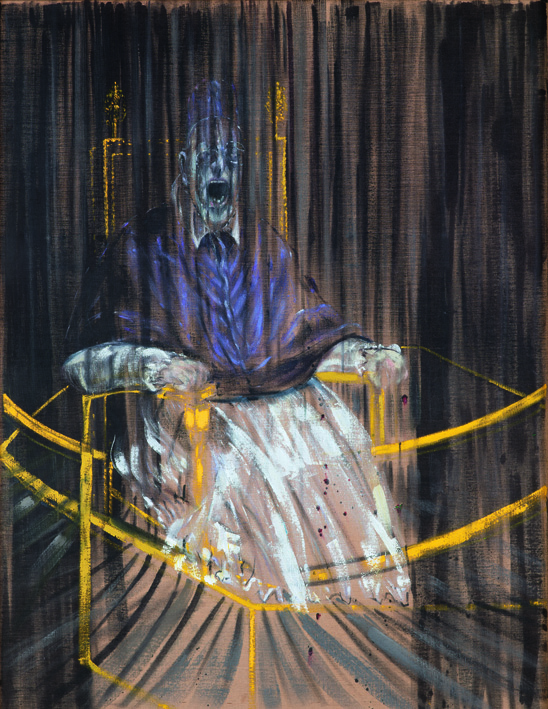
Francis Bacon- Study after Velázquez Portrait of Pope Innocent- 1953

****************************

Imagination was given to man to compensate him for what he is not; a sense of humor to console him for what he is.

–Sir Francis Bacon

****************************

There are two very different characters from history that carry the name Francis Bacon. Both are British, one a famous 20th century painter and the other a Renaissance man from the Age of Elizabeth in the late 16th/ early 17th century. The latter generally carries the Sir before his name. As I said, very different though I sometime come across a quote and have to do some checking to make sure one is not the other.

The painting Bacon was Irish born and lived from 1909 until 1992. He is best known for his dark figurative work that often contorts the features of the subjects of the work. I wrote about his studio (seen below) in an early post here. It was a spectacular mess, with piles of papers and paints and all sorts of detritus. Whenever I think my studio is an unworkable mess, I think of Bacon’s studio and suddenly mine doesn’t seem all that bad. His studio was such a spectacle of disarray that it was moved from where had been in London to a Dublin museum space, The Dublin City Gallery. There it was meticulously reconstructed to its former fabled jumble.

Francis bacon- Reece Mews Studio

Now, the other Francis Bacon, Sir Francis Bacon, lived a life of great achievement from 1561 to 1626. As a statesman, he served as the Lord Chancellor and Keeper of the Great Seal for Elizabeth I. He is perhaps better known as a philosopher and scientist, considered the father of the modern scientific method as well the father of empiricism.

One of the more famous stories of his life revolve around his death. While traveling, he was supposedly having a debate with a companion over his theory that animal meat could be frozen as a means of preservation, something unheard of at the time. Stopping at a farm they were passing, Bacon is said to have contracted the pneumonia which caused his death as the result of trying to freeze a chicken by stuffing its carcass with snow and ice.

What a way to go. But next time you pull your Swanson Chicken Pot Pie from the freezer, you might want to thank (or curse– it’s a frozen pot pie, for god’s sake) Francis Bacon. I mean, of course, Sir Francis Bacon.

The next time you have a nightmare with a screaming Pope, you can thank the other.


Francis Bacon- Three Studies Of George Dyer, 1966