Feeds:
Posts
Comments

Vasarely/ Quality

.

The value of the prototype does not consist in the rarity of the object, but in the rarity of the quality it represents.

–Victor Vasarely

*******************

I have to confess up front that I am not a big fan of Victor Vasarely (1906-1997) or the Op-Art movement of which he is at the forefront. It’s not that I am denigrating it. I have seen a number of pieces that I do like and I can certainly see people being intrigued by its color and forms and how it can reverberate in certain environments.

If I had a mid-century home with lots of glass and chrome, I might think about hanging this type of work. But I live in a cabin in the woods.

It’s just not to my particular taste, that’s all.

That being said, I immediately nodded in agreement when I read the quote above from Vasarely. As I read it, it jibes well with my own views on the intrinsic value of art and how the artist behind it affects the artwork’s value beyond that of a mere object.

When I have spoken with students in the past I try to impress on them that while they must learn their craft, they should also focus on making themselves fully rounded humans with an individual voice that reflects their uniqueness and individuality.

I urge them to read more, listen more, and to look at more things, all preferably outside their own known preferences.  I believe it creates a sense of fullness that will extend into their work, giving their work a greater sense of that quality that takes a piece beyond being a mere object of decoration.  And today, when there are more artists than at any other time at any point in history, its that rare sense of this quality that can make the difference in how seriously an artist’s work is viewed.

I don’t know if that ever gets through to these kids or if it even holds true in reality, but it seems right to me. I personally try to view each piece as a combination of skill, experience, acquired knowledge and influences, and the flaws and strengths of my own character–hopefully, the better parts of it.

Sometimes it works and at those times I see the quality represented by it that Vasarely described. When it doesn’t, I see a mere object that lacks the fullness that I am trying to put in it. I can see that I have somehow withheld some part of myself from that work and I try to figure out how to overcome that deficiency.

But most of all, I keep trying to find that rare quality…

Sorrow’s Companion

Truly, it is in darkness that one finds the light, so when we are in sorrow, then this light is nearest of all to us.

Meister Eckhart (1260-1328)

********************

In the last few days I finished a small group of paintings to add to the several I had already submitted for the West End Gallery‘s annual Little Gems show that opens on Friday. I hadn’t been planning on doing these additional pieces as I have other work that needs to be started. But there was something in the original pieces that I took out last week that lit that spark that I had been futilely searching for in the first month of the year. So, I thought I had been stick with it for a bit to see where it goes.

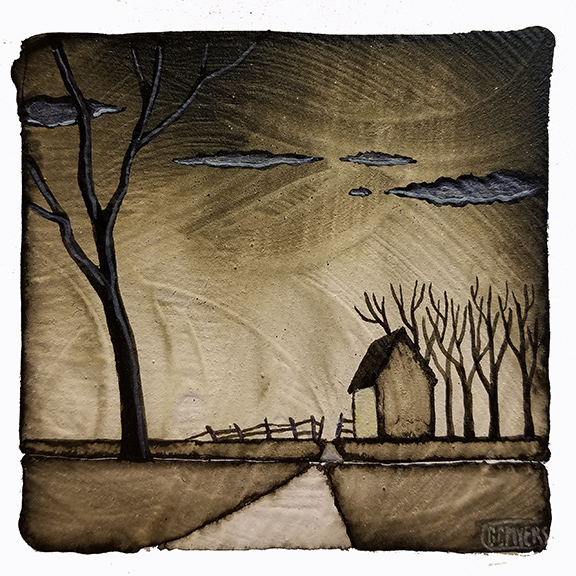
This piece, which I call Sorrow’s Companion, is one of the new paintings to emerge. Since it’s been done, I keep coming back to this one to just peer at it, all the while trying to discern what I am seeing and feeling in it.

There’s something very sorrowful in it’s imagery. The dark clouds in the sky. The empty chair. The dead tree with the lone crow on a branch. The empty horizon. It all point to the sorrow of loss of someone or something.

Yet, despite the sense of sorrow there is dull sunlight peeking through the gray in the sky. As the 14th century German theologian Meister Eckhart pointed out in his words at the top of the page, light is found in the darkness and is always nearest in our sorrow.

The light is sorrow’s companion.

So, I see this piece as having an air of melancholy but it is an optimistic melancholy, if there can be such a thing. Maybe this comes from understanding that true sorrow comes from knowing the feeling of true love. And there is a certain joy in just having experienced that feeling that lingers through the sorrow.

Sorrow doesn’t come without joy…

Rave On

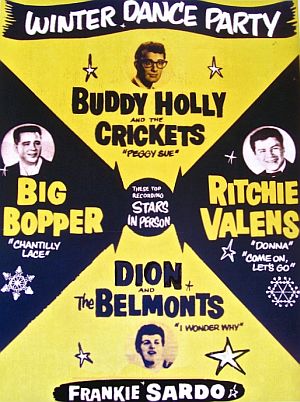
Forgot to mention yesterday that it was the anniversary of the Day the Music Died as Don MacLean called it in his 1971 mega-hit American Pie. It was early in the morning on February 3, 1959 that the small plane carrying Buddy Holly, Richie Valens and J.P. “The Big Bopper” Richardson to their next show in North Dakota crashed into an Iowa cornfield, killing all three.

Holly and Valens were key players in the transition from the early days of rock and roll to the next generation that was marked by the rise of the Beatles and the Rolling Stones, both bands that very heavily influenced in their early work by the music of Buddy Holly. Think of modern rock/pop music being a genealogy chart, a family tree with Buddy Holly as a parent and his offspring and their children and so on all branching out in front of him. Most likely, he is a direct musical ancestor of many artists you listen to today, even though they may not even recognize it themselves because each subsequent generation adds lines of influence from which they synthesize their own music.

Just like Buddy Holly was the result of country music, folk blues and early rock and roll, each generation is a distinctly unique blend.

So, 59 years ago it was a huge loss when that plane crashed outside Clear Lake, Iowa. I have to admit that I sometimes overlook Buddy Holly, shifting him into a hidden file in my mind, until I am reminded by something, such as yesterday’s anniversary just how unique an artist he was and how much I enjoyed his music. I’ve spent much of this morning revisiting his discography, listening to songs that had a huge impact on so many other artists: That’ll Be the Day, Not Fade Away, Maybe Baby, Peggy Sue, Well..All Right, Oh Boy and many others. Just plain good stuff.

Here’s a favorite of mine, Rave On. Have a great Sunday.

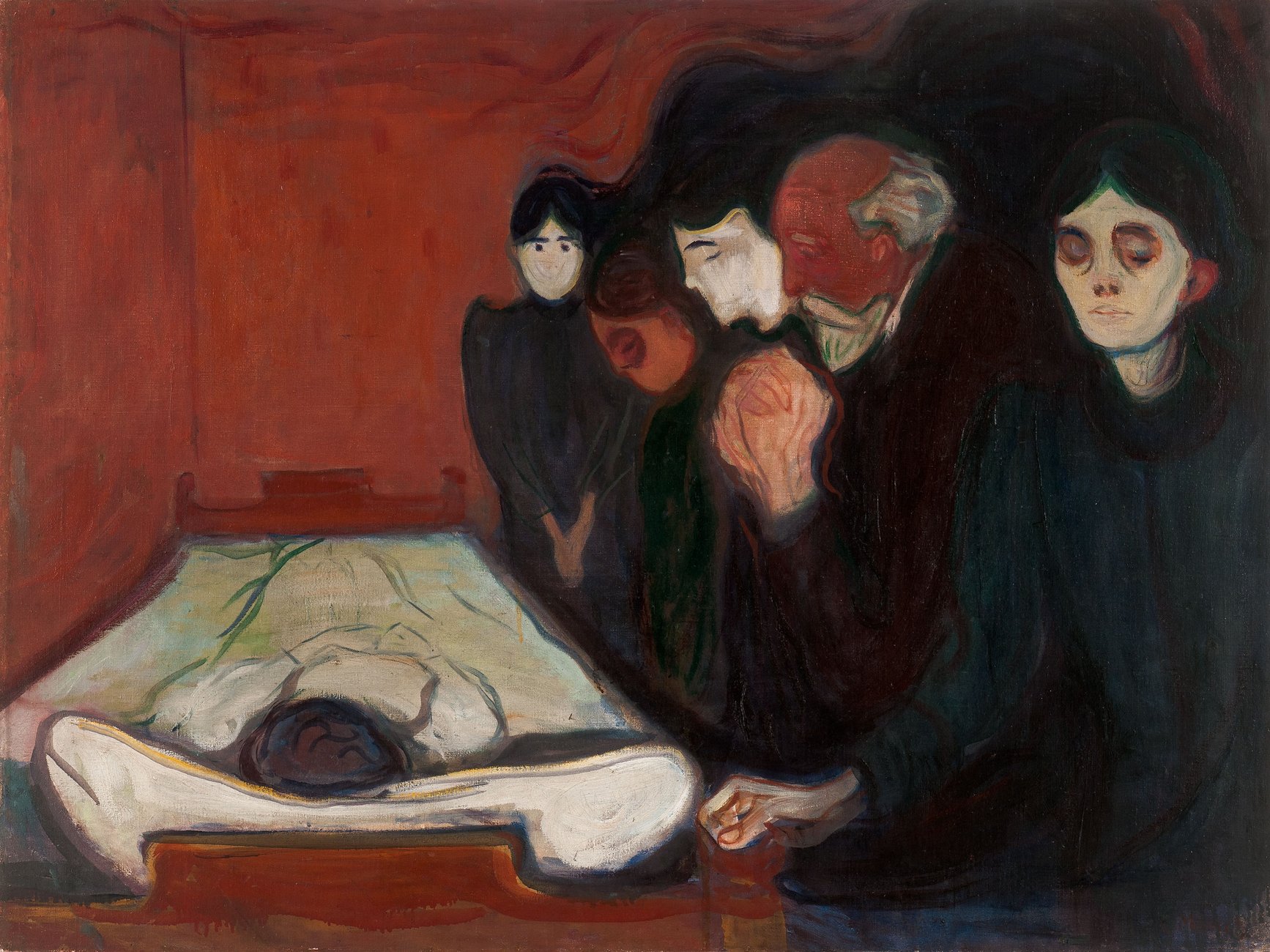
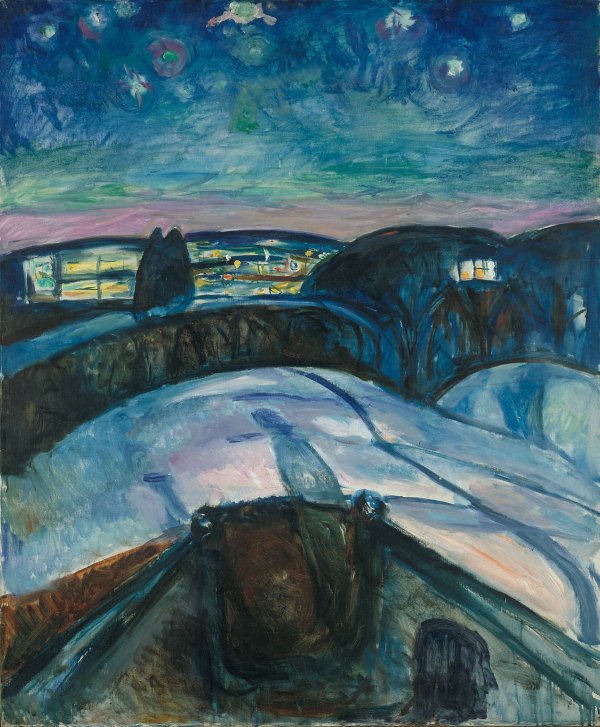
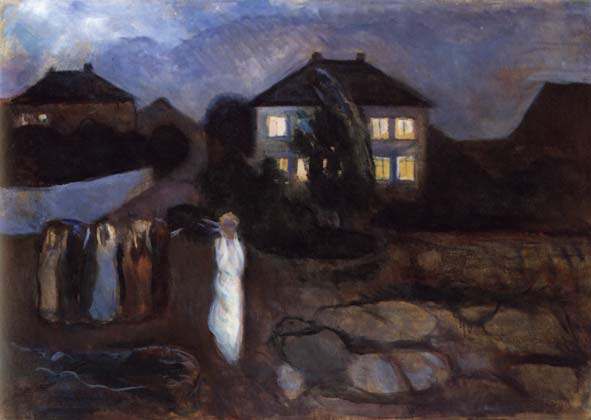
I do not believe in the art which is not the compulsive result of Man’s urge to open his heart.

–Edvard Munch

*****************

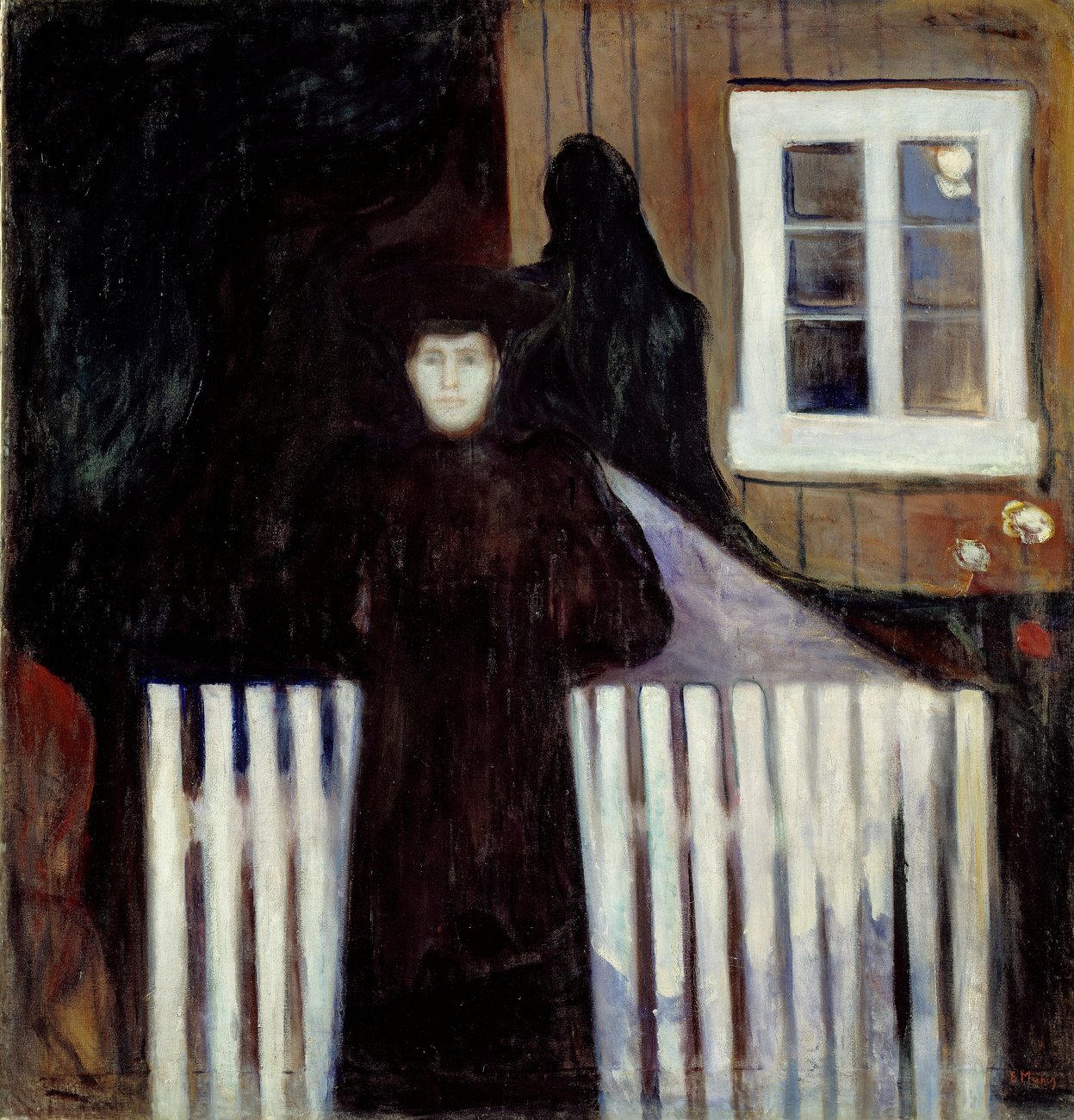
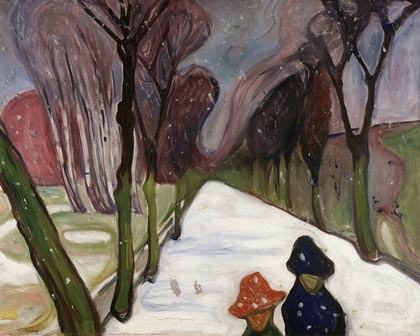
Edvard Munch, the Norwegian painter who lived from 1863 to 1944, is best known for his painting The Scream. Unfortunately, that’s the only painting of his most folks can recall. But he had a long and very productive career, creating work that was often dark and filled with anxiety. But it was always his own, pulling deeply from his own inner life and emotions.

His work may not resonate with you– not all of his work hits the mark for my own tastes–but there is no denying that it has the emotional power that can only come from an opened heart that seeks meaning in life, his ultimate goal as an artist.

Or as he said: In my art I have tried to explain to myself life and its meaning. I have also tried to help others to clarify their lives. 


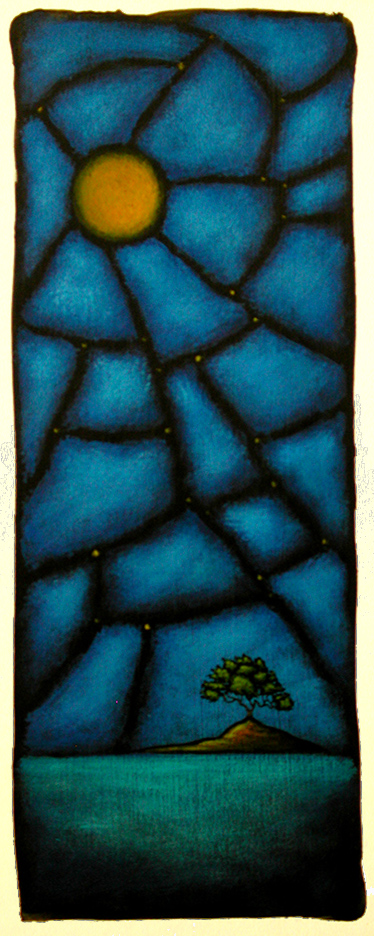
Night Blossom

I was recently going through some old work and came across some paintings from 2002 that had slipped my mind. There were several done in the same style as the piece shown here, Night Blossom, with chunky, mosaic-like skies in deep blues and greens.  They had a dark, moody tone and a sense of weight in them that really drew me to them when I pulled them up on my screen.

It made me wonder why it was a path that I didn’t follow a bit further at that time. Maybe I felt it was too reminiscent of stained-glass. It does have that feel in the way it goes together.

Or maybe I just was headed in another direction that had a little more pull on me at the time. I was in the midst of my Dark Work in the aftermath of 9/11 which took me directly into my Red Roof series so perhaps that is the main reason for not doing more in this vein.

So, it may be as simple as it turning out to be that there is not enough time in the day to follow up on all the flares that are sent off in one’s head sometimes. Who knew?

But seeing this again and examining it closely re-ignites that flare and I see this as a new possibility in a larger scale done with skills that have evolved in the past 16 years.

And that is exciting for me.

Whether it turns outs to be what I see in my head is another thing. Sometimes those things I envision turn out much different in reality and not always in a positive manner.

We shall see…

Like everything genuine, its inner life guarantees its truth. All works of art created by truthful minds without regard for the work’s conventional exterior remain genuine for all times. 

Franz Marc

******************

Franz Marc is not one of my favorite artists but that is not to say I am not a fan of his. I like many of his paintings and some do little for me. And that’s okay.

But I greatly admire the fact that he created an impressive body of work in a short period of time– he was only 36 years old when he was killed in the Battle of Verdun in World War I in 1916— that has survived and prospered during the last hundred years. Under Hitler’s Nazi Third Reich, his work was labeled as degenerate art and was subject to destruction. But his work persisted.

I also admire the fact that he chose to carve out his own niche, creating work that is instantly identifiable as his. His use of bold primary color, the animal subjects that populated many of his pieces and the use of Cubist elements make his work easy to distinguish when you come across one. Many of you are probably familiar with his famous yellow cow or his blue horses.

I also admire and am in agreement with many of his writings about art. We both tend to look at art as having an inner life of its own so long as the artist allows that truth to manifest itself and creates the work with true emotion and feeling.

His desire to create work that remains genuine for all time is mine as well. The idea of connecting and communicating with future generations is deeply appealing. You always hope your work speaks beyond time or language or place.

So, while I may not number Franz Marc among my favorite artists, he is nonetheless a great influence on my work.

One Last Look

Remembrance of things past is not necessarily the remembrance of things as they were.

 Marcel Proust

*********************

A few days back I featured a new small painting that is headed to the West End Gallery for next week’s opening of their annual Little Gems show. That piece, and never looked back…, was a stark image in tones of black and gray that was about the idea of being forced from your home, never to return. It’s a depiction of that moment of leaving and the sense of loss and abandonment that remains.

The new painting above, also headed to the Little Gems show, is another take on the idea of abandoning one’s home. This piece, One Last Look, speaks to the nostalgia that appears after time, as memories of bad times and the accompanying anxieties have faded and singular moments of happiness have grown to fill all the moments of that time.  Time has smoothed away the rough edges and we begin to think that that time, that place, was much more idyllic than it ever was in actuality.

To me, this painting speaks to that nostalgia and its idealized sense of home and youth. With nostalgia, the past seems more vivid and vibrant.

The grass was greener then, I guess.

I am reminded of a post I wrote back in 2009 where a large poll taken at that time throughout Russia named Joseph Stalin as the third greatest Russian of all time. I wrote: Despite the many millions, yes, millions of Russian citizens who were put to death by Stalin, despite the political purges and gulags and Soviet policies that caused a type of artificial famine that killed far more citizens than any natural famine more than once, the current populace said that this Man of Steel was their guy.

Some of those polled had lived through the Stalin era but time, and a little more food and comfort now, had eroded the memory of the hardship, the famines and the purges. In fact, Putin had began extolling the virtues of Stalin about that time and many of these people felt the country needed that type of autocratic leader again. In Putin, they– and, unfortunately, we as well– may have found him.

We all often fall prey to this sort of nostalgia, our memories holding onto a few events of happy triumph here and there through time and discarding the much more numerous days and weeks and months of chaos or drudgery that many of us live through.

Nostalgia is like a beautiful double-edged sword– both wonderful and terrible. Such things should be handled with care.


.

Visible things can be invisible. However, our powers of thought grasp both the visible and the invisible – and I make use of painting to render thoughts visible.

― René Magritte

******************

It’s an interesting thought, that our power of thought grasps both the visible and the invisible.

I, a seemingly visible thing, have sometimes felt invisible.

And I have sometimes seen things that turned out to not be there at all.

Thought is a magical thing.

And maybe that is why some folks paint, to attempt to capture those things they think they see and to take away their own invisibility.

Gotta chew on that one for a while…

Botero

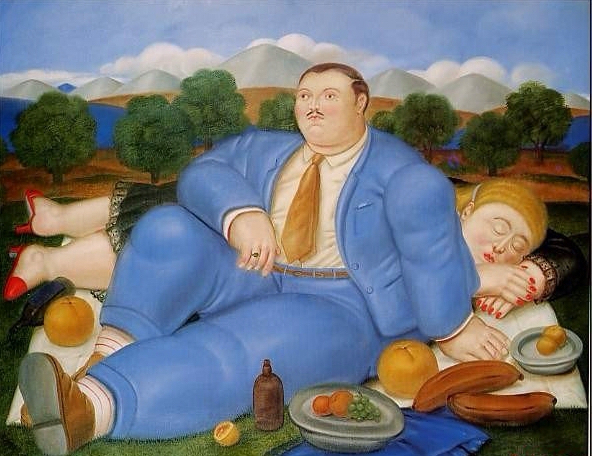
An artist is attracted to certain kinds of form without knowing why. You adopt a position intuitively; only later do you attempt to rationalize or even justify it.

Fernando Botero

.
*********************
I don’t know much about artist Fernando Botero, who was born in 1932 in Medellin, Colombia. But it is obvious that his work represents his attraction to a certain kind of form– the round and the over-sized. While I would not count him among my favorites, I am impressed by the impression his work makes, how you never doubt that a painting or sculpture is his work.
.
His work is boldly and instantly identifiable. And that is saying a lot.
.
I think a lot of artists struggle in finding that certain kind of form that speaks to them intuitively, a form that becomes part of their true voice. Botero found it in the form of rotund figures and listened to his intuition. I think the impressive body of work he created over his long career justifies his decision.

This new small painting is titled and never looked back… and is headed to the annual Little Gems show at the West End Gallery. It’s a piece that reminds me of the Depression era and the Dust Bowl refugees who forced from their homes by a hostile environment and a pitiless economy, leaving all they ever knew behind. I can only imagine the feelings of loss, the anxiety, the confusion and the anger that must have been constantly running through these people’s minds.

To have to leave one’s home– and never look back.

I know this is hardly a happy subject to face on a Sunday morning but I worry that we will someday soon face the same sort of situation. It has happened in one instance recently, if you consider the many people of Puerto Rico who have lost everything in the past year and how they have been forced to leave their island home. They are the current modern day Okies.

You may say this an unfounded worry, given the strength of our economy. And you’re probably right, at least for the short term.  But with the deregulation taking place in the financial sector, the shredding of the social safety net and unparalleled wealth inequality– a mere 6 people have more wealth than the bottom 50% of the global population, 3.7 billion people– we are setting the stage for a huge economic crash when the economy eventually sputters, as it will given its cyclical nature.

I know that I sound like a bummer filled with gloom and doom. I don’t mean it that way. I am just sending out a cautionary note that if we continue to ignore the lessons of the past, we will relive them. Not necessarily in the same way. We may not be Okies jammed into old trucks, heading out west to pick fruit. I don’t have the imagination to think what our lives might be in the next critical situation that comes our way. But I do know that it won’t be good unless we begin working now to avert the worst of it.

Okay, enough. Today’s Sunday morning music is a classic Dust Bowl era song from Woody Guthrie that was in my mind when I was finishing up this painting. It’s title is I Ain’t Got No Home in This World Anymore.

In the 1950’s, Guthrie lived in public housing in Brooklyn that was built with public funds by a NY developer by the name of Fred Trump – yeah, that guy’s father. Guthrie noticed the fact that people of color were not allowed in that development and later wrote new verses for this song that called out the racism of Old Man Trump, as he called him. This discrimination throughout Trump’s network of developments persisted for nearly 25 years until a Civil Rights lawsuit was brought by the Federal authorities and was settled in the late 70’s. Here’s a link to an article outlining more of the details.

Like I said, we relive the past.

Give a listen and have a good Sunday.