Lot to do this morning, mainly trying to start a tractor that balked at waking up in the -10 degree temps. Not something I want to do but at least it’s beautiful out there. Deadly cold but gorgeous.
Before I bundle up and head out I thought I’d share this week’s Sunday morning music. It’s one that I’ve been waiting to play for some time and today seems like the perfect day for a variety of reasons. It’s an old Aretha Franklin song, Runnin’ Out of Fools, that is covered here by Neko Case. The original Aretha version is great but I also love this performance.
This quote from the poet Maya Angelou has been floating around for some time. I think it’s a pretty powerful statement of a universal truth, especially on this particular morning.
Though there was never much doubt, we all positively now know what we are dealing with in this country.
Call it what you will– racism, nativism, moral bankruptcy and an ignorance of history along with a general lack of intelligence– but it sure as hell isn’t patriotism. No, this morning the mask is completely off and the barely disguised dog whistles have become megaphones.
And those that respond to the call of that megaphone can no longer claim they don’t know. By standing with this administration, they are revealing who they really are.
And when they show me who they are, I will believe them.
At seventy-three I learned a little about the real structure of animals, plants, birds, fishes and insects. Consequently when I am eighty I’ll have made more progress. At ninety I’ll have penetrated the mystery of things. At a hundred I shall have reached something marvelous, but when I am a hundred and ten everything I do, the smallest dot, will be alive.
–Katsushika Hokusai
***********************
I really like the bit of wisdom above from the great Hokusai, both for his optimism on aging as well as the idea that as he continues to progress his work will reach a point where everything he paints– even something as simple as a dot– has a life force within it.
Attaining that life force, where the painting transcends what you have put into it, in any one piece is a rare and difficult thing for any artist to achieve. But that idea that you might one day reach a point where your work has moved from a product of thought and craft to a transcendent expression of the spirit is something that seems beyond our reach or even our aim.
But perhaps we should keep it as an aim in our mind, along with the idea that we will continue to progress as we age, even if it is stored in rarely visited corner. If we hold on to it perhaps we will subconsciously find our way to that goal. And when we are a hundred and ten, the dots we paint will have that same life force as those created by Hokusai.
It’s something to hope for…
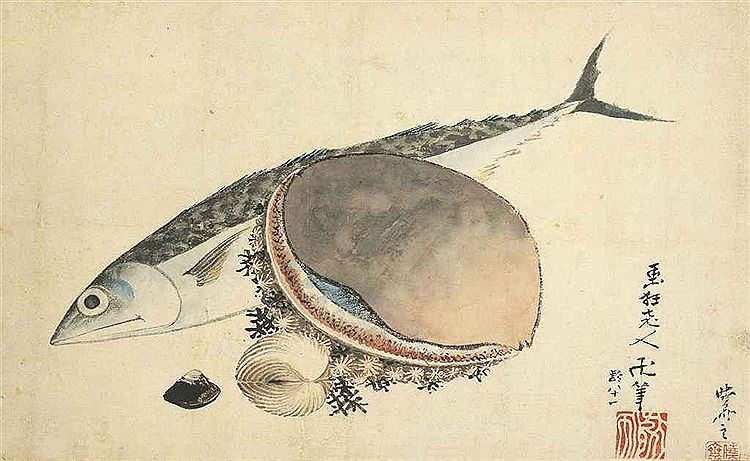
I’ve included a few of Hokusai’s paintings beyond his famed wave and landscapes. I love his fish pieces and the raven is wonderful. Enjoy!
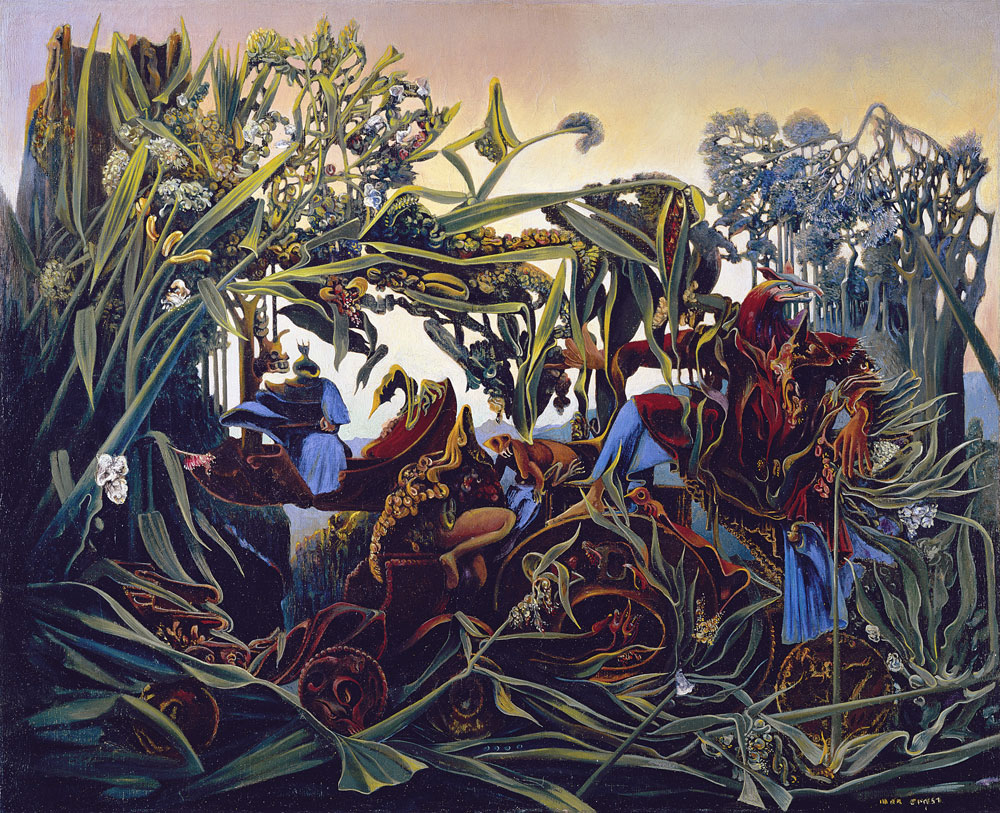
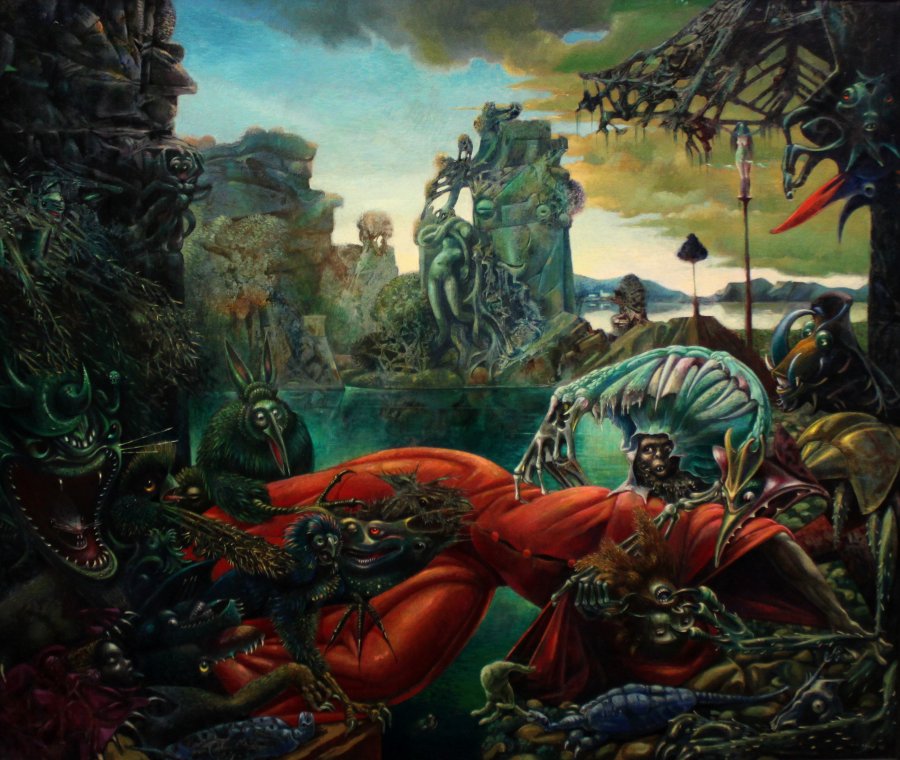
Every normal human being (and not merely the ‘artist’) has an inexhaustible store of buried images in his subconscious, it is merely a matter of courage or liberating procedures … of voyages into the unconscious, to bring pure and unadulterated found objects to light.
Sometimes when I speak to schoolkids, they show me their work. There is an interesting mix of pride and embarrassment in these kids which sometimes has them telling me that they don’t think their drawings or paintings are very good. I know that feeling well. I was those kids once, with an aim that far exceeded my ability at that point. A friend sent me an image from a 6th grade newsletter that had a drawing of mine from that time in it that had me gasping at how poorly I drew at that time. I think it was supposed to be Dr. J dunking a basketball but who could tell?
It was cringeworthy but it helped me in being able to tell these kids that where they are now is now where they will end up so long as they continue to practice and take small steps forward. You can’t judge a journey by the first steps on the path.
I thought I would share this post from about four years back that deals with this idea of development and growth. Plus, it’s just a great way to share some good work from Georges Seurat.
*********************************
I subscribe to a service that provides information such as auction results for artists, both living and dead. It is always interesting to scan the auction results for my favorite artists, to see how they are currently viewed by buyers. For example, anything by Vincent Van Gogh always draws huge money, even the work that doesn’t possess the signature brushwork and color of his better known works. Those pieces that do, go for astronomical sums. His popularity with the public is as strong as ever. I guess that is no surprise.
It’s also interesting to scan the results to see work from artists other than their more famous paintings that hang in museums. We tend to think of artists by their best work and seldom see the complete chain of work that runs through their career, never really seeing their weak links or the developmental work that led to their signature style or voice.
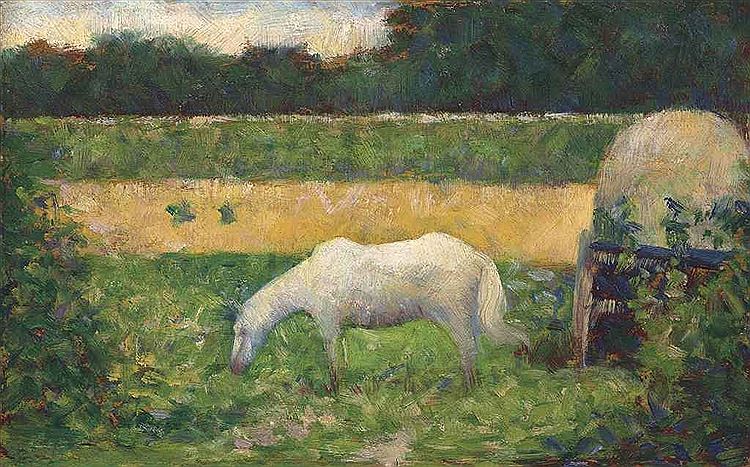
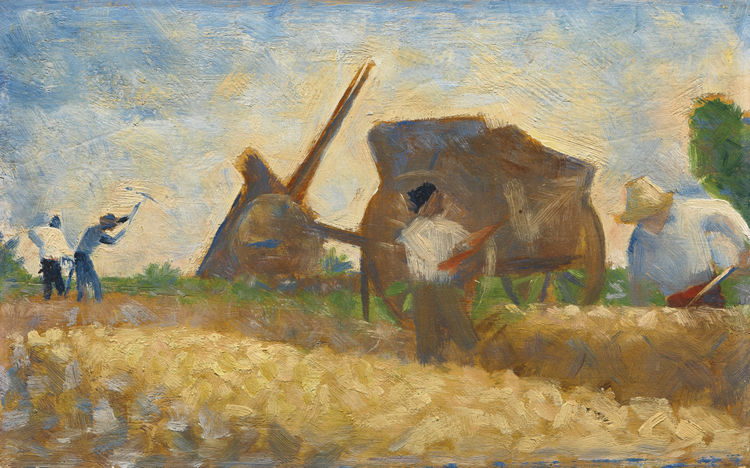
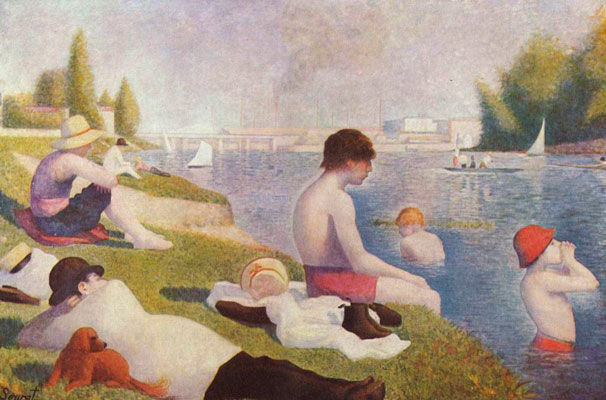
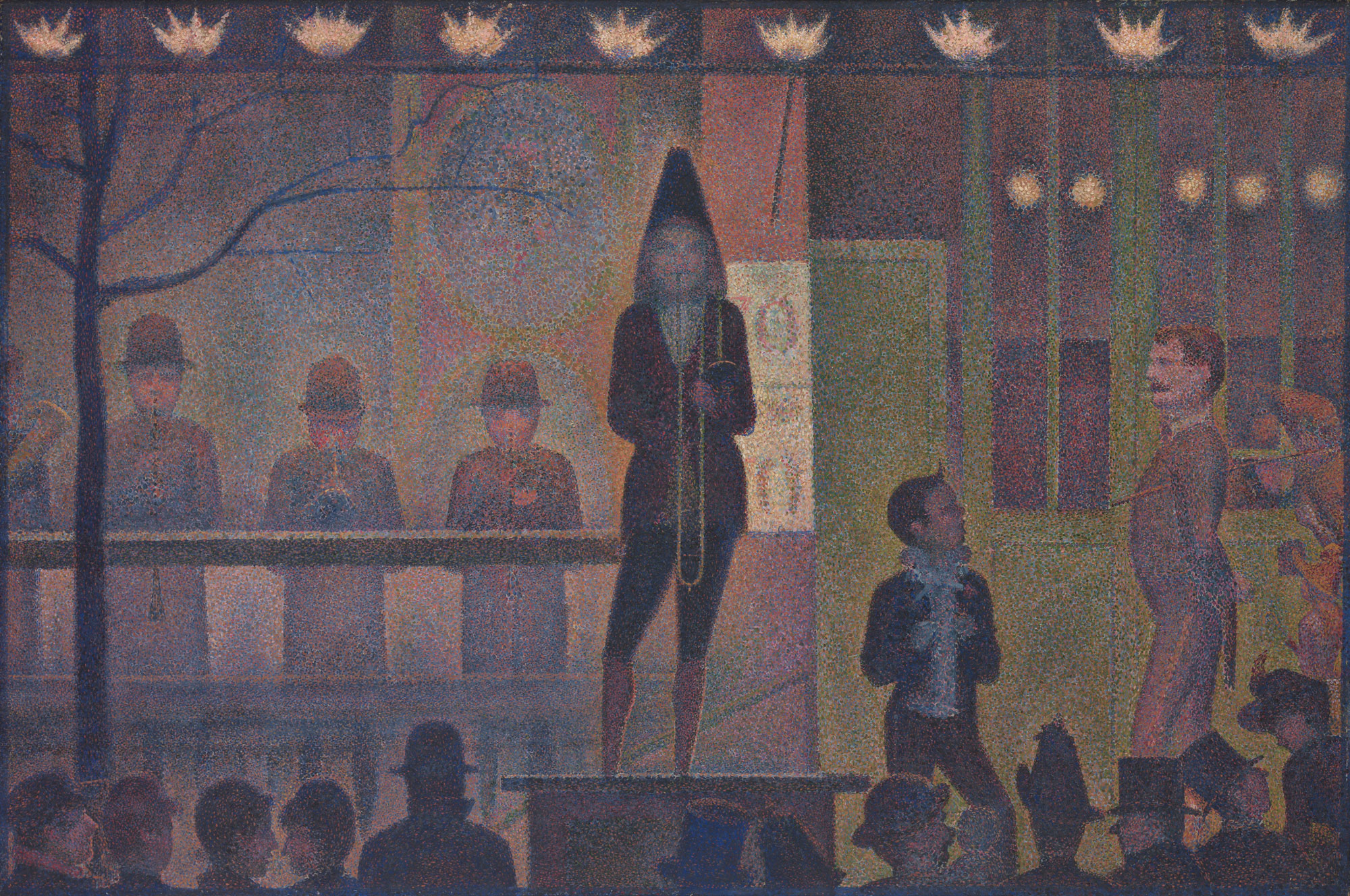
The image at the top, Paysage Avec Cheval, a painting that recently went up for auction at Christie’s London, is a good example of this. It’s a lovely piece but you might not guess the artist. This is from George Seurat whose work, such as his most famous work shown just above, is forever tied to pointillism. But scanning through his records, you can get a better sense of the evolution of his work. [ Note: This painting, small at about 6″ x 9″in size, sold in 2014 for over $1.8 million]
I am also looking for consistency in the artists whose work I am scanning through. Again, we always think of the artists in terms of their best known works and are often unaware of the totality of their body of work. Some artists are incredibly consistent, even in their early formative years. Others have high peaks and deep valleys, with a huge disparity between their best and not-so-best work. I am always encouraged by both types of artists.
I strive for consistency in my own work but have had dips and valleys in my work, particularly in the formative days early on. In those days, I thought of the great artists only in terms of their best works that hung in the great museums of the world, thinking that they simply got up each day and turned out incredible work. I could not fathom the possibility that they had swings and misses. It’s encouraging to see that those icons whose work I revere often struggled in the same way as me and that the great works we know them for were not created in a vacuum. They came with great effort and day after day of moving ahead in often small increments.
I think any aspiring artist should take a few minutes to look through the whole of the works of their heroes. They might be encouraged, as I often have been, to know that the path they are on is not so much different.
I opened the YouTube site this morning in hopes of finding a suitable song for this Sunday morning’s musical interlude and it was right there, waiting for me in the recommended section. I began to listen to the song and opened my files to find an image that jibed with the song, at least as I was hearing it in the moment. I opened a file of images from several years back and the first one I looked at felt instantly like a match.
Sometimes things fall into place.
And I appreciate that because there are so many other times when everything is a struggle, when every decision seems clouded with doubt and every action feels out of rhythm. Slog is a word that comes to mind. Just the sound of the word brings to mind the effort required on those difficult days.
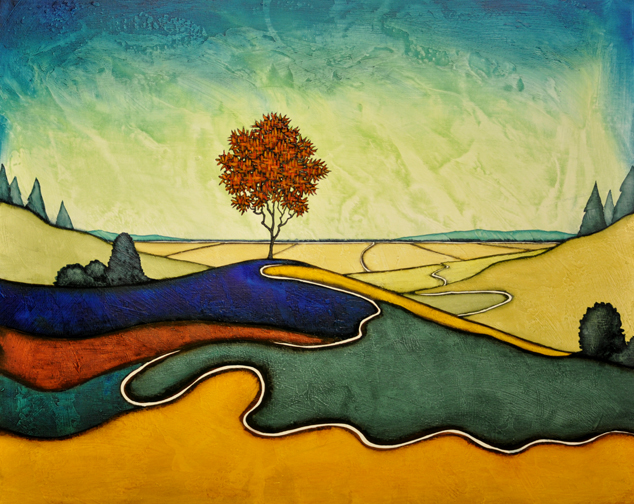
But these effortless days wash away all remnants of that word and feeling. I remember that the painting I chose, Only Now, shown at the top being done on such a day in the early days of 2012. It seemed to fall on to the canvas without much assistance or direction on my part. It needed to exist in that moment, needed to find its way into this world.
Needed to find its way home.
Interestingly, this painting has never found a permanent home in this world. It has been at the gallery that represents my work in California for several years now and the ease and freedom in it that makes it a personal favorite for me has never spoken loudly enough to someone who might give it a permanent home. which is not that unusual as some of the paintings that speak to me most personally are often the last to make their way to a new home. Maybe the void in these pieces that need to be filled by the viewer in order to complete them can only be filled by me.
We’ll see.
So this week’s song is fittingly titled Can’t Find My WayHome from Blind Faith back in 1969. Blind Faith, for you youngsters out there, was considered one of the first rock supergroups. The group was comprised of Eric Clapton, Steve Winwood, Ginger Baker and Rick Grech, all stars in big-name, established bands. They didn’t last long– one album and one tour– but they left a mark, including this song.
I think as an artist it’s very easy to [equate self-worth with artistic success] because of the nature of the work. If you think of art as a job, then your product is so much more than hours invested. The product is a piece of yourself, so of course if the reception is not the greatest, then it can feel like a direct hit to who you are as a person. I think this happened a lot more when I was younger and still finding my way around. I would doubt my direction when a viewer wasn’t thrilled. The trick for me is not to put more distance between my work and myself, but to close that gap completely. I can see myself in the art that I create, and that builds a wall of confidence.
–Hollie Chastain
***************
I was reading a bit this morning on one of my favorite websites,Brain Pickings, when I came across this quote from contemporary artist Hollie Chastain, a Tennessee based artist who works in paper art and collage. The quote was included in an article about creative blocks and her words really spoke to me.
I liked the idea that at some point there is no gap between the artist and their work. The artist is the work and vice versa. But that term she employed, wall of confidence, really hit home. I see ias being t something that comes with continuing to stick with what you know is true to who you are as an artist and not being swayed by momentary lapses in confidence. It’s a wall that protects you from the peaks and valleys that come in the course of a career, that shield you from those times when you are not the flavor of the month.
It’s a wall that allows you to fight off creative blocks, knowing that you are secure in your own vision and the work that flows from it.
When that wall is there, you– actually, I should be saying I here–just have to get to work. And that is what I am going to do.
Thanks for the good words, Hollie.
You should check out Hollie Chastain‘s work. Good stuff. You can get to her site by clicking here.
I like winter. The cold and the snow don’t bother me as a rule. But in these extended periods of cold, when the temps hover around zero and below with the winds making those temps feel even more perilous, I long for warmer weather. 30 degrees sounds like a balmy heaven at this point. Light jacket weather.
But you live with the weather you have. When life gives you frozen lemons, you make frozen lemonade. Lemon squishies?
So, it’s a cold and quiet landscape outside my studio windows and I’ll revel in the hard beauty that is there while I feel a little warmth from this morning musical selection. When it comes to warmth, Ella Fitzgerald singing Gershwin’s immortal Summertime from Porgy and Bessfills the bill for me. When the livin’ is easy…
Enjoy this performance, think warm and have a great day.
I stop every time I go back through old posts on the blog and come across this photo. It makes me think about how we constantly take in information in many forms and what we do with that input– how it affects our perception and vision as we move forward. As an artist, this is the fuel that feeds my furnace.
************************
I was listening to music this morning as I read email and puttered around. My iPod was docked and in random mode so anything could come on. At first one of my favorite pieces, Tabula Rasafrom composer Arvo Part, played. It’s a modern classical piece that I have always identified with. Tabula Rasa translates as empty slate and was actually very influential in a lot of my early painting, helping me visualize the feeling of wide space as I painted.
Next up was Highway Patrol from Junior Brown, which is worlds away from Tabula Rasa. It’s clunky and chunky and throttles along on Brown’s deep twangy voice and his unique guit-steel guitar licks. I began to think about how the mood shifts so quickly between the two selections, how the mind is suddenly thrown from silence to chaos and how in the vacuum of that contrast something new is being formed
Something very interesting in this contrast. I began to wonder if this has an effect on my painting, on strokes and color selection. Am I looking for different things in my work when different types of stimuli are present? It’s something I’ll have to examine further.
The picture shown is of a visual/psychological phenomenon called the contrast triangle. Just above the reflected light on the water is a dark triangle in the sky, tapering from the area above the lit reflection on water up to the moon/sun in the sky.
This triangle is not really there.
If you cover the water, the darkness fades away. Go ahead, try it.
The triangle only exists in our eyes and minds. Our reaction to the reflected light creates something new, a different form. Don’t know why I put this in today except that maybe this little area of created vision is similar to the influence of other stimuli on a person’s creative work.
I don’t really know. I am working off the cuff here, you know.
Here was the next song that came up this morning, perhaps the third leg in my own personal contrast triangle. It’s another favorite, Gillian Welch performing with her husband David Rawlings, with Miss Ohio. What this triangle will produce in my eyes is yet to be seen but I am sure it is something. We’ll see…
Maybe it is the extreme coldness or just the prospect of facing another year that might very easily resemble last year. Whatever the case, I find myself in sort of a dark mood, one that has slowed my creative process a bit as of late. I feel stuck in a slightly dark rut but don’t feel particularly worried about it as I have plans on digging my way out of it very soon. But this momentary darkness had me reexamining the work of Ivan Albright, a painter I featured here way back in 2009. I’m replaying that blogpost below with the addition of a video of his work and a few more images. It’s ominous stuff but well worth the look.
**********************************
This painting on the left, And Into The World There Came a Soul Called Ida, is the work of the late Ivan Albright. Not a household name by any means, but if you’ve seen his work you’ll definitely remember it.
I saw a large retrospective of his work a number of years ago at the Met and was fascinated ( and a little creeped out, I have to admit) by his subjects and the darkness and tone of the work. But it was the incredible textures of the paintings that I found amazing. They were very sculptural on the surface, with deep moonscapes of color, layer after layer of paint that seemed to be shoved and mashed on to the surface. It was unlike anything I had ever seen. It was obviously the product of a huge amount of labor but it wasn’t labored. There was something very beautiful there that transcended the unflattering depictions of the paintings.
Albright was best known for the painting he produced that was used in The Picture of Dorian Gray, the 1945 film version of Oscar Wilde’s famous novel of a corrupt young man who defies the ravages of time while his portrait reflects the true result of his debauched life. His painting was the horrifying image at the end of the film.
I’m still fascinated by his work even though I have to admit I get a queasy feeling when I really take in the whole of his characters, like seeing a car wreck and not being to turn away. They are horrible and beautiful at once. I now also really appreciate the epic efforts that must’ve went into creating these pieces, the hundreds of hours that must have been spent. The patience of maintaining vision.
So check out the work of Ivan Albright. You don’t have to like his work but you should be aware of it…








 Redtree Times