Feeds:
Posts
Comments


Art is a human product, a human secretion; it is our body that sweats the beauty of our works.

–Émile Zola, Le Moment Artistique (1868)


Calvin and Hobbes from artist Bill Watterson has long been a favorite comic strip of mine. Though the strip ended its run in 1995, it is still rerun daily in newspapers around the country. The strip above was rerun yesterday and while Calvin’s sales spiel made me chuckle, it also reminded me of a blog entry from back in early 2009. It concerns the question of how long it takes to finish a painting, a question that has been asked of me many, many times at openings and gallery talks. I usually tell the story of a commission I did for a Finnish diplomat a number of years back and how the work I did on that piece became the template or rehearsal for a larger piece soon after.

The answer that I gave in 2009 still pretty much applies although I have noticed that in recent years that it is taking me longer to finish paintings. The processes I employ in my work have evolved, sometimes gaining steps that were not in place in the earlier years. I also tend to dwell on each piece a little longer now and am more apt to set them aside so that I can simply consider them before forging ahead. But there’s even a variable in that– sometimes the energy and direction of a piece is so determined that there is a danger in losing its momentum by setting it aside.

So, there is no one answer to the question. Here’s what I wrote in 2009:


I am asked this question at every opening and gallery talk:  How long does it takes to finish a painting?

Though it’s a question that I’ve answered a thousand times, I still have to stop and think about my answer.

You see, there are so many variables in my painting technique at different times that sometimes the actual process can be much longer or shorter on any given painting. Sometimes I can toil over a piece, every bit of the process requiring time and thought. There may be much time spent just looking at the piece trying to figure out where the next line or stroke goes, trying to weigh each move. Then there are times when the painting drops out effortlessly and I’ll look up after a very short time and realize that it’s almost complete. Any more moves from me and the piece would be diminished.

I often cite an example from a number of years ago. I had been working on a series of paintings, working with a particular color and compositional form. Over the course of a month, I did several very similar paintings in several different sizes from very small up to a fairly large version. Each had a very distinct and unique appearance and feel but the technique and color were done in very much the same way.

One morning at the end of this monthlong period, I got up early and was in the studio at 5 AM. I had a very large panel, 42″ by 46″ if I am not mistaken, already prepared and pulled it out.

Immediately, I started on the panel. Every move, every decision was the result of the previous versions of this painting I had executed over the past month. I was painting solely on muscle memory and not on a conscious decision-making thought process. I was painting very fast, with total focus, and I remember it as being a total whirl. The piece always seemed near to disaster. On an edge.  But having done this for a month I trusted every move and forced through potential problems.

Suddenly, it was done. I looked over at the clock and realized it had only been two hours. I hadn’t even had breakfast yet. Surely, there must be so much more to do.

But it was done. Complete.

It was fully realized and full of feeling and great rhythm. I framed the piece and a few weeks later I took it to the Principle Gallery in Alexandria, VA with a number of other new pieces. This painting found a new home within hours of arriving at the gallery.

I realized at that point that every version of that painting was a separate performance, a virtual rehearsal for that particular painting.  I had choreographed every move in advance, and it was just a matter of the having that right moment when plan and performance converged.

It had taken a mere two hours, but it was really painted over the course of hundreds of hours.

And perhaps many years of painting, listening, reading, and observing before that.

I hope you can see why I always have to think about this question…

Work in Progress 2025


If you’re a painter, you are not alone. There’s no way to be alone. You think and you care and you’re with all the people who care. You think you care and you’re with all the people who care, including the young people who don’t know they do yet. Tomlin in his late paintings knew this, Jackson always knew it: that if you meant it enough when you did it, it will mean that much.

–Franz Kline, Evergreen Review interview, 1958


Just taking a moment to announce the dates for two upcoming events at the West End Gallery in Corning.

The first is for my annual solo exhibit at the gallery. I have normally had my solo show at the West End Gallery in July. This created a short turnaround between my annual June show at the Principle Gallery and the July show at the West End which was very stressful. It has become more and more difficult as I have aged and my processes evolve. By that, I mean it simply takes longer to complete each painting. As a result, we have moved this year’s West End Gallery show– my 24th solo effort there— to the autumn.  The 2025 exhibit will open on Friday, October 17 and run until November 13. The date for the accompanying Gallery Talk will be announced later, closer to the show opening.

The second announced date is much sooner and for something I seldom do for a variety of reasons. However, after being asked for a number of years, I will be doing a painting demonstration at the West End Gallery in a little over two weeks, on Saturday, April 26. My demo begins at 10 AM and runs to about 12 noon or thereabouts.

This event is being held in conjunction with the Arts in Bloom Art Trail of Chemung and Steuben County which involves open tours of artists’ studios and events such as this in the area’s art galleries. Painter extraordinaire Trish Coonrod will also be giving a demonstration at the same time. We will both be in the Upstairs Gallery so if you’re interested it serves up a nice two-fer. A chance to witness two starkly different processes.

As I said, I seldom do these demos. However, I felt that it was important, with what looks to be a challenging year for the artists and galleries, to do all I could do to support the gallery that has been my home for 30 years now.

It’s definitely out of my comfort zone and I am more than a little self-conscious about painting in front of people. I think it’s partly because, being self-taught, I don’t necessarily paint in a traditional manner. It’s not always flashy and fast. I also worry that someone will be there only when the painting is in one of the flat and unflattering stages that almost all my paintings go through.

But despite my apprehensions, I am certain it will come off well. Things usually do okay when I am this nervous.

I know it’s early in the day, but if you’re interested, please stop in at the West End Gallery on Saturday, April 26 to watch and chat for a bit. It might be fun. No kibitzing though!

Here’s a time-lapse video from 2011 that shows the stages some of my work goes through on the way to being a painting.


The Sane Society

GC Myers- The Angst


Alienation as we find it in modern society is almost total; it pervades the relationship of man to his work, to the things he consumes, to the state, to his fellow man, and to himself. Man has created a world of man-made things as it never existed before. He has constructed a complicated social machine to administer the technical machine he built. Yet this whole creation of his stands over and above him. He does not feel himself as a creator and center, but as the servant of a Golem, which his hands have built. The more powerful and gigantic the forces are which he unleashes, the more powerless he feels himself as a human being. He confronts himself with his own forces embodied in things he has created, alienated from himself. He is owned by his own creation, and has lost ownership of himself. He has built a golden calf, and says “these are your gods who have brought you out of Egypt”

–Eric Fromm, The Sane Society, (1956)


I have written here about being a fan of psychoanalyst and humanistic philosopher Erich Fromm. Born in Germany in 1900, Fromm fled the Nazis in the early 1930’s and settled in America where he lived until his death in 1980. His 1941 book Escape From Freedom is a classic that theorizes that though we claim to desire freedom and personal independence, the vast majority of us run from responsibilities required in freedom, preferring to be ruled over. This is often cited as a leading factor in the rise of authoritarianism, then and now.

Fifteen years after Escape From Freedom, Fromm wrote The Sane Society which warned of the threat posed by the growth of both technology and capitalism that was taking place around the world, but most particularly here in the USA, in the 1950’s. As expressed in the passage at the top, Fromm saw it creating an environment in which alienation experienced by the individual is pervasive in our society. The new technologies of automation and mass-communication were purported to make our lives easier and safer, to give us more leisure time that would unite and bond us. Fromm saw it doing exactly the opposite, writing:

…Man has lost his central place, that he has been made an instrument for the purposes of economic aims, that he has been estranged from, and has lost the concrete relatedness to, his fellow men and to nature, that he has ceased to have a meaningful life. I have tried to express the same idea by elaborating on the concept of alienation and by showing psychologically what the psychological results of alienation are; that man regresses to a receptive and marketing orientation and ceases to be productive; that he loses his sense of self, becomes dependent on approval, hence tends to conform and yet to feel insecure; he is dissatisfied, bored, and anxious, and spends most of his energy in the attempt to compensate for or just to cover up this anxiety. His intelligence is excellent, his reason deteriorates and in view of his technical powers he is seriously endangering the existence of civilization, and even of the human race.

Moving nearly 70 years into the future, Fromm’s observations here seem to be spot on. I might be wrong, but the last part of this paragraph could well be describing the average person today. I wonder how Fromm would respond to the world as it is now, if he would simply view it as the normal progression of his theorized behaviors from the time in which he wrote his book. Or perhaps he would even be a bit surprised at the point of progression/regression where we find ourselves now. I am not sure that he completely foresaw the speed of change and the effects that would take place with computerization and the internet.  I have a feeling he might view AI as the Golem to which we might all soon be servants.

He does give some hope in how we might actually one day achieve a sane society, defining it as:

A sane society is that which corresponds to the needs of man — not necessarily to what he feels to be his needs, because even the most pathological aims can be felt subjectively as that which the person wants most; but to what his needs are objectively, as they can be ascertained by the study of man. It is our first task then, to ascertain what is the nature of man, and what are the needs which stem from this nature.

That entails, of course, determining what those universal needs might be. And that might be a problem, especially right now where those whose actions are subject only to what they want rule. Their subjective wants outweigh our objective needs.

Until there is a movement that can define our objective needs and how they might be reasonably achieved, we are destined to live out the scenario that Fromm saw back in 1956.

I am neither optimistic nor pessimistic on this. Well, that depends on any particular moment of any particular day. Pessimistically, I think the coming weeks and months will come at us harder and faster than many of us expect, presenting us with great challenges that may test our mettle in ways most of us have never faced. 

But optimistically, I think seeing that what is taking place might well have been foreseen 70 or more years ago indicates that it is part of a pattern of behavior. And once recognized, behaviors can be changed and futures altered.

If we have the willpower and the desire to do so.

I am hoping we do.

Good luck to us all…

Exile on Main Street– (2020)


I’m going to a town that has already been burnt down
I’m going to a place that has already been disgraced
I’m gonna see some folks who have already been let down
I’m so tired of America

— Going to a Town, Rufus Wainwright


Much to do this morning so I am running short on time. But being a Sunday, I felt the obligation to share a song for my Sunday Morning Music. Checking my blog stats, I have noticed in the past few weeks that the post below from 2021 has been getting quite a bit of attention. I knew the song would be fitting for this moment in time, but went back to it to see if the writing might pertain as well.

It did. And it also reminded me of the shortness of our memories and how often we disregard history, having the hubris to think that we are beyond repeating the tragic mistakes of past eras.

But as often recently as I have felt like singing that chorus– I’m so tired of America— I still maintain the belief that we can and will get through to the other side, fire-tested and grateful for what we can hold on to.


I wasn’t going to display the lyrics above from the Rufus Wainwright song I am featuring here this morning. Saying that you’re tired of America isn’t a popular sentiment at any time and Wainwright says that this song, though one his more popular songs in concert, at times elicits strong response in the form of boos.

It was written in 2007 both as a relationship breakup song and as a protest against the Bush policies of that time, including an escalation of the war in Afghanistan, that Wainwright believed would lead to more and more damage here and abroad. America is symbolized here as being on fire and Wainwright is getting away by going to a city, a town, that has already gone through this experience, as the lyrics at the top point out.

That town is Berlin with its dark history from the Nazi era. A place that had already been burned down, filled with people who live in the long shadow of defeat and disgrace.

People who have stumbled through the inferno and came out the other side.

It’s an interesting song, one as much about rebirth as it is about the fire. It certainly has the feel of the bone-weariness that many folks here are experiencing now, as they can plainly see where things are headed. I know there are many days when I feel like saying that I am so tired of America and wish we could just move forward in time to the point where we are emerging from the fire.

But I won’t because we can’t. Just got to face the fire. Tired as we might be, someone has got to fight through the flames to that point when we start building once more.

Give a listen, if you are so inclined. It’s a lovely song. By the way, for those who don’t know, Rufus is the son of singer/songwriters Loudon Wainwright III and Kate Mc Garrigle and the brother of singer Martha Wainwright.


Serene Gratitude— At West End Gallery


On the day I was born,
Said my father, said he
I’ve an elegant legacy waiting for ye.
Tis a rhyme for your lips
And a song for your heart
To sing it whenever the world falls apart. Look, look, look to the rainbow
Follow it over the hill and stream
Look, look, look to the rainbow
Follow the fellow who follows a dream.

Yip Harburg, Look to the Rainbow from Finian’s Rainbow


I have a lot of faith in the ability of younger generations to see the horror show taking place in this country with clear eyes. That they will recognize the outright lies, the cruelty, the bullying, the hypocrisy, the corruption, and the stupidity that washes over us like a tidal wave every day.

But I have begun to question that belief in recent days.

I now finding myself worrying about what will come from the constant exposure to behaviors from our leaders that were once shameful and even disqualifying but have now become the accepted norm.

What is the legacy being created here? What kind of future world will it be when it becomes totally accepted to outright lie or cheat?  Or when selfishness is viewed as strength and compassion as weakness? When intelligence and science is derided while ignorance and unfounded belief is held in the highest esteem? When accountability and responsibility is replaced with buck-passing and scapegoating? When generosity and true charity is set aside in favor of piggish greed?

How will a society whose citizens have been raised with these shameful behaviors function?

From where I sit, it seems like it would be a hellish landscape, ugly and violent. A dystopian nightmare of cruel and crude people. 

Maybe I am dead wrong or overstating the case here. Maybe.

But how can we expect any different when every word and deed they now witness from those in power lacks traditional virtues of any kind and is considered acceptable? 

I know there are counterarguments here. For example, there are still many empathetic, caring folks whose parental influence will outweigh societal pressures. And maybe that will hold off us falling completely into the abyss for a time. But if we can’t reign this in soon and reestablish what we see as out of the norm and unacceptable, I fear it will eventually overtake us.

I can’t believe that is the legacy we want to leave for our future generations.

I wish I had answers instead of questions. Perhaps it’s not for me to answer. Perhaps the best we can do is to try to serve in our own small way as examples of kindness and compassion. 

Maybe by doing that we can serve as rainbows which others will follow. That would be a good start.

Here’s the song from which the lyrics at the top were taken. It’s Follow the Rainbow from the musical Finian’s Rainbow. The lyrics were written by Yip Harburg who also wrote the lyrics for many great songs– Over the Rainbow and all the other songs from The Wizard of Oz, Brother, Can You Spare a Dime?, April in Paris, Lydia the Tattooed Lady, and It’s Only a Paper Moon. There are a number of versions of this song out there, including one by Petula Clark from the film, but I prefer this version from the always great Dinah Washington.


Bring the Light

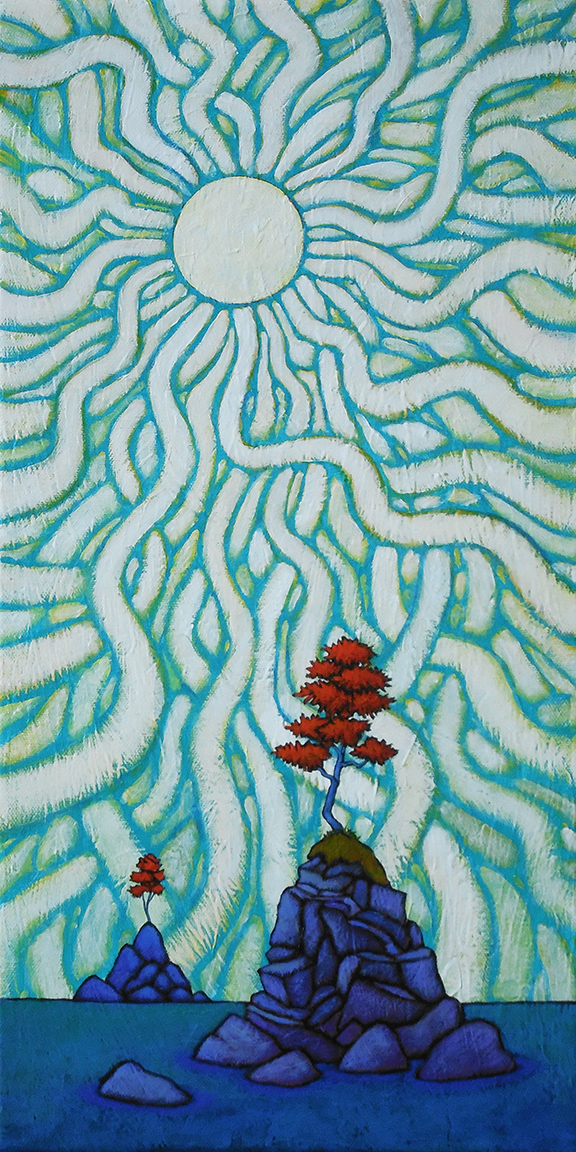
Between Order and Chaos– At the Principle Gallery


Most people live in almost total darkness… people, millions of people whom you will never see, who don’t know you, never will know you, people who may try to kill you in the morning, live in a darkness which — if you have that funny terrible thing which every artist can recognize and no artist can define — you are responsible to those people to lighten, and it does not matter what happens to you. You are being used in the way a crab is useful, the way sand certainly has some function. It is impersonal. This force which you didn’t ask for, and this destiny which you must accept, is also your responsibility. And if you survive it, if you don’t cheat, if you don’t lie, it is not only, you know, your glory, your achievement, it is almost our only hope — because only an artist can tell, and only artists have told since we have heard of man, what it is like for anyone who gets to this planet to survive it. What it is like to die, or to have somebody die; what it is like to be glad. Hymns don’t do this, churches really cannot do it. The trouble is that although the artist can do it, the price that he has to pay himself and that you, the audience, must also pay, is a willingness to give up everything, to realize that although you spent twenty-seven years acquiring this house, this furniture, this position, although you spent forty years raising this child, these children, nothing, none of it belongs to you. You can only have it by letting it go. You can only take if you are prepared to give, and giving is not an investment. It is not a day at the bargain counter. It is a total risk of everything, of you and who you think you are, who you think you’d like to be, where you think you’d like to go — everything, and this forever, forever.

–James Baldwin, The Artist’s Struggle for Integrity talk, 1962


Yesterday’s post was about art enduring times of strife and repression. Today, I am offering a snippet from a 1962 talk author James Baldwin gave at the Community Church in NYC in which he spoke of the responsibility of art and artists to humanity, one in which they were required to reveal and share the truth of our common experience as humans. This would serve as a clarifying light that would diminish the darkness that surrounds us.

I will note here that Baldwin’s talk took place at the height of the Cold War, only weeks after the Cuban Missile Crisis. The war in Viet Nam was ramping up and the struggle for Civil Rights was at a bitter juncture at that same time. It was a dark and scary point in time.

In the here and now, I think we can relate to that feeling of impending darkness.

It is a time in which art– and by art, I include all forms of art: literature and poetry, visual arts, music, dance, theater, etc. — is a necessity. Not as diversion or distraction. But for its ability to reflect the truth and gravity of the moment and cast a bright light against the darkness.

It is a light that allows us to see we have not been alone in the dark as we had feared. It also lets us clearly see the struggle ahead that will require action and sacrifice. And knowing these things focuses our attention which has a calming, centering effect. 

It is then that blind fear is often replaced with clear-eyed courage.

Saul Bellow said a similar thing in a Paris Review interview:

Art has something to do with the achievement of stillness in the midst of chaos. A stillness which characterizes prayer, too, in the eye of the storm… Art has something to do with an arrest of attention in the midst of distraction.

Like Baldwin’s talk, Bellow’s interview took place in 1962 when the world was in crisis. It was a time that made clear that art was a necessity. It illuminated the issues and brought a focus that, in many ways, swayed public opinion that in many ways shaped the future.

It was a floodlight in the dark. 

Though it is a different time with different circumstances and a world much changed via technology, we’re at a similar point in history today. Art remains a necessity in bringing the light. 

Art will bring the light, people.

Let us make sure we focus so that we may see and hear what it is saying.


Art Endures

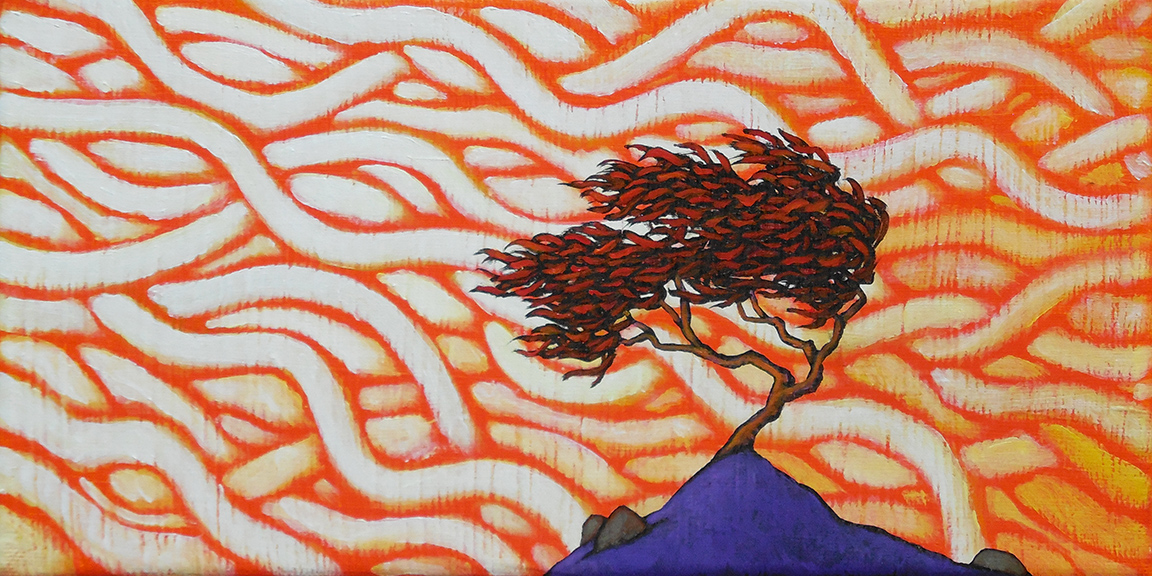
The Steadying Light– At the West End Gallery


But hell can endure for only a limited period and life will begin again one day. History may perhaps have an end; but our task is not to terminate it but to create it, in the image of what we henceforth know to be true. Art, at least, teaches us that man cannot be explained by history alone and that he also finds a reason for his existence in the order of nature.

–Albert Camus, The Rebel (1951)


With the hope that this doesn’t turn into an extended rant, let me point out that the hell that Camus refers to in the passage above from his book, The Rebel, is one created by authoritarian governments. As he puts it:

Modern conquerors can kill, but do not seem to be able to create. Artists know how to create but cannot really kill. Murderers are only very exceptionally found among artists. In the long run, therefore, art in our revolutionary societies must die. But then the revolution will have lived its allotted span. Each time that the revolution kills in a man the artist that he might have been, it attenuates itself a little more. If, finally, the conquerors succeed in moulding the world according to their laws, it will not prove that quality is king but that this world is hell.

Authoritarians come to power through destructive means and not having the ability to create or govern, stifle free thought, art, and the artistic impulse– anything that might in any way question their right to power. As a result, art dies which creates, in effect, a hell on earth. But he adds that each time they kill the artistic impulse, they weaken their authority, bringing their hellish reign closer to its inevitable end. As Camus writes: But hell can endure for only a limited period and life will begin again one day.

I guess my point here is a simple one– Art Endures. It is the realm of thought, feeling, and creation that cannot be suppressed for long because it is an innate and indomitable part of humanity, more so than the rule of any king or tyrant. 

Like a buried seed, it persistently seeks light and air.

So, though the days may seem dark and hellish, that seed is planted, always there, growing unseen beneath the surface. Waiting to emerge once more.

Art endures. And with it, our humanity and hope.

Here’s a favorite song from Richard Thompson. This is a duet with the great Bonnie Raitt of his The Dimming of the Day, that I haven’t shared here before.


Stand Alone

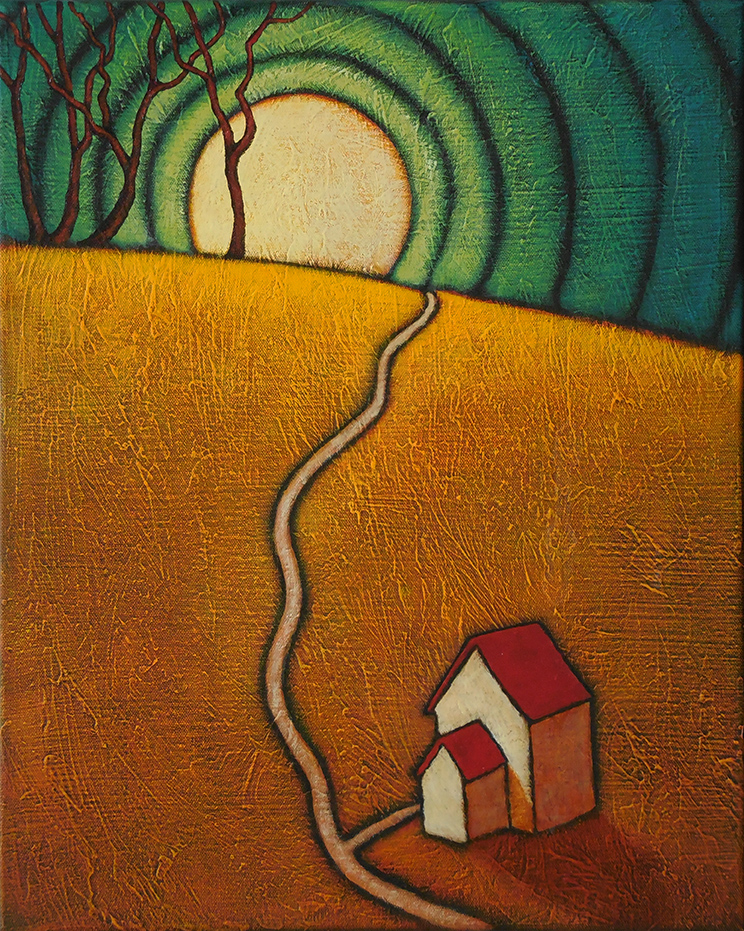
The Center Found– At the West End Gallery


The tumult of sorrow, of anger, of bitterness, of despair, was drifting farther and farther away. Even the terror, which was worse than any tumult, had vanished. In that instant of renunciation she had reached some spiritual haven. What she had found, she understood presently, was the knowledge that there is no support so strong as the strength that enables one to stand alone.

–Ellen Glasgow, The Difference (1923)


There really is something cleansing and ultimately clarifying in taking a stand or taking a path that diverges from the crowd. It sharpens your vision and centers you, washing away those depleting feelings– the tumult to which Glasgow referred above–that define and bind you to a herd.

Just reading that short paragraph, I am inclined to stop right here. What more need I say?

I will add that I really didn’t know the name Ellen Glasgow before I came across this passage. Glasgow, who was born and lived her entire life, from 1873 to 1945, in Richmond Virginia, is another of those folks who were celebrated in their time but whose work never quite reached the status of being iconic enough to span generations. I did know the title of her most famous novel, In This Our Time, which won the Pulitzer Prize in 1942 but only from the fact that it was also made into a Bette Davis film, one I have never actually seen.

But reading other passages and quotes from her, as well as reading several pages of the short story from which the passage at the top was taken, I am impressed by the depth of her observations. I certainly agree with her words on the enabling power that comes in standing alone.

Here’s a song from folk singer/songwriter Buffy Saint-Marie that emphasizes this point. It is the title track from her 1964 debut album, It’s My Way, that in 2016 was added to the National Recording Registry. Each year the Library of Congress selects 25 recordings that they deem to be “culturally, historically, or aesthetically significant.” It’s a richly deserving album with many significant tracks but for today we’ll focus on this one. It’s good stuff…

A late addition: Special kudos to Sen. Corey Booker for having the strength to stand alone. His record-breaking filibuster may seem a symbolic gesture in the moment but may inspire greater action for the future. But only if others have the strength to stand alone…


Steer Your Way


Student and Master— At Principle Gallery

The thought manifests as the word;

The word manifests as the deed;

The deed develops into habit;

And habit hardens into character;

So watch the thought and its ways with care,

And let it spring from love

Born out of concern for all beings…


As the shadow follows the body,

As we think, so we become.

 —From the DhammapadaSayings of the Buddha


I am short on time this morning but wanted to share a passage from the Buddha that I have shared here before. Its message, that we ultimately become what we think and say, has been echoed by philosophers through the ages which speaks to its truth.

I have been thinking about this message of caution recently, seeing the transformation of so many people by their casual acceptance and adaption of the ugliness in both word and deed that comes down from the leaders of our current government. This ugliness of thought and word has transformed into deed and habit and has finally transformed into a character defined by this ugliness.

Though it may not reflect the character of most of us, it is this ugly character that defines us to the rest of the world. My worry is that the rest of us may fall prey to that character, that we allow our words and deeds to alter who we are in ways that are irredeemable.

No answers here on that front, of course, outside of saying that one should be wary of falling into that trap, that downward spiral that leads to a darkened alteration of one’s character.

Think the Light. Speak the Light. Become the Light.

Easier said than done. But it can be done.

Anyway, that’s it this morning outside of a song from powerful final album, You Want It Darker, from the late great Leonard Cohen which very much sends the same message. This is Steer Your Way.


Frisson


Gravity– At West End Gallery

fris·son, frēˈsôn / noun– a sudden strong feeling of excitement or fear; a thrill. “a frisson of excitement”

Frisson (French for ‘shiver’) is a sensation somewhat like shivering, usually caused by stimuli. It is typically expressed as an overwhelming emotional response combined with pilo-erection (goosebumps), pupil dilation, and sometimes tears. Stimuli that produce a response are specific to the individual and most often involve a response to music, though it often occurs in response to film, oratory, literature, and art.


When the word frisson recently popped up as the subject of a short article I came across, it was new to me. It might be one of those words that just never registered in my mind when I had read it in the past or maybe I had simply never come across it before.

Whatever the case, I immediately recognized it as it was something I have experienced all my life. In fact, so long and so often that I assumed it was just a natural for everyone.

The article I read pointed out that it was not as common as I had thought. It claimed that the number of people who experienced it was perhaps a little less than 50% and that those who experienced frisson on a regular basis to a wide array of stimuli was probably a little more than 10%.

It went on to say that that those who most often experience it have been found to have a higher volume of fibers connecting their auditory cortex to the areas that process emotion.

The numbers surprised me. But the difference in the wiring of the brain actually made sense to me. It probably explains, in a physiological way, why I do what I do and why I have struggled at other endeavors in my life. I know that I have experienced this frisson with my own work at times. I have told the story here before of the breakthrough moment I had when I first began painting and stumbled across the style and feel that I suddenly knew without knowing I was seeking. It was an electric reaction with goosebumps and the hair raising on the back of my neck.

Perhaps it has been that feeling of extreme frisson that I have been hoping to create in others with my work ever since?

Perhaps. I have been fortunate to have had a few people describe feelings that resemble the frisson response they had felt from my paintings. Their description of this feeling creates a similar response in me, and for that moment I feel like the luckiest guy in the world.

For me, I get strong feelings of frisson from many things. There are songs that will make me tear up or produce an immense feeling of elation, even if I were to hear them every day. The same for certain scenes in films. For example, the scene in Casablanca where the patrons of Rick’s loudly sing the Marseillaise to drown out the Nazi’s singing never fails to make me bleary-eyed. Even thinking about it now produces the effect. I can also recall often coming across works of art or reading passages in poetry and literature, as well as theatrical performances and great speeches, that do the same.

I am sometimes embarrassed by this response, especially when I am around those who seldom experience it. Fortunately, I am seldom around people. But knowing that it might just be a matter of how the brain might be wired a bit differently takes away some of that stigma.

In fact, I am grateful for these feelings of frisson. I certainly wouldn’t be doing this or looking forward to painting soon after. That being said, I wouldn’t have it any other way.

Here’s a song I have played here once before that creates this feeling of intense frisson for me, especially with the gorgeous harmonies contained in it. It is Undertow performed by the Irish singer Lisa Hannigan accompanied by fellow countrywoman Loah (Sally Garnett) from a pandemic era performance at the National Gallery of Ireland. Their joyful laughter at the end of their performance makes me believe they knew they had just created something special.

And they had.