Feeds:
Posts
Comments

Collateral Damage

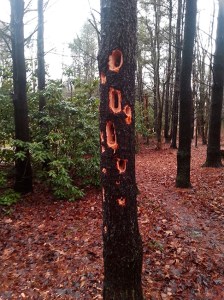
Pileated Woodpecker DetailGC Myers Tree Near  Studio 2016I posted a picture on social media a few days ago of a tree that had been recently visited by one of the several large pileated woodpeckers that reside in the woods around my home and studio.  Earlier that day I had been coming through the woods to the studio in the early morning,  As I passed this tree I stopped because it looked like the tree was casting a shadow in the moonlight which wasn’t unusual except for the fact that there was no moon out.  The light around the base of the tree turned out to be a large piles of woodchips created by the woodpecker.

A lot of people were surprised by the apparent damage done but for us it’s nothing new or unusual.  We’ve lived in these woods for going on twenty years and the sound of the woodpecker’s distinct cackle and hard pecking rings through the forest regularly.  We often see the very large birds at work and in flight with their strange up and down motion– each upstroke of their wings lifts them while each downstroke sees them seemingly pulled down by their sheer weight.
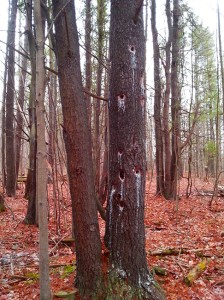
GC Myers Tree Outside Studio 2016In the first few years we lived here they seemed very evasive and we seldom caught sight of them but as we settled in and they grew accustomed to us, the sightings increased.  I think they see us now as part of the forest and we definitely see them as an integral part of the woods.  And while they appear to inflict damage on some of the trees of the forest, we know that the trees they work on are already being damaged and destroyed from the inside by boring insects, most often carpenter ants.

One way or another, these softwoods are in natural peril.  We view the woodpecker’s work as being simply collateral damage.  Although there are times when we wish their work wasn’t quite so close to our home or my studio.
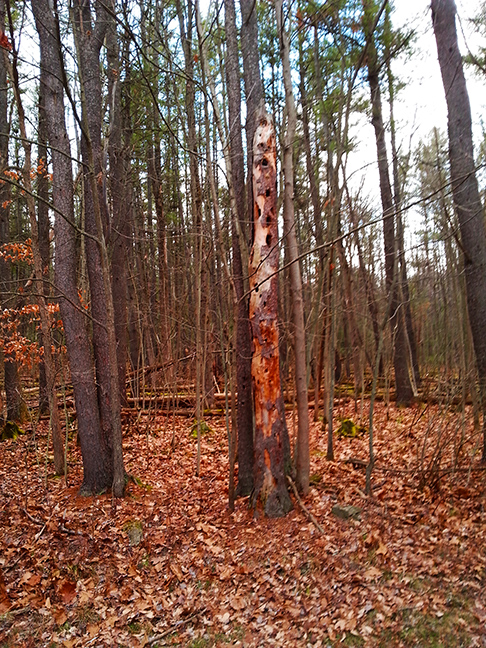
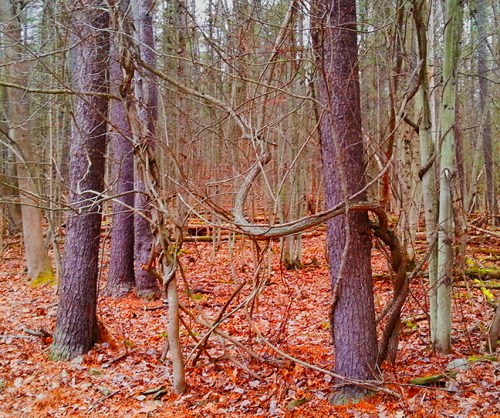
GC Myers Tree Near Studio 2016

These twisted trees and vines just outside the studio are not the target of our woodpeckers, I just found them interesting and wanted to share them.

These twisted trees and vines just outside the studio are not the target of our woodpeckers, I just found them interesting and wanted to share them.


Icon: William England

GC Myers- Icon-William EnglandAs pointed out in recent posts, I’ve been working on a group of new work that I am calling Icons, images that put people that I have come to know through doing some genealogical work.  They are not intended to be accurate depictions of these ancestors.  In each case, I have just found something compelling that sticks with me.  Such is the case with the painting above, a 10″ by 20″ canvas that I call Icon: William England.
I grew up knowing almost nothing about my ancestry.  In fact, I thought that a generation or two back, somebody had inadvertently tipped over a big rock and we had spurted out before they could put the rock back in place.  Not a lot of esteem at that point.  So it was a thrill as each new layer of our family history was uncovered.  I was pleased to see how many ancestors served in all of the wars of our country going back hundreds of years.  Many had fought in the American Revolution.

It turns out, on both sides of the conflict.

I can’t remember the source but I read once that during the revolution the American public was divided pretty evenly into three parts: a third that desperately wanted our independence from Britain, a third that wanted to remain part of the British Empire and a third that really didn’t care either way so long as they could live their lives as they had up to that point.  The  first group, of course, were the Patriots that we have come to believe was everyone living in America at that point and the second were the Loyalists who identified themselves as British living in the America colony.

One of my ancestors was a man named William England who fell into the Loyalist group.  Born in Staffordshire, England, he came to America as a teen and settled in the Saratoga Springs area of New York after serving in the British 60th Regiment during the French and Indian War.  He purchased a farmstead in Kingsbury, NY and was settled in when the Revolution broke out.Faced with the choice of breaking from his homeland or remaining loyal, he chose to protect what he felt was his British homeland.

Serving as a Sargeant with McAlpin’s Rangers, he fought in a number of battles including Burgoyne’s defeat at Saratoga.  British troops and families were driven north into Canada, settling in the Three-Rivers area of Quebec.  It was there that he, along with many other Loyalists, settled and raised his family in the years after the war, most of his children integrating through marriage into the early families of French Canada.

Many worked their way back into America in the late 1800’s, including his grand-daughter Mary England who died in St. Regis Falls, NY in 1896.  She was my 3rd great grandmother who was married to Jean-Baptiste Therrien.  Many of their children’s names were anglicized from Therrien to Farmer when they moved into NY.  I came across a photo of her when she was quite old and you can see the hardness of rural Canadian life written in her face.

This painting shows the conflict ( or at least the conflict I perceive) that took place in William England when the war broke out.  He had to make a hard decision, one that cost him his farm and all of his possessions, in order to stay loyal to his homeland.  He had to break the bond ( shown here in the form of the broken tree limb) with the America that emerged and face a new life in a territory he did not know.

We all have interesting twists in our family trees, some that take us in directions we would never imagine.  While I am proud of my ancestors who fought for the American cause, I am equally pleased with the loyalty and devotion shown by William England.

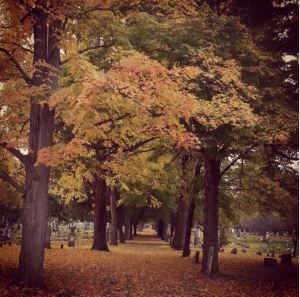
Maple Grove Cemetery HorseheadsWe take a walk just about every day in a local cemetery.  It’s not overly large nor does it  have  grand mausoleums or many elaborate memorials.  It’s not even an extremely beautiful cemetery, although there are lanes such as the one shown here that I find lovely.  It’s just a pleasant place to walk in relative quietness.

Part of our routine is to pick up garbage that blows into the cemetery or is left behind by slobs who feel that all the world is their trash bin.  It seems that hardly a day goes by that we don’t retrieve at least a handful of bottles, cups, fast food packaging and crumpled cigarette packs.  I don’t know how much we have picked up over the years but it is a considerable amount.

Too much.

I have began to simply accept that most people feel some sort of right to let others be responsible for their trash but it’s hard not to get angry at the sheer laziness of it.  But we’ll no doubt continue to pick up others’ garbage.  I like this place and the calmness of it plus both Cheri and I have family members and friends buried here.  So, it just seems like a simple act of respect to pick up a few things to keep their graves clean.

I thought I would have this week’s Sunday morning music match the thought.  Here’s the great Mavis Staples singing See That My Grave Is Kept Clean. Have a great day and keep it clean out there, okay?

GC Myers- Like Sugar In Water

Whenever I find myself going through  images from the past several years, I inevitably find myself stopping when I come to this painting from back in early 2011.  It is simply put and spare in nature but it just has a quietly commanding presence that draws me in.  It was part of my 2012 show at the Fenimore Art Museum and I received many comments from people about this painting who were also struck by it.  I thought I’d rerun the post from back in early 2011 where I wrote about this painting:

I call this painting Like Sugar In Water.  It is a continuation of the group of paintings that I have been working on over the past few months and is by far the largest of the series at 36″ by 60″.   The larger scale gives the piece a real sense of  space and depth that I think carries the work.

This painting evolved in a much different way than I originally thought it might.  As I started, I first saw this as being a piece about movement and saw a large tree bowing in the  gusting wind with leaves being released out into the large space created by the sky, which had its own sense of motion in the brushwork.  But as the sky came into being it changed and I found myself sensing a much different feel for this piece.  It became quieter and the sky didn’t feel frantic but rather had a sense of light breaking into particles and quietly dissolving into a multitude of colors.   Because of this change, the central figure in the painting, the tree, changed for me.  It had to have a calmness but it had to have a different function than my typical red tree.  Here I saw it as a connection between the landscape and the sky, like a conduit of energy from the earth upward.  It would have to be less dominate than my typical red tree.

At this point I set this piece aside so that I could fully consider it.  I really felt that the landscape and the sky were strong and could stand on their own but I wanted to make sure in my own mind.  So I went to work on other work and kept an eye on this piece, continually looking at it and pondering what lay in store for it.  Finally, after a couple of weeks, I decided it was time to let this painting complete its metamorphosis.  I had come to see the tree as being bare of leaves with the branches stretching up into the sky, almost dissolving into the particles of the sky. This feeling of dissolving is carried through in this piece by the landscape as well.  I see it in the road that runs through the structured geometric pattern of the field of the foreground, moving up through the spreading branches of the tree and into the breaking sky.

I see the red chair here, not as I often do as a symbol of memory or of the dead, but as a symbol of the temporary nature of our existence here, living as we do between the solidness of the earth beneath our feet and the particulate nature of the heavens above our heads.  This is reflected in the title as well.  Perhaps the universe is like a large body of water and we are but a bit of sugar.

I don’t know about that.  But I do that I think that there is a lot to be found in this piece and I find myself pondering over it quite often,  taking in whatever message there is in it.

Gilbert

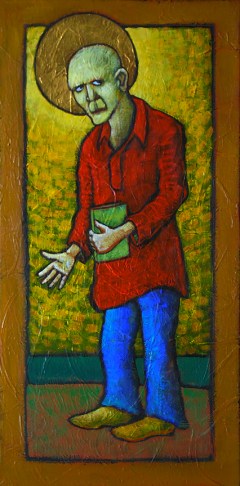
GC Myers Icon-Gilbert 2016This is the next step in the Icon series of paintings that I talked about a few days ago.  It’s an 18″ by 18″ canvas that I call Gilbert, going with the French pronunciation–  more jill-bear than gill-bert.  There’s a reason for that.
I had mentioned using this Icon series showing plain folks leading simple and uncelebrated lives in the pose and style of religious icon paintings.  But because these are personal pieces for me (by that I mean that these paintings are being done for me alone at this point) I decide to try to channel the spirit  of an ancestor into these pieces.  Kind of like the spirit portraits that famed folk portraitist William Matthew Prior did in the  19th century, where he would  paint a portrait of a dead person’s supposed spirit which of course didn’t look anything like their actual physical form.

I’m not claiming to be painting spirits here.  I don’t have that ability or the proper amount of belief to even attempt that.  But from doing genealogy I have come across figures that stand out for me, people that sometimes make me proud and sometimes make me not so proud.  Both have an attraction for me because as I stated  in the post about Frank the Icon,  I believe we are all capable of being both gods and monsters and every family has its fair share of both.  I thought it would be interesting to do  a take on those folks, good and bad, in the iconic form.

Gilbert is based on my great-grandfather, Gilbert Perry, a renowned lumberman of the early Adirondacks.  I have never seen a picture of him nor do I know much of him on a personal level.  He died nearly 25 years before I was born and was born in 1855.  But using old newspaper accounts and historic records I have been able to piece together a life that was based on life in the forests of the Adirondacks.  He went out his own at age 17 and immediately had a contract and a crew of workers to bring in a large number of logs in the burgeoning logging business of the late 19th century.

This was a time when the work was all by hand and the transport was all by horse sleds or by river.  The accounts of some of the river drives are pretty amazing.  Itw as time when being a cowboy or a logger were the most exciting jobs in the land. I read an account from the Atlantic magazine of that time that detailed a day in one of his camps.  Fascinating stuff.

He was  well known and did well in the Adirondack lumber world, at one point employing over 350 men and owning more than 50 teams of horses.  Born of French-Canadian descent, he brought many French-Canadian loggers and their families into this country.  That’s where the jill-bear comes from.  His nickname was Jib.

I wrote last year of going to North Lake in the Adirondacks where several of his logging camps had been located and standing on a dam that he had first built there in the 1890’s.  It was great to be in that space and air, not so unchanged as of yet from his time.  The sheer quietness of the place and the light of the sky off the lake made me think of how he must have felt in his early days, axe in hand and a huge task before him.  I think he was probably a happy man in that moment.

There’s more I could tell but it’s probably not that interesting to anyone outside my family.  And even many of them have eyes that glaze over when I do speak of it.  I will spare you that but his is how I choose to see my great-grandfather.

Zecchin

Vittorio Zecchin- Les Mille  et Une Nuit

Vittorio Zecchin- Les Mille et Une Nuit

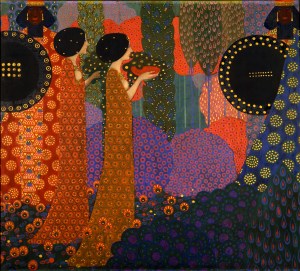
I often come across work online, some that just captures me immediately, and wonder how it is that I have never heard of the artist behind it.  Such is the case with Vittorio Zecchin, an Italian artist who lived from 1878 until 1947.  I came across the image above and it really rang my bell.  It had vibrant color and shapes throughout with a form and richness that brought the work of Gustav Klimt to mind.

Vittorio Zecchin -les mille et une nuits  1Looking for more info I found that background info on Zecchin was sketchy.  He was raised on Murano, one of the famed islands of Venice  known for its glass-making.  His father was a glass-maker and Zecchin grew up immersed in color and form.  He studied art but, feeling his voice would not be heard in the somewhat conservative artistic atmosphere of Venice at the time, put it aside in his early 20’s to pursue a job as civil servant.  However, he came back to painting around the age of 30, spurred on by a new movement in Venice of artists inspired by Klimt and other artists.

Vittorio Zecchin -les mille et une nuits 4All of this pieces shown here are from his grandest work, a mural completed in 1914 for the Hotel Terminus that consisted of 11 or 12 panels ( I have found conflicting reports) that measure around 300 feet in total length.  Called Les Milles et Une Nuit ( A Thousand and One Nights), it depicts the entourage of  kings, queens, princesses and princes as they bear gifts to encourage the Sultan to give his daughter’s hand to Aladdin.  You can see the influence of Klimt but more importantly you can see the influence of the glass and color of Venice.  Unfortunately, the panels are no longer together, having been dispersed throughout the art world over the years.
From this achievement, Zecchin moved on to incorporating his keen eye for design to other endeavors in the decorative arts.  He started a tapestry workshop on Murano in 1916 then became the director of the famed Cappellin-Venini glass works, as well as working with a number of other prestigious glass works until he retired at the age of 6o.  He said he was exhausted and  he was sucked dry.

I would love to have been able to see this painting complete and in its original setting.  Or even in some complete form online.  But I am simply pleased to have come across it at all.  There is something very encouraging in his work that pleases me.  And that is enough for now.

Vittorio Zecchin -les mille et une nuits  3


Frank the Icon

Even broken in spirit as he is, no one can feel more deeply than he does the beauties of nature. The starry sky, the sea, and every sight afforded by these wonderful regions, seems still to have the power of elevating his soul from earth. Such a man has a double existence: he may suffer misery, and be overwhelmed by disappointments; yet, when he has retired into himself, he will be like a celestial spirit that has a halo around him, within whose circle no grief or folly ventures.

–Mary Shelley, Frankenstein

**************************

GC Myers Frank the Icon 2016This is one of the new pieces I have been working on.  I wasn’t sure I wanted to show it in this state, as it is unfinished, or even when it is finished.  But as it progressed it began to grow on me and was meeting my expectations for what I wanted from it.  So, I thought I would show it and talk a bit about this piece, a 12″ by 24″ canvas that I tentatively calling Frank the Icon.

The idea for this came about from my admiration of religious icon painting and something I read in the foreword of a David McCullough book I recently started reading.  In it McCullough talked about history , while being documented in large and grand acts, often turns on the actions of ordinary people doing small but significant things that inspire or lead others to do those greater deeds.  It made me wonder who these people were today whose everyday  deeds would help rewrite our future history.

I thought it might be interesting to show ordinary figures painted in the style of an icon but in my own style of painting,  And that how Frank came about.  Early on, I was underwhelmed by this piece and could feel the effects of my recent absence from painting.  But midway through it began to pull at me in a way painting sometimes does for me, urging me on with small hints at what might be ahead.  It was an excitement I haven’t felt in a while and it felt very good indeed.  I truly wanted to see what was coming.

There are many things I like about this piece.  Even though I will admit to it being flawed ( as are most of my paintings) there is something in it that makes it alive for me, something that speaks to inner parts of me.  It has a real presence here in the studio and it is easy to engage with him as I walk around and the gold halo seems to push his countenance forward even more.

Cheri came into the studio and after looking at it asked why I hadn’t painted bolts on his neck.  She said he reminded her of the Frankenstein creature.  I could see that as well and thinking about it made me realize that there was something to this idea of an icon with beings that were capable of beings both gods and monsters.

As are we all.

That’s where the quote from Mary Shelley’s Frankenstein came in.  It is compelling and fitting, this idea of a naive creature who suffers the suffering and misery of being a lone being in this world, finding comfort in experiencing anew the  beauty of this world that we who know it so well often take for granted.  It even speaks of the halo.

So, that is here I am with this piece.  I am still up in the air as to where it will lead, if anywhere.  Part of me wants to continue with a series of icons but part of me is hesitant.  We shall see…

Back to Work

GC Myers- Experimental Piece 1995It’s the New Year and I am finally back at work.  I’ve started working on some pieces that have been brewing in my mind for a while, some that are out of my comfort zone.  I don’t know how they will turn out and there’s a good chance that most of this work will never see the light of day.  I have found that quite often work that is too idea based or thought out never gets into any kind of natural flow or rhythm, at least for me.  I have plenty of examples from over the years that I won’t show here.

Occasionally a piece will come along that just doesn’t seem to work at the time but has something that emerges later.  For instance, the piece at the top was an early experiment from back in 1995.  It just didn’t click for me then.  It just seemed too worked and not free enough, if that makes any sense to anyone out there.  But the spiral of the sky found its way back into my work years later in a different form when I developed a way to make it seem more naturally integrated into the painting.  I appreciate this piece much more now than I did 20 years ago.

Hopefully, some of this new work will be good enough to show here.  We shall see…

For the first Sunday morning music of the new year, I thought I’d break out one my old favorites, Hank Snow, the Singing Ranger.  I have always loved his music and there’s something I find really appealing about him that I can’t really explain.  With his small stature, close cropped hair and the looks of a hardware store clerk from years ago, he certainly doesn’t have the cool appearance of a star.  Maybe it’s that anti-cool factor that I like.  He just did what he did in his own way.

Anyway, here’s his Rhumba Boogie to kickstart 2016.  Have a great day and a better new year.

New Year’s Day

NewYearsDay NC Wyeth

Painting by N.C. Wyeth

New Year’s Day 2016. Thought I’d start 2016 with a few takes on New Year’s Day from some of my favorite illustrators.  Wishing everyone good health and good news in the New Year.  I’m getting ready and  am kind of looking forward to coming back to the blog on a regular basis in a few days.

NewYearsDay Ben Kimberly Prins

Painting by Ben Kimberly Prins

NewYearsDay Howard Pyle

Drawing by Howard Pyle

NewYearsDay Norman Rockwell

Painting by Norman Rockwell

leyendecker- new year1930-c

J.C. Leyendecker 1930

leyendecker New-Years-Baby-1940-Saturday-Evening-Post

J.C. Leyendecker 1940

leyendecker-new-year-1942

J.C. Leyendecker 1942

A Gorey Christmas

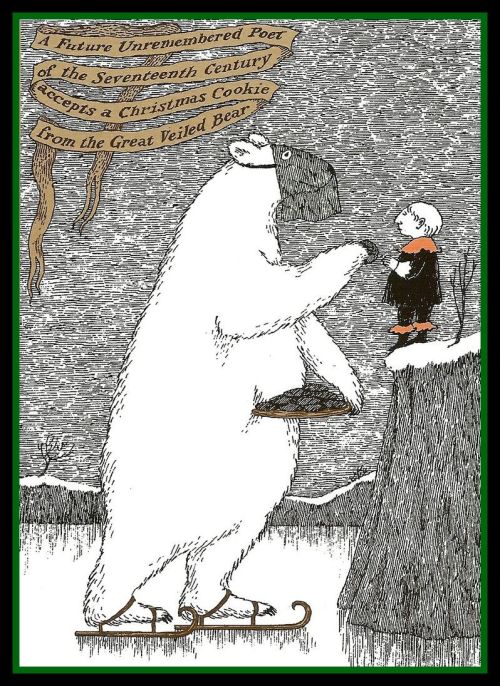
Edward Gorey Great Veiled Bear ChristmasMay the Great Veiled Bear bless you with Christmas cookies this year.