Feeds:
Posts
Comments

Harmonia

GC Myers-- Harmonia  2024

Harmonia— Coming to Principle Gallery


When we speak of man, we have a conception of humanity as a whole, and before applying scientific methods to, the investigation of his movement we must accept this as a physical fact. But can anyone doubt to-day that all the millions of individuals and all the innumerable types and characters constitute an entity, a unit? Though free to think and act, we are held together, like the stars in the firmament, with ties inseparable. These ties cannot be seen, but we can feel them. I cut myself in the finger, and it pains me: this finger is part of me. I see a friend hurt, and it hurts me, too: my friend and I are one. And now I see stricken down an enemy, a lump of matter which, of all the lumps of matter in the universe, I care least for, and it still grieves me. Does this not prove that each of us is only part of a whole?

For ages this idea has been proclaimed in the consummately wise teachings of religion, probably not alone as a means of insuring peace and harmony among men, but as a deeply founded truth. The Buddhist expresses it in one way, the Christian in another, but both say the same: We are all one.

–Nikola Tesla, The Problem of Increasing Human Energy


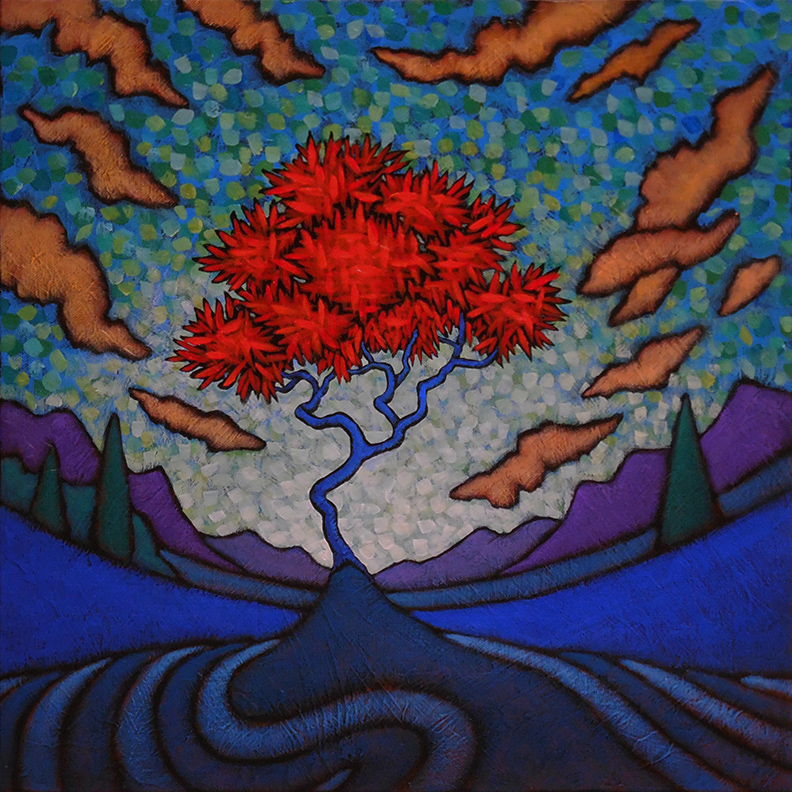
This is another new painting that is headed to the Principle Gallery with me tomorrow as part of a group of new work. It is titled Harmonia and is 8″ by 8″ on panel. Like a few other of the new pieces, this has an smooth untextured surface that gives it a very glass-like appearance. This is especially so with the transparency of the paints which allows the white ground underneath to shine through, producing an effect as though the piece is lit from behind.

That’s something that I always aim for in my work. When it appears, it shows itself in lesser or greater magnitudes. I think this one is on the higher end. It has a very striking appearance, much more so in person than in the image shown here. Sometimes a photograph loses some of the fullness of a painting, flattening out the colors and not fully capturing their depths, intensity or transparency. I think that is the case here.

The title comes from a belief of mine that is very much attached to the words above from Nikola Tesla, that we are all as one. It’s the same sentiment that echoes from poet John Donne:

No man is an island, entire of itself; every man is a piece of the continent, a part of the main; if a clod be washed away by the sea, Europe is the less, as well as if a promontory were, as well as if a manor of thy friend’s or of thine own were; any man’s death diminishes me, because I am involved in mankind, and therefore never send to know for whom the bell tolls; it tolls for thee.

That is the feeling I get from this piece, that as much as we try to isolate ourselves from the world we are forever attached to and affected by this connection. We live our best lives when we recognize this and achieve some sort of harmony — or should I say truce– between ourselves and the world. It’s a matter of giving everyone and everything the same degree of respect and kindness that we expect to be given by others. 

It’s another form of the old love-thy-neighbor adage. It’s been around forever because it contains an eternal truth. Harmony, both inner and outer, might be the prescription for all that ails us. That’s the easy part.

Finding it is another story. But like anything, once you know what you seek it becomes easier to find.

Speaking of harmony, here’s a song that practically oozes with it. It’s Helplessly Hoping from Crosby, Stills and Nash.


TOMORROW!!

SATURDAY, SEPTEMBER 28

GALLERY TALK at the PRINCIPLE GALLERY

 GOOD CONVERSATION, ART, SOME LAUGHS,

THE CHANCE TO WIN A PAINTING–AND MORE!!!

BEGINS AT 1 PM.


Unus Mundus

GC Myers- Between Order and Chaos

Between Order and Chaos– Coming to Principle Gallery


In all chaos there is a cosmos, in all disorder a secret order.

–Carl Jung


I am busy getting ready this morning for the Gallery Talk I will be presenting this coming Saturday, September 28, at the Principle Gallery, beginning at 1 PM. Part of this preparation is finishing new work and packing up that work as well as the painting that will be given away in a free drawing for those at the talk, along with a few other surprises. You have to come to the talk to know what those will be.

GC Myers- Point of Contact 2016

Point of Contact — You Could Win It!

Along with the new work, I am also bringing four favorites of mine from the past decade. One is the painting above, Between Order and Chaos, shown above. It is a piece that jumped out at me in many ways since it was first painted. The post below from a couple of years back explains one of those aspects.


There is a philosophical concept called Unus Mundus— Latin for One World. Its premise is basically that behind the evident chaos of this world and the universe there is a unifying realm of absolute knowledge on which all existence is based.

It has been around for ages, going back in some form to the ancient Greeks. In the last century, Carl Jung became the biggest advocate of this theory, using it to explain the similarity in the content and construct of the myths and stories of the cultures and their belief systems. Each represents the discovery of some small bit of the order or pattern contained in chaos surrounding this world and becomes a recurring symbol, forming what Jung termed as an archetype. 

I describe an archetype as being how there are universal reactions and interpretations to certain images. One of the main reasons I use the Red Tree and the Red Roof, the Red Chair, and the ball in the sky that serves as the sun/moon is that each translates seamlessly across cultures. You don’t need specific cultural knowledge to understand the reality they symbolize. Each carries universal meaning.

This theory, the Unus Mundus, is what I see as the force behind the new painting at the top, Between Order and Chaos. It’s about how we struggle to create order in the face of constant chaos (represented in the sky’s slashing marks) with the orderliness of the flower beds representing this attempt.

The round flower bed caught in the curve of the path echoes the sun above. I see it somewhat as a symbol of synchronicity, another term coined by Jung. He uses it to explain some coincidences that seem to have some sort of meaning though there is no explanation for this feeling.

A coincidence might be just that or it might be that we have unwittingly come in contact with a strand of the Unus Mundus.

I sometimes feel as I have had fleeting moments of synchronicity but I can’t be sure of that.

How does one really know such a thing?

And I can’t say that we will ever learn more about or understand the Unus Mundus or the meaning of synchronicity, even though it might be for the betterment of us all as a species.

Perhaps we have become too comfortable living in this slice of the universe between order and chaos?

I don’t know. But for now, it’s all we have.

Celebratio

GC Myers- Point of Contact 2016

Point of ContactGrand Prize at Saturday’s Gallery Talk


The very act of understanding is a celebration of joining, merging, even if on a very modest scale, with the magnificence of the Cosmos.

–Carl Sagan, Demon-Haunted World: Science as a Candle in the Dark


I will be giving a Gallery Talk at the Principle Gallery, beginning at 1 PM. I’ve been doing these talks at the Alexandria, VA gallery since 2003, with the only break coming during the pandemic. I enjoy these events, getting to speak with folks, answering some questions, and hopefully sharing some stories or information that is new to those in attendance.

I also have made a habit of giving away some things, including the painting chosen for this year’s event, shown at the top. This piece, Point of Contact, is one that is near and dear to me, which is why it was chosen. I’ve pointed out a number of times here that I only choose work to give away that has meaning to me.

GC Myers- Celebratio sm

Celebratio– Coming to the Principle Gallery

I’ve always believed that real giving has to hurt a bit in order to have real meaning. That’s the case with this piece for me.

I am also readying a group of new work to bring along on Saturday. Mixed in with this group are a few favorite pieces from the past decade. One, Celebratio,  10″ by 20″ on canvas, shown here on the right, is from the same time frame, 2016, as Point of Contact. It slipped under the radar at the time, getting limited exposure in the galleries. Inexplicably, it was never shown at the Principle Gallery or even shared here on this blog. but has become a favorite of mine here in the studio in recent years.

But it has become a favorite of mine here in the studio in recent years. Maybe it is the joy I see in it that inspired its title. It always lifts my spirits and that’s saying a lot, considering what has occurred in the world in the past eight years since it was created.

I like to think that it echoes the words of Carl Sagan at the top of the page, that it represents the coming to an understanding and merging of oneself with the magnificence of the Cosmos.

A reason for celebration, indeed.

Hope you can make it to the Gallery Talk on Saturday.

Here’s a song from Sly & The Family Stone that I think meshes pretty well with Celebratio. Like the painting, I was surprised to find that I have never shared this song on this site.

Better late than never, as they say…


Too Many Moons


GC Myers- Too Many Moons

Too Many Moons— Coming to Principle Gallery

Nothing is more fatal to happiness than the remembrance of happiness.

André Gide, The Immoralist


I am still trying to figure out what I am seeing in this painting that contains what I perceive to be multiple moons. It feels playful on one hand but also feels like a representation of some sort of remembrance of the past.

I don’t think it represents a longing or nostalgia for the past. Like the words above from Gide, I tend to believe that nostalgia discounts and takes away from the wonders of the here and now or, at least, distracts us from fully appreciating and engaging with the present.

No, this feels less like nostalgia and more like a deep recollection of the past, where one is trying to determine the precise course that brought them to the present moment. All the twists and turns of life, the ups and downs. The right decisions and the wrong.

Everything meaningful that took place while going unnoticed or unappreciated at the time. All those moments that made us what we see ourselves as being today.

It’s an impossible task and maybe that’s what this represents– that there are too many moons to recollect. To appreciate the present moment and where you are.

Hmm. That’s not too bad for 6 AM. I might go with that. It works for this morning, at least.


This painting, Too Many Moons, 8″ by 16″ on canvas, is coming with me this Saturday, September 28, when I head down to the Principle Gallery in Alexandria, VA. I will be giving my annual Gallery Talk there on that day, beginning at 1 PM. It is usually an hour of a little talk, many questions and a few answers, a free drawing for one of my paintings (see Saturday’s post!) and a few other surprises. Hope to see you there.

Natural Throne

GC Myers- Natural Throne  2024

Natural Throne– Coming to Principle Gallery


The greatest monarch on the proudest throne is obliged to sit upon his own arse.

–Benjamin Franklin, Poor Richard’s Almanack


This is another new painting, Natural Throne, that is coming to the Principle Gallery with me on Saturday, when I will be giving a Gallery Talk there. 

This is a small piece, coming in at 5″ by 7″ on panel, but it has a bigger feel in person. I think some of it comes from its surface appearance. It is painted with inks on a panel with a gesso surface that is very smooth. When finished off with a final layer of varnish, it has the look of glass or enamel, its surface giving it a glow. Quite striking, it feels as much like an artifact, an object, as it does a piece of art. 

But one shouldn’t let the surface appearance discount the painting itself. I believe it would hold up well whatever surface was under it.

I call this piece Natural Throne partly from an idea of personal sovereignty that lingers in my mind. This is not to be confused with sovereign citizenship, that fringe movement that has existed for a long time where people believe they are beyond the rules and regulations and obligations of the country in which they exist. No, this is more about people feeling small and having little control or say-so in their life or the world.  It’s about finding a place, a little space of their own, and seeing as their private kingdom, even if only in their minds.

I see this painting in this way because, as I have mentioned here before, this is one of those pieces that I see being as much as a royal portrait as it is a landscape. In these pieces, I often see the Red Tree as the crowned head with the mound on which it rests serving as a colorful robe of state and its kingdom spreading out behind it.

I definitely got that feel here.

Of course, you might not see it that way. And, as always, that is as it should be. I am just giving my view of it as I sit here this morning on my regal arse in my little kingdom in the woods.

Okay, I have to get to work. There are decrees to be issued, cat boxes to be cleaned and garbage to be gathered. Monday is the day for the royal garbage pickup here in the realm.

Ah, the life of a king…


The Future Looms

GC Myers- Archaeology: The Future Looms

Archaeology: The Future Looms– Coming to Principle Gallery


We’re all so clogged with dead ideas
passed from generation to generation
that even the best of us don’t know the way out
We invented the Revolution
but we don’t know how to run it
Look everyone wants to keep something from the past
a souvenir of the old regime
This man decides to keep a painting
This one keeps his mistress
He [pointing] keeps his garden
He [pointing] keeps his estate
He keeps his country house
He keeps his factories
This man couldn’t part with his shipyards
This one kept his army
and that one keeps his king

Marat, act 1 – Peter Weiss, Marat/Sade (1963)


What do we carry with us into the future? What do we leave behind?

Do we haul our best intentions, and our idealism? What about our creativity and sense of history– do they get hauled forward? Or is it all left to molder among the shards of pottery, rusting machine parts, broken toys, plastic bags, and other souvenirs we leave to the future as monuments to today?

Do we take with us our worst impulses and lack of responsibility, dismissing history and forgetting all that is buried in the past? Do we continue to drag the dead ideas of the past with us?

 I don’t know.

Those are some questions that sometimes come to mind when I look at some of the pieces from my Archaeology series. These questions seemed to pop up even more with this new small painting (10″ by 10″ canvas) from the series. There is something in it, something I can’t quite identify, that makes it feel as though there is a decision to be made about our future. I am sure the current political environment comes into play in my thinking but it feels as though it goes beyond even that. As though outside of a natural calamity — giant meteor strike, supervolcano eruptions, or all the land masses of the Earth suddenly sinking to the bottom of the oceans– we have a chance to determine what the future holds.  That we get to decide what those things are that we deem to be necessary for our survival and not mere souvenirs of a lost past.

Huh– that’s more thought than I wanted to expend this morning.

Anyway, this painting is titled Archaeology: The Future Looms and it is headed to the Principle Gallery this coming Saturday, September 28. I will be there to give a Gallery Talk beginning at 1 PM. Check out yesterday’s post to see the painting (Point of Contact) that will be awarded to one lucky attendee. It’s usually fun so I hope you can make it.

For this Sunday Morning Musical selection, here’s a somewhat fitting song, Souvenirs, that is sung by here by the late, great John Prine.  The song was written by Steve Goodman, who also wrote The City of New Orleans, recorded most famously by Arlo Guthrie. Most people have little knowledge of Goodman or his wonderful songwriting since he died in 1984 at the age of 36 due to leukemia. 


GC Myers- Point of Contact 2016

Point of Contact — Grand Prize at Next Week’s Gallery Talk

The world is full of magical things patiently waiting for our wits to grow sharper.

Bertrand Russell


It’s one week until my annual Gallery Talk at the Principle Gallery. It takes place next Saturday, September 28, beginning at 1 PM. One of my favorite parts of these talks comes at its end, in a drawing that is held for one of my paintings to someone in attendance. I have written before about how I choose these pieces, that they must have personal meaning for me. The chosen prize for this talk is Point of Contact, an 11″x16″ painting on paper, framed and matted at 16″ by 21″. It’s one of those pieces that often makes me stop and consider it whenever I pass it here in the studio. To be honest, I never thought I would give it away.

But it seems like the right thing at this moment. Hope you can make it to the Gallery Talk at the Principle Gallery in Alexandria next week. I will try to make it interesting. Maybe even fun. Plus, you might be the one to take home this painting. Who knows?

Here’s what I wrote about Point of Contact several years ago:


These handful of words from the great British thinker Bertrand Russell pretty much sums up what I see in this painting, Point of Contact.  And that is that there is a world of wonder within our grasp — those magical things– if only we make the effort to recognize the patterns and forces of which they are comprised.

I have said before that we are part of a greater pattern. I believe that it can be found in two simple ways– either looking inward or looking outward. Since we are formed from this pattern, we can find parts of by examining our own inner world, our thoughts and dreams. Or we can examine the world immediately around us for the hints of the pattern that are everywhere if only we can identify them.

Unfortunately, in this busy modern world we too often find ourselves doing neither. We live in a sort of limbo where we are mesmerized by the glossy lure of technologies that occupy our every moment. It’s hard to look inward or outward when our eyes and thoughts are fixed on the screen in our hands.

Don’t get me wrong– I’m no technology-resisting Luddite. I embrace the wonders of this technology when it serves us and provides a real purpose, when it expands our knowledge and sends it to the far corners of the world. The possibilities for good things from our technological often seem endless.

But none of it matters if we lose contact with the greater powers and wonders that surround us every day, forces and patterns that patiently wait for us to unravel the magic that makes them invisible to us.

These are things that may well forever be beyond technology. Maybe it is more a matter of refining our internal technology.

I know to some this sounds like a bunch of mumbo jumbo. Maybe the idea of great forces and patterns surrounding us seems a bit loony to some. I get that. But set that aside, if you must, and simply consider the benefits of looking away from your smartphone or laptop for a short time each day to examine the inner and outer world outside of that screen. Maybe if we do this on a regular basis our wits will sharpen to the point that we will better see that world of magical things as Bertrand Russell pointed out.

Natural Anthem

Natural Anthem sm

Natural Anthem– Coming to Principle Gallery


I can’t run no more
With that lawless crowd
While the killers in high places
Say their prayers out loud
But they’ve summoned, they’ve summoned up
A thundercloud
They’re going to hear from me

Ring the bells that still can ring
Forget your perfect offering
There is a crack, a crack in everything
That’s how the light gets in

–Leonard Cohen, Anthem


This is a new smaller painting (6″ by 12″ on canvas) that is coming with me to the Principle Gallery for next Saturday’s Gallery Talk. It’s a piece that speaks to an island serving as a symbol of personal sovereignty, as it being a place where one can remain apart from the forces that shape the outer world.

A place where you are bothered by nobody and you, in return, bother nobody.

Of course, that place can’t truly exist in the real world. As John Donne said, no man is an island. We all interact with the world every day in more ways than we realize, in both beneficial and bothersome ways. Regardless of how hard we try to deny it, we are connected to the world as a whole.

But this idea of personal sovereignty, of seeing ourselves on this remote island, plays a vital part in dealing with the travails presented by the modern world. Well, it does so in my mind, at least. I create it for myself in my work and in shaping it from the art of others across the creative spectrum– music, literature, film, drama, etc.

I think this inherent symbolism is why I often go to the island as a subject in my paintings. It has an instant elemental feel that speaks to me and inevitably evokes a response from others. I believe it’s a mostly positive reaction, but I can never know how everyone reacts to any of my work. There might be a whole group out there who hate the island and see it as coldly isolating. I can see that.

I saw the violinist (or is it a fiddler?) here as playing the national anthem for this tiny sovereign state. I was going to call it National Anthem but settled on Natural Anthem as its title. It made me wonder what song I might choose as the natural or national anthem for my own tiny island of being.

I can think of many songs that might serve well in this capacity but perhaps it would be Anthem, a favorite song from Leonard Cohen whose lyrics began this post. I think the sky in this piece illustrate the idea of the cracks in everything where the light gets in. Give a listen and think about what song you might choose as your own natural anthem.


This painting is in a group of new works that will be coming to the Principle Gallery in Alexandria, VA on Saturday, September 28. I will be giving a Gallery Talk there beginning at 1 PM that is open to all and will conclude with a free drawing for one of my paintings that will go to one lucky attendee. Hope you can be there!


Longing For Clarity

GC Myers- In the Light of Stillness 2024

In the Light of Stillness— At West End Gallery


I said that the world is absurd, but I was too hasty. This world in itself is not reasonable, that is all that can be said. But what is absurd is the confrontation of this irrational and the wild longing for clarity whose call echoes in the human heart.

–Albert Camus, The Myth of Sisyphus, And Other Essays


There are times when I feel a bit lost with my work. I find myself not sure what I am looking for in it, not sure if I am on the right path with my work or if it has any meaning at all. This always leads me to question what I was originally seeing in the work, what in it gave me the idea that it had purpose or meaning in the first place.

What was I finding in it then? And why?

Thinking about this recently, as I was struggling a bit, I began to settle in on the idea of somehow finding clarity. It was the idea that while I might not be able to completely stave off the chaos and darkness I perceived in the world, I could create a small island of respite from it in my work.

A sliver of reason in an often unreasonable world.

Clarity meant, for me, that the work would be easily entered by the viewer. They wouldn’t need an interpreter to tell them what it meant to them, wouldn’t need prior knowledge of art history or anything else for that matter. They could just hold onto whatever edge they might find in it and find a smoother ride through the chaos.

That didn’t mean that it had to be superficial or shallow in its meaning. The chaos of the world was never ignored or hidden. It was always present, looming. Chaos, in fact, became the background on which this world of clarity was built. The gesso of one of my painting’s surface is applied haphazardly in a chaotic manner.  The hope is that the viewer will not notice it at first, that they will focus on whatever it was in it that attracted them originally.

My belief is that having this chaotic underlayment creates depth in the clarity of the feeling of the painting, whatever that might be. If one takes hope from it, that hope is a rational form of it. Not irrational in a cockeyed optimist sort of way. It is a hope that understands that, while there are forces that turn the world that appear chaotic and beyond our understanding, we have an ability to find some sort of clarity.

Breathing room, I guess you might call it.

I don’t know. Just thinking out loud this morning.

Here’s another song from the new album, The Southwind, from guitarist Bill Mize. I had a post about him last week, mentioning that he had chosen a painting from my Archaeology series for the cover of his new album. I thought this song fits well for today’s subject. It is his arrangement/interpretation of a wonderful Dolly Parton tune, Light of the Clear Blue Morning.

Clarity


Influence/ Parrish

maxfield-parrish-aquamarine

Maxfield Parrish– Aquamarine


It is generally admitted that the most beautiful qualities of a color are in its transparent state, applied over a white ground with the light shining through the color.

–Maxfield Parrish


I am currently preparing a small group of work for my Gallery Talk at the Principle Gallery on Saturday, September 28. Part of my prep work for the talk is also trying to think through things I might speak about. One question that often arises is what artists I view as influences. I usually respond with a quick list but often forget to mention Maxfield Parrish

I came across the quote above recently and I realized that the very thought he expressed about the beauty of transparent color on a white ground was the basis for almost all my early work. I painted then (and sometimes now) with watercolors and transparent inks on a white gessoed surface. It give a glow to the colors that imbues everything with light.

This thought reminded me of meeting someone who had seen my 2012 show at the Fenimore Art Museum who said that he was attracted to my work because they were the paintings he wanted to paint.  That’s advice I often offer to would-be painters and, looking at the work of Maxfield Parrish, I can see myself now in his shoes.  Below is a reposting of a blog entry from January of 2009 that I think really summarizes what I see in his work and how I have incorporated some of these things into my own. I have also added a video slideshow at the bottom of this page containing Parrish’s best-known pieces.


parrish-christmas-morning-1949

Christmas Morning 1949– Maxfield Parrish


Today I want to just show the influence of Maxfield Parrish on my work. He is certainly well known for his fairy tale-like scenes of scantily-clad young women or children in fantastical settings but I have always loved his other, lesser known work, particularly his landscapes and homescapes. 

There’s an intensity and warmth of color that I find completely compelling, drawing you in immediately and immersing you in a luxurious blanket of warm tones. For instance, in the piece above, Christmas Morning 1949, even though it is a wintry, snowy scene there are warm tones in the snow fields. It changes how you look at and feel about the scene, differentiating it from the normal, obvious winter landscape. 

parrish-hunt-farm1

Hunt Farm- Maxfield Parrish

I am also visually excited by the way Parrish used gradience in the colors of his skies, taking a deep rich color at top and drawing it down in lighter fragments of the colors that make up the original color. It creates a brilliant effect. 

The trees often took a central part in his compositions as well, something to which I was obviously attracted. Many were boldly colored and powerful. 

The houses were mainly long range and very idyllic, warm interpretations. More home than house. There was never a specific story conveyed in these homes, just an overall feeling that was formed by their part in the overall picture. parrish-hill-top-farm-winter

I have also been influenced by the way Parrish put his compositions together, how all the elements were placed to create mood. The way the trees fill the picture plane. The way the houses are shown, seldom in full view. More about feeling and inference rather than representation. 

I could go on and on about his work and all the little things comprising his magic that I’ve tried to incorporate into my own work but the images tell the story much better. Enjoy…

parrishevening-shadows1parrish-the-reservoir-at-villa-falconieri-frascati1