Feeds:
Posts
Comments

Posts Tagged ‘Art’

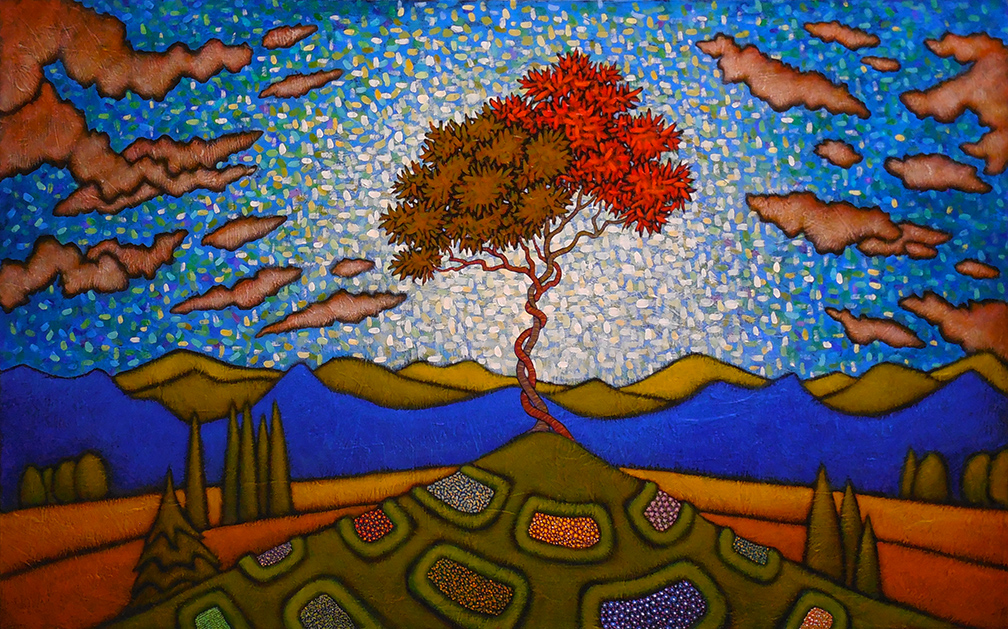
GC Myers – Mountain of Frustration 1995


Frustration is one of the great things in art. Satisfaction is nothing.

–Philip Guston, Philip Guston: Collected Writings, Lectures, and Conversations


I don’t know that I completely agree with the late artist Philip Guston on frustration being one of the great things in art. When you are truly frustrated great is not a word that springs to mind. 

It might be great in the fact that it is sometimes a potent motivator for artists. It creates a sense of restlessness that I believe artists need in order to maintain growth in their work.

Without this restlessness, the artist begins to view their work with mere satisfaction and as Guston says, satisfaction is nothing. I agree completely with that.

Frustration for the artist comes in many forms. Sometimes it is a mental block that prevents them from achieving their vision or, sometimes, from even being able to work. Been there, done that.

Sometimes it comes from outside the artist, in the obligations and responsibilities that often keeps them from focusing on their work. Been there, done that.

Sometimes it comes with feeling that their work is overlooked and underappreciated, that the outside world just doesn’t comprehend what the artist is trying to communicate. Or that the outside world sees the work as being so irrelevant that they don’t even stop to really consider it. Been there, done that, as well. Too many times.

There are plenty of other frustrations for the artist, probably too many to laundry list here.  But for the purpose of today’s post let’s focus on the last one listed above, about the artist being frustrated by others not seeing the value of what they are trying to do.

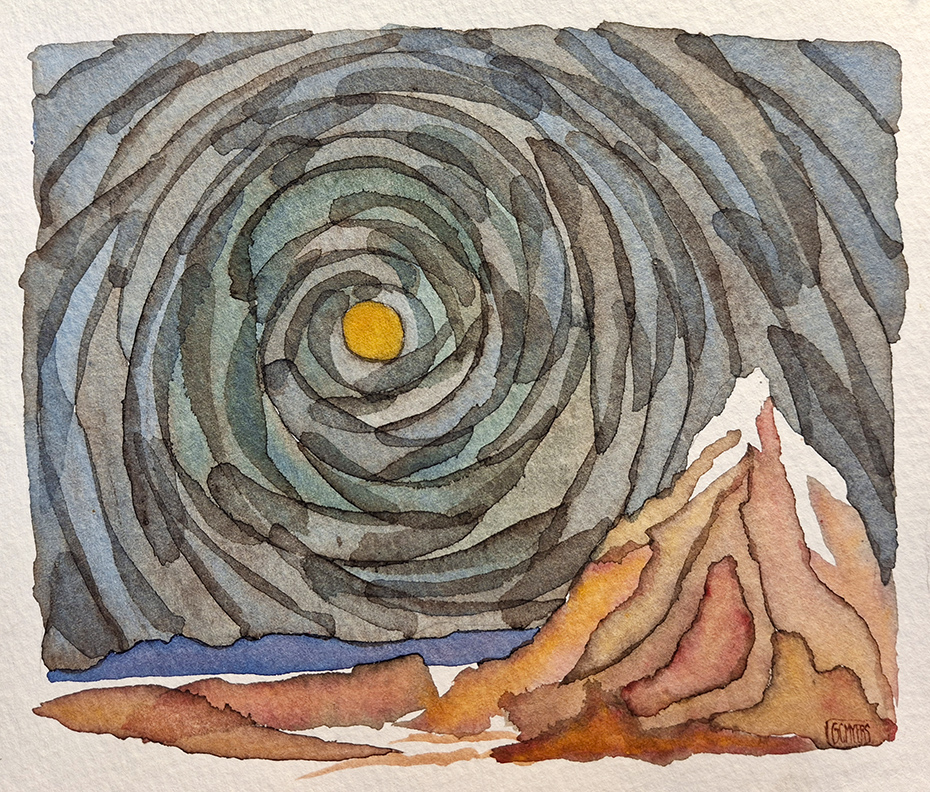
The painting at the top is another early piece, one from early May of 1995. I remember finishing this piece thirty years ago and just not clicking with it in the moment. So, it was set aside and never shown. But like many of those early pieces, I would periodically pull it out and look it over for a while. I began to see more and more in it over the years and came to have a real affection and appreciation for it. It has things in it that excite me now, making me wonder why I couldn’t see them when it was first painted.

The paper on which it was painted listed only the date and the number I had given at the time. No title or note on it.  As a result, I never viewed it with a title in mind, nothing that could inform me of what I was feeling about it at the time. But I recently looked it up in my painting diary from that time, something which, for some unknown reason, I had failed to do in the intervening years. 

There was a title for it, Mountain of Frustration, and a note. The note said it was an odd, color-filled picture and that I was feeling anxious and frustrated on that day. It went on to say that I was disappointed by being rejected for a regional exhibit to which I had submitted my work and was beginning to question my ability. I ended by writing that maybe I was mentally putting myself further down the road than where I truly was at that point.

I had no memory of writing that entry. But reading it made so many things clearer for me about this painting. I could see now how my frustration shaded my opinion of this painting for a number of years until the memory of it faded.

Actually, my first reaction was to laugh at the fact that I was so upset by the rejection in the first place. This was May of 1995, so I had only been showing my work for a few months at that time and had only been painting for a little over a year. I am not sure I had even sold my first painting at that point.

Saying that I was putting myself further down the road was an understatement. Hell, until just a few months before this, I didn’t even know there was a road. 

I can’t remember what painting had been rejected but I am sure the slide I submitted was very poor in quality. I laughed and shook my head at the gall and hubris I had displayed. I thought I had responded like a fool.

But even though I see how ridiculous it was now, I can’t discount the impact of that frustration I was feeling at the time. I looked at it then as a challenge. It was a defiant call to arms and an “Oh, yeah? Well, I’ll show you!” moment.

I’ve had plenty of those over the years but many more so in those early years. As I wrote above, that frustration transformed into a huge motivating force for me, one that has served me well for many years.

It strengthened my resolve and focus. I may not have seen it in this painting then, but I definitely see it now. After having the diary entry jog my memory, this painting, though I have come to appreciate its power over the years, now drips defiance for me.  It was just what needed to be painted in that moment.

It was a bellow into the void. My first real yawp. Many of you know what I mean by that.

Just sorry that it took thirty years to realize it.

A side note:  I completed my next painting after this on the following day. It was titled The Sky Doesn’t Pity and was later that year submitted to another regional exhibition. It was awarded third prize. There was a lot of validation in receiving that small award. Though I don’t put my work up for competitions today, I entered several regional and national competitions in those early years and won a number of prizes, including a couple of Best of Show awards. 

That was probably all a result of the disappointment and frustration I felt then from that first rejection. Maybe Guston was absolutely correct in saying that frustration is one of the great things in art.

Works for me.


Read Full Post »

All Embracing– At West End Gallery


There must be some other possibility than death or lifelong penance … some meeting, some intersection of lines; and some cowardly, hopeful geometer in my brain tells me it is the angle at which two lines prop each other up, the leaning-together from the vertical which produces the false arch. For lack of a keystone, the false arch may be as much as one can expect in this life. Only the very lucky discover the keystone.

― Wallace Stegner, Angle of Repose (1971)


The lines above from the 1972 Pulitzer Prize winning novel, Angle of Repose, from the late Wallace Stegner really jumped out at me this morning. To be honest, I haven’t read the book so can’t speak to its context. I read a summary that described its theme, described by its title, as a metaphor for finding balance between personal ambition and contentment. His description of this concept being like two vertical lines tipping together so that they meet and prop each other up to create a self-supporting false arch just seemed like the perfect imagery for today, Valentine’s Day.

Love, like every lasting relationship including the inner one we maintain between our hopes and reality, depends on this arch. I hesitate to use the word “false” though I understand it is in reference to the distinction between “true” and “false” arches.

True” arches are carefully designed and slowly built, having angled stones and a keystone at its apex that sturdily binds it all together. It is built to last.  “False” arches that may have the appearance and serve the same purpose are more organic, not really designed or constructed so much as they just happen, often haphazardly and by sheer coincidence of time, place, and circumstance.

Two trees falling against one another in the forest, for example.

Or maybe even two trees that grow together and eventually seem almost as one, a la the trees in my Baucis and Philemon based paintings such as the example at the top.

I’ve been part of such a false arch for a very, very long time. As a result, Valentine’s Day takes on a different look for me. Though it still maintains a romantic aspect, it is now more about a deeper recognition and appreciation of all the many aspects that make up that tree that somehow fell my way all so many years ago to create the false arch that has somehow, often against all odds, survived.

Actually, I should say when my tree came to rest against the strength that is her tree.

Without that support, I would most certainly have fallen all the way to the forest floor.

Many times. I have always existed as a pretty precarious tree, after all. Even in my sapling days.

As the Stegner lines above point out, this type of false arch might be as much as one can expect in this life. I certainly couldn’t ask for anything more.

Here’s one of my favorite Rickie Lee Jones songs, one that seems fit for this day and post. This is We Belong Together, from her 1981 album, Pirates. Though this album was critically acclaimed when it came out, I don’t know how it has aged through the years or how it is viewed by a younger audience nowadays. I have always thought it as a classic, with its striking cover photo from the great French photographer Brassai who has been featured here before, and the many songs that have stuck with me for forty-five years now.

There’s an angle of repose in there somewhere…


This post ran several years ago. I rewrote it a bit, adding and subtracting here and there, but its sentiment holds true for this Valentine’s Day in this forest.


Read Full Post »

Harmony in Blue and Green— At West End Gallery


Excellence is an art won by training and habituation: we do not act rightly because we have virtue or excellence, but we rather have these because we have acted rightly; ‘these virtues are formed in man by his doing the actions‘; we are what we repeatedly do. Excellence, then, is not an act but a habit: ‘the good of man is a working of the soul in the way of excellence in a complete life… for as it is not one swallow or one fine day that makes a spring, so it is not one day or a short time that makes a man blessed and happy’.

–Will Durant, The Story of Philosophy (1926)


I recently came across the passage at the top from the esteemed historian/philosopher Will Durant. I was taken by hos words which very much aligned with one part of yesterday’s post that stated that we become what we say and do. Durant stressed the repetition required to create habit in our virtue and excellence.

Good stuff. Practical and applicable to most people. And the practice of becoming and being an artist. I’ve often felt that one of my strengths is my willingness– or perhaps it’s compulsion– to work. I would like to believe that this habit I have created shows itself in some small degree of excellence.

While reading the article that contained this passage from Durant, I noticed there was an attached note pointing out that the passage’s quoted phrase ‘these virtues are formed in man by his doing the actions were taken from the Nicomachean Ethics written by Aristotle around 350 B.C.E. I decided to investigate a bit further to see the context of Aristotle’s words. This further digging is now part of my writing habit. Not sure any excellence has come of it yet.

I was interested in what Aristotle wrote on this subject. My concise reading of the chapter containing the phrase above is that all art has a level of goodness contained within itself. This applies even if it is performed or created by those lacking goodness and virtue. The character of the work only becomes virtuous when the work is created with conscious intent by a virtuous artist of firm and unchanging character.

This made me wonder if the qualities that I sense in my work were the inherent goodness already present in it or did they reflect my character and whatever goodness I might have contributed to the work? Were my feelings I experienced from seeing the work I created actually part of the work? Or was any character and virtue the work possessed its alone?

This created quite a quandary in my mind. It made me think of a conversation I had with a good friend recently where I was briefly talking about the new work created in this past year, of which the piece at the top is an example. I was describing to my friend the disappointment I felt in the general reception to this work. I said that I saw something in the work from this time that felt as though it might one day be important and definitive in the larger context of my work.

Well, if there ever is such a thing as the larger context of my work. That’s out of my hands.

But I felt that this work was created with great intent and was truly reflective of my character and beliefs. It had a passion in it that was instantly apparent to me. It deserved to be created and seen.

Of course, that is my personal opinion. That can often be too close or biased in judging one’s own work. Maybe the passion and depth I sensed didn’t come through in the inherent goodness of the work? Or perhaps that which I perceived then as goodness and virtue is not that exactly? Maybe much less?

Or maybe what I was seeing was real and present in the work but was appearing in the wrong time and place?

I don’t know and may never know. That’s something you have to accept as an artist. You never know how your work, no matter how passionate you are about it, will be received. Now or in the future. You create on your own faith and belief in what you do, over and over again, with the hope that, as Durant points out, excellence will one day be achieved through this habituation.

You just do what you do and let the chips fall where they may. Now and in the future.

As I said, maybe the work was in the right place at the wrong time. Here’s the late and ever flamboyant Dr. John with a song that hits this nail on the head. This is a performance from the Midnight Special in 1973 of his Right Place Wrong Time with the Doc in full Night Tripper regalia.

A blast from the past. Well, my past, at least. You got your own past to work from, kids.

Now get out of here before I turn surly.


Read Full Post »

Moment of Pride— At West End Gallery


Children show scars like medals. Lovers use them as secrets to reveal. A scar is what happens when the word is made flesh.
It is easy to display a wound, the proud scars of combat. It is hard to show a pimple.

–Leonard Cohen, The Favorite Game (1963)


I am not sure why I chose this passage from a Leonard Cohen novel to pair with this painting, Moment of Pride. Maybe it is because I just discovered, even though I have been a fan of his music for a very long time now, that Cohen had been a poet and novelist for ten years before finding his way into the world of music.

During that time in the 1950s up through the mid 60’s, he experienced a variety of ups and downs with varying degrees of success, as is the case with any artist. But he did have quite a bit of acclaim. In fact, in 1966, a critic for the Boston Globe in a review for his novel Beautiful Losers compared him favorably with James Joyce. There was even a 1965 film, Ladies and Gentlemen… Mr. Leonard Cohen, produced by the National Film Board of Canada on the work and life of the author/poet, a couple of years before he set out for what was to be a legendary career as a singer/songwriter.

I was kind of surprised that I didn’t know this upon discovering it this morning. Adds a layer of interest to what was already an interesting and unique figure in the world of music. Coincidentally, a song of his just came on the station I listen to each morning.

But it was his words on a pimple that struck me and how we proudly display our wounds and scars but try our best to conceal our natural flaws., often viewing them with shame, fearing that we will be somehow judged on them. This observation resonated me personally, as it probably does for most of you, as well.

Been there. Done that.

As with everything, I immediately equated it with my work. After all, I do think of each piece as having a life of its own and like all living things, each has its fair share of imperfections. When I first began to paint, I viewed these little flaws in much the same way that each of us does our flaws, trying to hide them. To somehow deny that they were present and part of the painting.

But time taught me that these little flaws and glitches were the thing that made them unique, that gave them depth of flavor, to use a culinary term. After a while I began to celebrate these pimples in my work. Don’t get me wrong here. I don’t try to create them nor are they planned beforehand. It’s just that I know that sometimes burst through the surface, like pimples do, but do nothing to detract from what is beautiful in the painting.

If anything, they validate its humanity.

How this applies to this painting is kind of circumspect. Oh, it has little flaws throughout. I am sure I can find plenty if I want to concentrate on them. I like this piece as it is, no matter how many little blips I could find.

How it came about might apply. I don’t know, maybe it doesn’t. No matter. Consider this a pimple in this blog, okay? A couple of years ago, some friends and their daughter stopped in and I gave them a quick tour of the studio, something I seldom do. While they were here, I gave them a quick demo of my wet painting style. I opened the container of some sepia ink and its stench filled the space.

There’s a longer story about the ink but the short one is that I have been working off of a number of 5-gallon pails of ink for about the last 17 years now. Some have organic elements that cause them to almost ferment in the buckets. The black and sepia are most susceptible to this. When I open these buckets there is often a skim of mold on the top of the ink and along with it, a pungent stink that hits you in the face like a punch.

It’s not quite so bad when I open the smaller containers in which I keep the ink for use on my painting table but it still bites pretty hard sometimes. On this occasion it was enough that it caused their teenage daughter to immediately run from the room in revulsion. Laughing a bit, I proceeded to paint the top block of color as Ebba, the daughter, watched from a considerable distance. It started with sepia which I then diluted. I then removed most of the sepia and replaced it with a red that I washed down to the shade you see.

That ended the demo for that day. I set this little block of color aside for a long time, always chuckling at Ebba’s response to the smell of the sepia whenever I would pull it out to consider it. I didn’t know if it would ever be another other than an anecdote.

But there was some latent potential in it that spoke to me. Something well beyond a mere anecdote, though that is part of it now. I think it was the idea that the many elements that go into creating beauty often seem less than beautiful in themselves.

That is where the title, Moment of Pride, came from. The fact that it takes effort and stink, sweat and sometimes blood, to create something that transcends its parts and its inherent flaws is a point of pride for me. I sometimes stand in front of a piece, unshaven and unwashed in grubby, paint-covered clothes with the stench of acrid paint in the air and feel a sense of awe for what I am seeing. I sometimes wonder how something possessing even a small degree of such beauty can come from such a person as I. How can such a thing seem to dispel all my flaws, hide all my pimples?

I don’t really know. And to be honest, I don’t really care. So long as it keeps me with that small sense of pride and awe, I will live and die a happy man. Pimples and all.

Amen.

This piece, by the way, is included in the Little Gems show opening tonight at the West End Gallery. The Opening Reception is from 5-7 PM.

I guess we should have a Leonard Cohen song, right?  The natural pick is Anthem, a song that I have shared here a few times. Let’s go with that. This is a live version from 2008 which opens with Cohen speaking the song’s famous lyrics which applies to this post: Ring the bells that still can ring / Forget your perfect offering / There is a crack, a crack in everything / That’s how the light gets in


Read Full Post »


Blue Moon Rising– At West End Gallery

I have no doubts that our thinking goes on for the most part without use of signs (words) and beyond that to a considerable degree unconsciously. For how, otherwise, should it happen that sometimes we “wonder” quite spontaneously about some experience? This “wondering” seems to occur when an experience comes into conflict with a world of concepts which is already sufficiently fixed in us. Whenever such a conflict is experienced hard and intensively it reacts back upon our thought world in a decisive way. The development of this thought world is in a certain sense a continuous flight from “wonder.”

A wonder of such nature I experienced as a child of 4 or 5 years, when my father showed me a compass. That this needle behaved in such a determined way did not at all fit into the nature of events, which could find a place in the unconscious world of concepts (effect connected with direct “touch”). I can still remember—or at least believe I can remember—that this experience made a deep and lasting impression upon me. Something deeply hidden had to be behind things. What man sees before him from infancy causes no reaction of this kind; he is not surprised over the falling of bodies, concerning wind and rain, nor concerning the moon or about the fact that the moon does not fall down, nor concerning the differences between living and non-living matter.

–Albert Einstein, Autobiographical Notes (1949)


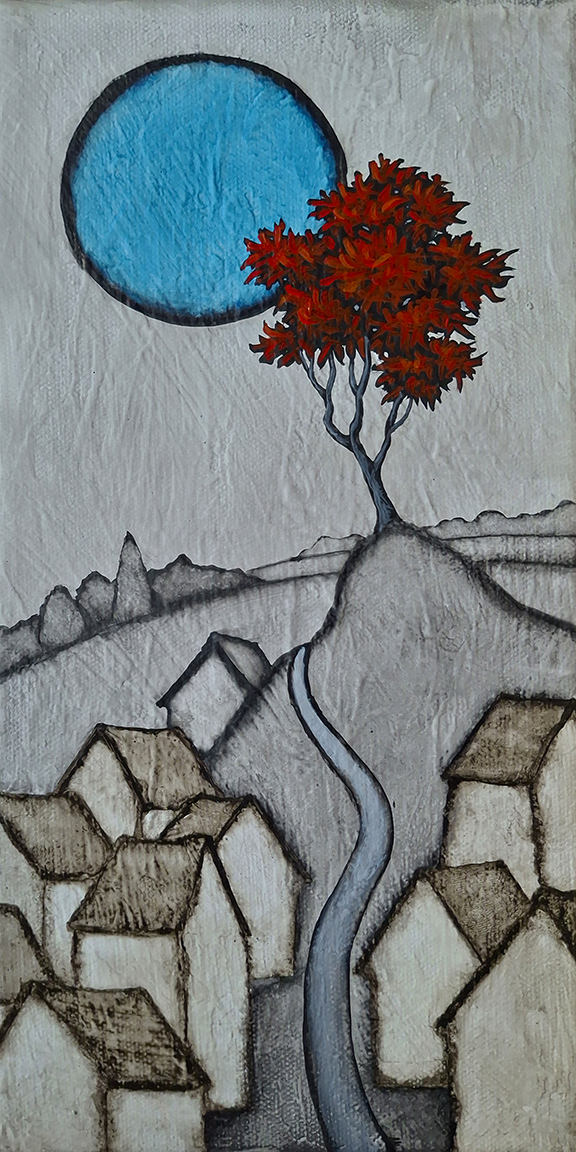
This passage from Albert Einstein seemed to fit well with what I see in this new painting, Blue Moon Rising, as well as an observation that has been on my mind for some time. It is about our sense of wonder. Or should I say, our sometimes lack of wonder.

Einstein writes about some events in his early life that upset his view of the world in some way, that went against what he felt he knew and believed at that point. Instead of simply accepting this new view, it instead awakened a sense of wonder in him. He goes on to say that without this sense of wonder, we begin to accept whatever appears before our eyes without thought or question.

It’s the equivalent of sleepwalking through life. The great wonder of this world and our place in it is simply taken for granted and largely ignored. Unseeing and unquestioning, we become inured to both the beauty and ugliness of this world. We lose the ability to be emotionally connected to the world around us, to feel, to love, to care for others.

It is our sense of wonder that is the basis for all compassion and grace. And it is a lack of this that creates all ignorance and cruelty.

Asking a question out of wonderment often has a unifying effect for us to whatever or whoever the question is directed. It sometimes feels that we have become a society based on statements of belief that are devoid of that sense of wonder. It feels like we don’t ask many questions of others nowadays. We say what we think we need to say and just accept what others say or present to us. No sense of wonder about the other person is ever created and, as a result, our connection to them is tenuous at best.

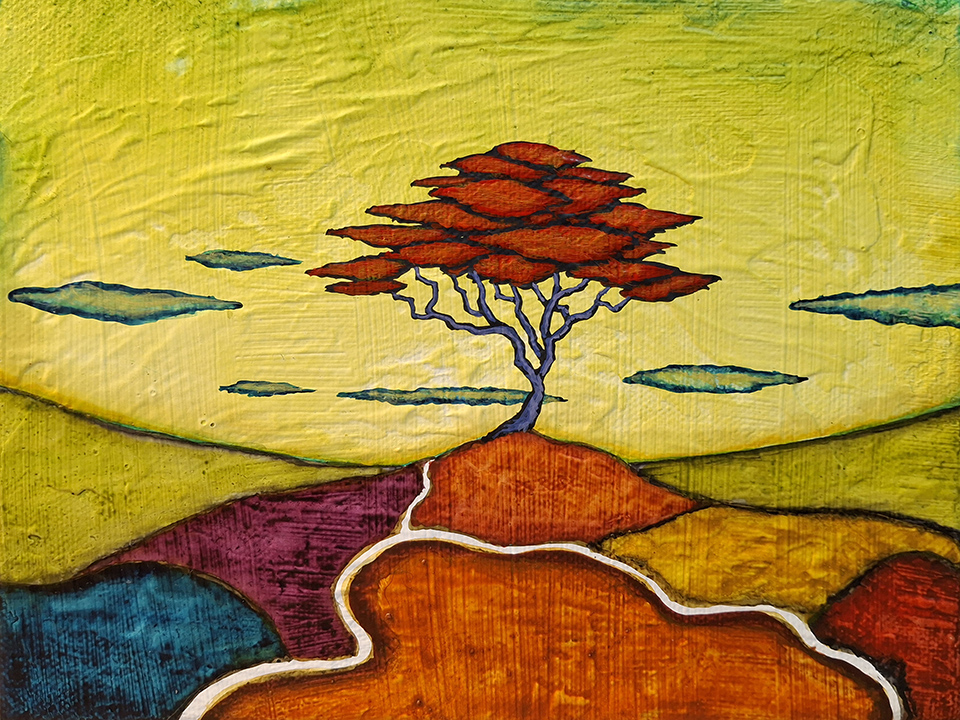
I see this scenario in this painting, Blue Moon Rising. I see it as the Red Tree observing the unusual Blue Moon rising. It alone questions the why of it all while its neighbors in the houses around it remain locked away. Unseeing and unquestioning. The colors in the Blue Moon and the Red Tree, for me, symbolize the connection created by the Red Tree’s observation and wonderment. The very questioning of why the rising moon is blue creates a connection to it.

Of course, that is only how I see it. Like all art, you will see it in your own way, with all that you bring to it.

Hopefully, you will bring your own sense of wonder.

Here’s a song from the Red Clay Strays that is kind of about this sense of wondering, except in a very specific way. Called Wondering Why, it’s about wondering why someone loves us in the way they do. Given all our faults, that’s a good question.


 Blue Moon Rising (6″by 12″ on canvas) is included in the Little Gems show at the West End Gallery that has an Opening Reception tomorrow, Friday, February 6, running from 5-7 PM.


Read Full Post »

Odd Bodkins Blue Sky– At West End Gallery


And where are the dreams I dreamed
In the days of my youth?
They took me to illusion when they
Promised me the truth
And what do sleepers need to make them listen,
Why do they need more proof?
This is a strange, this is a strange affair

Richard Thompson, Strange Affair (1978)


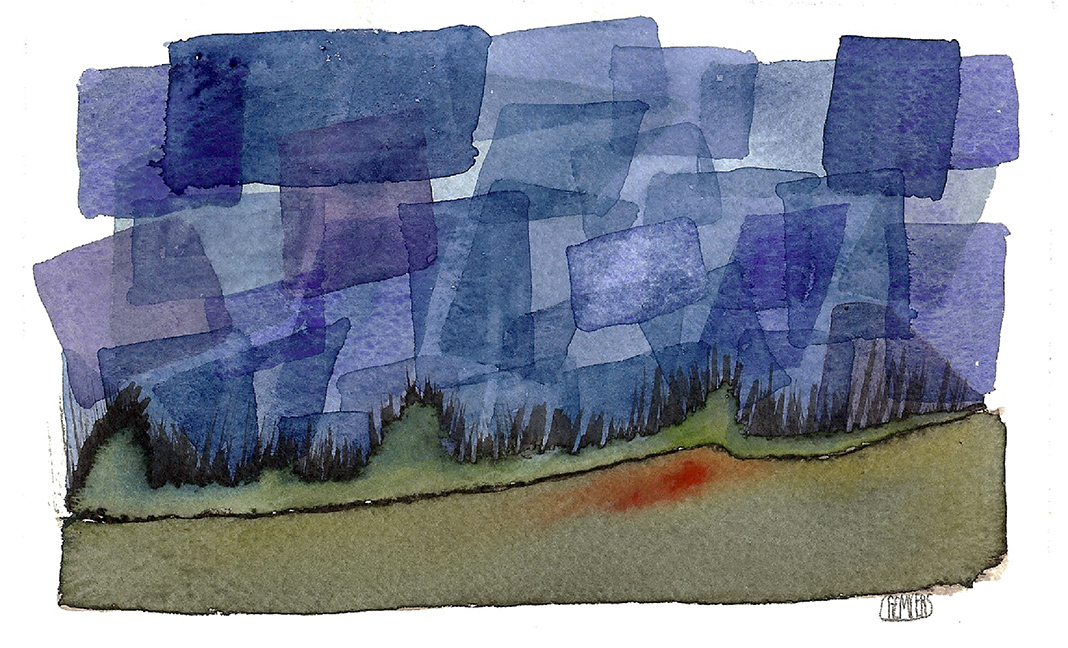
This is another of the small early paintings that I have released from their captivity. This one carries a memorable title, Odd Bodkins Blue Sky. which in itself indicates that it is a favorite of mine. It was painted in August of 1994 and it is being shown at the West End Gallery as part of the annual Little Gems show that opens on Friday.

It’s a piece that has always elicits an approving reaction those many times I’ve looked at it over the years. It makes me both happy and slightly regretful. I get a lot of joy from the painting itself but there’s just something in it that makes me wonder what might have been if I had followed the path that it promised me.

And it seemed to promise a lot.

It has a sort of organic abstraction that gives only hints of a narrative. It gives no answers but instead raises many questions. What is that red patch in the upper foreground? Are those clumps of grass? Is this even a landscape or something else altogether? What is the significance of the blocks of blue and violet making up the sky?

I, of course, can’t answer these questions for anyone but myself. And I am not sure I can fully answer them for myself. This enigmatic quality think that is part of this piece’s appeals for me.

Another part of that I am particularly drawn to is the organic feel of its forms and lines. It has the feel of a living thing, if that makes any sense. One part of it that gives me great pleasure comes in the line between the two green forms that make up the foreground. You might not be able to see this unless you zoom in to the image, but there are little flecks of white from the underlying paper. I don’t know why they give me such joy but they do. It’s a tiny aspect of this painting but for me, it makes the whole piece resonate.

It’s a strange little piece in many ways. And that is also part of its appeal.

A special child whose oddness is its gift to the world.

Odd bodkins, by the way, is an old English exclamation that comes from the Middle Ages. It was a way of swearing without actually blaspheming. If you yell Gosh darn it! after you hit your thumb with a hammer now, you might have yelled Odd bodkins! if you did the same thing in England a thousand years ago. How this applies to this painting, I have not a clue except that it kind of points out its strangeness.

Speaking of strange things, here’s a favorite song that, much to my surprise, I discover that I haven’t shared since early 2016. This is the great Richard Thompson song, Strange Affair, performed beautifully by June Tabor, accompanied by another of my favorites, Martin Simpson, on guitar. Tabor’s smoky voice makes this a memorable interpretation.


A quick note: The Opening Reception for the Little Gems show at the West End Gallery is this Friday, February 6, from 5-7 PM.


Read Full Post »


Into the Valley (1995) – At West End Gallery


There was a long hard time when I kept far from me the remembrance of what I had thrown away when I was quite ignorant of its worth.

–Charles Dickens, David Copperfield (1850)


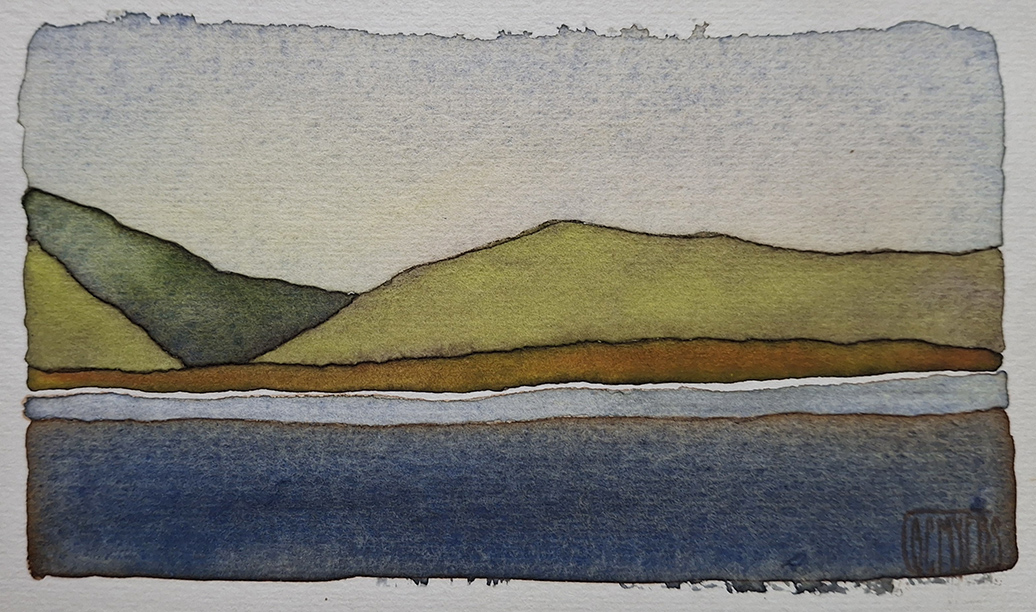
 The painting at the top is another early piece that is going to be included in the Little Gems exhibit opening at the West End Gallery this coming Friday, February 6. This painting, Into the Valley, has a direct connection to the Little Gems show of 1995, which was the first such exhibit for the gallery as well as the first public showing of my work.

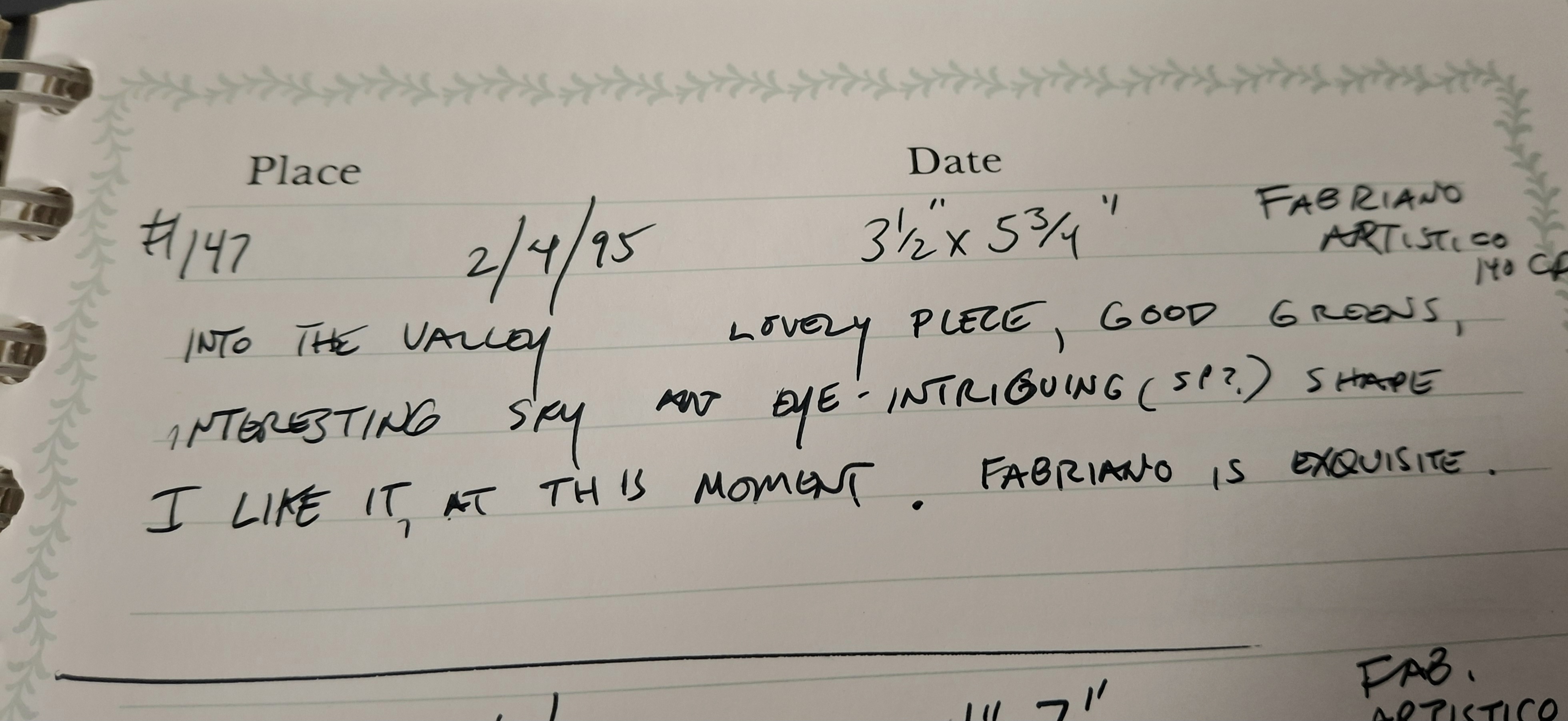
Painted on February 4, 1995, this was the first work produced after I had attended the opening of the show the night before, on February 3. In the painting diary I kept at the time there was no mention of the night before. I was a bit surprised that there was no mention of the opening since it had an immediate effect on me. But after looking at the diary a little more, I wasn’t so surprised. It included mainly simple direct information about each piece such as the date, title, the type of paper used (I was working solely on paper at that point), and some notes on the piece. These notes sometimes pertained to the paints I was using as well as my first impressions of the painting.

Here’s the entry for this painting what will be from 31 years ago in just two days:

Lovely piece, good greens, interesting sky and eye-intriguing shape. I like it, at this moment. Fabriano is exquisite.

It’s a short entry but it gives me a world of pertinent info. Mainly, it tells me that my first impression of it was very positive, but I wasn’t totally confident in my own opinion of it. Some things never change. It was this hesitation in my judgment that probably kept this painting in a box for the past three decades.

My first impression of Into the Valley as I wrote then was right on the money. It is a lovely piece. It does have good greens and its sky is interesting and its shapes are eye-intriguing. And the Fabriano paper that I was just working with for the first time around then was and is exquisite.

Looking at it now, I realize that I made a mistake in not freeing this little guy long ago. I hope that it gets to have a long life of the appreciation it due.

A little side note. I stopped using this painting diary at the end of 1995. My entries for the time after that are regrettably even less informational. But I am thrilled in having these notes for the earliest works. Reading recently, I noticed that I seldom went beyond this terse format in my painting diary.  One interesting except was an entry a few weeks before I painted Into the Valley.

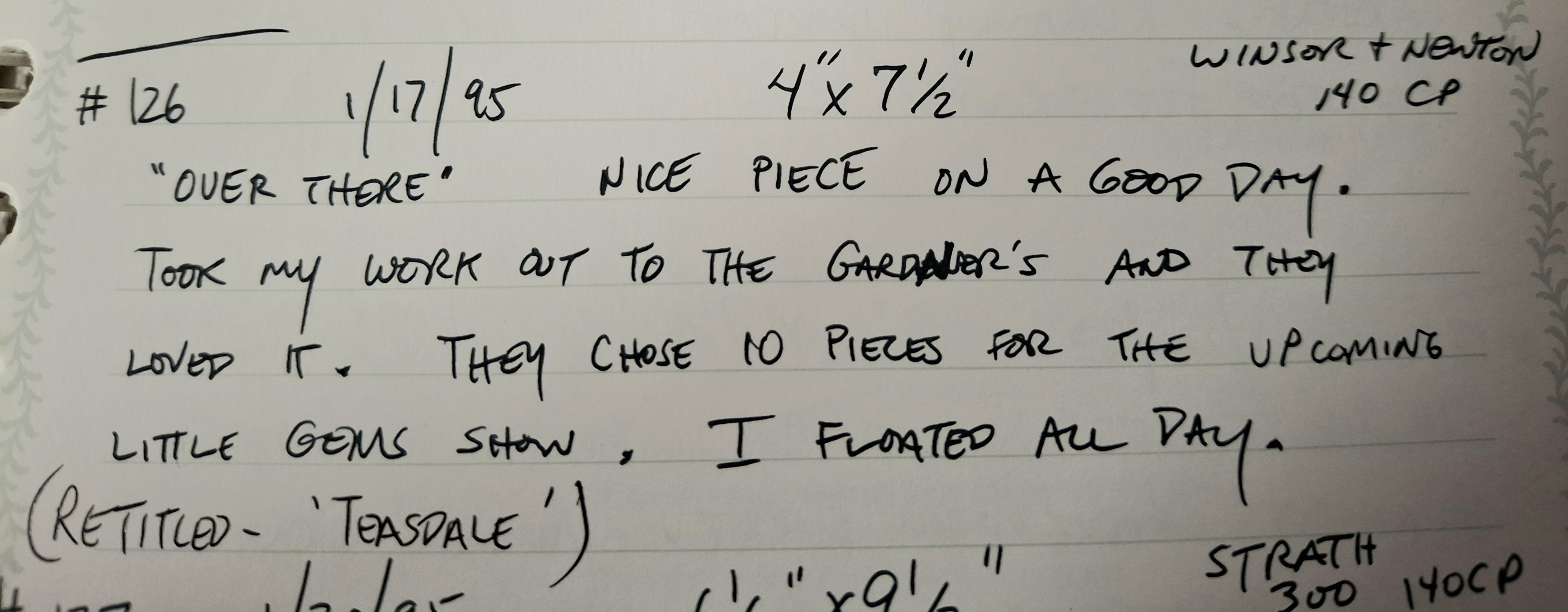
It came on January 17, 1995. I don’t remember much about the painting from this entry except that it was renamed Teasdale which I remember did find a new home later in the year. I don’t think I even have an image of that painting or, if I do, it is lost in a jumble of poorly shot slides from that time.

But the painting is not the interesting thing here for me.

More importantly, this short entry came from the day I took my work stuffed willy nilly into man old blue milk carton out to the West End Gallery. That was the day when all kinds of new horizons opened for me that I hadn’t even dared to imagine before that day. Here’s what I wrote after that meeting with Tom and Linda Gardner at the West End:

A good day… I floated all day. It now seems like such a restrained understatement for what I was feeling on that day and for what it came to mean for my future.

This probably gives you an idea why I have such deep appreciation and fond feelings about the Little Gems show. It is an integral part of my career, the point of departure for my artistic path. Without that day in January back in 1995 and that first opening a few weeks later, I have no idea where I might be now. The only thing I can say for certain is that I could not be any more content wherever I might have ended up.

When I see new artists, especially the younger ones, show for the first time at the West End, or any gallery for that matter, I look at them closely, knowing how excited and hopeful they must be. I can only hope they use the opportunity to find a path forward that is as satisfying for themselves as mine has been for me.

I’ve said it before, but I owe so much to Tom and Linda Gardner for that opportunity, that good day back in January of 1995.  Thank you, Linda. Thank you, Tom. Thanks to you both, I still find myself floating.


The 32nd annual Little Gems opens Friday, February 6, 2026, with an Opening Reception that runs from 5-7:30 PM.  Hope to see you there.


Read Full Post »

The Juncture— At West End Gallery


The tree which moves some to tears of joy is in the eyes of others only a green thing which stands in the way… As a man is, so he sees.

–William Blake (1757–1827), 1799 letter to Dr. John Trusler


Ot it could be a red thing, right?

I would like to think that Blake would be okay with red trees. He was someone who definitely marched to his own drum in his time, never compromising his artistic vision to suit anyone other than himself. He willingly paid the price for choosing to maintain the integrity of his work, dying a pauper.

Such choices are not the sole province of artists. We all face similar choices in our lives about love, family, friends, work, and so on. Our lives are built on the decisions we make when faced with such choices. Some of our choices have huge and obvious consequences but even the smallest decision has some bearing on where we eventually end up and who we become.

To me, this new small painting, The Juncture, represents such a choice.  The path brings us to a fork in the road. We can see a bit ahead where one path will lead us. It seems safer and even bends back towards us. The other veers off and over the mound, giving away few hints to where it might take us. One is safe and one entails the risk of the unknown.

There is no telling if it will end up being a big or small choice. You often don’t know at the time you decide. Choices can sometimes hide or mask their eventual importance and, as a result, we end up taking them too lightly I think that’s why we make so many decisions.

Some may see the Red Tree here as just something to rush by, much like those who according to Blake see trees as something merely standing in the way. In my mind, the Red Tree here is advocating for taking that risk, for pushing ahead to the new unknown. I see it as a knowing guide, letting you know that it can see further ahead than you and that it can be okay– if you commit fully to that path.

That unknown path is not for the squeamish or those require absolute comfort and security. The unknown path has other rewards.

William Blake understood this.

This is a simply constructed painting but its colors the relationship of its forms make it seem bigger and more complex. It makes it feel like makes a statement even though it is smaller and spare in detail.

Well, that’s how I see it but, of course, I am more than a little biased.

This piece, 6″ by 8″ on canvas, is included in the Little Gems exhibit at the West End Gallery, opening one week from today, on Friday February 6.

Here’s a song from Ray LaMontaigne that may or may not mesh with the other part so this post. Actually, it just came up on my playlist as I finished that last paragraph. It’s a song that I have liked for a while and it felt right in the moment. Even its title feels right– Highway to the Sun. And its chorus below could easily be applied to this painting, representing why one might decide to take that unknown path.

I just wanna wake upUnderneath that open skyJust wanna feel something realBefore I die


Read Full Post »


But above all, in order to be, never try to seem.

― Albert Camus, Notebooks, 1935-1951


I am going to try to share an older piece every Monday. I say try because I may simply forget to continue the series at some point or it might run out of steam. It’s happened with me before. Like the old line from Robert Burns: The best laid plans of mice and men often go awry.

But for now, I will try to keep it going.

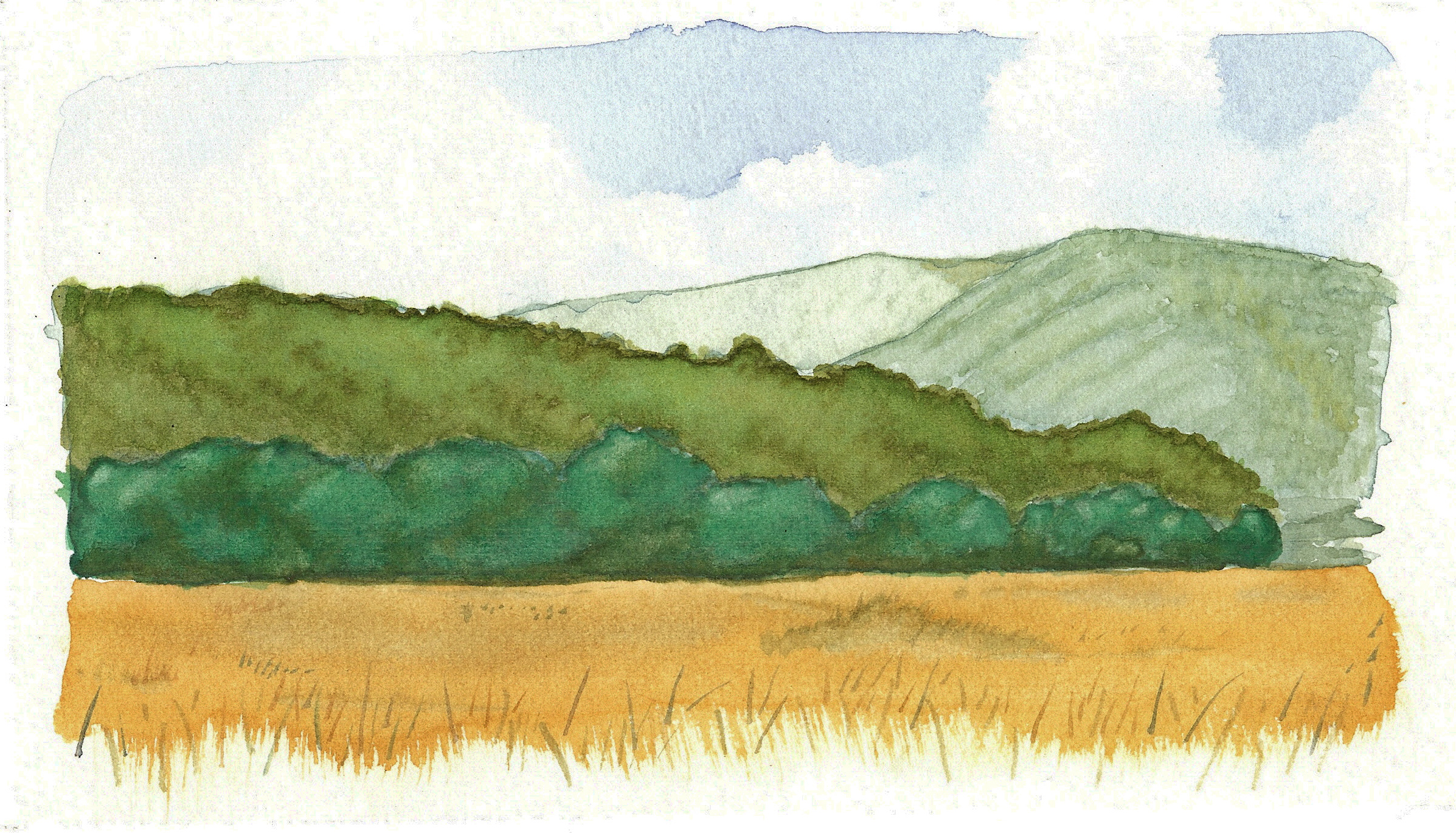
This small painting, Summerfield, from 1994 has been a favorite in recent years for me. To be fair, I liked it when it was painted. However, I was just finding my voice at around the same time, transitioning to a more personalized style and process that would better speak for me.

This piece represented that period in my development where I was still trying to make work that was comparable to others. It’s a period most artists go through, when the work of others serves as gauge against which they can compare and gauge their progress. It’s helpful and sometimes satisfying as you approach what you consider an acceptable level of ability. You begin to feel as though you’re part of the club.

But for some there comes a point where you sense that this is not the path for you. You realize that you don’t really want to be in the club, however prestigious that club might be. You don’t want to be compared to the others in the club, don’t want to be limited by the constraints of the rules of the club, some of which felt arbitrary.

If I felt that the sky should be red or the fields purple, why should I not paint them in those colors?

This piece was one of the last pieces where I was still thinking about joining the club. Maybe the last one actually. I never signed it, nor do I believe I have ever shown it publicly even though the progress and quality it showed pleased me greatly.

It just didn’t seem to fit into where I saw my work going at the time.

But over the years it has become a favorite, always bringing a warm feeling when I come across it. Its sense of place and time resonates with me. Perhaps more now than when I painted in over 30 years ago.

I no longer see it as an echo of someone else. I view it as a helpful stop along the way where I was deciding which way to go.

More than that, I simply appreciate it now for what it is in front of me.

Much like Camus’ words at the top, it doesn’t seem to be trying to be what it is not.

It has its own sense of being. It just is what it is.

And though it took time to come to this recognition, I like what it is.

Here’s a song that came on while I was writing this. Its tone seemed so perfect for the feeling I was getting from Summerfield that I can’t resist sharing it. This is Blue Skies from Tom Waits. It’s a stark contrast to his The Earth Died Screaming that I included in a post a few days back.

This is one of his earlier songs so maybe this is his Summerfield?

Who knows?

Doesn’t matter. It just is what it is. And that is all I need to know.


Read Full Post »

The Passing Parade— At the West End Gallery


One never finishes learning about art. There are always new things to discover. Great works of art seem to look different every time one stands before them. They seem to be as inexhaustible and unpredictable as real human beings.

–Ernst Gombrich, The Story of Art (1978)


I think the passage above from art historian Ernst Gombrich (1909-2001) is an apt flourish to this reminder that my solo exhibit, Guiding Light, at the West End Gallery comes to its conclusion at the end of the day this Thursday, November 13. There are three days to arrange to see the show.

I believe Gombrich’s statement applies here because as he says, art looks different every time one stands before it. And I think when a show is hung it creates a unique atmosphere created by the dynamics of the individual pieces in relation to one another, the space, and the viewer. It makes viewing any painting in an exhibit, as well as the exhibit as a whole, a unique experience for the viewer.

Maybe I am out of place in saying this, but I felt that this show at the West End Gallery was one of those unique experiences with its own atmosphere. Each piece stands out in their individuality but is reinforced by the work surrounding it.

Like strong individual voices gathered in a choir.

Hope you get a chance to catch the show before the choir disbands and the singers go solo.

Here’s a favorite song from the Talking Heads and David Byrne performed during his American Utopia tour of 2018. This is This Must Be the Place (Naive Melody).

The less we say about it the better
Make it up as we go along
Feet on the ground, head in the sky
It’s okay, I know nothing’s wrong, nothing


Read Full Post »

« Newer Posts - Older Posts »