Feeds:
Posts
Comments

Posts Tagged ‘Art’

Advice: Hard Work

gc-myers-1994

GC Myers- Early Work, 1994


He was justifying his existence, than which life can do no greater; for life achieves its summit when it does to the uttermost that which it was equipped to do.

–Jack London, White Fang


From 2011:

I had a nice email from a gentleman who sent me the image of painting done by his 16-year-old daughter, telling me about a prize it had been recently awarded in a scholastic competition.

I took a look at the piece, and it was indeed a very well-done painting, nicely composed with strong lines and color. It was certainly far ahead of anything I was doing at that age, especially by the virtue that it was complete. It was obvious that this young person had talent, and I could see this young person doing more with it in the future. I wrote him back and told him this but with my standard warning, one that I have written about here before: Potential must be actively pursued with constant efforts and a consistent pushing of one’s abilities.

In other words: Talent is great but doesn’t mean much if it’s not constantly practiced

I wrote him to tell him this, to let him know about some of the young talents I have seen come and go because they felt their talent was something that was innately within them and could be turned on and off with the flip of a switch.

I told him to tell her to look at the work required in the way a musician looks at rehearsals. Perhaps even look at their talents as being like those of a musician, talents that need constant exercise in order to stay sharp and strong. For instance, even if you have great innate talent, you can’t expect to play the violin like Itzhak Perlman if you don’t devote your talents in the same way as he does. As it is with many great musicians, the greater part of his life is spent in nurturing his abilities.

I always feel like a sourpuss when I’m giving this advice. Nobody wants to hear that in order to reach their potential they need to work harder or that they might have to sacrifice time that might be spent elsewhere doing other things. Everyone wants to think that they have this great talent born within them and it will flow like a spigot whenever they so desire.

If only that were true.

I think you will find that those who succeed at the highest levels in any field are those who understand this need to constantly push and work their talents. I’m sure there are exceptions, but none come immediately to mind. I wrote about this in a blog post when I first started this, two years back, in 2009. I wrote about something author John Irving had said about his work habits.

He saw himself competing as a writer in the same way as he did in his time competing as a wrestler. Irving felt that reaching one’s fullest potential as writer required putting in the same levels of intense effort as those needed to compete as a wrestler or any other athlete on the Olympic level. 

Hard work– it’s not glamorous especially in this world of instant gratification but it is a proven entity.

I’m showing the piece above to highlight this. It’s a small painting that I did before I was showing in any galleries, in 1994. At the time, it pleased me very much, though I am not sure I felt it was the best thing I had done to that point. However, it felt complete and self-contained. I could have very easily kept painting in that style and been satisfied in some ways without much effort.

But I also recognized that it was limited in many ways. It began to say what I was feeling but didn’t fully express it. There was more beyond this. I just knew there had to be. A little voice kept urging me to push ahead and work harder, to dig deeper to uncover what I could accomplish with greater effort.

This little painting soon was not an endpoint but a steppingstone on a much longer path.

 I hope this man’s daughter also sees her painting as a steppingstone. She may think now that it is the best thing she has ever done. She might be right– to this point. But if she is willing to push ahead and put in the effort, she will look at it someday as a very fine first step in a journey to reach her true potential.


I think the last time I shared this was ten years ago. Nothing has really changed. Around the time I painted the piece at the top, I read about John Irving comparing his work schedule to that of an Olympic athlete. That really connected with me. By then, I knew that I possessed an ability to work hard. It might even be my only true talent. If for once I was to apply this talent towards doing something that truly excited me, who knew where it might lead? And even if it was short path to nowhere, the time was well spent since I was doing something that had meaning and fulfillment for myself.

I don’t regret taking that path or a single minute spent toiling at whatever hard work there is in doing what I do. Like they say, it’s not hard work if you’re doing that which you enjoy. The hardest work I ever did was working at jobs I hated, jobs where was little pay, fulfillment, or joy. 

My worst day in the studio is better than most of the best days at those other jobs. But making that happen took a lot of time, effort and blood, sweat and tearsthe definition of hard work.

Maybe it is also, as Jack London put it at the top, the justification for our existence.

Maybe…


Read Full Post »

The Omnipresence— At West End Gallery


Shakespeare said that art is a mirror held up to nature. And that’s what it is. The nature is your nature, and all of these wonderful poetic images of mythology are referring to something in you. When your mind is simply trapped by the image out there so that you never make the reference to yourself, you have misread the image.

Joseph Campbell (with Bill Moyers), The Power of Myth (1988)


I love the passage above that Joseph Campbell spoke during his conversation with Bill Moyers for the PBS series The Power of Myth. I feel that it describes beautifully the connection between the individual and mythology and art, at least in my view. I believe that we truly connect with myth and art when we see it as personal to ourselves, as being somehow symbolic of our own experience and being.  

Our emotions and reactions.

Of course, some myths and much in art may not speak to us on this personal level. There is plenty of art out there that doesn’t speak to me. That is not to say that it is not good work. Some is masterfully crafted and has an undeniable surface. It is not a judgement of quality.  just doesn’t speak to me personally and doesn’t reflect my own experience or worldview.

And I certainly don’t expect my work to speak to everyone no matter how much I may wish that it could. 

It simply cannot be a reflection for everyone.

My work, after all, is a reflection of my life’s journey. My experiences, knowledge, understanding, and being are mine, complete with flaws and limitations. Yours is completely different, as it should be. Try as we might, no two people can have an identical existence. I believe (without evidence, of course) that even conjoined twins must have differing views and feelings of their shared experiences.

But occasionally, there is a moment of overlap, when the work reflects a truth– perhaps a personal truth or one that is universal– that speaks to another and that other person recognizes something of themself and their own world in my representation of my inner world.

That is a magical and most gratifying moment for me. The fact that someone might see a reflection of their own life and experience of the world in my representation of my own that makes me feel connected to the mythic and the universal.

For that moment, I feel that there is a meaning beyond the mere surface imagery of my work. And I think that sense of meaning is something we all crave, regardless of the field in which we toil.

Here is a song I’ve shared a couple of times over the years. It may or may not have anything to do with this post. I just felt like hearing it this morning. This is Marmalade with the very 60’s sound of their Reflections of My Life.


Read Full Post »

Soloist– At West End Gallery


We’re creators by permission, by grace as it were. No one creates alone, of and by himself. An artist is an instrument that registers something already existent, something which belongs to the whole world, and which, if he is an artist, he is compelled to give back to the world.

Henry Miller, The Rosy Crucifixion Book I: Sexus (1949)


The words above from Henry Miller very much echo in several things I have written here in the past. An artist recreates in their own manner that which already exists, the seen and the unseen. It is created from a multitude of influences, experiences, and observations from this world.

As he says, this creation, being comprised of this world, belongs to the whole world. Art, though its message often feels targeted to us as individuals, is at its heart communal, meant to be shared.

I am not going anywhere with this statement this morning. I simply like the thought and thought it needed to be shared.

Now, here’s a song from a favorite of mine, guitarist Martin Simpson. It fits well with the painting at the top but most likely has nothing to do with Miller’s words. As it was with the Miller passage, I simply like it and wanted to share it. This is Granuaile from his 1991 album When I Was on Horseback. I believe it refers to Grace O’Malley, the head of the Irish O’Malley dynasty in the 16th century. She is often referred to as the Pirate Queen. and is known for a meeting she had late in her life with Queen Elizabeth to ask for the release of her sons who were being held captive by the English governor of Connacht.


Read Full Post »

If I Only Had a Brain

Theodore Rousseau- Under the Birches (1842)


It is better in art to be honest than clever.

–Theodore Rousseau


Theodore Rousseau (1812-1867) was part of the Barbizon School of painters, an art movement in 19th century France that was instrumental in moving away from formalism and towards naturalism and artistic expression of emotion. It was very influential on many of the painters who later created the Impressionist movement.

Rousseau and Jean-Francois Millet, best known for his peasant scenes, were the two artists from this school whose work really spoke to me, seeming to have honest emotional content in them. Perhaps that is why his short quote resonated so strongly with me. That and the fact that I have found myself less impressed with cleverness than honest expression through the years. I have always believed that art comes from tapping into the subconscious, something beyond that part of our brain that produces conscious thought.

I guess I just don’t think we are that smart. Or clever.

I know I am not. My work is at its best when it comes from a place of honesty and real emotion, when it is made with more intuition than forethought. When it is too thought out and directed it begins to feel stilted and contrived, losing its naturalness and rhythm and becoming heavy-handed.

That is probably the reason I tell young or beginning painters to focus not so much on the actual idea of a painting but more on things like paint handling and color quality, those things that make up the surface of a painting and convey the real meaning of the painting. And I think that is what Rousseau was probably getting at in his terse quote.

But maybe not.  Like I said, I am not that smart. Or clever.


The post above is from ten years back, but my admiration for this Theodore Rousseau painting– it’s a Red Tree! — and the message of his words remain evergreen with me. Even so, I often have to remind myself every so often to resist relying on forethought and to instead trust my intuition and reactions.

Emotional intelligence usually outshines brainpower. That holds true for both art and life in general.

Well, that’s the opinion of someone who admits to being neither smart nor clever so it might be wise to take this with a grain of salt.

Here’s a song, If I Only Had a Brain, that Ray Bolger sang as the Scarecrow in The Wizard of Oz I submit the Scarecrow and this song as evidence of my thesis. Pretty clever of me to call it a thesis, huh?

Anyway, here’s a fine version of the song from Harry Connick, Jr. from back in 1987.


Read Full Post »

The Exile’s Wilderness– 2020


For the first time in years, he felt the deep sadness of exile, knowing that he was alone here, an outsider, and too alert to the ironies, the niceties, the manners, and indeed, the morals to be able to participate.

― Colm Tóibín, The Master


The painting above, The Exile’s Wilderness, was originally painted in early 2020 but without the actual figure that represents The Exile, as seen in the bottom right of the image above. I thought that the painting as it was, sans The Exile figure, was really strong and it quickly became one of my favorite pieces from that period in the early days of the pandemic.

I originally felt that the painting didn’t need the figure, that it represented a view seen from the eyes of the exile. But over the past year or so [2021], as much as I liked this painting without the figure, I began to recognize that it actually needed The Exile in order to provide context.

In my mind, I was the context. I had to remind myself that not every person who looks at this will see themselves as The Exile.

So, The Exile entered the picture, literally. And, though I was apprehensive as I proceeded, I was pleased by its effect. It’s contrast to the emptiness of the streets and windows made the figure seem even more alone. More apart. It heightened the overall effect for me.

It completed the circle of feeling that I was seeking in it.

Now, it doesn’t need that caveat of being a favorite from a certain time period. It is simply a favorite. Period.

Here’s a 2001 song from Leonard Cohen, By the Rivers Dark. Though The Exile’s Wilderness doesn’t display a river, this song definitely has the mood that I glean from this painting. Maybe the buildings here are of a riverside street along that dark river?

Maybe…


Still feeling quite drained and under the weather. Trying to keep working but it is slow going. This a slightly reworked post from several years back about a favorite painting that is here in the studio. I thought I should point out that anytime I share a painting from the studio that doesn’t list a gallery location, you can contact me if you are interested in that piece, and I will let you know who to contact about obtaining it. I only mention this because I sometimes sound like I am hoarding certain pieces when, in fact, feel that most of my favorites here in the studio deserve a life that will continue someplace other than here where only I can experience them.  


Read Full Post »

The Pacifying Light– At Principle Gallery


A man’s work is nothing but this slow trek to rediscover through the detours of art those two or three great and simple images in whose presence his heart first opened.

-Albert Camus


These lines above are from an early essay, Between Yes and No, written by the French Nobel Prize-winning writer Albert Camus. It basically states, in sometimes grim detail, his belief that art “exalts and denies simultaneously.” In short, truth is generally somewhere in the middle, never absolutely in yes or no.

Yes or no is generally an oversimplified view, the extreme ends of the pendulum’s arc on which we swing.

While I may not fully understand all the subtleties of Camus’ essay, I do fully agree with the premise as I see it in my own simplified way. I think that art communicates best when it contains both the yes and the no— those polar oppositions that create a tension to which we react on an emotional level. For example, I think my best work has come when it contains opposing elements such as the light of hope or optimism tinged with the darkness of fear or remorse.

The Yes and The No of things. The certainty and uncertainty of all things.

Beyond that, I find this line about the artist’s effort to rediscover those few simple images that somehow first stirred something within their heart and soul intriguing. I certainly recognize it within my own work. I had no idea what I was trying to find when I first began to paint those many years ago. But the idea that there were some inner images that needed to be expressed nagged at me, even though I wasn’t fully aware of what those images were. They were slowly revealed to me and though I often didn’t fully understand their meaning, they somehow made sense and began to fill an emptiness.

That continues to this day. It is, as Camus, says, a slow trek. I still don’t know what to expect when I begin to paint and still have the nagging feeling that there is still an image out there– or in there– that eludes me. But I have some small degree of certainty, for whatever that is worth, that it is there waiting to be discovered. I just have to keep moving towards it.

Here’s a favorite song from a favorite artist, Rhiannon Giddens.  The song is the folk classic Wayfaring Stranger. It’s one of those songs that has been covered by a multitude of singers and is such a strong tune that every incarnation is equally wonderful.


Read Full Post »

New Day Rising– Now at West End Gallery


Art is not a plaything, but a necessity, and its essence, form, is not a decorative adjustment, but a cup into which life can be poured and lifted to the lips and be tasted.

–Rebecca West, Black Lamb and Grey Falcon (1941)


In what is considered her masterpiece describing the history and culture of Yugoslavia, author Rebecca West wrote in Black Lamb and Grey Falcon that art and culture, especially in the form of myths and storytelling, provide both countries and individuals with a revitalizing well from which they can drink in order to survive the difficulties of life and history. Art and culture connects us with symbols, stories, and myths that changes our mere existence into one brimming with purpose and meaning. 

I know that West is writing primarily about storytelling and the myths of nations, which is evident in the passage from which the lines above are taken, which I am sharing below. But I feel that the purpose they serve, as West sees it, is very much the same for art in general. Art moves us beyond our own day-to-day existence, connecting us with our known and unknown pasts and futures. It allows us to feel as though we are part of some greater vehicle, serving both as a function of memory and desire.

Indeed, art is not a plaything. It is an elixir that invigorates the spirit and soul.

Below is the expanded passage from Rebecca West. I think there may be relevance in it for this country at this juncture in history.


Art is not a plaything, but a necessity, and its essence, form, is not a decorative adjustment, but a cup into which life can be poured and lifted to the lips and be tasted. If one’s own existence has no form, if its events do not come handily to mind and disclose their significance, we feel about ourselves as if we were reading a bad book. We can all of us judge the truth of this, for hardly any of us manage to avoid some periods when the main theme of our lives is obscured by details, when we involve ourselves with persons who are insufficiently characterized; and it is possibly true not only of individuals, but of nations. What would England be like if it had not its immense Valhalla of kings and heroes, if it had not its Elizabethan and its Victorian ages, its thousands of incidents which come up in the mind, simple as icons and as miraculous in their suggestion that what England has been it can be again, now and for ever? What would the United States be like if it had not those reservoirs of triumphant will-power, the historical facts of the War of Independence, of the giant American statesmen, and of the pioneering progress into the West, which every American citizen has at his mental command and into which he can plunge for revivification at any minute? To have a difficult history makes, perhaps, a people who are bound to be difficult in any conditions, lacking these means of refreshment.

Read Full Post »


The artist must train not only his eye but also his soul, so that it can weigh colours in its own scale and thus become a determinant in artistic creation.

–Wassily Kandinsky, Concerning the Spiritual in Art (1912)


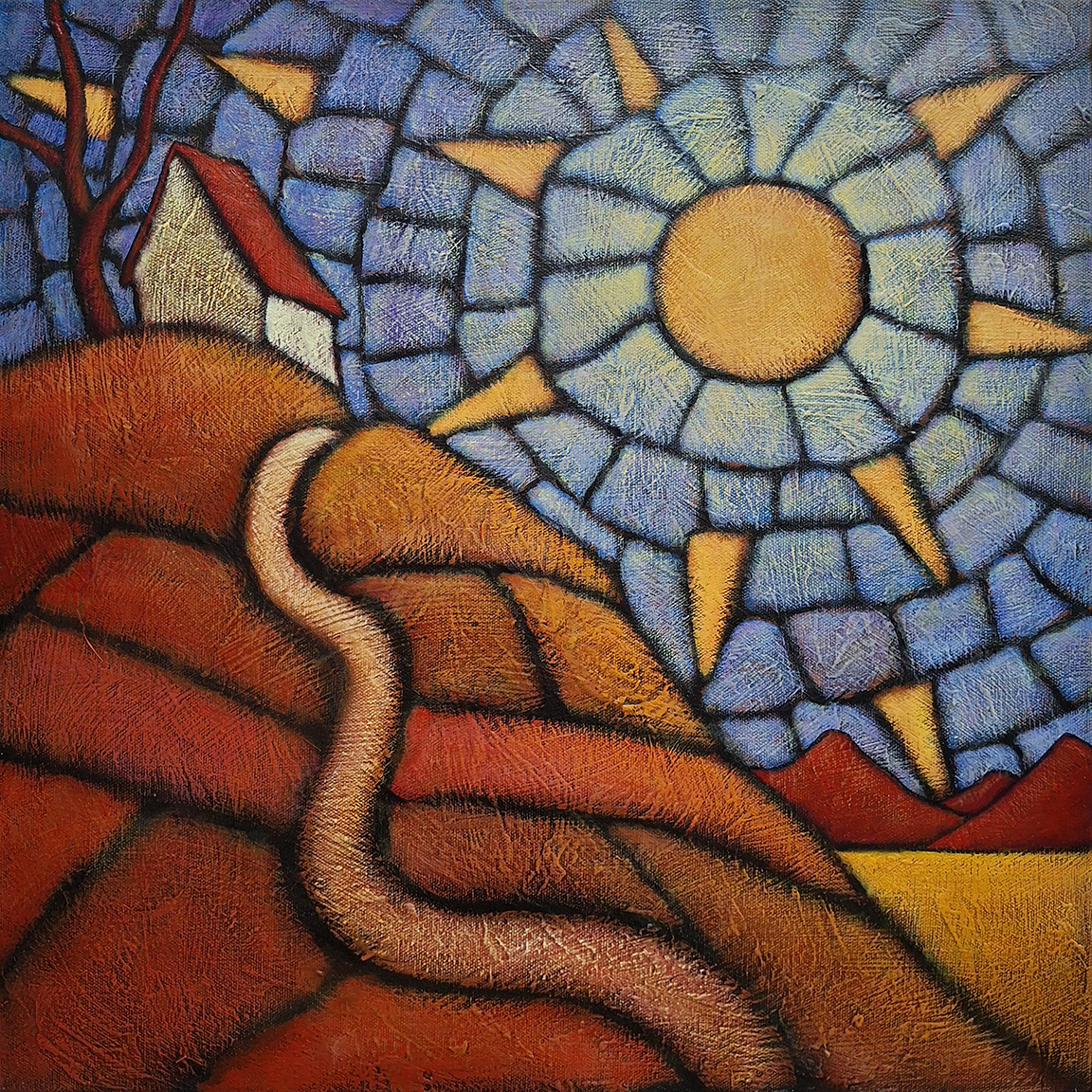
It’s been about a month since I gave a painting demonstration at the Principle Gallery. In the days after, I shared an image of the progress that had been made on the demo painting at the end of the session. I was fairly pleased with how it had emerged but could immediately see that there were changes– additions, subtractions and alterations– that needed to be made before it would truly come into form, at least to my eyes. There were a number of small adjustments and a couple of major changes.

Among the larger changes was altering the shape and color of the distant mountains in the lower right quarter. I simply wasn’t satisfied with the original. There was something in them– or not in them– that just didn’t sit right with me. 

I also changed the shape of the Red Roof house in the upper left. Again, the original just didn’t feel right to me. I depend on my ability to sense rightness in my work, and it was not meeting the mark.

I changed the angle of the roof and extended it a tiny bit, which allowed me to clean up some messiness in the sky behind it. It’s not that I mind a little messiness. The late biophysicist Max Delbruck (1906-1981) had a theory that he called the Principle of Limited Sloppiness. which stated that too much sloppiness was unacceptable in scientific research but allowing a little sloppiness sometimes revealed startling, unexpected results that could then be cleaned up. 

I guess you could say I adhere to Delbruck’s theory. A little sloppiness is fine and sometimes revelatory. However, in my work it’s a problem when the messiness is out of the rhythm of the painting and becomes a distraction, pulling focus from the whole of the painting.

Cleaning up that bit of messiness really honed the feel of the painting for me as did the fine tuning of the colors throughout. The rising road was lightened and a bit of darkness added to the left side of the hill, away from the sun, which, along with its light arrows, was brightened a bit.

It may not seem to the casual observer that the painting was greatly changed but to my eyes it emerged in a much different form., one that truly reaches that sense of rightness that I mentioned. Looking at it now here in the studio, it doesn’t feel like a hurried demo piece. It has its own feel and life now– an extension of the inner world I try to show in my work. It feels like it is truly part of that world now.

I used a Kandinsky quote at the top about an artist needing to train both their eye and their soul. I think of all the hours I have spent alone working in my studio have honed whatever skill I possess– the eye that Kandinsky mentions– as well as the sense of rightness which might well translate as the Kandinsky’s soul. I don’t really know that can express what I am trying to say but I like the idea that an artist is seeking their own soul in their work.

I am pleased I was able to share a little of what seeking looks like with the folks who made it to the demonstration a month ago. Many thanks again to everyone who made it possible.

I have yet to title this piece. A reader suggested the title of an old Cat Stevens song, Road to Find Out, as a title. That might work but I am open to suggestions. Let me know what you think.

Let’s listen to that Cat Stevens song. There’s larger image of the completed painting below. That is, if it is truly completed. Like people, art sometimes needs to change…


Read Full Post »

Moment Revealed — At West End Gallery


We have five senses in which we glory and which we recognize and celebrate, senses that constitute the sensible world for us. But there are other senses – secret senses, sixth senses, if you will – equally vital, but unrecognized, and unlauded… unconscious, automatic.

–Oliver Sacks, The Man Who Mistook His Wife for a Hat


Maybe that’s the purpose of art, to prompt us to some sort of sixth sense, one that otherwise goes unnoticed and underutilized in our usual five-sense lives. It is something that we don’t even know that we have been needing and missing until we are awakened to it.

This sixth sense enables us to detect the many dimensions which exist between and beyond that which we observe with our five senses, adding depth and richness to our sense-limited world. 

And art does just that, serving as the activating agent for this sixth sense and beyond that, acting as the connecting link between the known and the unknown. I believe that is what is taking place when one is moved by art in any form.

It transports you into dimensions beyond the five senses. 

And that’s where the good stuff is…

Here’s a song this morning about one type of sixth sense from Irish singer/songwriter Imelda May. With a style that covers many genres of music including jazz and rockabilly, she wasn’t on my radar until just a couple of years ago. I stumbled across a video of Robert Plant and her performing a rockabilly-Big Band rave-up of Led Zep‘s Rock and Roll that I very much enjoyed. I’ll throw that on below as well.


Read Full Post »

The Passing Parade— Now at the Principle Gallery


It’s akin to style, what I’m talking about, but it isn’t style alone. It is the writer’s particular and unmistakable signature on everything he writes. It is his world and no other. This is one of the things that distinguishes one writer from another. Not talent. There’s plenty of that around. But a writer who has some special way of looking at things and who gives artistic expression to that way of looking: that writer may be around for a time.

–Raymond Carver, A Storyteller’s Shoptalk,  New York Times (1981)


I am in the midst of a deep funk, a depressive event that comes on the heels of every show or gallery talk. Every show or talk–good, bad, or indifferent. It’s just the way it is. I think it’s a blend of several things.

One is simply being worn down with the effort of both creation and promotion. The promoting part– this blog, for example– becomes difficult and depleting just before and after each event.

Another is in creating unrealistic expectations for the event. This is especially true when I have stronger than normal feelings about the work.

Some of it comes in questioning my own efforts. Did I do enough? Did I break new ground? Or the simple but deadly– Am I good enough? 

Some of it comes from second-guessing my interactions with people. In her diary, author Anaïs Nin described very much what I go through after any event:

I have never described, even in the diary, the act of self-murder which takes place after my being with people. A sense of shame for the most trivial defect, lack, slip, error, for every statement made, or for my silence, for being too gay or too serious, for not being earthy enough, or for being too passionate, for not being free, or being too impulsive, for not being myself or being too much so.

You add in the deadline for the show being met which means that an endpoint, a destination, has been reached. It seems as though it should be a time to feel free but for a short time after each event, I feel unmoored, without direction, until a new destination is put in place.

These post-show depressions usually find me questioning what I do and the choices I have made. The questions that usually satisfies and begins to put me back on course comes by asking myself if I am painting the paintings I want or need to see. Am I doing work that is mine alone?

For the answer to those questions, I am going to continue here with a blog entry that has ran a couple of times here, the last time being in early 2020. The painting at the top of the original post  has been switched out for one, The Passing Parade, from my current Entanglement exhibit at the Principle Gallerystill promoting!— which satisfies now what I wrote then. I have also added the passage at the top from the late Raymond Carver. It’s another one of those quotes about writing where one can easily substitute artist for writer. It very much ties into the idea of painting the paintings you want to see for me. Or to create the world in which you wish to live, to put it another way.

Here’s that earlier blog post:


This painting really captivates me on a personal level and reminds me of a thought that once drove me forward as a younger painter. It’s a thought that I often pass along as a bit of advice to aspiring artists:

Paint the paintings you want to see.

Sounds too simple to be of any help, doesn’t it? But that simplicity is the beauty and strength of it.

For me, I wasn’t seeing the paintings out there that satisfied an inner desire I had to see certain deep colors that were being used in a manner that was both abstract and representative. If I had seen something that fulfilled these desires, I most likely would not have went ahead as a painter. I wouldn’t have felt the need to keep pushing.

It was this simple thought that marked the change in my evolution as a painter. Before it, I was still trying to paint the paintings that I was seeing in the outer world, attempting to emulate those pieces and styles that already existed as created by other artists. But it was unsatisfying, still echoing the work of others, forever judged in comparison to these others.

But after the realization that I should simply paint what I wanted to see, my work changed, and I went from a bondage to that which existed to the freedom of what could be found in creating something new. For me, that meant finding certain colors such as the deep reds and oranges tinged with dark edges that mark this piece. It meant trying to simplify the forms of world I was portraying so that the colors and shapes collectively took on the same meditative quality that I was seeing in each of them.

In my case this seems to be the advice I needed. But I think it’s advice that works for nearly anything you might attempt.

Paint the paintings you want to see.

Write the book you want to read. Toni Morrison said this very thing at one point.

Play the music you want to hear. Make the film you want to see. Cook the food you want to eat. Make the clothes you want to wear.

Make the world in which you want to live.

Simple.

Now go do it.


It was good advice then and it still is now. Time for me to claw my way out of this hole. Paint toward the light…

Read Full Post »

« Newer Posts - Older Posts »