Feeds:
Posts
Comments

Posts Tagged ‘Early Work’

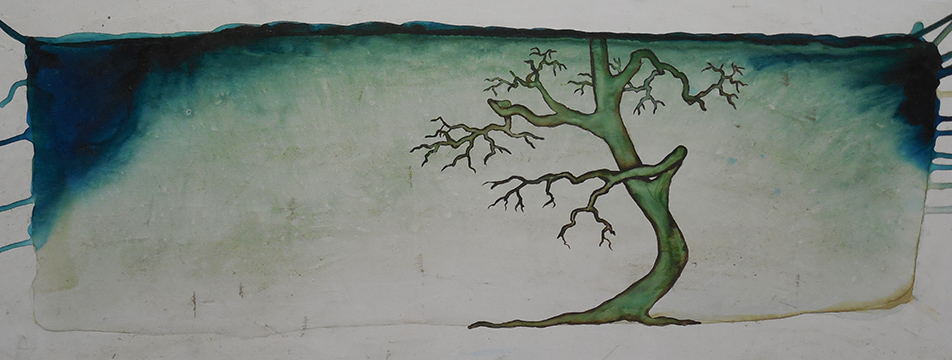
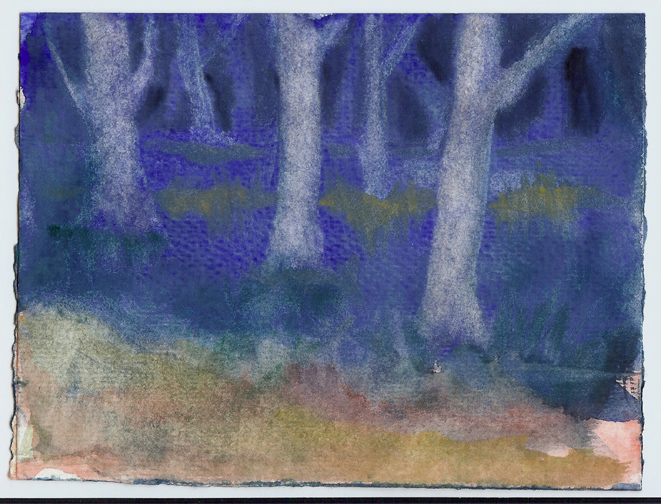
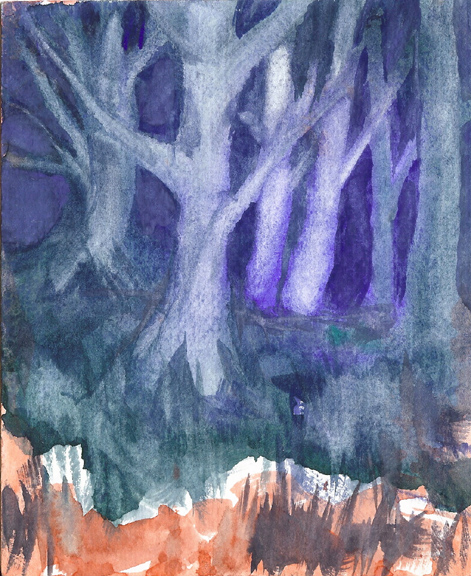
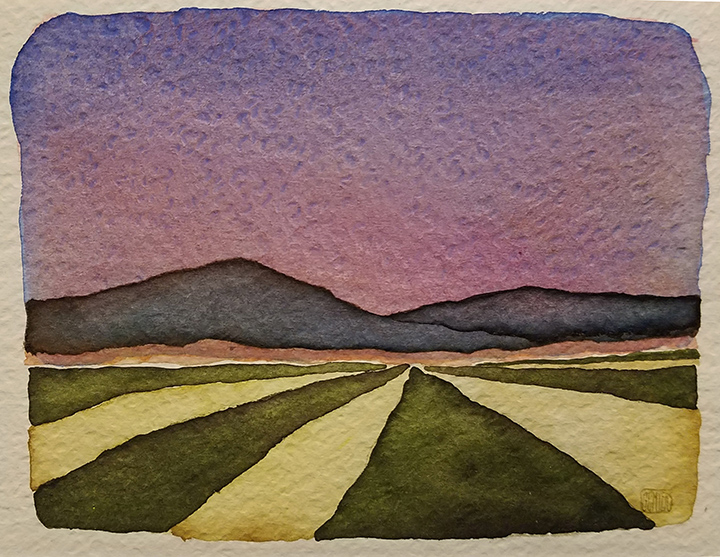
While doing a short talk and demonstration for a local arts group last week I mentioned my early work and the fact that it was mainly watercolor based. This surprised some of those in attendance who were not familiar with my early work. I tried to describe my process but thought this blog from several years back might help, at least with the images. Not so much with the words. I still don’t describe this work well. I’ve added a few images from that time.

************************

GC Myers 1994 Early ReductiveWork6I have been spending a lot of time here in the studio in the last few weeks painting in a more traditional manner, what I call an additive style meaning that layers of paint are continually added , normally building from dark to light. I’ve painted this way for many years but much of my work is painted in a much different manner where a lot of very wet paint is applied to a flat surface. I then take off much of this paint, revealing the lightness of the underlying surface. That’s a very simplified version of the process, one that has evolved and refined over the years, that I, of course, refer to as being reductive.

When you’re self-taught, you can call things whatever you please. I’m thinking of calling my brushes hairsticks from now on. Or maybe twizzlers.

This reductive process is what continually prodded me ahead early on when I was just learning to express myself visually. I went back recently and came across a very early group of these pieces, among the very first where I employed this process. I am still attracted to these pieces, partly because of the nostalgia of seeing those things once again that opened other doors for me. But there was also a unity and continuity in the work that I found very appealing. Each piece, while not very refined or tremendously strong alone, strengthened the group as a whole. I would have been hesitant to show most of these alone but together they feel so much more complete and unified.

This has made me look at these pieces in a different light, one where I found new respect for them. I think they are really symbolic of some of  what I consider strengths in my work, this sense of continuum and relativity from piece to piece. It also brings me back to that early path and makes me consider if I should backtrack and walk that path again, now armed with twenty years of experience. Something to consider.

GC Myers 1994 Early ReductiveWork 1 GC Myers 1994 Early ReductiveWork 3 GC Myers 1994 Early ReductiveWork 5 GC Myers 1994 Early ReductiveWork 2 GC Myers 1994 Early ReductiveWork 4

Read Full Post »


**************************

“It has always seemed to me that so long as you produce your dramatic effect, accuracy of detail matters little. I have never striven for it and I have made some bad mistakes in consequence. What matter if I hold my readers?”

― Arthur Conan Doyle

**************************

Who would have thought that the creator of Sherlock Holmes would have some good advice to offer to artists?

The words above from Sir Arthur Conan Doyle about how he he would sacrifice accuracy of detail in order to gain greater dramatic effect in his work are very enlightening.

And reassuring.

I have been going through a lot of older work from over twenty plus years back when I was still in a formative stage with my painting. I hadn’t read these words from Doyle but one of the first conscious decisions I made about my work was that I would not be a slave to detail, that I would slash away as much detail as possible while still conveying a sense of what was being represented. Oh, I would use smaller details when they served the greater effect of the painting but the fewer the better.

One example from this early work is the piece at the top that is from around 1997. I was surprised when I came across this small painting in a file folder that I hadn’t examined in many years. It was a solid example of the work I was doing at the time, mainly in watercolor with the beginnings of my relationship with the acrylic artist inks that have long been a staple of my work.

It is sparsely detailed with little consideration to trying to replicate natural color. It just allows the colors and the shapes do what they will in communicating a sense of place and feeling. It works pretty well for what I want from it.

Over the years, I sometimes have strayed from this credo of spareness but I always find my way back to it. There just seems to be more space for the expansion of feeling when details are cut away. It’s a good thing to keep in mind.

So, thanks for the reminder, Mr. Doyle. I can use all the help I can get.

Read Full Post »

GC Myers Exiles-Bang Your DrumThe switch to Daylight Saving Time really cuts into my prep time this morning. So I am going to share my musical selection for this Sunday along with a rerun of a post that originally ran ten years back. I reran it once four years back but I think it’s worth sharing again. Plus the painting fits the song. So here it is along with The Beat Is Rhythm from Club Des Belugas. As is the case with much of their music, it’s heavy on the beat which is as good a way as anything to give a kick to a dragging Sunday morning.

This is another piece from my early Exiles series, titled Bang Your Drum. This is a later piece, finished in late 1996.  

Initially, I was a bit more ambivalent about this painting compared to the feeling I had for the other pieces of the Exiles series. It exuded a different vibe. For me, the fact that the drummer is marching signifies a move away from the pain and loss of the other Exiles pieces. There is still solemnity but he is moving ahead to the future, away from the past.

Over the years, this piece has grown on me and I relate very strongly to the symbolism of the act of beating one’s own drum, something that is a very large part of promoting your work as an artist.  

For me and most artists, it is a very difficult aspect of the job, one that is the polar opposite to the traits that led many of us to art. Many are introverted observers of the world, passively taking in the world as it races by as they quietly watch from a distance. To have to suddenly be the the motor to propel your work outward is an awkward step for many, myself included. Even this blog, which is a vehicle for informing the public about my ongoing work and remains very useful to me as a therapeutic tool for organizing my thoughts, is often a tortuous chore, one that I sometimes agonize and fret over. Even though my work is a public display of my personal feelings, this is different. More obvious and out in the open.

There’s always the fear that I will expose myself to be less than my work. The fear that people will suddenly discover the myriad weaknesses in my character that may not show in my paintings, forever altering their view of it. The fear that I will be  revealed to be, as they say, a mile wide and an inch deep.  

But here I stand with my drumstick in hand, hoping to overcome these fears and trusting that people will look beyond my obvious flaws when they view my work. Maybe they too have the same fears and that is the commonality they see and connect with in the work. Whatever the case, there is something in the work that makes me believe that I must fight past these fears and move it forward, out into the world.

What that is, as I’ve said before, I just don’t know.  Can’t think about it now– I’ve got a drum to pound…

Read Full Post »

Came across this old piece, an early attempt from 1994 before I was showing my work in public. It’s painted in way, a direction I never followed much further but it is a piece that always makes me stop.  Don’t know where it came from or why I painted it. Don’t know why I gave him some sort of seaman’s cap and striped shirt. I loosely refer to this as the Sea Dog.

I don’t think there was a narrative at all. It just came. But after 24 years or so, it has developed a story, of a sort, for me. I see him as sailor in an exotic South Seas port city on a misty and mysterious night. A scuffle, a knife fight and a man falls down dead on the dark, wet streets. He flees the port and begins on building a new life with a new identity.

For a minute this morning, I saw him as a young Santa.

Maybe that’s Santa’s backstory? A murderous sailor redeemed?

I don’t know about that. But, hey, you never know.

That brings me to a Christmas song. Well, kind of a Christmas song, one that’s keeping in the spirit of a Killer Kringle. It’s from  John Prine, and it’s Christmas in Prison. It’s been a favorite of mine for decades so I was surprised that I haven’t played it here yet, after ten years of this blog.

Well, today’s the day. Give a listen and don’t mind the subject or title too much. It’s actually a beautiful song. It could be Santa singing, in different circumstances.

Read Full Post »

I was in my basement earlier moving some things around, trying to get somewhat organized, when I came across a box with a handful of giclee prints of my work  from 2001. I hadn’t went through this box in a while so took a few minutes to see what was there.

My eyes settled for a bit on the piece shown above, titled Give the Wind Its Due. I’d looked at it many times over the years but it was always for but an instant, just in quickly passing over it. But this morning, I took a minute and really looked. It tried to remember what I could of it from back in 2001. It was a large painting, I remember that, measuring 36″ high by 48″ wide on birch panel.

It was painted with oils rather than acrylic. I used oils as often as I would use acrylics around that time. I transferred almost solely to acrylics in the next few years, that medium better matching my technical and thought process. I found that I was too impatient to wait to get the effects I wanted with oils. The quicker drying time of acrylics allowed me to dive back in sooner while I was still focused in on what I was seeing and where I saw it going.

But this piece oil worked well as it was. It still worked and stood out for me now. Hopefully, whoever has ownership of this piece thinks so, as well. Unfortunately, I have no idea where the original painting is. Like this piece, there are many paintings that will be forever lost to me. I would love to see some of these earlier pieces just to examine the surfaces closely. Look at the edges and how the colors layer together.

In looking, I try to remember what I was doing then that I don’t do now, sometimes from just forgetting how it was done in that particular moment. I sometimes have memory problems when it comes to procedural items.

There are maintenance things that I have to do every year around the house or studio and I often have to go to the printed directions because my memory refuses to hold those details. Unfortunately, this also sometimes extends to my own work procedures. Revisiting older work sometimes is like looking at those printed directions and I find myself saying to myself, “Oh, so that is how I did that!

I find that there’s a lot to be learned from looking back periodically.

Maybe that applies to life as much as art. Or maybe not.

I can’t really say.

Read Full Post »

I have been looking at this painting quite a bit lately. It’s from back in 2010 and is titled Raise Your Eyes. Featured in my 2012 exhibit at the Fenimore Art Museum, it’s a piece that I find myself coming back to examine quite often.

It’s different in many ways from the larger body of my work. For one thing, there are plenty of windows and doors, things I seldom use in my regular work where I prefer the blank  anonymity of windowless and doorless houses. This painting is all detail, even though its not extremely fine detail.

In some ways it reminds me of my Archaeology series, mainly because there is so many small touches to examine beyond the greater whole. I think that’s why I come back to this painting so often. Every new look reveals something I haven’t noticed since I first painted it. There are so many individual decisions here that dictate how the painting comes together, how it reads and expresses itself. Each window and door, each ledge and building top is a decision. Looking at them closer makes me appreciate the thought process behind it.

I mention  this painting today because I am working on a new piece that is based loosely on it. At least, it goes back to the process behind it and fills the canvas with thousands of small but vital decisions. It’s been exciting to revisit and I like what I have so far. Keep an eye out for it in the near future.

I also thought it might be a good painting to remind you to support your local small businesses on this Small Business Saturday. Every artist and every gallery owner is a small businessperson that rolls much of their income back into their respective local economies. Your patronage of artists and galleries. as well as so many other small local businesses, is vital to your local community.

I know that I can’t do this, can’t maintain a career as an artist without your support. And I am deeply grateful for that support and hope you’ll continue to patronize the galleries that show my or anybody else’s work.

Art is more than decoration, more than a product. It is an expression of humanity and a message that, in its best form, communicates through time. It is who we are.

And that is worth supporting.

Read Full Post »

Looking through some older work, I came across this piece from January of 1995. It was from a time just before I first showed my work publicly. It seems like just yesterday in some ways but a hundred years ago in others. I was just finding voice in my work but still had some work to go before I  could fully utilize it.

This is called Outside Shakeytown and it’s obviously watercolor on paper. Shakeytown was the name I used sometimes at that time for a mythical dark and dank town that hovered under dirty gray skies and sooty foundries and factories. It is a name that could be used in place of any number of small Rust Belt cities and towns that have seen industries disappear over the past 40 or 50 years. These often impoverished towns often still have shuttered factories that stand like ugly monuments to a long gone past as they struggle to find a new identity in a modern world.

It can be a compelling setting, one filled with deep darkness that give rise to startling and dramatic contrasts. One of the birthplaces of art.

This piece is a favorite of mine, one that checks a lot of boxes in a list of what I want to see in my work. It always sends off sparks within me when I pull it out. For me, it acts as sort of a creative terminus from which all sorts of paths depart.

And like the beginning of any journey, it fills me with excitement and a bit of dread.

And those are good starting points for new work.

While I never had plans of showing this publicly, I had to laugh when I looked this morning and noticed that I had signed it twice. The one on the left is the original and the one on the right is from what I think is a much later date when I must have not noticed the other signature. They are both in pencil so I could just erase one but I am going to leave it as it. That way, a couple of hundred years in the future maybe someone will stumble across it– in a gallery or a junk shop or a junk heap, who knows?–and will wonder what was meant by the two signatures.

I won’t be there but I can chuckle at the possibility of it now.

And these days, here in Shakeytown, that’s a good thing.

Read Full Post »

I call this painting Let Us Now Praise Famous Men, a title I used for a few paintings from my early Exiles series, in which this piece is included. I seldom show this piece and am not sure if it has ever appeared here. While I like this piece for a variety of reasons– for instance, I love the sky and hill colors– I never felt it was up to the same level as the other work in the Exiles series. I felt that it was more flawed than the others and too forced, not as organically formed as much of the other Exiles.

But every time I pull this piece out I feel a small sense of satisfaction in it and maybe that it needed to be aired out. I want to play a song today and thought this would be a good opportunity to let this little guy get out a bit. We’ll see.

The song is Work Song. It was written by the brother of jazz great Cannonball Adderley, who originally performed the song as an upbeat  jazz piece. But it has been interpreted by a number of artists over the years, some to great effect. Others, not so much to my taste. But one of my favorites is from one of my  guilty pleasures, Tennessee Ernie Ford.

He certainly doesn’t seem like a “cool” choice if you remember his public persona in the 50’s and 60’s as the goofily naive but affable hick from Bristol, Tennessee. I enjoyed that caricature as kid but it was his music that hooked me. He had a deep and mellow voice and a knack for choosing songs and arrangements that fit him perfectly. His series of country boogies were great and his 16 Tons is a classic. His version of this song is a great interpretation, spare and deep felt.

I couldn’t find a decent video of this song so here is the track alone:

Here’s another version that is a different interpretation from a band called The Big Beats with vocalist Arlin Harmon. I don’t have a lot of info on either though from what I can glean Harmon was a highly esteemed singer out in the Northwest. It’s a solid rocking performance with a different flavor. Give a listen.

Read Full Post »

Last week a notification came up on my Facebook feed of a painting of mine that was being offered for sale locally. It wasn’t the best of photos but I immediate recognized the painting. It was from back in 1999 and was titled Black Opal Night. The price was very reasonable and I immediately contacted the seller, offering to buy the painting back.

In our back and forth, she asked why I was buying this painting back. It seems that artists buying their work back is not a normal thing.

I replied that it was from the years between 1996 and 2000, a five year period that was pre-Red Tree and an evolutionary step to my subsequent work. It was also a time from which I have practically no remaining work and would love to have a few more pieces. I have been very fortunate in that almost all of the work from that time have found new homes. The few that remain with me are pieces that most likely should have never left the studio in the first place. They have major flaws– poor color quality, composition balances that seem off a bit and so on– which I would now consider disqualifying, that would keep me from showing it publicly.

I may have been a little less discerning in earlier times.

This piece, from what I could see in the photo and could glean from my memory of it, didn’t seem to fall into this category.

Another part of wanting to acquire this piece was that my documentation at the time was pre-digital and spotty. I most likely have slides of this piece but the slide itself is most likely poorly shot. And a poorly photographed slide is still a poor image when transferred to a digital format, which is still an iffy process for me. It would be good to see a painting from the time and get proper photos. I have to admit that the photo here was taken through glass so it is not a perfect image. But it works.

So I picked this up over the weekend and I couldn’t have been more thrilled. First, the image itself looked new even though the frame, a blue-green color that I no longer use, was a bit less fresh looking. It was definitely of the time. I could see where I was at the time from a process standpoint, how I was still embracing techniques that are now deep embedded.

I often speak at gallery talks about the 60 or 70 thousand hours spent in the studio over the past two decades. This piece was from the beginning of that time and offered a glimpse of how the work had evolved and changed. This piece was pushing at the edges of my abilities at the time which gives it an excited feel. I can almost feel my excitement in painting it from the time. There are surface flaws that are integral to the energy of this painting that give it a rawness that I think was a big part of the strength of that early work.

That rawness is something I don’t see as much in recent work. Oh, the excitement is still there but the expression of it is more refined, more controlled. And looking at this painting makes me wonder if I am pushing myself enough. Am I staying too far inside the lines? How do I regain that raw energy?

And maybe the answers to these questions are the real reasons for me re-acquiring this painting. Even though it’s simply an older painting in my body of work, it has given me so many things to ponder.

Let’s see where it goes from here.


Read Full Post »

I was recently going through some old work and came across some paintings from 2002 that had slipped my mind. There were several done in the same style as the piece shown here, Night Blossom, with chunky, mosaic-like skies in deep blues and greens.  They had a dark, moody tone and a sense of weight in them that really drew me to them when I pulled them up on my screen.

It made me wonder why it was a path that I didn’t follow a bit further at that time. Maybe I felt it was too reminiscent of stained-glass. It does have that feel in the way it goes together.

Or maybe I just was headed in another direction that had a little more pull on me at the time. I was in the midst of my Dark Work in the aftermath of 9/11 which took me directly into my Red Roof series so perhaps that is the main reason for not doing more in this vein.

So, it may be as simple as it turning out to be that there is not enough time in the day to follow up on all the flares that are sent off in one’s head sometimes. Who knew?

But seeing this again and examining it closely re-ignites that flare and I see this as a new possibility in a larger scale done with skills that have evolved in the past 16 years.

And that is exciting for me.

Whether it turns outs to be what I see in my head is another thing. Sometimes those things I envision turn out much different in reality and not always in a positive manner.

We shall see…

Read Full Post »

« Newer Posts - Older Posts »