Feeds:
Posts
Comments

Posts Tagged ‘Fenimore Art Museum’

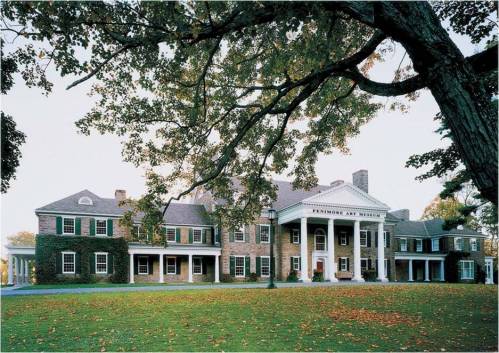
My exhibition, Internal Landscapes: The Paintings of GC Myers, has officially opened at the Fenimore Art Museum in lovely Cooperstown, NY.  The exhibit hangs until the end of the year, December 31.  It’s a select group of mostly larger paintings from the last few years along with a few very early small pieces that show the beginning stages of the evolution of my work.

One of the highlights for me is the first public showing of the piece shown above, The Internal Landscape, a painting familiar to regular readers of this blog.  It is a very large painting, measuring 54″ high by 84″ wide.  This large scale gives it  a real presence in any space.

If you can make it to the Fenimore in the next month, the exhibit hanging in the adjacent gallery is American Impressionism: Paintings of Light and Life, which is a grand collection of paintings from the likes of Mary Cassatt, Childe Hassam and William Merritt Chase.  And if you’re looking for real star power, there’s even a piece from one of the most influential Impressionists, Claude Monet.  Plus there are several other great exhibits not to mention the incredible Thaw Collection of American Indian Art, which is worth the trip on its own.  I’m pretty excited to be in such grand company.

On November 7, I will be giving a talk on show after a luncheon, from 12:30 until 2:30,  as part of the museum’s Food For Thought lecture series.

Read Full Post »

“When I am in my painting, I’m not aware of what I’m doing. It is only after a sort of “get acquainted” period that I see what I have been about. I have no fears about making changes, destroying the image, etc., because the painting has a life of its own. I try to let it come through. It is only when I lose contact with the painting that the result is a mess. Otherwise there is pure harmony, an easy give and take, and the painting comes out well.”

–Jackson Pollock

*************************************

Well put words from Pollock, words that very much fit with how I feel about my own work and process, even though our works seem to have little in common in appearance.  I think it’s the harmony that he speaks of that is our common ground.  At least, I hope.

Note:  The show, Internal Landscapes: The Paintings of GC Myers, has opened two days early at the Fenimore Art Museum in Cooperstown.

Read Full Post »

Well, the exhibition of my paintings, Internal Landscapes: The Paintings of GC Myers, has been delivered and is being installed at the Fenimore Art Museum in Cooperstown for its opening on Saturday, August 18.   I’m experiencing levels of excitement and satisfaction, along with my normal anxiety, at the prospect of this show.  Who wouldn’t be excited at the prospect of showing their work in a beautiful world-class facility where your work will hang in close proximity to the great artists of the past?  It’s the goal of most artists to be allowed to show their work in such a setting, to feel the validation and atmosphere that the institution  offers.

I am no different.

It is also a marked point on the timeline of any artist, where they can pause for a moment from the constant creative push forward to reflect on the years leading up to it,  to once again examine all the steps (and missteps) that brought them to this point.

To look back on  the many  thousands of hours spent alone in the studio and feel as though they were well spent.

To think again about all the kind words of encouragement over the years from those who found something for themselves in the work, words that have served as creative nourishment.

To again see all the moments of serendipity that have occurred on the road to this point in time,  all the opportunities that  came unexpectedly, often at times when they were most needed.

To reflect on the many times that self-doubt threatened the personal voice that was forming and now shows in the work.  And how this doubt was overcome through a firm belief that the vision being followed was as real and as valid as any other artist’s.

I could go on but I won’t.  It is obviously a retrospective moment.  I can only hope that those who see the show will get a true sense of my work.  That will make this a successful show.  We shall see.

The show opens August 18 and hangs until December 31.  I will be giving a talk at the museum on November 7, from 12:30- 2:30  as part of their Food For Thought lecture series.

Read Full Post »

   Yesterday, I  delivered the group of paintings for my show, which opens next week,  to the Fenimore Art Museum in Cooperstown.  It felt pretty good to finally have the work out of the studio and in place for this show which I have been anticipating for so long.  Relief set in on the drive home  and soon turned to fatigue.  I had a chance to think and began to consider all of the things that one has to do in order to pursue a career such as mine, all of the seldom thought of aspects that are necessities but have little to do with the actual act of painting.  Things like dealing with galleries, framing and matting, packaging, delivery, pricing and the endless promotion of the work.  The gritty unromantic details that take a toll on one’s energy.   Basically, the same things any small business owner has to face.

It’s like someone who has a gift for cooking, making glorious food in their kitchen with great ease.  They dream of opening a restaurant where they can share their gift with the world and make a living doing what they love most.  But once they open the doors they find that the act of cooking, their great pleasure, is only one aspect of being a restaurateur.  They find themselves buried in heap of things far from their love of cooking.  They must deal with staff, advertising and promotion, dealing with suppliers and a thousand other details.  They find themselves fatigued like they never felt before from their cooking.

That’s kind of how I felt yesterday.  I was fatigued from all of the detail work– the driving, packing and shipping, framing paintings, the talking about and  promotion of my work and events.  Even writing this blog.  They were all things that, while necessary, were far from  the creation of the work itself.  Actually, I never felt real fatigue from the act of painting.  In fact, quite the opposite.  For me, painting is invigorating, energizing.  So much so that it makes these other tiring details tolerable, especially if it  means that I can do what I love as my livelihood.

I hope this doesn’t sound like I’m complaining.  I am definitely not.  Every job, every career, is tough in it’s own way and I have done enough other things in my life to know that  this is, by far, the sweetest gig I have encountered.  The many positives of my job far outweigh the negatives.  It’s just that occasionally when I am away from painting for too long, I get a little tired and stressed, feeling that need for the rejuvenation that painting offers for me.

Probably like that onetime cook-turned-restaurateur who, standing in the midst of a busy dining room,  longs to be in front of  a stove, simply cooking and happy.

Read Full Post »

This tryptych , Golden Time, is part of my solo exhibit, In Rhythm,  currently hanging at the West End Gallery in Corning, NY.  I’m doing a gallery talk there today at noon where I will talk about this painting and many of the other pieces in this show.  I will also talk about my upcoming exhibit at the Fenimore Art Museum as well as any other subject that may arise.

I have talked a number of times on this blog about my gallery talks, about how they usually don’t have a set form and rely more on interaction with the audience.  Reacting to questions and comments sets the course of the talk, which I think both the audience and I find more appealing than a set lecture .  It gives the talk an organic feel, something I also try to find in my own paintings.

Of course, there are stories that are my old standards that I have to tell for those who aren’t familiar with my work or how I came to it.  How a fall from a ladder turned into a career.  What the story is behind the Red Tree and the Red Chair.  How I ended up showing my work at the West End, the first place to display it.  These standards round out the body of the talk, giving it fullness.  But for me the best part of these talks are the questions that I have to really struggle to answer, questions that I couldn’t foresee in the run-up to the talk.  These give me a chance to sometimes find a new perspective on what I am doing, to see the work with new eyes.  I can’t tell you how exciting that is for me to see new things or re-see old things in a new way in my work.  I often come away with a renewed vigor which carries me for quite some time in the studio.

So, if you can make it to the West End Gallery today, stop in and ask away.  Maybe we will both hear something new that we can take away with us.

Read Full Post »

Yesterday, there was a guest blog on the Huffington Post from Paul D’Ambrosio, who heads the New York State Historical Association which contains the Fenimore Art Museum and the Farmer’s Museum in Cooperstown.

It’s a really interesting insight into what it takes for a museum in a fairly remote area to thrive, to be a vibrant presence that attracts a wide audience.  As I’ve noted  here, I have an exhibit, Internal Landscapes: The Paintings of GC Myers, opening at the Fenimore in August so I read with interest as D’Ambrosio recounted how the museum has grown in the past few years with heady choices for its exhibits including recent shows featuring the work of John Singer Sargent,  Edward Hopper and an American Impressionists show featuring works from Mary Cassatt (and one from Monet) which is now there.  These shows have drawn wide coverage from the  press and have helped attract museum-goers from distant locales to the museum to take in these shows there as well as its formidable permanent collections of Native American Art,  Amercian Folk Art and Hudson River paintings.  This mixture of a great permanent collection and intriguing new exhibits make the Fenimore a very attractive destination, one that the USA Today called one of the 10 Great Places to See Art in Smaller Cities.

Check out the article and, if you can, the museum and Cooperstown’s other charms as well.  I don’t think you will be disappointed.

Read Full Post »

2012 is going to be a very exciting year for me– and not only for the Mayan Apocalypse.  I have three solo shows at the galleries that represent my work all set around my upcoming  exhibit,  Internal Landscapes: The Paintings of GC Myers, at the Fenimore Art Museum in Cooperstown which runs from August 17 through December 31 of this year.  There will also be four gallery talks, including one at the Fenimore in November. So, as I say, it looks to be a busy and exciting year.

Also new this year is an energetic Midwest gallery that will begin representing my work beginning later this month.  Watts Fine Art opened in 2010 in the historic district of Zionsville , a suburb of Indianapolis with tree-lined brick streets.  It is ran by Shannon and John Watts, a young couple who retired a few years back from extremely sucessful corporate careers and decided to make their passion for art their newest life adventure in the form of a gallery dedicated to bringing the very best contemporary art to the Midwest. 

Shannon and John have a palpable excitement for the work they represent which is something that, as an artist, you hope for in the gallery staffs that represent your work.  Their enthusiasm for their gallery and the possibility of showing my work there was key in my decision to join with them.  They also have a wide and long-range vision for their gallery,  wanting to introduce collectors throughout the entire Midwest with their collection of artists from around the country.  I am really pleased and enthused about joining their gallery and having Shannon and John represent my paintings.

So, with all of this on my plate, I guess I should get back to work!

Read Full Post »

On my recent visit to the Fenimore Art Museum, there were many pieces that really hit with me but one that I keep coming back to in my mind is a folk art painting from Malcah Zeldis titled Homage to Hank Greenberg.  Greenberg, the large figure of the baseball player in the upper center of the painting, played for the Detroit Tigers in the 1930’s and 40’s and was a power-hitting superstar of that era.  Known as the Hebrew Hammer, not only was he the hero of Detroit fans but he was also a hero to Jewish fans throughout the nation.  Malcah, born in the Bronx but raised in Detroit, was a fan of Greenberg’s in both camps.  He was to her, as the painting shows, larger than life.

The painting has a wonderful glow to it in the museum gallery, a bit more warm and orange than this image, that makes it most appealing.  This warmth draws you in and allows you to take in all the smaller details that Malcah has painted into the beautifully laid-out scene,  such as  scene directly below Greenberg where the artist and her family are portrayed sitting around the radio, listening to the game. 

I also find appeal in this painting in that the work is so confident and sure handed in the way the paint is applied.  It creates a real sense of solidness in the whole piece, giving you the sense that the artist is totally committed to their vision and their message. 

In short, I think it’s just a damn fine painting. 

For more info, on Malcah Zeldis, who is one interesting person, I refer you to a blogpost from the  American Folk Art @ Cooperstown site and to an interesting article from earlier this year in the Downtown Express, the Newspaper of Lower Manhattan as they put it.  She has led a vibrant and interesting life and still creates wonderful work at the age of 80.  Here’s a video that shows her in her apartment talking about some of her paintings and other objects she has found.

Read Full Post »

I have mentioned here that my work will be the subject of an exhibition at the Fenimore Art Museum in Cooperstown , NY next year, running from August 17 through December 31, 2012.  I had not been at the museum for many, many years so last week Cheri and I decided to pay a visit to both see the space where the exhibit will be hung and to see the museum as a whole.

I haven’t been to Cooperrstown in quite a while but from the moment I enter this little gem of a village I remember how much I like the place.  I’ve used the word idyllic several times recently here but must use it again to describe the atmosphere of this village built around the southern end of Lake Otsego, the lake famously referred to as Glimmerglass by James Fenimore Cooper, a name that now graces the renowned seasonal operatic company that resides there, the Glimmerglass Opera.  It is just a lovely  place especially in the quieter days of late autumn when the tourist trade is a bit slower and the beauty of the place shines through. 

Turning by the grand Otesaga Hotel, you head north up the west side of Lake Otsego and come quickly to the museum, resting on a slight rise above the lake.  The museum was built on the former site of the James Fenimore Cooper farmhouse and across the road is the famed Farmer’s Museum with its beautiful stone barns and outbuildings. 
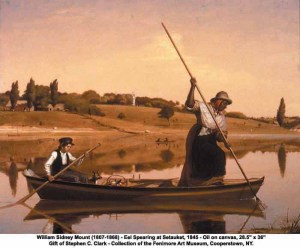
I can’t really tell you how impressed I was with the museum, from the moment I entered the front doors  until the moment we drove away.  It is a truly beautiful space that is maintained to the highest standards.  We met with with Paul D’Ambrosio who we have known for many years and who is the President of the museum.  He gave us a tour through the galleries, giving us an education on many of the pieces.  For instance, the piece shown to the right, Eel Spearing at Setauket from William Sidney Mount, is considered the painting which serves as the face of the Fenimore Collection.  We were told that the lady in the painting from 1845 still has family that lives near the site of this painting on Long Island and that they periodically make the pilgrimage to the museum to visit their now famous ancestor.

After seeing most of the collections, including the  fabulous Thaw Collection of American Indian Art, we finally made our way to the galleries on the second floor and came to the East Gallery, where next year’s exhibit will be held.  I was a bit nervous with anticipation, to tell the truth.  But finally seeing the space and visualizing my paintings in the space helped settle my nerves.  The space is neither small nor large but has a sense of intimacy that I think will serve my work well.  There is a fireplace at one end that I could see my work easily hanging above.  The anxiousness of the unknown faded away and the actual idea of how the show might look began to take its place.  I now had sometihing tangible on which  to build the show.  A different sort of anxiety set in but it is the kind I often have before any show so I view it as an old friend who will ultimately help me in my task.

We talked for a bit about wall colors for the show which I hadn’t even considered.  I began considering colors that will push the work forward off the walls and accentuate the color in my work.  As we were leaving, Paul told me that my show would ne hanging at a great time next year as the show  hanging at that time in the other upstairs gallery would be an exhibit of American Impressionism featuring Mary Cassatt.   They would have a Monet, as well, to show his influence on the American painters.  He said there would be great crowds in the late summer for that show and would be great exposure for my exhibit.

So, we departed and I drove through the rain of that day with new concepts of how the work in the exhibit would relate to the space and to each other.  I began to have second thoughts about some pieces that I had originally thought might be perfect and paintings that I had dismissed began to come back into play.  The visit and the tremendous quality of the space and the works there raised the bar for what I wanted from my own work.  The task now seemed larger than before and I knew that I would have to really focus in order to make it work as I know it can.

In short, it was a good visit.  Thanks for the wonderful tour, Paul!

Read Full Post »

Beauty translates across all cultural boundaries. 

We visited the Fenimore Art Museum in Cooperstown this past Thursday, to tour the facility and get a better view of the space where my work will be hung in an exhibition that opens in August of 2012.  I will write more about that in the upcoming days but I feel compelled to expand first on my opening sentence above in relation to this visit. 

 We finished our visit by heading into the spectacular addition to the museum that houses the Eugene and Clare Thaw Collection of American Indian Art,  considered to be one of the finest collection of Native American art in this country.  It’s pretty amazing that this group was only assembled since 1988.  The Thaws were committed to finding work that best represented the artistry in Native American objects based on their philosophy that the aesthetic power of American Indian art is equivalent to that from any culture.  This has resulted in a collection that is not home to  a few masterpieces set among some other lovely but typical pieces. 

 No, it is a collection of masterpieces. 

To give you an idea of the strength of this collection, there is a traveling exhibition from the collection that has been wowing museum goers in Cleveland, Milwaukee and Dallas museums and is set to open in Indianapolis on December 2.  It has 111 pieces from the collection and has earned rave reviews from critics for the sublime nature of the collected pieces.  Yet, you would never know anything was gone when you go through the collection on display at the Fenimore.  We went from display to display, our mouths open with wonder, the superlatives coming from us seeming so insufficient after a while.

Perhaps the highlight of their collection is the basket shown above, the famed Beacon Lights basket made by Washoe basketmaker Louisa Keyser, Dat So La Lee in her native language.  It is considered a treasure of American Indian art, called for the many years the most famous basket in the world.  It took Keyser 14 months to weave this masterwork and when it was first sold in 1915 it brought a price of around $1500, a small fortune in that day and a sum that drew headlines for the basket.  It is constructed of willow strips that run in horizontal bands around the basket held together with tiny willow strings that are woven vertically.  The threadwork is extraordinarily fine.  Most of the finest baskets of this sort have 27 strands per inch, or so I am told.  This basket has 30.  But beyond the sheer craft, it is the form that takes your breath away.  It is as pure and graceful a form as you will ever witness. Anywhere, in any culture. 

Perfection.

There are so many examples beyond this spectacular basket that I cannot even begin to start detailing them.  If you’re in Indy, take the time to examine that slice of this collected masterpieces.  Even better, take a trip to the beautiful village of Cooperstown and be prepared to have your breath taken away.  I know that I left the museum with the thought that started this blogpost ringing in my head.  Beauty translates.  Seeing this collection made me appreciate so much more the opportunity I have in communicating with my own work, this chance to create a visual language that goes beyond my own limited spoken and written range, beyond the confines of ones own culture. 

The opportunity to speak to the universal nature of the human spirit.  The work in the Thaw Collection certainly does that.

Read Full Post »

« Newer Posts - Older Posts »