Feeds:
Posts
Comments

Posts Tagged ‘GC Myers’

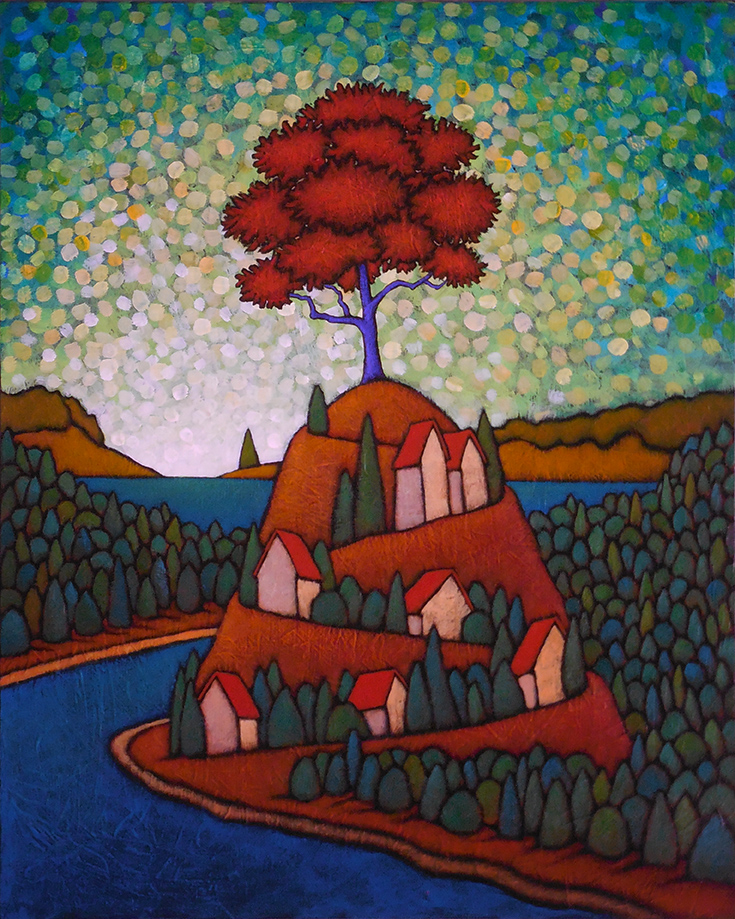
The Steadying Light– At the West End Gallery


But hell can endure for only a limited period and life will begin again one day. History may perhaps have an end; but our task is not to terminate it but to create it, in the image of what we henceforth know to be true. Art, at least, teaches us that man cannot be explained by history alone and that he also finds a reason for his existence in the order of nature.

–Albert Camus, The Rebel (1951)


With the hope that this doesn’t turn into an extended rant, let me point out that the hell that Camus refers to in the passage above from his book, The Rebel, is one created by authoritarian governments. As he puts it:

Modern conquerors can kill, but do not seem to be able to create. Artists know how to create but cannot really kill. Murderers are only very exceptionally found among artists. In the long run, therefore, art in our revolutionary societies must die. But then the revolution will have lived its allotted span. Each time that the revolution kills in a man the artist that he might have been, it attenuates itself a little more. If, finally, the conquerors succeed in moulding the world according to their laws, it will not prove that quality is king but that this world is hell.

Authoritarians come to power through destructive means and not having the ability to create or govern, stifle free thought, art, and the artistic impulse– anything that might in any way question their right to power. As a result, art dies which creates, in effect, a hell on earth. But he adds that each time they kill the artistic impulse, they weaken their authority, bringing their hellish reign closer to its inevitable end. As Camus writes: But hell can endure for only a limited period and life will begin again one day.

I guess my point here is a simple one– Art Endures. It is the realm of thought, feeling, and creation that cannot be suppressed for long because it is an innate and indomitable part of humanity, more so than the rule of any king or tyrant. 

Like a buried seed, it persistently seeks light and air.

So, though the days may seem dark and hellish, that seed is planted, always there, growing unseen beneath the surface. Waiting to emerge once more.

Art endures. And with it, our humanity and hope.

Here’s a favorite song from Richard Thompson. This is a duet with the great Bonnie Raitt of his The Dimming of the Day, that I haven’t shared here before.


Read Full Post »

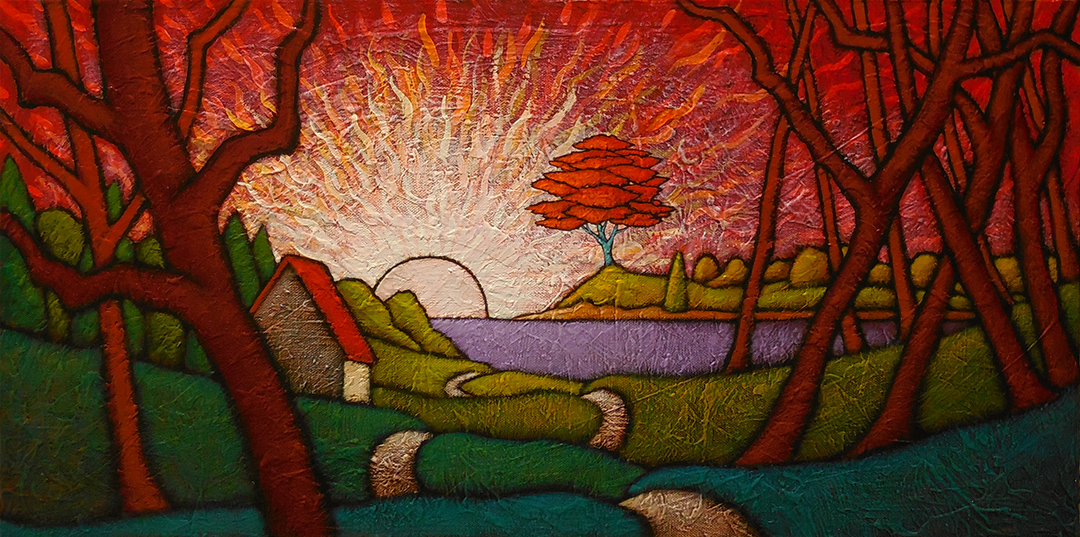
The Center Found– At the West End Gallery


The tumult of sorrow, of anger, of bitterness, of despair, was drifting farther and farther away. Even the terror, which was worse than any tumult, had vanished. In that instant of renunciation she had reached some spiritual haven. What she had found, she understood presently, was the knowledge that there is no support so strong as the strength that enables one to stand alone.

–Ellen Glasgow, The Difference (1923)


There really is something cleansing and ultimately clarifying in taking a stand or taking a path that diverges from the crowd. It sharpens your vision and centers you, washing away those depleting feelings– the tumult to which Glasgow referred above–that define and bind you to a herd.

Just reading that short paragraph, I am inclined to stop right here. What more need I say?

I will add that I really didn’t know the name Ellen Glasgow before I came across this passage. Glasgow, who was born and lived her entire life, from 1873 to 1945, in Richmond Virginia, is another of those folks who were celebrated in their time but whose work never quite reached the status of being iconic enough to span generations. I did know the title of her most famous novel, In This Our Time, which won the Pulitzer Prize in 1942 but only from the fact that it was also made into a Bette Davis film, one I have never actually seen.

But reading other passages and quotes from her, as well as reading several pages of the short story from which the passage at the top was taken, I am impressed by the depth of her observations. I certainly agree with her words on the enabling power that comes in standing alone.

Here’s a song from folk singer/songwriter Buffy Saint-Marie that emphasizes this point. It is the title track from her 1964 debut album, It’s My Way, that in 2016 was added to the National Recording Registry. Each year the Library of Congress selects 25 recordings that they deem to be “culturally, historically, or aesthetically significant.” It’s a richly deserving album with many significant tracks but for today we’ll focus on this one. It’s good stuff…

A late addition: Special kudos to Sen. Corey Booker for having the strength to stand alone. His record-breaking filibuster may seem a symbolic gesture in the moment but may inspire greater action for the future. But only if others have the strength to stand alone…


Read Full Post »


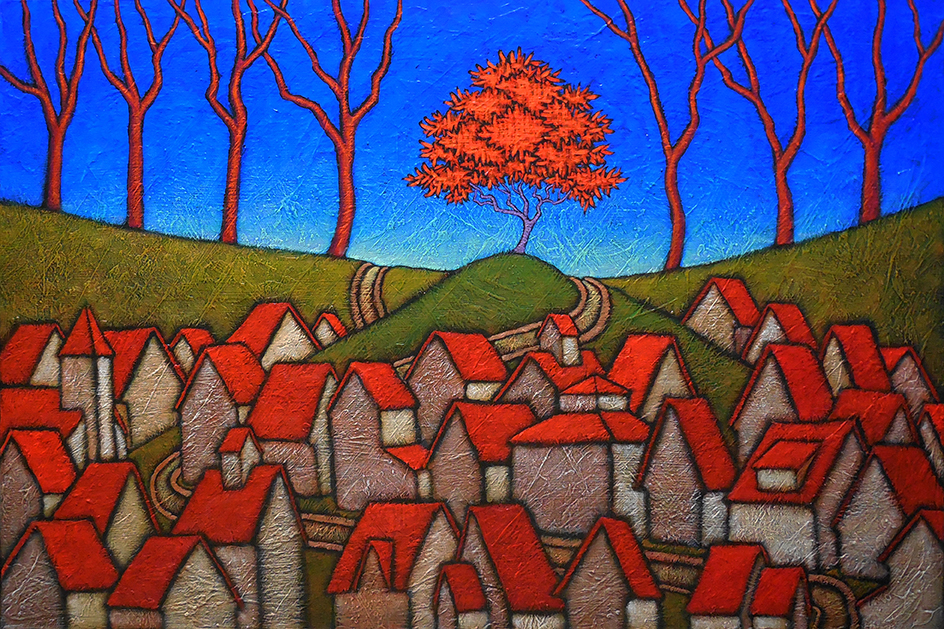
Student and Master— At Principle Gallery

The thought manifests as the word;

The word manifests as the deed;

The deed develops into habit;

And habit hardens into character;

So watch the thought and its ways with care,

And let it spring from love

Born out of concern for all beings…


As the shadow follows the body,

As we think, so we become.

 —From the DhammapadaSayings of the Buddha


I am short on time this morning but wanted to share a passage from the Buddha that I have shared here before. Its message, that we ultimately become what we think and say, has been echoed by philosophers through the ages which speaks to its truth.

I have been thinking about this message of caution recently, seeing the transformation of so many people by their casual acceptance and adaption of the ugliness in both word and deed that comes down from the leaders of our current government. This ugliness of thought and word has transformed into deed and habit and has finally transformed into a character defined by this ugliness.

Though it may not reflect the character of most of us, it is this ugly character that defines us to the rest of the world. My worry is that the rest of us may fall prey to that character, that we allow our words and deeds to alter who we are in ways that are irredeemable.

No answers here on that front, of course, outside of saying that one should be wary of falling into that trap, that downward spiral that leads to a darkened alteration of one’s character.

Think the Light. Speak the Light. Become the Light.

Easier said than done. But it can be done.

Anyway, that’s it this morning outside of a song from powerful final album, You Want It Darker, from the late great Leonard Cohen which very much sends the same message. This is Steer Your Way.


Read Full Post »

Maestro— At West End Gallery


A rock pile ceases to be a rock pile the moment a single man contemplates it, bearing within him the image of a cathedral.

He who bears in his heart a cathedral to be built is already victorious.

–Antoine de Saint-Exupéry, Flight to Arras (1942)


Yesterday I shared a passage concerning a metaphor of a pile of stones and a cathedral from the book Flight to Arras from French author/pilot Antoine de Saint-Exupéry, who I failed to mention was also the author of the classic The Little Prince. The passage felt very relatable to the current situation here in this country.

I thought I would share a Credo from Saint-Exupéry that came soon after that passage. In general, I like these statements of belief from writers and thinkers. I have shared a few here in the past, the short one below from 19th century orator Robert Ingersoll, which was one of several creeds he wrote, being the one that immediately comes to mind:

Justice is the only worship.
Love is the only priest.
Ignorance is the only slavery.
Happiness is the only good.
The time to be happy is now,
The place to be happy is here,
The way to be happy is to make others so.
Wisdom is the science of happiness.

The credo below from Saint-Exupéry really struck a chord with me. It is a statement of belief and purpose that I wish to aspire to for myself, especially in this moment in time which is one that demands that a person consciously acknowledge that which they firmly believe. His description of the cult of the particular being a cult of death really jumped out at me since it seems, from my perspective, that we are currently dealing with the cult of the particular, which is used here to indicate cult that elevates and serves a particular race, a particular gender, a particular class, a particular religion, a particular definition of liberty and justice as well as a particular way of living.

It is a cult of the particular that will, as Saint-Exupéry writes, ultimately imprison the individual in an irredeemable mediocrity. It feels like that has already began, right from the top down.

Please take a moment and read the Credo below from Antoine de Saint-Exupéry. I think it’s worth the time.

My eyes have been unsealed, and I want now to remember what it is that they have seen.  I feel the need of a simple Credo so that I may remember.

I believe in the primacy of Man above the individual and of the universal above the particular. I believe that the cult of the universal exalts and heightens our particular riches, and founds the sole veritable order, which is the order of life. A tree is an object of order, despite the diversity of its roots and branches.

I believe that the cult of the particular is the cult of death, for it founds its order upon likeness. It mistakes identity of parts for unity of Being. It destroys the cathedral in order to line up the stones. Therefore, I shall fight against all those who strive to impose a particular way of life upon other ways of life, a particular people upon other peoples, a particular race upon other races, a particular system of thought upon other systems of thought.

I believe that the primacy of Man founds the only equality and the only liberty that possess significance. I believe in the equality of the rights of Man inherent in every man. I believe that liberty signifies the ascension of Man. Equality is not identity. Liberty is not the exaltation of the individual against Man. I shall fight against all those who seek to subject the liberty of Man either to an individual or to the mass of individuals.

I believe that what my civilization calls charity is the sacrifice granted Man for the purpose of bis own fulfillment. Charity is the gift made to Man present in the insignificance of the individual. It creates Man. I shall fight against all those who, maintaining that my charity pays homage to mediocrity, would destroy Man and thus imprison the individual in an irredeemable mediocrity.

I shall fight for Man. Against Man’s enemies – but against myself as well.

Read Full Post »


The Natural— At West End Gallery

Solitude is not something you must hope for in the future. Rather, it is a deepening of the present, and unless you look for it in the present you will never find it.

–Thomas Merton, The Ascent to Truth


I had something in mind yesterday that I wanted to write this morning. It was a sort of vent. I won’t even mention the subject of this proposed diatribe but there is enough horrific crap floating around that won’t have to strain your imagination if you guess.

But when I finally plopped in front of my laptop, I had lost the desire to vent. It wasn’t a moment of exhaustion or dejection. I just wanted to sit in peace for a little bit this morning. Wanted to simply take in the quiet of the darkness around me.

Wanted to deepen the present, to steal a phrase from the Thomas Merton quote above. As he implied, you can’t hope or wait for solitude to arrive. It’s here in the present, always near and waiting to embrace you if only you can slow your mind enough to detect it.

That’s seems simplistic and much easier said than done. After all, it’s a hard task to slow the mind given the speed and anxiety of life today. There’s even a little guilt in doing so, especially for a compassionate and caring person. It might feel selfish for some to feel peaceful solitude while others suffer.

But solitude often brings clarity. And clarity of thought often brings decisive action. and that is what is needed in this world right now.

So, for this morning I am guiltlessly seeking the clarity that comes in solitude. I know it’s in here somewhere.

Here’s Across the Universe from the Beatles. It seems right for the moment, with its refrain of Jai Guru Deva Om which literally translates from the Sanskrit as glory to the shining remover of darkness. And looking out my window just now, I see the tall trees as dark bony silhouettes against the emerging light…


Read Full Post »

The Burning Secret– At the West End Gallery


As I thought of these things, I drew aside the curtains and looked out into the darkness, and it seemed to my troubled fancy that all those little points of light filling the sky were the furnaces of innumerable divine alchemists, who labour continually, turning lead into gold, weariness into ecstasy, bodies into souls, the darkness into God; and at their perfect labour my mortality grew heavy, and I cried out, as so many dreamers and men of letters in our age have cried, for the birth of that elaborate spiritual beauty which could alone uplift souls weighted with so many dreams.

—William Butler Yeats, Rosa Alchemica


In this passage from the beginning of Rosa Alchemica, Yeats describes the driving force behind his search for that driving force of alchemy that has not only the purported ability to transform lead into gold but can also in the same manner transform and elevate the human spirit above that of the ordinary and mortal. A search for the essence of the spirit. The alchemy within ourselves.

Though humans have searched diligently for such a thing since ancient times, I don’t know that such an ability truly exists. But as Yeats’ words indicate, one long look into the night sky makes it easy to see why one would want to believe that such a thing is possible.

With the sky filled with a universe of wonder and the promise from distant stars and worlds, why wouldn’t we think we had the ability to transform and elevate ourselves and our lives? Or our world?

Maybe that’s the driving force behind the creative arts, an attempt at some crude alchemical transformation of the ordinary into something more, something greatly enriched with the essence of the human spirit.

Maybe. I look out the window at the morning light beginning to filter through the trees and think to myself: Why not?

It’s time to get to work on my own small attempts to achieve an alchemy of some sort. Perhaps today is the day that unlocks the secret?

Who knows? Why not?

This morning, I am sharing a video of an acoustic instrumental cover of I’d Love to Change the World, originally from Alvin Lee and Ten Years After. This is from a musician, Johnny Thompson, busking with his guitar on the street in Costa Rica. His YouTube channel has covers as well as his own originals. Though there are a few spots of wind noise, I like this performance very much.


Read Full Post »

Dawn’s Return–At West End Gallery


Doubt is not a pleasant condition, but certainty is an absurd one.

-Voltaire, letter to Frederick II of Prussia in 1767


It’s one of those mornings. I am filled with uncertainty and the idea of focusing on writing something seems like an unbearable burden. I would rather get to a painting I am working on that will be included in my annual June solo exhibit at the Principle Gallery. That’s where the uncertainty sets in.

I am in the midst of a group of new work that is really hitting the mark for me on all levels. Oddly enough, that’s where the problem begins. My strong positive reactions are triggering equally strong feelings of doubt. It sounds crazy, I know, but the idea of certainty– my own or others– almost always raises my anxiety levels, especially when it comes to my work. 

Trying to balance these two polar opposites– doubt and certainty–results in times when one prevails. This morning, doubt wins the day. After I begin to work, certainty will make a mighty comeback. And after my painting day is done, the two will wrestle until I drift off to dreamland. 

All in all, it’s often an uncomfortable existence bouncing between the unpleasant and the absurd conditions, as Voltaire called them. 

I sometimes wish for absolute certainty. It seems like it would be satisfying to believe that your every word, action, opinion, and belief were absolutely correct. But we’ve seen where the extreme nature of that kind of certainty has taken us. I sometimes think the great divide between people is one of those who sometimes feel doubt and those who always feel absolute certainty.

Well, for someone who didn’t want to write this morning, I seem to have done quite a bit when all I wanted to do was write few words to share the post below that first ran here in 2014. FYI, I am not ready to share my new work yet but will start showing it in the coming weeks–on a day when I am more certain of things.


Much of my work seemingly has a journey or a quest as its central theme. But the odd thing is that I don’t have a solid idea of what the object is that I am seeking in this work. I have thought it was many things over the years, things like wisdom and knowledge and inner peace and so on. But it comes down to a more fundamental level or at least I think so this morning. It may change by this afternoon.

I think I am looking for an end to doubt or at least coming to an acceptance of my own lack of answers for the questions that have often hung over us all.

I would say the search is for certainty but as Voltaire points out above, certainty is an absurd condition. That has been my view for some time as well. Whenever I feel certainty coming on in me in anything I am filled with an overriding anxiety.

I do not trust certainty.

I look at it as fool’s gold and when I see someone speak of anything with absolute certainty–particularly politicians and televangelists– I react with a certain degree of mistrust, probably because I see this absolutism leading to an extremism that has been the basis for many of the worst misdeeds throughout history. Wars and holocausts, slavery and genocide–they all arose from some the beliefs held by one party in absolute certainty.

So maybe the real quest is for a time and place where uncertainty is the order of the day, where certainty is vanquished. A place where no person can say with any authority that they are above anyone else, that anyone else can be subjugated to their certainty.

To say that we might be better off in a time with such uncertainty sounds absurd but perhaps to live in a time filled with absolute certainty is even more so.

Read Full Post »

Anchor— At West End Gallery


It is a strange freedom to be adrift in the world of men without a sense of anchor anywhere. Always there is the need of mooring, the need for the firm grip on something that is rooted and will not give. The urge to be accountable to someone, to know that beyond the individual himself there is an answer that must be given, cannot be denied.

–Howard Thurman, The Inward Journey (1961)


I wrote a couple of weeks back about how part of my response to the veritable dismantling of this country that is taking place was a feeling of grief for something lost. I think that lost something could be defined as many things– a loss of belief, loss of security, loss of trust, loss of respect, loss of pride, loss of honor, loss of community, and on and on.

So much has seemingly– and perhaps irrevocably– been lost by so many that there may not be a single definition that covers our loss.

For me, I define my grief as being for the loss of bearings, of losing a sense of having an anchor that I could rely on at any given time, one that let me know who and where and what I was in relation the world at that given moment.

A sense of place. Of home.

It makes me ache to write about this feeling of loss. It is one of feeling unmoored and adrift in a fast-moving current. Looking back, I can catch a brief glimpse of that place, but it fades further into the distance with each successive glance.

Can I escape this current? Can we? And if I do and somehow find my way back to some of that same sense of home, will these feelings of loss subside?

Can it ever be the same anchor that I once thought it was?

I don’t think anyone really knows that answer. I sure as hell don’t. And I don’t think speculating on it matters. Because if we cannot escape that rushing current, the path back is gone forever.

I know this sounds too stark, too grim. Grief is like that. Even so, it not without hope.

Hope has not been completely lost.

I can still look back and see home, as I define it, in the distance. It’s there and, therefore, a way to it must exist.

We just got to get back to it, one way or another, because where we’re at now ain’t home.

Here’s a favorite song, one of many, from Talking Heads. This is This Must Be the Place (Naive Melody) from their great 1984 concert film Stop Making Sense.


FYI– Howard Thurman (1899-1981), who is quoted at the top, was an American author, philosopher, theologian, Christian mystic, educator, and civil rights leader. He was considered a mentor to MLK and other civil rights leaders.


Read Full Post »

Nightbloom— At West End Gallery


The melancholy river bears us on. When the moon comes through the trailing willow boughs, I see your face, I hear your voice and the bird singing as we pass the osier bed. What are you whispering? Sorrow, sorrow. Joy, joy. Woven together, like reeds in moonlight.

–Virginia Woolf, A Haunted House, and Other Short Stories (1921)


What do I have to say this morning? Is there anything that needs to be said? Any grievances, worries, sorrows, joys, that need to be expressed if only to feel as though they have been released from within, even in this little forum?

There’s a desire to say much this morning. But the will to do so is not there.

Maybe that’s the melancholy river bearing on us? I don’t know but that feels right this morning, sitting here in a darkened studio with the glow of my computer screen serving as moonlight.

And in it is sorrow and joy, woven together.

I am going to let the river flow by this morning. Here’s a song, Hold Back the River, whose title and lyrics says something quite different, about not allowing time and tide to wash away the moment. I don’t know if that’s absolutely correct but, as they say, you get what you pay for. This song written and performed by James Bay is from about ten years back. I have to admit that even though it was a platinum record at the time, I was unaware of it before this morning. It’s hard enough keeping up with old music, let alone everything new. But I liked the song and this performance and felt it kind of fit.

Give a listen them step aside– you’re blocking my view of the river.


Read Full Post »


In Eminence— At Principle Gallery

The sole art that suits me is that which, rising from unrest, tends toward serenity.

–André Gide, journal entry, November 23, 1940


The journal entry above from Nobel Prize-winning author André Gide very much speaks to me. Though it serves many purposes for me, I tend to view my work as a means of absorbing and acknowledging the anxieties and pressures that this world often presses upon us, dampening their effects, and then moving, to use Gide’s term, toward serenity.

The darker aspects of the world are still there, an underlying presence that creates a contrasting tension, a counterpoint that serves as a starting point from which serenity and other aspects of light can build.

I am talking about the emotional tone of the work here, but it also roughly describes my actual painting process. Much of my work starts with a dark surface on which light and brightness is built.

Even my work with transparent inks that is more watercolor-ish in nature employs a process where a darker layer of ink is first applied. almost as a dark puddle on a light– usually white and prepped with layers of gesso– surface. This layer, this puddle of ink, is then little by little removed, each deduction revealing more and more light from the underlying surface.

From darkness comes light…

Let’s have a tune this morning. The song is I See a Darkness. It’s one I have played a couple of times over the years, once by Will Oldham (aka Bonnie “Prince” Billy) who wrote and originally recorded it and the other as covered by Johnny Cash, from the American Recordings period late in his life. His work from this time, when his scarred voice carried his age and emotion so eloquently, is potent stuff.

Light coming from darkness…

 I think this part of its chorus fittingly applies to today’s post and to life in general:

Oh, no, I see a darkness.
Did you know how much I love you?
Is a hope that somehow you,
Can save me from this darkness.


Read Full Post »

« Newer Posts - Older Posts »