Feeds:
Posts
Comments

Posts Tagged ‘GC Myers’

The Wanderer’s Compass— Coming to the Principle Gallery


I think while appropriation has produced some interesting work … for me, the most interesting thing is to back yourself into your own corner where no one else’s answers will fit. You will somehow have to come up with your own personal solutions to this problem that you have set for yourself because no one else’s answers are applicable.

[…]

See, I think our whole society is much too problem-solving oriented. It is far more interesting to [participate in] ‘problem creation’ … You know, ask yourself an interesting enough question and your attempt to find a tailor-made solution to that question will push you to a place where, pretty soon, you’ll find yourself all by your lonesome — which I think is a more interesting place to be.

— Chuck Close, 2006 interview with Joe Fig for Inside the Painter’s Studio


I have written about late artist Chuck Close (1940-2021) a few times here before. While I was fan of his distinctive work, it was his words that really hit close to home for me. For example, his Inspiration is for amateurs, the rest of us just show up and get to work has been a credo of sorts for me for some time now. In this article which spawned that credo, Close also spoke the words above and they have the same sort of meaning.

Back yourself into your own corner where no one else’s answers will fit.

I love this and can easily identify with it. I have sometimes described it as working to a place where all your influences have faded away completely and your work becomes distinct, almost self-referential.

Painting is about problem solving. Just the process of taking paint and using it to give form and meaning in two dimensions is, at its heart, a major problem. Some artists follow the lead of those who came before them in solving the problems that come with painting. That’s the appropriation that Close mentions.

But as he also says, it is most interesting when the well-worn answers no longer solve the problem as you see it. You must depend on your own unique set of skills and intuition. That is when the work of any artist takes on a new dimension and singularity for a solution. It also creates a great sense of autonomy in the artist, one that feels freed from the constraints of the influence of the past.

I also like Close’s thoughts on problem creation versus problem solving in the creative process. Problem creation forces us into those corners where new answers emerge as solutions.

I think the painting at the top is microcosm or shorthand version of that principle. It was started at the Painting Demo I gave at the Principle Gallery in June. I had a young lady from the assembled group make the first mark on the canvas.

It was a slash in a difficult spot on the surface. Definitely a problem that somewhat backed me into a corner. But it was actually a good thing because it allowed me to demonstrate how I react to such problems and the problems that arose from my initial reactions. And in my own way.

I often think that my best work comes when I encounter a problem that stretches me out and makes me uncomfortable., forcing me to look beyond the toolbox of skills I have assembled. The creation of new problems allows us to react in different ways, to climb out of our own ruts.

To create new solutions and maybe open new avenues to follow forward– that is where growth begins.

The painting, a 20″ by 20″ canvas, from the Demo is now finished, framed, and titled The Wanderer’s Compass. It will be coming with me to the Gallery Talk this Saturday, September 27, along with a group of new work. The Talk begins at 1 PM.

Gallery Talks also fall into the province of problem creation and problem solving. A big part of my talks is Question & Answer, which by its very nature is problem creation which often makes me scramble to come up with an answer that makes sense. It’s much like painting in that way.

Of course, I can cover up all my mistakes at the Talks by giving away a painting at its end. The painting this year is A Place of Sanctuary, shown below. Hope you can make the Gallery Talk on Saturday. You might well walk away with this painting!


A Place of Sanctuary— You Could Win This Painting!


Read Full Post »

Questions For the Moon-At West End Gallery in October


Do not now seek the answers, which cannot be given you because you would not be able to live them. And the point is, to live everything. Live the questions now. Perhaps you will then gradually, without noticing it, live along some distant day into the answer.

~Rainer Maria Rilke, Letters to a Young Poet


Do not now seek the answers…

Such a counterintuitive and wise bit of advice that Rilke passed on to his young poet friend. History and mythology are filled with characters who stand before the void, frustrated and grieved with life, pleading for answers to come out of the nothingness before them.

Answers seldom come.

But the questions remain. These questions and concerns become ingrained to the point of almost being unnoticed in the seeker’s life and being.

And one day, if they are fortunate, they realize that that the question itself was the answer and that it was always within them, ready to reveal itself when they have lived and dealt with that question in their life and finally came to this realization.

This realization is earthshaking for some and mundane for others. For others, it is both.

The point is that there are seldom easily obtained answers to the existential questions that plague us.\

Only time and life can turn these questions into answers. And some questions are such that the answers may well be beyond our living or recognition. Those answers remain a mystery.

Maybe the ultimate question here is how well we cope with lives filled with such mystery.

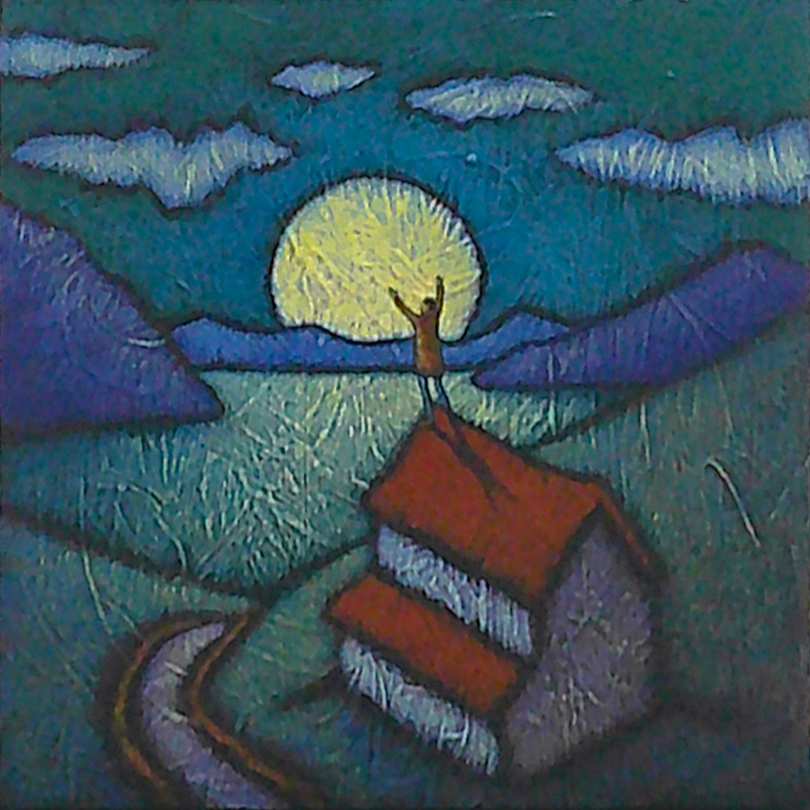
That is my first take on this new small painting, 8″ by 8″ on panel, that is included in my October solo show at the West End Gallery. I call it Questions For the Moon.

I’ve been on a lot of roofs in my life, having been a chimneysweep for several years, and, more importantly, have been on the roof depicted in this painting, sending out questions whose answers I was not yet ready to recognize within myself. I know the frustration and pain in that moment of questioning as you teeter on the roof’s peak.

In that moment, the only answer is to get off the roof in one piece and move on, accepting that this might not be such a bad answer. One day further down the road, if you’re lucky and have let those questions fade onto the deep recesses of your mind, almost forgotten, the question might once more show itself as an answer that has meaning for your life as it has been lived.

And you understand in that moment that this was the only way it could have been, that it took the pain and toil of life to get to where the question could be answered.

That’s a lot to ponder for a little painting.

Here’s song in that vein from the always charming Iris Dement. This is Let the Mystery Be.


Read Full Post »

A Place of SanctuaryYou Could Win This Painting!


The whole value of solitude depends upon oneself; it may be a sanctuary or a prison, a haven of repose or a place of punishment, a heaven or a hell, as we ourselves make it.

― John Lubbock, Peace and Happiness


I promised the other day to reveal the painting that I would be the main prize awarded to someone at the Gallery Talk that I will be giving at the Principle Gallery next Saturday, September 27.

Well, here it is.

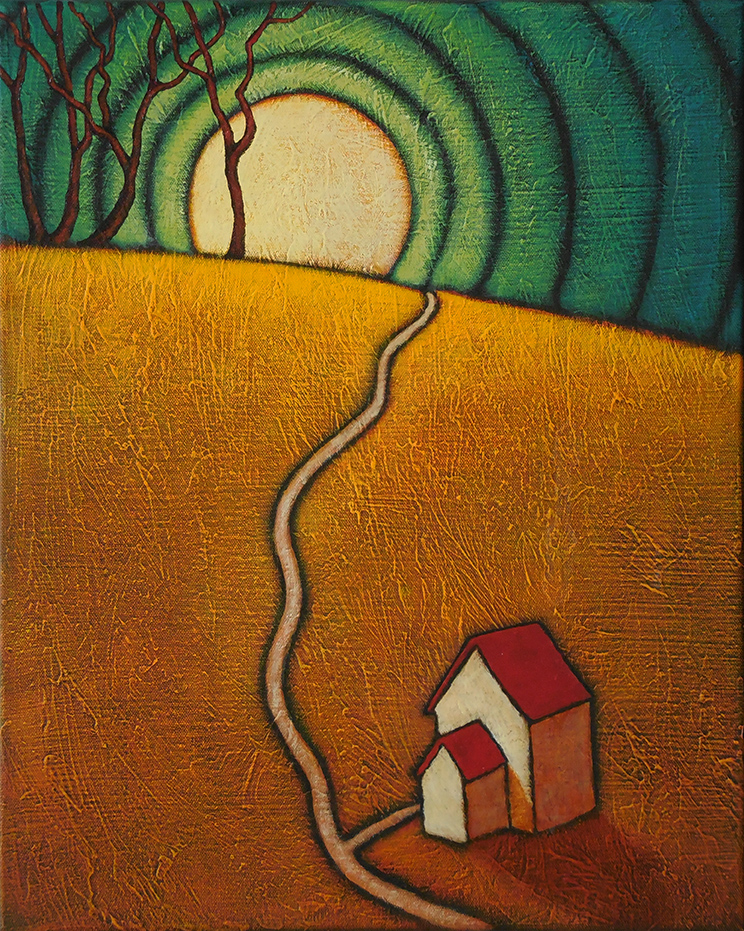
It’s titled A Place of Sanctuary and is a substantial piece at 18″ by 24″ on canvas. I believe this painting is, as I wrote earlier, a pip. I can’t fully describe what it is that makes it so, but it never fails to capture my attention when I am in its presence. Presence might be the right word, with its deep and rich colors and a large sun that feels that it might be a hypnotist’s watch mesmerizing me as I gaze at it.

Whatever it is, it transports me to a place that feels like sanctuary.

I have always maintained that the paintings given away at Gallery Talks over the years have great meaning for me, that giving it away has to involve a sense of sacrifice on my part. It has to hurt a little bit, has to make me question if I am making a mistake. This painting definitely falls into that category.

There will be a drawing for A Place of Sanctuary at the end of the Gallery Talk at the Principle Gallery which takes place next Saturday, Saturday 27, beginning at 1 PM. The Gallery Talk and the drawing for the painting is free and open to everyone. You must be present when the painting is awarded.

Hope you can make it to the Principle Gallery next Saturday. In the meantime, here’s post about this painting from a few years back:


I had never heard of John Lubbock before coming across the short quote above. He was one of those interesting 19th century British characters, a titled member (1st Baron Avebury) of a wealthy banking family who made great contributions to the advancement of the sciences and math as well as to many liberal causes. For example, it was John Lubbock who coined the terms Paleolithic and Neolithic in describing the Old and New Stone Ages, as well as helping to make archaeology a recognized scientific discipline. As a youth he was a neighbor to Charles Darwin and was heavily influenced by the older scientist, who he befriended. He also worked with Darwin as a young man and championed his evolutionary theories in his later adulthood. He was obviously a man who used his position and access to higher knowledge to add to both his own intellect and that of our collective body.

That being said, his words this morning gave me pause. I have generally viewed solitude as a sanctuary, even in the troubled times of my life. It was a place to calm myself, to gather my thoughts and clearly examine what was before me. I crave solitude so the idea that for some this same solitude could feel like a hell or a prison seemed foreign to me.

What differentiates one’s perception of such a basic thing as the solitude in being alone? How could my place of sanctuary be someone else’s chamber of horrors?

If you’re expecting me to answer, you’re going to be disappointed because I can’t really say. I might say it might have to do with our insecurity but I have as much, if not more, uncertainty and insecurity than most people. We all have unique psychological makeups and every situation, including that of solitude, is seen from a unique perspective.

This subjectiveness is also the basis for all art. What else could explain how one person can look at a painting and see an idyllic scene while another can feel uneasy or even offended by the same scene?

Now, the painting at the top, titled A Place of Sanctuary, is a piece that very much reflects this sense of finding haven in solitude. For me, it is calming and centering, a place and time that appeals to my need for sanctuary.

Someone else might see it otherwise. They might see something remote, alien and unsettling in it.

I may not understand it but that’s okay, too. So long as they feel something…

Read Full Post »

Inner Perception (2011)– Coming to Principle Gallery


I have sat here for quite some time this morning trying to write about some of the new work I have been producing for my October West End Gallery show or some that is headed with me to the Principle Gallery for my Gallery Talk there next Saturday.

I know that I am more than little distracted and anxious by what is happening in this country as we descend into outright authoritarianism. It sometimes seems trivial and foolhardy to talk about art and thought when the house is burning down around you.

But I also know that part of what I do is to create work and write about things that deal with coping with life and all its travails. There is a need and a place for what this is in times like this.

I am time strapped now after sitting and ruminating here for so long. So, I am running an older post that deals a bit with an older piece, Inner Perception, shown above, that I am bringing next week to the Gallery Talk at the Principle Gallery. Every so often I like to break out and make available a vintage piece or two. This has been a personal favorite for a long time now and I felt it was time to let it find a place where it could be viewed with fresher eyes than mine.

Here the post from 2014:


This is a painting from a few years back that has toured around a bit and found its way back to me. Called Inner Perception, it has been one of my favorites right from the moment it came off my painting table. Maybe the inclusion of the the paint brush (even though it is a house painter’s brush) with red paint in the bristles makes it feel more biographical, more directly connected to my own self. Or maybe it was the self-referential Red Tree painting on the wall behind the Red Chair.

I don’t know for sure. But whatever the case, it is a piece that immediately makes me reflective, as though it is a shortcut to some sort of inner sanctum of contemplation.

Looking at it this morning, a question I was asked at a Gallery Talk I gave at the Principle Gallery a week or so ago re-emerged.

I was asked what advice I might give my fifth-grade self if I had the opportunity.

I had answered that I would tell myself to believe in my own unique voice, to believe in the validity of what I had to say to the world.

I do believe that, but I think I might add a bit to that answer, saying that I would tell my younger self to be patient and not worry about how the world perceives you. That if you believed that your work was reflecting something genuine from within, others would come to see it eventually.

I would also add to never put your work above the work of anyone else and, conversely, never put your work beneath that of anyone else. I would tell myself to always ask “Why not me?” instead of “Why me?”

This realization came to me a couple of years ago at my exhibit at the Fenimore Art Museum. When it first went up it was in a gallery next to one that held the work of the great American Impressionists along with a painting from Monet. I was greatly intimidated, worrying that my work would not stand the muster of being in such close proximity to those painters who I had so revered over the years. Surely the greatness of their work would show me to be a pretender.

But over the course of the exhibit, that feeling faded and the intimidation I had initially felt turned to a type of defiant determination. I began to ask myself that question: Why not me?

If my work was genuine, if it was true expression of my inner self and inner perceptions, was it any less valid than the work of these other painters? Did they have some greater insight of which I was not aware, something that made their work deeper and more connected to some common human theme? If, as I believe, everyone has something unique to share with the world, why would my expression of self not be able to stand along their own?

The answer to my question was in my own belief in the work and by the exhibit’s end I was no longer doubting my right to be there. So, to my fifth-grade self and to anyone who faces self-doubt about the path they have chosen, I say that if you know you have given it your all, shown your own unique self, then you must ask that question: Why not me?

Read Full Post »

In the Weave of Time– Coming to West End Gallery


Each minute bursts in the burning room,
The great globe reels in the solar fire,
Spinning the trivial and unique away.
(How all things flash! How all things flare!)
What am I now that I was then?
May memory restore again and again
The smallest color of the smallest day:
Time is the school in which we learn,
Time is the fire in which we burn.

–Delmore Schwartz, Calmly We Walk Through This April’s Day (1938)


Sometimes I begin to write about a new painting fully intending to describe what it means to me. But there are times when those intentions go out the window. Then I find myself just staring blankly at the piece.

I should say staring blankly into rather than at the painting because it’s not one of those cases where you stare straight ahead without focusing on or even knowing what is in front of your eyes. The mind is so preoccupied with something else that it commandeers your eyes.

No, this is the opposite, more like having what is front of my eyes push away all thought and empty my mind.

The eye commandeers the mind. I suppose that would be a form of involuntary meditation. Maybe that’s the best kind, one that comes without trying.

That’s kind of what happened first thing this morning. I was intending to write a bit about the new painting at the top. It’s an 18″ by 18″ canvas titled In the Weave of Time and is included in my October solo exhibit, Guiding Light, at the West End Gallery.

I pulled up the image and before I knew it, I was staring into it with an empty mind. I say empty but it was not a pure void. It had a harmony, a tone of great calmness. It had a space as well, one that placeless and timeless.

It’s hard to explain. Placeless and timeless things often are.

But frustrating as it was to find my mind empty at a time when I was desiring words and thought, I was pleased by the effect. It gave me some much-needed stillness at a moment when time and deadlines plague my thoughts.

It felt like a gift in the dark of morning.

This not what I intended to write about this painting but maybe it should have been. It certainly says more about it than the meager words I probably would have spewed.

Unfortunately, I have to return to a world filled with time and place and deadlines right now. But first, I am going to spend a few more minutes in this painting. I need it.

Here’s a favorite song, The Stable Song, from Gregory Alan Isakov. It came on while I was writing what I hadn’t intended writing and it felt right in the moment. I often have music playing while I work and much of it plays without me noticing the song or artist due my focus on the work in front of me. But whenever this song comes on, I stop and listen for a few minutes.

There’s a familiarity in it that rhymes with some memory of in the weave of time. And that’s all I could ask for this morning.


Read Full Post »

Still Can’t Let Go

Imitatio (2021)


The patient cannot remember the whole of what is repressed in him, and what he cannot remember may be precisely the essential part of it. He is obliged to repeat the repressed material as a contemporary experience instead of remembering it as something in the past.

― Sigmund Freud, Beyond the Pleasure Principle


I am sharing what might seem like an odd triad this morning– a passage from Sigmund Freud on compulsion, a Red Chair painting of the aftermath of what looks to be a wild party and a song, Can’t Let Go, from the odd and wonderful pairing of Alison Krauss and Robert Plant.

I think there’s a connection in there somewhere. Just can’t be sure if anyone else will see it.

A compulsion to repeat ourselves is an underlying theme in my work. I sometimes think I know there is something more than meets the eye in these familiar forms and colors and lines and icons –the omnipresent Red Tree, for example– and that if I keep delving into them, they will at some point reveal their secrets to me.

Some tidbits of wisdom, any iota of truth that will make it all make sense.

That must be close to a definition of compulsion. Probably much in the same way that we– both individually and collectively– seem to constantly repeat ourselves, making the same missteps and covering the same ground as though we have some sort of short-term memory dysfunction that prohibits us from seeing the patterns we have followed all along, that keeps us from learning from our mistakes.

I am hoping there is some constructive effect in my own compulsion. I would hate to think that the decades of work that have come with it are a matter of me simply making the same mistake over and over again.

Not that that would surprise me. I often make the same mistake again and again, somehow thinking that this time will yield different results.

Maybe I should stop contemplating my navel this morning and get to work. Who knows? Maybe today will be the day I figure it all out, the day that bit of long sought wisdom is finally revealed.

Or not. Doesn’t matter. My compulsion would most likely blind me to it and keep me at it even if I find it now.

In the meantime, enjoy this Alison Krauss and Robert Plant version of Can’t Let Go, from their second album together, Raise the Roof. It’s a song famously covered by Lucinda Williams on her great 1998 album, Car Wheels on a Gravel Road.

Good stuff.


This post is from several years back. I was going to comment on the many events taking place right now– the Kirk killing, the Russian drones probing NATO airspace, the Epstein revelations, the random abductions by ICE agents, the continued occupation by US troops within our cities, etc. Just thinking about it as a whole felt very much like what this post, especially Freud’s words. We repress the lessons of our past and continually repeat patterns of behavior, thinking that we can come up with different results than those from prior times.  

Like the title of the song, we just can’t let go.


Read Full Post »

Dusk of Time– Coming to West End Gallery


When philosophy paints its grey on grey, then has a shape of life grown old. By philosophy’s grey on grey it cannot be rejuvenated but only understood. The owl of Minerva spreads its wings only with the falling of the dusk.

–Georg Wilhelm Friedrich Hegel, Philosophy of Right (1821)


This is the first new painting from my October solo show at the West End Gallery that I am sharing here. I didn’t think it would be the first painting from the show to be shown, mainly since it is relatively small at 6 inches wide and 18 inches tall. There are much bigger pieces from the show, including the title painting, Guiding Light, that I could have shared here first. But it stood out to me this morning and it still does somewhat represent the title of the show with its prominent dropping sun.

You might see it as a rising sun and that’s fine. Art is subjective to our own personal interpretation. While I might see it one way and I am its creator, that doesn’t mean it must have only that meaning. Once I put it out in the open air it is on its own and it becomes what the viewer thinks it is.

But I am sharing my thoughts today, so we’ll call it a dropping sun at dusk. I felt that the passage at the top from the German philosopher Hegel truly fit what I was seeing in this painting. I saw it as being about the passage of time, the ending of a period of time, and the retrospection that comes after that time is gone. 

He is basically saying that we can only truly know and understand anything until it has fully run its course and is well beyond our efforts to bring it back to life. The Owl of Minerva that he employs here is an ancient symbol of wisdom. The owl flies when we gain the wisdom from any time or event only after it has completed the course of its existence. 

That makes sense to me. So often we lose understanding and insight when we are in the midst of the happenings of our time. We see and hear only bits and pieces of the truth along with a multitude of falsehoods, biased opinions, and myriad distractions. We are unable to see the full scope and perspective of events (or lives) while they are happening.

We can’t see them in their fullness until the arc of their being has been completed. Only then does there come clarity as time washes away the debris that obscured the truth while it existed.

Of course, sometimes this clarity is only gained after years, decades, and centuries. Sometimes eons and ages. 

In this painting, Dusk of Time, I see that clarity on a smaller scale in the reflection that sometimes comes at the end of the day, especially when that day has been an eventful one. Ideally, you can see the arc of the day and understand how it took shape and where it led you. Perhaps how you will go forward.

That’s a thumbnail explanation. There’s a lot of feeling in this smaller painting, much more that I can put down right now.

It just feels like it knows a story that it needs to share. I have a sense of the story and the truth it is telling me. But what that story is and what truth it reveals is up to whoever engages with it. 


Read Full Post »

Lux Templi-At the West End Gallery


I dream’d in a dream, I saw a city invincible to the attacks of the
whole of the rest of the earth;
I dream’d that was the new City of Friends;
Nothing was greater there than the quality of robust love—it led the
rest;
It was seen every hour in the actions of the men of that city,
And in all their looks and words.

— Walt Whitman, I Dream’d in a Dream (1855)


Keeping it simple this morning since it is a Labor Day weekend. The theme today is dreaming of a better world and though it might seem that has little to do with the work or labor that is celebrated by this holiday, there is a connection.

After all, why do we work?

To provide a better life for ourselves.

Though it might seem like we toil simply to survive at times, we all still maintain a dream of a better world for ourselves in some form.

I would like to think that it is not asking too much that we extend that dream of betterment to all others. Wouldn’t our personal world be enriched and made better by the fulfillment of such a dream?

That’s all I have to say this morning. I have work to do. It might not better my life or anyone else’s in any way, but I am still going to make the effort. It’s all we can do– make an effort.

Here’s a bit of Sunday Morning Music. I went with two biggies today, two American icons– Walt Whitman and Elvis Presley. The song is If I Can Dream from Elvis’ legendary Comeback Special in 1968. I remember watching this as a kid with my dad and even then, being impressed with how hard this guy was working for our approval. You may or not be an Elvis fan, but there is no denying that the man is working hard here.

Dreams take that kind of effort.


Read Full Post »

The Call of Wonder– At Principle Gallery


Three Rules of Work:

Out of clutter find simplicity; From discord find harmony; In the middle of difficulty lies opportunity.

–Albert Einstein


This Einstein fellow is a pretty smart guy.

Simplification, harmony and opportunity could be ingredients for any recipe to success in any field, but I think they apply particularly well to the creative arts. I know that I can easily apply these three rules to my own work.

For me, its strength lies in its ability to transmit through simplification and harmony. The forms are often simplified versions of reality, shedding details that don’t factor into what it is trying to express.

There is often an underlying texture in the work that is chaotic and discordant. The harmonies in color and form painted over these create a tension, a feeling of wholeness in the work. A feeling of finding a pattern in the chaos that makes it all seem sensible.

And the final rule–opportunity lying in the midst of difficulty– is perhaps the easiest to apply. The best work always seems to rise from the greatest depths, those times when the mind has to move from its normal trench of thought. Times when one has to expand beyond the known ways of doing things and find new solutions and methods to move the message ahead.

The difficulties of life are often great but there is almost always an opportunity or lesson to be found within them if only we are able to take a deep breath and see them. These lessons always find their way into the work in some way.

Thanks for the thought, Mr. Einstein. I hear good things about the work you’re doing.


I run theses Three Rules from Einstein every couple of years and it felt like the right time since I think we are all looking for simplicity, harmony, and opportunity in our own lives. Plus, I am short on time this morning. I am going to embellish a bit with two other favorite quotes from Mr. Einstein and a newer version of the wizened wisdom of Oh What a Beautiful World from the ageless Willie Nelson and Rodney Crowell, who wrote and first recorded the song in 2014.

Here are those words from Einstein:

The world as we have created it is a process of our thinking. It cannot be changed without changing our thinking.

———–

“People like you and I, though mortal of course like everyone else, do not grow old no matter how long we live. What I mean is we never cease to stand like curious children before the great Mystery into which we were born.”

Albert Einstein, Letter to Otto Juliusburger, September 29, 1942

And what a mystery it is…


Read Full Post »

Bound in Time— At Principle Gallery


Chaos is the first condition.

Order is the first law.

Continuity is the first reflection.

Quietude is the first happiness.

— James Stephens / The Crock of Gold (1912)


The lines above are from a novel, The Crock of Gold, from Irish author James Stephens. The form above is not how they were presented in the book originally. They were actually dialogue spoken by the main character, the Philosopher, in the comic/fantasy novel that deals with philosophy, murder, love and marriage, and Irish folklore, including Leprechauns and a stolen crock of gold.

From the bits of it I have read on Internet Archive where it is available, it seems like a wild ride. It has had continuing influence, too. The late Shane McGowan, leader of the Irish band The Pogues, used the title for his last studio album before his death.

But it is the bit of dialogue that caught my eye. It seemed to capture much of what I have been seeing in my work in recent times. Or. at least, hoping to see. You’re never quite sure what will emerge when you’re pulling things out of the ether.

This procedural list seems to match with what I am trying to depict. We try to identify order within the chaos in which we find ourselves. Having revealed whatever bit of order there is to be found, we try to maintain it through repetition of conditions and behaviors. Having done so, we find a bit of tranquility in whatever small patch of order we are able to maintain. Therein lies happiness.

That might be all you need to know about life.

I don’t know, that’s for damn sure. But it sounds like a decent recipe.

Maybe that is the gold in the Leprechaun’s crock?

Here’s a song that probably has nothing to do with post. Maybe that’s the chaos part of it?

Anyway, it came on the station I often listen to just a few minutes ago. I hear it every couple of days, and it always catches my attention, even if I am really focused on painting at that time. It’s One of Those Days from singer/songwriter Eilen Jewell.

Maybe the appeal for me is that I’ve had a lot of those days. Bet a lot of you have, as well.


Read Full Post »

« Newer Posts - Older Posts »