The lonesome friends of science say “This world will end most any day” Well, if it does, then that’s okay ‘Cause I don’t live here anyway I live down deep inside my head Well, long ago I made my bed I get my mail in Tennessee My wife, my dog and my family
—John Prine, Lonesome Friends of Science (2018)
Another short post this morning. Not even the normal triad of word, image and song since the chorus from the song is serving as the word leg of the three-legged stool I am building here.
So, it’s a two-legged stool. Hope, it stands up.
At least for today.
The same goes for me.
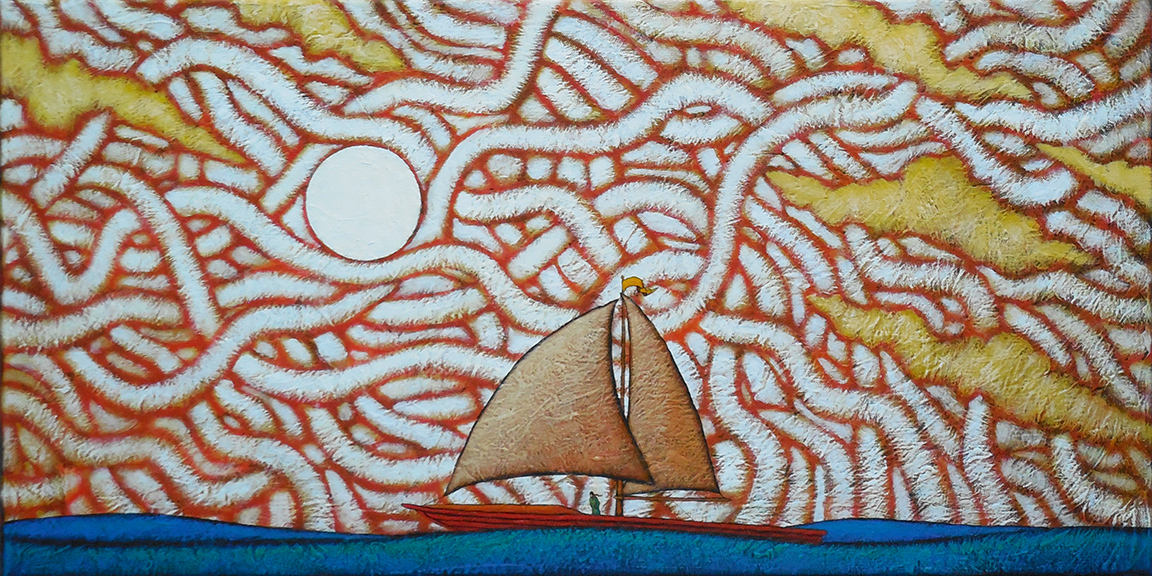
Here’s the song, Lonesome Friends of Science, from John Prine‘s last album, The Tree of Forgiveness, from 2018. As you might know, John Prine passed away in 2020 from covid. II am using the painting above, Echoes of Time, because this morning I am seeing it as that tree of forgiveness as John Prine put it.
There is one thing one has to have: either a soul that is cheerful by nature, or a soul made cheerful by work, love, art, and knowledge.
—Friedrich Nietzsche, Genealogy of Morals (1887)
Nietzsche wrote a lot more about cheerfulness than one might expect. Not that I suspect that he himself was a cheerful soul. Maybe he was one of those, as the quote above implies, was made cheerful through work, love, art and nature.
I don’t know and I’m not interested enough right now to explore it any further at the moment. This quote seems to be one that is not verbatim from its source but was instead a compilation of thought.
That, too, doesn’t matter to me at the moment. I just like the quote as it stands, without full context.
It makes me wonder about my own nature and that of many others I know. Do I consider myself one who is cheerful by nature? I don’t believe I am though I have certain aspirations of being naturally cheerful, to not feel the weight of periodic depression or be eternally optimistic. I am not to that point yet and seriously doubt I will ever be there.
Actually, I know I won’t ever be that person. Whatever cheerfulness I possess comes from those potential sources that Nietzsche mentions. I think that holds true for most people, but I can’t say for sure. We all wear masks that sometimes cover our true natures.
I am sure we could go into a whole psychological examination of one another here but let’s save that for our diaries this time.
Instead let us enjoy another song from Chicago that plays into the theme today, as does the painting at the top. This is Make Me Smile. I wasn’t a big Chicago fan when I was younger and they were in their heyday. But we change with time– hopefully and thankfully– and I have become quite a fan over the years.
For the first time in years, he felt the deep sadness of exile, knowing that he was alone here, an outsider, and too alert to the ironies, the niceties, the manners, and indeed, the morals to be able to participate.
― Colm Tóibín, The Master
The painting above, The Exile’s Wilderness, was originally painted in early 2020 but without the actual figure that represents The Exile, as seen in the bottom right of the image above. I thought that the painting as it was, sans The Exile figure, was really strong and it quickly became one of my favorite pieces from that period in the early days of the pandemic.
I originally felt that the painting didn’t need the figure, that it represented a view seen from the eyes of the exile. But over the past year or so [2021], as much as I liked this painting without the figure, I began to recognize that it actually needed The Exile in order to provide context.
In my mind, I was the context. I had to remind myself that not every person who looks at this will see themselves as The Exile.
So, The Exile entered the picture, literally. And, though I was apprehensive as I proceeded, I was pleased by its effect. It’s contrast to the emptiness of the streets and windows made the figure seem even more alone. More apart. It heightened the overall effect for me.
It completed the circle of feeling that I was seeking in it.
Now, it doesn’t need that caveat of being a favorite from a certain time period. It is simply a favorite. Period.
Here’s a 2001 song from Leonard Cohen, By the Rivers Dark. Though The Exile’s Wilderness doesn’t display a river, this song definitely has the mood that I glean from this painting. Maybe the buildings here are of a riverside street along that dark river?
Maybe…
Still feeling quite drained and under the weather. Trying to keep working but it is slow going. This a slightly reworked post from several years back about a favorite painting that is here in the studio. I thought I should point out that anytime I share a painting from the studio that doesn’t list a gallery location, you can contact me if you are interested in that piece, and I will let you know who to contact about obtaining it. I only mention this because I sometimes sound like I am hoarding certain pieces when, in fact, feel that most of my favorites here in the studio deserve a life that will continue someplace other than here where only I can experience them.
Fixity is always momentary. It is an equilibrium, at once precarious and perfect, that lasts the space of an instant: a flickering of the light, the appearance of a cloud, or a slight change in temperature is enough to break the repose-pact and unleash the series of metamorphoses. Each metamorphosis, in turn, is another moment of fixity succeeded by another change and another unexpected equilibrium. No one is alone, and each change here brings about another change there. No one is alone and nothing is solid: change is comprised of fixities that are momentary accords.
–Octavio Paz, The Monkey Grammarian (1974)
It is almost banal to say so yet it needs to be stressed continually: all is creation, all is change, all is flux, all is metamorphosis.
–Henry Miller, Sunday After the War (1944)
Yesterday, I was working– more slowly than I would like– and a favorite Philip Glass composition, Metamorphosis II, came on. Glass wrote five Metamorphoses piano pieces in 1988, taking inspiration from the Franz Kafka story, TheMetamorphosis. I am sure most of you are aware of the story in which a young man, Gregor Samsa, awakens one morning to find that he has been transformed into a large insect. There has been a lot of conjecture over the years as to the meaning of Samsa’s transformation and, like most works of art, is subjective. We each see what speaks to our own circumstances, values, and concerns.
I am a big believer in personal metamorphosis. Certain constancies seem appealing, of course. To always be honest, fair-minded, or kind, for examples. I would hope they would remain unchanged. But in many other ways all I can think is how awful it would be to always remain the same, to never change even as the world around you constantly transform itself. And wouldn’t it be shameful to stay the same if you were to become aware of your own shortcomings or past errors of judgement?
I know that I have experienced some degree of metamorphosis in my life. And I am thankful for that because the idea of being that same exact person from 50 years ago seems terrifying in an almost Kafkaesque way. Kind of a reverse Gregor Samsa situation, where he wakes up one morning to find that he has totally been unchanged by the events– the tragedies and triumphs, the sorrows of loss and the joys of love– of his life. I think
I would prefer to be a large insect.
Maybe that is one way to look at Kafka’s story, that Gregor Samsa found that after everything that occurred in his life, he woke one morning to find himself changed not for the better. Instead, he found that he had become the absolute worst version of himself.
That’s a scary scenario and, unfortunately, I would not be surprised that there are many such Gregor Samsa’s out there.
You might be wondering, for good reason, what is the point I am trying to make here.
I don’t really know. except to say that change is a universal constant which no person can fully resist. Learning and adapting to these changes ultimately metamorphosizes, like that of the caterpillar into the butterfly, into something more, perhaps wisdom, truth, and beauty.
Resist change and instead of a butterfly, you’ll find yourself a big cockroach or maybe a stink bug. Your choice.
Probably not the ending you were expecting here. Oh, well.
It all really comes around to sharing the Philip Glass piece, Metamorphosis II. I recently found out that this piece was greatly influenced by another favorite piece, Fratres, from composer Arvo Pärt, whose work I have featured many times over the years. Probably why it so appeals to me.
A man’s work is nothing but this slow trek to rediscover through the detours of art those two or three great and simple images in whose presence his heart first opened.
–-Albert Camus
These lines above are from an early essay, Between Yes and No, written by the French Nobel Prize-winning writer Albert Camus. It basically states, in sometimes grim detail, his belief that art “exalts and denies simultaneously.” In short, truth is generally somewhere in the middle, never absolutely in yes or no.
Yes or no is generally an oversimplified view, the extreme ends of the pendulum’s arc on which we swing.
While I may not fully understand all the subtleties of Camus’ essay, I do fully agree with the premise as I see it in my own simplified way. I think that art communicates best when it contains both the yes and the no— those polar oppositions that create a tension to which we react on an emotional level. For example, I think my best work has come when it contains opposing elements such as the light of hope or optimism tinged with the darkness of fear or remorse.
The Yes and The No of things. The certainty and uncertainty of all things.
Beyond that, I find this line about the artist’s effort to rediscover those few simple images that somehow first stirred something within their heart and soul intriguing. I certainly recognize it within my own work. I had no idea what I was trying to find when I first began to paint those many years ago. But the idea that there were some inner images that needed to be expressed nagged at me, even though I wasn’t fully aware of what those images were. They were slowly revealed to me and though I often didn’t fully understand their meaning, they somehow made sense and began to fill an emptiness.
That continues to this day. It is, as Camus, says, a slow trek. I still don’t know what to expect when I begin to paint and still have the nagging feeling that there is still an image out there– or in there– that eludes me. But I have some small degree of certainty, for whatever that is worth, that it is there waiting to be discovered. I just have to keep moving towards it.
Here’s a favorite song from a favorite artist, Rhiannon Giddens. The song is the folk classic Wayfaring Stranger. It’s one of those songs that has been covered by a multitude of singers and is such a strong tune that every incarnation is equally wonderful.
If you have built castles in the air, your work need not be lost; that is where they should be. Now put the foundations under them.
–Henry David Thoreau, Walden (1854)
I was going to write something else this morning but am feeling a bit foggy and tired. Instead, I thought I would share a post from a few years back and add the Don McLean song, Castles in the Air, at the bottom.
This is a well-known quote from Walden. Maybe the most well-known. It basically states, in my opinion, that we are meant to dream, to imagine better things and circumstances for ourselves. But there comes a time when we have to put the necessary work if these dreams are ever to become a reality.
Pretty sound stuff. The value of work and dreams is not lost on me. My life as it currently is, relatively simple and humble, was once a castle in the air. I was leafing through an old journal from when I was 16 or 17 years old and came across a list of goals for my future.
I had forgotten that I had made such a list and was surprised at how closely it matched the life I now live. Apparently, though I stumbled and fumbled around for too long a time, I somehow subconsciously made my way back to those castles I had built in the air with that list as a teenager.
I was pleased at first for it validated this idea that you somehow eventually reach destinations for which you set a course. Then I began to wonder what might have happened had I built my castles even further up in the sky.
Were the goals of an unexceptional and naive 16-year-old too restrained and self-limiting? Or did that 16-year-old know itself better than I currently think it did, that it already recognized its own core strengths and deficiencies?
I don’t know the answer to that question. But I can say that I don’t regret placing the foundation under the castle that I first built in the air when I was young. It suits me.
My one wish is to have time enough to put other foundations under a few other castles that float in the air above me. We shall see.
As it is with most of the quotes I use here, I like to seek out the context in which they appear in their original form. I felt that the paragraphs that end with these words from Thoreau should be shared in full.
There’s still a lot of meat on this old bone from Mr. Thoreau:
I left the woods for as good a reason as I went there. Perhaps it seemed to me that I had several more lives to live and could not spare any more time for that one. It is remarkable how easily and insensibly we fall into a particular route and make a beaten track for ourselves. I had not lived there a week before my feet wore a path from my door to the pond-side; and though it is five or six years since I trod it, it is still quite distinct. It is true, I fear, that others may have fallen into it, and so helped to keep it open. The surface of the earth is soft and impressible by the feet of men; and so with the paths which the mind travels. How worn and dusty, then, must be the highways of the world, how deep the ruts of tradition and conformity! I did not wish to take a cabin passage, but rather to go before the mast and on the deck of the world, for there I could best see the moonlight amid the mountains. I do not wish to go below now.
I learned this, at least, by my experiment: that if one advances confidently in the direction of his dreams, and endeavors to live the life which he has imagined, he will meet with a success unexpected in common hours. He will put some things behind, will pass an invisible boundary; new, universal, and more liberal laws will begin to establish themselves around and within him; or the old laws be expanded, and interpreted in his favor in a more liberal sense, and he will live with the license of a higher order of beings. In proportion as he simplifies his life, the laws of the universe will appear less complex, and solitude will not be solitude, nor poverty poverty, nor weakness weakness. If you have built castles in the air, your work need not be lost; that is where they should be. Now put the foundations under them.
Art is not a plaything, but a necessity, and its essence, form, is not a decorative adjustment, but a cup into which life can be poured and lifted to the lips and be tasted.
–Rebecca West, Black Lamb and Grey Falcon (1941)
In what is considered her masterpiece describing the history and culture of Yugoslavia, author Rebecca West wrote in Black Lamb and Grey Falcon that art and culture, especially in the form of myths and storytelling, provide both countries and individuals with a revitalizing well from which they can drink in order to survive the difficulties of life and history. Art and culture connects us with symbols, stories, and myths that changes our mere existence into one brimming with purpose and meaning.
I know that West is writing primarily about storytelling and the myths of nations, which is evident in the passage from which the lines above are taken, which I am sharing below. But I feel that the purpose they serve, as West sees it, is very much the same for art in general. Art moves us beyond our own day-to-day existence, connecting us with our known and unknown pasts and futures. It allows us to feel as though we are part of some greater vehicle, serving both as a function of memory and desire.
Indeed, art is not a plaything. It is an elixir that invigorates the spirit and soul.
Below is the expanded passage from Rebecca West. I think there may be relevance in it for this country at this juncture in history.
Art is not a plaything, but a necessity, and its essence, form, is not a decorative adjustment, but a cup into which life can be poured and lifted to the lips and be tasted. If one’s own existence has no form, if its events do not come handily to mind and disclose their significance, we feel about ourselves as if we were reading a bad book. We can all of us judge the truth of this, for hardly any of us manage to avoid some periods when the main theme of our lives is obscured by details, when we involve ourselves with persons who are insufficiently characterized; and it is possibly true not only of individuals, but of nations. What would England be like if it had not its immense Valhalla of kings and heroes, if it had not its Elizabethan and its Victorian ages, its thousands of incidents which come up in the mind, simple as icons and as miraculous in their suggestion that what England has been it can be again, now and for ever? What would the United States be like if it had not those reservoirs of triumphant will-power, the historical facts of the War of Independence, of the giant American statesmen, and of the pioneering progress into the West, which every American citizen has at his mental command and into which he can plunge for revivification at any minute? To have a difficult history makes, perhaps, a people who are bound to be difficult in any conditions, lacking these means of refreshment.
All journeys have secret destinations of which the traveler is unaware.
–Martin Buber, The Legend of the Baal-Shem (1955)
Wasn’t planning on posting anything today but a song popped into mind and I thought I would share it. Not sure that it fully lines up with the painting or the words of Martin Buber at the top, which do mesh well together. The idea of secret destinations, of arriving at a point that is unexpected, is the basis for the story of many life journeys, after all.
How many of us can say our lives ended up exactly where we thought they would be when we first set out? And for those who did arrive exactly where they intended, I don’t know whether to envy or pity them. There’s something to be said for the security of sticking precisely to your set course. On the other hand, that insinuates that will travel unchanged throughout your long journey, that your desires and values won’t be shaken up and reorganized by things encountered along the way. That you won’t at some point realize that where you thought you wanted to arrive then was not the same as it is now.
For myself, it’s pretty obvious that I never had a real plan, a true set course to any destination. And though at times it’s been hard, and that even now, though my journey is much closer to its end than its beginning, I still am not sure where it will ultimately take me, I wouldn’t have it any other way.
Here’s that song. It’s another gem from that perfect coupling of artist and composer, Dionne Warwick and Burt Bacharach. From 1966, this is Trains and Boats and Planes.
Centuries of husbandry, decades of diligent culling, the work of numerous hearts and hands, have gone into the hackling, sorting, and spinning of this tightly twisted yarn. Furthermore, we have not even to risk the adventure alone; for the heroes of all time have gone before us; the labyrinth is thoroughly known; we have only to follow the thread of the hero-path. And where we had thought to find an abomination, we shall find a god; where we had thought to slay another, we shall slay ourselves; where we had thought to travel outward, we shall come to the center of our own existence; and where we had thought to be alone, we shall be with all the world.
–Joseph Campbell, The Hero with a Thousand Faces (1949)
Was reading some Joseph Campbell and came across this passage and it immediately struck me as another way of looking at the Entanglement paintings from my recent Principle Gallery show. Perhaps the twisting bands of ethereal energy as I see them are also representative of the twists and turns of the hero’s journey. It’s the story of human’s existence, one that takes them through a winding and often dark labyrinth filled with dead ends and numerous paths that seem to be leading to one’s desired destination only to be found to have led the traveler even further away.
And then when we are exhausted and filled with fear, all hope drained away, we take a turn on the twisting path and we find ourselves facing the light that gives us hope, the light that energizes and illuminates all that is behind and before us, showing us the unity of all things.
Hmm. Got to think about this a bit more.
Here’s this week’s Sunday Morning Music. Not sure it exactly fits the theme. I think it might. but it doesn’t really matter since I like this song and wanted to hear it this morning. It’s from one of my many favorites, Neko Case. This is Hold On, Hold On.
The artist must train not only his eye but also his soul, so that it can weigh colours in its own scale and thus become a determinant in artistic creation.
–Wassily Kandinsky, Concerning the Spiritual in Art (1912)
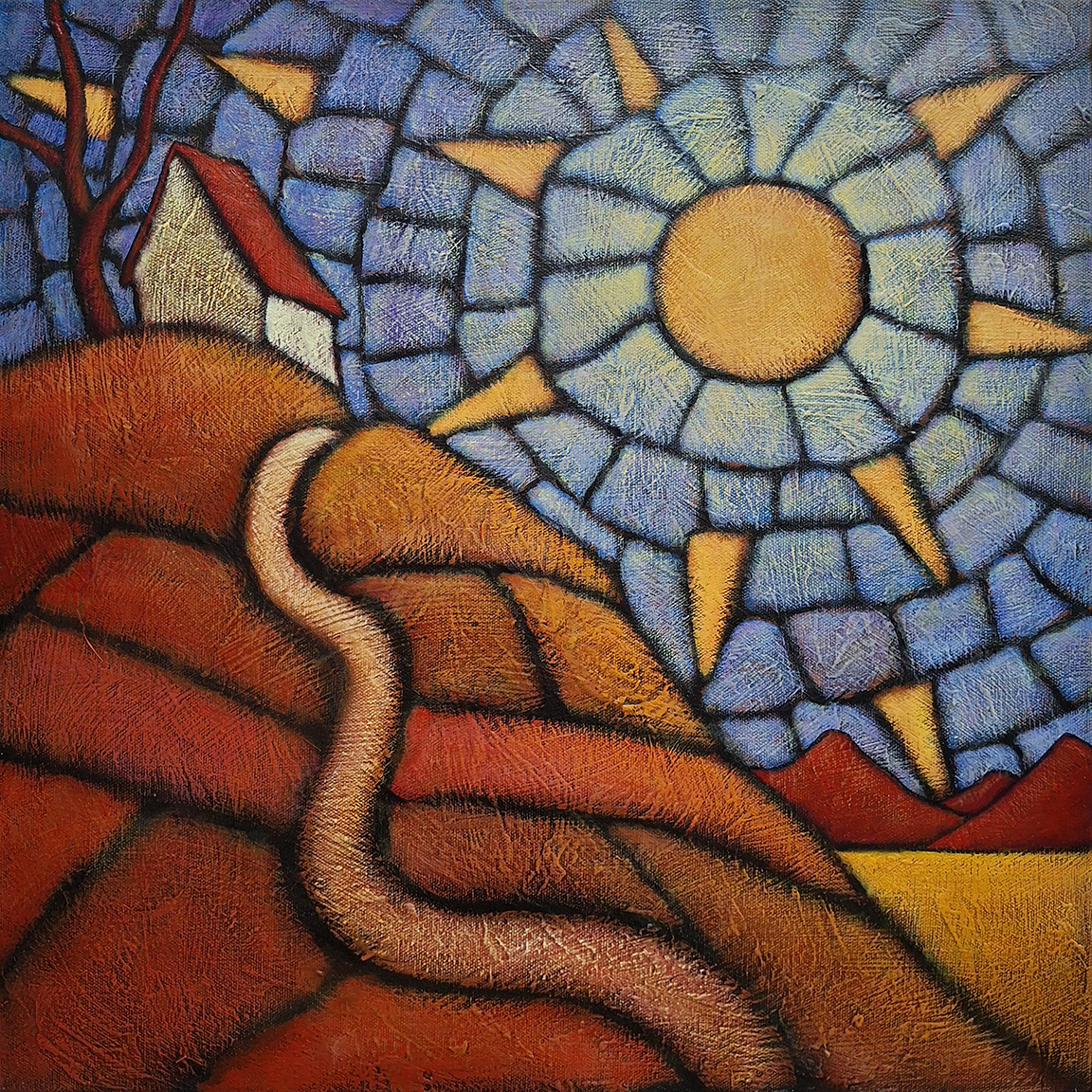
It’s been about a month since I gave a painting demonstration at the Principle Gallery. In the days after, I shared an image of the progress that had been made on the demo painting at the end of the session. I was fairly pleased with how it had emerged but could immediately see that there were changes– additions, subtractions and alterations– that needed to be made before it would truly come into form, at least to my eyes. There were a number of small adjustments and a couple of major changes.
Among the larger changes was altering the shape and color of the distant mountains in the lower right quarter. I simply wasn’t satisfied with the original. There was something in them– or not in them– that just didn’t sit right with me.
I also changed the shape of the Red Roof house in the upper left. Again, the original just didn’t feel right to me. I depend on my ability to sense rightness in my work, and it was not meeting the mark.
I changed the angle of the roof and extended it a tiny bit, which allowed me to clean up some messiness in the sky behind it. It’s not that I mind a little messiness. The late biophysicist Max Delbruck (1906-1981) had a theory that he called the Principle of Limited Sloppiness. which stated that too much sloppiness was unacceptable in scientific research but allowing a little sloppiness sometimes revealed startling, unexpected results that could then be cleaned up.
I guess you could say I adhere to Delbruck’s theory. A little sloppiness is fine and sometimes revelatory. However, in my work it’s a problem when the messiness is out of the rhythm of the painting and becomes a distraction, pulling focus from the whole of the painting.
Cleaning up that bit of messiness really honed the feel of the painting for me as did the fine tuning of the colors throughout. The rising road was lightened and a bit of darkness added to the left side of the hill, away from the sun, which, along with its light arrows, was brightened a bit.
It may not seem to the casual observer that the painting was greatly changed but to my eyes it emerged in a much different form., one that truly reaches that sense of rightness that I mentioned. Looking at it now here in the studio, it doesn’t feel like a hurried demo piece. It has its own feel and life now– an extension of the inner world I try to show in my work. It feels like it is truly part of that world now.
I used a Kandinsky quote at the top about an artist needing to train both their eye and their soul. I think of all the hours I have spent alone working in my studio have honed whatever skill I possess– the eye that Kandinsky mentions– as well as the sense of rightness which might well translate as the Kandinsky’s soul. I don’t really know that can express what I am trying to say but I like the idea that an artist is seeking their own soul in their work.
I am pleased I was able to share a little of what seeking looks like with the folks who made it to the demonstration a month ago. Many thanks again to everyone who made it possible.
I have yet to title this piece. A reader suggested the title of an old Cat Stevens song, Road to Find Out, as a title. That might work but I am open to suggestions. Let me know what you think.
Let’s listen to that Cat Stevens song. There’s larger image of the completed painting below. That is, if it is truly completed. Like people, art sometimes needs to change…





 Redtree Times