Feeds:
Posts
Comments

Posts Tagged ‘Henry Ward Beecher’

In the Free World-– Now at Principle Gallery, Alexandria


Every artist dips his brush in his own soul, and paints his own nature into his pictures.

–Henry Ward Beecher, Proverbs from Plymouth Pulpit (1887)


As an artist, if you will allow to call myself that, I believe these words the famous 19th century preacher Henry Ward Beecher are true. I know that I feel closest to my work when it most reflects a feeling and tone that I recognize deep within myself. You just hope that this aspect of your nature is equally reflected outward, that people see that same aspect in you as a person.

Sometimes they do and sometimes they do not. It is not always an easy transition when trying to bring anything from the inner to the outer world. I guess the best one can do as an artist is to be sincere, to represent those aspects which truly are part of your true nature.

To try to do otherwise produces insincere work. And while it can exist and even prosper in the short term, it eventually reveals its insincerity.

I don’t know, maybe I am just spinning my wheels this morning. I often do that in the aftermath of a show opening. It’s a matter of finding something to hold on to before I fully fall into the abyss of funk that I seem to encounter after every show. In this year’s case, I am holding on to the fact that I know the work I produced is indeed sincere and represents what I believe is my true nature.

Well, most of my true nature. You know, the good parts. The aspirational. The inspirational. But in reality, even the darker aspects of my true nature show up in what I consider my best work. I think it is that tension between the dark and light aspects of an artist’s nature that produce meaningful art.

Sincere art. Art of the soul.

Okay, a little more info on Henry Ward Beecher, for those of you not familiar with the name. He was one of the biggest celebrities of the late 19th century, on an equal footing with the actors, musicians, and writers of the era. At one point, he was referred to as the Most Famous Man in America. He was even on popular trading cards and had his own sex scandal that culminated in one of the most celebrated trials of the time. He was also a great social reformer as an abolitionist and advocate for women’s suffrage. He was the brother of Harriet Beecher Stowe of Uncle Tom’s Cabin fame, as well as the brother of Thomas K. Beecher. I throw in Thomas because of his local connection to my hometown. He was the big fish in our small pond at the time, a preacher who drew huge congregations as well as a civic leader. He was a good pal of Mark Twain and buddied around with him, playing pool and such, during Twain’s many summer stays here in Elmira. Beecher also presided over Twain’s wedding to local girl Olivia Langdon.

Okay, enough extra info. Let’s have a song. Since we’re discussing the nature of the soul, here’s Soul Time from Shirley Ellis. You might know her from her fun big hits The Name Game and The Nitty Gritty. A video for The Nitty Gritty with some exuberant dancer, highlighted by the wild moves of well-known dancer/choreographer Bobby Banas, became a viral hit. Lots of fun.



Read Full Post »

Thankful

++++++++++++

The unthankful heart discovers no mercies; but the thankful heart will find, in every hour, some heavenly blessings.

― Henry Ward Beecher

+++++++++++++


Hoping your hearts are thankful today and that you recognize the blessings that surround you. Have yourself a Happy Thanksgiving.

Read Full Post »

“If men had wings and bore black feathers, few of them would be clever enough to be crows.” 

~ Rev. Henry Ward Beecher

*********************

The new painting shown here on the right is titled Memory of the Crow and is included in the Little Gems show at the West End Gallery which has its opening this evening.

I’ve always felt there was something special about crows, especially in regard to their intelligence. I couldn’t agree any more than I do with the words above from Henry Ward Beecher.  Especially about the cleverness of men.

But the intelligence of crows is obvious to anyone who watches them for any amount of time. This was evident to the Native Americans who held these birds and their wisdom in high esteem as part of their belief system and their mythology.

Maybe because they are always near, always in close proximity to man as they live off the refuse he creates, the crops he plants and the vermin he attracts. This omnipresence gives the crow a sense of being a constant, unblinking witness to all that happens. And maybe this constant watching breeds that sense of wisdom that some of us see in them.

It makes me wonder what the crow sometimes thinks or remembers.  How do they perceive us and what is their awareness of us? Are our good and bad times their good and bad times as well? When we  abandon a place do they feel sense of loss? Do they attach themselves in any way to us?

Or do they see it as a passing of time with us as ephemeral visitors passing through their eternal world?

Those are the kind of  questions that rise for me in this piece. Makes me wish I could talk with the crow…

********

Here’s a link to a post and update from a number of years back about a crow that lived around my studio.  It also includes a version of Joni Mitchell’s Black Crow from Diana Krall– good listening on a Friday morning.

Read Full Post »

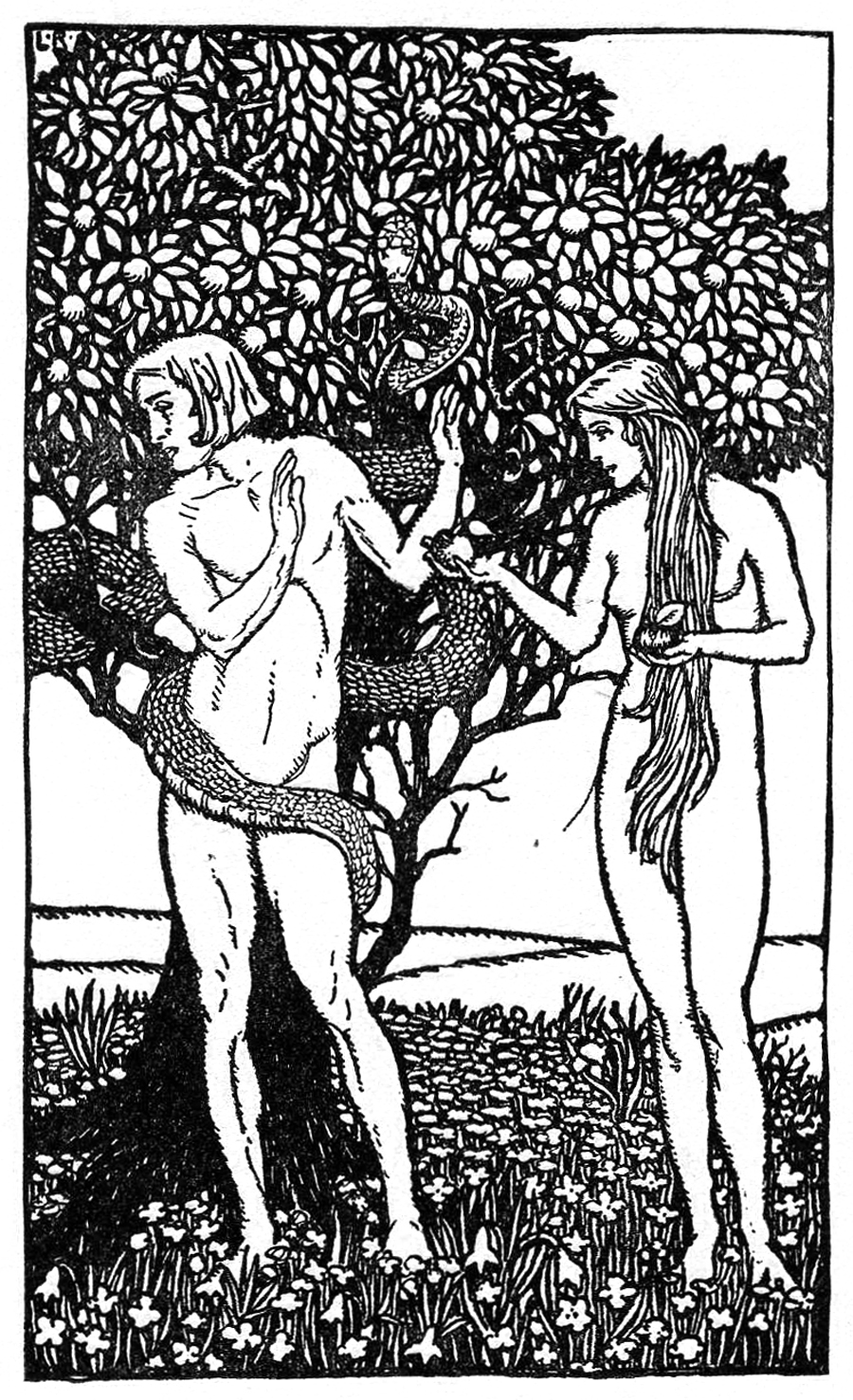
Mark Twain's "Eve's Diary" Title Page - by Lester Ralph

There is a slate of activities scheduled tonight at the historic Park Church in my hometown of Elmira to commemorate this city’s part in an episode that Mark Twain chronicled in a very short vignette called A Monument to Adam.  It seems that Twain had made an offhand comment at one point in the late 1870’s to the then minister of Park Church, Thomas K. Beecher, who was the  brother of Harriet Beecher Stowe and Henry Ward Beecher and a favorite drinking buddy of the famed writer.  It was in the era when the evolutionary theories of Charles Darwin were taking hold of the wider population and Twain, in speaking of Darwin with Beecher, joked that the biblical Adam had altogether been overlooked by the naturalist and that  he would surely soon be forgotten.  He then suggested, with tongue even more firmly planted in cheek, that Elmira should erect a monument to Adam that would keep his name alive as well as serve as a great boon to local tourism.

Much to his surprise, the idea took off locally and soon he was in meetings with bankers who pledged thousands of dollars to erect the monument and began to solicit designs from all over, some from Paris, as Twain notes.  Elmira was on its way to becoming a tourist mecca.  Or so the locals thought.

The Park Church, Elmira NY

Twain felt it was always a ridiculous idea and, in an effort to curtail its momentum, wrote a request to be read before the congress asking the federal government to erect the monument, knowing full well that once the idea was presented it would be ridiculed and would soon be forgotten.  But the representative wouldn’t read it because he felt that it was so seriously written and sentimental that they might just consider it in earnest. 

Of course, the idea ran out of steam and was soon set aside only to revived later as a short article by Twain.  Elmira never became a tourist destination, outside of the folks who come to see Twain’s gravesite.   But tonight the idea lives on again in that same church where Twain would periodically listen to the preaching of Beecher.

Read Full Post »