 This painting, a new 24″ by 20″ canvas, is titled Icon: Peter the Scoundrel. This may not be my favorite painting from the Icon series that I’ve been working on as of late but this has been by far the hardest piece for me to complete. It just kept going and going and I completely repainted the head and face at least six different times. Each face never felt right and I could not get a handle on how I wanted to portray the person behind this painting.
Actually, I could never get a handle on this person, period.
His name was Peter Bundy, my 3rd great grandfather and he is buried in an old cemetery in Caton, just outside of Corning. It’s a cemetery that I knew well from my childhood, having spent a lot of time with my favorite cousin in Caton. In fact, my cousin worked in the cemetery as a teen, digging graves by hand. I never knew at the time how many ancestors of mine were buried right there but doing research on my family lines I found that there were dozens and dozens of relatives there including this Peter Bundy.
His grave stone says that he was born in Scotland in 1823 and served in the Civil War with the Ohio 75th Regiment. Doing a bit of research I found a veteran’s pension record from the 1890’s that stated he had been captured and held at the infamous Andersonville Prison Camp. That same record listed him as having an alias— Charles McKinney. My mind began to imagine that perhaps he was a Union spy.
If only it could have been that simple.
A few years passed and one day I had a message about my family line on the Ancestry site. It was from a family who had done research on their family line and had found that my gr-grandfather Peter Bundy was also their gr-grandfather. Except that he had a different wife and a different name– Levi McProuty. It turns out that my Peter Bundy held that name and married under it in the years before the Civil War. Living in western Steuben County, they had two children, a boy and two girls, before he ostensibly left in 1861 to serve in the Union army. A year or so later, his wife was informed somehow that he had been killed in combat.
She and her children never saw him again.
It seems that in the year that he was gone, he had shed the name of Levi McProuty, married my 3rd great-grandmother, Elizabeth Everetts, and had a child, my 2nd gr-grandmother. While he may not have even served in the war as Levi McProuty, he did leave for service in the Civil War as Peter Bundy. He returned to his second wife and child.
However, for the next twenty or so years, he didn’t show up in any public records. But his wife and child did– his wife under the name of McKinney and his daughter under her married name. He showed up in some veterans’ pension records and the census before dying in 1901. His wife died in 1915. Both were listed under the Bundy name.
I don’t know if this is clearly written so that you can follow it– I know that it is so convoluted that I have trouble keeping it straight in my head.
So, was he really Peter Bundy or Levi McProuty? Or Charles McKinney? Or somebody completely different? Was he even born in Scotland? I find myself thinking that he may not have even served in the war, that he may have stolen the identities of other soldiers. How he ended up serving in an Ohio regiment– Ohio being several hundred miles away– is another question that comes to mind. Was his time at Andersonville just another lie? I don’t know if anything that is considered factual about this person is indeed real except for the fact that this person, my great-great-great grandfather, lived for a time and died in Caton–that’s on his gravestone.
And that he was a scoundrel. That is not on his stone.
I think it’s this doubt that fed the troubles I had with this painting. I could never see a face or a facial expression that suited this person because I never had an idea of his truth. And just when I thought I would have a sense of him, there was always a new twist with which to contend. When I had the different faces on this figure I felt a lot of discontent and anxiety, even waking up in my sleep thinking about it.
So yesterday morning, I came into the studio and decided to just simply put him in a mask. A grinning, mocking mask that let’s me know that I don’t really know him and I doubt that I ever will.
 When you delve back into your ancestry you often uncover surprises, some pleasantly exciting and some a bit disappointing. In some cases, it’s a bit of both. Such is the case of the person behind this latest painting from my current Icons series. This piece is 24″ by 12″ on masonite and is titled Icon: Eleazer.
 As pointed out in recent posts, I’ve been working on a group of new work that I am calling Icons, images that put people that I have come to know through doing some genealogical work. They are not intended to be accurate depictions of these ancestors. In each case, I have just found something compelling that sticks with me. Such is the case with the painting above, a 10″ by 20″ canvas that I call Icon: William England.
 This is the next step in the Icon series of paintings that I talked about a few days ago. It’s an 18″ by 18″ canvas that I call Gilbert, going with the French pronunciation– more jill-bear than gill-bert. There’s a reason for that.
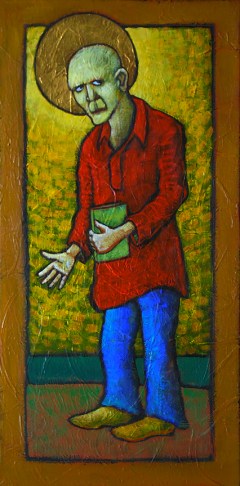 This is one of the new pieces I have been working on. I wasn’t sure I wanted to show it in this state, as it is unfinished, or even when it is finished. But as it progressed it began to grow on me and was meeting my expectations for what I wanted from it. So, I thought I would show it and talk a bit about this piece, a 12″ by 24″ canvas that I tentatively calling Frank the Icon.


 Redtree Times