Feeds:
Posts
Comments

Posts Tagged ‘Mark Rothko’

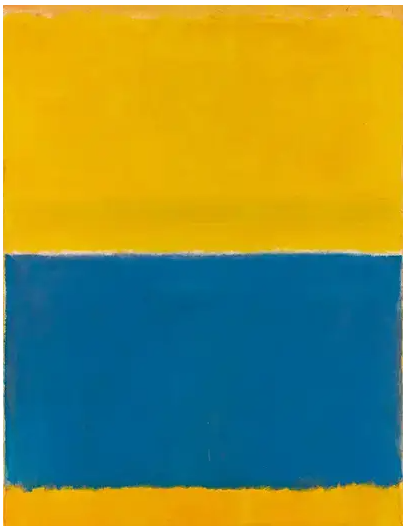
Mark Rothko –Untitled (Yellow and Blue) 1954


“You might as well get one thing straight. I’m not an abstractionist… I’m not interested in the relationships of color or form or anything else. I’m interested only in expressing basic human emotions—tragedy, ecstasy, doom and so on. And the fact that a lot of people break down and cry when confronted with my pictures show that I communicate those basic human emotions… The people who weep before my pictures are having the same religious experience I had when I painted them. And if you, as you say, are moved only by their color relationships then you miss the point.”

― Mark Rothko, 1956 Interview with Selden Rodman


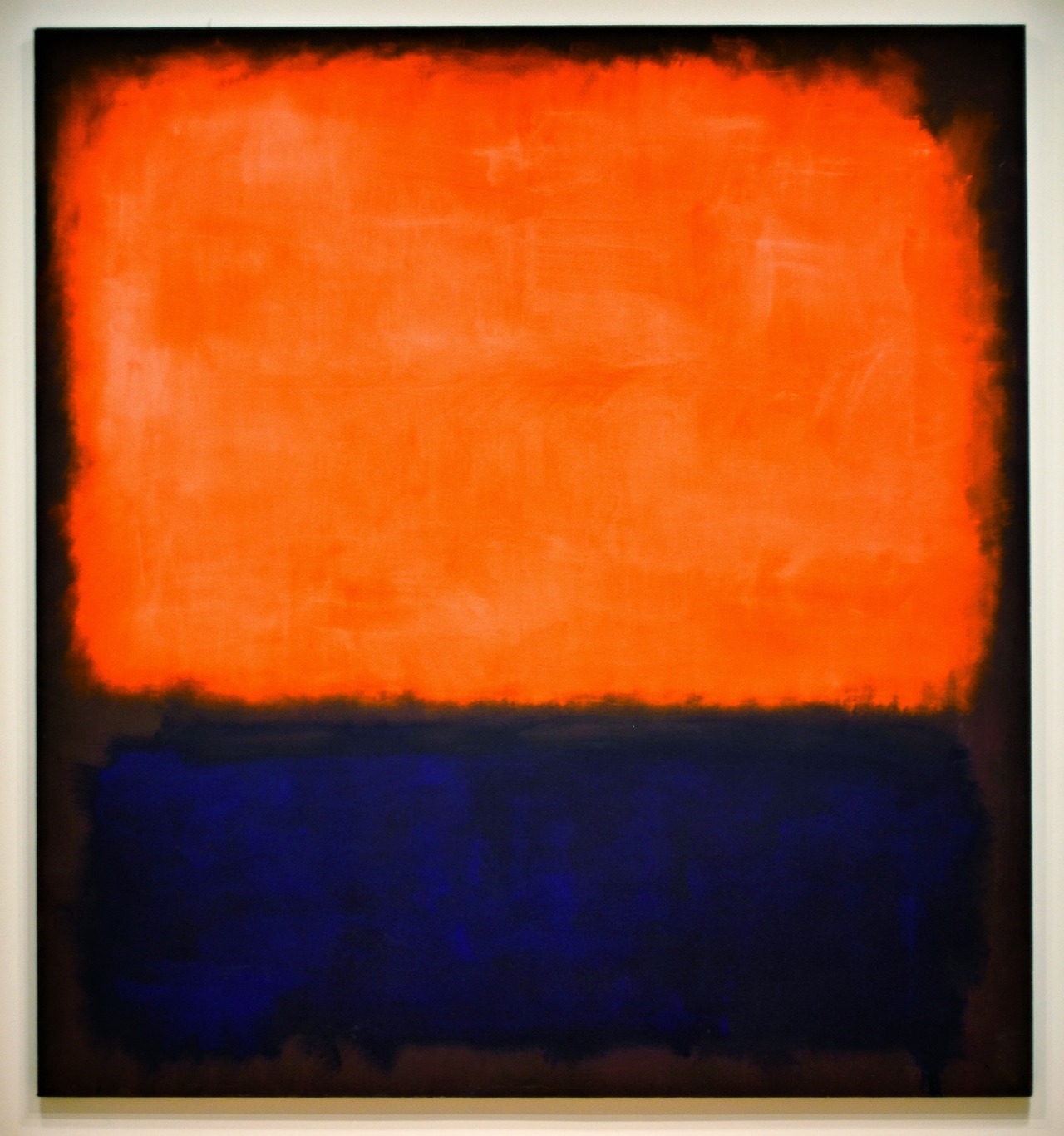
I used a representation yesterday of the colors of the flag of the Ukraine that was actually a detail, shown above, taken from the large Mark Rothko painting shown at the top. I had used this detail before in a post around this time in 2022, one which drew a lot of attention yesterday. Enough so that I went back to check out that post which I am sharing again today as the quotes in that post from Rothko speak so clearly to a lot of things that I have been focusing on recently, on both this blog and in my work.

And since it is Sunday, I am also sharing some Sunday Morning Music at the bottom. In light of what is taking place in this country, the calming effect of Gnossienne No. 1 from Erik Satie seems like the right choice to accompany Rothko as Satie’s work followed similar paths of deep expression and silences. The version I am sharing is a mesmerizing performance from celebrated Finnish guitarist Otto Tolonen.


Busy morning ahead with painting and plowing from what I hope is the last snowfall of this winter. But I thought I would share a Mark Rothko painting (the image at the top is only a detail of its lower section- the whole painting is shown here on the left) and a video on it from Sotheby’s auction house (where it sold for $46.5 million in 2015) along with several Rothko quotes.

Rothko (1903 -1970) was a big influence on my early work. The idea of expressing the big human emotions through simplified forms and color really spoke to me because I never looked at painting as a craft but more as a means to express those forms of emotion that well up inside because they are sometimes too difficult to express in words and voices.

Another aspect that attracts me to Rothko is that he, like Kandinsky, was often eloquent in speaking about his work and art in general. And in those words I found that my own already developed perspectives often largely meshed with and echoed both of these artists’ words and views.

For example, in the quote below the idea that a picture lives by companionship is one that is central to my work.

“A picture lives by companionship, expanding and quickening in the eyes of the sensitive observer. It dies by the same token. It is therefore risky to send it out into the world. How often it must be impaired by the eyes of the unfeeling and the cruelty of the impotent.”

Here a few more that also speak to me, things I have often written about here, about the need of emotional expression in art and of the searching for silence.

“It is the poet and philosopher who provide the community of objectives in which the artist participates. Their chief preoccupation, like the artist, is the expression in concrete form of their notions of reality. Like him, they deal with the verities of time and space, life and death, and the heights of exaltation as well as the depths of despair. The preoccupation with these eternal problems creates a common ground which transcends the disparity in the means used to achieve them.”


“When I was a younger man, art was a lonely thing. No galleries, no collectors, no critics, no money. Yet, it was a golden age, for we all had nothing to lose and a vision to gain. Today it is not quite the same. It is a time of tons of verbiage, activity, consumption. Which condition is better for the world at large I shall not venture to discuss. But I do know, that many of those who are driven to this life are desperately searching for those pockets of silence where we can root and grow. We must all hope we find them.”



Read Full Post »

GC Myers-- Moment of Pride 2023

Moment of Pride— At West End Gallery


Pictures must be miraculous: the instant one is completed, the intimacy between the creation and the creator is ended.

Mark Rothko


I came across the words above from the late painter Mark Rothko and found myself relating very much to their meaning. The process of creating a picture is ideally a period of intimacy, one where the maker ideally opens their inner self and exposes their totality to the surface. There is a transference of energy and thought in that moment that forms the new life taking place on that surface.

Each move, each change to the surface pulls bits from the inner stores of the creator and alters the new reality being formed. For a rare moment, the two entities– the maker and the surface–are locked together.

They are one.

But as the picture takes shape and form, beginning to express its own life force, it moves away from the maker. At completion, the painting takes on its own being and at that point is beyond the reach and influence of the maker.

As a maker of pictures, I can say that this moment is both wistfully sad and exhilarating. When that moment of completion is at hand, I immediately miss that time of transference when the air is still filled with excitement and possibility. But seeing the new picture, self-contained and speaking for itself, brings a kind of parental pride. I know that I will never be as close to that picture as I was in that moment. But that moment binds us forever, even if it will be always as a faint memory when I glimpse its image in the future.

I chose the piece at the top for this post- fittingly titled Moment of Pride because it sums up the feeling felt when that transference has taken place and the piece stands apart, living and breathing on its own. I certainly felt the feeling depicted when completing this piece.

There was a definite moment of transference when this painting made the leap from being me to being it. It had its own story to tell that was then beyond me, speaking with its own voice, its own meaning that it will someday make known to someone other than me.

And they will hopefully experience their own rare moment….


This is a reworked post from 2016. It seemed to perfectly fit the painting at the top, Moment of Pride, which is now at the West End Gallery as part of their Deck the Walls exhibit, opening tomorrow. I’ve been adding songs to most every post lately and I’ll keep that going today.

Don’t think this song fits the painting here but it has a wistful feel much like that feeling felt when you realize that you’ve lost a closeness with someone or something that you will never be able to recapture, so it might. Whether it does or not, it’s a song that like a lot from an album that I like a lot and that’s good enough for me. It’s the title track from the Anodyne 1993 album, the last album from Uncle Tupelo before splitting up the next year as its members moved on separately to form the bands Son Volt and Wilco.

The tune and lyrics have a weary, disenchanted feel that seems to fit my own lately and probably a lot of others out there:

You threw out the past
When you threw out what was mine
Throughout the years
It was hard to make it last

Anodyne, anodyne

No sign of reconciliation
It’s a quarter past the end
Full moon from on high
Across the board, we lose again

Give a listen if you are so inclined. And don’t slam the door when you leave, okay?


Read Full Post »

Rothko/Experience

Mark Rothko- Red and Black 1968

*****************

A painting is not a picture of an experience, but is the experience.

Mark Rothko
.
*****************
This quote from Mark Rothko made me stop this morning. I hear a lot of artists talk about capturing a moment with their work. I am pretty sure those words have come out of my mouth when I am just blathering on. But a piece of art works best when it causes the viewer (for visual artists) to feel as though they are experiencing something new in that moment when they stand in front of it.
.
Not a representation of a moment but a moment in itself.
.
But how do you do that?
.
I can’t really say for sure. Maybe it comes in being fully engaged emotionally during the creation of the work. Perhaps that moment of emotion becomes part of the piece and it is that which the viewer senses and experiences in the work.
.
I don’t really know but it is something I will consider when I am in front of the easel in a few minutes.

Read Full Post »

*********************

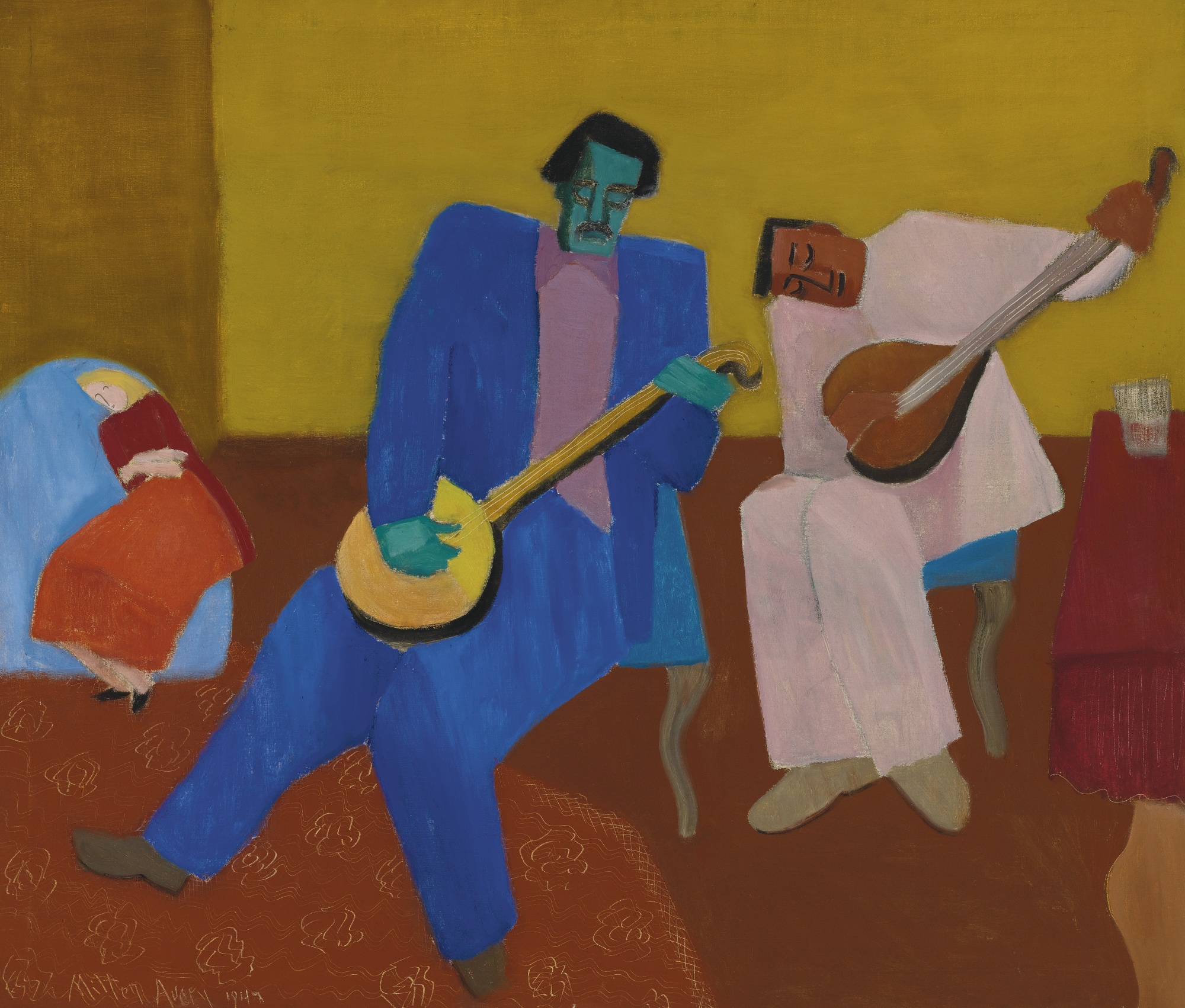
What was Avery’s repertoire? His living room, Central Park, his wife Sally, his daughter March, the beaches and mountains where they summered; cows, fish heads, the flight of birds; his friends and whatever world strayed through his studio: a domestic, unheroic cast. But from these there have been fashioned great canvases, that far from the casual and transitory implications of the subjects, have always a gripping lyricism, and often achieve the permanence and monumentality of Egypt.

Mark Rothko, 1965

*********************

While not a huge fan of the paintings of Milton Avery upon my first encounters with it, I find myself respecting and appreciating his work the more I look at and read about it.

Born in 1885, Avery worked blue-collar jobs into his thirties. He felt a desire to paint and began taking classes while still toiling as a laborer, working in obscurity for many years. He moved from pure representation of his subjects to an abstracted representation built on blocks of color and a flattening of the picture plane that became his signature style. His work eventually was recognized by a wealthy collector who set out to make it better known by distributing it among various American museums.

It worked and Avery became a leading light of the early abstract movement with his abstracted takes on representation and was considered a master colorist, sometimes referred to as the American Matisse. He died in 1965 at the age of 80.

I find that there are commonalities between us that give me a better sense of his work. First, there is his late entry in the world of art and a prior existence as a blue-collar worker. I certainly can relate to that.

Then there is his use of blocks of color, especially colors that seem radical for the subject. Looking at his work, I can easily relate to how he composed his paintings, how each block of color relates to those around it.

I also like the fact that Mark Rothko pointed out the lyricism of his work which refers to the fact that his painting, even when the subject matter seems most mundane, has high emotional notes that give it great weight beyond the subject matter. That lyric quality is something I desire in my own work.

I also like some of the writings from Avery especially one quote that rings true for me:

I try to construct a picture in which shapes, spaces, colors, form a set of unique relationships, independent of any subject matter. At the same time I try to capture and translate the excitement and emotion aroused in me by the impact with the original idea.

That is exactly what I trying to do– trying to capture the excitement and emotion aroused in me— each day in the studio. I think I often use those very words when talking about my work practices.

So, these common bonds allow me me to see Avery’s work in a better light. I find myself liking the consistency of his work, how he confidently used his native voice to express himself.

Respect is now there.

Read Full Post »

++++++++++++++++++

“Art is such an action. It is a kindred form of action to idealism. They are both expressions of the same drive, and the man who fails to fulfill this urge in one form or another is as guilty of escapism as the one who fails to occupy himself with the satisfaction of bodily needs. In fact, the man who spends his entire life turning the wheels of industry so that he has neither time nor energy to occupy himself with any other needs of his human organism is by far a greater escapist than the one who developed his art. For the man who develops his art does make adjustments to his physical needs. He understands that man must have bread to live, while the other cannot understand that you cannot live by bread alone.” 

― Mark Rothko, The Artist’s Reality: Philosophies of Art

++++++++++++++++++

Read Full Post »

GC Myers- That Rare Moment smPictures must be miraculous: the instant one is completed, the intimacy between the creation and the creator is ended.

Mark Rothko

****************

I came across the words above from the late painter Mark Rothko and found myself relating very much to their meaning.  The process of creating a picture is ideally a period of intimacy, one where the maker  ideally opens their self and exposes their totality to the surface.  There is a transference of energy and knowledge in that moment that forms the new life taking place on that surface.

Each move, each change to the surface pulls bits from the inner stores of the creator and alters the new reality being formed.  For a rare moment, the two entities– the maker and the surface–are are locked together.  They are one.

But as the picture takes shape and form, beginning to express its own life force, it moves away from the maker.  It is its own being at that point, beyond the reach and influence of the maker.

As a maker of pictures, I can say that this moment is both wistfully sad and exhilarating.  When that moment of completion is at hand I immediately miss that time of transference, so full of possibility.  But seeing the new picture, self-contained and speaking for itself, brings a kind of parental pride.  I know that I will never be as close to that picture as I was in that moment.  But that moment binds us forever, even if it will be always as a faint memory when I glimpse its image in the future.

I chose the piece at the top for this post- fittingly titled That Rare Moment– because what I could have been writing solely about this piece.  This painting, an 8″ by 24″ canvas, was very much created with in the process that I described.

There was a definite moment of transference when this painting made the leap from being me to being it.  In the days after it was complete, I would look at it and sigh with that mix of sadness and pride.  It is beyond me now and speaks with its own voice, its own meaning that will no doubt soon express itself to someone other than me.

And they will hopefully experience their own rare moment….

____________

This painting is part of my solo show, Contact, at the West End Gallery in Corning, NY.  The show opens FridayJuly 22, 2016 with an opening reception that runs from 5-7:30 PM.  There is also an accompanying Gallery Talk that takes place on August 6.  More details on that later.

Read Full Post »

mark_rothkoIt is a widely accepted notion among painters that it does not matter what one paints as long as it is well painted […] There is no such thing as good painting about nothing.

Mark Rothko

**************

I have often said, often without much grace, that the subject for a painting is secondary, not really that important so long as the painting says something, expresses feeling and evokes emotion within the viewer.  I think the work of Mark Rothko is a good example of this sentiment. They are simple of blocks of opposing colors set one over the other or, as in the case of the piece above, one alongside another.

Seemingly without subject.

Seemingly about nothing.

But as Rothko states, there is no such thing as a good painting about nothing.  And this is a good painting.  It allows the viewer’s own emotions into its space, lets their own story become the story and subject of this work.  That space is the subject and purpose of this work.

So, every picture does tell a story.  Some dictate the story, forcing the viewer to follow a set storyline through the picture as though they were the plot of a murder-mystery novel.  Others do so like a song or poetry, evoking feeling with a suggestion or a gentle nudge.  The viewer here is complicit in the fulfillment of the art.

For myself, I prefer the latter but have enjoyed works with more obvious subjects.  Perhaps not as deeply felt but enjoyable nonetheless.  I still question where my work falls on this scale.  I am sure it has been both and I know I am much more satisfied when it appears more poetic.  But being able to dictate the nature of the work is often beyond me.  It sometimes appears in the poetic form seemingly on its own, without my direction.

And that is most satisfying.  And elusive.

All this being said is mere pretense for this week’s Sunday Morning Music.  It’s a cover of Rod Stewart‘s classic song, Every Picture Tells a Story, done by the Georgia Satellites back in 1986.  I always liked their version of this song and hope it’ll kick off your Sunday on a high note.  Have a great day!

Read Full Post »

Rothko Number 14Art to me is an anecdote of the spirit, and the only means of making concrete the purpose of its varied quickness and stillness.

–Mark Rothko

*****************

I don’t think there is anything that I can add to this except to nod silently in agreement.

Have a great day.

Read Full Post »

Geloven Onderweg CoverI just received a copy of a Dutch magazine, Geloven Onderweg, which loosely translates into English as Go Believe.  I mention this because it contains an image of one of my paintings, Archaeology: Rainbow’s End, as the illustration for one of its articles.  I was approached a few months back about the possibility of using the image in this magazine which is published by the Dominican order in the Netherlands.

The article is written by Jakob Van Wielink and is titled  Archeoloog wit een mild hart which translates as Archaeologist With a Mild Heart.  Beyond that, there is little I can tell you about the article or any of the other writing in this issue.  However, I can tell you that the  theme of this issue is outlined on the cover with Trust and the Future in Dutch under the image of a small boy confronting a Mark Rothko painting.  Interesting image…

They used my painting in a lovely manner with the image in the upper right hand corner of a two page spread with the image also used as a half-tone underlay.  It looks good and I am pleased to be able to have my work exposed in some small way in the Netherlands.

Geloven Onderweg Article 2014


Read Full Post »

earl-kerkam1891-1965-1361546399_org I am very interested in the painter’s painter, those artists who garner the respect and  admiration of other artists while often not attaining the same sort of attention from the general public.  I try to figure out where the disconnect comes in how these artists are perceived so differently by these two groups.  I recently came across a prime example by the name of Earl Kerkam, a NY painter who lived from 1891 until 1965.

Kerkam trained in some of the finest art academies here and abroad, studying for a while with Robert Henri.  He showed his work in important shows alongside some of the greats of the early 20th century.  His work is included in some of the great museum collections of this country.  In the aftermath of his death,  modern artists of huge stature  such as  Mark Rothko and Willem  de Kooning proclaimed Kerkam to be one of the finest painters to ever emerge from America.

earl-kerkam1891-1965self-portrait-1361546314_bYet his work is basically unknown outside a handful of art insiders.  His work sells of very modest prices at auction and I doubt if anyone who reads this will have ever heard the name.

There could be many reasons for this relative anonymity.  Perhaps his work is too esoteric, too caught up in the dogma of style or too narrow in its range of emotional impact.  Perhaps his work was caught between eras, never really falling into a classification where he would be swept to the forefront of a wave. This might have something to do with it because, while his work is modern, it never really moved into the realm of the abstract expressionism that was the rage of the day.

I don’t really know and looking at his work I found myself torn between liking it in some instances and being indifferent to  others.  I can see how both sides, artists and the  general public, might take opposing views on his work.  His work remains an enigma to me and I don’t know if I will ever see enough of it, or at least a single piece that could be called a masterwork,  to make me say that he deserves to be among the beacons of mid-20th century painting  or if he was simply a fine painter who garnered just the attention his work deserved.   But for now, the name Earl Kerkam is at least on my radar and I will be open to finding other works from him that will move my perceptions.

Read Full Post »

Older Posts »