Feeds:
Posts
Comments

Posts Tagged ‘Mary Oliver’

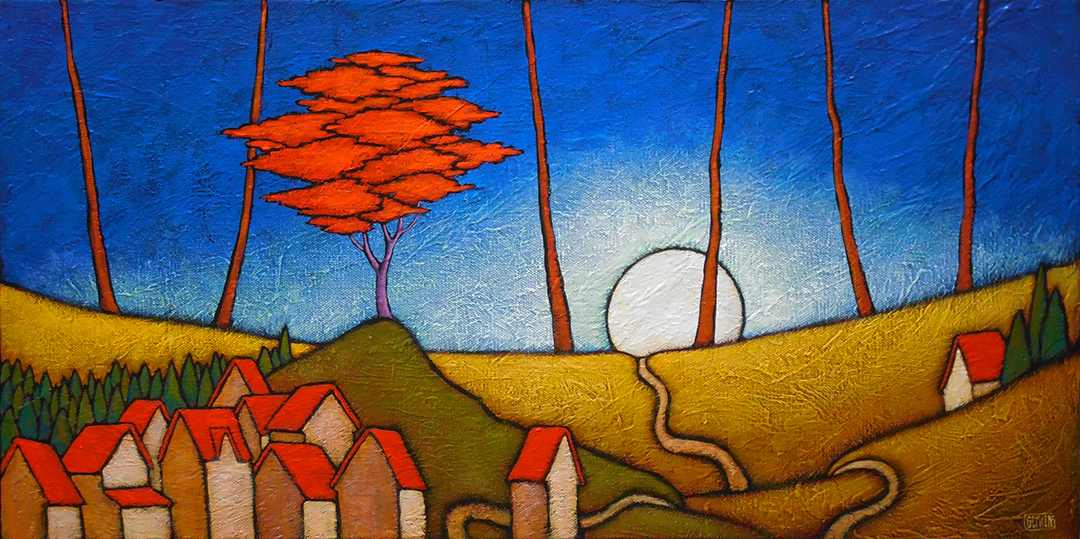
Eye to the Future— At West End Gallery


You can have the other words-chance, luck, coincidence,
serendipity. I’ll take grace. I don’t know what it is exactly, but
I’ll take it.

— Mary Oliver, Sand Dabs, Five


I am getting ready for a painting demonstration I am giving on Saturday at the West End Gallery, beginning at 10 AM. This event is part of the Arts in Bloom Art Trail of Chemung and Steuben County which involves open tours of artists’ studios and events such as this in the area’s art galleries.

As I mentioned before, I seldom paint in front of people and am a little self-conscious as a result. Even more so when at one point on Saturday painters Trish Coonrod and Gina Pfleegor will also be showing off their prodigious talents. Both paint in a more traditional manner at a very high level of skill. I think of Trish’s talents as one would of a grandmaster pianist and Gina’s as that of a highly trained operatic soprano or a golden voiced chanteuse.

Me? I think of myself as a guy with an old and out of tune guitar who knows maybe three or four chords. Sings a little off key. What I lack in skill I try to make up for with the 3 E’seffort, emotion, and earnestness

I do whatever it takes to find something on that surface in front of me. It’s kind of like the line at the top from poet Mary Oliver— I’m forever looking for serendipity or, on those special days, grace to show up before me in the paint. There’s a lot of time when its appearance is an uncertainty and it can take some time to coax it out into the open. 

My hope is that it will choose to show up during the few hours I will be working on Saturday. I am still trying to decide if I should have a plan on how or what I will paint or if I should just let serendipity and grace decide for me. I am leaning toward the latter just because that path can sometime be the most exciting.

We’ll see what happens Saturday morning. I am hoping grace shows up for a brief visit.

I am sharing the rest of the Mary Oliver poem, Sand Dabs, Five, from which the line at the top was taken. I think that I could apply much of what it expresses to what I am trying to say as an artist., particularly those final lines.


Sand Dabs, Five

Mary Oliver


What men build, in the name of security, is built of straw.

*

Does the grain of sand know it is a grain of sand?

*

My dog Ben — a mouth like a tabernacle.

*

You can have the other words-chance, luck, coincidence,
serendipity. I’ll take grace. I don’t know what it is exactly, but
I’ll take it.

*

The pine cone has secrets it will never tell.

*

Myself, myself, myself, that darling hut!
How quick it will burn!

*

Death listens
to the hum and strike of my words.
His laughter spills.

*

Spring: there rises up from the earth such a blazing sweetness
it fills you, thank God, with disorder.

*

I am a performing artist; I perform admiration.
Come with me, I want my poems to say. And do the same.


Read Full Post »

The Blue Moon Calls– At West End Gallery


Of The Empire

We will be known as a culture that feared death
and adored power, that tried to vanquish insecurity
for the few and cared little for the penury of the
many. We will be known as a culture that taught
and rewarded the amassing of things, that spoke
little if at all about the quality of life for
people (other people), for dogs, for rivers. All
the world, in our eyes, they will say, was a
commodity. And they will say that this structure
was held together politically, which it was, and
they will say also that our politics was no more
than an apparatus to accommodate the feelings of
the heart, and that the heart, in those days,
was small, and hard, and full of meanness.

–Mary Oliver, Red Bird (2008)


The question is: When the collective heart of a people has become small, and hard, and full of meanness, can a person keep their own heart from becoming the same?

Or maybe it should be: Is the condition of the collective heart, now small, and hard, and full of meanness, terminal? Can it ever be reversed so that one day in the future it will be said that we were a people whose heart was large, and soft, and filled with warmth and kindness?

Of course, only time will reveal the answers to these questions.

Time is, after all, the ultimate revelator.

On that note, here’s one of my all-time favorite songs, The Revelator, from Gillian Welch. When I worked in my first and much more rustic studio (no phone, TV, internet, or other distraction) up in the woods in the early 2000’s, this song was in heavy rotation on my playlist.

I imagine most of you know who Mary Oliver (1935-2019) was but for those of you not familiar, she was perhaps the best known and bestselling contemporary American poet in recent times. I have featured her work, including her best-known poem Wild Geese, several times in the past.


Read Full Post »

Dale Nichols-  Company for Supper

Dale Nichols- Company for Supper


Snow was falling,
so much like stars
filling the dark trees
that one could easily imagine
its reason for being was nothing more
than prettiness.

― Mary Oliver


Several things to do this morning so I wasn’t planning on writing. But the looking at the light snow that has covered the ground and all the trees here at the studio put me in a mind to want to look at some of the snow paintings of Dale Nichols that I have featured here in the past. Whenever I come across them, I sense a form of completeness in them that I find very satisfying. Maybe it’s because it represents a quality that I seek in my own work. I don’t know but it is always there. Worth looking at this post from a few years back as the snow lightly falls this morning.


Most likely prompted by the recent weather here as well as a desire to try a slight change of palette, I have been doing a small group of snow paintings recently. I thought I would look at several other artists, especially those with a distinct personal style, to see how they handle snow in their work. One of the artists whose snow works really stuck out was Dale Nichols, who was born in Nebraska in 1904 and died in Sedona, AZ in 1995. He is considered one of the American Regionalists, that loosely defined group of primarily landscape painters whose work for which I have long expressed my admiration.

Dale Nichols- After the Blizzard 1967His biography is a bit sparse and there isn’t a lot written about him, but Nichols lived a long and productive life, serving as an illustrator, a college professor and the Art Editor of the Encyclopedia Brittanica. He also spent a lot of time in Guatemala which resulted in a group of work with Meso-American forms that is quite different from his Regionalist work and more than likely influenced the color palette of his normal work as well.

But Nichols is primarily known for his rural snow scenes and it’s easy to see why. The colors are pure and vivid. The snow, put on in multiple glazed layers with watercolor brushes has a luminous beauty. The stylized treatment of the crowns of the bare trees adds a new geometry to the paintings. There is a pleasant warmth, a nostalgic and slightly sentimental glow, to this work even though they are scenes that depict frigid winters on the plains of Nebraska. Free of all angst, they’re just plain and simple gems.

You can see a bit more of Dale Nichols other work on a site devoted to him by clicking here.

Dale Nichols- The SentinelDale Nichols- Silent Morning  1972Dale Nichols- Mail Delivery  1950Dale Nichols-  Bringing Home the Tree

Read Full Post »


“Snow was falling,
so much like stars
filling the dark trees
that one could easily imagine
its reason for being was nothing more
than prettiness.”

― Mary Oliver


As I get ready to go out and plow the snow that has already fallen while fretting about the snow that is coming behind, I thought I would repost an entry from several years ago about an artist whose snow paintings always please me. They focus on the prettiness of the snow and not the work nor the possibility for peril that it brings. And there’s nothing wrong with that. Even though I am no fan of plowing or shoveling or trudging in wet and cold boots, the beauty and quieted atmosphere of snow is among my favorite things. And Nichols captured that in his work. Enjoy this rerun and have a good day, snow or not.


Most likely prompted by the recent weather here as well as a desire to try a slight change of palette, I have been doing a small group of snow paintings recently. I thought I would look at several other artists, especially those with a distinct personal style, to see how they handle snow in their work. One of the artists whose snow works really stuck out was Dale Nichols, who was born in Nebraska in 1904 and died in Sedona, AZ in 1995. He is considered one of the American Regionalists, that loosely defined group of painters whose work  for which I have long expressed my admiration.  

Dale Nichols- After the Blizzard 1967His biography is a bit sparse with but Nichols lived a long and productive life, serving as an illustrator, a college professor and the Art Editor of the Encyclopedia Brittanica. He also spent a lot of time in Guatemala which resulted in a group of work with Meso-American forms that is quite different from his Regionalist work and more than likely influenced the color palette of his normal work as well.  

But Nichols is primarily known for his rural snow scenes and it’s easy to see why. The colors are pure and vivid. The snow, put on in multiple glazed layers with watercolor brushes has a luminous beauty. The stylized treatment of the crowns of the bare trees adds a new geometry to the paintings. There is a pleasant warmth, a nostalgic and slightly sentimental glow, to this work even though they are scenes that depict frigid winters on the plains of Nebraska. Free of all angst, they’re just plain and simple gems.

You can see a bit more of Dale Nichols other work on a site  devoted to him by clicking here.

Dale Nichols- The SentinelDale Nichols- Silent Morning  1972Dale Nichols- Mail Delivery  1950Dale Nichols-  Bringing Home the Tree

Read Full Post »

“Sublime”– Currently at the Principle Gallery, Alexandria


WHEN I AM AMONG THE TREES

When I am among the trees,
especially the willows and the honey locust,
equally the beech, the oaks and the pines,
they give off such hints of gladness.
I would almost say that they save me, and daily.
I am so distant from the hope of myself,
in which I have goodness, and discernment,
and never hurry through the world
but walk slowly, and bow often.
Around me the trees stir in their leaves
and call out, “Stay awhile.”
The light flows from their branches.
And they call again, “It’s simple,” they say,
“and you too have come
into the world to do this, to go easy, to be filled
with light, and to shine.”

–Mary Oliver


It’s been my privilege and good fortune to spend much of my life among the trees. I have climbed and played on them as a child and there are many memories of specific trees from my childhood. I have planted multitudes of trees and nurtured them.  I have lived under their watchful cover and have built a studio among them where I worked for many years. In fact, much of my livelihood has been derived from a certain Red Tree.

Throughout it all, there has been a sense of them as beings, unlike us humans but living beings nonetheless. I think that sometimes that we are the aliens living among their native race here on earth. I also like to think that I have a neighborly friendship of sorts with the trees around me. An understanding it might be called.

I try to not harm them and try my best to protect them, That it is becoming harder as invasive species become more and more prevalent. The ash trees in our area are on their last legs, for instance, from the emerald ash borer beetle. It is tragic to see them begin to fail from the onslaught of the beetles. But they maintain their stoic dignity until the bitter end, as they slowly dissemble with their upper limbs falling first. Eventually, all that remains is a tall sheared off trunk standing as a memorial to the life that once stood proudly in that space.

I do mourn for the trees. There is a white pine that stands by our drive. It is probably 25-30 years old and watching its growth over the years has been a delight as it grew large and full in that time. But this year, this goddamn 2020, its needles suddenly went brown and it died quickly and completely. Each time, we pass it as we go down our drive, I feel a great sense of loss, a deep bite of anguish over the fact that it died on my watch.

It feels like it was our responsibility. We are the caretakers for our trees. Or rather, we serve the trees so that they can complete their destiny on their land.

That being said, the poem at the top from Mary Oliver certainly rings true for me as it recognizes the profound gift that trees often offer to those of us lucky enough to spend time and share space with them.

Here’s lovely reading of the poem from Amanda Palmer.


Read Full Post »

The American poet Mary Oliver died yesterday at the age of 83. I can’t claim to know much about poetry but I always found her work engaging and enlightening. There was a plain-spoken quality to her work that gave her musings the feel and clarity of newfound wisdom. She is gone but her voice will carry on. Here’s a post from a couple of years ago that was about the relationship of a painting of mine to one of her better known poems, Wild Geese.

**********************

GC Myers- The Singular HeartYou do not have to be good.
You do not have to walk on your knees
For a hundred miles through the desert, repenting.
You only have to let the soft animal of your body
love what it loves.
Tell me about your despair, yours, and I will tell you mine.
Meanwhile the world goes on.
Meanwhile the sun and the clear pebbles of the rain
are moving across the landscapes,
over the prairies and the deep trees,
the mountains and the rivers.
Meanwhile the wild geese, high in the clean blue air,
are heading home again.
Whoever you are, no matter how lonely,
the world offers itself to your imagination,
calls to you like the wild geese, harsh and exciting —
over and over announcing your place
in the family of things.

Mary Oliver

****************

A while back, a person interested in my work sent me the poem above, Wild Geese.  It was written by the esteemed Pulitzer Prize winning poet Mary Oliver. This person wanted to know if I would be interested in translating this poem into into one of my paintings for them. I replied that when I had some time I would gladly do that as I think the poem strikes a chord that very much resonates in my work.

After a short while, this person contacted me again and said they had been looking at my work and had found a painting that they felt captured the spirit of the poem. The painting is the one shown at the top, The Singular Heart.

I was thrilled by the choice. It had the feeling and message of the poem without being absolutely literal.  It’s exactly how I wanted to portray it. And the message and title of the painting fell perfectly in line with Oliver’s poem.  The Red Tree stands, singular and alone, with the realization that it has a unique place, as does every being, in the family of things.

I told this person a bit about this painting and an experience I had with it that stuck with me.  Once it hung in my home area gallery, the West End Gallery, and I met with a local college art class there. One of the questions was which of the pieces there was my favorite. I normally don’t answer that question because I have always felt that any painting that I decide to show has something unique to it, some quality that makes it special to me. Kind of like a parent with their kids.

But on this occasion I didn’t hesitate and pointed at this painting.  I told them if I were to try to describe in one painting what I wanted to say with the body of my work and what I hoped for myself as a person, that this piece would summarize it perfectly.

I told this person that I felt it was perfect choice and was pleased when they chose this painting to represent the poem in their home. It means a lot when any painting finds a home but is even more special when I know that it resonates on many levels with its owner, that it goes deeper than the surface.

Here’s a clip of Mary Oliver reading her poem, Wild Geese:

Read Full Post »

GC Myers- The Singular HeartYou do not have to be good.
You do not have to walk on your knees
For a hundred miles through the desert, repenting.
You only have to let the soft animal of your body
love what it loves.
Tell me about your despair, yours, and I will tell you mine.
Meanwhile the world goes on.
Meanwhile the sun and the clear pebbles of the rain
are moving across the landscapes,
over the prairies and the deep trees,
the mountains and the rivers.
Meanwhile the wild geese, high in the clean blue air,
are heading home again.
Whoever you are, no matter how lonely,
the world offers itself to your imagination,
calls to you like the wild geese, harsh and exciting —
over and over announcing your place
in the family of things.

Mary Oliver

****************

A while back, a person interested in my work sent me the poem above, Wild Geese.  It was written by the esteemed Pulitzer Prize winning poet Mary Oliver. This person wanted to know if I would be interested in translating this poem into into one of my paintings for them. I replied that when I had some time I would gladly do that as I think the poem strikes a chord that very much resonates in my work.

After a short while, this person contacted me again and said they had been looking at my work and had found a painting that they felt captured the spirit of the poem. The painting is the one shown at the top, The Singular Heart.

I was thrilled by the choice. It had the feeling and message of the poem without being absolutely literal.  It’s exactly how I wanted to portray it. And the message and title of the painting fell perfectly in line with Oliver’s poem.  The Red Tree stands, singular and alone, with the realization that it has a unique place, as does every being, in the family of things.

I told this person a bit about this painting and an experience I had with it that stuck with me.  Once it hung in my home area gallery, the West End Gallery, and I met with a local college art class there. One of the questions was which of the pieces there was my favorite. I normally don’t answer that question because I have always felt that any painting that I decide to show has something unique to it, some quality that makes it special to me. Kind of like a parent with their kids.

But on this occasion I didn’t hesitate and pointed at this painting.  I told them if I were to try to describe in one painting what I wanted to say with the body of my work and what I hoped for myself as a person, that this piece would summarize it perfectly.

I told this person that I felt it was perfect choice and was pleased when they chose this painting to represent the poem in their home. It means a lot when any painting finds a home but is even more special when I know that it resonates on many levels with its owner, that it goes deeper than the surface.

Here’s a clip of Mary Oliver reading her poem, Wild Geese:

https://www.youtube.com/watch?v=lv_4xmh_WtE

Read Full Post »