Feeds:
Posts
Comments

Posts Tagged ‘Painting’

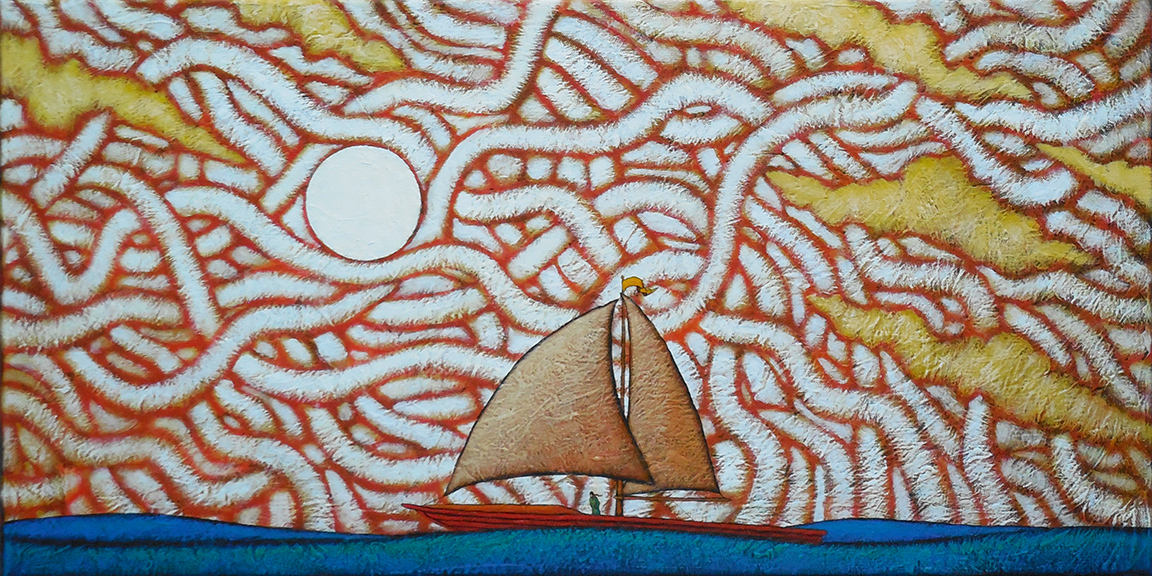
Wherever the Wind Takes Me – At Principle Gallery


All journeys have secret destinations of which the traveler is unaware.

–Martin Buber, The Legend of the Baal-Shem (1955)


Wasn’t planning on posting anything today but a song popped into mind and I thought I would share it. Not sure that it fully lines up with the painting or the words of Martin Buber at the top, which do mesh well together. The idea of secret destinations, of arriving at a point that is unexpected, is the basis for the story of many life journeys, after all.

How many of us can say our lives ended up exactly where we thought they would be when we first set out? And for those who did arrive exactly where they intended, I don’t know whether to envy or pity them. There’s something to be said for the security of sticking precisely to your set course. On the other hand, that insinuates that will travel unchanged throughout your long journey, that your desires and values won’t be shaken up and reorganized by things encountered along the way. That you won’t at some point realize that where you thought you wanted to arrive then was not the same as it is now.

For myself, it’s pretty obvious that I never had a real plan, a true set course to any destination. And though at times it’s been hard, and that even now, though my journey is much closer to its end than its beginning, I still am not sure where it will ultimately take me, I wouldn’t have it any other way.

Here’s that song. It’s another gem from that perfect coupling of artist and composer, Dionne Warwick and Burt Bacharach. From 1966, this is Trains and Boats and Planes.


Read Full Post »


The artist must train not only his eye but also his soul, so that it can weigh colours in its own scale and thus become a determinant in artistic creation.

–Wassily Kandinsky, Concerning the Spiritual in Art (1912)


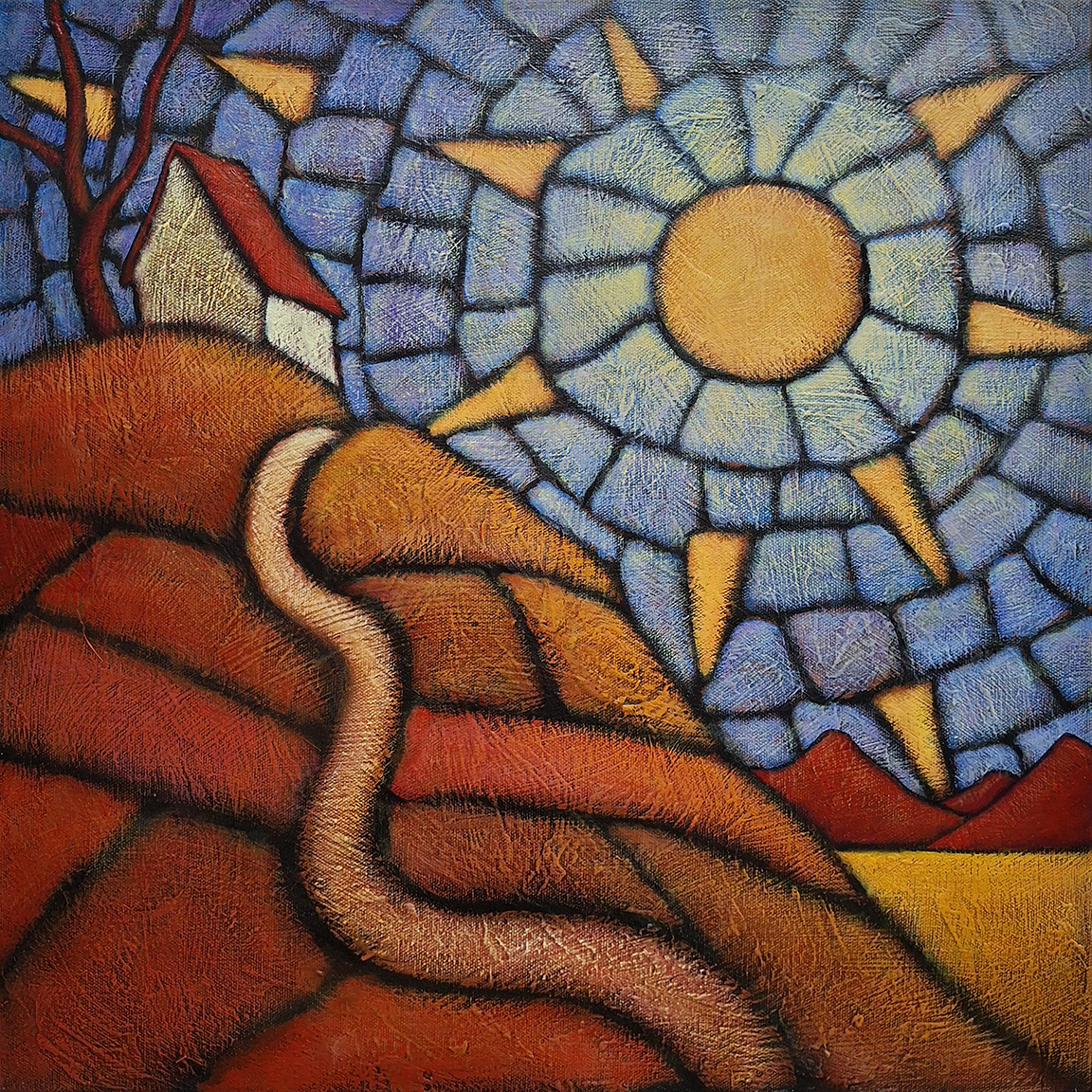
It’s been about a month since I gave a painting demonstration at the Principle Gallery. In the days after, I shared an image of the progress that had been made on the demo painting at the end of the session. I was fairly pleased with how it had emerged but could immediately see that there were changes– additions, subtractions and alterations– that needed to be made before it would truly come into form, at least to my eyes. There were a number of small adjustments and a couple of major changes.

Among the larger changes was altering the shape and color of the distant mountains in the lower right quarter. I simply wasn’t satisfied with the original. There was something in them– or not in them– that just didn’t sit right with me. 

I also changed the shape of the Red Roof house in the upper left. Again, the original just didn’t feel right to me. I depend on my ability to sense rightness in my work, and it was not meeting the mark.

I changed the angle of the roof and extended it a tiny bit, which allowed me to clean up some messiness in the sky behind it. It’s not that I mind a little messiness. The late biophysicist Max Delbruck (1906-1981) had a theory that he called the Principle of Limited Sloppiness. which stated that too much sloppiness was unacceptable in scientific research but allowing a little sloppiness sometimes revealed startling, unexpected results that could then be cleaned up. 

I guess you could say I adhere to Delbruck’s theory. A little sloppiness is fine and sometimes revelatory. However, in my work it’s a problem when the messiness is out of the rhythm of the painting and becomes a distraction, pulling focus from the whole of the painting.

Cleaning up that bit of messiness really honed the feel of the painting for me as did the fine tuning of the colors throughout. The rising road was lightened and a bit of darkness added to the left side of the hill, away from the sun, which, along with its light arrows, was brightened a bit.

It may not seem to the casual observer that the painting was greatly changed but to my eyes it emerged in a much different form., one that truly reaches that sense of rightness that I mentioned. Looking at it now here in the studio, it doesn’t feel like a hurried demo piece. It has its own feel and life now– an extension of the inner world I try to show in my work. It feels like it is truly part of that world now.

I used a Kandinsky quote at the top about an artist needing to train both their eye and their soul. I think of all the hours I have spent alone working in my studio have honed whatever skill I possess– the eye that Kandinsky mentions– as well as the sense of rightness which might well translate as the Kandinsky’s soul. I don’t really know that can express what I am trying to say but I like the idea that an artist is seeking their own soul in their work.

I am pleased I was able to share a little of what seeking looks like with the folks who made it to the demonstration a month ago. Many thanks again to everyone who made it possible.

I have yet to title this piece. A reader suggested the title of an old Cat Stevens song, Road to Find Out, as a title. That might work but I am open to suggestions. Let me know what you think.

Let’s listen to that Cat Stevens song. There’s larger image of the completed painting below. That is, if it is truly completed. Like people, art sometimes needs to change…


Read Full Post »

Trio: Three Squares – 2002


Summertime, and the livin’ is easy
Fish are jumpin’
and the cotton is high
Oh, your daddy’s rich
and your ma is good-lookin’
So hush, little baby, don’t you cry

One of these mornings
you’re gonna rise up singing
And you’ll spread your wings
and you’ll take to the sky
But till that morning
there ain’t nothin’ can harm you
With daddy and mammy standin’ by

–Summertime, from Porgy and Bess, Dubose Heyward, George & Ira Gershwin (1934)


I am not so sure about the livin’ is easy part of summertime. Summer has often felt more like steel cage death match for me. Or a grim and gritty fever dream. You might ascertain that it is not my favorite season by a long stretch.

But that doesn’t take anything away from my appreciation of the great aria from Porgy and Bess. Like so many great songs, it’s melody and lyrics are so beautifully composed that it’s hard to find a performance that doesn’t resonate. There have been many, many great versions of this classic and there’s hardly a lemon among them. The Ella Fitzgerald version is perhaps the gold standard though that might be debatable. I am sharing a live performance by Janis Joplin from 1969 in Amsterdam.  I probably like this version because it has the grit and tone of my summers.

The image at the top is a small triptych from 2002 that hangs in my studio. It has long been a favorite and still gives me a rush when I look up at it, like I did just this moment. I see it as a link between my earliest work of the mid and late 1990’s that focused on sparsely detailed blocks of color and the subsequent work.

Here’s Janis…


Read Full Post »

Moment Revealed — At West End Gallery


We have five senses in which we glory and which we recognize and celebrate, senses that constitute the sensible world for us. But there are other senses – secret senses, sixth senses, if you will – equally vital, but unrecognized, and unlauded… unconscious, automatic.

–Oliver Sacks, The Man Who Mistook His Wife for a Hat


Maybe that’s the purpose of art, to prompt us to some sort of sixth sense, one that otherwise goes unnoticed and underutilized in our usual five-sense lives. It is something that we don’t even know that we have been needing and missing until we are awakened to it.

This sixth sense enables us to detect the many dimensions which exist between and beyond that which we observe with our five senses, adding depth and richness to our sense-limited world. 

And art does just that, serving as the activating agent for this sixth sense and beyond that, acting as the connecting link between the known and the unknown. I believe that is what is taking place when one is moved by art in any form.

It transports you into dimensions beyond the five senses. 

And that’s where the good stuff is…

Here’s a song this morning about one type of sixth sense from Irish singer/songwriter Imelda May. With a style that covers many genres of music including jazz and rockabilly, she wasn’t on my radar until just a couple of years ago. I stumbled across a video of Robert Plant and her performing a rockabilly-Big Band rave-up of Led Zep‘s Rock and Roll that I very much enjoyed. I’ll throw that on below as well.


Read Full Post »

Betwixt and Between— At Principle Gallery


Don’t think. Thinking is the enemy of creativity. It’s self-conscious, and anything self-conscious is lousy. You can’t try to do things. You simply must do things. 

— Ray Bradbury


I ran a post featuring a Ray Bradbury quote the other day which reminded me of another of his quotes and a favorite blog entry from the past that employed the above quote. It’s a refinement of a quote from a 1962 essay, The Queen’s Own Evaders, in which Bradbury wrote about his time in Ireland writing the screenplay for the 1956 John Huston film, Moby Dick.

Never wanting to be a screenwriter, Bradbury adapted only his work for movies or television but made an exception when offered the chance to adapt the Melville classic. He struggled for months and months trying to adapt the novel then one day realized he was being too self-conscious, overthinking every word and element. He began anew and, at the end of an epic eight-hour writing session, finished the script.

The original quote was:

Self-consciousness is the enemy of all art, be it acting, writing, painting, or living itself, which is the greatest art of all. 

Ridding one of self-consciousness was a subject that popped up in many of his essays and interviews over the next 20 years or so as he refined the message. I well understand his view since I feel that I am least self-conscious when I am painting. My paintings are my world much like Bradbury’s world was that of Mars or the October Country or the strange, animated skin of the Illustrated Man.

Bradbury also stated over the years that an artist should not attempt to explain an artwork while it is being created. That’s how I feel about painting, as well. You do it. Then you think about it. As a result, that is why I seldom even begin to think about what the painting is about or what it might be called until it is done or at least well into its process.

Bradbury’s words on creativity are worthwhile for anyone, not just writers or artists. As he said, living is the greatest art of all. Here’s that earlier blog post, last shared here in 2018:


I came across this quote from famed sci-fi writer Ray Bradbury on an online site with quotes on creativity. This struck close to the bone for me as I have proudly not thought for years now. I have long maintained that thinking usually inhibits my work, making it less fluid and rhythmic.

It’s a hard thing to get across because just in the process of doing anything there is a certain amount of thought required, with preliminary ideas and decisions to be made. I think that the lack of thought I am talking about, as I also believe Bradbury refers, is once the process of creating begins. At that point you have to try to free yourself of the conscious and let intuition and reaction take over, those qualities that operate on an instantaneous emotional level.

I can tell instantly when I have let my conscious push its way into my work and have over-thought the whole thing. There’s a clunkiness and dullness in every aspect of it. No flow. No rhythm. No brightness or lightness. Emotionally vacant and awkward. Bradbury’s choice in using the term self-conscious is perfect because I have often been self-conscious in my life and that same uncomfortable awkwardness that comes in those instances translates well to what I see in this over-thought work.

So, what’s the answer? How do you let go of thought, to be less self-conscious?

I think Bradbury hits the nail on the head– you must simply do things. This means trusting your subconscious to find a way through, to give the controls over to instinct.

And how do you do that? I can’t speak for others but for myself it’s a matter of staying in my routine. Painting every day even when it feels like a struggle. Loading a brush with paint and making a mark even when I have no momentum or idea or at hand. Just doing things and not waiting for inspiration.

You don’t wait for inspiration– you create it.

So, stop thinking right now and just start doing things.

Read Full Post »

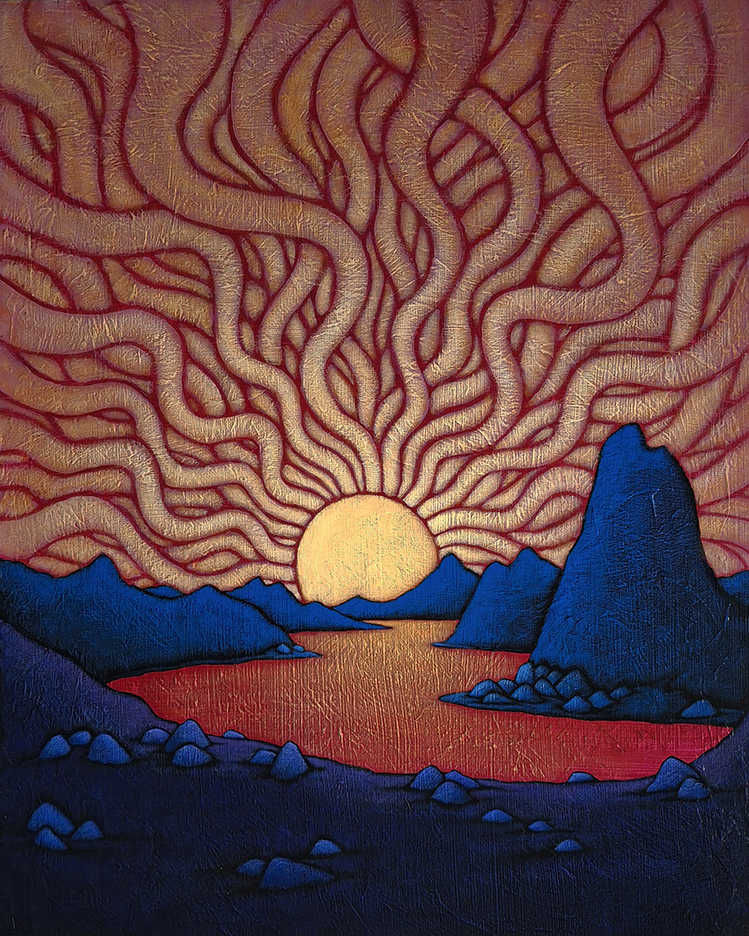
Finis Terrae (Land’s End) — “Entanglement” Ends July 7,2025


Man is least himself when he talks in his own person. Give him a mask, and he will tell you the truth.

-Oscar Wilde, The Happy Prince & Other Tales


I basically believe these words from Wilde. To a point. There is a certain class of folks however who wear a mask to hide behind, to prevent them from telling truth. Usually for duplicitous reasons, to benefit themselves or to avoid responsibility. Certainly not to spare the feelings of others.

But then again, maybe wearing that mask reveals their truth, after all. It exposes their weakness and greed, their contempt for the truth as well as their lack of compassion and unwillingness to even attempt to feel empathy.

You can probably think of somebody like that. Or a whole bunch of them.

Don’t make me put a label on this group this morning. I am still reeling a bit from whatever has ailed me for the past several days and don’t want to get any more aggravated than I am feeling at the moment.

On the broader subject of Wilde’s quote, I have often wondered which is the mask I wear — my actual self or my painting? Which is more likely to tell the truth? Which is real? Or are they now one and the same? I say now because they were once two distinctly different entities, one being decidedly more truthful than the other.

I won’t say which was the more honest being.

If I did, it might well be a lie.

I do hope they’re one and the same.

And I am not just saying that. Cross my heart and hope to die.

Let me finish with song and a reminder that this is the final week to see my Entanglement exhibit at the Principle Gallery in Alexandria, as it comes down July 7. If this work is my mask, I am proud to wear it.

I think it tells truth, for both me and the work.

Here’s John Lennon and Gimme Some Truth.


Read Full Post »

The Passing Parade— Now at the Principle Gallery


It’s akin to style, what I’m talking about, but it isn’t style alone. It is the writer’s particular and unmistakable signature on everything he writes. It is his world and no other. This is one of the things that distinguishes one writer from another. Not talent. There’s plenty of that around. But a writer who has some special way of looking at things and who gives artistic expression to that way of looking: that writer may be around for a time.

–Raymond Carver, A Storyteller’s Shoptalk,  New York Times (1981)


I am in the midst of a deep funk, a depressive event that comes on the heels of every show or gallery talk. Every show or talk–good, bad, or indifferent. It’s just the way it is. I think it’s a blend of several things.

One is simply being worn down with the effort of both creation and promotion. The promoting part– this blog, for example– becomes difficult and depleting just before and after each event.

Another is in creating unrealistic expectations for the event. This is especially true when I have stronger than normal feelings about the work.

Some of it comes in questioning my own efforts. Did I do enough? Did I break new ground? Or the simple but deadly– Am I good enough? 

Some of it comes from second-guessing my interactions with people. In her diary, author Anaïs Nin described very much what I go through after any event:

I have never described, even in the diary, the act of self-murder which takes place after my being with people. A sense of shame for the most trivial defect, lack, slip, error, for every statement made, or for my silence, for being too gay or too serious, for not being earthy enough, or for being too passionate, for not being free, or being too impulsive, for not being myself or being too much so.

You add in the deadline for the show being met which means that an endpoint, a destination, has been reached. It seems as though it should be a time to feel free but for a short time after each event, I feel unmoored, without direction, until a new destination is put in place.

These post-show depressions usually find me questioning what I do and the choices I have made. The questions that usually satisfies and begins to put me back on course comes by asking myself if I am painting the paintings I want or need to see. Am I doing work that is mine alone?

For the answer to those questions, I am going to continue here with a blog entry that has ran a couple of times here, the last time being in early 2020. The painting at the top of the original post  has been switched out for one, The Passing Parade, from my current Entanglement exhibit at the Principle Gallerystill promoting!— which satisfies now what I wrote then. I have also added the passage at the top from the late Raymond Carver. It’s another one of those quotes about writing where one can easily substitute artist for writer. It very much ties into the idea of painting the paintings you want to see for me. Or to create the world in which you wish to live, to put it another way.

Here’s that earlier blog post:


This painting really captivates me on a personal level and reminds me of a thought that once drove me forward as a younger painter. It’s a thought that I often pass along as a bit of advice to aspiring artists:

Paint the paintings you want to see.

Sounds too simple to be of any help, doesn’t it? But that simplicity is the beauty and strength of it.

For me, I wasn’t seeing the paintings out there that satisfied an inner desire I had to see certain deep colors that were being used in a manner that was both abstract and representative. If I had seen something that fulfilled these desires, I most likely would not have went ahead as a painter. I wouldn’t have felt the need to keep pushing.

It was this simple thought that marked the change in my evolution as a painter. Before it, I was still trying to paint the paintings that I was seeing in the outer world, attempting to emulate those pieces and styles that already existed as created by other artists. But it was unsatisfying, still echoing the work of others, forever judged in comparison to these others.

But after the realization that I should simply paint what I wanted to see, my work changed, and I went from a bondage to that which existed to the freedom of what could be found in creating something new. For me, that meant finding certain colors such as the deep reds and oranges tinged with dark edges that mark this piece. It meant trying to simplify the forms of world I was portraying so that the colors and shapes collectively took on the same meditative quality that I was seeing in each of them.

In my case this seems to be the advice I needed. But I think it’s advice that works for nearly anything you might attempt.

Paint the paintings you want to see.

Write the book you want to read. Toni Morrison said this very thing at one point.

Play the music you want to hear. Make the film you want to see. Cook the food you want to eat. Make the clothes you want to wear.

Make the world in which you want to live.

Simple.

Now go do it.


It was good advice then and it still is now. Time for me to claw my way out of this hole. Paint toward the light…

Read Full Post »
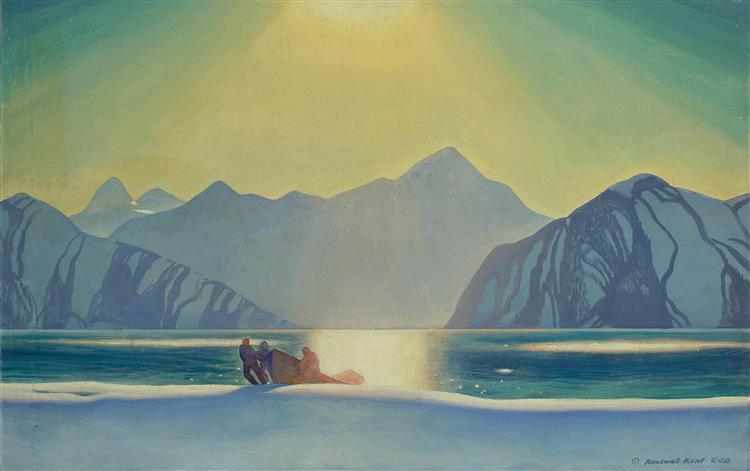
Rockwell Kent– Sunglare, Alaska (1919)


Often I think that however much I draw or paint, or however well, I am not an artist as art is generally understood. The abstract is meaningless to me save as a fragment of the whole, which is life itself… It is the ultimate which concerns me, and all physical, all material things are but an expression of it… We are part and parcel of the big plan of things. We are simply instruments recording in different measure our particular portion of the infinite. And what we absorb of it makes for character, and what we give forth, for expression.

–Rockwell Kent, Wilderness: A Journal of Quiet Adventure in Alaska (1918)


I am sometimes a little hesitant in using the words of other artists in describing my own. After all, art is so subjective, both in viewing and creating, that the driving forces and subjective criteria of one can be quite different than those of another. In short, my what and why may not be the same as yours.

But I came across this passage from the journal of Rockwell Kent, an artist whose work and words I have always admired. One of the big moments in my early career was being chosen for a museum exhibition in which his work was also shown. It sure felt like a big deal then to have my name listed alongside his on the brochure for the show.

Kent kept this journal during the time in 1918 when he withdrew to an island off the coast of Alaska, along with his seven-year-old son. He was fleeing to a remote place where he could get away from marital and financial problems and a world where a World War raged and the Spanish Flu pandemic was in full, deadly force. The same world that at that time seemed to care little for the work he passionately created.

In this time, he deeply felt his own apartness from this world while at the time finding an understanding of the interconnectedness of all things. The idea that we are all part of the infinite was something which became a theme for much of his work.

I can understand that. It is basically the theme for my current show and much of my work throughout my career.

The paragraph above just slayed me when I read it. It hit on several things that I feel in my own life and work. The end of that first sentence– I am not an artist as art is generally understood— is a thought that has been with me for many years, long before stumbling across Kent’s words.

For me, I often don’t think of myself as an artist first since I didn’t come to it because of a natural and readily evident physical talent. My main impetus was instead the need to express something felt deep within, something that could not find form in any other way, something I could not easily identify or even know. That need to express the inexpressible far outweighed any innate ability that I possessed. 

I’m not sure that is the same for all artists. I don’t know, of course, and I am certain that there are plenty who have this same feeling, this sense of being both apart from the world of art even as they are seen as part of it. Perhaps as many or more than those who easily made their way to a life in art because of their natural facility and talents, those artists who feel comfortable and accepted within the world of art, never doubting their place in it. 

The latter part of this paragraph where Kent states that all physical, material things are mere expressions or physical manifestations of the infinite– the ultimate, as he calls it– echoes in what I have described as the belief system behind the work in my Entanglement series.

And that is reinforced even more in the next part: We are part and parcel of the big plan of things. We are simply instruments recording in different measure our particular portion of the infinite. 

We are all part of that one infinity and we uniquely serve purposes that we may never know or understand, hard as we may try to do so. For some like Rockwell Kent–and myself as I see it– that task or purpose is to give form to feeling so that others might somehow find some understanding of the infinite and their own unique part in it. 

Another short passage from this journal says:

These are the times in life — when nothing happens — but in quietness the soul expands. 

This sentence also struck a resonating chord with me. It wasn’t always that way. There are times in one’s life when sound and action is more welcoming than stillness and quiet, times when doing and going seem more important than simply being.

It seems that stillness creates space in which the soul can expand. 

That’s my take on Kent’s lovely words for the day. Does it make sense for anyone other than me? I can’t say. 

Just looking to expand my soul this morning with a little quietness,,,


Read Full Post »

Semi-Finished Demo Painting- Principle Gallery 2025

Thought I would share a recap of this past weekend at the Principle Gallery in the aftermath of my opening there on Friday evening.

The opening itself was a bit more subdued than in previous years but that was something that was anticipated by the gallery and me.  With the high temps (94° on the highway during the drive into town) and humidity along with the threat of severe thunderstorms, we knew that the crowd might be smaller. You can add to that the scheduling of the political circus/parade that was centerstage in DC this weekend, tying up traffic and both driving many people out of the area and keeping others away. And there was also my scheduled painting the following day which no doubt would keep those who wished to attend that making the decision to skip the opening. Thus, we lowered expectations accordingly. 

But the turnout was fairly good, for all of that. I was engaged in many conversations for the entire time and before I knew it, it was time to close up. Time flew by. Many thanks once more to those who made it out to the gallery on Friday. 

Then came the painting demonstration late the next morning. Due to the uncertainty of the weather, we held in the gallery as opposed to being out on the closed-off street as originally planned. The turnout was exceptional for this event with about as many people as we could comfortably fit in the space. And they were exceptional in other ways as well. 

Up to the minute it started I was unsure what I was going to do with the demo. I opted at the last second to make it a little more interactive– and a little riskier. I asked if anyone would like to make the first mark on the 20″ by 20″ canvas I had prepared first with multiple layers of gesso then a final layer of black paint. I explained that I would then work off that first mark, that it would dictate my reaction the next steps in the painting. Everything after that first mark would be an unplanned reaction.

A familiar and friendly face to me, Jesse (hope that is spelled correctly!), volunteered to make the first mark. I loaded a brush with the red oxide paint I use to compose the underpainting and handed it to her. She hesitated a bit then made a swooping and bending downward moving line. 

Now, allowing someone to make that first mark can be a risky proposition. It’s a bit like a circus highwire performer working without a net. The difference is that the circus performer rehearses their act over and over and there is only one way to go once you’re on the wire.

I immediately saw Jesse’s swooping line as a path. That was the good news. The bad news was that the mark began in the upper left quarter of the painting. I quickly realized that this first mark put some limits on where I could go compositionally. Kind of like my tightwire suddenly came apart and I was left with several narrower but shakier paths ahead. None were the optimal, easiest wire to walk.

On the other hand, being put in a tighter, more awkward spot allowed me to better show how decisions pop up during the process of painting that are often unforeseen but have to be quickly made in order to make progress.  In this case, I decided to keep the mark as a path and build a sloping hill around it, one that allowed more space for a sky to the right of it. What that sky would be was another question, another decision to be made, along with many others.

I am not going to go into every decision made or every twist and turn that the painting took here. As I told the folks there on Saturday, I was painting much faster than I would in the studio, making those decisions much quicker and putting on paint a bit sloppier and at a much faster pace. I was sometimes making instantaneous decisions.

As we got near the end of the demonstration, the piece had taken on a somewhat complete appearance and most folks there felt it was complete. The image at the top is the painting at that point. All it could very well be complete. But there were things that I can see– then and even more so back in the studio when I looked it over yesterday–that still need to be addressed along with a few changes that I would like to make but am not sure are even possible. These were mainly the result of decisions that I made before taking every possibility into consideration. Kind of like real life, right?

Overall, I was pleased to get to that point of completion while working so quickly. It still has work to be done which I will be doing in the coming days. I think you will be surprised at the transformation– if I can pull it off. Either way, I will share the change.

Time being such a precious commodity in this lifetime, the group that spent those several hours with me on Saturday were exceedingly generous with not only their time but with the good humor and kindness they offered me. In return, I hope they got a better glimpse of the thought process behind the making of a painting, at least in the way I work.

As is often the case, I believe I got more from them than they from me. Thank you to the many who were there on Saturday. I am as appreciative as can be.

Here’s a short video slideshow that shows the process. Many thanks to my friend Larry Robertson who I met along with lovely wife, Kai, many years ago at the gallery, for the photos from the demonstration.


GC Myers/ Principle Gallery Demo June 2025

Read Full Post »

The Regeneration— At Principle Gallery, June 13, 2025


There can be only one permanent revolution — a moral one; the regeneration of the inner man.
How is this revolution to take place? Nobody knows how it will take place in humanity, but every man feels it clearly in himself. And yet in our world everybody thinks of changing humanity, and nobody thinks of changing himself.

Leo Tolstoy, Three Methods of Reform, 1900 Pamphlet


The regeneration of the inner man…

It’s a similar sentiment to one shared here the other day from the Dalai Lama, one that stated that change in this world begins with the individual. An act of change much like a pebble thrown into a pond whose ripples continue to move outward from itself.

Change the world? Change yourself.

Why would the world change when you will not? The world is waiting for each of us to shape it, to be that pebble thrown into the pond.

A blank canvas waiting for us to pick up a brush and make that first mark.

That is a rough interpretation of this new painting from my show that opens tomorrow at the Principle Gallery. I have titled it, The Regeneration, and it is 24″ by 30″ on canvas. In short, I see it as being about the world as that blank canvas, a surface filled with all possibility. Everything we need is at hand. We simply have to put things in place in a way that satisfies our needs and desires.

Of course, with a painting like this, that is only part of its message. Regeneration also refers to the Earth’s ability to repair and recreate itself in the wake of human action. We muddy the canvas and it immediately begins to paint it over so that it appears once again as a blank canvas, waiting for that next first mark from its next inhabitants. Maybe a more apt analogy would be that of a landlord painting the walls of an apartment between tenants?

This piece also plays strongly to the Entanglement theme with its bands of color and light harmonizing in its sky. One perception of it that sticks with me was that this represents a time of absolute harmony, a time when humans have finally moved on. Perhaps it represents a time when we have evolved enough that we are released from the cycle that had us leading constantly reincarnated lives that continuously repeated the same mistakes life after life. Perhaps it is a time when we have finally learned the lessons of time and harmony and rejoined the greater energy bands that make up everything.

Maybe. Maybe not.  I think it’s a boldly strong piece however you or I may interpret it. It generates its own life. It certainly draws and holds my attention. And that’s a good thing, in my opinion.


The Regeneration is now on the wall at the Principle Gallery, for my 26th annual solo show, this year called Entanglement, which opens tomorrow, Friday, June 13. The paintings for the show are now in the gallery and are available for previews, in the gallery or online with a Virtual Walkthrough that you can access by going to my Artist Page at the Principle Gallery website (where all my work for the exhibit is also shown) or by simply clicking here. The Virtual Walkthrough is a great tool, allowing you to move through the exhibit and view the work both up-close and from different angles. 

I will be attending the Opening Reception for the show that runs tomorrow evening, Friday from 6-8:30 PM. I look forward to chatting with you.

And the following day, next Saturday, June 14, I will also be giving a Painting Demonstration at the galleryThe demo, my first there, should run from 11 AM until 1 PM or thereabouts.

Hope you can make it.


Read Full Post »

« Newer Posts - Older Posts »