Feeds:
Posts
Comments

Posts Tagged ‘Philosophy’

Dusk of Time– Coming to West End Gallery


When philosophy paints its grey on grey, then has a shape of life grown old. By philosophy’s grey on grey it cannot be rejuvenated but only understood. The owl of Minerva spreads its wings only with the falling of the dusk.

–Georg Wilhelm Friedrich Hegel, Philosophy of Right (1821)


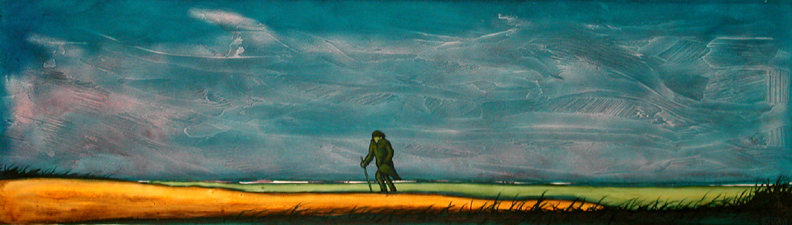
This is the first new painting from my October solo show at the West End Gallery that I am sharing here. I didn’t think it would be the first painting from the show to be shown, mainly since it is relatively small at 6 inches wide and 18 inches tall. There are much bigger pieces from the show, including the title painting, Guiding Light, that I could have shared here first. But it stood out to me this morning and it still does somewhat represent the title of the show with its prominent dropping sun.

You might see it as a rising sun and that’s fine. Art is subjective to our own personal interpretation. While I might see it one way and I am its creator, that doesn’t mean it must have only that meaning. Once I put it out in the open air it is on its own and it becomes what the viewer thinks it is.

But I am sharing my thoughts today, so we’ll call it a dropping sun at dusk. I felt that the passage at the top from the German philosopher Hegel truly fit what I was seeing in this painting. I saw it as being about the passage of time, the ending of a period of time, and the retrospection that comes after that time is gone. 

He is basically saying that we can only truly know and understand anything until it has fully run its course and is well beyond our efforts to bring it back to life. The Owl of Minerva that he employs here is an ancient symbol of wisdom. The owl flies when we gain the wisdom from any time or event only after it has completed the course of its existence. 

That makes sense to me. So often we lose understanding and insight when we are in the midst of the happenings of our time. We see and hear only bits and pieces of the truth along with a multitude of falsehoods, biased opinions, and myriad distractions. We are unable to see the full scope and perspective of events (or lives) while they are happening.

We can’t see them in their fullness until the arc of their being has been completed. Only then does there come clarity as time washes away the debris that obscured the truth while it existed.

Of course, sometimes this clarity is only gained after years, decades, and centuries. Sometimes eons and ages. 

In this painting, Dusk of Time, I see that clarity on a smaller scale in the reflection that sometimes comes at the end of the day, especially when that day has been an eventful one. Ideally, you can see the arc of the day and understand how it took shape and where it led you. Perhaps how you will go forward.

That’s a thumbnail explanation. There’s a lot of feeling in this smaller painting, much more that I can put down right now.

It just feels like it knows a story that it needs to share. I have a sense of the story and the truth it is telling me. But what that story is and what truth it reveals is up to whoever engages with it. 


Read Full Post »

The Wisdom Beyond Words– Coming to Principle Gallery, June 2025


There is in all visible things an invisible fecundity, a dimmed light, a meek namelessness, a hidden wholeness. This mysterious Unity and Integrity is Wisdom, the Mother of all, Natura naturans. There is in all things an inexhaustible sweetness and purity, a silence that is a fount of action and joy. It rises up in wordless gentleness and flows out to me from the unseen roots of all created being, welcoming me tenderly, saluting me with indescribable humility. This is at once my own being, my own nature, and the Gift of my Creator’s Thought and Art within me, speaking as Hagia Sophia, speaking as my sister, Wisdom.

— Thomas Merton, Hagia Sophia (1961)


I was looking for something to accompany the new painting shown here, The Wisdom Beyond Words, and came across this passage from Thomas Merton. It’s the opening section of his prose poem Hagia Sophia written sometime around 1961.  Though it speaks through the dogma of Catholicism, it matches very well the belief system I somewhat laid out here a week or so back. As it often is with most religions, the underlying structure and belief is very much the same idea but with symbols, stories, and representations that reflect cultural differences. 

In short, this passage captured in words what I see and sense in this painting. It could very well be used to describe the theme of my Entanglement exhibit that opens June 13 at the Principle Gallery, which I have described as being how everything is contained in small part in every other thing. Much as it is in the theory put forward by Stephen Hawking that when a star dies it collapses into itself until it is finally a single tiny point of zero radius, infinite density, and infinite curvature of spacetime at the heart of the black hole formed from the star’s collapse. A single point of immense mass and energy This was referred to as a Singularity

Hawking looked at this singularity and wondered since this was the end point of star’s death could it not also be the starting point for future new universes that might emerge if this singularity were to explode outward– the Big Bang Theory.

The underlying thought is that the universe and all that it is was once a single thing before the Big Bang created all that we know the universe to be now from that single point.

We were all part of one thing. We were that one thing.

And it’s that unity and wisdom of all things, much like that of which Merton wrote, that I sense in this painting. 

Read Full Post »

The Entanglement— Coming in June to Principle Gallery


So the universe is not quite as you thought it was. You’d better rearrange your beliefs, then. Because you certainly can’t rearrange the universe.

–Isaac Asimov, Nightfall (1941)


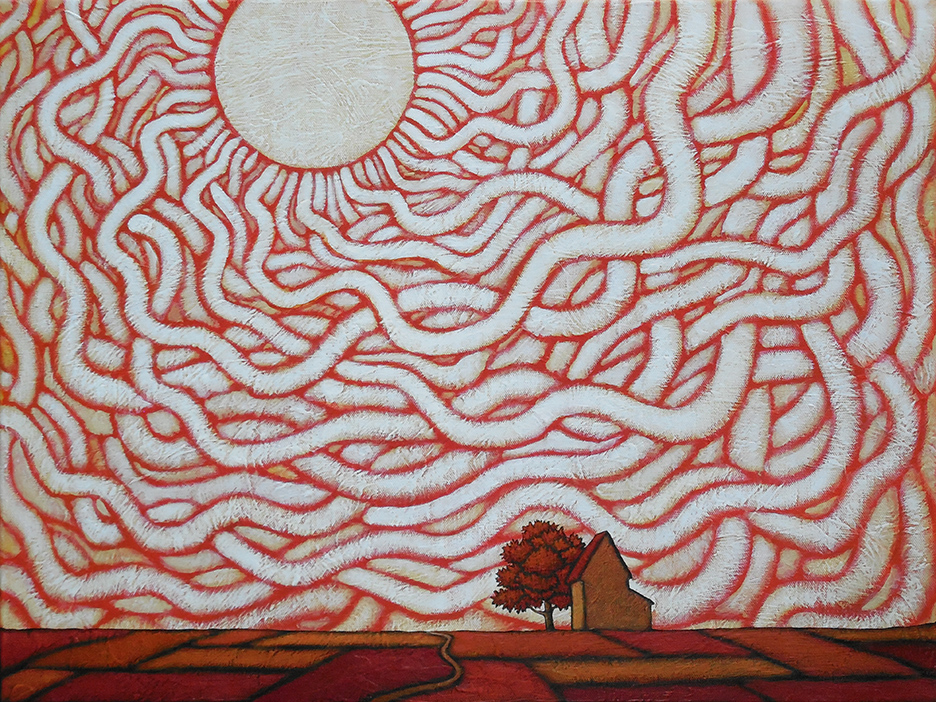
 I have been extraordinarily fortunate to have had solo exhibits at the Principle Gallery in Old Town Alexandria, VA every year since 2000. This year’s exhibit, my 26th solo effort there, opens Friday, June 13, and is titled Entanglement. The painting at the top is the first piece from this show that I am sharing. It is titled The Entanglement.

At my last Gallery Talk at the Principle Gallery this past September, I spoke briefly about my own belief system. I can’t remember exactly how I put it since I pretty much speak off the cuff at Gallery Talks, but I vaguely remember beckoning at my work on the walls behind me and stating that one could observe my entire belief system in those paintings. It was not of any particular religion nor was it a rejection of any other. I pointed out that we all have a belief system of some sort. Even Atheism or whatever else you might call believing in nothing is a belief system. Mine, as shown in my work, was simply how I saw the totality of the world and the universe, expressed in a way that my simple mind could comprehend and accept. 

I don’t know that I was able then to fully explain it in a way that was satisfactory to anyone but myself. Probably not. But I felt kind of freed up by just admitting to a belief system, however unformed and vague it might seem. Thought I had felt this way about the link between my work and my beliefs, saying it aloud made me look at my work in a different way. It became the impetus for this year’s exhibit.

Entanglement, the title of this exhibit, also is perhaps the most vital aspect of what I believe. Over the coming weeks, I will try to explain it a bit more, though my perception of it shifts and moves all the time.

You see, my belief system is not based on any dogma or doctrine or on any sort of demand for certainty. Human uncertainty is a given in my belief system.  I say human uncertainty because I do believe there is some sort of certainty in my belief system. But it’s more in the way of the immutable laws of physics. Well, the laws physics as an ill-educated person sees them.

And that’s where Entanglement enters the picture here. I see us as being manifestations of waves and bands of energy that have merged together to manifest and create flesh and blood beings. These beings, we humans, are temporary, existing for but a limited time on this physical plane. When that time comes to an end, their energy rejoins the bands and waves are constantly in motion around us.

We have free will in my belief system. There is no central figure overseeing and guiding our movements or choices while we in our physical form. Our freely chosen actions either create harmony or disharmony with these bands of energy. Good as we understand it might be seen as being in harmony with this energy while Evil might be seen as being in disharmony, which creates a disruption in the intricate pattern which these energy bands create.

However, it is a self-healing system, one that instantaneously begins to modulate and return itself to a state of harmony. The results of these healing actions within the system are sometimes referred to here as karma. As far as I my limited knowledge of history tells me, though there is always someone using their free will to choose disharmony, the system always comes back to a state of harmony within a reasonably short time. In short, evil seldom prevails for an extended period of time.

Much of what makes up this belief system of energy waves and bands is not inconsistent with other religions or systems of belief. Much of the underlying theology for most religions, once you strip away parochial dogma, is fairly consistent throughout the world. The Ten Commandments, after all, are generally rules which aim to create harmony and discourage disharmony. You needn’t be Christian to see that they aren’t bad rules to live by.

I am going to take a break from this for now. I get a little self-conscious talking about this, imagining someone reading this and rolling their eyes and saying, “What a nutjob!”

Not that I need to defend myself, I will say that it makes this world somewhat tolerable for me. When things are going bad for us as species, it allows me to believe that the system is already beginning to correct itself, aided by those on this physical plane who sense this disharmony and attempt to bring the world back into rhythm with their efforts.

There’s a lot more to it that I will share in the near future.  Actually, if you have read along for a while, you probably know what I believe already.

Now, getting back to this painting, The Entanglement. For me, I see this as being a scene of the harmony of which I have describing. The bands of energy move all around in patterns and directions we cannot sense and will never fully understand while we are here. It also creates a feeling of placidity in the scene as well as a sense of connection to the immense power behind it.

We are, after all, built from that energy, distinct parts of it. Our energy, our spirit, as we might call it, will forever be entangled with those ever-swirling bands of energy.

This connection and entanglement is the focus of much of the work from this year’s show. I find myself staring intently at the swirls and tangles in the skies I have painted for this show. Engrossed by its layers and shifts, I find myself sitting for a long time in front of some of these new pieces, often asking where it begins and where it ends. 

And I know there are no answers to these questions. And that’s just fine with me.

I don’t need an answer from that which I am.


The Entanglement is 18″ by 24″ on canvas and will be part of Entanglement, my annual exhibit at the Principle Gallery, opening Friday, June 13, 2025.


Read Full Post »

Seeking Imperfection– 2001


Free men are aware of the imperfection inherent in human affairs, and they are willing to fight and die for that which is not perfect. They know that basic human problems can have no final solutions, that our freedom, justice, equality, etc. are far from absolute, and that the good life is compounded of half measures, compromises, lesser evils, and gropings toward the perfect. The rejection of approximations and the insistence on absolutes are the manifestation of a nihilism that loathes freedom, tolerance, and equity.

–Eric Hoffer, The Temper of Our Time (1967)


Several times I’ve shared the words of Eric Hoffer, the Longshoreman Philosopher as he was sometimes called who died in 1983 at the age 80. He had a way of stating complex idea in a straightforward manner. His 1951 book The True Believer, which sets out his theories on the rise of mass movements– most notably extreme political movements and cults– and the dangers they pose, is widely considered a classic of social psychology. You can read it and see many parallels to the

This particular passage spoke to me immediately when I came across it a few years back. It was something that seemed to be proving itself in real time with what we were and are experiencing here. It is a situation that might be described simply as a struggle between those who see things only in absolute terms and those who understand that there are few if any absolutes in an imperfect world such as ours.

A battle between unfounded certainty and founded uncertainty. True belief and true doubt.

Needless to say, Hoffer’s passage felt spot on for me, a creature who dwells in uncertainty. I could feel the truth in his words, particularly that last sentence: The rejection of approximations and the insistence on absolutes are the manifestation of a nihilism that loathes freedom, tolerance, and equity.

This one sentence might be the best description of the horror show we are experiencing first-hand.

Not sure why I am sharing this this morning. This passage has been sitting in my drafts file for a long time now and it just felt right this morning, a simple understanding of what we are witnessing, though I doubt any of you need to have it clarified for you.

Anyway, there it is. And here’s a song that speaks to uncertainty in equally simple terms. It’s What’s Happening?!?! by the Byrds from back in 1966, around the same time as Hoffer’s words. Nearly sixty years later and it is the same story. Nihilism then is nihilism now…


Read Full Post »

Night Karma (2002)


For the keynote of the law of Karma is equilibrium, and nature is always working to restore that equilibrium whenever through man’s acts it is disturbed.

–Christmas Humphreys, Karma and Rebirth (1948)


I came across the quote above from a book on Buddhism from a Brit named Christmas Humphreys. I had never heard the name but agreed the sentiment that nature is a continuously bringing the world into equilibrium despite our best efforts to disrupt and destroy its balance. Turns out that Christmas Humphreys was a famous British barrister as well as a judge at the Old Bailey later in his career.

But the more interesting part for me was that he was, in his lifetime from 1901 to 1983, one of the highest profiled Buddhists in Britain, having founded the London Buddhist Society and authoring a large number of books on the religion. After his death his home in St. John’s Wood became a Buddhist temple.

His involvement in a number of famous trials led to him being portrayed in several films, including a recent one (it’s on the streaming service BritBox now) concerning the Ruth Ellis trial, in which he was the prosecuting barrister. Ruth Ellis was convicted of murdering her abusive lover and was subsequently the last woman executed in the UK, hanged in 1955.

I guess that’s some sort of karma, right? Probably depends on your perspective.

Humphreys was also mentioned with a line– “I went home and read my Christmas Humphreys book on Zen“– in the 1982 Van Morrison song, Cleaning Windows. I thought that make a good final addition to today’s triad alongside Humphreys’ quote and the 2002 painting at the top, Night Karma. which is one only a few pieces that remain with me from what I call my Dark Work, those pieces painted in the period of about 18 months immediately after 9/11. It’s been a longtime favorite of mine here in the studio.

Now here’s Cleaning Windows from Van Morrison.


Read Full Post »

Sea of the Six Moons– At West End Gallery


What we, thanks to Jung, call “synchronicity” (coincidence on steroids), Buddhists have long known as “the interpenetration of realities.” Whether it’s a natural law of sorts or simply evidence of mathematical inevitability (an infinite number of monkeys locked up with an infinite number of typewriters eventually producing Hamlet, not to mention Tarzan of the Apes), it seems to be as real as it is eerie.

-Tom Robbins, The Syntax of Sorcery (2012)


I came across the passage from author Tom Robbins, who died in February at the age of 92, while doing some research. One phrase from it, “the interpenetration of realities,” really jumped out at me. I am not ready to tell you what I was researching or why the phrase struck me as it did. That will be forthcoming and self-evident in the coming weeks.

But I will say that, for some reason, it reminded me of a favorite song, That’s the Way the World Goes Round, from the late John Prine. I think it has something to do with the constancy of the inevitabilities of life– the sun coming up and the sun going down, the tide coming in and the tide going out, the joy and sorrow that comes with living and dying, and so on. They all come to us at some point while this old world just keeps turning round.

That doesn’t really answer anything about the interpenetration of realities, does it? All I’ll say is that it made me wonder if the rhythms of our life cycles are modulated by other dimensions or worlds of reality that we may never know. Do they serve as a sort of unseen natural force, much like gravity, that keeps on track?

I don’t know. But rereading that just now makes me wonder if there was a little something extra in my coffee this morning.

I think I’ll just leave it there for now and share the song with the promise that I will sometime soon explain how the interpenetration of realities comes into play. Well, that is if I don’t forget…


Read Full Post »

GC Myers- The Angst


Alienation as we find it in modern society is almost total; it pervades the relationship of man to his work, to the things he consumes, to the state, to his fellow man, and to himself. Man has created a world of man-made things as it never existed before. He has constructed a complicated social machine to administer the technical machine he built. Yet this whole creation of his stands over and above him. He does not feel himself as a creator and center, but as the servant of a Golem, which his hands have built. The more powerful and gigantic the forces are which he unleashes, the more powerless he feels himself as a human being. He confronts himself with his own forces embodied in things he has created, alienated from himself. He is owned by his own creation, and has lost ownership of himself. He has built a golden calf, and says “these are your gods who have brought you out of Egypt”

–Eric Fromm, The Sane Society, (1956)


I have written here about being a fan of psychoanalyst and humanistic philosopher Erich Fromm. Born in Germany in 1900, Fromm fled the Nazis in the early 1930’s and settled in America where he lived until his death in 1980. His 1941 book Escape From Freedom is a classic that theorizes that though we claim to desire freedom and personal independence, the vast majority of us run from responsibilities required in freedom, preferring to be ruled over. This is often cited as a leading factor in the rise of authoritarianism, then and now.

Fifteen years after Escape From Freedom, Fromm wrote The Sane Society which warned of the threat posed by the growth of both technology and capitalism that was taking place around the world, but most particularly here in the USA, in the 1950’s. As expressed in the passage at the top, Fromm saw it creating an environment in which alienation experienced by the individual is pervasive in our society. The new technologies of automation and mass-communication were purported to make our lives easier and safer, to give us more leisure time that would unite and bond us. Fromm saw it doing exactly the opposite, writing:

…Man has lost his central place, that he has been made an instrument for the purposes of economic aims, that he has been estranged from, and has lost the concrete relatedness to, his fellow men and to nature, that he has ceased to have a meaningful life. I have tried to express the same idea by elaborating on the concept of alienation and by showing psychologically what the psychological results of alienation are; that man regresses to a receptive and marketing orientation and ceases to be productive; that he loses his sense of self, becomes dependent on approval, hence tends to conform and yet to feel insecure; he is dissatisfied, bored, and anxious, and spends most of his energy in the attempt to compensate for or just to cover up this anxiety. His intelligence is excellent, his reason deteriorates and in view of his technical powers he is seriously endangering the existence of civilization, and even of the human race.

Moving nearly 70 years into the future, Fromm’s observations here seem to be spot on. I might be wrong, but the last part of this paragraph could well be describing the average person today. I wonder how Fromm would respond to the world as it is now, if he would simply view it as the normal progression of his theorized behaviors from the time in which he wrote his book. Or perhaps he would even be a bit surprised at the point of progression/regression where we find ourselves now. I am not sure that he completely foresaw the speed of change and the effects that would take place with computerization and the internet.  I have a feeling he might view AI as the Golem to which we might all soon be servants.

He does give some hope in how we might actually one day achieve a sane society, defining it as:

A sane society is that which corresponds to the needs of man — not necessarily to what he feels to be his needs, because even the most pathological aims can be felt subjectively as that which the person wants most; but to what his needs are objectively, as they can be ascertained by the study of man. It is our first task then, to ascertain what is the nature of man, and what are the needs which stem from this nature.

That entails, of course, determining what those universal needs might be. And that might be a problem, especially right now where those whose actions are subject only to what they want rule. Their subjective wants outweigh our objective needs.

Until there is a movement that can define our objective needs and how they might be reasonably achieved, we are destined to live out the scenario that Fromm saw back in 1956.

I am neither optimistic nor pessimistic on this. Well, that depends on any particular moment of any particular day. Pessimistically, I think the coming weeks and months will come at us harder and faster than many of us expect, presenting us with great challenges that may test our mettle in ways most of us have never faced. 

But optimistically, I think seeing that what is taking place might well have been foreseen 70 or more years ago indicates that it is part of a pattern of behavior. And once recognized, behaviors can be changed and futures altered.

If we have the willpower and the desire to do so.

I am hoping we do.

Good luck to us all…

Read Full Post »

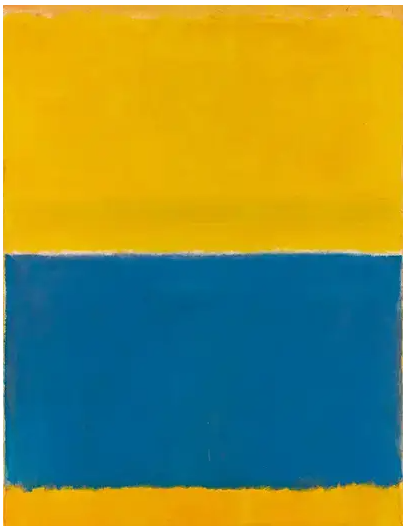
Mark Rothko –Untitled (Yellow and Blue) 1954


“You might as well get one thing straight. I’m not an abstractionist… I’m not interested in the relationships of color or form or anything else. I’m interested only in expressing basic human emotions—tragedy, ecstasy, doom and so on. And the fact that a lot of people break down and cry when confronted with my pictures show that I communicate those basic human emotions… The people who weep before my pictures are having the same religious experience I had when I painted them. And if you, as you say, are moved only by their color relationships then you miss the point.”

― Mark Rothko, 1956 Interview with Selden Rodman


I used a representation yesterday of the colors of the flag of the Ukraine that was actually a detail, shown above, taken from the large Mark Rothko painting shown at the top. I had used this detail before in a post around this time in 2022, one which drew a lot of attention yesterday. Enough so that I went back to check out that post which I am sharing again today as the quotes in that post from Rothko speak so clearly to a lot of things that I have been focusing on recently, on both this blog and in my work.

And since it is Sunday, I am also sharing some Sunday Morning Music at the bottom. In light of what is taking place in this country, the calming effect of Gnossienne No. 1 from Erik Satie seems like the right choice to accompany Rothko as Satie’s work followed similar paths of deep expression and silences. The version I am sharing is a mesmerizing performance from celebrated Finnish guitarist Otto Tolonen.


Busy morning ahead with painting and plowing from what I hope is the last snowfall of this winter. But I thought I would share a Mark Rothko painting (the image at the top is only a detail of its lower section- the whole painting is shown here on the left) and a video on it from Sotheby’s auction house (where it sold for $46.5 million in 2015) along with several Rothko quotes.

Rothko (1903 -1970) was a big influence on my early work. The idea of expressing the big human emotions through simplified forms and color really spoke to me because I never looked at painting as a craft but more as a means to express those forms of emotion that well up inside because they are sometimes too difficult to express in words and voices.

Another aspect that attracts me to Rothko is that he, like Kandinsky, was often eloquent in speaking about his work and art in general. And in those words I found that my own already developed perspectives often largely meshed with and echoed both of these artists’ words and views.

For example, in the quote below the idea that a picture lives by companionship is one that is central to my work.

“A picture lives by companionship, expanding and quickening in the eyes of the sensitive observer. It dies by the same token. It is therefore risky to send it out into the world. How often it must be impaired by the eyes of the unfeeling and the cruelty of the impotent.”

Here a few more that also speak to me, things I have often written about here, about the need of emotional expression in art and of the searching for silence.

“It is the poet and philosopher who provide the community of objectives in which the artist participates. Their chief preoccupation, like the artist, is the expression in concrete form of their notions of reality. Like him, they deal with the verities of time and space, life and death, and the heights of exaltation as well as the depths of despair. The preoccupation with these eternal problems creates a common ground which transcends the disparity in the means used to achieve them.”


“When I was a younger man, art was a lonely thing. No galleries, no collectors, no critics, no money. Yet, it was a golden age, for we all had nothing to lose and a vision to gain. Today it is not quite the same. It is a time of tons of verbiage, activity, consumption. Which condition is better for the world at large I shall not venture to discuss. But I do know, that many of those who are driven to this life are desperately searching for those pockets of silence where we can root and grow. We must all hope we find them.”


Read Full Post »

Heart’s Fortress– At West End Gallery


Fortify yourself with contentment, for this is an impregnable fortress.

–Epictetus


Epictetus probably personally knew a thing or two about building a fortress out of contentment. He was a Greek Stoic philosopher born into slavery in the middle of the first century AD. In Rome, he served as a slave to a powerful and wealthy man who was secretary to Emperor Nero. His owner recognized that Epictetus, who also had a disability caused in his childhood which required him to use a crutch, possessed a passion for philosophy and allowed him to study under a Stoic master.

Eventually the owner released Epictetus from servitude, and he began teaching philosophy in Rome. Around 93 AD, Emperor Domitian banished all philosophers from Rome and Epictetus left for Greece where he established his school of philosophy which became well known and revered.

Having survived slavery, disability, and banishment, Epictetus was someone who knew hardship and loss. Even so, it seems as though he was able to find his own fortress of contentment that was beyond the reach– the influence, opinion, and injury– of the outside world.  

I think that idea applies to the new painting from the Little Gems show (opening today at the West End Gallery) shown at the top, Heart’s Fortress. I know that it is just an idealized condition, that no one can fully isolate from the world. But we all need a place of our own, even if it exists only for short periods of time in our inner landscape, where we can be free from the world. A safe island of quiet where we can examine all that we are and find some degree of satisfaction in that.

I try.

Occasionally, I succeed.

And sometimes the world comes in the form of tidal waves that crash on the cliffs of my fortress, shaking away much of my contentment.

Still, my fortress remains. Perhaps a little disheveled and in need of some maintenance. But it stands.

And in that alone, there is some satisfaction, some contentment. 

Heart’s Fortress is a small painting, 3″ by 4″ on paper that is now at the West End Gallery in Corning as part of the annual Little Gems show. There is an opening reception for the show today from 5-7 PM. Hope you can make it.

Here’s a lovely song that, while it may not be about the specific island of my heart’s fortress, is about the love of an island. This is Island in the Sun from the late great Harry Belafonte.


Read Full Post »

Wabi Sabi


“The tides of time should be able to imprint the passing of the years on an object. The physical decay or natural wear and tear of the materials used does not in the least detract from the visual appeal, rather it adds to it. It is the changes of texture and colour that provide the space for the imagination to enter and become more involved with the devolution of the piece. Whereas modern design often uses inorganic materials to defy the natural ageing effects of time, wabi sabi embraces them and seeks to use this transformation as an integral part of the whole. This is not limited to the process of decay but can also be found at the moment of inception, when life is taking its first fragile steps toward becoming.”

― Andrew Juniper, Wabi Sabi: The Japanese Art of Impermanence


The post below is from four years back. It got a bunch of hits yesterday and when I went to see what it had to say (I often forget what I’ve written) I was struck by the image at the top of the post. The whiskey-brown color just grabbed me and at the bottom of the image I noticed wear around an exposed knothole that reminded me of a wave. Maybe Hokusai’s Great Wave in wood? I began to see the image as a painting, something I had not done before. Anyway, I read the post and liked it a lot, which pleased me. I am sometimes surprised when I read something from years ago and am impressed with it, like I was reading it for the first time. As I’ve added to my own patina in the past four years, I thought this would be worth replaying.

I added a song at the bottom that is kind of about wabi sabi. It’s called The Wino and I know from Jimmy Buffett. It’s from his 1974 album, Living and Dying in 3/4 Time, long before there were Parrotheads or Margaritaville. Hard to believe I bought it about 50 years ago. This song has been a favorite of mine for that long.


The photo at the top is the floor of our garden shed. It’s a simple structure that we bought new probably 35 [ about 40 now] years ago. Over the years, the once pristine plywood floor has darkened, taking on a smooth rich patina on the parts that have not pitted or worn away from decades of comings and goings.

It’s a beautiful thing and I often find myself stopping while I’m in there, which is every day, just to take some small pleasure in looking at its worn surface. The fact that it took a long period of time and innumerable footsteps, along with the mud, snow, grass trimmings, and oil that come along for the ride, to smooth and wear down the surface adds to my appreciation. It’s not something that could be replicated easily. Oh, you could try but it would lose that organic depth that comes with time.

Just a bit of the wabi-sabi of things around us. That’s the Japanese concept of finding beauty in the imperfection and natural wear shown by things.

And I guess that applies to people, as well. I know I am fascinated in seeing how folks age, how their faces and bodies reflect the life they have lived. There is beauty in the lines on the face or the graying of one’s hair.

Of course, I am talking about other people. I don’t find any beauty at all in my wrinkles or my whitened and thinning hair. In fact, I close my eyes now when I walk past my bathroom mirror out of the fear that some old man will jump out of it at me.

Nah, that’s not true. As much as I would sometimes like to have the smooth skin and the darker, fuller head of hair of my youth, I am satisfied, even pleased, in seeing the wear and tear written on my features. I see a small scar high on my forehead and remember the wound that left it so well.

It was many years ago and I was playing with my Magpie– her name was actually Maggie Blackwater–our highly charged husky-shepherd, chasing her around our yard. As I pursued her, I went through some low hanging branches on a birch tree next to the deck I was building off the back of our home. Midway through, as I ducked my head lower to avoid the sweep of the branches, I slammed it suddenly into a deck board that I had not yet cut off. I was knocked on my back and could feel the instant throb of pain on my forehead from the blow.

Maggie was on me in an instant, licking and urging me to get up and play some more. I laid there on the ground on my back and just laughed as hard as I could while the blood trickled down my forehead. I tend to laugh at my own misfortune, especially when it is of my own doing, which is almost always the case.

Maybe there is a bit of wabi-sabi in our laughter? Maybe it comes from the recognition of our imperfections, our humanness, in those moments?

And even while I was there on the ground, that same garden shed was not far away, its floor not yet so deeply darkened or worn. It didn’t yet have the accumulated memory of its being written on its surfaces. It was newer but it certainly wasn’t as beautiful.

And maybe that’s the attraction of this concept of wabi-sabi for me, that the wear and tear that appears is evidence of our being here, that we existed in this place and in this time. It’s much the same way in which I view my work, my paintings. Evidence that I was here, that my hand made these things and in some way my voice was heard.

That I, like that garden shed and its floor, had a purpose in this world.

Appreciate and enjoy the wabi-sabi in your own life.


Read Full Post »

Older Posts »