Feeds:
Posts
Comments

Posts Tagged ‘Poetry’

Follow the River— At West End Gallery


Look down the long valley and there stands a mountain
That someone has said is the end of the world.
Then what of this river that having arisen
Must find where to pour itself into and empty?
I never saw so much swift water run cloudless.
Oh, I have been often too anxious for rivers
To leave it to them to get out of their valleys.
The truth is the river flows into the canyon
Of Ceasing-to-Question-What-Doesn’t-Concern-Us,
As sooner or later we have to cease somewhere.
No place to get lost like too far in the distance.
It may be a mercy the dark closes round us
So broodingly soon in every direction.

–Robert Frost, Too Anxious for Rivers (1947)


The canyon of Ceasing-to-Question-What-Doesn’t-Concern-Us…

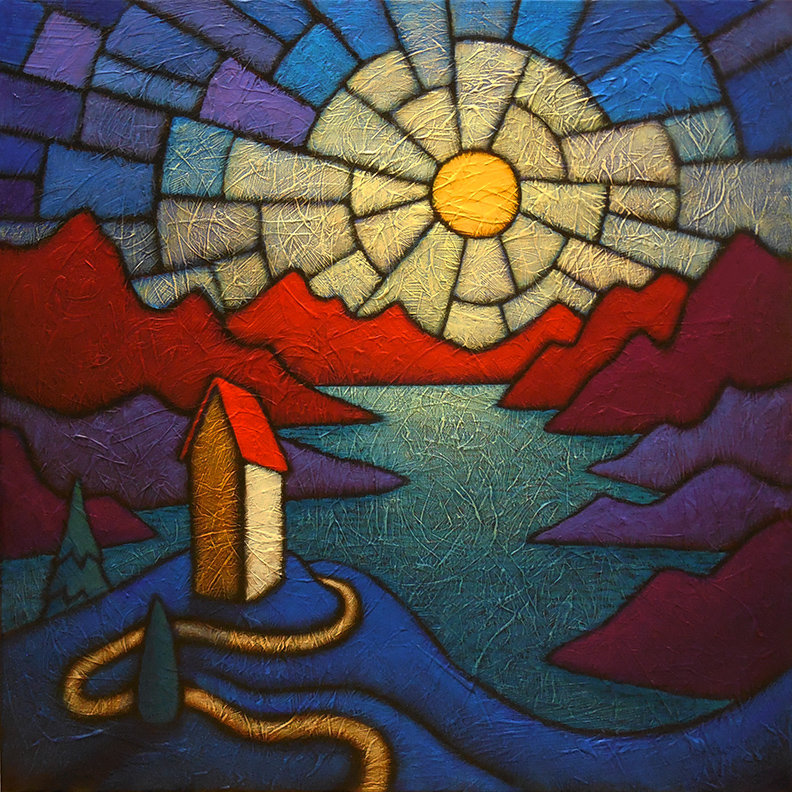
This line (and the title) caught my eye when I first came across this Robert Frost poem, Too Anxious for Rivers. I thought the first half the poem shown above (the full poem is included at the bottom of the page) was a fine companion to the painting at the top, Follow the River.  Both have an existential theme and feel.

I could see this river flowing into that particular canyon. There is something about that slash of that particular blue cutting through the center of the painting that speaks to me, something that calms me. I guess that is a good thing, as I, much like the title states, am sometimes too anxious for rivers. Too anxious to simply float along with the current.

So much energy wasted struggling against the rhythm and force of the river when I should be letting it guide me, rather than trying to make it deliver me where it refuses to go. 

The river will deliver you on its own terms and schedule.

This painting, Follow the River, is 30″ by 15″ on canvas. It is included in my current exhibit, Guiding Light, at the West End Gallery. The show is hanging until November 13.

Next Saturday, November 1 I will be giving a Gallery Talk at the West End Gallery, beginning at 11 AM. Today or tomorrow, I will be choosing the painting that will be given away in a drawing at the end of the talk to someone in attendance. As always, the Gallery Talk is free and open to everyone. I will be announcing the prize painting in the next few days so keep an eye out here.

Here’s a song, River Man, from Nick Drake. Nick Drake recorded three albums from 1969 to 1972 that never really found an audience at the time. Tragically, he died from an overdose of antidepressants in 1974 at the age of 26. In the years since, his work has gained that audience that eluded him during his short lifetime and has a cult following. I find this song particularly haunting.

And soothing like the flow of a river.


Look down the long valley and there stands a mountain
That someone has said is the end of the world.
Then what of this river that having arisen
Must find where to pour itself into and empty?
I never saw so much swift water run cloudless.
Oh, I have been often too anxious for rivers
To leave it to them to get out of their valleys.
The truth is the river flows into the canyon
Of Ceasing-to-Question-What-Doesn’t-Concern-Us,
As sooner or later we have to cease somewhere.
No place to get lost like too far in the distance.
It may be a mercy the dark closes round us
So broodingly soon in every direction.
The world as we know is an elephant’s howdah;
The elephant stands on the back of a turtle;
The turtle in turn on a rock in the ocean.
And how much longer a story has science
Before she must put out the light on the children
And tell them the rest of the story is dreaming?
“You children may dream it and tell it tomorrow.”
Time was we were molten, time was we were vapor.
What set us on fire and what set us revolving,
Lucretius the Epicurean might tell us
‘Twas something we knew all about to begin with
And needn’t have fared into space like his master
To find ‘twas the effort, the essay of love.

Read Full Post »

The Restless Seeker

The Restless Seeker– Coming to West End Gallery in October


He in his madness prays for storms, and dreams that storms will bring him peace”

The Sail, Mikhail Lermontov


These are the last lines of the poem The Sail from early 19th century Russian poet Mikhail Lermontov. Actually, I haven’t been able to locate a translation of the poem that translates his lines with this wording, but since Leo Tolstoy quoted these lines in this way in his The Death of Ivan Ilych it has become the accepted wording. The meaning of these lines in any translation is pretty consistent in meaning– that there are some so desperate in their search that they will head into the teeth of storm and chaos because they believe that the calm naturally accompanies the storm.

As a bit of added info, the poet Lermontov lived his life as though he was the sailor seeking calm by heading into a storm. He packed a lot into his short life, including being acclaimed as the natural heir to Pushkin’s title as the greatest Russian poet, being exiled twice, serving in the Russian army where he led a troop of Cossacks described as a gang of dirty thugs whose duty was to charge headlong into their Chechen enemy forces, and dueling twice. The second duel left him dead after a direct shot to his heart at the age of 26.

He apparently adhered to the words of the old Faron Young song– I want to live fast, love hard, die young, and leave a beautiful memory.

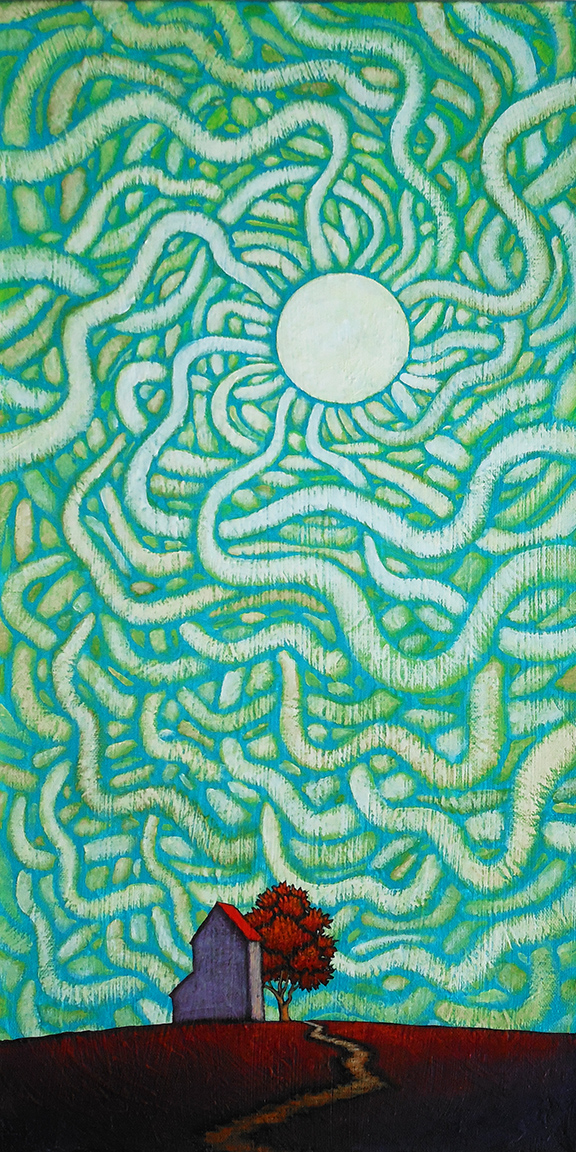
The poem itself, below, seemed to fit well with the new painting shown at the top. Titled The Restless Seeker, it is   6″ by 18″ on canvas and included in my solo exhibit, Guiding Light, at the West End Gallery that opens on October 17.

There is a stormy and otherworldly quality that comes with its chaotic sky and blood red sun/moon. Oddly enough, though it is a painting that is filled with motion, there is also a calm determination in it along with a feeling of defiant courage in the boat and its sails that I find particularly appealing. Maybe it’s the focused calm mustered by those ultimately endure the storm.

It’s a quality that we need a bit more of in these troubled times. That might be part of its appeal for me.

For this week’s Sunday Morning Music, here’s a song that has been shared here a couple of times over the years. It is The Ship Song from the always interesting Nick Cave and the Bad Seeds.


A lonely sail is flashing white
Amdist the blue mist of the sea!…
What does it seek in foreign lands?
What did it leave behind at home?..

Waves heave, wind whistles,
The mast, it bends and creaks…
Alas, it seeks not happiness
Nor happiness does it escape!

Below, a current azure bright,
Above, a golden ray of sun…
Rebellious, it seeks out a storm
As if in storms it could find peace!

–The Sail, Mikhail Lermontov


Read Full Post »

Lux Templi-At the West End Gallery


I dream’d in a dream, I saw a city invincible to the attacks of the
whole of the rest of the earth;
I dream’d that was the new City of Friends;
Nothing was greater there than the quality of robust love—it led the
rest;
It was seen every hour in the actions of the men of that city,
And in all their looks and words.

— Walt Whitman, I Dream’d in a Dream (1855)


Keeping it simple this morning since it is a Labor Day weekend. The theme today is dreaming of a better world and though it might seem that has little to do with the work or labor that is celebrated by this holiday, there is a connection.

After all, why do we work?

To provide a better life for ourselves.

Though it might seem like we toil simply to survive at times, we all still maintain a dream of a better world for ourselves in some form.

I would like to think that it is not asking too much that we extend that dream of betterment to all others. Wouldn’t our personal world be enriched and made better by the fulfillment of such a dream?

That’s all I have to say this morning. I have work to do. It might not better my life or anyone else’s in any way, but I am still going to make the effort. It’s all we can do– make an effort.

Here’s a bit of Sunday Morning Music. I went with two biggies today, two American icons– Walt Whitman and Elvis Presley. The song is If I Can Dream from Elvis’ legendary Comeback Special in 1968. I remember watching this as a kid with my dad and even then, being impressed with how hard this guy was working for our approval. You may or not be an Elvis fan, but there is no denying that the man is working hard here.

Dreams take that kind of effort.


Read Full Post »

Placidarium (2017)


I long for scenes where man hath never trod
A place where woman never smiled or wept
There to abide with my Creator, God,
And sleep as I in childhood sweetly slept,
Untroubling and untroubled where I lie
The grass below—above the vaulted sky.

–I Am, John Clare, ca 1845


I came across the post below from several years ago and was reminded of the painting shown above, Placidarium. It was painted in 2017 and instantly became a favorite of mine. The title was a conjured word that described a self-contained environment much like a terrarium or aquarium. I saw this as a self-contained ecosystem of tranquility. Over the years this painting has traveled far and wide in attempt to find a home that needs a placidarium of its own. And time and again, it has always returned to me like a boomerang.

Though I was pleased to have it with me once more, it was always a little disappointing when it would come back. Was there something in it that only I could see, a voice that only I could hear? That was certainly a possibility. Some work speaks so loudly to me that it feels like it must be audible to many others and sometimes that’s just not the case.

Some voices speak to only one person. Kind of like the many voices in my head that tell me to do terrible things. I am just kidding, of course– there’s not many voices, just one.

All kidding aside, the fact that this painting’s voice seemed to go unheard and the tranquil world it portrayed reminded me of this poem and the life experience of poet John Clare. I could see him lying untroubled as he slept among the flowers under this sky.

Sounds pretty damn good to me, as well.


[From 2021]

John Clare was an interesting case. He led a troubled existence for much of his 70 years on this planet. Born in Northampton in England to a family of rural farm laborers, Clare bounced from job to job and place to place, living a life of poverty. In an attempt to raise money to prevent his parent’s eviction from their home, Clare, through a local bookseller, submitted his poetry to the publisher who had published the works of John Keats. His book of verse, as well as a second soon after, was published and praised.

But even then, recognized as he was as a poetic genius in farmer’s garb, he struggled with his own mental demons. Much of the rest of his life was spent in English asylums. His most famous poem, I Am, whose final verse is shown above, was written in one such asylum, Northampton General Lunatic Asylum, around 1844 or 1845.

His work was somewhat overlooked after his death in 1864 at the Northampton Asylum, where he had spent his final 23 years. But in the 20th century his worked received new attention and Clare’s work was elevated and he has been deemed a major poet of the 19th century.

It’s a sad life, indeed. It reminds me of those times when I have been going through genealogy records, following an ancestor’s life as it progresses, and come upon a record from some sort of institution. It might be an almshouse– a poorhouse– or a county home, a place where they gathered the paupers, the handicapped and those with mental problems so that they would be out of sight.

Coming across these records always makes me very sad. I can imagine myself in these ancestors’ places, the feelings that I would no doubt be experiencing– the loss, the alienation, the confusion that must have plagued their minds.

But even more than that, my sadness comes from knowing that their voices were no doubt unheard by the time these records were registered. They had, by that time, become problems to be swept aside.

And they, no doubt, wanted little more than the peace of mind that Clare describes in that final verse– the untroubled sleep of a child in the grass beneath a high, clear sky.

I find my own desires for this life dwindling down to those same simple wants. And in this, I find a bond with these poor, troubled relations. And with Clare in that English asylum.

And that in turn makes me grateful for the small graces that allow me to live the life I live and to find expression for my own small I Am.

Sigh.

Here’s a fine reading of I Am from Tom O’Bedlam:


Read Full Post »


The Answering Light— At Principle Gallery,

make a poem that does not disturb
the silence from which it came.

Wendell Berry


I run the post below every five years or so. Since I’m busy this morning (trying to not disturb the silence) and it’s been five years, thought today would be as good a time as any to replay it.

Regardless of what we do, we all need a reminder now and then to heed the silence.


I came across this poem a while ago from poet/author Wendell Berry on Maria Popova‘s wonderful site, Brain Pickings. It’s a lovely rumination that could apply to any creative endeavor or to simply being a human being.

I particularly identified with the final verse that begins with the line: Accept what comes from silence and ends with the lines above. I’ve always thought there was great wisdom and power in silence, a source of self-revelation and creative energy. Perhaps that self-revelation is why so many of us shun the silence, fearing that it might reveal our true self to be something other than what we see in the mirror.

Berry’s words very much sum up how I attempt to tap into silence with my work, to find those little words that cone out of the silence, like prayers, and to find inner spaces to paint that are sacred to me and not yet desecrated by the din of the outside world.

At the bottom is a recording of Wendell Berry reading the poem which gives it even a little more depth, hearing his words in that rural Kentucky voice. It’s fairly short so please take a moment and give a listen.


HOW TO BE A POET
(to remind myself)

Make a place to sit down.
Sit down. Be quiet.
You must depend upon
affection, reading, knowledge,
skill — more of each
than you have — inspiration,
work, growing older, patience,
for patience joins time
to eternity. Any readers
who like your poems,
doubt their judgment.

Breathe with unconditional breath
the unconditioned air.
Shun electric wire.
Communicate slowly. Live
a three-dimensioned life;
stay away from screens.
Stay away from anything
that obscures the place it is in.
There are no unsacred places;
there are only sacred places
and desecrated places.

Accept what comes from silence.
Make the best you can of it.
Of the little words that come
out of the silence, like prayers
prayed back to the one who prays,
make a poem that does not disturb
the silence from which it came.

Wendell Berry


Read Full Post »


Pity the nation whose people are sheep
And whose shepherds mislead them

Pity the nation whose leaders are liars
Whose sages are silenced
And whose bigots haunt the airwaves

Pity the nation that raises not its voice
Except to praise conquerors
And acclaim the bully as hero
And aims to rule the world
By force and by torture

Pity the nation that knows
No other language but its own
And no other culture but its own

Pity the nation whose breath is money
And sleeps the sleep of the too well fed

Pity the nation oh pity the people
who allow their rights to erode
and their freedoms to be washed away

My country, tears of thee
Sweet land of liberty!

–Pity the Nation, Lawrence Ferlinghetti (after Khalil Gibran) 2007


I leave this here today without image, comment, or music, except to point out that Ferlinghetti took inspiration in 2007 from the Kahlil Gibran poem of the same title, published posthumously after his death in 1931. Both poems clearly speak to their own times as well as this present moment. Here is the Gibran poem:


Pity the nation that is full of beliefs and empty of religion.
Pity the nation that wears a cloth it does not weave
and eats a bread it does not harvest.

Pity the nation that acclaims the bully as hero,
and that deems the glittering conqueror bountiful.

Pity a nation that despises a passion in its dream,
yet submits in its awakening.

Pity the nation that raises not its voice
save when it walks in a funeral,
boasts not except among its ruins,
and will rebel not save when its neck is laid
between the sword and the block.

Pity the nation whose statesman is a fox,
whose philosopher is a juggler,
and whose art is the art of patching and mimicking

Pity the nation that welcomes its new ruler with trumpeting,
and farewells him with hooting,
only to welcome another with trumpeting again.

Pity the nation whose sages are dumb with years
and whose strongmen are yet in the cradle.

Pity the nation divided into fragments,
each fragment deeming itself a nation.

–Kahlil Gibran, from The Garden of The Prophet (1933)


Read Full Post »

The Communing– Coming to Principle Gallery, June


I have never started a poem yet whose end I knew. Writing a poem is discovering.

–Robert Frost, The New York Times (Nov. 7, 1955)


I am at that point in preparing for my annual solo show at the Principle Gallery where fear and panic set in. I begin to doubt every movement or decision made in producing the work.  It’s a common occurrence with any of my exhibits at this juncture in the proceedings. You would think after nearly 70 such solo shows that these doubts would subside, that one would maintain absolute trust in their work and the processes they employ in producing it. But they never do. 

This feeling of angst made writing a blog post about my new work difficult this morning so I am once again running one of my most popular blogposts with hardly a day going by when it doesn’t get at least a handful of views. It is about a well-known essay from poet Robert Frost that describes in a poetic way how his work emerges.  I write about the many parallels to the way I paint that I see in Frost’s methodology.

Much of it certainly applies to the work from this show, which seemed to guide me rather than be guided by me.

A little bit of that was on display at the demonstration I gave recently at the West End Gallery. I will be doing another such demonstration at the Principle Gallery in Alexandria on Saturday, June 14, the day after the opening of my show, Entanglement, on Friday, June 13


The poet Robert Frost wrote a wonderful preface to the 1939 edition of his collected poems. It was titled The Figure a Poem Makes and it described how he viewed his process of unveiling the true nature of his work. Reading it, I was struck by the similarities between his development of a poem and how I view my process for a painting.

For example, the following paragraph-I have highlighted individual lines that jumped out at me. I probably could have highlighted them all:

It should be of the pleasure of a poem itself to tell how it can. The figure a poem makes. It begins in delight and ends in wisdom. The figure is the same as for love. No one can really hold that the ecstasy should be static and stand still in one place. It begins in delight, it inclines to the impulse, it assumes direction with the first line laid down, it runs a course of lucky events, and ends in a clarification of life–not necessarily a great clarification, such as sects and cults are founded on, but in a momentary stay against confusion. It has denouement. It has an outcome that though unforeseen was predestined from the first image of the original mood-and indeed from the very mood. It is but a trick poem and no poem at all if the best of it was thought of first and saved for the last. It finds its own name as it goes and discovers the best waiting for it in some final phrase at once wise and sad-the happy-sad blend of the drinking song.

A painting often begins in delight, assuming direction, as Frost put it, with the first line laid down. A certain tone of color, the shape of a form, the way a line bends, the manner in which a brushstroke reveals the paint or in how the contrast of light and dark excites the eye. The delights pull you in and keep you engaged and it is not until you have finished that you are able to understand the sum of these elements, to detect the wisdom, the meaning, behind it all. It is only then that you know what you have uncovered and how it should be named.

The work itself, if left to its own means, knows what it is and will tell you.

Then there is this gem of a paragraph:

No tears in the writer, no tears in the reader. No surprise for the writer, no surprise for the reader. For me the initial delight is in the surprise of remembering something I didn’t know I knew. I am in a place, in a situation, as if I had materialized from cloud or risen out of the ground. There is a glad recognition of the long lost and the rest follows. Step by step the wonder of unexpected supply keeps growing. The impressions most useful to my purpose seem always those I was unaware of and so made no note of at the time when taken, and the conclusion is come to that like giants we are always hurling experience ahead of us to pave the future with against the day when we may want to strike a line of purpose across it for somewhere. The line will have the more charm for not being mechanically straight. We enjoy the straight crookedness of a good walking stick.

I have often spoke of the need to have my emotions near the surface when I work, to always need to feel excited and surprised by what I am working on. To recognize new things I never knew as being part of me. If I am not moved by the thing I am working on at any given time, how can I expect others to be moved by it? This paragraph speaks clearly to my experience as an artist.

Then there is the final sentences of the essay:

Like a piece of ice on a hot stove the poem must ride on its own melting. A poem may be worked over once it is in being, but may not be worried into being. Its most precious quality will remain its having run itself and carried away the poet with it. Read it a hundred times: it will forever keep its freshness as a petal keeps its fragrance. It can never lose its sense of a meaning that once unfolded by surprise as it went.

My translation of this, as a painter, is that the work must be free to move and grow of its own volition. It tells you where it wants to go and, if you don’t constrain it and try to push it to a place to which it was not intended, will reveal its truth to you. If you can do that, it remains always fresh, always in the present and always filled the excitement and surprise that it contained in that burst when it was created.

And that, to feel always fresh and in the present, is the goal of all art, be it painting, poetry, music, or dance.

I don’t want to bore you too much. It’s a great essay and is a valuable read for anyone who makes art in any form. You can see the whole book, The Collected Poems of Robert Frost, and read this essay in full by clicking hereThe link takes you to one of my favorite sites on the whole interwebs, the Internet Archive, which has a huge library of available books that you can view in book form online. With its great search engineit is a super reference tool.

Read Full Post »

The Calming Flow— Coming to Principle Gallery, June 2025


In my youth the heart of dawn was in my heart, and the songs of April were in my ears.
But my soul was sad unto death, and I knew not why. Even unto this day I know not why I was sad.
But now, though I am with eventide, my heart is still veiling dawn,
And though I am with autumn, my ears still echo the songs of spring.
But my sadness has turned into awe, and I stand in the presence of life and life’s daily miracles.

Youth and Age, Kahlil Gibran (1926)


I recently came across the opening portion above from the poem Youth and Age from poet/philosopher Kahlil Gibran (1883 –1931) and felt that it spoke deeply to both what I have been feeling in my recent work and in my own life. I suppose that makes sense since my work very much reflects the experience and feeling of my life. I 

I think that anyone who is into the autumn or winter of their life can identify with the message of these lines. The face in the mirror shows the wear of the years and the body often aches and groans but the heart and spirit still feel youthful. As Gibran puts it, my ears still echo the songs of spring.

But it is a youthfulness that comes with much more understanding and acceptance than when one was actually the age felt. I think this is put best in a passage from later in this poem:

And in my youth I would gaze upon the sun of the day and the stars of the night, saying in my secret, “How small am I, and how small a circle my dream makes.”
But today when I stand before the sun or the stars I cry, “The sun is close to me, and the stars are upon me;” for all the distances of my youth have turned into the nearness of age;
And the great aloneness which knows not what is far and what is near, nor what is small nor great, has turned into a vision that weighs not nor does it measure.

The extremes of smallness and largeness of self that one sometimes felt in their youth has mellowed with the knowledge that while we are but small and seemingly insignificant bits of whatever you want to call this swirling, chaotic mass that is our existence and the universe, we occupy a place in it.

Born of a singularity, we are of it. 

And with that knowledge, as Gibran puts it so well, my sadness has turned into awe, and I stand in the presence of life and life’s daily miracles.

I think this thought is an apt description for what I see in this new painting, The Calming Flow, an 18″ by 18″ canvas that is part of my upcoming solo exhibit, Entanglement, at the Principle Gallery. I recognize that same sense of acceptance and realization that I read in Gibran’s verse. It is one of the calmness and patience that comes with age for some.

The complete poem Youth and Age is below.


Entanglement opens Friday, June 13 at the Principle Gallery with an Opening Reception from 6-8:30 PM. I will also be giving a Painting Demonstration at the gallery on the following day, Saturday, June 14, from 11 AM until 1 PM.


In my youth the heart of dawn was in my heart, and the songs of April were in my ears.
But my soul was sad unto death, and I knew not why. Even unto this day I know not why I was sad.
But now, though I am with eventide, my heart is still veiling dawn,
And though I am with autumn, my ears still echo the songs of spring.
But my sadness has turned into awe, and I stand in the presence of life and life’s daily miracles.
The difference between my youth which was my spring, and these forty years, and they are my autumn, is the very difference that exists between flower and fruit.
A flower is forever swayed with the wind and knows not why and wherefore.
But the fruit overladen with the honey of summer, knows that it is one of life’s home-comings, as a poet when his song is sung knows sweet content,
Though life has been bitter upon his lips.
In my youth I longed for the unknown, and for the unknown I am still longing.
But in the days of my youth longing embraced necessity that knows naught of patience.
Today I long not less, but my longing is friendly with patience, and even waiting.
And I know that all this desire that moves within me is one of those laws that turns universes around one another in quiet ecstasy, in swift passion which your eyes deem stillness, and your mind a mystery.
And in my youth I loved beauty and abhorred ugliness, for beauty was to me a world separated from all other worlds.
But now that the gracious years have lifted the veil of picking-and-choosing from over my eyes, I know that all I have deemed ugly in what I see and hear, is but a blinder upon my eyes, and wool in my ears;
And that our senses, like our neighbors, hate what they do not understand.
And in my youth I loved the fragrance of flowers and their color.
Now I know that their thorns are their innocent protection, and if it were not for that innocence they would disappear forevermore.
And in my youth, of all seasons I hated winter, for I said in my aloneness, “Winter is a thief who robs the earth of her sun-woven garment, and suffers her to stand naked in the wind.”
But now I know that in winter there is re-birth and renewal, and that the wind tears the old raiment to cloak her with a new raiment woven by the spring.
And in my youth I would gaze upon the sun of the day and the stars of the night, saying in my secret, “How small am I, and how small a circle my dream makes.”
But today when I stand before the sun or the stars I cry, “The sun is close to me, and the stars are upon me;” for all the distances of my youth have turned into the nearness of age;
And the great aloneness which knows not what is far and what is near, nor what is small nor great, has turned into a vision that weighs not nor does it measure.
In my youth I was but the slave of the high tide and the ebb tide of the sea, and the prisoner of half moons and full moons.
Today I stand at this shore and I rise not nor do I go down.
Even my roots once every twenty-eight days would seek the heart of the earth.
And on the twenty-ninth day they would rise toward the throne of the sky.
And on that very day the rivers in my veins would stop for a moment, and then would run again to the sea.
Yes, in my youth I was a thing, sad and yielding, and all the seasons played with me and laughed in their hearts.
And life took a fancy to me and kissed my young lips, and slapped my cheeks.
Today I play with the seasons. And I steal a kiss from life’s lips ere she kisses my lips.
And I even hold her hands playfully that she may not strike my cheek.
In my youth I was sad indeed, and all things seemed dark and distant.
Today, all is radiant and near, and for this I would live my youth and the pain of my youth, again and yet again.

–Youth and Age, Kahlil Gibran 


Read Full Post »

The Happy Donor— Rene Magritte


I conceive of the art of painting as the science of juxtaposing colours in such a way that their actual appearance disappears and lets a poetic image emerge. . . . There are no “subjects”, no “themes” in my painting. It is a matter of imagining images whose poetry restores to what is known that which is absolutely unknown and unknowable.

–Rene Magritte, 1967, In a letter two months prior to his death


I am getting ready for my annual solo exhibit at the Principle Gallery. This year’s edition, Entanglement, my 26th such show at the Alexandria, VA gallery, opens five weeks from today on Friday, June 13th. I will also be doing a Painting Demonstration at the gallery the following Saturday, June 14, from 11AM until 1 PM. There is still a ton of work to be done so I am simply sharing a reworked post from several years back.


The quote above from Belgian Surrealist Rene Magritte reminds me of an instance where I didn’t fully get across what I was trying to communicate in response to a question while speaking to a group. It occurred at a demonstration and talk I gave before a regional arts group consisting of enthusiastic painters, some amateurs and some professional.

While I was working, a question was brought up about the importance of subject. Magritte elegantly stated in his words what I was trying to say that evening, that the purpose of what I was doing was not in the actual portrayal of the object of the painting but in the way it was expressed through color and form and contrast. To me, the subject was not important except as a vehicle for carrying emotion.

Of course, I didn’t state it with any kind of coherence or clarity. Hearing me say that the subject wasn’t important visibly angered the man who was an art teacher and an accomplished lifelong painter of realistic landscapes. He said that the subject was most important in forming your painting. I fumbled around for a bit and don’t think I ever satisfied his question or got across a bit of what I was attempting to say.

I think he was still mad when he left which still bothers me because he was right, of course. Subject is certainly important. It is the artist’s relationship that with the subject and the emotional response it elicits that allows the artist to create this poetry of the unknown, as Magritte may have put it.

While I am not interested in depicting landscapes of specific areas, I am moved by the rolls of hills and fields and the stately personae of trees that populate my work. I believe it comes through in my painting. Yes, I can capture emotion in things that may not have any emotional attachment to me through the way I am painting them, which was part of what I was saying to that man that evening, but it will never be as fully realized as those pieces which consist of things and places in which I maintain a personal relationship. It is always easier to find the poetry of the unknown in those things which we know.

But there is a caveat: The subject is often not the tree or the landscape, as much as it may seem the case. Often, it is the vague poetry made from that tree, the sky, the landscape, or whatever is chosen to paint along with things not visibly apparent that makes up the atmosphere of the painting.

That poetry is the real subject of a painting. 

Read Full Post »

A Matter of Perspective— At the West End Gallery


The Moment

The moment when, after many years
of hard work and a long voyage
you stand in the centre of your room,
house, half-acre, square mile, island, country,
knowing at last how you got there,
and say, I own this,

is the same moment when the trees unloose
their soft arms from around you,
the birds take back their language,
the cliffs fissure and collapse,
the air moves back from you like a wave
and you can’t breathe.

No, they whisper. You own nothing.
You were a visitor, time after time
climbing the hill, planting the flag, proclaiming.
We never belonged to you.
You never found us.
It was always the other way round.

–Margaret Atwood


It’s hard to watch the Billionaire Boys Club pillaging day after day, discarding people at will while staking claims and planting their flags on everything in sight. Brazenly displaying the power of their ownership.

I take some solace in putting things into perspective.

For example, the top of Mount Everest is comprised of limestone, sedimentary rock that contains marine fossils. It was formed more than 450 million years ago, during the Ordovician period, at the bottom of a large body of water before shifting tectonic plates and volcanic forces pushed it upward toward the sky, to the rooftop of the world. 

The land surface of the Earth is approximately 29% with the other 71% under water. Our knowledge of the Earth’s history is known primarily from limited examination over a very short period of time of a very small amount of the 29% that is currently above water. We know little, if anything, of what rests beneath the bottom of the other 71%. We know nothing of any other creatures or civilizations might have lived and prospered during their time on this Earth, before all evidence of their existence was plunged into the depths of the seas. 

I can’t say for sure, but it seems plausible that during those intervening 450 million years some being existed who dominated and ruled over the other beings in their region, claiming all the Earth that they could see and reach as their own. 

At the other end of the spectrum, the mayfly emerges from the water each year and lives for but a day. A mere 24 hours.

That lifespan seems ludicrously short and insignificant to us humans. But to the mayfly that timespan is all they will ever know, representing everything within their purpose. For that time period the world they know belongs to them.

Their ownership of their time and space is no different than our own. No less significant or insignificant than our own. When you compare the lifetime of the mayfly with that of the human within the Earth’s timeline, the difference between them is negligible. In the eyes of the Earth’s history, we are little different than the mere mayfly.

When our civilization is long gone and buried at the bottom of some future ocean, what importance will there be in the ownership and power possessed now? For that matter, in just a few years when age or violence has claimed the lives of the tyrants and oligarchs who revel in their power now, what good will the hoarded wealth, be to them?

The real estate and all the things on this Earth they claimed as their own never really belonged to them. As the poem says in its final verse:

No, they whisper. You own nothing.
You were a visitor, time after time
climbing the hill, planting the flag, proclaiming.
We never belonged to you.
You never found us.
It was always the other way round.

In the end we own nothing here. We are but momentary visitors on the great timeline of this Earth.

You might ask how that gives me solace? After all, isn’t it simply evidence of my own insignificance? 

Well, yes, it is.

It shows us to all be little more than mayflies. And when the mayfly’s 24 hours are up, does the life of one mayfly matter anymore than that of another?  

Just thinking out loud this morning. Take it for what it worth– the ramblings of a mayfly…

Read Full Post »

Older Posts »