Feeds:
Posts
Comments

Posts Tagged ‘Quote’

Franz Marc- The Yellow Cow 1911


Traditions are lovely things- to create traditions, that is, not to live off of them… the great shapers do not search for their form in the fogs of the past.

–Franz Marc


I chose today’s quote from German painter Franz Marc (1880-1916) because he was an influence for me early in my career. Not so much in the style or subject matter that he employed but more in attitude. I admired the fact that he created work that stood out and was identifiable as his from across a gallery space.

His work, vision, and voice were his alone, never aspiring to follow the style or schools of others. This is basically what he is pointing towards in the aphorism above– to not toil in the fields planted by earlier artists but to carve out your own space and work it in the way that suits and  best expresses you.
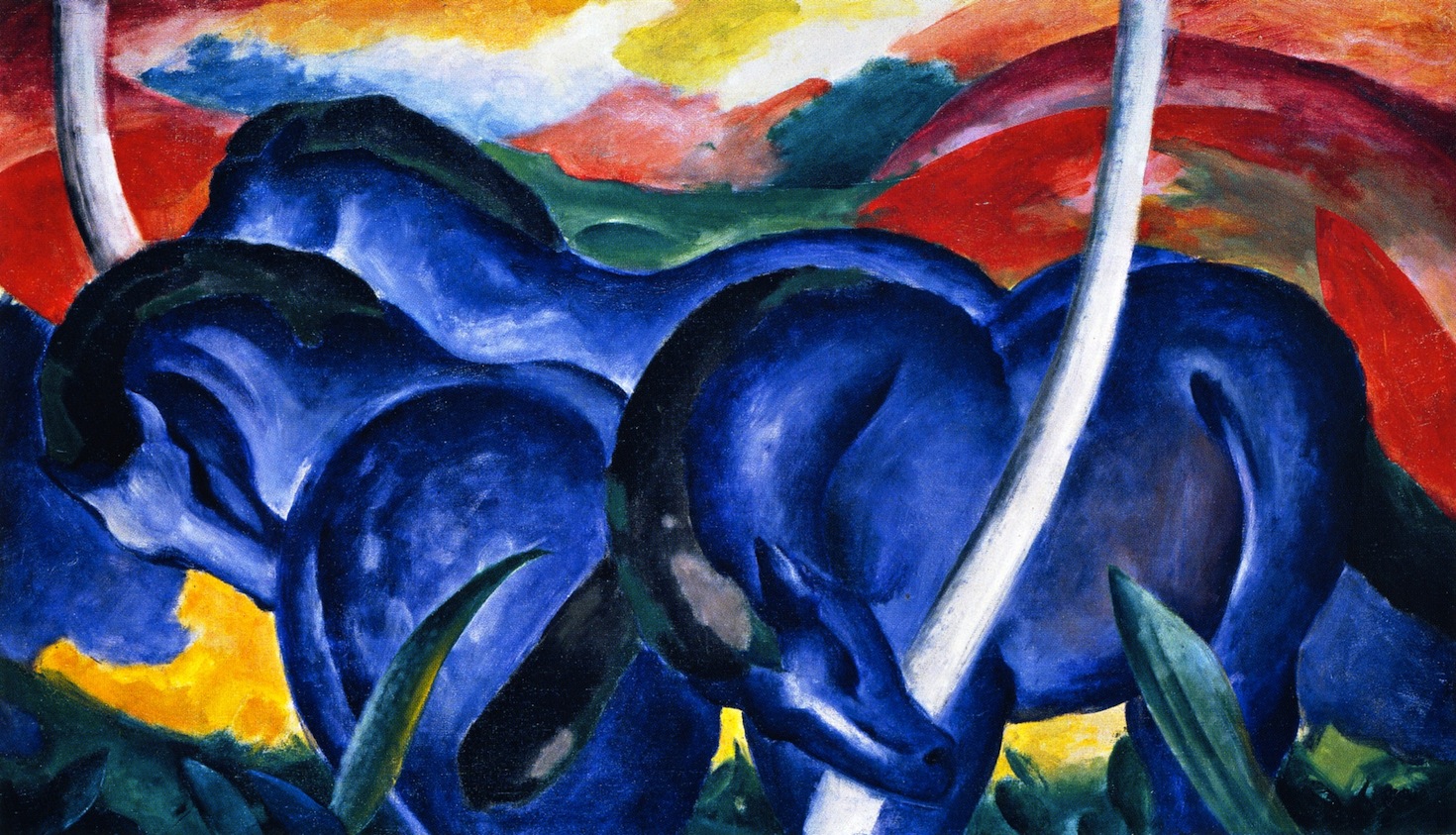
Franz Marc- Large Blue Horses

Franz Marc- Large Blue Horses

He is not downplaying the influences of the past. Early in his career Marc copied the works of other artists from before and contemporary to him. Doing so allowed him to pick and choose the elements in the works of others that meshed with his vision, allowing him to use these found elements to create his own avenue of expression.

He did not want to remain a replicator but wanted instead to be a creator. He wanted to work in a field that he had planted and nurtured. One that was his own.

And that was the attraction for me.

Of course, there was safety and security in remaining in the larger symbolic field with others but it would often be as an anonymous member of a larger group, your furrow always directly compared to the furrow of those alongside you, your harvest always compared to those of others.

Breaking away and heading out was risky. You had to believe that in taking this leap of faith that you would be able to work your little spot in your own way away from others and produce a harvest that is uniquely appetizing to others in some manner. But you might end up toiling in barren soil, creating crops that appealed to no one but yourself. It was scary to think that your field might never expand but you were at least nourishing yourself.

This was the type of thinking that drove my work early on, fueled by looking at the work of Marc and others who veered from the traditions of the past in their times.

Unfortunately, Franz Marc only worked his fields for a relatively short time, dying in WW I at the Battle of Verdun. He was a mere 36 years old. But his crop still lives on, surviving being labeled as degenerate art in the 1930’s by Hitler and the Nazi regime.

It is unique and in his own tradition.

I believe that the lives and careers of artists  like Franz Marc provide valuable lessons for any aspiring artist, even in this world and creative environment that is vastly different than the one that Marc inhabited.

I know it helped me. 


Back trying to take a hiatus. This post ran six years ago but it’s one that I felt deserved another run. Unlike the traditions that sustain and give meaning to our everyday lives, art often occurs when the traditions of art are set aside. I think that is what Marc was talking about here and I believe it is an important thought to keep in mind for those who have their own voice heard.

Back to plowing. Again. Have a good day.


Franz Marc- The Waterfall 1912

Franz Marc- The Waterfall 1912


Franz Marc- Horse and Eagle 1912
Read Full Post »

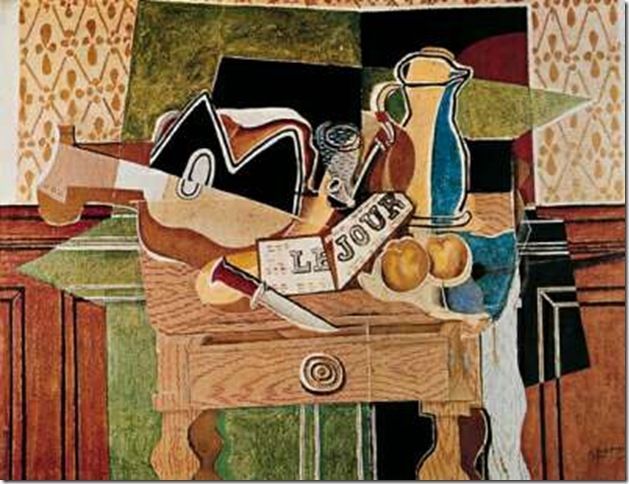
Georges Braque- Still Life: Le Jour


Truth exists. Only lies are invented.

Georges Braque


I am in the studio, looking at a new larger painting on my easel that is nearing completion. The words above from Georges Braque clang around in my mind as I look at it.

The painting is strictly an invention, a representation of a nonexistent place.

I ask myself, “Is it therefore a lie?”

No, of course not.

The painting is a true expression of my emotion and existence. That place represented on the canvas exists within me. And maybe within others who see its symbolic truth.

But I think I know what Braque means with his words. I have some paintings in the studio that I know are lies– inventions and constructions not built  with honest emotion. They aren’t necessarily bad. In fact, a few have a shiny appeal and have an appearance of truth in them. But there is something just a bit off in the way they come across to me, like hearing the words from someone that you know in fact to be untrue.

Their lies might be well constructed and even feel true but they are still lies.

And if that feeling comes across to me, it no doubt does the same for some others, as well. Not everyone. Some people don’t want to look beyond the surface and are willing to accept the lie before them because it somehow fits their own needs. For them, it is an acceptable truth.

It is a useful lie that serves a purpose to fill their personal need.

And that is okay.

Well, at least it’s okay in the realm of art which is based on personal and subjective preferences.

In other aspects of this life, I think we are finding that this casual acceptance of invented lies can have dire consequences.

Hopefully, truth prevails…


I am looking back at some older posts this week and maybe next, adding just a little commentary and maybe attaching a song at the end. This post was from a few years back and I thought it had some relevance to current events and the explosion of falsehoods that have overtaken our country through misinformation, disinformation, and bald-faced lies that make up the insane conspiracies and beliefs that have driven so many of our fellow citizens off the rails.

Art is where we should live our subjective lives. But we live in an objective world and all the subjective belief in the world does convert a lie or untruth into reality there.

At least, it shouldn’t.

As predicted, the casual acceptance of invented lies by some of us have produced dire consequences for us all. Let’s hope we can get back to a shared reality with facts that we can all agree on sometime soon.

Here’s a song that seems relevant to the subject from the Avett Brothers. It’s called The Weight of Lies. And believe me, lies have real weight. 


Read Full Post »


“I can live with doubt and uncertainty and not knowing. I think it is much more interesting to live not knowing than to have answers that might be wrong. If we will only allow that, as we progress, we remain unsure, we will leave opportunities for alternatives. We will not become enthusiastic for the fact, the knowledge, the absolute truth of the day, but remain always uncertain … In order to make progress, one must leave the door to the unknown ajar.”

― Richard P. Feynman


The post below is from several years back and deals with my constant uncertainty, a theme that has ran through my life. I added the Feynman quote above because I like the idea of uncertainty opening the doors to new possibilities and futures that would not even be imagined if we held too tightly to our beliefs and saw them as absolute. Here’s that post:


I don’t know…

I would guess that I’ve said that phrase a couple of hundred thousand times in my life. Or maybe even a million times.

But then again, I don’t know.

As years pass, I am constantly fascinated by how little I know despite consciously trying to obtain more knowledge. It turns out that there are an awful lot of things out there that I will never know.

That doesn’t make me happy but I have learned to live with it and take some comfort in knowing that I am not alone. I don’t think any of us really knows as much as we let on. Oh, some speak with absolute certainty and and an air of confidence but that’s just bravado or a simple failure to recognize their lack of knowledge.

I do know that.

From personal experience, unfortunately.

So I cringe a bit now when I spot that arrogant certainty in the declarations coming from myself or others. Then I cast a doubtful eye towards these claims, my own included.

What does this have to do with the price of a gallon of milk in Kokomo?

I don’t know. I’m just blabbing in order to set up a song from the Irish singer Lisa Hannigan and is titled, fittingly, I Don’t Know. I particularly like this version shot in a Dingle pub. Lovely.

Have a good day and be wary of those who seem a bit too certain. Or not.

I don’t know.


Read Full Post »

This is a post from a couple of years back with a new addition at its end:


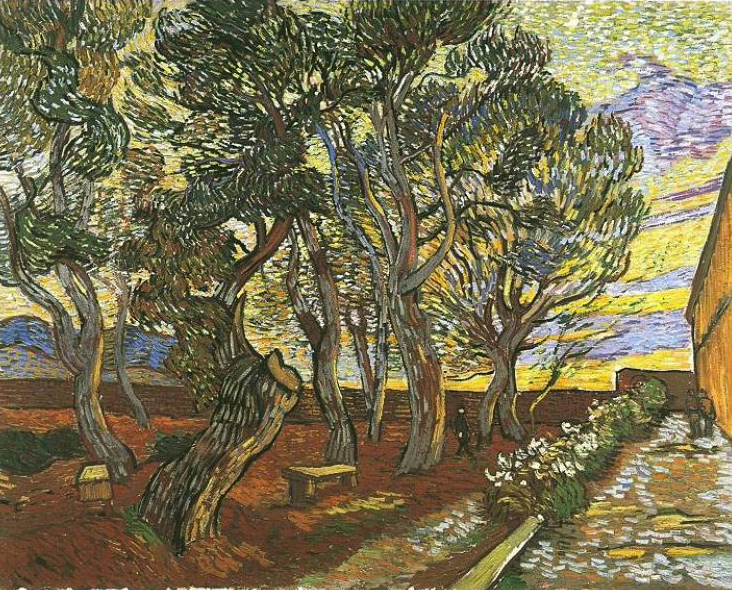
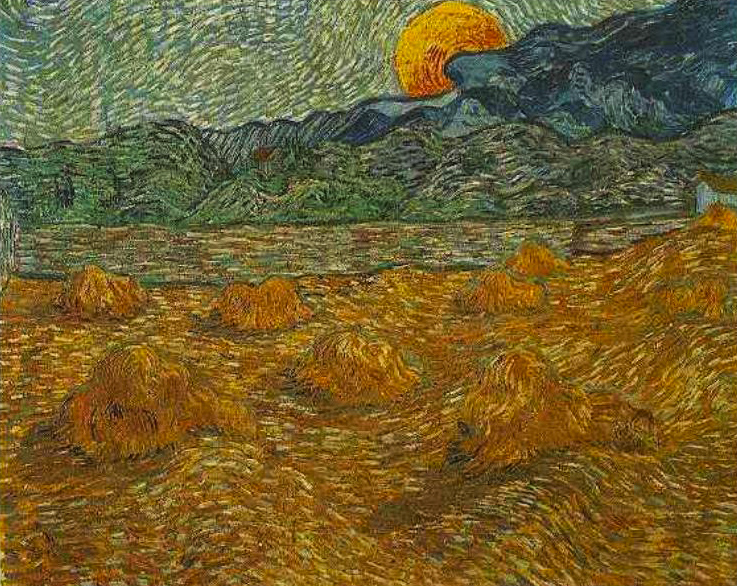
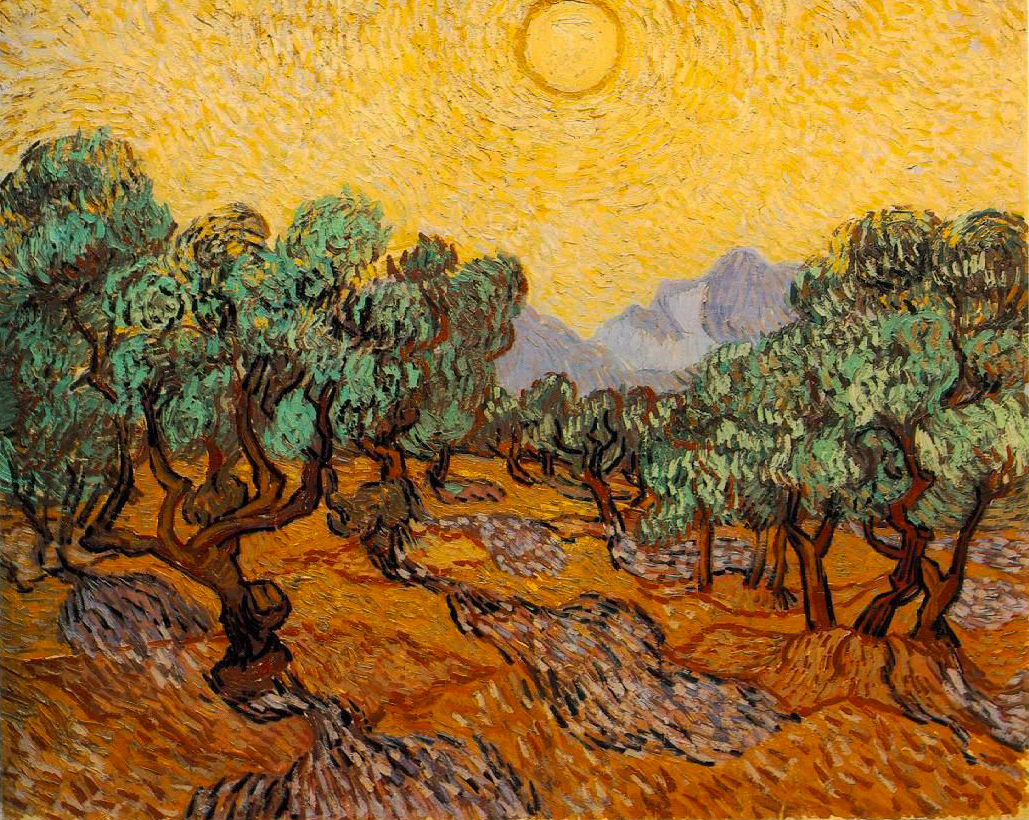
“The world concerns me only in so far as I owe it a certain debt and duty, so to speak, because I have walked this earth for 30 years, and out of gratitude would like to leave some memento in the form of drawings and paintings—not made to please this school or that, but to express a genuine human feeling.”

― Vincent van Gogh, The Letters of Vincent van Gogh


Thought a good way to kick off this week might be to share a few paintings from Vincent van Gogh along with a quote from one of his letters that speaks very much to my own feelings about my own reasons for doing what I do. These are not his better known paintings, though some of you may well know these pieces. They’re pieces that speak to my own personal inclinations. You might notice that most of these paintings have his ball-like sun/moon.

The idea of feeling a need to leave a memento behind that expresses one’s gratitude and one’s expression of self is one that is not foreign to me. I often think about how my work will speak for me after I am gone. Actually, the thought is often if it will speak into the future at all and, if so, will it be an honest reflection, a true representation of my voice.

I know that an artist, for all of the ways they try to guide the narrative about their work and life, have little control on the future.

What will be, will be.

The artist’s voice might echo but it is always just that, an echo, a one-sided conversation from the past. Hopefully, what is said in that echo reverberates and speaks to someone of that future time so that they can fully understand and connect to the feeling behind it. And if so, with the hope that they might respond to that voice in some small way that continues to give life to it.

As I said, an artist has little control over this outside of doing their work with honest efforts and emotions. It’s obvious this was the case in the work of van Gogh and we continue to have a conversation with his echoes from the past, his mementos of gratitude.

[2021 Addendum]

Here’s a few lines from Goethe’s Faust that mirror this same sentiment:

“You can’t, if you can’t feel it, if it never
Rises from the soul, and sways
The heart of every single hearer,
With deepest power, in simple ways.
You’ll sit forever, gluing things together,
Cooking up a stew from other’s scraps,
Blowing on a miserable fire,
Made from your heap of dying ash.
Let apes and children praise your art,
If their admiration’s to your taste,
But you’ll never speak from heart to heart,
Unless it rises up from your heart’s space.”

― Johann Wolfgang von Goethe, Faust, First Part

Have a good day.


Read Full Post »


“One never reaches home,’ she said. ‘But where paths that have an affinity for each other intersect, the whole world looks like home, for a time.”

-Hermann Hesse, Demian: The Story of Emil Sinclair’s Youth


The painting at the top, Home in Sight, is a new small piece that is headed to the West End Gallery for their annual Little Gems show which opens in February. The words above are from a Hermann Hesse book that holds a special place in my heart, a book that served a very important purpose for me when I was struggling at my lowest point. 

It helped me find my way home. 

Often, when I employ the concept of home in my work, that book comes to mind. And I am always so grateful then for what it did for me then. And now because without it there may well not have been a now.

And that’s sort of what I see in this little gem.

Let’s leave it at that today.

Have a good day wherever your home may be.

Read Full Post »


The past slips from our grasp. It leaves us only scattered things. The bond that united them eludes us. Our imagination usually fills in the void by making use of preconceived theories…Archaeology, then, does not supply us with certitudes, but rather with vague hypotheses. And in the shade of these hypotheses some artists are content to dream, considering them less as scientific facts than as sources of inspiration.

-Igor Stravinsky, Poetics of Music in the Form – Six Lessons


I was looking through some older posts and came across the quote and painting above which caught my eye. It was probably because the painting, Archaeology: The Golden Age, was the last piece I had painted in the Archaeology series and may well be the last of that series.

It is one of those pieces that still live with me here in the studio, having never found a home. While I want it to find a place where it can satisfy someone other than myself, I am happy to have it here. From the time it was completed, I considered it one of the stronger pieces in the series. That might even be the reason it has continued to be the last in the Archaeology series.

Maybe the series had reached its potential, its endpoint, with this painting. I don’t know.

I also was captured once again by Stravinsky’s thoughts on the artistic process, how we use our imagination and what little knowledge we have to fill out the blank spots among our scattered fragments of memory to create something new. He equated it to archaeology which is a similar process, taking bits and pieces from the past and filling in the blanks with imagination and knowledge to create a theory of what might have been. 

As he says archaeology does not supply us with certitudes. There are too many voids to fill before one can deal in absolutes.

And so it is with art. Art seldom deals in strict factual representation. Art comes together as a mixture of the facts of the work, the imagination and process of the artist, and the emotions and imagination of those who take it in. 

It’s as much alchemy as it is archaeology.

Whatever it is, I am happy to deal in this strange world of imagination, one that often offers me more questions than answers.

Reading the older post this morning also reminded me of an old Jethro Tull tune that I haven’t heard or thought of in many years. Probably decades. Here’s a blast from the past, as the old AM deejays used to say. This is Living in the Past.

Have a good day.


Read Full Post »

“Culmination”- Now at the West End Gallery


Each man is always in the middle of the surface of the earth and under the zenith of his own hemisphere, and over the centre of the earth.

-Leonardo da Vinci


As we count down the last four days of this excruciatingly long year of 2020, I was looking for a a painting that had to do with the endpoint of things. I immediately thought of the piece shown here, Culmination, that is currently at the West End Gallery.

Its title came about because I saw the path in it as being the trunk of a tree with the paths going off each side as its limbs. The Red Tree at the top was the endpoint of this tree much like each of us are in our own genealogies.

Genealogically, each of us sits at the very top of a pyramid where everyone below us in that pyramid has endured wars, illnesses, pandemic and plague, persecution and imprisonment, and even slavery and holocaust just to get us to this place and time. We are the culmination, the very pinnacle of our family tree. 

For now.

Eventually, we are just part of the trunk with a branch that goes on and on. Or one that breaks off and abruptly ends.

I thought this piece would fit well with the end of this year. So many of the things that came to bear in this strange and awful 2020 were the culmination of events, lives, and organisms that developed and grew– and often worsened– in the years and decades before.

They all seemed to converge to make this year feel like an endpoint, a culmination of some sort.

For some, it was the ultimate endpoint, maybe the end of days as the evangelicals call them. For some, it felt like the end of democracy was all too close to its end here. And this year certainly felt like it marked the end of civil discourse and civility in general.

And of course, for hundreds of thousands of families, the pandemic brought an end to the lives of all too many loved ones. 

2020 was a year that sits atop a pyramid of horrors and atrocities. Hopefully, as it draws to a close later this week, it’s a position it maintains for a long time to come. The year that pushes it further down this monstrous pyramid is not one I wish to endure.

Have a good day, okay?

Read Full Post »


We’re so caught up in our everyday lives that events of the past, like ancient stars that have burned out, are no longer in orbit around our minds. There are just too many things we have to think about every day, too many new things we have to learn. New styles, new information, new technology, new terminology … But still, no matter how much time passes, no matter what takes place in the interim, there are some things we can never assign to oblivion, memories we can never rub away. They remain with us forever, like a touchstone.

― Haruki Murakami, Kafka on the Shore


Murakami’s words above are a continuation of yesterday’s theme, how early memory embeds deeply and remain with us forever. It’s one of those obvious truths that becomes more and more evident as the years pile up. I’ll probably revisit some deep recollections today, as I usually do around this time every year.

Polishing the touchstone.

Here’s a warm wish to all of you for a happy holiday. May you assist your young ones in creating their own touchstones of happiness or even create a new one for yourself.

Here’s a Christmas tune that goes back to the basis for the day, Christmas Must Be Tonight, from The Band. As with most everything they did, it feels right.

Stay safe out there. Merry Christmas.


Read Full Post »


Time is the substance I am made of. Time is a river which sweeps me along, but I am the river; it is a tiger which destroys me, but I am the tiger; it is a fire which consumes me, but I am the fire.

-Jorge Luis Borges


It’s that time of the year when the young build up their stores of memories and the older folks delve into their own storage for past remembrances from this same time many years ago.

The memories that the young will bank this year will be so different from our own memories of holidays past that many of us may pull out this week or the next. And how could they not be different? The world is forever changing, for good or bad. But the relationships of families and friends remain constants so while circumstances and surroundings may change, the base on which memories are built remains much the same.

So these memories being formed in the next week or so will likely be as rich for these young people fifty years from now when they find themselves watching the youth of that time creating their first deep memories. These may end up being the richest they know because this year with all its awfulness created hardships that in many cases illuminates the good that is embedded in our lives, good that is often overlooked in the rush of life.

This year gave us time to reflect on such things and to see that our time here is all we really possess.

If you’re looking for a silver lining to a very dark cloud, maybe that’s it. Maybe time is, in the end, that substance, as Borges writes, of which we are made, that thing that sweeps us along and inevitably consumes us.

This seems a little more evident this time of year as I revisit my own richly detailed memories of this season from many decades ago. There are many remembrances from the intervening years but they most often lack the depth and detail of those early ones and some even have faded into seeming non-existent. Some are there but remain hazy, as though they don’t belong to me, like I am looking at the memories from another life. Like I was a different person at that point.

And maybe I was. Perhaps that’s another thing that comes with being made from time– it changes and as a result, we cannot help but change, as well.

Time…

Here’s a song about time. It’s not a holiday song but it is a great, great song from Tom Waits. I feel a bit sacrilegious in playing anything other than Waits’ iconic version but this one is lovely. Plus to add a festive touch, it is performed by a giant tragic clown who strokes his sleeping French bulldog as he sings. It’s a nice performance by Puddles Pity Party of a song that always slows my heartbeat a bit. I particularly always seem to hear the line And the things you can’t remember tell the things you can’t forget/That history puts a saint in every dream even when the song is playing in the background.

Have a good day. Enjoy your time here.


Read Full Post »


Practice giving things away, not just things you don’t care about, but things you do like. Remember, it is not the size of a gift, it is its quality and the amount of mental attachment you overcome that count. So don’t bankrupt yourself on a momentary positive impulse, only to regret it later. Give thought to giving. Give small things, carefully, and observe the mental processes going along with the act of releasing the little thing you liked.

–Robert A.F. Thurman, American Buddhist author/professor


I like this bit of advice.

Give away things that mean something to yourself, something to which, as Thurman points out, you have a mental attachment that must be overcome. That’s always been the yardstick I use when giving away work at my talks or simply as a gift. It has to be something that hurts a bit to give away, something that you just want to hold onto a bit longer. 

But giving away the valued things of self brings on a feeling of magnanimity in myself, a feeling that seems so much larger and grander than that which usually comes along with clinging onto something. The feeling of generosity is warm and encompassing, like a field of fully opened sunflowers reaching toward the sun. On the other hand, miserly stinginess feels cold and all balled up, like a raisin sitting on a frigid garage floor.

And you most likely will find that the more that you give away, your desire to cling on to these things will fade away.

Let me clarify: I am not saying that you should give away all you have. Again, as Thurman also points out, don’t bankrupt yourself on a momentary positive impulse. First of all, a large or expensive gift doesn’t necessarily have any emotional attachment. Sometimes a small but thoughtful thing, even something that might appear trivial to someone from the outside, holds the most lasting meaning.

So, don’t equate price with meaning. But give when you can or when it it is needed and don’t be afraid to give of yourself, even if it’s only a few sincere words on a piece of paper. Those always ends up being the gifts that hold the most meaning for both the giver and the receiver.

But you probably knew this, right? So let’s listen to a song with a similar message from JD McPherson and his fun holiday album, Socks, from a few years ago. This is All the Gifts I Need.

Have a great day.


Read Full Post »

« Newer Posts - Older Posts »