I wrote the post below back in 2009. I’ve revisited the use of multiple images a few times since but only on a limited basis. Maybe once or twice a year. But it’s a concept that appeals to me and just seeing these images again always sparks something.
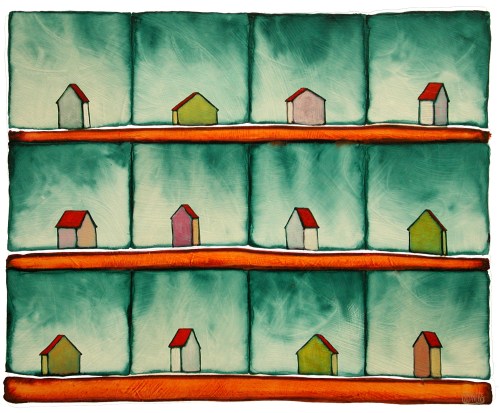
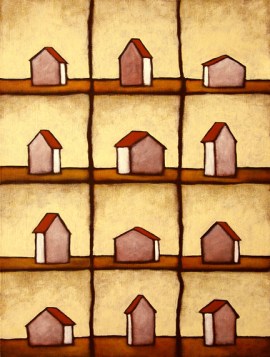 I was looking through some older images on my computer, searching for a painting that I had completed several years back. As I scanned through the paintings, I noticed several pieces through the years that were different from most of the work I’ve been doing recently. They were multiples, such as Peers, shown here. They were paintings with several windows with a new scene in each, although most of the scene were very similar to the others.
It was a format in which I really enjoyed working and one that I have not revisited in a couple of years. I really don’t know why. They have a very graphic appearance and really stand out on a wall, making them pretty well received as a rule. I guess in the past few years I’ve been focusing more on working on texture and heightening the color, as well as working in the Archaeology series, so that I haven’t even thought of revisiting this format.
 I remember some of the early ones very well. One had 48 cells and had a great look, the result of overlaying the paint with layers of chalk and pastel. Another was the same number of cells with 48 individual small paintings, each window having a separate opening in the mat. It was a pretty difficult piece to mat and frame but it also popped off the wall. I will have to go through my slides from that time (pre-digital) and see if I can wrangle up a few shots. I would like to see them again to see how they really hold up against my memory.
Maybe I will revisit the multiples sometime soon. I often run across things that have slipped from the front of my painting mind when I go back looking for something else. It may be a format such as these multiples or may be a small compositional element. It’s always interesting for me to try to re-insert this older element into the new work, to see how the inevitable evolution of the work will change this older concept. We’ll have to see what this brings…


 “Enlightenment is man’s release from his self-incurred tutelage. Tutelage is man’s inability to make use of his understanding without direction from another. Self-incurred is this tutelage when its cause lies not in lack of reason but in lack of resolution and courage to use it without direction from another. Sapere aude!- ‘Have courage to use your own reason!’- that is the motto of enlightenment.”
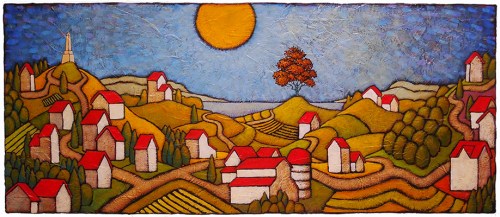 We have to balance the lineality of the known universe with the nonlineality of the unknown universe.


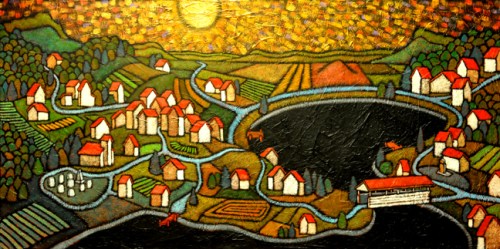
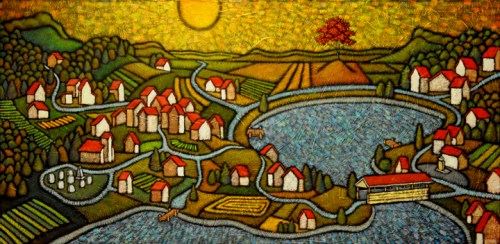
 What did the tree learn from the earth
 The omnipotence of evil has never resulted in anything but fruitless efforts. Our thoughts always escape from whoever tries to smother them.
  All human accomplishment has the same origin, identically. Imagination is a force of nature. Is this not enough to make a person full of ecstasy? Imagination, imagination, imagination. It converts to actual. It sustains, it alters, it redeems!
 Through practice we can get to the point where some disturbance may occur but the negative effects on our mind remain on the surface, like the waves that may ripple on the surface of an ocean but don’t have much effect deep down.
  The truth remains the same in every version of this world. It is a constant.
 Redtree Times