Feeds:
Posts
Comments

Posts Tagged ‘Red Tree’

OtherWorld

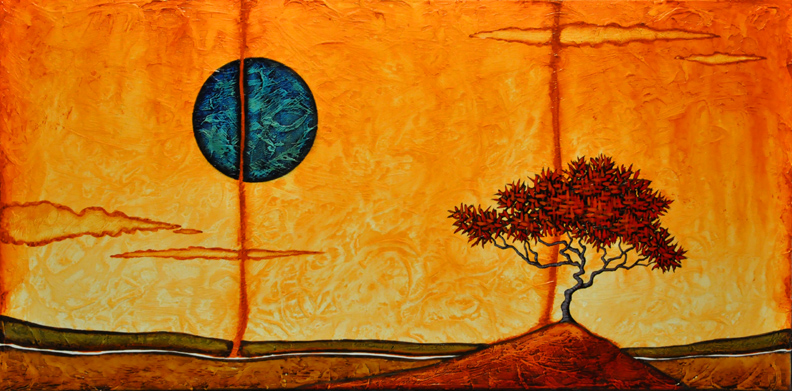
I was contacted a week or so back from a gallery that represents me, asking about an image that appears in In Quiet Places, the book that shows some of the paintings  from the 2003 -2008  time period.  I opened the book to the page so I could fully reference as we talked and it wasn’t until they asked about the color of the sun did I even realize that the sun was  blue in the painting.  It just didn’t register at first and my mind didn’t even recognize the fact that the color was unusual , instead focusing on the feeling it gave to the piece.

It was the feeling of a bright and seemingly normal day that was somehow different.  A strangeness that didn’t threaten but was instead like a sudden awareness of the unseen that surrounds us.

It was at this point that I realized that a painting that I had just finished had such a blue sun hovering in its sky.  It is the one shown here, a 20″ by 40″ canvas that I have titled OtherWorld.  It. too, had that feeling of the unseen dimension, one that is everywhere but remains hidden to us and, therefore, strange.  The sky in this  piece is painted in three sections that seem to hover transparently between the blue sun and the red tree, symbolic of that invisible other  world that surrounds us.  Perhaps it signifies the spiritual dimension or maybe it is a purely physical dimension of energies that we simply cannot detect or feel.  Or maybe it is both.

I surely don’t know.

But that blue sun made me feel differently in this painting than if it had been a more traditional color, say a yellow or orange.  It was as though I were suddenly aware of that hidden dimension and this knowledge changed my perception of all things normal, everything somehow just a bit different.  Slightly strange yet the same.  Like the feeling when the hairs on the back of your neck suddenly raise for no apparent reason.  You feel there is something there but it remains a mystery and then the moment is passed, soon to be forgotten. 

Maybe that is what this piece is about– how we remain remain strangers to those dimensions that we often brush against.  Those other worlds.
 

Read Full Post »

I wrote the other day about the rhythm I’m looking for when I’m in the studio, that groove where the painting is more instinctual than intellectual.  Everything flowing fast and easy with little thought, each brushload of paint inspiring the next and on and on.  All intuition and reaction with hardly a thought given to subject or meaning.   It’s a great feeling, one that makes me feel as thought I am somehow connected to some sort of better self within, one that can only be reached by letting go of conscious thought.

A rare and delicate thing.

Delicate in the sense that I find myself at points coming out of this groove to examine what I’ve done and I lapse into conventional thought.  At these times I look at the work spread around the studio, in various stages of their journey to completion.  I forget for the moment how the work came about , about  the fact that the work is not about subject or the scene but about capturing emotion and feeling.  All I see is repetition of form, red trees and red roofs set on mounds and plains.

And for that moment, I panic just a bit.  The delicate thing seems almost crushed in that instant.

But then I focus on a painting and the fragility of  how it came about and what it really is doesn’t seem all that delicate after all.  Though there is often repetition of forms, I can see by looking at this individual painting that these elements are only part of the whole, that, while  they often serve as the central focus of the piece, their importance comes from how they play off the other less obvious elements of the painting to create the real feel of it.  People are not moved by the tree but by the sense of feeling that the tree evokes within the painting. 

It’s not subject but the emotion captured that makes each piece unique. 

And with that realization in hand, I feel free once again to go back into the rhythm, that rare and delicate thing.

The painting above is a new one that fits perfectly with this post.  It is a 10″ by 16″ painting on paper that I call Beeswing,  after a line from a Richard Thompson song of the same name that has as its chorus the line, ” she was a rare thing, fine as a bee’s wing…”  There  is a delicacy in this piece, a fineness of form that makes the moment of it seem forever fragile.  When I look at it all I can think of are those incredibly rare moments of absolute happiness, when the outer world is completely forgotten and there is a clarity of joy in myself.  A fleeting feeling, rare and delicate, fine as a bee’s wing.

Here’s the song from Richard Thompson—-


Read Full Post »

I call this new painting String Theory.  It’s a 20″ by 40″ canvas that is simple in design but has great depth of color and a strong underlying texture that gives it added dimensions.  It’s a striking piece in the studio, especially given its larger size, with its saturated tones and the thick spiral bands that run through it catching glints of light at different angles. 

The Red Tree’s crown is painted as a monolithic form and seems to glow with life  amid the contrasting darkness of the sky.  I chose a deep red for the color of the fields in the foreground because I wanted it to represent  the earth as a physical dimension, the red symbolizing the blood of the living.  The swirling  blues and greens of the sky, to me, represent a different dimension, one less tangible and more ethereal. 

As for the title and the thought behind it, I described this in a blogpost from July of 2009.  I think I will let the words from that post describe what I see here as well:

The title of this painting comes from the way the sky is formed from many patches of color and the way the light is formed therein. It reminded me of one of the supposed byproducts of the string theory which is a very speculative area of quantum physics. Without going into the scientific basis for the theory ( which I really couldn’t do very well anyway), string theory basically creates a platform where extra dimensions could and may exist alongside the dimensions that we know and dwell within, without our knowledge of their existence. A simplified example of how this might work is the way we are surrounded by radio signals all the time without our knowledge but with the proper receptor, a radio, they become apparent. With string theory, perhaps there are also parallel dimensions around us without our knowledge, dimensions that contain others forms of energy, other forms of existence. 

People have used this as theoretical basis for many things such as time travel, the existence of UFOs, and things supernatural such as ghosts and other spectral occurrences. The string theory has been a very fertile field for science fiction writers to work. 

Perhaps it also provides a place where the soul, the source of energy that animates the body, ultimately dwells. Perhaps there is the energy of souls all around us in these alternative dimensions. Maybe the photons we see are also the part, a facet, of something unseen. That’s how I see the sky in this painting, as masses of disparate energies that we only see partially in the dimensions we can detect. 

Okay, remember that it is early in the morning when I’m writing this. I’m not smart enough to really discuss quantum physics. I am not familiar with all the New Age-y spiritualism. I’m just saying there is some form of energy out there in the light we see. What it is, I surely don’t know. In this painting I like to see it as light and energy of souls. 

And that makes me feel good…

It made me feel good then and does now as well.

Read Full Post »

Give me a place to stand, and I will move the Earth.

Archimedes

^^^^^^^^^^^^

This is actually a condensed and long accepted version of  Archimedes‘  words.  It was really about the power of lever in physics.  He actually said: Give me a lever long enough and a place to stand  and I will move the Earth.  But the lever has been dropped over the 2200 or so  years since he lived and has come to signify something more than a statement about physical mechanics.  It is an almost existential statement about the power of the individual in changing the world.  The small somehow defeating  the overwhelming forces set against them.

David versus Goliath. 

 David’s lever was the sling and stone he used to take down the giant.  Every underdog has somehow identified a strategic advantage that has enabled them to triumph against all odds.  Something that plays to their own strengths and magnifies their greater opponent’s weaknesses. 

What is the lever you will use to move the Earth?

I call the painting above A Place to Stand after these words of Archimedes.  It is a new piece that is a 24″ by 30″ canvas that is a very simple composition that relies on the juxtaposition of the single Red Tree set against a powerfully set sky that seems ready to overwhelm the diminuative tree.  Yet, against all the elemental force  of wind and weather that  the sky can muster, the tree perseveres.  It uses the flexibility of its trunk and limbs to absorb the wind and its bark protects it against the heat and cold. 

It stands alone, without protection.  Yet it stands.   Just standing  strong where you are is a lever powerful enough to change the world. 

Perseverance is often its own victory.

Read Full Post »

This a new painting that I am calling Pot Luck, a 10″ by 36″ piece on paper.  The pot part of the title is referring to the several pot lakes that surround the Red Tree, a slightly different way for me to represent water in my work.  But after using the term I began to think about how it might refer in a deeper sense to this scene and to our lives.  It now normally refers to a community meal where there is no specific menu and everyone brings a dish to share. It derived from the British Isles of centuries ago, when households might have only one pot in which to cook and a meal would often consist of whatever was available being thrown into the pot.  The resulting meal was called potluck.

 It’s this meaning that sparked my interest.  It made me think of how our lives are often very much like those potluck dinners where we make do with the ingredients at hand.  It may not always seem like the tastiest of dishes and we might sometimes cast an envious eye at those whose luck has blessed them with more ample pantries, wishing we were so fortunate.  But, hopefully in the end, we try to make the best of what is available to us and in the process become better chefs, making the most fulfilling  meals from the simple ingredients at hand. 

 I think that’s the takeaway here– to make the most of what we have in our lives.  To not bemoan that which we do not have but to instead celebrate and accentuate what we have.  We are what we are.  A simple stew can never be chateaubriand but, with care and attention,  can be tasty and quite satisfying in itself.  Maybe we should all give this same  proper care and attention to our own lives.

Meanings aside, the other thing that I really like in this piece are the way the clouds reflect the shape of the pot lakes, their elliptical silhoueettes making them look kind of flying-saucery in the sky.  It is an  afternote that doesn’t greatly alter the scene but adds a layer of depth to it.  An added layer of flavor to the stew, if you see it that way…


Read Full Post »

I’ve written here before about how I find the color blue an intoxicant.  When my nose is to the canvas and it is all that I can see, it has a way of making me feel that it is the only color in my world.  It’s a very satisfying and mollifying effect and, if I am not wary, I can find myself using blue tints to the exclusion of all others.  Because of this wariness, I try to only sporadically break out the blues.  But even with this watchful effort, I find the addictive pull of the color very strong in some pieces.  This new painting is such a case.

Called Blue Dance of Dawn, it’s a 10″ by 30″ canvas that employs two of my familiar icons, the Red Tree and the the Red Roofs.  They, however,  feel secondary to the predominance of the color blue here.  They serve as warmer counterpoints to the coolness of the blue and signify awakening  to me in this scene.  But the feel of this piece is dictated by the calm harmony of the blues.

I find this piece very placid with that  kind of satisfying effect that one sometimes has in the best dreams, that feeling of total understanding and acceptance of the universe.  That wonderful feeling that fades so quickly once you open your eyes and realize that it was only a dream, the details suddenly fuzzing over.  Maybe that’s what this painting represents– that idealized version of the world in those dreams just before we are awakened to the reality of the moment. That fleeting feeling of grace, seemingly within grasp then gone.

Let me think that over…


Read Full Post »

Archaeology is the peeping Tom of the sciences. It is the sandbox of men who care not where they are going; they merely want to know where everyone else has been.

Jim Bishop
 
*************************************************************
 
   Maybe I fit into the quote above from the  late journalist Jim Bishop and maybe that’s why the idea of incorporating archaeology into my work, as I have done with my Archaeology series over the last few years, has been so appealing to me.  The idea of diverting our eyes from where we are headed to instead see where we have been, to examine those things which have shaped us as we stand now, is indeed intriguing to me.  We are the products of our past and where we are headed is often determined in the how and the why of the past.  Unfortunately, and to our detriment I fear, we often fail to look back and, as a result, are continually reliving  pasts that could and should  have been avoided.
 
This thought is definitely behind the title of this new piece, Archaeology: Formed in the Past, a 10″ by 16″ painting on paper.  I see the central Red Tree here as being formed and twisted by the artifacts below the surface, remnants of the past.  The trees in line behind stand  like stoic witnesses to this history.  The artifacts contain tools and toys, books and bottles, shoes and other items of the everyday– the things that make up a life and a world.  There is also evidence of the creative side of life here– a painting, paint brush, a drama mask, a ukulele and an artist’s mannequin. 
 
It’s always interesting to look at these pieces after finishing them and to see how they come together to offer up some sort of narrative in the collection of artifacts.  Interesting because I don’t really think about how the items will interact as I am painting.  No forethought at all really.   They’re just painted in rhythm as they come to mind, often just because a shape or form fits at the moment.  So when I see the commonality of thought and narrative  running through them, I wonder what the source might be. 
 
Is it just a reflection of my own psyche and interests? 
 
Perhaps.  Probably.  But even so, there’s something somehow compelling in sifting through the debris, even the debris of one person’s mind.

Read Full Post »

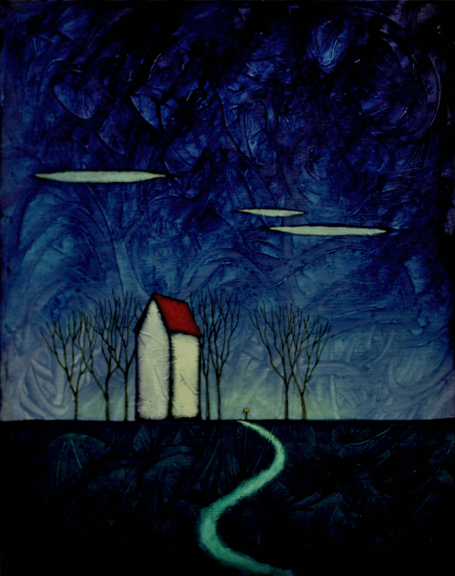
RFD

A new painting, a 16″ by 20″  canvas that I call RFD for rural free delivery.  It alludes to the small mailbox with the the door hanging open, a theme I have  used in a prior piece within the past few years.  Maybe it’s a comment on the decline of our postal system, something that saddens me because, as I have writtern here before, it meant so much to me as a child as a form of connection to the greater outer world in the days long before the internet and social media, both terms that would have drawn quizzical looks at that time.  Maybe that’s what it’s about.  Maybe not. I know I’m not sure.

There’s a moody melancholy to this piece that is both a little scary and satisfying at once, something that I am hard-pressed to explain.  But I guess that’s what I find appealing in this painting- the fact that it is harder to take in easily with no apparent answers.  It is dark and a bit foreboding, filled only with questions.  Who might live here?  Where are they now?  Is mail delivered there now or has this place been abandoned?  Is this the end of the road or does it travel on?  When is this moment?  Is it a darkening or lightening sky?  Fall or spring?

There is no Red Tree, no central personification here.  Just a tall, windowless and doorless  house with a gaping mailbox set amid bony trees and an ominous sky.  There is no heroic quality here, no absolutely positive reading or message. Just a mood of mystery. 

And sometimes that’s enough…

Read Full Post »

Well, I am finished with the large canvas I started over three weeks ago.  It is the largest piece in size I’ve ever attempted by quite a bit at 54″ by 84″ which I often found intimidating at times, as I freely admitted here.  But that intimidation and fear faded over the weeks as the painting evolved, moving from the darkness in which it began to the vibrant brightness of the finished product.  This shift in tone mirrored my own shift in my feelings for the painting.  I began with a fearful anxiety that began to ease with each new layer of color added.  I began to feel a lightness in myself as the piece began to find its unity and rhythm and a sense of confidence when it began to start taking on a life of its own as it neared completion.

It was interesting  to see how its domination of the studio space changed.  At first, its size and darkness made it seem at times like a big canvas eclipse blocking out and absorbing all incoming light.  But near the end it bagan to have its own glow, seeming to give off more light than it absorbed.  Even after the large floodlight under which I work was turned off, its glow cut through the hazy darkness.  Those moments of seeing that really struck me and gave me a real sense that it was becoming what I hoped for it. 

 As the final strokes went on to the Red Tree that stands above the lake, bringing the piece into a state of completion, it began to move completely into its own realm, its own life.   I felt like a parent watching their child move out of their home and into their own life.  The  influence of the parent is evident but there is a point where the child moves on, no longer dependent on the parent.  It is a moment filled with both the joy of  pride and the sadness of loss. 

 Like this parent, I feel both of these emotions.  I am proud of how this painting has come around and grown into something strong and viable but sad that my time with it has come to an end.   Well, close to an end.  I will spend the next few months with it, making little tweaks here and there.  Nothing large.  Just a tiny  rounding of the edges here and a smoothing of the line there. 

I’m calling this painting The Internal Landscape.  I will discuss this at a later date along with some other observations about it.  But for now, I’m going to simply stand back and take it all in again.

Read Full Post »

There are only two mistakes one can make along the road to truth; not going all the way, and not starting.
—Buddha

This is a new painting that recently went to Watts Fine Arts in Zionsville, outside of Indianapolis.  It’s a large canvas, 20″ tall by 60″ wide, that is called Where the Road Ends
 
I often use a pathway or road leading into my work, the idea being that it serves as an invitation for the viewer to enter the scene.  Sometimes the path simply cuts through the landscape and runs to a horizon, a symbol of  the continuity of the journey.  But sometimes the path seemingly ends and I find myself at these times asking myself what that means, both in the context of the painting and in my mind.  Is it the reaching of a goal, such as the truth to which Buddha alludes above?  Or is it merely a road that comes to an end?   
 
Probably both are correct.  In the process of painting I don’t go forward with this final image in mind.  The road neither ends nor goes on when I am in the midst of painting.  It’s just there.  But at a certain point, the composition demands that a decision be made, to either continue with it or to let if disappear behind a knoll.  The easier decision is always to continue, to let the path represent  the continuum of time.  It is natural and something we can all relate to in some way.  We understand theconcept of the journey.
 
But to terminate the road means that there is some sort of finality, an endpoint.  Be it wisdom, truth, death or some other sort of epiphany, this terminus presents a great opportunity for symbolism.  Enter the single Red Tree.  Set against the end of the path and the  landscape that opens to lines of distant hills, it becomes an icon for that for which we strive. 
 
 Perhaps it is a symbol for our wiser self in the here and now, enlightenment found.  Perhaps for some it represents an afterlife, the step beyond our earthly journey.  Or it could be any number of other readings.  But however it is read, the Red Tree here, sitting away the end of the road, demands engagement from the viewer, demands that they consider its meaning to them.
 
And I like that.
 

Read Full Post »

« Newer Posts - Older Posts »