Feeds:
Posts
Comments

Posts Tagged ‘Red Tree’

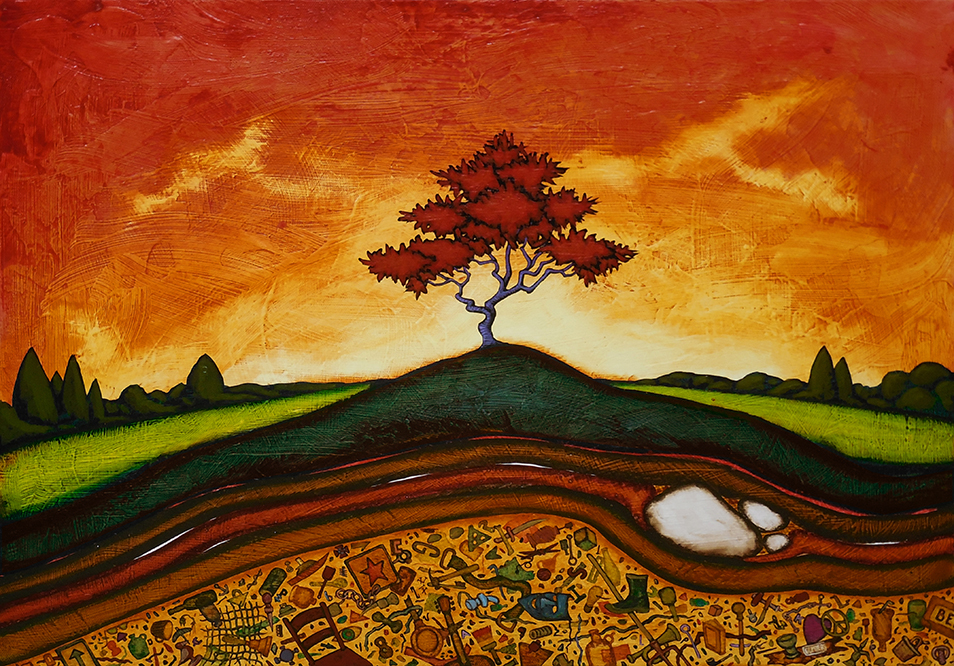
GC Myers- And Dusk Dissolves sm

And Dusk Dissolves – At the West End Gallery


It was that hour that turns seafarers’ longings homeward- the hour that makes their hearts grow tender upon the day they bid sweet friends farewell…

― Dante Alighieri, Purgatorio


Dante had it right– dusk is that hour of recollection, some warm and some less so. As I age, I see this more clearly, most likely as a result of simply having more to look back on than look forward to at this stage in my life.

Don’t jump too hardly on that last line. I feel there is still a tremendous amount of living ahead for me and others my age or older. It’s just math– the ratio of time lived to the expected or hoped for time left in one’s life– says that the greater part of our life is behind us for people of my age and older.

And I believe dusk does often remind us of this fact. It’s a time when we sometimes pause to look back on the day, to reckon what we have done and not done during that time and to measure what lies ahead for the next day.

And sometimes this recollection extends back further than the day that just passed due to the moment in which it takes place. Maybe it’s the warmth and color of the sunset. Maybe it’s the way the landscape around us changes in the setting light, as colors deepen and contrast to the narrowing light. Whatever it might be in that moment, something triggers flashes of distant memories.

Words spoken and unspoken. Maybe just a glance from a face you remember or the most innocuous detail from some moment that didn’t seem important when you saw it so long ago.

Sometimes these moments are full and make sense. Sometimes they are fragments that seem insignificant. Yet they remain in place in our memory.

And as that moment of recollection passes and we move to settling in for the night and looking ahead to the coming day, these recalled moments dissolve, much like the setting sunlight melts into darkness.

There’s a wealth of recollections to pull from as one ages and maybe I see that in the depth and richness of the colors here. Maybe every stroke of color in that sky is a fleeting and flashing moment from my memory. I don’t know.

It makes me think of when my dad was in his final years suffering from dementia. His memory was spotty at best and often large segments of it were absent. I remember one instance when he was disturbed and asked me with great seriousness to tell him who his mother was. I went to a photo of her from her college yearbook (Potsdam 1918!) that was on a bulletin board we had put up in his room. I pointed her out and explained in great detail her history. He listened to me more intently than any other time I can remember in my life, like he needed to know this and wanted to inscribe it deep into memory.

Looking back on that moment now, I can only imagine him as the Red Tree looking back and, instead of the richness of individual colors in that sky of memory, he is seeing a hazy grayness with occasional peeks of color. A recognizable tree or hillside whose color has faded to a duller shade, almost gray. And the distant deeply colored mountain that might have been his mother was not even visible.

Makes me appreciate every moment, every fleck of color, every drop of light, every insignificant recollection that remains with the hope that my dusk never fully dissolves.


This post ran a few years back. I came across the image of the painting at the top, And Dusk Dissolves, and remembered that this painting was still at the West End Gallery. I had forgotten that it was there. It’s a very large piece, 30″ by 48″, so it is often difficult to find space for it on the gallery walls. But it remains a favorite of mine. Seeing it and reading the post reminded me of my parents, who I have been thinking about in recent weeks.

Here’s a song about looking back, a version of a favorite Beatles song, In My Life, from 1965‘s Rubber Soul album. Hard to believe this song is almost 60 years old. This version is from the American recordings of Johnny Cash, done in the final months of his life. n a long and storied career, I’ve always felt it was among his most impactful work. His age and ailments changed his delivery and imbued the songs with real heart-felt emotion and purity. A powerful group of music. This version of the Beatles’ song is not so different stylistically, but it it is filled with his own personal meaning which, n a way, makes it his own.


Read Full Post »

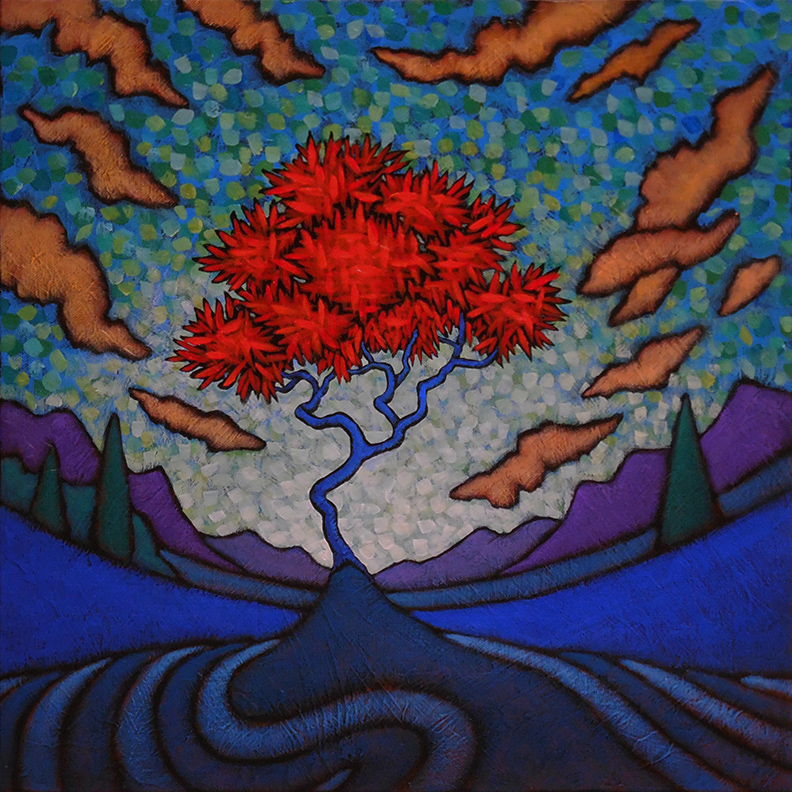
GC Myers- On the Blue Side  2024

On the Blue Side— At the West End Gallery


Poetic power is great, strong as a primitive instinct; it has its own unyielding rhythms in itself and breaks out as out of mountains.

–Rainer Maria Rilke, Letters toa Young Poet


The line above from Rilke has been translated a couple of different ways. This is an abridged version that omits any reference to the subject, a German poet, who Rilke was describing in his letter. This version becomes only about poetic power. This is the version you will mainly see quoted today.

The original version was a direct reference to Richard Dehmel, a German poet who died in 1920 from injuries sustained in WW I. Dehmel was an influential poet in Germany in the pre-war years, his verse considered very rhythmic. It was a favorite among popular composers of that era– Richard Strauss, Carl Orff, and Kurt Weill, for examples–who regularly set his poetry to their music. He is best known for his work that was strongly sexual in nature, so much so that he faced obscenity charges several times.

The original line is at the end of a paragraph where Rilke writes about his admiration for the beauty of Dehmel’s work as well as his concern that he sometimes went beyond the prevailing accepted levels of decency of that era. The original line:

His poetic strength is great and as powerful as primal instinct; it has its own relentless rhythms within, and explodes from him like a volcano.

It wasn’t changed that much actually, mainly keeping a direct reference to Dehmel and using the explosive nature of a volcano instead of breaks out as out of mountains.

I know this is not of much interest to anyone, but I only mention it because the original made me think of the Red Tree in some of my paintings as a sort of small volcanic explosion. I had never thought of them in this way and it intrigued me. It gave them a new dimension.

I can definitely see this in the painting at the top, On the Blue Side, which is at the West End Gallery. The Red Tree here has a feel of released energy, as though it is exploding from the earth. Maybe trees and everything springing from the earth is a small volcano, a bursting eruption of energy? I don’t know but I like the idea.

Hmm….

Here’s a song that is about mountains in a way. This is Remember the Mountain Bed, another favorite from Mermaid Avenue, the Wilco/Billy Bragg collaboration where they composed music for the unpublished Woody Guthrie lyrics. Good stuff.


Read Full Post »

Natural Anthem sm

Natural Anthem– At Principle Gallery, Alexandria VA


To Mercy, Pity, Peace, and Love
All pray in their distress;
And to these virtues of delight
Return their thankfulness.

–William Blake, Songs of Innocence (1789–1790)


Speaking of thankfulness in this week of thanks, I might add silence or quietude to those virtues of delight that Blake listed above, though that probably falls under his definition of Peace. I know that I am always thankful when I am gifted with silence or quiet when I am in the midst of some sort of distress. It stills the waters, in a manner of speaking.

There are others that I might add, as well. Understanding and compassion for example. Again, you might classify them under Blake’s Mercy and Love, respectively.

I guess it doesn’t matter how you classify them. Receiving any of these virtues of delight are gifts of the highest order, gifts of the soul that inspire thankfulness in most of us. Unfortunately, there are some who don’t recognize these gifts when given and are stingy in offering these gifts to others. I feel bad in a way for such people. There seems to be an incompleteness to them, a void of virtues that should be filled with gratitude. As the Roman orator Cicero stated: Gratitude is not only the greatest of the virtues, but the parent of all of the others.

Anyway, that’s my spiel for this morning. Thank you for reading.

Here’s a piece of music for which I am very much thankful. It’s the first movement, Ludus: Con moto, from Tabula Rasa. a 1977 work from Estonian composer Arvo Pärt.  I picked up this album back in 1999 and listened to it over and over during my early years as a full-time painter. The feel of this music and its themes of love, empty space, and silence seemed to fit well with my work at that time. Hope it still does. This features violinist Gil Shaham along with the Gothenburg Symphony Orchestra.

Still hits me hard. And I am thankful for that…


Read Full Post »

GC Myers -Proclaim the Day  2024

Proclaim the Day— At the West End Gallery


By health I mean the power to live a full, adult, living, breathing life in close contact with what I love — the earth and the wonders thereof — the sea — the sun. All that we mean when we speak of the external world. A want to enter into it, to be part of it, to live in it, to learn from it, to lose all that is superficial and acquired in me and to become a conscious direct human being. I want, by understanding myself, to understand others. I want to be all that I am capable of becoming so that I may be (and here I have stopped and waited and waited and it’s no good — there’s only one phrase that will do) a child of the sun. About helping others, about carrying a light and so on, it seems false to say a single word. Let it be at that. A child of the sun.

Katherine Mansfield (1888- 9 January 1923)

October, 1922, Her final journal entry


About ten years back, I came across this final journal entry from the Modernist writer Katherine Mansfield, who died much too early from tuberculosis at age 35, and employed it for a painting called Proclamation. The feel of that painting very much mirrors that of the painting above, Proclaim the Day, which is at the West End Gallery as part of their Deck the Walls show which opened yesterday. The sense I get from both paintings remind me very much of the emotions expressed by Mansfield.

This is a painting that speaks to me of having come to an understanding of oneself, to be willing to stand strong against the prevailing winds in order to show that true identity. It is at once strong yet fragile, flawed yet beautiful. A strength derived from the challenges it had overcome and a fragility in that it recognizes its limits and mortality. Flawed by the scars of attained wisdom and change. Beautiful because it is honest and authentic, open to the elements and all who look upon it.

In these ways, it has become a source of light in its own right or, to use Mansfield’s term, a child of the sun.

 A child of the sun.

If only we could all see ourselves in that way.

Here’s a song I shared a couple of years back. It often comes back to me in a haunting kind of way. It’s a remake from horn player Takuya Kuroda of the 1976 song, Everybody Loves the Sunshine, from jazz artist Roy Ayers. The original is great, but I personally prefer Kuroda’s remake.  Has more of that child of the sun feel in my opinion. But, hey, that’s just me…


Read Full Post »

GC Myers- Someway Somehow

Someway Somehow — At West End Gallery


…Perhaps
The truth depends on a walk around a lake, A composing as the body tires, a stop
To see hepatica, a stop to watch
A definition growing certain and A wait within that certainty, a rest
In the swags of pine-trees bordering the lake.
Perhaps there are times of inherent excellence

–Wallace Stevens, Notes Toward a Supreme Fiction (1942)


This new small painting, Someway Somehow, now showing at the West End Gallery as part of their Deck the Walls holiday exhibit, might well represent finding beauty and color amidst the ashes of the everyday. Much like the lines from Wallace Stevens above.

For me, it has the feel of dreaming for me. Maybe it would be better to say dreams set against reality.

Maybe that’s the same thing as what I derived from Stevens’ lines. Not sure this morning.

The lower part of the image is in tones of gray that symbolize the sometimes grayness and monotony of our everyday existence, that workaday part of our lives when we set aside our hopes and dreams to focus on tasks and responsibilities. The upper part is set in colors that represent for me the rare times we find in order to return to those hopes and dreams.

We often find ourselves living in that area that straddles both gray and color, with the hope that we can find a way to live in the color of our dreams. Getting to that place is sometimes a hard road to follow and too many people give up early on. But those who continue do so withe thought echoing in their mind that someday somehow they will reach that place.

The dream of the dream.

Here’s a tune to go along with it. It’s Follow That Dream from Bruce Springsteen. It’s often referred to as a cover of the Elvis Presley song from his 1962 movie of the same name. Springsteen has often referred to the Elvis song as a favorite and covered it a number of times in early concerts.  I had a bootleg version of his cover that I can’t locate much to my dismay as it was a wonderful performance. The version of Follow My Dream from Springsteen that people might know is a reinvention of the song with altered melody, pace, and lyrics that he began performing in the early 1980’s. Not really the same song except for a few lines and its message.

But still effective. I think it fits well with this painting.

As I noted above, Someway Somehow is at the Deck the Walls show at the West End Gallery that opens today, Friday, November 22, with an opening reception that runs from 5-7 PM.


Read Full Post »

GC Myers- Moment Revealed

Moment Revealed — At Principle Gallery


What is the meaning of life? That was all- a simple question; one that tended to close in on one with years, the great revelation had never come. The great revelation perhaps never did come. Instead, there were little daily miracles, illuminations, matches struck unexpectedly in the dark; here was one.

–Virginia Woolf, To the Lighthouse


little daily miracles, illuminations, matches struck unexpectedly in the dark…

We often look for one singular moment that reveals an ultimate truth, something that answers all our questions. Something that gives structure and meaning to the great riddle that is life. In waiting for that one burst of revelation, we often overlook the tiny clues given to us on a daily basis.

We want it to come all at once, easy and simple. But it comes in dribs and drabs, leaving it up to us to somehow put all these clues, those little daily miracles, illuminations, matches struck unexpectedly in the dark together for ourselves.

How do we do that?

I don’t know. I am still groping around in the dark. But every so often a match flares up and for a brief and glorious moment there is bright light shining on everything. Of course, it doesn’t last long and I am plunged back into darkness with nothing but the quick flashes of what had been illuminated– partial glimpses of odd angles and shadows–running through my mind. It all makes sense for a brief instant in which I am filled with a sense of understanding.

Not happiness, not even contentment. Just understanding.

And within an even briefer instant, it is gone and I am once more groping in the dark. But at least I know there will most likely soon be more little daily miracles, illuminations, matches struck unexpectedly in the dark. 

And for the time being, that is all I can hope for. It might be all I ever get so it will have to be enough.

Here’s a song, Everybody Knows from Leonard Cohen, that probably has little connection it whatever it is I wrote about. It’s just that I woke up with this song in my head and it stayed with me while I was walking to the studio in the darkness way too early this morning. Maybe it is one of those little daily miracles, illuminations, matches struck unexpectedly in the dark?

Maybe. Who knows?


Read Full Post »

9924132 Passing Through Blue sm

Passing Through Blue– At West End Gallery


Sweet moonlight, shining full and clear,
Why do you light my torture here?
How often have you seen me toil,
Burning last drops of midnight oil.
On books and papers as I read,
My friend, your mournful light you shed.
If only I could flee this den
And walk the mountain-tops again,
Through moonlit meadows make my way,
In mountain caves with spirits play –
Released from learning’s musty cell,
Your healing dew would make me well!

― Johann Wolfgang von Goethe, Faust


Maybe there is something to that line: Your healing dew would make me well! The moon last night (and this early morning, for that matter) was full and bright in the clear night sky. A glorious supermoon.

Though the full moon is often associated with madness– lunatics and lunacy, for example– there is also a great calming effect in standing under it.

Maybe it’s the polarity of it making you feel both insignificant and significant. You feel small compared to the magnitude of a universe where the gigantic moon that looms over us is miniscule by comparison. Yet in the bright moonlight, you are illuminated and made to feel larger as you cast a long shadow on the ground.

Or maybe it is just the moon’s symbolic nature, still and steady as it serves an essential service to humanity in the way it reflects the hidden sunlight into our dark nights.

Not a bad example to emulate– quietly steady and bringing light to others…

Here’s a classic from Frank Sinatra, Fly Me to the Moon. I never actually wanted to go the moon, never ached to travel in space, but I have often wanted to be transported there in the way this song describes. And fortunately, I’ve made that journey many times.


Read Full Post »


GC Myers- In Eminence 2024

In Eminence– At Principle Gallery, Alexandria

“This is why alchemy exists,” the boy said. “So that everyone will search for his treasure, find it, and then want to be better than he was in his former life. Lead will play its role until the world has no further need for lead; and then lead will have to turn itself into gold.

That’s what alchemists do. They show that, when we strive to become better than we are, everything around us becomes better, too.”

— Paulo Coelho, The Alchemist


This is a rehash of a post from 2013. It was originally about a solo show from that year titled Alchemy I chose that title because it often feels as though art is akin to alchemy, the ancient and mysterious practice that is defined by its stated goals of turning base metals into gold or silver and creating an elixir that would give man’s life great longevity, possibly immortality.

Most of us likely think of it in terms of some wild-eyed, wild-haired scientist futilely seeking a way to transform lead into gold.

But at the heart of alchemy is the simple concept of the transformation of something ordinary into something more than it initially appears to be. That really strikes home for me. I have often written of sometimes feeling surprised when I finish a piece, as though the end result, the sum of my painting, is often far more than what I have to personally offer in terms of talent or knowledge. Like there is a force beyond me that is arranging these simple elements of this work into something that transcends the ordinariness of the subject or materials or the creator.

This feeling has remained a mystery to me for almost twenty years, driving me to write here in hopes of stumbling across words that would adequately describe this transformation of simple paint and paper or canvas into something that I sometimes barely recognize as being my own creation, so marked is the difference between the truth of the resulting work and my own truth.

Even as I write this, I can see that my words are inadequate to describe this vaporous process. So, I will stop here. But, of course, I will probably continue to try to describe it again and again in the future.

And will inevitably come up short.

I chose the painting here for this rehash because I thought it was a good example. It is simply composed with basic elements. While I was working on it, it felt as though it was a bit dull. Flat. Then at a certain point, it suddenly transformed in almost every way. It felt like it had come to life, from a leaden, flat surface to animated being within the blink of an eye.

It must be alchemy…

Read Full Post »


GC Myers-- Archaeology- The Golden Age Beyond

Archaeology: The Golden Age Beyond — At Principle Gallery


At Saturday’s Gallery Talk at the Principle Gallery, I started by speaking about how my painting came about as a result of a lifelong search to identify my own belief system. I feel that everyone has some sort of belief system– even atheism is a belief system– and had always wanted to understand why we were here and what our purpose truly was.

Eventually, the talk turned to the Red Tree. That was fortuitous since it has become an icon for me of some sort of the sort of cobbled together belief system I have come to hold. I went on to read a passage from Hermann Hesse on his own feelings on the meaning and importance of trees.

Hesse holds a place in the formulation of my belief system, something I didn’t mention this during the talk. At a dark low point in my life, I had come across a book, Demian, by Hermann Hesse that I believe saved my life. I have read many of his other works and have gleaned bits here and there but that one resonated most with me and the turmoil I was experiencing at the time.

But I was equally affected when I came across the passage from Hesse below on what we can learn from listening to trees from Hermann Hesse. The late Nobel Prize winning writer included this in his 1920 book, Wandering: Notes and Sketches. It well describes much of what I have received from the Red Tree, things that have contributed to my belief system.

There is a lot to like here but I was most struck by the line: Home is neither here nor there. Home is within you, or home is nowhere at all.

That line would be included in the Proverbs section of my belief system.

I thought it would be fitting to include his essay here once again. I have also included a reading of this selection at the bottom. I have listened to several and they often miss the mark for me. This one is fairly good, in my opinion. But perhaps you should just read it in your own voice. Here it is, if you choose that route:

For me, trees have always been the most penetrating preachers. I revere them when they live in tribes and families, in forests and groves. And even more I revere them when they stand alone. They are like lonely persons. Not like hermits who have stolen away out of some weakness, but like great, solitary men, like Beethoven and Nietzsche. In their highest boughs the world rustles, their roots rest in infinity; but they do not lose themselves there, they struggle with all the force of their lives for one thing only: to fulfill themselves according to their own laws, to build up their own form, to represent themselves. Nothing is holier, nothing is more exemplary than a beautiful, strong tree. When a tree is cut down and reveals its naked death-wound to the sun, one can read its whole history in the luminous, inscribed disk of its trunk: in the rings of its years, its scars, all the struggle, all the suffering, all the sickness, all the happiness and prosperity stand truly written, the narrow years and the luxurious years, the attacks withstood, the storms endured. And every young farmboy knows that the hardest and noblest wood has the narrowest rings, that high on the mountains and in continuing danger the most indestructible, the strongest, the ideal trees grow.

Trees are sanctuaries. Whoever knows how to speak to them, whoever knows how to listen to them, can learn the truth. They do not preach learning and precepts, they preach, undeterred by particulars, the ancient law of life.

A tree says: A kernel is hidden in me, a spark, a thought, I am life from eternal life. The attempt and the risk that the eternal mother took with me is unique, unique the form and veins of my skin, unique the smallest play of leaves in my branches and the smallest scar on my bark. I was made to form and reveal the eternal in my smallest special detail.

A tree says: My strength is trust. I know nothing about my fathers, I know nothing about the thousand children that every year spring out of me. I live out the secret of my seed to the very end, and I care for nothing else. I trust that God is in me. I trust that my labor is holy. Out of this trust I live.

When we are stricken and cannot bear our lives any longer, then a tree has something to say to us: Be still! Be still! Look at me! Life is not easy, life is not difficult. Those are childish thoughts. . . . Home is neither here nor there. Home is within you, or home is nowhere at all.

A longing to wander tears my heart when I hear trees rustling in the wind at evening. If one listens to them silently for a long time, this longing reveals its kernel, its meaning. It is not so much a matter of escaping from one’s suffering, though it may seem to be so. It is a longing for home, for a memory of the mother, for new metaphors for life. It leads home. Every path leads homeward, every step is birth, every step is death, every grave is mother.

So the tree rustles in the evening, when we stand uneasy before our own childish thoughts: Trees have long thoughts, long-breathing and restful, just as they have longer lives than ours. They are wiser than we are, as long as we do not listen to them. But when we have learned how to listen to trees, then the brevity and the quickness and the childlike hastiness of our thoughts achieve an incomparable joy. Whoever has learned how to listen to trees no longer wants to be a tree. He wants to be nothing except what he is. That is home. That is happiness.


Read Full Post »


Art is lunging forward without certainty about where you are going or how to get there, being open to and dependent on what luck, the paint, the typo, the dissonance, give you. Without art, you’re stuck with yourself as you are and life as you think life is.

–Mark Vonnegut,  Just Like Someone Without Mental Illness Only More So: A Memoir


GC Myers- Point of Contact 2016

Point of Contact — You Could Win It!

I am on the road this morning, heading to Alexandria, VA for the Gallery Talk I will be giving today, beginning at 1 PM. I have some new paintings with me, like the three smaller pieces shown at the top, along with some other cool stuff to give away, including the painting, Point of Contact, shown here on the right. I think it’s going to be a fun talk as well as an insightful one.

I am focusing today (this is written yesterday since I am on the road right now) on luck since someone will have a bit of luck at today’s Talk when they walk away with a favorite painting of mine.

I also thought luck was appropriate since luck or serendipity or whatever you want to call it has played a big part in my career as an artist. I’ve encountered it in my dealings with galleries and people who’ve helped me move along. I’ve seen it play a part in my painting , when what looked like a mistake suddenly turns out to be hugely fortuitous, opening up new avenues that I hadn’t recognized before.

I included the passage at the top from Mark Vonnegut, son of the great Kurt Vonnegut, from his memoir on his struggles with mental health issues. His thought here on art and how it helps one sort out and find a way to escape the trap of living as someone you know yourself not to be makes sense to me and speaks to my own journey and luck as an artist.

That might part of the talk today. Not exactly positive on that but it’s a possibility. I won’t know until I am standing there.

Hope you can make it. If you can, good luck to you!!

1 PM at the Principle Gallery in Alexandria, VA.

Here’s song for the road. It’s a highly entertaining version of Road to Nowhere, the old Talking Heads classic. This from David Byrne‘s wonderful stage show, American Utopia. Lots of fun…


Read Full Post »

« Newer Posts - Older Posts »