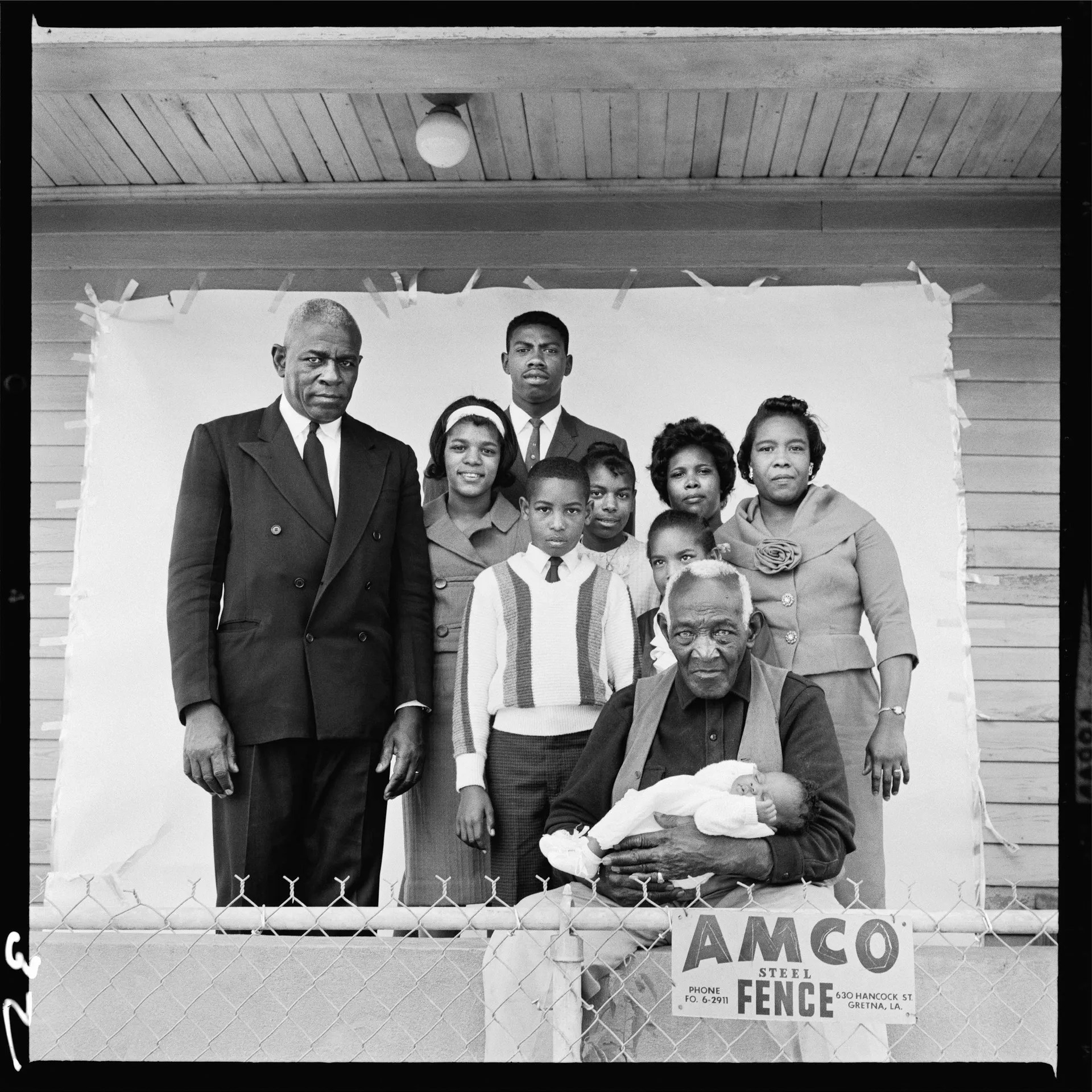
William Casby, one of the last Americans born into slavery with several generations, of his family in Louisiana, 1963, Richard Avedon photo
“I have slept on rooftops and in basements and subways, have been cold and hungry all my life; have felt that no fire would ever warm me, and no arms would ever hold me. I have been, as the song says, ‘buked and scorned and I know that I always will be. But, my God, in that darkness, which was the lot of my ancestors and my own state, what a mighty fire burned! In that darkness of rape and degradation, that fine flying froth and mist of blood, through all that terror and in all that helplessness, a living soul moved and refused to die.
“We really emptied oceans with a home-made spoon and tore down mountains with our hands. And if love was in Hong Kong, we learned how to swim. It is a mighty heritage, it is the human heritage, and it is all there is to trust. And I learned this through descending, as it were, into the eyes of my father and my mother. I wondered, when I was little, how they bore it-for I knew that they had much to bear. It had not yet occurred to me that I also would have much to bear; but they knew it, and the unimaginable rigors of their journey helped them to prepare me for mine.
“This is why one must say Yes to life and embrace it wherever it is found—and it is found in terrible places; nevertheless, there it is; and if the father can say, Yes, Lord, the child can learn that most difficult of words, Amen. For nothing is fixed, forever and forever and forever, it is not fixed; the earth is always shifting, the light is always changing, the sea does not cease to grind down rock. Generations do not cease to be born, and we are responsible to them because we are the only witnesses they have. The sea rises, the light fails, lovers cling to each other, and children cling to us. The moment we cease to hold each other, the moment we break faith with one another, the sea engulfs us and the light goes out.”
–James Baldwin, Nothing Personal (1964)
There is so much to love in this passage from James Baldwin in his 1964 collaboration, Nothing Personal, with legendary photographer Richard Avedon. The pairing came about as the two had both attended DeWitt Clinton High School in NY at the same time and became reacquainted years after when both had had achieved great fame.
There’s much that I could go on about in this passage, about the human capacity to endure, overcome, and achieve. About embracing life, even in the worst of times. About learning to accept the certainty of change, to understand that nothing remains forever in place. About how we, as the current generational heir of this legacy, owes future generations the benefit of our observations and insights so that the potential of their world might one day eclipse our own. And about how it only continues to stay intact so long as we love and trust one another.
That is a heap of wisdom in a few paragraphs. I could go on and on about it but it would most likely only serve to dilute the tonic in Baldwin’s words.
Instead, let me focus on one sentence from a 2017 review in The New Yorker of the reissue of the Avedon/Baldwin book that year. In the review, critic /writer Hilton Als wrote about coming across the book in the public library as inquisitive 13-year-old. One phrase in a sentence of the opening paragraphs of Als’ review made me stop. It beautifully summed up my feelings about this passage and so much more:
I look at the images and read the book’s elegiac, crystal-clear essay in those library stacks because it’s the first time I see and realize that current events can be art, that being humane is an art.
Being humane is an art…
This phrase still stops me dead as I sit here in the dark this morning. I don’t know that I need to say anymore. At least anything that would add anything of value.
I will say that it sometimes seems like a lost artform. But to see someone practice this ancient art that has descended from our prehistoric past and sustained us through the darkest of ages to this very moment is still a source of great wonder for me, especially when witnessing those who are obviously more skilled than myself display the gift that is their humanity with such grace and ease.
It makes me want to practice more, to become better and better at this artform that sometimes feels awkward and clumsy in my hands. It gives me hope that others will feel equally inspired to try their hand at this ancient and lovely artform.
I can’t add any more here. A song just came on, a longtime favorite. It seemed to be destined to appear at this very moment, as a sign that I should stop and just listen. That’s part of this artform, you know. Here’s that song. It’s from the White Stripes. Here’s We’re Going to be Friends.
I was going to end by telling you to get the hell out of here. But I decided against it. How’s this: Leave now, PLEASE.
See? Maybe I’m getting better at this artform, after all.


 Redtree Times