Feeds:
Posts
Comments

Posts Tagged ‘Strata’

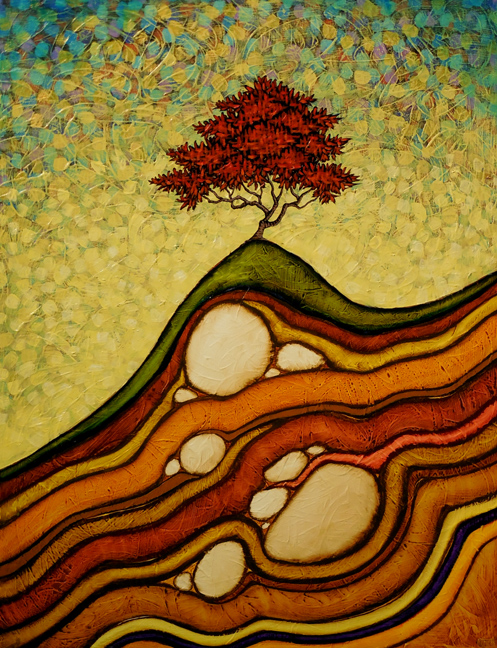
GC Myers-  In the Pocket of Time sm

In the Pocket of Time, 2014


The crystal sphere of thought is as concentrical as the geological structure of the globe. As our soils and rocks lie in strata, concentric strata, so do all men’s thinkings run laterally, never vertically.

Ralph Waldo Emerson, The Method of Nature (1841)


I came across the passage above from an Emerson essay and decided to look it up to find the context from which it came. It originated in an essay/oration that was written in the 1839-1841 period and was titled The Method of Nature.

I am still trying to glean the exact meaning of the essay but the section that contained the line above speaks about how those who, in any time, claim to have the answers to existential questions or insights into the deepest concerns of mankind eventually reveal themselves to be superficial. Their thoughts seldom, if ever, dig deeply enough to reveal eternal truths that might unify all people and times.

As he put it, their thinking runs laterally, not vertically.

I immediately felt that this might be applied to the painting the top, In the Pocket of Time. It’s a painting (30″ by 24″ on canvas) from 2014 that I brought to the Principle Gallery this past weekend as part of a group of work featured at my Gallery Talk there. It is from a subset of my Archaeology series that I call my Strata work. It is much like the Archaeology pieces without evidence of humans, focusing instead on the layers below the surface.

This particular painting from that Strata series has been with me for a while now. It hung for the last few years in a back bedroom/storage space of my studio. It reminds me of fine wine as it seems to get better with time. I am more and more struck by its surface finish and the rhythm of the strata, as well as how well it transmits its feeling and message from the wall. It’s a piece that speaks directly to me.

Putting Emerson’s thought to it deepened my appreciation of it. I could see in it how we deal always with what is presented on the surface and how seldom we recognize how much more there is to discover if we would only dig a little deeper.

That might be a gross simplification. Or not. Who knows? The words and the mage just seemed to click for me and maybe that’s enough to say.

Let’s tie this up with some music. Here’s a 1992 song from Peter Gabriel titled Digging in the Dirt.  The video is from the same time frame as his Sledgehammer song/video and, like it, this video has some interesting visuals.
Read Full Post »

Archaeology: All We Leave Behind

Archaeology: All We Leave Behind

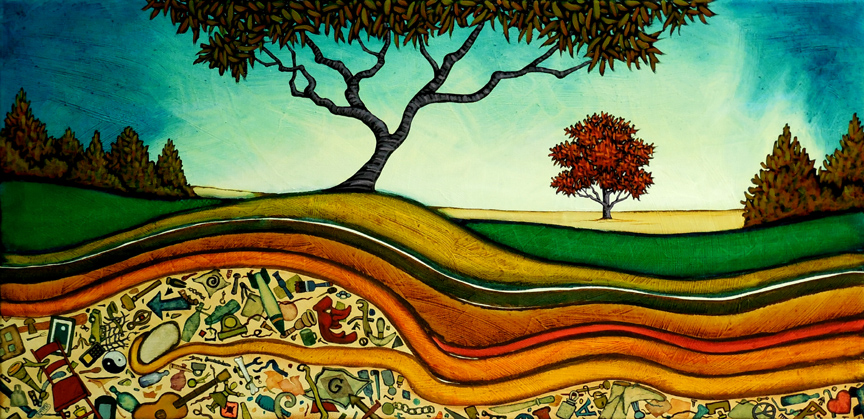
As the title suggests, there are a few paintings from my Strata and Archaeology series in the Layers show that opens Friday at the West End Gallery.  The piece above, Archaeology: All We Leave Behind, is a 12″ by 24″ canvas is the latest and perhaps last entry in the Archaeology series.

I am considering retiring this series that started back in 2008 although I can’t say I won’t revisit it at some distant point in the future.  It has been a series of paintings that has been among my favorites, both in painting and in delving deeper into them, as well as being important to my development as an artist.  When I first started the series, it came at point when I was in need of inspiration and was questioning my future as an artist.  These paintings gave me footing, a firm base to rest on while I gathered what I needed to move on.

Looking at these pieces, I am almost always surprised when I get to inspect the underground artifacts.  So many of the items  were painted  without any forethought or afterthought so once they were done and I had moved on to the next item in the debris field, they sometimes escaped my notice of their singularity.  They just became part of a larger pattern of forms and color.  But going back and looking at the items later gives me little surprises that sometimes make me smile and sometimes scratch my head, wondering what the hell some not quite recognizable thing is or what I might have meant by its inclusion.

But all things must come to an end, which is actually the theme of this series.  And this piece, which took over a year to complete as I worked on it a bit at a time,  seems like a fitting end.  And if it does end up being the last in its line, what better place to show it than where my little journey as a painter began back in 1995, the West End Gallery.

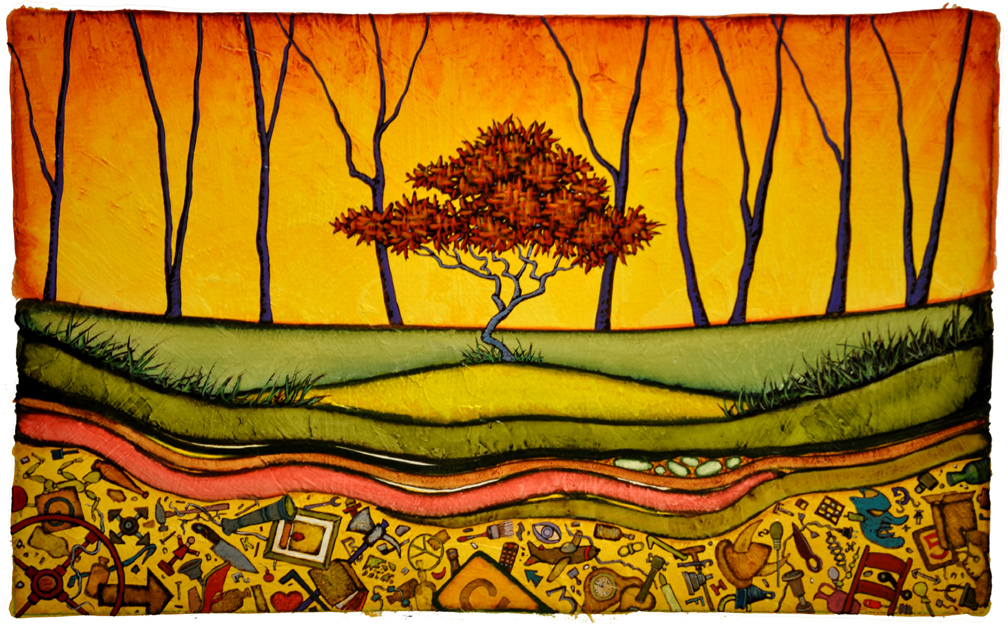
Here’s another Archaeology piece in the show, Archaeology: Formed in the Past,  one from a few years back that has a favorite of mine from the minute it was completed:

Archaeology: Formed in the Past

Archaeology: Formed in the Past

Read Full Post »

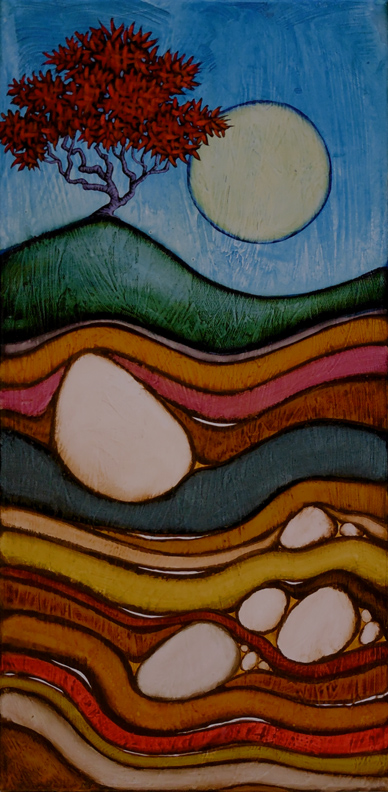
Strata smI’ve been working on a new group of pieces that incorporate the layered  elements, the subterranean strata,  from my Archaeology series. I decided to forego the field of artifacts that mark the Archaeology work, instead focusing on the color and  organic lines of the layers and the geometry of the boulders and stones between them.  These layers and forms take on an abstract sense that really appeals to me, especially when countered against the representational feel of the surface elements– the Red Tree and the sun/moon.

For me, the resulting image takes on a really contemplative feel.  Maybe it’s the idea of seeing  a cross-section of the immense changes that time brings, reminding me of our own relative smallness in the larger picture.  Any one of those layers, perhaps the thinnest ones,  could represent our time on this planet.  It takes away a lot of the hubris and bluster of man and reduces it to an organic line.

And in the end, life still goes on in the form of the Red Tree.  It may not be the human form that we hope for but it is life, nonetheless.

Life persists.

And even without us, the human race, that in itself is comforting.  That is,  if you believe that there is a unity and a force that connects us to all living things, great and small.  In that sense, we might still be around to look upon that sun/moon many, many millennia from this moment.  And I find that sort of comfort, both humbling and reassuring,  in this series of layers and color.

Read Full Post »