This is another small painting that is part of the Little Gems exhibit opening this coming Friday at the West End Gallery. This is a little 3″ by 5″ piece on paper that I call The Blue Cool. I guess that it arose from the current frigid temps that we are in here in the Northeast. The sky here is in three blocks of an aqua blue color that has a transparency that makes them seem like thin slabs of ice. I don’t know if this quality shows up on the computer screen but when this piece was in the studio I always felt like holding it up to the light to see light shine through the ice that I felt like I was seeing.
It’s a simple meditative piece, what I like to typically see in these small works. The small scale lends itself to simplicity. Maybe this built-in restraint is one of the reasons why I enjoy painting these small pieces and why I feel they often work so well.
I don’t know for sure. And I think that uncertainty or puzzlement is sometimes a good thing. It creates a sense of wonder and surprise and that is always a good thing.
I thought for this week’s Sunday music I would stick with the Blue theme and some blue cool jazz from one of my favorites, the late great Chet Baker. The song is Born to be Bluewhich is also the title of a film currently in production about Baker’s life with Ethan Hawke portraying the gifted but tragic trumpeter. His story reads like a screenplay– Golden Boy of jazz with movie-star looks loses everything to drug addiction and violence and tries to find redemption. I’ve thought for years that it was meant to be a film and now it is, hopefully one that does the story justice.
When I listen to Baker’s music, I hear it with that same sense of uncertainty and puzzlement I alluded to above. There’s just something natural and right in it that can’t be, or shouldn’t be, defined. It just is. Give a listen and have a great Sunday.
Four years ago I posted a description of one of the process for one of my paintings, followed by a short video showing its evolution from start to finish. I thought it might be a good time to revisit it as there are many new readers who may not be familiar with how my work comes together. I paint in two distinctly different processes, one being a reductive process where I put paint on the surface then remove much of it and this process that is additive, with layer after layer of paint building up. Here’s what I wrote in January of 2011:
I worked on a new piece the last couple of days, a large canvas that is 24″ by 48″. I had already gessoed the canvas with a distinct texture and applied a layer of black paint. I had vague ideas of where I thought the painting might go from a composition standpoint but knew that this was only a starting point in my mind. Like most of my paintings, the finished product is often drastically different than what I imagined at the beginning. As I paint, each bit of paint dictates the next move and if I don’t try to force in something that goes against these subtle directions given to me by the paint the piece usually has an organic feel, a natural rhythm in the way the different elements go together. A cohesion of sorts.
Knowing I wanted to use a cityscape in this piece, I started in the bottom left, slowly building the city with geometric forms and rooflines in a red oxide paint that I use to block in my composition. I like the red oxide because ti gives a warmth under the layers paint to come that comes through in small bits that are almost undetectable at a quick glance.
At this point I still am unsure where the painting is going. I have thoughts of filling the canvas completely with the cityscape with the smallest view of the sky through the buildings but am not married to this idea. The paint isn’t telling me enough yet to know. But it has told me that I want a path of some sort- a street or canal- through the composition. I make room for one near the center before starting on the right side with the buildings there. I go back and forth between the right and left sides as I build the city, constantly stepping back to give it a good look from a distance to assess its progress and direction.
At a point where the city is nearing the halfway point on filling the canvas, I decide I want this piece to be less about the cityscape and more about how it opens to the open sky beyond it. I extend the road that started at the bottom and twist it upward, terminating it at a bend in what will be now a field beyond the city edge. The sky, though still empty, is pushing me ahead, out of the city. The piece has become about a sense of escape, taking the street from the cityscape and heading upward on it towards the open fields and sky. Painting faster now, another field with a bit of the road appearing is finished beyond the first lower field. I have created a cradle in the landscape for the sky to which I now turn my brush.
There’s a certain symmetry at work here and I decide I want the central focus of a sun in this composition. I roughly block in a round form, letting it break beyond the upper edge of the canvas. I pay little attention to the size of this sun except in its relationship to the composition below it. My suns and moons are often out of proportion to reality but it doesn’t matter to me so long as it translates properly in the context of the painting. If it works well, it isn’t even noticed.
I finish blocking in the sky with the red oxide, radiating the strokes away from the sun, and step back. The piece has become to come alive for me and I can start to see where it is going. The color is starting to fill in in my mind and I can see a final version there. This is usually a very exciting time in the process for me, especially if a piece has a certain vitality. I sense it here and am propelled forward now, quickly attacking the sky with many, many brushstrokes of multiple colors. working from dark to light.
There are layers of a violet color in different shades that are almost completely obscured by subsequent layers. I could probably leave out these violet layers but the tiny shards that do barely show add a great depth to the flavor of the painting for me and to leave them out would weaken the piece in a way.
I have painted several hours on the sky now and still have a ways to go before it reaches where I see it in my mind. There are no shortcuts now. Just the process of getting to that final visualized point. But it’s dinnertime and my day is now done. I pick up and step back to give it one final look before I head out into the darkness. This is where the painting is at this point, where I will start soon after I post this:
In the blog post with the final version I then wrote:
I will say that the final version is much different in many ways than I first envisioned with the first strokes of red oxide that went on the canvas. Each subsequent bit of color, each line that appeared, altered the vision in my head just a bit, evolving the piece constantly until the very end of the process. Even the last part, where I inserted the treeline that appears on the farthest ridge, was not seen in my mind until just before the decision to proceed with them was made. I decided to go with this treeline to create a final barrier for the road to break past on its way upward toward the sky. A final moment of escape.
And here’s the video, only about a minute long, that shows how the piece came about.
It’s New Year’s eve tonight and we’ll shake off the dust of yet another year and move into the next, all clean and shiny with that new year smell. Well, that’s the popular belief. We are, of course, who we are and no amount of calendar voodoo will alter that.
But that’s okay. We should be okay with ourselves and just ride along on the tides of time. Good and bad things happen along the way and both can be tolerated if we just can understand and accept who we are.
I think that’s why I chose this painting at the top and the song below to end 2014. The painting is titled Brighter Days Ahead and has a brightness and optimism that jibes well with its title. But the darkness underneath gives it some balance that keeps it from being too giddily gleeful.
Yes, there are brighter days ahead but there are some darker ones as well. But having a belief in who we are, believing that we have the balance and strength to withstand troubles and accept the good with grace makes this brightness seem more tangible and less wishful thinking.
The song, New Year’s Prayer, is from the late Jeff Buckley who in his short life left us a remarkable version of the Leonard Cohen song, Hallelujah, and much more. This song has a mantra-like feel to it with the phrase … feel no shame for what you are… as a refrain. It doesn’t look forward or back with any hope or regret– it is just in the moment. And that’s how I feel about the turning of this year.
Wishing you all a good New Year with the hope that feel no shame for what you are.
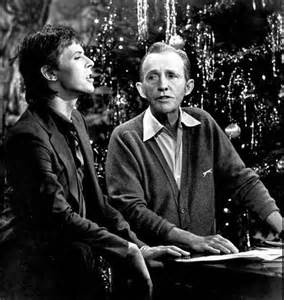
Well, it is Sunday morning and that usually means that it is time for some music here. Since it is the last Sunday before Christmas a little holiday music is called for. This is a song that I have played here before. It’s that odd pairing between Bing Crosby and David Bowie and the song The Little Drummer Boy/ Peace on Earth.
The story behind how it came about is pretty interesting. In 1977, 73 year old Bing Crosby was in the midst of what would be his last British tour. While there , producers put together Crosby’s annual holiday special for American TV, this time with an English theme, a Merrie Olde Christmas. It was filmed in September with a number of British celebrity guests, including the 30 year old rock star David Bowie. Bing actually introduced and showed the video to Bowie’s song Heroes on the special.
On the day of shooting, Bowie learns that he is scheduled to sing Little Drummer Boy with Crosby. He balks, telling producers that he hates the song and if that’s the song they wanted he might as well leave. He said he was only there because his mother was huge Crosby fan.
Producers and composers went to work. In just over an hour, they produced an original tune, Peace on Earth, that would be sung by Bowie as a counterpoint to Bing’s Little Drummer Boy. The two singers both liked the new addition and the arrangement and ran through it together several times in less than an hour before recording the final version.
Bing Crosby died less than a month later and the special ran as scheduled in December of 1977. The pairing of Bing and Bowie was considered an oddity then and producers of the show and song thought that was the end of it. But bootlegs of the song circulated for several years, gaining in popularity to the point that RCA decided to release it as single in 1982. It has become one of the most popular holiday songs in the intervening years.
I know it’s one of my favorites. Have a great Sunday…
At the Kada Gallery opening last week, a very pleasant man asked if my work was influenced by the Peanutscartoons. He said the work had that same feeling for him. I laughed and said that, of course, these cartoons had been a large influence on my work and probably the way I see things in general. After all, Snoopy was the first thing I ever learned to draw, the result of an older boy on my school bus ( thank you, Tom Hillman, wherever you might be) showing me how to do so in several easy steps. Throughout grade school Snoopy was drawn all over every piece of paper I came across, his Joe Cool and World War IFlying Ace characters being personal favorites.
I explained that many of those early cartoons — the great Chuck Jones’ Looney Tunes , the very early Popeyes , the Disney cartoons with their gorgeous color, and so many more–informed and influenced the way I looked at things and set a pattern for the way I would later interpret the landscape. They created a visual shorthand in the work that simplified the forms in the surrounding landscape yet still gave a sense of place and time and emotion.
And that’s precisely what I try to do in my work today.
For me, A Charlie Brown Christmas is as close to perfect as any cartoon can be. It’s a wonderful blending of mood, movement and music with a smartness and charm that never seems to diminish. For this week’s dose of Sunday morning music, what could be more fitting than the Vince Guaraldi’s Christmas Dance from it?
Have a great Sunday and, if you feel like it, dance along with the Peanuts gang. It’ll do ya’ good…
Great opening night for my show, Into the Common Ground, this past Friday at the Kada Gallery in Erie. Great crowd with a nice mix of people, old and new to my work. Good questions and conversations. Just a very successful show opening all the way around.
Many, many thanks to Kathy, Joe and Morgan at the Kada for making it such a wonderful night and making me feel like a part of the family there. Also, many thanks to everyone who came out and took part. I can’t tell you how much it is appreciated. And thanks to the weather for being relatively mild, a sometimes rare thing on the shores of Lake Erie in December.
Thank you!
Well. that being said, it is time for a little Sunday music. I was thinking Otis Redding and that voice that I could listen to sing almost anything. It’s hard to believe that in a few days it will 47 years since he was killed in a plane crash in 1967 at the age of 26. Hard to imagine what might have come from this huge talent. But he did leave behind an impressive legacy of music, including this great version of the Sam Cooke classic A Change is Gonna Come. It gives you something to think about on this Sunday morning.
I thought I’d play some music for this Sunday music with the theme being giving thanks. Looking around, I found there weren’t a lot of choices and none that really were explicitly about the holiday. I guess the circumstances of the original event didn’t lend themselves to really interesting holiday music, certainly not on the level of Christmas songs and carols. But whenever I think of songs that mention thanks in them, even in a way that barely grazes the idea of Thanksgiving, I always immediately come back to the song of thanks from the magnificent funkiness that is Sly and the Family Stone.
Of course, I am talking about Thank You (Falettinme Be Mice Elf Agin.) Love the wordplay.
I wrote about Sly Stone back in August on the 45th anniversary of his epic Woodstock appearance. I mentioned then that whenever I hear something from him I find myself wondering why I am not listening to him all the time. It seems to always perk me up, make me feel invigorated. And this song is no different.
So, while it might not be on the playlists of any Pilgrims, here is a little Sly to kickstart your Sunday. Have a great day and give some thanks to someone or something today. Why wait until Thursday?
I am really busy this morning with the last details of preparation for the upcoming Kada Gallery show. I am a little hectic but felt compelled to put something up on the blog out of a sense of obligation to the regimen that has been formed over the six years that I have been writing this blog. I always feel somewhat guilty if I miss more than a day. Five years ago, I shared a video of female portraits throughout the art of last 500 years that was put together by video enthusiast Philip Scott Johnson. It was a well done assemblage with portraits morphing from one to another and was immensely popular with over 14 million views on YouTube.
I came across another of his morph films, this time featuring the portraits of Pablo Picasso. I thought I would share this short but interesting film today.
I sometimes think that Picasso’s immense worldwide fame, especially around the 60’s and 70’s, kept me from fully appreciating his work. I never thought of him as an artistic inspiration for my own work but over time I have found that his work almost always captures my attention when I come across it. There is usually something in it that has that sense of rightness I often struggle to explain here. I have become, more and more, a fan of his work over the years.
Take a look at the film and see for yourself in this great little film that features the laying of Yo-Yo Ma.
I heard a version of Duke Ellington‘s signature tune, Take the “A” Train, the other day that caught me off guard. The music was playing in the background and I caught the notes of a tune that made me stop and listen. It was so familiar but it was so different. Then I recognized it and realized it was someone other than the Duke and his orchestra. It didn’t have the urbane and upbeat swing, that joyful feeling of breezing carefree along that marked the original.
No, it was a slow jaunt, a meandering and elegantly peaceful ride. No horns. Just a thumping upright bass and gorgeous piano work over some light drum work. It was still the same tune but it was oh so different in feel. It was from jazz great Ray Brown and his trio– Gene Harris on the piano. Beautiful stuff.
It reminded me of the times when I had taken the color from my work and work in tones of gray or sepia just to change things up a bit, to cleanse the palette so to speak. The piece shown here on the left is an example.
I described it as being like hearing a song that you’ve heard a thousand times before then hearing a completely different take on it. It’s the same tune, same notes and chords, but it just feels different, opens up something new inside. This version by the Ray Brown Trio is exactly what I was describing.
It is the same but different. Plus soaking in that bass thump is just a great way to kick off a quiet Sunday morning. Have a great day…
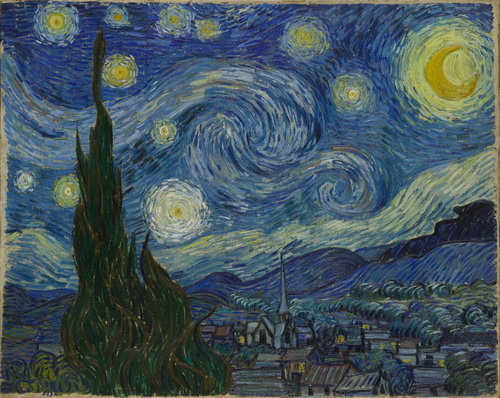
The Starry Night by Vincent Van Gogh is one of the most beloved paintings of all time, stirring all sorts of emotions from a wide spectrum of the population as it presents a paradox of serenity and turbulence in the night sky of Provence. It has been analyzed to death by art critics, psychologists, theologians and every art history student since it was painted in 1889, each striving to explain the meaning that they pull from it.
And maybe they’re all right.
But recently there has been a different analysis of this work. It has to do with fluid dynamics and the problem of finding a mathematical equation for turbulence– the sort of turbulence you might see in an eddy in a stream or that which is depicted in the swirling light and color of Van Gogh’s painting. Russian mathematician Andrei Kolmogorov (1903-1987) came closest to solving this problem in the early 1950’s yet it remains one of the great unsolved problems of physics.
Back in 2004, the Hubble telescope picked up images of eddies of gas and dust around a distant star and scientists were reminded of Van Gogh’s painting. Scientists from a number of countries collaborated on an analysis of the luminance in his painting and discovered that the structure of his painting was very much patterned like Kolmogorov’s equations for turbulence.
I am not going to say much more. There is a wonderful short film below from TED-Ed and Natalya St. Clair that much better explains this. But before you watch, I wanted to add one more thing which is the supposed inspiration for Van Gogh’s sky.
There was a drawing that was well known in Europe in the latter part of the 19th century that was done by William Parsons, also known as Lord Rosse, who had built a large telescope on his Irish castle in the 1840’s. Called Leviathan, it was the largest telescope in the world until 1918. With it, Lord Rosse was able to observe the great swirls of the near universe, turning them into drawings which circulated throughout Europe. This one shown on the left is of the Whirlpool Galaxy, M51, and is believed to have been the spark for Van Gogh’s sky.
Anyway, watch this great short on the analysis of Van Gogh’s great painting. Or perhaps you would rather just be content with our own interpretation of the work and what it does for you personally. Either way is good.
 This is another small painting that is part of the Little Gems exhibit opening this coming Friday at the West End Gallery. This is a little 3″ by 5″ piece on paper that I call The Blue Cool. I guess that it arose from the current frigid temps that we are in here in the Northeast. The sky here is in three blocks of an aqua blue color that has a transparency that makes them seem like thin slabs of ice. I don’t know if this quality shows up on the computer screen but when this piece was in the studio I always felt like holding it up to the light to see light shine through the ice that I felt like I was seeing.





 Redtree Times