Feeds:
Posts
Comments

Archive for January, 2010

I can’t believe I failed to mention the birthday of Elvis Presley, who would have turned 75 a  few days back.  It’s not that I was the hugest of Elvis fans although I was an admirer of many of his songs and performances and recognized the attraction his talent had for many.  It’s just that in death he has become this cultural phenomenon, an icon that has taken on almost mythic and mystical qualities for his ardent fans.

That’s kind of what I saw when I painted this small piece a few years back.  It’s called Elvis in the Wilderness which recalls Moses‘ exile to the wilderness.  I may do a follow-up where Elvis leads the exodus from Eygpt.

Or maybe Elvis healing lepers.  Or perhaps traveling through time, battling various injustices throughout history.  Elvis in hand to hand combat with the tag team of Hitler and Mussolini.  Elvis at Valley Forge.

TCB, baby.  Just like the 3 letters on his huge belt buckle indicate.  Taking care of business.

It could be anything, anywhere.  That’s the beauty of Elvis as a mythic character, a superhero.  He fits easily into any time and setting with the powers imbued on him by his fans and as a result, never really dies.

Here’s a performance that I really love if only for the iconic stance in his white suit before the huge ELVIS sign.  Great visual.

Read Full Post »

Work! labor the asparagus me of life; the one great sacrament of humanity from which all other things flow — security, leisure, joy, art, literature, even divinity itself.

Sean O’Casey

.

.

.

I had the movie Young Cassidy on in the studio yesterday which is a mid-1960’s biopic  starring Rod Taylor as the great Irish playwright Sean O’Casey.   It documents the formative years up to the time when he finally had his first plays produced at the Abbey Theatre , the first being in 1923 when he was 43 years old.  It ends with the production of his play,  The Plough and the Stars , which caused  riots at the time and propelled him into a career as a full-time playwright.  He had worked as a laborer for the many years before this breakthrough and as a result his work often dealt with the inequality of  the classes and other societal ills.

I can’t say that it was a great movie but it was pretty good, good enough that it made me think.  Think about O’Casey’s work and how it was shaped by his early life, living in poverty and oppression.  Think about how such inequalities still rule our world and how we so willingly live with them so long as it doesn’t affect our own little worlds, so long as we don’t have to think about them.

Makes me glad there were men like O’Casey to inflame thought and passion with their work,  because to make us think is to put us on the road to action.  It seems that such thought is a rare commodity today even with the billions of words that spring forward every day on the web, on blogs like this, on Twitter, on text messages and on and on.  We talk and talk, blathering on and on (this is a prime example!) but are these words adding anything to the greater good?  How many of these words make us stop and think or inspire us to action?  Or is action lost in the deluge of words?

Could we even hear the words of an O’Casey today in the din of all these meaningless words?


Read Full Post »

This is my first complete piece of 2010,  a 30″ wide by 40″ high painting that is tentatively titled Raise Your Eyes.  It’s a continuation, of sorts, of my Red Roof series.  Instead of focusing on doorless and windowless structures, like many of the other pieces in this series, this painting is actually centered around the multitude of windows and doors present.

It creates very much the same feeling, for me, as the earlier doorless pieces, of solitude and maybe even a bit of alienation within an inhabited space.  However, there’s more of a busy feeling as though the windows were actually eyes.  It’s that feeling of being on a busy street yet feeling completely anonymous.  That’s what I wanted to make the lone tree stand out a bit more as the central voice in this painting, as it stands in relation to the sun.

I painted this with  larger brushes than I normally use for this type of painting.  It gives the structures and their doors and windows a little rougher, less precise and fussy appearance.  It creates a rhythm and motion of its own within the picture.

The central tree is also a bit against type for my work.  It’s not the red tree you might normally see.  I chose to go with a green leafed tree for this piece, to counter the reds of the roofs.  Again, it makes it stand out a bit more

I’ve spent a lot of time looking at this and there are a lot of things that I like about this piece.  The size and the warmth of the colors makes it  a pretty dynamic piece to view.  Hopefully, this is a good start to a good year of painting…

Read Full Post »

When we were driving back from my great-nephew’s birthday yesterday, Cheri mentioned something that a friend had told her earlier this week.  It was a minor incident, one of no great consequence, that happened locally.  Neither of us had heard anything about it nor had we seen it in our local newspaper.

I said that it was the type of thing that you would have seen in local newspapers of the past but which no longer appeared in the new reality of print journalism.  Our local newspaper, the Elmira Star Gazette, which was the first newspaper that Frank Gannett operated on the way to building his news empire, has evolved over the years from an informative, vital chronicle of the local area to  a much leaner, less informative leg of a group of local  newspapers that is more regional in coverage, sharing reporters and coverage.   As a result, there are  fewer reporters covering much greater areas with less space to fill on the pages of each paper.  Local coverage consists of a page or two, at best.

Gone are the little details that newspapers of the past provided, the minutiae of day to day life in a locality that gave the reader a true feel of the newspaper’s area of coverage.  Less coverage of small incidents, minor arrests, social gatherings, small local events, etc.  The type of things that give an area’s readers a sense of definition of what they are as a community.

That’s a lot to lose.

My fear, which is beyond nostalgic longings for a return to some idealized past, is that the generations of the future will actually have a harder time trying to put together the day to day life of any specific area because of the loss of this minutiae  that was in the past always gathered in one convenient source, the newspaper.  For instance, as I’ve written before, I didn’t know much, practically nothing, about my great-grandfather’s life in the Adirondacks in the late 19th and early 20th century.  But by reading the old newspapers of that time and locality ( St. Regis Falls) I was able to get a very good an detailed idea of how that area’s inhabitants lived their lives, their social  and family networks and how they operated and interacted as a community.  It seemed like every little detail was chronicled in some way that I would never be able to find in today’s papers.

It gave depth and detail to a time and place that is a distant point in the past.

With the loss of the newspaper’s effective local coverage, I don’t know if the same could be said today, even with all the awesome sources of information available to us.  There is an enormous amount of data, given all the new technology such as the internet, out there but it’s not unified and day to day in one specific area.

Maybe I shouldn’t care about this.  Who does?  And maybe I’m just plain wrong.  Maybe it will be easier in the future to pull all the data together and get an idea of how specific people lived in specific localities.  I just feel there is a loss here that goes beyond the purely nostalgic, especially when examining the historic anthropology of a given area.

I think a small part of our cultural voice and identity will fade away…

Read Full Post »

When I was first starting to paint, one of the painters that I admired when I first ran across his work was the Modernist painter of the early 20th century, Arthur Dove.  As I was beginning to form my own visual vocabulary, I found many similarities in how Dove and I represented certain elements in our paintings. This gave me a feeling that I may be following the right path and gave me a little more certainty and confidence in my own work.  I was also drawn by the duality in his work between the abstract and the representational.  There was always the sense that you were looking at something recognizable and familiar even when there was definite abstraction present.  This was something I have aspired for in my own work.

I didn’t know much about the man but was also pleased when I found that he was from the Finger Lakes region of NY  and had been educated just up the road at Cornell.  No big deal, obviously, but it gave me an insight into the influence of the local landscape in his work and his eye that I could compare to my own.

One of the factors in being self-taught for me, was in finding an artist that I could identify with , who seemed to have a similar feel for how things would translate in different media.  I am surprised, even today, how much of my early work resembles some Dove pieces that I have only seen recently for the first time.

I can’t say I loved all of Dove’s work.  I don’t know if anybody can say that about any other human if their work fully represents them.  But I do admire the spirit and feeling of his work and know my work is better for it.

Read Full Post »

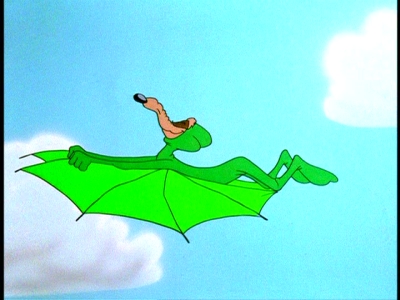
I probably would never take any hints for doing anything from watching Wile E. Coyote cartoons but when I see films of people in wingsuits stepping off sheer cliffs and soaring like rockets at 150 MPH only several feet from the face of the mountain, all I can wonder is Where did they get this idea?

Were these guys sitting around, eating bowls of cereal at four in the afternoon,watching cartoons and when the image of Wile E. in his 1950’s wingsuit came on the screen, thought, “That is so cool!  Let’s try that!” ?

I kind of hope so.  That means there’s still a possibility for rocket-powered rollerskates out there.

The first time I saw any video of these fearless fliers, it was a guy buzzing by the Giant Jesus on Sugarloaf down in Rio.  I couldn’t believe my eyes.  The guy was a streak going nearly horizontal across the sky.  Amazing.

Currently, the flights generally last a little over a minute until the flier opens his chute and sails easily to the ground but there are many who trying to develop suits that would enable them to glide to the ground without a chute.  That would probably allow for longer flight times.  Zowie!

I can’t even imagine standing at the precipice of a cliff, looking over at a couple of thousand feet of a sheer granite wall, let alone wanting to step off it with only a nylon suit and a giant set of cajones to take me to the bottom.  I am enthralled by their daring and ability to overcome the primal fear that must be present when they raise that first foot before the leap.  I don’t know that I’ve ever experienced anything near that burst of adrenaline that must be throbbing through them at that point and as I watch them from the safety of  my chair, I am both excited by their adventurous spirit and disappointed by my own.

It make me wonder.  Are these guys crazy? Or are  many of us too bound to this earth by our own fears?  Could I ever take that step?

Take a look at this before you decide if you’re willing to take that step.  It’s from the film, The Sharp End, which documents this type of flying and other extreme rocksports such as free-climbing without ropes and which comes highly recommended by my nephew, Jeremy, who dabbles in rock climbing out West.


Read Full Post »

I’m back to painting after a hiatus of about five weeks, one of the longest periods I’ve went without lifting a brush in the past fifteen years.  I really felt it was necessary at this point to just step back and take a pause.  Take a deep breath and let things build back up inside.

The last few days I’ve been working on a new piece that is a continuation of the Red Roof series.  It felt pretty odd, at first, to step before the easel again after such a long period.  In fact, I kept delaying it for the days before I finally started.  There was a slight fear that it would be a struggle to find anything there and it was easy to let myself be distracted by any and everything.

But I was finally there.  I had a knot in my gut and was really unsure but, as I do with the Red Roof pieces, I started with a block of color in the bottom left corner and suddenly the anxiety began to lift.  This first block started a chain of actions that began to spread, even before I painted them, across the canvas.  All the distractions receded to a point far in the distance and I was completely in the moment there in front of the easel.

Man, it felt good.  Felt right.

There are still distractions that pull time away from this feeling.  It still is going to take several days to be in full rhythm which is, as I’ve described before, a very important aspect in my process.  The rhythm I’m talking of involves total immersion in the surface, free of all distraction.  Every action is effortless and immediate.  There’s a freeing of something in the mind that allows color and form to flow easily out.

That’s still some time away but that first hour or so with the brush in hand let me know it was there to be attained.

It felt good.

Read Full Post »

This is Herb and Dorothy Vogel.  Herb’s retired from his job at the post office and Dorothy from a job as a librarian.  They live in a small apartment in NYC.  The only connection I have with them is that Dorothy is from my hometown of Elmira.  That and the fascination I have for the passion that they possess for collecting art.

You see, the Vogels have compiled one of the greatest collections of modern art in the world over the past forty eight years or so.

I’ve written before that art does not have to be the sole province of the wealthy, that art is accessible to most every income level if the person really feels the desire to collect.  The Vogels are positive proof of that.

They married in the early 60’s and immediately began their obsession, living on Dorothy’s income as a librarian and using Herb’s paycheck to buy art. They sought out new and what they felt were important artists, meeting them and learning about them as they acquired early, important works from the artists before they were discovered by the greater art world.  Many artists became friends and gave them numerous pieces until their small apartment was bulging.  Artworks under the bed, artworks on the ceiling, artworks in every nook and cranny– art consumed their home.

By this time, their collection was recognized throughout the art world as one of the largest and most comprehensive collections held by a private collector.  In the 90’s, the National Gallery of Art took stewardship of their collection, allowing the Vogel’s collection to live on long after they are gone.  It also allowed the Vogel’s the room, as the collection was taken by the National Gallery, to continue collecting with the same passion for the modern art they so loved.  It’s said that their collection is probably worth in the hundreds of millions of dollars today but that was never the reason behind their manic collecting.  It was about their love of, and connection to, the art.  It proves that wealth or income is not the primary factor in collecting.

Only a passion and desire.

The story of Herb and Dorothy Vogel is a great story and was the subject of an award-winning documentary this past year called, of course, Herb and Dorothy.  There is also a ton of written articles and broadcast stories out there about the Vogels, so please look them up.  You may not like a lot of the work they collect but their passion is worth watching.

Here’s a trailer for the documentary:

Read Full Post »

Yesterday was the annual appearance of the Mummer’s Parade from Philadelphia, which has been going on for a couple of hundred years there although the first “official” parade was held in 1901.  It’s usually held on or around New Year’s Day and fills Broad Street in Philly with incredibly costumed bands playing out pretty ornate choreographed pieces.  The amazing thing is how much effort is put in by the social clubs of that city throughout the year, practicing and making the stunning costumes, for the five minutes or so they get in the spotlight.

The idea of the Mummer’s Parade is derived from the Mummer’s Plays of medieval Europe where groups of costumed performers went door to door, acting out their simple plays which had many regional variations but normally involved a Hero being killed by some sort of evil opponent then being revived by a Doctor of sorts, usually on the day after Christmas.  It has survived in many parts of the world and is still often practiced during the holiday season with revelers going from home to home, singing and accepting drinks and such from their hosts.

They show part of the parade annually on WGN , the nationally broadcast superstation out of Chicago, and we always watch at least part of it.  It’s a great scene and you have to admire the dedication these groups have for the tradition of this parade.  Cheri has often said that it would be a great setting for a movie from Christopher Guest and company, of Best in Show, A Mighty Wind and Waiting For Guffman fame.  These movies usually have self-contained environments and casts of really interesting characters.  Perfect fit for this parade. Maybe Murder at the Mummers?

Here’s an example of one of the string bands, one of the different competing divisions:

Read Full Post »

First Time

I received an e-mail this morning from a person who was looking to obtain her first painting and was asking for some advice on where and how to buy.  This is an e-mail I receive quite often and I’m always particularly interested in the first-time collector.  There is something very exciting in that first acquisition, for them and for me as well.

For the would-be collector, there is that first flush of excitement in finding something original that really strikes a chord within them, that triggers some emotional response in them unlike any time before.  A response strong enough to make them willing to make a leap of faith based on their own subjective view of a piece of art and spend more money than they normally would on something for just themselves. With this excitement there’s also a bit of fear mixed in.  They’re doing something they’ve never done before and they afraid of making a mistake, afraid of turning this initial giddiness of discovery into an event of regret.  It’s a big, scary step into a world that seems foreign to them.

I understand that all too well.  Maybe that’s why I find first-time collectors so appealing.  I really like the idea of de-mystifying the process of art buying and letting people know they have nothing to fear in most galleries.  They see the art galleries as dens of snobs and elitists, a place where their choices will be belittled or mocked for a lack of knowledge.  In fact, there is truly no right or wrong in choosing a piece of art nor is there any secret knowledge required.  If you like something, you like it.  If you don’t, you don’t.  My response to people who say, embarrassed,  that they don’t know anything about art is to say , “Well, you know what you like and what you don’t.  What more do you need to know?”

All that’s needed is the courage to take that small leap.

For me, I am drawn to this leap they’re willing to make.  I know when they take that first piece into their home, it will mean something very special to them even if they go on to obtain more art in the future, especially if it takes a sacrifice of sorts to get that first painting.   And if it is the only piece they ever buy, it will maintain a place of honor in their home.

And that’s all an artist can ask for his work- an audience that will continue to enjoy their work for years to come.

Read Full Post »

« Newer Posts - Older Posts »