Feeds:
Posts
Comments

Archive for April, 2010

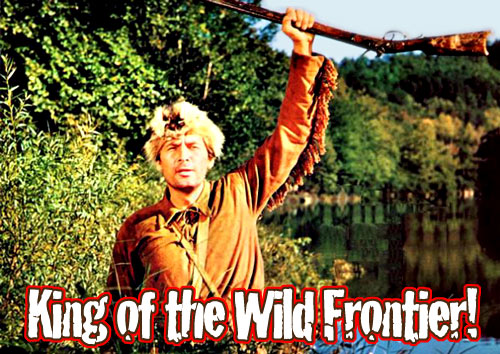
Fess Parker died last month.  He probably isn’t too well known to the younger generations but for anyone who grew up in the 50’s and 60’s, he was a big deal.  Portraying Davy Crockett in the movies and Daniel Boone on television, Parker was one of the biggest stars for kids of that time.  He became the personification of the mythical American frontiersman, the civilization shunning, wise old man of the mountains who lived off the land and gloried in his personal liberty.

Elbow room! cried Daniel Boone.

Popular myth has long glorified the lives of Boone and Crockett.  In the 1780’s, Boone exploits entered popular culture in a book that was more myth than fact.  It became a huge hit here and abroad, creating a legend that took on a life of its own, even influencing Lord Byron to make mention of Boone’s tales in his Don Juan.  He was portrayed as an Indian-fighting man of action who continually fled the reach of an ever impinging civilization.  A man who lived by his own rules without any concern for government.  Davy Crockett, in popular legend, was seen in much the same terms.  This mythic image of both has found its way into our collective psyche where it still dwells today, influencing our very definition of American liberty and the relationship of the common man to our government.  The Tea Party movement is filled with folks who grew up with these myths and surely believe that they can live a life like Daniel Boone or Davy Crockett, if only they could break the shackles of  government.

Unfortunately, many of the myths surrounding both men are unfounded and their real lives run counter to those who hold up their mythic images as a rallying flag.  Both were men were land-owners and served the government, Boone serving as a legislator and sheriff and Crockett as a congressman.  Both were leading citizens of their communities and basically enacted governance wherever they lived, prospering in civilization.  Boone’s biggest gripe with government came when he lost several land claims in a legal dispute about the same time he lost a government bid to another bidder for a contract to widen the Wilderness Road to aid in the westward expansion of the country.

I don’t really know why I’m mentioning this today.  Maybe it’s frustration at the rhetoric of some of the anti-government groups that have been filling the air recently.  Their usurping of American myth to fit their own selfish aims reminds me of evangelists who pull verses from the scriptures and throw them around out of context to prove their own selfish point.  Maybe that’s what I’m looking for here- context.

And an end to living a life based on unfounded myths such as the rugged individualist.

Read Full Post »

I often get comments from people asking about the Eastern, particularly Japanese, influence in my work.  While it has never been intentional, I have always been drawn to the prints of the Japanese masters Hiroshige and Hokusai and their influence inevitably finds its way into my own work.

I find the rhythm and structure of Hokusai’s wave prints very appealing.  There is a great combination of quietude and motion in the prints, brought to great effect with the use of gorgeous colors and impeccable design.

Along with this dichotomy of quiet and movement, there is a omnipresent sense of the immense force of nature over man.  Hokusai often has Mt. Fuji in the distance behind the curls of his powerful waves, reinforcing the power and sanctity of nature.  The finger-like  quality of the edges of the breaking waves seem like the hand of mother nature reaching out to slap at the reaching hands of her children, the boatmen.  Again, reinforcing the dominance of nature over man.

There is a lot more I could say about Hokusai’s work but so much of my appreciation for it is almost indefinable.  The work allows me to enter and translate it easily and thrill in the beauty of the lines and hues of the picture plane without determining why I am drawn to it.  This unquantifiable ease of translation may be the element of Hokusai’s work that I desire to see in my own work.

Great stuff…

Read Full Post »

I call this recently finished piece Between Worlds.  It’s a 12″ by 24″ canvas and contains several of the elements I often use in my work.  The omnipresent red tree.  The simple red roofed house without window or door.  The patterned patchwork of the fields.  The curling path leading into the landscape.

I like the feel of this piece.  I find a great calmness and comfort in the colors of the sky even though it appears to be composed of chaos in the form of the short, choppy strokes used.  The fields below have a greater formality and order, a different sort of calmness than the sky above.  This is what brought the title to mind.

I see the orderliness of the fields and the the chaos of the sky as one might view the two side of the brain.  The sky is the creative side; the fields the logical, more rational side.  The sky is intuitive, emotional.  The fields are based in empiricism, fact.  The house denotes  the security of residing in this orderly landscape, of living in a world of fact and logic.

The tree, however, lives in both worlds.  It is rooted in the earth, the soil of logic yet grows toward the free-moving sky.  Unlike the straight and stoic lines of the house, the tree is organic and reactive as it grows, always adjusting to support itself and growing towards that which nurtures.

It is between worlds.

Read Full Post »

Jury Duty

Jury duty begins for me today.  I would like to say I’m excited about exercising my civic duty, about playing a small but vital part in our justice system.

I would really like to say it.

But…

Yeah, I ‘m ashamed to say I am less than thrilled at the prospect.  I always flash back to my first time serving many years ago.  Even though I was really too young and inexperienced to sit in judgement of anyone, it was still painfully obvious how a verdict was often the result of people’s personal preferences and biases as much as it was a result of the evidence.  When seen up close, it seemed too open to manipulation from those with strong personalities and prejudices which made it a less than balanced set of scales for those on trial.  Especially, say for a person of color or someone with a foreign accent.

I would like to say I believe every person chosen will keep an open mind free from personal prejudice and thinking based on stereotypical imagery, that they will base their decisions solely on the merit of the evidence placed before them.  I would like to believe that rational thought would far outweigh the pettiness of the biased mind.

I really would.

But I’ll see today.  Maybe I will be surprised and filled with pride at the efficiency and true justice of our jury system.

Maybe.  The jury’s out on that one.

Read Full Post »

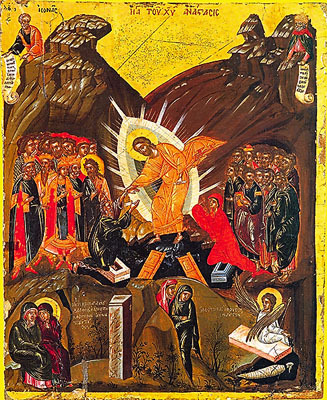
Whether you have a belief system that encompasses the resurrection story of Christ, the basis for the Easter holiday, or you don’t, there is great potency in the symbolism of this story.  The idea of the death of one self and the rebirth of another transfigured self is perhaps one of the most powerful paradigms of mankind and personal evolution.

I am drawn to the resurrection imagery used in religious icons from the medieval time to the present.  There is a great beauty and power in these images and a consistency in the placement of the symbols used, as though the constant  use of a formal pattern  hints at the universality of the story’s transformative power as a possible template for every person’s life.  We all have the possibility of change, of transfiguration, within our own lives.  It may not entail literal death and rebirth,  but it can be a transformation of the self and spirit.  This is not about religion but about a sea change in the way we view and live in this world.

Personal resurrection.

Read Full Post »

Once again, it’s the time of the year when the movie, The Ten Commandments, takes to the airwaves, an Easter tradition on ABC.  I’m pretty sure I mentioned in the past how much I enjoy this film on so many levels.  It has a great epic quality from the solemn narration by its director, Cecil B. DeMille, to the huge sets employed.

It also has a great deal of goofiness in the writing and acting, where I sometimes feel like I’m watching an SCTV skit and half expect Eugene Levy to stumble into the scene.  Pure kitsch.

When you throw in the fact that it’s such a great tale, it makes for a great night of viewing.

Here’s something that has very little to do with the movie except for the title.  It’s Desmond Dekker‘s early reggae hit, The Israelites.  When I hear this song I am immediately transformed to being a kid listening to this song in our kitchen on my Dad’s big old plastic AM radio that had its batteries held in place with a piece of wood in its open backside.

Anyway, enjoy…

Read Full Post »

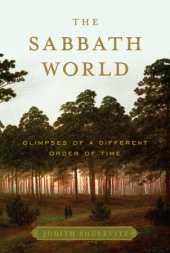
I saw Judith Schulevitz on The Colbert Report last night promoting her book, The Sabbath World: Glimpses of a Different Order of Time, and it brought a lot of things to mind.  Her book, from what I take, examines the concept of our need for a sabbath and how we have lost the benefits of this day of stoppage as we have become more and more entrenched in a hectic 24/7 world.   Our concept of time has been altered by our change as a society.  We see time spent in activity of ant sort as more meaningful than any spent in stillness.

I am old enough to remember when the Blue Laws of the past were still in play in this part of the world and how most businesses were closed on Sunday.  It was hard to find a gas station open.  You couldn’t buy alcohol.  Almost all retail stores were closed.  Traffic was lighter and Sundays had a quieter tone in general, even for my family which was not religiously observant in any way.

I used to think, when reminiscing about those days, that this slower pace and quiet was nothing more than the fact  that I was a kid and lived on the more casual, relaxed kidtime.  No deadlines.  No schedules.  Just be a kid and let time flow naturally.  But as I remember more, it really seemed to be a quieter and calmer time for the adults as well.  There was something very comforting in knowing that everyone’s week had this common day when we would all reset and realign.  A common stopping point where we could all reflect on the week that was past and regroup for the coming week..

Of course, that could never happen now.  We are too invested as a culture of perpetual motion now and to try to put on the brakes would take a revolution of sorts.  But people like Judith Schulevitz and her family are trying to return to that feeling of reflection.  It’s a small step but if only a few families can regain that sense of of calming the hands of the ever spinning clock, then it’s a worthy effort.

Here’s an article Judith Schulevitz wrote for the NY Times, several years ago that is the seed for this book and more clearly defines what I’m struggling to say.  For example:

What was Creation’s climactic culmination? The act of stopping. Why should God have considered it so important to stop? Rabbi Elijah of Vilna put it this way: God stopped to show us that what we create becomes meaningful to us only once we stop creating it and start to think about why we did so. The implication is clear. We could let the world wind us up and set us to marching, like mechanical dolls that go and go until they fall over, because they don’t have a mechanism that allows them to pause. But that would make us less than human. We have to remember to stop because we have to stop to remember.

Take a look and this Easter Sunday, relax.  Reset the clock…

Read Full Post »

The other day I wrote in this blog about the process of painting which brought a comment about appreciating the physicality of painting in person.  It immediately brought to my mind the paintings of Joan Miro, the great Catalan painter/sculptor.

I have always been greatly attracted to his paintings having seen them countless times in books and in popular culture, such as on the cover of Dave Brubeck’s  jazz classic Take Five.  There was something very enticing about the imagery and the geometry of his work, something that that was symbolic and beautiful at once.  However, I never wanted to know too much about the paintings, never wanted to try to read into every symbol.  I just loved the way they felt on the eye.

Dark joy.

But my main memory, and the one I returned to when I read the comment about seeing the physical nature of work in person, is of seeing a Miro painting in person for the first time.  When I saw it across the museum hall, I was excited.  It was like seeing an old friend after a long time, even though I had only seen the work in print.

But as I got closer I began to feel a dull pang of disappointment.  Up close, the surfaces were flat and dull, the paint thin.  It was still striking imagery but the feel on my eye was different and I left feeling a little different about his paintings.  A feeling that has remained with me even though I rationally accept it as his style and have come to more fully appreciate it.

I suppose it was simply the difference between expectation and the reality of actually seeing the work.

As I said, I have come to terms with the way they appear up close and understand that was how he worked, how his mind best translated to his chosen media.  That’s enough for me and far outweighs my own initial expectations and reaction.

The imagery still stuns me.

Read Full Post »

« Newer Posts