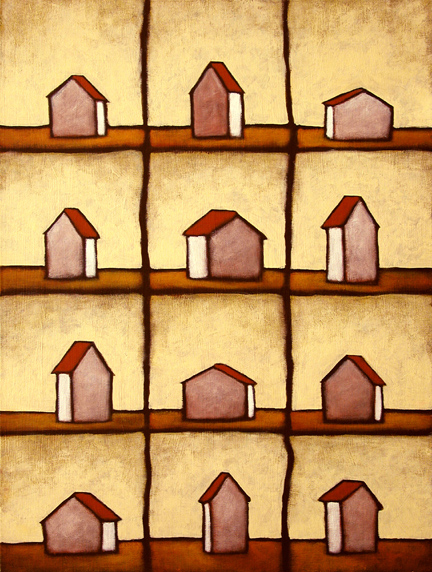
Peers- GC Myers 2003
I’m in the last days of painting before I start final preparations such as framing and such for my upcoming show. I’m currently putting the final touches on a piece that is a multiple similar in form to the one shown here, Peers from back in 2003. The piece I’m working on consists of 3 rows of 3 red trees on a 30″ by 30″ canvas. I’ve used multiple images a number of times over the years, although I often go years between. There is something almost musical, almost choral, in the repetition of form.
I only mention this today because when I came into the studio I put on an album (CD actually but I still call them albums) of work from Arvo Part. One of the first pieces to play was Cantus in Memoriam of Benjamin Britten. It was a mesmerizing tonal piece and as it played, I looked at the title and realized I didn’t know what was meant by the cantus in the title.
Looking it up brought me to the term cantus firmus which is described as a sort of polyphonic composition, meaning it is comprised of multiple interwoven and, often, the same melodies. A Gregorian chant is an example of one type of polyphony. The voices, or melodies, are repeated, one over the other, some at different tones and varying lengths. I don’t know much about music but as I read I began to equate this meshing of voices and melodies in a cantus firmus with what I was trying to achieve with the multiple images in the painting I was working on. Each image is basically the same but because of the way they are positioned and come together as a whole, they become more than the product of their parts.
At least, that’s my take on it.
Anyway, I found a name for the piece I am finishing. Cantus Firmus.
Here’s the composition from Arvo Part:
+
 Redtree Times
After doing some reading, I realized that the rounds we sang at camp aren’t precisely the same as cantus firmus, but they do have one thing in common: the whole is greater than the sum of the parts.
I always loved singing rounds – the way each new voice added to the complexity and beauty. “White Coral Bells” or even “Row, Row, Row Your Boat” aren’t in the same class as your video, but they’re accessible to everyone. And in the case of rounds, it’s immediately clear why repetition is such a good thing.
I really like this painting, and your reflections on it.
Thanks, as always. You know, when I wrote about this form , the idea of singing rounds a camp came to mind. I don’t know if it’s the same thing in theory but you’re right, the whole is greater than the sum of the parts. There’s a certain power in uniting simple forms.