Feeds:
Posts
Comments

Archive for January, 2011

Growing a Painting

Above is the tentatively finished version of the painting I started earlier this week, a 24″ by 48″ canvas that I am considering calling Escape Route. I showed the first few steps of the painting process on this blog two days ago, ending with the sky being near finished and the composition blocked in.  I’m not going to go into all the steps and decisions that went into completing this piece.  Instead, I put together a short film that shows the painting evolving to the finished product.

I will say that the final version is much different in many ways than I first envisioned with the first strokes of red oxide that went on the canvas.  Each subsequent bit of color, each line that appeared, altered the vision in my head just a bit, evolving the piece constantly until the very end of the process.  Even the last part, where I inserted the treeline that appears on the farthest ridge, was not seen in my mind until just before the decision to proceed with them was made.  I decided to go with this treeline to create a final barrier for the road to break past on its way upward toward the sky.  A final moment of escape.

This painting has given me a great sense of satisfaction after finishing it.  I spent much of the late afternoon yesterday just looking at it and taking it in.  I don’t know if it will translate as well on the computer screen but this piece has substantial size at 24″ by 48″ which gives great weight to the blocks of color from the buildings and the light from the sky.  There is a sense of completeness here that I could  only struggle to explain, but as I said, brings me great satisfaction.  I feel as though the evolved painting has exceeded what I imagined when I first started this piece.   While I can’t fully explain that, it is all I can hope for from my work.

I will spend some more time over the next several weeks looking at this painting, determining if anything should be tweaked or altered.  A highlight added here, a line crispened there.  But as it stands, I think it has taken on its own life and I will probably leave it alone as it is.

Here is the short film, Growing a Painting:

Read Full Post »

I wrote yesterday, while descibing the initial stages of my painting process for a new piece, about stepping back from the canvas at a distance to take in the piece as a whole.  During these early stages, when I’m blocking in the painting with red oxide, I give it what I call my snake-eyed look. This entails squinting the eyes and sort of unfocusing, taking in the shapes as sort of abstract forms that play off one another.  Without taking in great detail with this snake-eyed look I am also imagining ahead in the process, seeing the shapes taking on color and how they’ll react within the composition.  It’s hard to explain except to say that it is a sort of intuitive visualization.

I got the term, snake-eyed look, from a scene from the movie Little Big Man starring Dustin Hoffman as Jack Crabb, the son of westward bound settlers who are killed in an attack by the Pawnee tribe and is subsequently raised as a Cheyenne after being foundby them  in the wreckage of their family’s wagon.  The story tells of his misadventures in going back and forth between the worlds of the Native Americans and the white man , culminating in him being present at the Little Big Horn where Genral Custer (played brilliantly by Richard Mulligan) meets his death.  Great movie and a great tale based on Thomas Berger’s wonderful novel of the same name.

In one scene Jack is reunited with his sister who also survived the massacre but escaped from their rescuers, certain they would rape her.  The Cheyenne, however, thought she was a man.  She takes Jack out to teach him how to use a handgun.  She tells him to go snake-eyed and to visualize shooting a bottle before drawing his gun.  Kind of like the description I gave above.   It’s a scene that I always think of when I find myself standing back from a painting with my eyes in a snake-eyed squint and I often wonder if I adapted this because of the scene or if my squinting  just came naturally.  Whatever the case, it worked for Jack Crabb and it works for me.

I will show the progress of the piece I wrote of yesterday in tomorrow’s post.  For today, here’s that scene from Little Big Man with that snake-eyed look.  If you haven’t seen the whole film or read the book, I definitely recommend either.

Read Full Post »

I worked on a new piece the last couple of days, a large canvas that is  2′ by 4′ .  I had already gessoed the canvas with a distinct texture and applied a layer of black paint.  I had vague ideas of where I thought the painting might go from a composition standpoint but knew that this was only a starting point in my mind.  Like most of my paintings, the finished product is often drastically different than what I imagined at the beginning.  As I paint, each bit of paint dictates the next move and if I don’t try to force in something that goes against these subtle directions given to me by the paint the piece usually has an organic feel, a natural rhythm in the way the different elements go together.  A cohesion of sorts.

Knowing I wanted to use a cityscape in this piece, I started in the bottom left, slowly building the city with geometric forms and rooflines in a red oxide paint that I use to block in my composition.  I like the red oxide because ti gives a warmth under the layers paint to come that comes through in small bits that are almost undetectable at a quick glance. 

At this point I still am unsure where the painting is going.  I have thoughts of filling the canvas completely with the cityscape with the smallest view of the sky through the buildings but am not married to this idea.  The paint isn’t telling me enough yet to know.  But it has told me that I want a path of some sort- a street or canal- through the composition.   I make room for one near the center before starting on the right side with the buildings there.  I go back and forth between the right and left sides as I build the city, constantly stepping back to give it a good look from a distance to assess its progress and direction. 

 At a point where the city is nearing the halfway point on filling the canvas, I decide I want this piece to be less about the cityscape and more about how it opens to the open sky beyond it.  I extend the road that started at the bottom and twist it upward, terminating it at a bend in what will be now a field beyond the city edge.  The sky, though still empty, is pushing me ahead, out of the city.  The piece has become about a sense of escape, taking the street from the cityscape and heading upward on it towards the open fields and sky.  Painting faster now, another field with a bit of the road appearing is finished beyond the first lower field.  I have created a cradle in the landscape for the sky to which I now turn my brush.

There’s a certain symetry at work here and I decide I want the central focus of a sun in this composition.  I roughly block in a round form, letting it break beyond the upper edge of the canvas.  I pay little attention to the size of this sun except in its relationship to the composition below it.  My suns and moons are often out of proportion to reality but it doesn’t matter to me so long as it translates properly in the context of the painting.  If  it works well,  it isn’t even noticed.

I finish blocking in the sky with the red oxide, radiating the strokes away from the sun,  and step back.  The piece has become to come alive for me and I can start to see where it is going.  The color is starting to fill in in my mind and I can see a final version there.  This is usually a very exciting time in the process for me, especially if a piece has a certain vitality.  I sense it here and am propelled forward now, quickly attacking the sky with many, many brushstrokes of mutiple colors. working from dark to light. 

There are layers of a violet color in different shades that are almost completely obscured by subsequent layers.  I could probably leave out these violet  layers but the tiny shards that do barely show add a great depth to the flavor of the painting for me and to leave them out would weaken the piece in a way. 

I ahve painted several hours on the sky now and still have a ways to go before it reaches where I see it in my mind.  There are no shortcuts now.  Just the process of getting to that final visualized point.  But it’s dinnertime and my day is now done.  I pick up and step back to give it one final look before I head out into the darkness.  This is where the painting is at this point, where I will start soon after I post this:

Read Full Post »

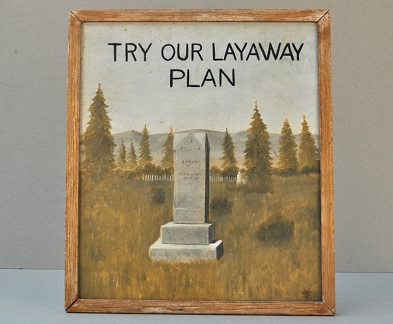
I came across this on  Candler Arts , website that features an eclectic collection of American folk art available for purchase.  I wrote a couple weeks ago about one of their paintings, a nativity scene from Jimmy Lee Sudduth painted with mud and housepaint.  When I saw this piece I gave a chuckle and thought about the reactions it would bring hanging in a shop or gallery. 

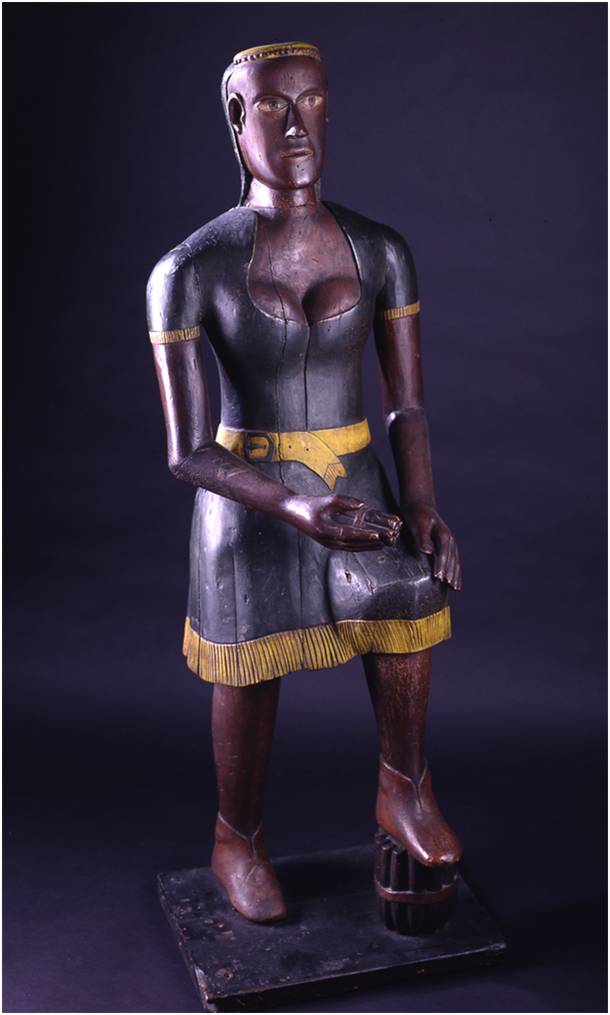
It is probably an advertising piece for a monument maker, probably in the first half of the 20th century, probably in a rural region.  Advertising pieces through the last century or so have provided us with some great folk art.  Think of the large cigar store figures.  Paul D’Ambrosio, who writes the vastly informative blog, American Folk Art @ Cooperstown, has written a number of times about the handmade signs and figures that once graced the counters of small shops and stores in earlier America.  Many are a bit rough, like this sign, but all are simply trying to communicate with their customers and did so with a sort of grace that we can still see in them today. 

One of my favorites from Paul’s blog is a piece from the Fenimore Art Museum collection believed to be from a freed slave named Job from around 1825.  It is an African-American cigar store figure and is a sensitive depiction of such a figure for the time. A female figure holding out a bundle of cigars, it is not a harsh caricature one often would see at that time.  But is still an eye-catching figure which was the purpose of these pieces, to attract customers into the shops. 

 I would definitely stop and take a serious look today if I saw a carving like this outside a shop.  And maybe I would even ask about their layaway plan.

Read Full Post »

On the Chang Tang

I wrote this past week about Jeremy and Eliza, my nephew and his wife, and their adventure to climb Aconcagua in Soth America.  After arriving in Mendoza in the foothills of the Andes, they set up for  preparations at hostel there that is a gathering spot for international climbers on their way to and from the mountains.  There they met a Swede named Janne Corax.

Of course, the name meant nothing to me but it turns out he is a legendary figure in the world of adventure travel, a man who is best known for his bicycle treks that have taken him all over the globe.  He rides his bike to the mountains, climbs them, then mounts his bike and pedals home.  I’m not talking about riding a few hundred miles down the road here.  He has several times started his journey from his home in southern Sweden , pedaling to Tibet to climb the peaks there then back home via the bike.  At this point he has logged over 82500 km on his cycle.  That’s over 51000 miles.

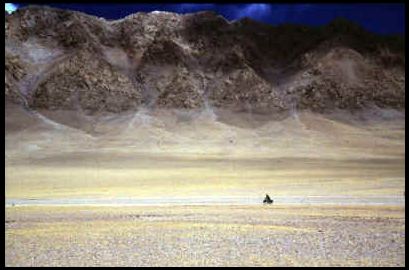
The picture shown here was on his website and is from one of his journeys across the Chang Tang plateau in Tibet.  The Chang Tang is a vast barren plateau that is about the size of Texas in size, all at an altitude of between 4500 and 5500 meters.  That’s between 16000 and 18000 feet which makes this a very high altitude.  Corax was the first cyclist to ride across this severe terrain.  Actually, he’s done it twice.

When I saw this photo it reminded me of an image I had in my mind many years back, before I had started painting.  It was almost identical to this image of a lone figure crossing a vast desolate plain with mountains rising  directly behind it.  It was something I struggled to capture in writing  but could never capture the essence of how it made me feel.  For lack of a better term, I called it the Big Quiet, a term I still use today.  It refers to a personal paradise for me, even in this harsh and desolate context.  An environment free of the constant throb and noise of man.  The world laid bare, at it’s most essential.

So, here it was.  He had found the Big Quiet that I could only imagine.  Actually, I could never do what he has done.  But knowing that it is still out there is a comfort and I am glad there are people like Janne Corax to inspire the imaginations of others with their determination and their daring in seeking their own Big Quiet.

Read Full Post »

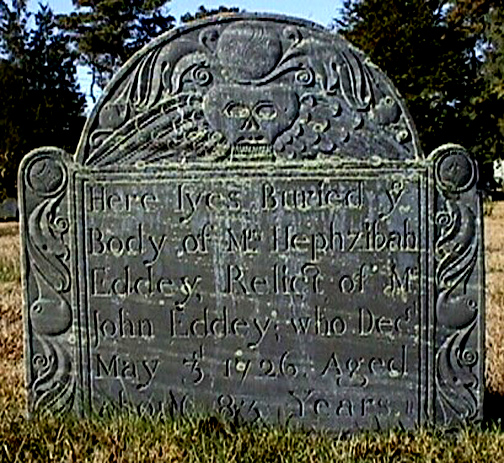
I’ve always been a fan of graveyards, a fact that I’ve proclaimed here in the past.  The monuments and tombstones are an unceasing source of fascination, both in the data provided and the design of the stones. 

 So you can imagine how happy I was to stumble across a relative who also has a great tombstone.  Such is the case with this particular stone, one that marks the grave of my tenth great grandmother on Martha’s Vineyard.  Died in 1726 at the age of 83.  Her name was Hephzibah Doggett who was married to John Eddey.

Hephzibah Doggett.  Got to love that name.

   Before I started venturing into genealogy a few years back I had no idea of any family before the last two or three generations, and even then the history was sketchy at best.  On my mother’s side, it was almost non-existent.  So, to turn previously unturned pages in the family history is exciting and gives a new perspective on how we arrived at this place.  It also provides an opportunity to imagine how the thoughts and mind of a person like Hephzipah relate to your own, to wonder if their eyes saw things in a way that I could understand.

Of course, I will never know the answers to such questions but at least I know that she existed and has left a wonderful monument as her marker on time.

Read Full Post »

A number of years back, I saw an exhibit at a NYC gallery that consisted of many, many versions of The Last Supper by Leoanrdo Da Vinci, all painted by painters of differing skill levels and styles.  Some were well executed, professional, and some were crude and amateurish.  But they all, especially in the context of the exhibit, had a vibrancy that came from the original composition.  It was a very interesting show and I carry strong memories of some of those versions of DaVinci’s masterpiece.

I was reminded of this when I came across this version of the rock classic Whole Lotta Love from Led Zeppelin.  It’s from the San Francisco based band The Waybacks (featuring guest vocalist John Cowan from New Grass  Revival) and is from a performance at Merlefest in 2008.  Merlefest is an annual festival of  folk and Americana music that takes place in Wilkesboro, North Carolina.  It was started by the great Doc Watson in 1988 to honor his son and guitar playing stage partner, Merle, who had died a few years earlier in a tractor accident. 

I thought of The Last Supper show from this because it’s often interesting to see how a composition works in different genres and styles. This version from The Waybacks is based on acoustic instruments but  still maintains the  potency of the original, while forming a slightly difefrent feel and translation.  I’ve talked about this in this post before when I painted a series of gray and black pieces based on my typical landscapes.  They were the same but had a different  feel with the differing treatment.

That’s how this feels– the same but different.

Read Full Post »

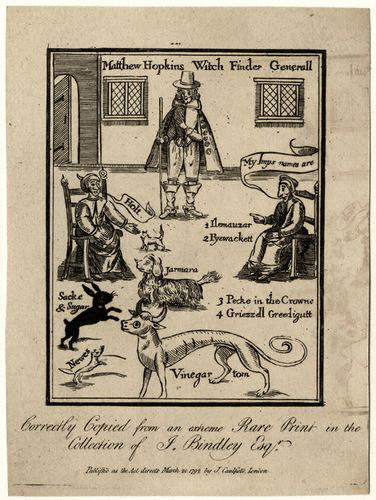
Sometimes you run across things in history that sound so odd  to our own modern sensibilities that they seem like they could be fictional in nature.  Such is the case with Matthew Hopkins, the self-proclaimed Witch-Finder General  who flourished in 1640’s England.

Because of the power and influence of the church, anyone who held contrary views was considered a heretic and was therefore assumed to be in an alliance with the Devil.  Hopkins saw a great opportunity in this belief and in the years 1645 to 1647 travelled from town to town through the English districts cleansing the towns of witches, for which he was paid a handsome fee.  In those few short years, Hopkins was responsible for the death of 300-400 people he deemed to be witches.

He would use a variety of tests to determine whether the accused was indeed a witch.  His assistants would shave the body of the accused and Hopkins would search for a devils-mark.  It could be a mole, a birth mark or a third nipple.  He would then prick it and if it failed to bleed the accused was a witch. 

Then there was the time honored tradition of tying the accused to a chair and heaving them into a pond.  Float and you’re a witch.  Sink, you’re not a witch and you’re safely at the bottom of a pond.  This method was eliminated by Parliament during this time.  Even then it seemed a little out there.  He also used sleep deprivation and other traditional methods used for extracting confessions from those accused, who often happened to be older women, many widows. 

 It is believed that Hopkins also used a spring-loaded blade for his testing which meant that when he pricked the skin, the blade would appear to enter the skin but would in fact push back into the handle, leaving no mark or blood.  A little insurance that there were enough witches in town to make it worthwhile.

Thankfully, Hopkins’ actions raised a lot of eyebrows and opposition was raised against his campaign by a vicar who went so far as to publish a treatise condemniong Hopkins and his ways.  Hopkins reacted with his own pamphlet, The Discovery of Witchcraft, from which the illustration shown above is derived.  As a result of this opposition an investigation was launched which ended when Hopkins retired from his odd vocation in 1647.

There is little known of Hopkins after this .  It is held in legend that he met his death when he was confronted by townsfolk who were up in arms over his activities and was subjected to the water test.  Most others believe he died from tuberculosis.  Whether he believed his own words or was simply a charlatan out to make a pile of dough will never be known.  But it made for an odd, and terrifying , tale that one wishes were fictional.

I  wonder who will be our time’s Matthew Hopkins five hundred years in the future?  What  beliefs of ours will be made to look ridiculous with time?  I’m sure there will some…

Read Full Post »

The Struggle

Yesterday was the best day I’ve had painting in the past few weeks.  The holidays and the distractions they provide had really knocked me out of  rhythm and I’ve been struggling to get back on the path.  I think this has probably been evident in the writing on this blog.  Writing for this is a real chore when I fall out of my painting routine.  I find myself struggling for things to say and words to express anything.  The writing rhythm is definitely entwined with my painting rhythm.

But yesterday was good in the studio so I’m hoping to see some improvement here, even though I view this writing and my painting as very separate and different entities.  I’ve always viewed writing as being an expression of what the writer knows and sees.  On the other hand,  painting to me is about expressing what I feel but don’t know and am incapable of expressing otherwise.  Painting is more about intuition and the intangible for me. 

Not to say that intuition and intangibles don’t play an important role in writing.  But I can’t find them as effortlessly in writing as I can with a slash of color here or in the way a form plays off another in my painting.  I don’t have to fill in detail, don’t have to create a whole scenario for my work to communicate. 

I think that’s the distinction between the two forms.  With writing, I must know what I am trying to communicate.  With painting, I can communicate without knowing.  In fact, it is preferable that I don’t know.  The work that comes without trying to direct it is usually the best, graceful and filled with emotion.  I don’t see that happening with my writing.

So, I must get back to the paints and gain a bit more rhythm, let the momentum carry me ahead.  I’ll let you know how it goes.

Read Full Post »

Aconcagua

Today, my nephew Jeremy and his new wife, Eliza, head out to Philadelphia from where they will depart tomorrow for Argentina.  They lived and worked for several years in the San Francisco area and this past year made some big life decisions.  The first was to get married and the second was to quit their jobs and take to the trail for a year or so,  starting with an expedition climbing Aconcagua in the Andes.  It is the tallest peak in South America as well as the tallest peak in the Western and Southern  hemispheres.

It’s a real mountain at over 22000 feet and will present their group, comprised of the two of them and three close climbing friends, with  challenges they haven’t faced yet in their previous outdoor excursions.  Several years back, Jer and Eliza completed the Pacific Crest Trail (PCT), a grueling hike that began in April at the Mexican border and ended in October at the Canadian border.  They chronicled their 2650 mile journey on their blog,  A Wolf Walk.  While their trail then took them through the highest points of the Sierras and the Cascades, it offered none of the high altitude challenge that Aconcagua will offer.  To determine their tolerance of the altitude as well their overall readiness, their group  will spend a week or two climbing lesser peaks surrounding Aconcagua before making their attempt in mid-February.

For those of you have an interest in following their journey in the Andes, they are maintaining a blog from the trail (ah, technology!) that is called Foschizzel Around the World!  The Foschizzel here is a combination, of sorts, of their last names, Foster and Schissel.  Snoop Dogg is not sponsoring their trip, if you thought that was the case with the name.

I envy the intentionality with which they are living their life and wish them well on this expedition.  I will follow their progress closely and live vicariously through their experiences.  Hopefully, good fortune will be with them.

Good luck and good climbing, Eliza and Jer!

Read Full Post »

« Newer Posts - Older Posts »