Feeds:
Posts
Comments

Archive for August, 2011

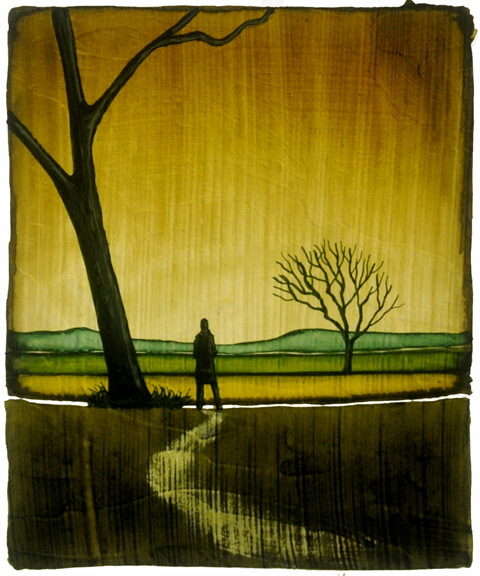
Uncharted

This is a small painting on paper, only 4″ by 5″, that I immediately began calling Uncharted as soon as the final stroke fell into place.  The way the path ends at the edge of the field in the foreground and the way the central figure stood there brought to mind someone coming to a point in their life, their journey, who realizes they are at a point and place they have never encountered before nor even been warned of by others.  They want to move forward, they know they must move ahead but they are filled with fears and doubts.  Second guessing.

I think most people try to avoid ever coming to such a place in their lives.  Most of us follow templates set down by many generation before us which attempt to create a stable and safe path for us to journey down. 

The known.  Familiar territory.

 But for some, that path soon comes to an end and they must venture forward using their own instincts, making their own way ahead if they can ever expect to find satisfaction with their existence here.

Again, it’s a scary route and not one easily chosen.  But for those who seek something that fulfills the inner aspects of themselves, it is the only way.  In a way I feel like I’m describing the route that the shamans of some natives tribes around world take in finding their spiritual awakening and maybe that is akin to the journey of many other seemingly normal people in other cultures who seek those intangibles that lay off the known map that we usually folllow.

 I’m not really sure.  That is uncharted territory for me but I am gratified that this simple, small piece inspires a little more thought.

Read Full Post »

The Spotnicks!

It’s funny how your intent sometimes leads you to some interesting things.  Well, maybe not so much interesting as goofy or kitschy.  I was thinking this morning about a version of a song, the theme from the classic movie The Third Man (great film!), that I had posted on this blog a few years back.  It was from the early ’60’s from an Indonesian guitar band called The Crazy Rockers, a group of which  I was totally unaware. 

 Looking it up this morning, I began to notice all the different versions of this song from many different types of musicians.  There were Gypsybands, which seemed in character with the music.  Jose Feliciano did a guitar version and Herb Alpert and the Tijuana Brass did a horn version.  The Band did a chunky, lumbering version.  There were so many versions, so many takes on the same song.  I began to think this wouldbe an interesting subject to write on– how one composition can be tranlated in so many various ways.

But as I clicked on several versions of The Third Man theme I noticed  something on the side of the YouTube page I was on among the suggested videos.  Spacemen with guitars.  It looked like they were on some early ’60’s TV set.  The Spotnicks.  Looking them up quickly, I found that they were a Swedish band that started in 1961 , gaining popularity throughout Europe for their electric guitar sounds.  They have sold over 18 million records over the last half century and are still performing together. 

That was all interesting but I wondered how they sounded.  I clicked on this video and I was sold.  It’s their version of My Bonnie Lies Over the Ocean and it’s performed in full Spotnicks spaceman regalia.  They seem to be singing the song phonetically which adds to the charm of this wonderful early 60’s period piece. Take a look and behold The Spotnicks


Read Full Post »

There was a John Mellencamp album from 1990, Big Daddy, that had a song with the line ” Henry sent a postcard from a better place…”  There’s something in that line that has stuck in my memory far more than the original song and always comes to mind when I receive a postcard from friends or family.  I thought of it yesterday when I received this postcard from a friend I know through my paintings who now lives in Slovakia.

It’s an image of the painting Vier Baume ( Four Trees)  from the great Austrian painter Egon Schiele  whose work has always captivated me.  He saw it while visiting the Belvedere Museum in Vienna and it reminded him of my paintings, joking that this Schiele guy must have been influenced by GC Myers.  His mother, a lovely woman who I know and who was visiting with him there, added the line, “If only he’d thought to put a red chair in the tree!”  Gave me a chuckle.

One of the little perks of doing this is having my work connect with people and have them tell me of  how they are reminded  of this at different times in their travels.  I posted a photo here last year that was given to me at a gallery talk by a man who saw this tiny, tiny island off the coast of Venezuela with a single twisted tree atop it.  It reminded him of one of my paintings and he was kind enough to snap a photo of it for me. 

These little gestures mean an awful lot to me as small validations of the strength and voice of the work.  When I’m painting in the solitude of my studio I can only hope that the piece I’m at work on will have such an impact to make someone far removed think of it beyond the moment when they actually see it.  There’s something comforting to me in this thought. 

Perhaps the postcards sent are because these folks view my painting as a sort of postcard from a better place. 

Who knows?


Read Full Post »

This painted, The Plumed Hat, from the artist Henri Matisse was attcked the other day at the National Gallery in Washington, DC.  There wasn’t any apparent damage to the painting itself after the attacker took it by the frame and slammed it a few times against the wall.

That in itself is not that interesting except when one note that the attacker was the same woman who had attempted to deface Two Tahitian Women from  Paul Gauguin at the same museum in April of this year.  After being tackled while trying to protect the Gauguin painting from its protective plexiglass case she was quoted as saying, “I am from the American CIA and I have a radio in my head. I am going to kill you.”

It’s pretty rare when the same person makes such an attempt at the same museum.  With the Gauguin there seemed at least a hint of her motivation in trying to destroy the painting that she described as “evil” and “homosexual.”  To some, could the the idea of two bare-breasted women standing next to one another might be perceived as evil?  I guess.  And could the idea of one woman looking over at the other could be seen as homosexual to some folks?  I suppose, although I think she is actually casting a hungry eye at that watermelon.

But why attack this Matisse?  There is nothing overtly evil or gay in  it that would offend delicate sensibilities.  It’s hardly provocative in any way.  Or attractive.  It’s not a piece I would give much thought to in any way, other than thinking it is definitely not one of Matisse’s finest examples, at least in my eyes.  I don’t find much in it that excites me in one way or the other.  Certainly nothing that makes me want to freak out and try to destroy it.

So what is here that I’m not seeing that might excite the obviously troubled mind of the woman who attacked it?  Is it that same thing in it that another mind might perceive as beautiful?

Read Full Post »

I was going through a pile of old work, mostly rougher  stuff from when I first started painting that had small glimpses of promise but lacked real spark or cohesiveness in the way they came together, when I came across this piece from 1994.  It’s about 12″ by 16″ on rough Arches watercolor paper and has the words Bradford County written in pencil at the  bottom corner of the paper. 

It’s a piece that I always found attractive but seeing it really brought me to a stop.  I so recognized that time when it was painted and could now see several potential directions where my work might have headed other than the one it eventually followed. 

This piece was very much in a more traditional watercolor style, with no treatment of the paper and the colors pure.  The colors had not yet come around to the palette that I later adopted.  For instance, the sky is a single uncomplicated shade of blue.  There are no other colors, not even other blues in it.  I had yet to make the move to more complex colors even though there is a hint of it in the foreground and the hills.

It also is a depiction of a real place, as denoted by the Bradford County.  Growing up, we lived on Wilawana Road just a few short miles from the NY/PA border and if you followed the road into PA you found yourself in Bradford County.  That part of the border is at the base of steep hills and is filled with rural valleys that I spent many hours exploring.  This scene was purely based on that place even though it is not any one location there.  I had not yet made the leap into creating my own landscape, forming the felt space rather than real space of Ralph Fasanella that I had mentioned in an earlier post.

To me, this is a time capsule that takes me back to the time when I painted it.  It suggests potentials that seem a million miles away from where I finally landed at the present.  It shows the possibility of staying strictly as a traditonal watercolorist or painting solely as painter of reality.  A depicter of the what is with the proper colors and forms.  I wonder how my work might look today, how it might differ,  if I had followed any of those other possible routes for the work? 

 I suppose many of us can look back at certain points in our lives and see times much like the one captured for me in this simple painting, times when we are at a junction in our lives and must decide which path to follow.  I’m sure some of us would look at such a time with a certain level of regret but for me, I am happy with my decisions made at and after the point of this painting so for me this is a warm memory, a reminder of the path I was about to follow.

Read Full Post »

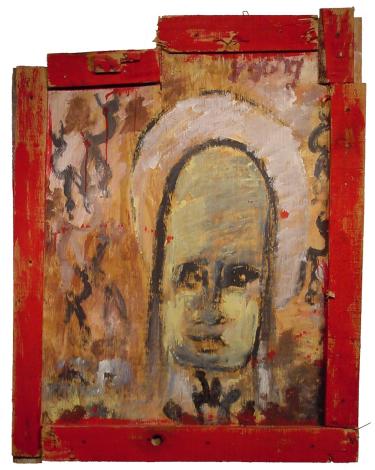
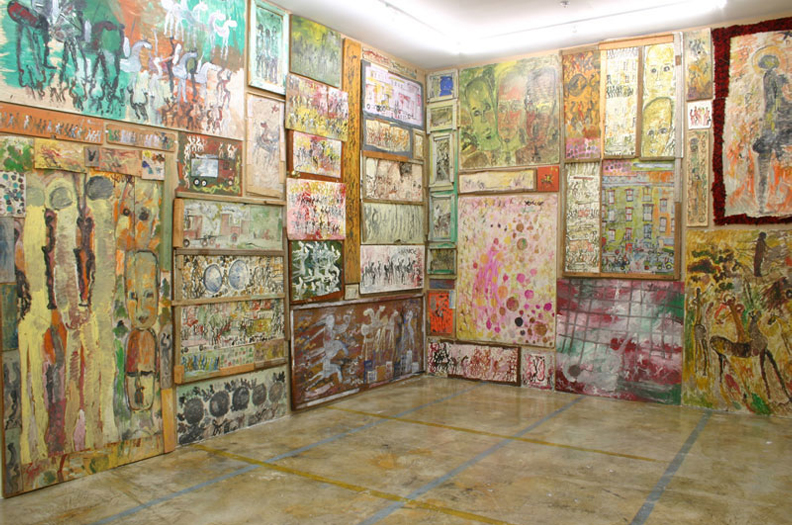
I’ve always been drawn to the work of self-taught artists and the way they synthesize their experience into their work, finding forms for their need for expression.  There is a great freeness and rawness to much of the work of self-taught artists, an energy that is so electric that many well trained artists try to capture it in their own work.  Expressionism is pretty much based on this energy.

This point is well made in Purvis of Overtown,  a 2006 documentary made about outsider artist Purvis Young who lived his life in the Miami neighborhood called Overtown.  Being not well educated and poor, Young found trouble at an early age and spent time in prison before pursuing the art that led him to some pretty spectacular heights before his death in 2010 at the age of 67, from diabetic complications.  He has said that he was called to his art by a meeting with angels in a dream.

He basically lived much of his life in the warehouses where he painted, sleeping among the accumulated trash and eating junk food.  His whole existence seemed to be driven by his need to create and he produced what appears to be a huge body of work.  The work itself had that electric energy that I wrote of above, a blistering raw qualityand rhythm that marks it as authentic.  It was not a contrivance for Young, not the product of some intellectual exercise.  It was pure emotion and it can’t be replicated through style alone.

Here’s the trailer for the documentary Purvis of Overtown:


Read Full Post »

Doppelganger

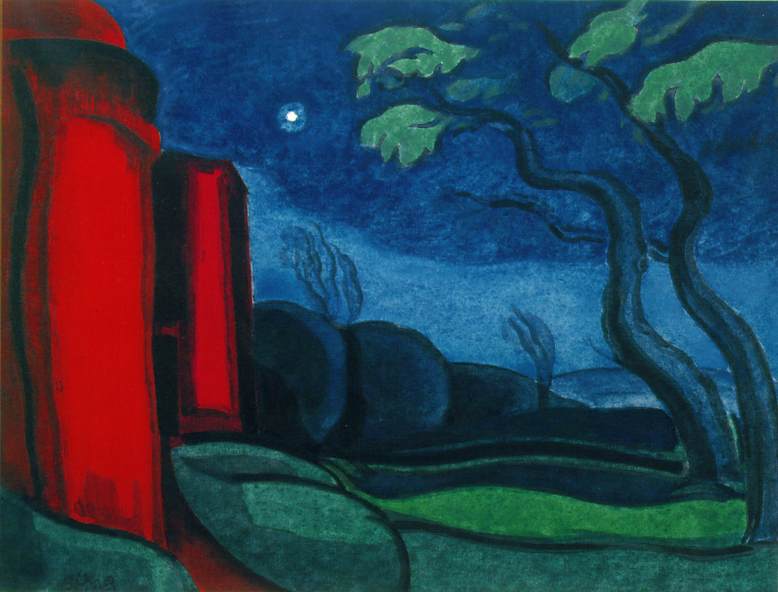
A month or so back in a post, I wrote about the late Modernist painter Oscar Bluemner and the odd feeling of connection I felt to his work.  There was something in it that seemed beyond familiar and that really intrigued me, making me want to find out more about this little known painter.  I found one book, Oscar Bluemner: A Passion for Color, written by Barbara Haskell , the curator for a Bluemner retrospective of the same title at the Whitney Museum of Modern Art in 2005.

When it arrived yesterday I opened the package and flipped through it quickly, taking in the images that all seemed so right to me.  Stopping on a page of print, the first sentence I read surprised me and made this feeling of connection with Bluemner seem even more palpable.

Bluemner considered subject matter irrelevant except as a conduit through which to convey his moods and inner consciousness, yet he also believed that art must be based on the real world in order for it to communicate with viewers.

That sentence succinctly captures much of what I try to convey about my work when I stumble through my writtten explanations.  Looking further I came across pieces of his that so meshed with my own work, particularly in my earlier phases, that it was eerie.  The colors and forms and even the sense of rhythm seemed so close.   Even the words he chose when writing about his work seemed to mirror my own.  He spoke of that same rhythm to which I often refer.  The words continuum and polarity seem to pop up frequently as well as I glimpsed through, both words that draw my antennae. 

I begin to wonder about he connection.   Perhaps it is inevitable in this wide world of ours that two widely separated minds would view thie world in the same spatial way and would emply the same colors and forms and rhythms, would try to communicate may of the same emotions and perceptions.  Perhaps we all have these creative doubles, our artistic doppelgangers, and the only exceptional thing is that I may have come across such a person and recognize it. 

I don’t know.  I have yet to read deeper into this treatise and may come across something that will make me deeply regret connecting my work in any way with his.  Judging from his life and death, he was obviously deeply flawed.  I hope that my own many flaws do not match too well with those of Bluemner.

We’ll see.

Read Full Post »

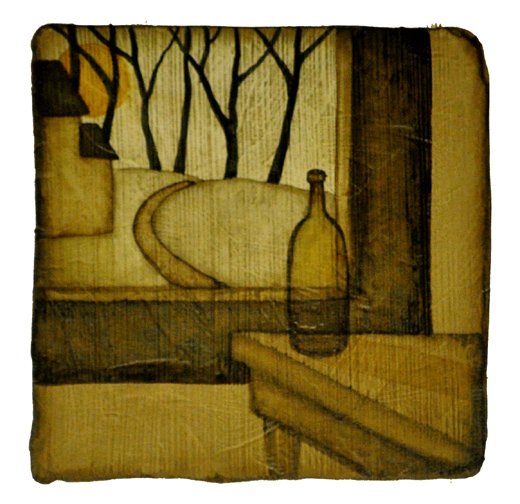
This is a painting I recently finished, a small piece, only 4″ square on paper.  It’s a mix of landscape and very uncomplicated still life with stark but distinct elements throughout.  There’s a simplicity that runs through this scene that covers a depth of feeling, a pang from the heart.

I sat this aside for a day or two after finishing it and found myself coming back to it.  There was a familiar tone to it that reminded me of something that I couldn’t quite identify until this morning when I walked into the studio.  I looked at it as I sat down and instantly said to myself, “Far From Me.”

It was the old John Prine song from his first album which came out forty years back, in 1971. There was something in this piece that filled me the feeling of Prine’s lyrics of gradual loss:

And the sky is black and still now

On the hill where the angels sing

Ain’t it funny how an old broken bottle

Looks just like a diamond ring

But it’s far, far from me

This piece will probably always be that song now for me, a personal avatar for a song buried deep inside and often forgotten.  Funny how things work…

Here’s Far From Me  done by Jamestown Ferry,  a Berlin, Germany based duo who performs Americana music as well as traditional Scotch and Irish music.  It’s a lovely and faithful version.

Read Full Post »

I came into the studio this morning and immediately sat down to read my emails.  Among them was the most recent post from American Folk Art@ Cooperstown titled Ralph’s Take On Rembrandt.  It concerned the late and great American folk artist Ralph Fasanella and his reaction to criticism and unsolicited advice.  I finished reading and burst out laughing.  Boy, did it hit close to home!

Over the years, I have been approached by several people who think they are doing me a great service by telling me that I should change the way I paint in some way or that I should try to paint more like some other artist.  Early on, when I was first exhibiting my work, I had another more established artist tell me that I should change the way I paint my figures, that they should look the way other artists paint them.  I responded to this artist and the others who offered me their advice with a smile and an “I’ll look into that.”  But  that one time,  I also mistakenly heeded the older painter’s words, being inexperienced and seeking a way as I was, and stopped painting figures for a while before realizing that this was not good advice at all. 

Here’s the post about Fasanella and his response to such advice. 

Ralph Fasanella had trouble painting hands. A lot of trained artists do too, so it is not surprising that a union organizer who turned to drawing suddenly at the age of 40 would struggle with hands early in his career. But he did have something that proved better than years of formal training: he believed that he was an artist and that what he was doing – painting the lives of working people – was a calling that deserved his complete attention and all-consuming passion.

And that made him react when anyone suggested that his paintings weren’t up to snuff. He said that he was painting “felt space,” not real space. His people and the urban settings he placed them in were not realistic in the purest sense of the word, but they sang with spirit and emotion. As Ralph said, “I may paint flat, but I don’t think flat.”

Rembrandt Hands

His most memorable quote, and the one that says the most about him, occurred very early in his artistic career, when someone told him that his hands looked like sticks. He ought to study Rembrandt’s hands, they said, in order to get it right.

His response is priceless: “Fuck you and Rembrandt! My name is Ralph!”

I may not really adopt Ralph’s approach but you can bet his words will be echoing in my head the next time someone says “You should paint like…”

Read Full Post »

Watching the way the world is reacting to recent economic events brings to mind how connected we have become.  A significant movement in one location causes ripples that move quickly and often forcefully around the globe.  It makes me wonder if thought and consciousness moves in the same way, like a wave of energy that moves around the globe on some unseen grid that surrounds and connects us all.  The universal mind, if you will.

Well, there is a long-term study based at Princeton University called the Global Consciousness Project( also knowns as the EGG Project)  that may be beginning to discern such a thing.  They seek to find if there is a way to detect our collective consciusness, to discover if there is a force that connects our minds.  In 70 locations around the woprld, they have placed random number generators which basically produce high-speed versions of coin flips.  A heads on the coin, to illustrate the point, would show up as a zero and a tails would appear as the number one.  There should be total randomness in these flips. especially over long periods of time.  And especially between the results from the 70 different generators.

However, they have found that when large events occur the results veers from random and takes on an apparent pattern in these machines.  And this same departure doesn’t simply take place at the generator nearest the event but through the whole system, as though they are synchronized.  For example, on 9/11 the machines produced a remarkable synchronicity in their results in the hours before, during and after the event.  These results defied all odds.

Even though this has been going on for many years already, I still don’t think they’ve reached any concrete answers as to causation.  Perhaps they never will.  Perhaps they don’t even know the question to the answers they’re beginning to find.   But it makes you wonder.

Here’s a more in depth explanation fromproject participant Dean Radin:

Read Full Post »

« Newer Posts - Older Posts »