Feeds:
Posts
Comments

Archive for February, 2012

I’ve been a fan of the work of Chuck Close for some time, admiring the grand scale that much of his work assumes as well as his evolution as an artist, especially given his challenges after a spinal artery collapse left him paralyzed from the neck down in 1988.  He regained slight use of his arms and continued to paint, creating work through this time that rates among his best.  He also suffers from prosopagnosia which is face blindness, meaning that he cannot recognize faces.  He has stated that this is perhaps the main  reason he has continued his explorations in portraiture for his entire career.  The piece shown here is a portrait of composer Phillip Glass that was made using only Close’s fingerprints,  a technique which presaged his incorporation of his own unique form of pixelation into his painting process.

His determination to overcome, to keep at it, is a big attraction for me and should be an object lesson for most young artists (and non-artists, also) who keep putting off projects until all the conditions are perfect and all the stars align.  Waiting for the muse of inspiration to take them by the hand and lead them forward.  Sometimes you have to meet the muse halfway and Close has this advice for those who hesitate:

The advice I like to give young artists, or really anybody who’ll listen to me, is not to wait around for inspiration. Inspiration is for amateurs; the rest of us just show up and get to work. If you wait around for the clouds to part and a bolt of lightning to strike you in the brain, you are not going to make an awful lot of work. All the best ideas come out of the process; they come out of the… work itself. Things occur to you. If you’re sitting around trying to dream up a great art idea, you can sit there a long time before anything happens. But if you just get to work, something will occur to you and something else will occur to you and something else that you reject will push you in another direction. Inspiration is absolutely unnecessary and somehow deceptive. You feel like you need this great idea before you can get down to work, and I find that’s almost never the case.

Amen to thatThe process provides the inspiration.  I’ve stumbled around for some time trying to say this but never could say it as plainly and directly as Close has managed.  Thanks, Chuck.  I think I’ll take your advice and get to work.

Read Full Post »

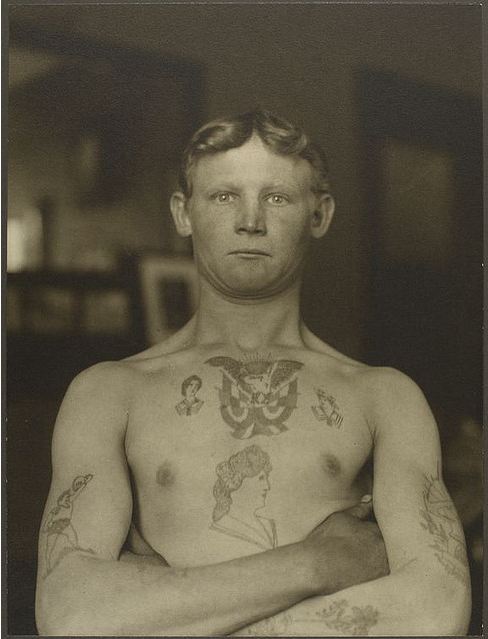
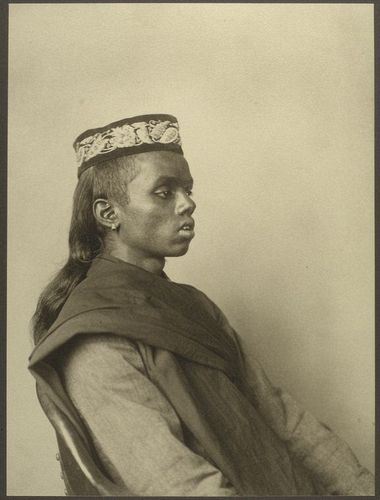
This photo caught my eye recently.  It’s a shot of a Romanian piper, most likely a shepherd, taken around 1906.  It was taken by Augustus Francis Sherman, a registry clerk who worked at Ellis Island, the primary processing point for immigrants coming to America around the turn of the early 20th century.  Sherman was an amateur photographer who would sometimes document those would-be immigrants who were detained at the facility as the officials determined whether they would be allowed to enter the country.  Sherman would ask the detainees to don the clothing of their native country so he might document them during their time at the Ellis Island,which might be hours, days or even weeks.   Some of these subjects made it through and others were deported.

Seeing this photo and others taken by Sherman made me wonder about these folks as they posed in their native garb.  If they made it through the  immigrationprocess, how did they make their way in America and where is their family now?  This Romanian man with the flute– what became of him?  What was his new occupation? Was this perhaps the last time he ever wore the clothing of his earlier life?  And what became of this group of Cossacks, shown to the right?  I wonder how their new life here differed from that one they left behind, where they donned such large knives.  Are their descendants aware of these photos?

As I said, some of these portayed by Sherman did not make it into America, at least at that time.  Some had physical ailments or mental illness and some, like the young German man with the multiple tattoos shown to the left, came as illegal stowaways and were immediately deported back to their native land.  I wonder how many of these deportees came back and tried again?

Sherman’s photos have been the subject of a number of exhibits over the years.  Though he was untrained, he had an ability to see the individual humanity that was sometimes lost in the masses that were paraded before him.  He was able to capture the pride and dignity in his subjects at a time when they were under great stress as they awaited the decisions on their futures here.  I find them fascinating, both as a documentation of the many diverse  peoples who built this country and the innate human drama in the process.

Though provoking.

Read Full Post »

There are only two mistakes one can make along the road to truth; not going all the way, and not starting.
—Buddha

This is a new painting that recently went to Watts Fine Arts in Zionsville, outside of Indianapolis.  It’s a large canvas, 20″ tall by 60″ wide, that is called Where the Road Ends
 
I often use a pathway or road leading into my work, the idea being that it serves as an invitation for the viewer to enter the scene.  Sometimes the path simply cuts through the landscape and runs to a horizon, a symbol of  the continuity of the journey.  But sometimes the path seemingly ends and I find myself at these times asking myself what that means, both in the context of the painting and in my mind.  Is it the reaching of a goal, such as the truth to which Buddha alludes above?  Or is it merely a road that comes to an end?   
 
Probably both are correct.  In the process of painting I don’t go forward with this final image in mind.  The road neither ends nor goes on when I am in the midst of painting.  It’s just there.  But at a certain point, the composition demands that a decision be made, to either continue with it or to let if disappear behind a knoll.  The easier decision is always to continue, to let the path represent  the continuum of time.  It is natural and something we can all relate to in some way.  We understand theconcept of the journey.
 
But to terminate the road means that there is some sort of finality, an endpoint.  Be it wisdom, truth, death or some other sort of epiphany, this terminus presents a great opportunity for symbolism.  Enter the single Red Tree.  Set against the end of the path and the  landscape that opens to lines of distant hills, it becomes an icon for that for which we strive. 
 
 Perhaps it is a symbol for our wiser self in the here and now, enlightenment found.  Perhaps for some it represents an afterlife, the step beyond our earthly journey.  Or it could be any number of other readings.  But however it is read, the Red Tree here, sitting away the end of the road, demands engagement from the viewer, demands that they consider its meaning to them.
 
And I like that.
 

Read Full Post »

« Newer Posts