Feeds:
Posts
Comments

Archive for February, 2020

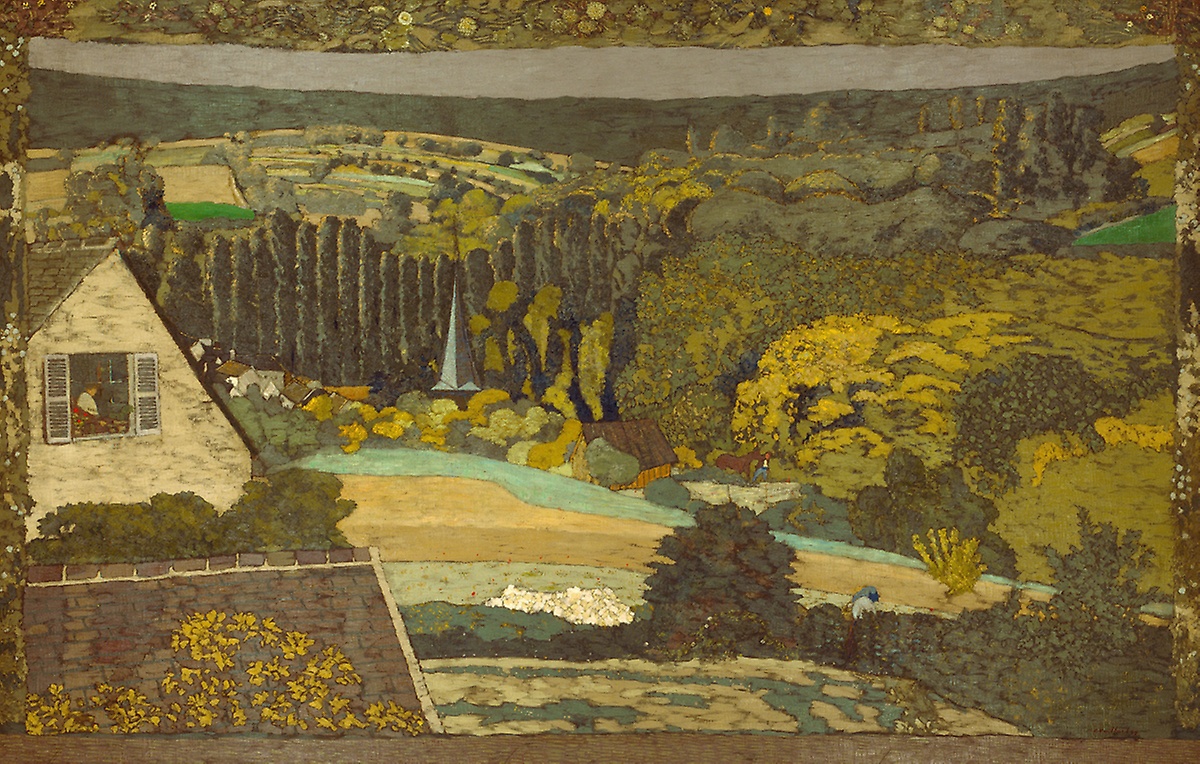
Édouard Vuillard – Landscape at Saint-Jacut

*******************

To say that a thing is beautiful is simply an act of faith, not a measurement on some kind of scale.

–Édouard Vuillard

*******************

If you asked me about my favorite painters, Édouard Vuillard (1868-1940) is not a name that would come to mind. In fact, I never even gave much thought to his work and didn’t have much of an opinion on it. I knew a little bit about the interior scenes for which he is well known but if you asked me to name or even describe his best known work, I would be at a loss.

But the more I look and the more I see of his work, the more of a fan I become of Édouard Vuillard. There is such a wide array of style in the body of his work that shows his exploration and growth.

The interior scenes I once shrugged over now seem to be wonderfully dense explorations into abstraction, pattern and color. There is so much to latch onto in each piece that a cursory glimpse doesn’t often suffice. I now see his work with a bit of a sense of awe and can honestly take that leap of faith and say that I see them as beautiful.

I even like a few of the things from him I have read, like the words at the top. Beauty is indeed subjective, not measurable with any set scale. My sense of beauty may well differ from yours. You may be moved by things that do nothing for me and vice versa. I don’t know that there is any one things, any one piece of art, that is absolutely beautiful to everyone.

Maybe there is. Who knows? Certainly not me.

He also wrote: I do not belong to any school, I simply want to do something that is personal to my self

These words depict that need to create something that is only mine, not something instantly attributable to a school or movement or any other artist, that has always been the driving force behind my own work. I don’t know that I have always been successful but I can say that Vuillard definitively did create a distinct body of art, beautiful work that is all his own.

Just good stuff. Here are a few examples from a sea of choices.


Read Full Post »

Since I have much to do this morning, I am running this post from back in 2013 that concerns a few early pieces. I came across one of these pieces, Doug’s First Day on the Job, early this morning and, while it made me chuckle, it reminded me of current events. Thought this post was worth looking at again.

*******************

GC Myers Early Interior sm“Can you remember who you were, before the world told you who you should be?”

Charles Bukowski, Post Office

***************

I have often shown early work here, stuff from when I was still trying to find a path forward. Most of it is from before I ever thought  that showing my work in public was a possibility. As I have pointed out, I still revisit this early work on a regular basis in an effort to stay connected with that time in which the need to create was the only motivation needed. There’s also an element of backtracking in this as well, trying to put together how this work somehow led to what I do now.

Sometimes it is hard to see the connections as the work is so singular and never followed up on, then or now. I think those are the pieces from that time that intrigue me the most, making me wonder how my journey forward from that time would have been different had I chosen and stayed on that path.

For example, here are three pieces from around the same time, all painted within a month or so of each other back in 1994. None really lead directly forward to the current time but I really always enjoy seeing these three pieces, wondering what my motivation was at the time. The first , shown above, is an interior scene that just formed on the paper. I had no idea what was going to be there, outside of the checkered tablecloth. I remember that the cross on the wall was a last minute addition, one that changed the whole feel of the piece. I can understand why I didn’t follow this path but it still makes me wonder.

GC Myers Still Life smThe next was this still life, here on the left. I remember this piece well, having ambivalent feelings about it as a whole. I liked the clear graphic look of it but it was almost too clean, too sharp. It had really good eye appeal but it seemed all surface to me. I see things from this piece that I did bring forward, such as some of the clearness of the colors which I like in some instances. The thing that always strikes me is that I see a face in profile, looking to the right. Faces subconsciously built into the composition are something I often look for in my work, feeling a curious satisfaction when I find them. I wish I knew why. Maybe that’s what draws me back to these early pieces.

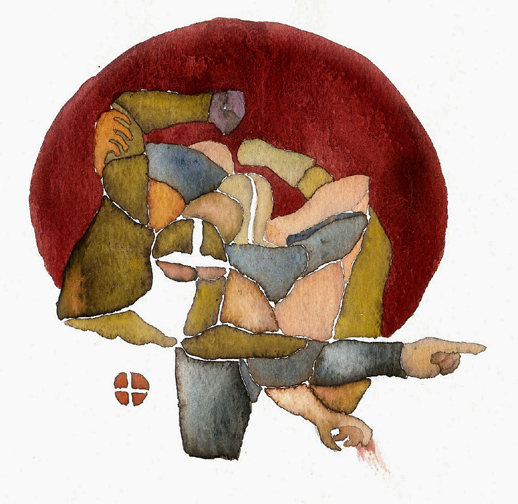
GC Myers- Doug's First day on the Job smThe last was one that had a title, Doug’s First Day on the Job.  I remember this as a piece that I viewed as an exercise even as I started, experimenting with forms and color. The resulting scrum of arms and fists with the strange authoritarian figure in the foreground, hooded and  pointing ominously out of frame reminded me of the chaos and confusion of  a kid’s first day on a new job. A strange environment with new procedures to learn and strange new people who struggle with each other and boss the new guy around. I knew even as I painted this that this was not my path but I enjoyed this piece anyway. It had a cleansing effect and was a wonderful lesson in color and form .

Plus it made me chuckle.

I don’t know that there is any great connection between these pieces or to my future and current work. I always wonder though at how these disparate  pieces formed in such a short time, wondering if I have that same burst of energy within me still. Maybe that is the reason for this backtracking, looking for that energy source, that fount of inspiration.

I don’t know…

Read Full Post »

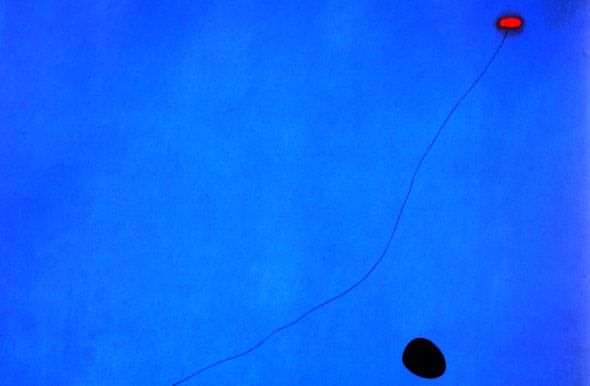
Blue II- Joan Miro

*****************

The picture should be fecund. It must bring a world to birth.

-Joan Miro

****************

This is a thought that I often keep in mind. Art succeeds when it creates its own reality, when it brings a world to birth in the mind of those who behold it. The artist’s own belief in the reality of that new world is a large determinant in whether this birth takes place.

For myself, I almost always feel like I am taken to a different world, one as real as the world I inhabit in my human skin, by whatever is on the surface before me.

That is, when it works. Sometimes it is difficult to climb into that new world and that new reality that wants to be born on the surface is nothing more than a lifeless mishmash of paint blotches and lines. That is frustrating, to say the least.

But when it works, it is an easy glide into that new world with its own atmosphere and landscape, so familiar yet new and fresh in the nose and to the eye. It’s a thrill just to be in there for that time when taking on its lifeform.

Joan Miro (1893-1983) did such a thing with such ease. I am showing his Blue triptych today. I find it interesting how intimate and alive they feel as single images on a screen where their scale fades away. These could easily be small paintings. But when you see them as they are in the two photos below, you can see their size and how it magnifies their lifeforce.

They are a world unto themselves.

Take a look for yourself. I have also included a video of Dave Brubeck’s Bluette below that is played over a slideshow of Miro’s work.

Just good stuff.


Joan Miro Blue I

Joan Miro Blue III


Read Full Post »

*********************

The writer operates at a peculiar crossroads where time and place and eternity somehow meet. His problem is to find that location.

–Flannery O’Connor

**********************

I think you could probably substitute artist in for writer in the words above from author Flannery O’Connor (1925-1964) without changing the gist of the thought too much. All art, and literature certainly falls into that category, is about transforming the now of the creation– the time and place— into something beyond that moment, into something timeless–the eternity to which O’Connor refers.

Finding that intersection where those two things come together is, as she points out, not such as easy thing to accomplish. And almost every instance the artist will never know if they have come to those crossroads that moves their work into the realm of the eternal.

I guess the finding is immaterial without the seeking. And seeking without any assurance of finding something that will ever reveal itself to you is an act of faith, a belief that there something eternal worth seeking.

I don’t know what else to call it. You keep trying. You think it is near sometimes but when you finally come to it, you’re not sure enough of what you’re experiencing to stop seeking.

Does one ever know when they have come to that crossroads?

That being said, here’s this week’s Sunday morning music from a longtime favorite of mine, Tracy Chapman. I think her body of work sometimes get overlooked in the deluge of the new but every time I come back to her, I wonder how I have let her slip out of mind. Here’s a song that fits the subject here, Crossroads, to accompany the painting at the top, Beyond the Crossroads, from back in 2004.

Have a good Sunday, okay?


Read Full Post »

The Classic Bob Gibson Followthrough

This is an edited version of a blog entry from way back in 2009:

It’s that time of the year.

Catchers and pitchers are reporting to spring training. Baseball is in the air. Is there any better time of the year?

Baseball has always held a special place for me. Oh, I was no more than an average player– decent bat, lousy arm and a so-so glove– but there was pure magic in seeing the heroes of my youth and hearing the stories of the early legends of the game.

I remember my grandmother telling me of going with my grandfather to New York City on their honeymoon in 1921 and seeing Babe Ruth play with the Yankees. Ruth hit a double and a triple as she recalled.

I remember sitting with my grandfather, the mythological Shank, so called for the holds he would apply to his opponent’s legs during his time as a professional wrestler, and watching the World Series in the afternoons of 1968. I had my tonsils out and was still recuperating and we watched the St. Louis Cardinals play the Detroit Tigers, who won the series. It was great watching with my grandfather plus I was introduced a player who became one of the heroes of my youth, Bob Gibson, the Cardinal’s pitching ace.

Gibby was it for me. The toughest guy out there, one whose competitive fire was, and is, legendary. So dominating as a pitcher that baseball changed the mound height because they felt the hitters needed help since he was practically unhittable. I read his early autobiography, From Ghetto to Glory, numerous times as a kid and that made him an even bigger hero to me. He was eloquent and college-educated, a rarity for ballplayers of that era, and his story was compelling, going from abject poverty onto college then a stint with the Harlem Globetrotters then on to baseball stardom.

He remains a hero.

Baseball was always played at our house. My dad was a pretty fair pitcher who had promise as a youth. In subsequent years, I have uncovered numerous news stories in old newspapers about his exploits on the mound and in the field. But later, as a dad, he would occasionally play catch with me and my friends. Eventually, he would break out his knuckleball, a pitch he was known for in his younger days. It was practically uncatchable, having a spectacular drop that would appear to be entering your glove only to end up hitting you in the stomach. Or lower. I was never able to master the pitch but still appreciate the awkward grace and dance of a well thrown knuckler.

Other times, I would pitch to him and he would hit flies to my brother in the outfield. Periodically, he would hit hard liners back at me. They would bang off me or make me dive out of the way and he would cackle. I would then try to drill him with the next pitch, which would make him laugh even more because he had gotten my goat.

I would calm myself and wait until he would pitch to me, waiting for the perfect pitch when I could send a hard line drive back at him, making him duck or dive. At such times, after having to jump out of the way or  defend himself with his glove, he would yell out a Hey! and give me a harsh look. Then he would usually laugh because he knew that I was just paying him back for his earlier actions. Payback was just part of the game.

Even my work has been somewhat affected by my experiences with the game. I remember the first time coming out of tunnel during a night game at Shea Stadium in the late 1960’s and seeing the field spread out before me. I was stunned by the colors that were so rich and lush under the warmth of the lights. It was a feeling that I think I wanted to replicate in some manner which ultimately led me to art.

Over the years baseball has become my calendar for the passing of the year and is a comforting friend on the days when the world seems ready to implode. I am still captive to the numbers and legends of baseball, one of those romantics who see poetry in a game based in tradition.

To that end, here is a wonderful version of Take Me Out to the Ballgame from Harpo Marx, played on I Love Lucy. It is delicate and graceful.  It’s the essence of the memory of baseball for me…

Read Full Post »

*************************

Love, whether newly born, or aroused from a deathlike slumber, must always create sunshine, filling the heart so full of radiance that it overflows upon the outward world.

–Nathaniel Hawthorne

*************************

A few choice words for this Valentine’s Day from Nathaniel Hawthorne, who is not someone who normally comes immediately to mind when one thinks of love and romance. But creating sunshine and filling the heart with radiance,as he put it, is not the province of any one writer.

I have plenty to do so I am going to keep this short today. Here’s a wonderful version from the immortal Nat King Cole performing the classic Embraceable You, written by George Gershwin back in 1928. Enjoy your Valentine’s Day. Or if the holiday doesn’t really move you, enjoy your Friday. Either way, it’s a win.

**************


Read Full Post »

*****************

Artists who live and work with spiritual values cannot and should not remain indifferent to a conflict in which the highest values of humanity and civilization are at stake.

–Pablo Picasso

******************

I always worry about alienating people who come to this blog to read about art and are greeted with my opinions and beliefs on the world. But reading the words above from Pablo Picasso this morning reminds me that my art is a product of all that I am and all that I witness in this world. I like to think that the work is about the human spirit and emotion. As such, I can’t remain indifferent or ignore those things that set off my emotional alarms nor those that eat away at what I see as the collective human spirit that we all share.

Thinking this made me look for another blog entry that I wrote just a couple of years back that featured some other words from Picasso as well the painting above, his masterpiece Guernica.

Here it is:

***************

Art is a lie that makes us realize the truth.

Pablo Picasso

****************

Many of my favorite artists worked and produced their greatest works in times where the world was under great stress. Two World Wars only decades apart and– in the case of Picasso– the Spanish Civil War in between. Here, we had the Great Depression. Times of social transformation and spiritual upheaval. Even when the work didn’t overtly deal with the events of the day, much of the work reflected on the collective consciousness of that time.

I think that is so because art is, just as Picasso so succinctly states, a lie that makes us realize the truth.

Artists fabricate, often creating work that is on its surface pure fantasy with little relation to the world as others might observe it. But their fabrication is made up from everything that impacts them– their knowledge, their observations, their opinions and emotions. Artists take in the world and create something that seems like a pure fabrication.

A lie.

But what seems the lie often proves to be built of ultimate truths, just constructed in a manner that allows others to see this truth clearly.

I don’t know that we artists always succeed. I certainly don’t feel that I do as often as I would  like. But when a piece succeeds and shows us something far beyond what its surface represents, it is a true revelation.

Believing that, so long as we feel deeply and continue to create our lies, we will at some point reveal a truth.

Got to get to work now…

Read Full Post »

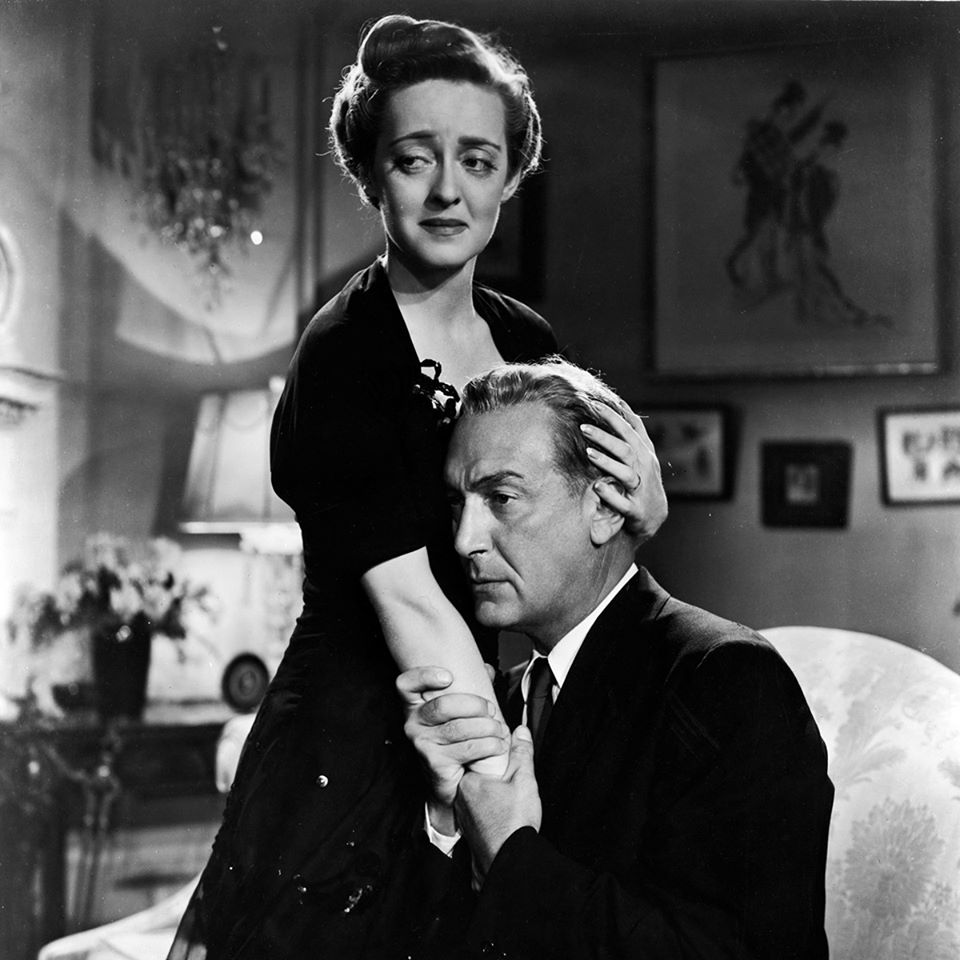
Watch on the Rhine- Bette Davis and Paul Lukas, 1943

**********************

In Praise of the Fighters

There are men who struggle for a day and they are good.

There are men who struggle for a year and they are better.

There are men who struggle many years, and they are better still.

But there are those who struggle all their lives:

These are the indispensable ones.

Bertolt Brecht, The Mother,  1930

********************

I came across this short poem/song taken from the play The Mother written by Bertolt Brecht and was reminded of one of my favorite movies, Watch on the Rhine, which featured one such indispensable fighter. I was reminded, as well, of the path we are hurtling down as a nation, especially in the light of the events here of the last few days and weeks. The transformation is accelerating as all guide rails that have protected us in the past are smashed aside. The parallels between what is happening here at the moment and the formation of other authoritarian/fascist regimes in the past century are haunting.

But this short verse and this movie favorite of mine remind us that in almost all of these other regimes, they have been opposed and often defeated by people of great strength and resolve. They were Anti-Fascists or Freedom Fighters who put aside concerns for their personal benefit or safety and devoted their lives to opposing, in every possible manner, the cruelty of fascist rule.

You might read this and shake your head and think that this is an overstatement of what is taking place, that things are not so dire as I might see them and that we are light-years away from fascism.

I hope you’re right.

But I remind you that in all of these past regimes there were large numbers of their citizens who thought just that same thing, that such a thing was inconceivable. It can’t happen here. But authoritarianism creeps up on you, taking hold little by little. Then, when there is a window of opportunity for it to impose its total will on the citizenry, it accelerates at a pace that exceeds the ability of normal response to restrain it.

It may be too late beyond that point but for these people who stand in brave opposition. The fighters.

I urge you to see Watch on the Rhine if you get a chance or at least read the original play. The film was made in 1943, adapted for the screen by Dashiell Hammett from the prize-winning play written by his wife, Lillian Hellman. It concerns a well-heeled family in the Northern Virginia area across the Potomac from Washington whose daughter ( played beautifully by Bette Davis ) returns home from a war-torn Europe for the first time in many years with her husband and children. It is set, and was written, in the year or so before before our entry into World War II.

Her husband is a German freedom fighter named Kurt Muller who is a fugitive leader in the underground movement against the Nazis. He is played by Paul Lukas in a magnificent performance, one that won him the Academy Award for Best Actor that year over Humphrey Bogart in Casablanca and Gary Cooper in For Whom the Bells Toll. Yes, it was that good.

His Muller is the common man who finds himself in the role of the selfless hero willing to give up everything– his career, his family, his life– in order to stand against evil. Muller did not seek this task but knows that it is one he must shoulder. His words are simple, direct and powerful.

Lukas, who also originated the part on the Broadway stage, is brilliant. Whenever I see this movie, I am haunted for weeks afterwards by Lukas’ performance. The power of it thrills me but I find myself questioning my own strength and beliefs as a human. Thankfully, to this point, I have never been put into a situation like that faced by Kurt Muller and hopefully never will.

But would I be able to stand with even a fraction of the grace and courage of Lukas’ character?

I really don’t know.

There is a different first line of Brecht’s song at the top of the page taken from another translation of the verse from its original German: Those who are weak don’t fight.

I sincerely hope I don’t fall into that category if the situation ever presents itself at my door.

And I worry that it is coming up my walkway even as I write this.


Read Full Post »

Peter Doig- Swamped 1990

********************

I sometimes wish I had never had to sell a painting. Every painting you make represents the time it was made and how you were feeling and what your influences were… You are never going to feel that way again, so you can never repeat it…

–Peter Doig 

*******************

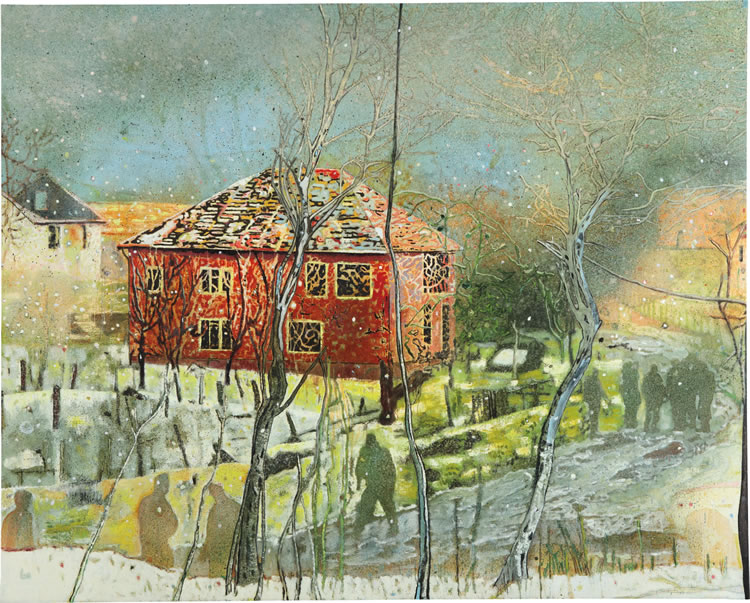
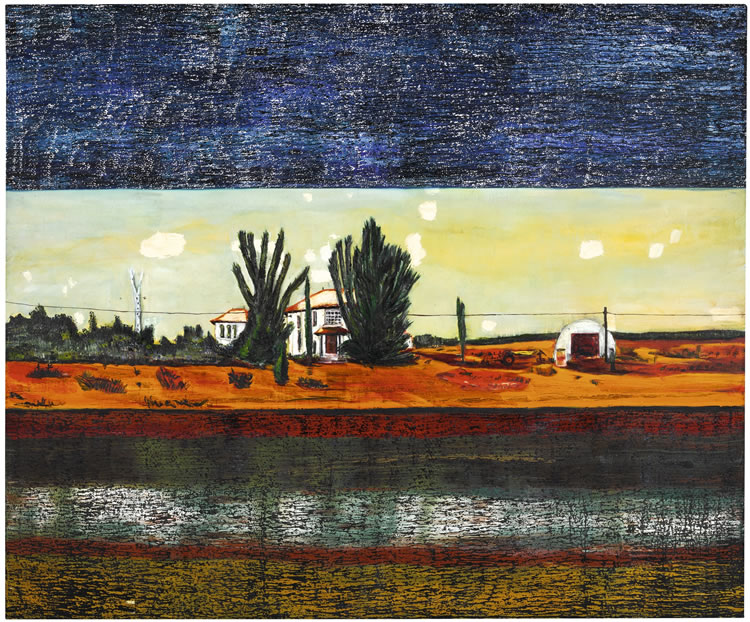
I shouldn’t make such a blanket statement but I doubt that most of you out there know the name of the contemporary artist Peter Doig. I know that I wasn’t fully aware of him until a decade or so back and even then only on a passing basis where I would stop and examine his work when I would come across it in an article. The piece at the top always made me stop and look a bit closer.

But the fact of the matter is that the Scottish born Doig (b. 1959) is perhaps the most sought after living artist working today with works selling for the tens of millions at auction. Of the 9 paintings shown here, only one sold for less than $10 million at auction. The most expensive sold for over $ 28 million. I won’t tell you which is which. There were many others on the auction sites that sold for between 1 and 4 million that I didn’t include.

These prices always open up a debate with lots of questions on the relative value of artwork. What makes a work worth $28 million? Does the auction value of the work determine its importance or does its importance determine its value? Is the working and thinking process of this artist that much different than that of an artist that sells for tremendously less?

You might think from the direction this seems to be heading that I am decrying Doig’s work selling for what I believe are ludicrous sums. I am not. I very much like and admire his work. I can see those elements in it that make it distinct. It is good and great work and might very well be among the most important work from this time. If his work can bring in that kind of money, I applaud him.

I am, if anything, criticizing myself for not having the ability– or knowledge or audacity– to command such prices. I know that the price of a piece of art sometimes determines how serious collectors view it and that a great piece can be overlooked simply because it is too inexpensive, at least by the standards of collectors.

That has happened to me at times.

In some galleries, my works sits at the top end of their market and in others, in the middle or near the bottom of their price ranges. While I am satisfied with that, I firmly believe that my work is greatly undervalued across the board, that it should be demanding much higher prices.

Now, that sounds like confidence, doesn’t it? Maybe even overconfidence?

Actually, it is the opposite of that. It is a lack of confidence and a bit of fear that keeps the prices of my work in the range where they are and have been. While I have the belief in the relative value of my work, I just don’t have the guts to make that jump.

I have been poor in my life and it wasn’t that long ago that I was dead broke and I think that tempers my ambitions, as far as pricing my work is concerned. I like to have my work sell and make a living from it. I take pride in being able to live off of the product of my own thoughts and imagination. And I find a sense of security in being able to provide what I consider high quality work at prices that make it obtainable for more people than if it were in a much higher range– it’s undervaluation generally means that the work will sell eventually.

Maybe I am too comfortable and seeing Mr. Doig’s prices just nudges me a bit, telling me to be less comfortable, to be more proactive.

I don’t know. Just thinking out loud this morning. I wrote this because much of what I have read about and from Doig jibes with my own experiences, including the quote at the top. For all the talk about prices, every real piece of art represents a certain time and place for that artist, one that is distinct and not repeatable. I know that I will sometimes look at a piece and remember the days I spent in front of it while painting it. That time, that thought process is burned into my psyche and will never happen again in the same way.

Anyway, lets’s push aside thoughts of money for now and just look at the paintings of Peter Doig a bit more.

Peter Doig- Rosedale 1991

Peter Doig– Red House 1995

Peter Doig– Island Painting 2000/01

Peter Doig– Grasshopper 1990

Peter Doig — Daytime Astronomy 1998/99

Peter Doig– Charley’s Space 1990

Peter Doig– Forestia 1996

Peter Doig– Almost Grown 2000


Read Full Post »


Thought I’d share the film that won the Academy Award last night for Best Animated Short Film. It is titled, Hair Love, and was written and directed by Matthew A. Cherry, and co-produced with Karen Rupert Toliver.  I saw it yesterday morning on CBS Sunday Morning and thought it was absolutely charming and sweet.

I think we need both of those two things and the humanity they represent, even if it is only for the 7 minutes of this short film.

I didn’t watch the Oscars last night. Since I don’t see many movies at the theater these days, usually waiting until they move to streaming services, I am usually not in any position to root for any one movie. In fact, of this year’s crop of Best Film candidates, I have only seen one, Jo Jo Rabbit, which I thought was marvelous. Both laugh out loud funny and moving, it is one of my favorite films in many years.

But I look forward to seeing the others, particularly Parasite, the Best Film winner from South Korea and the first to ever win as a foreign language film, and 1917, set in WW I. Seems like quite a good crop of films this year.

But for now, from Sony Pictures Animation, take a look at Hair Love. Hope it gets your week off to a good start.

Read Full Post »

« Newer Posts - Older Posts »