Feeds:
Posts
Comments

Archive for February, 2020

*******************

Some humans ain’t human
Some people ain’t kind
They lie through their teeth
With their head up their behind

You open up their hearts
And here’s what you’ll find
Some humans ain’t human
Some people ain’t kind

John Prine, Some Humans Ain’t Human

*******************

Maybe it’s just being tired from wrestling with a foot of fallen snow or maybe it’s just being sick of being sick about the state of affairs taking place here in this country. I can’t say for sure but whatever the case, it has made me a little misanthropic as of late.

It bothers me and it’s not something I embrace lightly. I’ve always resolved to follow the Will Rogers maxim of I never met a man I didn’t like, believing that I could always find common ground with anyone I came across, could find something that we could agree on. And that was generally the case for the better part of my life.

But the last three or so years have put that resolution to the test as so many of my fellow citizens have been suddenly liberated to openly express their prejudices, their hatreds, their conspiracy based beliefs, their petty spitefulness and a whole litany of stupid behaviors that would crush my spirit completely if I were forced to list them all.

This morning, I just want to give up and embrace my angry misanthropy. Maybe walk to the end of my driveway and give the finger to the first passing car.

That’ll teach ’em, won’t it?

Oh, I know. That won’t happen. I will still try to find good in people, try to find things we have in common.

But be warned: my patience ain’t what it used to be.

So, for this Sunday morning music I have selected what I consider a fitting choice for this mood. It’s Some Humans Ain’t Human from John Prine. He wrote it in 2005 as political commentary on George W. Bush‘s decision to put into the war with Iraq, that one we still can’t seem to shake free from. He said he didn’t want to die with people not being sure where he stood on Bush.

Give a listen and if you want to sing along, go to this link for the lyrics. Then have yourself a good day. No, I really mean it. I want you to have a good day. So steer clear of me, okay?


Read Full Post »

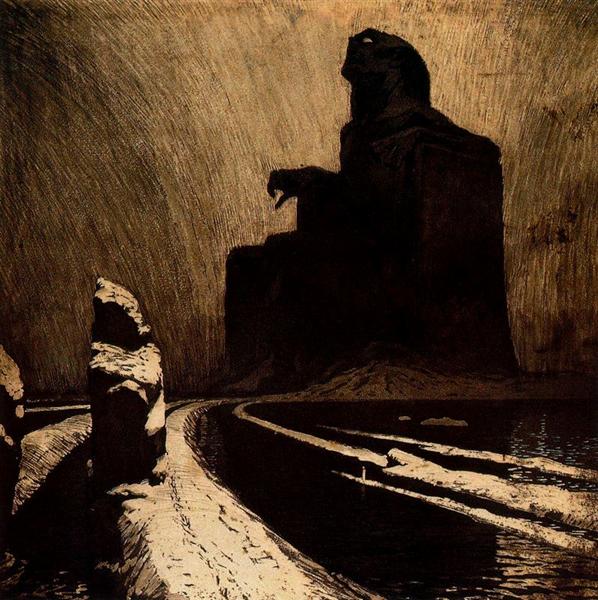
Frantisek Kupka – The Black Idol (Resistance) 1903

*************************

“In keeping silent about evil, in burying it so deep within us that no sign of it appears on the surface, we are implanting it, and it will rise up a thousand fold in the future. When we neither punish nor reproach evildoers, we are not simply protecting their trivial old age, we are thereby ripping the foundations of justice from beneath new generations.”

Aleksandr I. Solzhenitsyn, The Gulag Archipelago 1918–1956

**************************

Cautionary words from a man who experienced the results from a nation that went in the direction in which we seem to be moving. Much like yesterday’s post, a warning that we shall reap the amplified consequences from the evil we have sown with the silent compliance contained in our acceptance of it.

As they say, ’nuff said.

Read Full Post »

************************

When men sow the wind

it is rational to expect

that they will reap the whirlwind.

–Frederick Douglass

************************

Amplified consequence.

In his 1892 essay, Lynch Law in the South, Frederick Douglass used the proverb from biblical book Hosea, to illustrate how man often sets things in motion that have results that extend far beyond– and often in stark opposition to– their intended goals. Douglass wrote that the deadly violence being shown against the black citizens of the south at that time would eventually come back to haunt those that perpetrated the deed or stood idly by, complicit in their silence.

The biblical proverb in Hosea was about how the the citizens of Israel of that time ( ca 725 BC, I believe) took to idolatry, the worship of false idols, and how their actions brought down upon them the wrath of God. In that book the author uses the concept of farming to make his point, that a  a single seed of grain sowed by a farmer returns to him many times over.

An amplified consequence.

Of course, the farmer can usually tell what the result of his sowing will be. X amount of seed will allow him to reap Y amount of grain at harvest under normal circumstances. Predictable.

But that same degree of predictability doesn’t apply to all other actions man sometimes sets in motion. While we might initially think we control the outcome, we sometimes put actions into motion — sow our seed– that we cannot control, that return to us with such amplification and intensity that we are overcome and sometimes decimated by the result.

One small, seemingly insignificant action, such as not paying attention to a rising dangerous wind, can sometimes turn into a maelstrom of destruction that we never saw coming.

Take that for what it’s worth, given the events in recent days in this country.

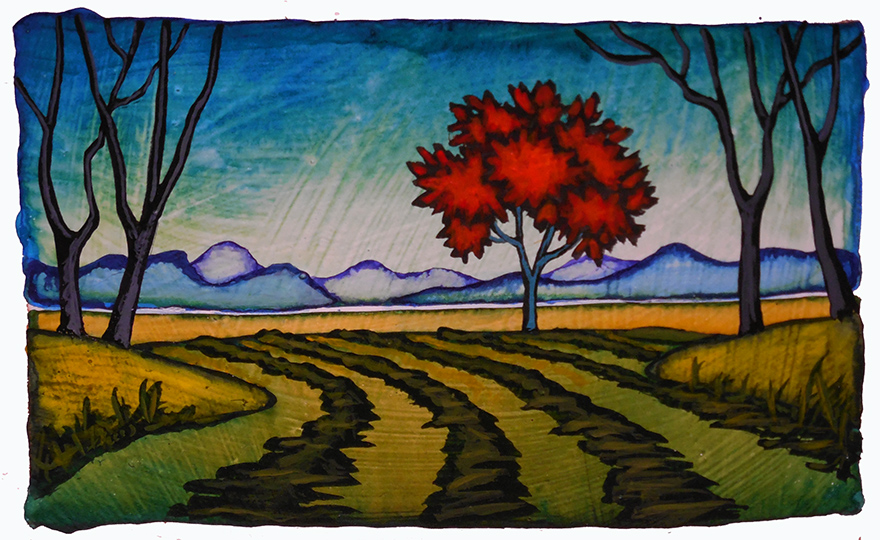
The painting at the top is called Into the Winds of Change and is part of the West End Gallery‘s annual Little Gems show that opens tonight with an opening reception from 5-7:30 PM. Hopefully, like the Red Tree here, we can stand against and overcome the whirlwind that may soon be upon us.

Read Full Post »

*********************

“Look at everything always as though you were seeing it either for the first or last time: Thus is your time on earth filled with glory.”

Betty Smith, A Tree Grows in Brooklyn

*********************

In times like these, it is even more important to consider the words above from the classic book A Tree Grows in Brooklyn. In days that often filled with anger, anxiety and sometimes despair, we must remember to take in the simple wonders that surround us, to pay notice to the beauty and magic of the natural world surrounding us.

As the death of the great actor Kirk Douglas yesterday reminds us, how much time is guaranteed for any of us here? Do we want to leave this world not having paid attention to the simple wonder within our reach?

I’e been in my current studio for over twelve years now and have looked out its windows tens of thousands of times. But even after all that gazing I still am able find new things to see. Trees I have never noticed. The way the sunlight comes through and hits certain limbs at a certain times. The way the wild turkeys gather under the maple trees beside the studio when its raining and face the house, sometimes gobbling at it as though they believe I can come out and shut off the rain.

If I could, I would do that for them.

Small things. Simple things. But wonders nonetheless.

I find myself sometimes stopping in the woods and looking around, taking notice of the small wonders within my sight. I try to take a snapshot in my mind of that place in that moment, thinking that if I were to suddenly pass away, I would have as an image to carry with me from my last day.

You would be surprised how much comfort I take in that little moment, standing still on a woody path.

This is the gist of what this painting at the top of page is saying to me. Titled In Simple Wonder, it’s part of the Little Gems exhibit at the West End Gallery that opens tomorrow evening.


Read Full Post »

When I finished this small painting, the term Seventh Heaven quickly came to mind and bound itself to it as its title. There was a quality attached to it that evoked that phrase that I’ve heard thousands of times, mostly describing a time and place of immense satisfaction.

Bliss.

But in all those times I never thought about what Seventh Heaven really meant or where it came from. It was just a phrase that was thrown around easily without thought.

Turns out it has beginnings and attachments to the ancient Greeks, the Kabbalah of Jewish mysticism and in Hindic and Islamic belief.

The Greeks’ believed there to be seven classical planets beyond our earth —Mercury, Venus, the Moon, the Sun, Mars, Jupiter, and Saturn— each having its own heaven.

In the Jewish Kabbalah, there are seven levels of heaven, each ruled by an angel. For example, Shamayim is the first heaven, governed by Archangel Gabriel. It is the closest of heavenly realms to the Earth; it is also considered the abode of Adam and Eve. The seventh heaven here is called Araboth. Under the leadership of the angel of Saturn, Cassiel, it is the holiest of the seven heavens, housing the Throne of Glory attended by the Seven Archangels and serves as the realm in which God dwells. Beneath the throne itself lies the abode of all unborn human souls. It is also considered the home of the Seraphim, the Cherubim, and the Hayyoth.

The Islamic seventh heaven is similar in many ways to that of the Kabbalah, comprised of a divine light that is incomprehensible to mortal man.

Hinduism divides the material universe into fourteen worlds, seven of them being upper and seven being lower. Brahmaloka is the highest of the seven upper worlds, the highest of the joyful worlds a person might attain. It is the home of Lord Brahma.

There’s more but we’re going to keep this shallow today. It comes down to all of the different forms of  Seventh Heaven denoting a place of ultimate joy.

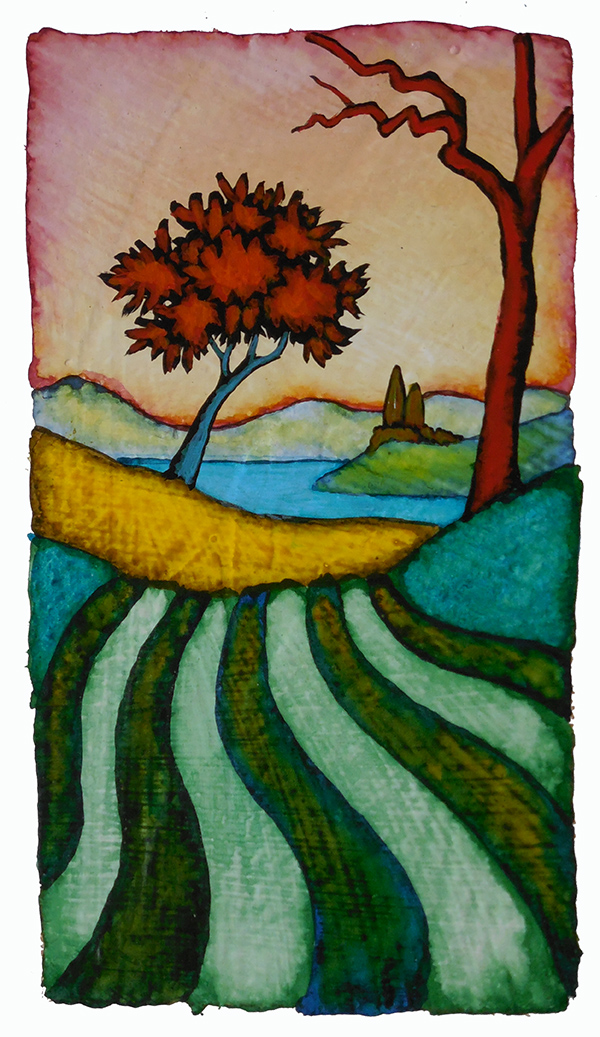
That description fits this little piece, with its seven rows in the field of the foreground, for me.

It is a seventh heaven by itself.  Even if it brings me only a moment of bliss, that’s I all I can ask for here on this earth, I suppose.

******************

This piece, Seventh Heaven, is part of the Little Gems exhibit at the West End Gallery which opens Friday, February 7 with an opening reception that runs 5-7:30 PM.


.


Read Full Post »

Coming to the studio this morning and the song, It Ain’t Necessarily So, runs incessantly in my head for some unknown reason, reminding me of a post from a few years back that speaks directly to this. Here it is:

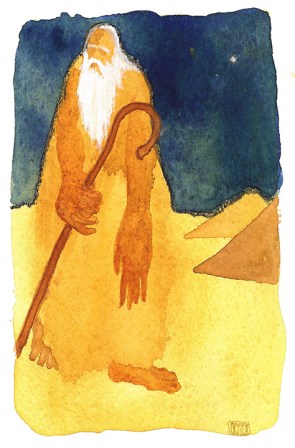
GC Myers- Moses (I Supposes)Sometimes when I am walking over to the studio in the morning I will have a song stuck in my head. Sometimes it is one that I recently heard, something from the radio. But sometimes it’s one that just springs deeply from the past, something I haven’t thought of in some time. That’s how it was this morning. And thinking of that song linked me to a small painting that I did many years ago.

They just fit together in my mind for some reason.

The song was It Ain’t Necessarily So, the song sung by the slick drug dealing Sporting Life in the great George and Ira Gershwin opera, Porgy and Bess, set among the Gullah population living on the sea islands off of Charleston, South Carolina.

Just a fantastic mix of sound and wordplay.

For some unknown reason, when I hear this song this small painting from over 20 years ago always comes to mind. It’s a piece that I did very quickly, not really knowing what I was trying to paint.  It just sort of popped out and I immediately began calling it Moses (I Supposes). There was something about this piece that I have always liked. Maybe it’s the I-don’t-give-a-damn way way everything in it is painted, from the giant hands down to the giant feet.

It’s just a personal favorite that somehow always springs to mind when I think of this song. Maybe because Moses is mentioned in a verse in the song–

Lil’ Moses was found in a stream
He floated on water
‘Til Ole’ Pharaoh’s daughter
She fished him, she says from dat stream.
***************
I don’t know for sure why the song and painting are connected in my mind but I enjoy the combination. Here is one of my favorite versions of the song, the one from the Simon Rattle directed version with the London Philharmonic from the Glyndbourne Festival with Damon Evans as Sporting Life.
Have a great day and remember– not everything is necessarily as it seems to be. It ain’t necessarily so…
**************


Read Full Post »

The annual Little Gems exhibit opens this coming Friday, February 7, at the West End Gallery in Corning. This is the 26th year that the West End has hosted this show and I am fortunate to have been along for the ride, going back to that first one in 1995 at their second story old gallery space.

That was my first experience showing my work publicly. I had no idea what to expect when I stood there, anxiously trying to blend into the background as people milled around the gallery, on that night of the first opening. But based on the past 25 years, things seem to have worked out okay.

For me and for the Little Gems show which has turned out to be a perennial favorite for fans of the West End Gallery. It is the most popular show there, year in and year out. It’s fun for most of the artists to make small work and perhaps try out new things. There are plenty of small but mighty paintings created for this show which allows attendees, be they avid or first-time collectors, to attain original and high quality pieces of art at obtainable prices.

This painting above is called Riding High. I haven’t looked back but I think a boat painting is part of my contribution for this show most years. It’s a theme and an image that translates well to a smaller scale, maintaining its full impact. By that, I mean that it seems bigger on the wall than it actually is.

A lot of the work throughout this show have that quality.

So, hope you can make it to the show this Friday, February 7. The opening reception begins at 5 PM and goes to 7:30. The show is hanging if you want to stop in for a preview and to claim a little gem for yourself.

Here’s a song from the late June Carter Cash‘s final album that I think lines up well with this painting. It’s a lovely old Carter Family song called Sinking in the Lonesome Sea.

Have a good day.


Read Full Post »

**********************

“I’m not sure this will make sense to you but I felt as though I’d turned around to look in a different direction so that I no longer faced backward toward the past but forward toward the future. And now the question confronting me was this: What would the future be”

― Arthur Golden, Memoirs of a Geisha

**********************

This small painting that is hanging as part of the Little Gems exhibit at the West End Gallery (opening Friday, February 7) is titled Memoir.

The thought behind that title was that that while the future seems uncertain as we look forward, our pasts as we recall them are often just as uncertain.

Our personal histories are a patchwork, like the sky in this painting, of half memories and dimly lit stories. Faces and names fade. Words once spoken are lost in the void. We have grainy snips and snaps of what we recall as significant moments and some surprisingly sharp images of insignificant moments that puzzle us, leaving us to wonder why they remain so clear.

Do they mean something more and we just don’t see their true meaning?

I looked at this small piece and wondered what I would include in my memoir. What would I pull from that haphazard patchwork that I would want to share now and into the future?

After sifting through the shards of broken memories, I come to the conclusion that I don’t want to write a memoir. Let my memoir show itself in my work, let my story be told in paint and line and shapes, a crude group of hieroglyphs that will no doubt go untranslated in generations to come.

Let the future, if it is so inclined, write my past. That shall be memoir enough for me.

For this Sunday morning music, here’s a song to go along with this painting. It’s the Nick Lowe pop classic, When I Write the Book.

Have a good Sunday.

Read Full Post »

**************************

The worst of it is that we live in a spoiled moral environment. We have become morally ill because we are used to saying one thing and thinking another. We have learned not to believe in anything, not to care about each other, to worry only about ourselves. The concepts of love, friendship, mercy, humility or forgiveness have lost their depths and dimension, and for many of us they represent only some sort of psychological curiosity or they appear as long-lost wanderers from faraway times, somewhat ludicrous in the era of computers and space ships. . . .

If I speak about a spoiled moral atmosphere I don’t refer only to our masters. . . I’m speaking about all of us. For all of us have grown used to the totalitarian system and accepted it as an immutable fact, and thereby actually helped keep it going. None of us are only its victims; we are all also responsible for it.

Vaclav Havel, New Year’s Day Address, 1990

**************************

I came across the line, We have become morally ill because we are used to saying one thing and thinking another, in a tweet last night from former CIA Director John McLaughlin who said it ran through his mind several times yesterday as he watched the display of moral bankruptcy from the GOP senators taking place before our very eyes.

The onetime Czech playwright and dissident Vaclav Havel spoke those words in his New Year’s Day address to the Czech people after becoming the first democratically elected President of that nation in the post-communist era just weeks before. To that point, Havel had lived his entire life under an authoritarian regime. His plays were banned in his own land and he was imprisoned as a political prisoner multiple times, over four years during the longest incarceration, for attempting to bring light into a society where truth was what the regime claimed it to be. Many citizens were under almost constant surveillance and show trials were the norm.

Shows trials are those, particularly in Soviet nations of the Cold War Era, that have a predetermined outcome and don’t rely on witnesses or real evidence. As with truth, the evidence was what the regime claimed it to be. It was an expedient manner to remove political opponent with the appearance of justice taking place.

Sound familiar?

After reading Havel’s address and watching the events of the last few days, knowing already what the outcome will be as in any show trial, I could see real parallels in the moral illness that Havel described in his address and the behavior of our Republican senators. How can these people who speak one thing while thinking another believe that this will not corrupt our whole society, that which they have been entrusted to protect?

Their corruption will beget more corruption and that corruption more yet. Our Great Leader’s thousands upon thousands of lies will become accepted truths and his skewed amorality becomes the moral compass of our nation. Unless we reject these new norms, we will remain in this spiral that will soon bring us to a form of totalitarianism complete with more show trials and deeper surveillance for those who dare to stand against those in power.

We still have a chance to avoid this end. As Havel said: None of us are only its victims; we are all also responsible for it.

You can’t stand on the sidelines now. You can’t let others do the heavy lifting alone. Too many of us have done that for too long.

We are all responsible for it.


Read Full Post »

« Newer Posts