Feeds:
Posts
Comments

Archive for February, 2021


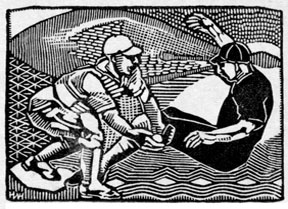
I’m helplessly and permanently a Red Sox fan. It was like first love…You never forget. It’s special. It’s the first time I saw a ballpark. I’d thought nothing would ever replace cricket. Wow! Fenway Park at 7 o’clock in the evening. Oh, just, magic beyond magic: never got over that.

― Simon Schama


Maybe it takes the words of an esteemed British historian like Simon Schama to best describe the grand attraction of a ballpark when first seen in the waning light of the day, with the lights making the green grass and bright white chalk lines of the field pop into your eyes. I remember that feeling at Shea Stadium in the late 60’s, going up the darkened ramp from the concourse to the stands, emerging into a burst of deep colors and lights along with the buzz of the crowd increasing with each step forward.

It was magic beyond magic.

Baseball is back this week, with Spring Training beginning. For me, baseball is the canary in the coalmine. It felt odd and out of place last year with a raging pandemic and the country ripped apart by culture wars and the political apocalypse of an election that felt as existential as any we have had in recent times. Baseball was still there in a weird bubble that took away much of what made it important as a cultural touchstone.

It felt sporadic and detached.

Like most of us.

But it is coming back, as it always has each February, and with it comes the hope that we are nearing a point where we can sometime soon return to a form of normalcy. Where kids can experience that burst of color and light for themselves, can root loudly for slick fielding infielders and hard hitting sluggers. Where old farts like me can revel in the cyclical nature and routine of the game along with its esoteric details, its poetry, and its history. That

Author Michael Chabon, in his book Summerland, put words to my own feelings the game and how it echoes and rhymes with day to day life:

 The first and last duty of the lover of the game of baseball,” Peavine’s book began, “whether in the stands or on the field, is the same as that of the lover of life itself: to pay attention to it.

I have had trouble immersing myself in spectator sports this past year with all that is happening. But the start of Spring Training offers renewed hope. And that hope is a big part of the game. While personal glory and team victory are the goal, baseball is a game about how one copes with failure. It is a game of humility. The greatest players of all time failed more than they succeeded and most players go through their careers without winning the World Series. 

The hope is that if you give it your best effort, this pitch might be the big pitch or this catch will be the big catch. This hit might be the big hit.

This year might be the year.

It is a grand metaphor for the hardship and grace of life that repeats itself 162 times a year. Like life, it offers us everything if only we pay attention.

Pay attention and have a good day.

Here’s a favorite baseball tune from Mabel Scott to kick off the season:


Read Full Post »


“Everyone must leave something behind when he dies, my grandfather said. A child or a book or a painting or a house or a wall built or a pair of shoes made. Or a garden planted. Something your hand touched some way so your soul has somewhere to go when you die, and when people look at that tree or that flower you planted, you’re there.

It doesn’t matter what you do, he said, so long as you change something from the way it was before you touched it into something that’s like you after you take your hands away. The difference between the man who just cuts lawns and a real gardener is in the touching, he said. The lawn-cutter might just as well not have been there at all; the gardener will be there a lifetime.”

― Ray Bradbury, Fahrenheit 451


I recently finished this small piece shown above, a little guy that’s only 2″ by 4″ on paper. I wasn’t — and am not yet– exactly sure what meaning it holds for me, what message, if any, it carries. It certainly felt like it had something to offer.

It might be small but it seemed like it was speaking with a much larger voice. I was mulling this over this morning when I heard a new song, Calling Me Home, from one of my big favorites, Rhiannon Giddens. It’s from a new album coming out in April. There’s a line in the song that immediately struck me:

Remember my stories, remember my songs/ I leave them on earth, sweet traces of gold

It made me think of that existential question: What is it we leave behind?

That immediately brought to mind a favorite excerpt, shown at the top, from Ray Bradbury in his sci-fi/ dystopian classic Fahrenheit 451. It’s those things to which we devote or full effort, our mind and time, that have lasting effect. Often, things that are done with no real expectation of anyone recognizing your thought or effort in doing them.

It makes me think of my pond. I can see its top now in the winter since the leaves have fallen from the trees. I built it back in the summer of 1998 during a week spent pounding the hard pan soil beneath the clay of my property on a rented Cat D9 dozer. I am not sure my brain has come to rest yet from that beating. But the thrill of seeing it fill in the rains later that summer and fall along with the many life forms that soon made it their home were as satisfying as anything I have painted. I often look at it and think that it will be here long after I am gone, supporting lives of creatures that will have no knowledge of my efforts.  

And that pleases me greatly. Even as much as any legacy my work here in the studio, if any, will have.

I think I will call this little painting Calling Me Home. Not sure it’s absolutely the title others will see but if fits for me this morning.

Here’s the song from Ms. Giddens. have a good day, 


Read Full Post »

To tell the truth, I had nothing in mind this morning for the blog. I was thinking that I would be too busy plowing but we didn’t get nearly as much of a snowfall as had been anticipated. We got a few inches but most of the precipitation came in an icy rain that coated everything. Not terrible, at least at my place, like some of the scenes I have seen from where the storm dropped larger amounts of icy rain that brought down wires and trees.

So, not having to get out there early to plow I found myself wondering what to talk about this morning. I went back through the archives and came across an entry from over ten years back. It’s about a piece that is in the possession of my sister. It might be my favorite among several she has , one that I always look forward to seeing when I visit her. With the pandemic, there haven’t been any visits so I haven’t had a chance to visit this piece recently. So, I thought I ‘d share it along with a little music at the end that seems to fit, at least in my head, some of the great Son House playing his wonderful Delta blues. Take a look at Big Foot Stomp, painted around 1995. And have a good day.


Singing and Mending– Robert Gwathmey


I was looking through a book containing many of the works of the painter Robert Gwathmey when I came across an image that reminded me of a small piece that I had painted several years back. Gwathmey’s painting was titled Singing and Mending and featured, like many of his paintings, a depiction of African-American life from the rural South.

This piece had a man in overalls playing a guitar while a woman mended a piece of clothing. It was the man playing the guitar that caught my eye. Perhaps it was the overalls or the position of the guitar or the bare feet but all I could think of was a similarity in its nature to a small painting that I had painted a few years ago and which now hung on my sister’s wall. It is a little oddity, a favorite that I always look at with interest whenever I go to her place. I call it Big Foot Stomp.


It was an experimental piece, a revisiting of another earlier foray in paint when I was just starting  years before. I can’t quite recall what my initial intentions were with this piece. I remember that I laid down the splattered background with spray bottles of paint, masking the lighter center with a piece of matboard as I did the darker outer edge. But I don’t think I ever had this figure in  mind when I began to paint in that center. But I’m glad that he came out in this way.

I recall painting the head first, just laying down a silhouette of paint then trying to make something from it. I remember liking the way the dark paint seemed to pop from the lighter background, making me think this was a black man and that I wouldn’t lighten it any more. It was right as it was.

The rest is hazy in my memory except for a slip in my brushstrokes that affected the size of his feet and for the decision to leave out the parts of his clothing that would normally be visible. For me, these two elements really make this little guy special. There’s something about the white space where his clothing would be that brings a spiritual element to this piece for me, as though his playing and the rhythm of his large feet on the floor are taking him to a place beyond the here and now. I think the way he rests in the splattered background enhances this.

I’ve never painted another piece like this. Maybe he was just meant to be one of a kind. He certainly feels that way. But at least in the Gwathmey piece I have found a spiritual relative to this lone guitar player.


Here’s Son House (1902-1988) and his Levee Camp Blues. House influence on the blues and, by extension, rock music, is huge. He is often cited as an influence on two other giant influencers, Muddy Waters and Robert Johnson. It don’t get much more real than that.


Read Full Post »


“There is a vitality, a life force, an energy, a quickening that is translated through you into action, and because there is only one of you in all time, this expression is unique. And if you block it, it will never exist through any other medium and will be lost.”

― Martha Graham


I was thinking about a recent comment on social media below one of my paintings where the commenter said that the piece made this person feel as though they were wasting their time with their own painting. They added that this wouldn’t stop them from continuing to paint.

I can’t tell you how relieved I was at that. While I gladly accepted the implied compliment of the first part of the comment I was mortified by the idea that someone would not continue painting because of my work.

And this was mainly because I had been at that same point early on, when as a novice painter I would look at artists whose work was fully realized, who through hard work had found their own style and voice. At that point, in comparison to the famed artists whose careers were full and complete, I felt inferior and dejected, thinking that maybe this wasn’t the path for me after all.

Maybe I should give it up and try another path or just give up altogether.

But I had a thought in my head very similar to the words at the top from the late dancer/choreographer Martha Graham. I truly believed that I had something inside me that needed expression and since there was only one of me in this world, whatever came out, good or bad, would be uniquely mine. At that point, I wasn’t thinking about selling my work or galleries or a lifelong career. It was just about getting the inner thing that was distinctly mine out into the world, if only to say, “Like it or not, here I am.

I believed then and now that we are all distinct creatures. We are all unique endpoints of evolution, ancestry, and experience. Even those people with almost identical evolution and ancestry often have widely varying experiential differences and influences. I see this with my own brother and sister.

Nobody has your exact pedigree. Nobody has your exact life experiences. Nobody has your exact way of seeing and feeling.

You are the unique and only you.

Your expression has meaning. It may not be pleasing to everyone or may not speak to all but it is yours alone.

This thought sustained me early on and it still does. I sometimes look at what I do and am deeply unsatisfied, thinking that I will never be at the point of which I think I am capable, never reach the endpoint I have formed in my mind. I see nothing but flaws and inadequacies at that moment.

But then I think, “This is me. For better or worse, nobody else could have done this.

The endpoint doesn’t matter. It’s simply taking the journey that counts.

You don’t have to be perfect. You don’t have to be the best. You have to just try to show what you truly are– the unique and only you. Let the world know it.

And have a good day doing so.


Read Full Post »


If you only had brain in your head you would be as good as man as any of them, and a better man than some of them. Brains are the only things worth having in this world, no matter whether one is a crow or a man. 

― L. Frank Baum, The Wizard of Oz


Watched the end of the impeachment trial yesterday. Sad day for this country and for every American as the former president* was acquitted.

Acquitted but not exonerated in any way.

It was actually more of an embarrassing day for republican voters who see themselves as being American first then republican. I believe there are a few still remaining out there. These folks witnessed and understood the criminality– which their party leader readily admitted was present in the words and actions of the president– that put our democracy in peril, knew that it went against everything that our country once claimed as virtues.  But they saw the majority of their craven senators say that it didn’t matter, that their partisanship and short term self-interest was more important than doing what was right for the future of our nation.

These senators seem intent on following the road to disgrace to its bitter end.

Their votes to acquit made this political in a proceeding that, at its heart, was not apolitical. It was necessary and for the majority party to have not went down this path would have been betraying their sworn oaths to the Constitution and to the future generations of this country. The House Managers laid out a compelling and convincing evidentiary argument that won the day.

57-43 is a victory in a way. It was an acquittal but, as I said, not an exoneration. No innocence was implied or proven. The majority of the country recognizes and approves of the guilt attached to this vote. I say majority because the 57 senators who voted to convict represent 76.7 MILLION MORE Americans than the 43 dissenting senators.

The people know. 

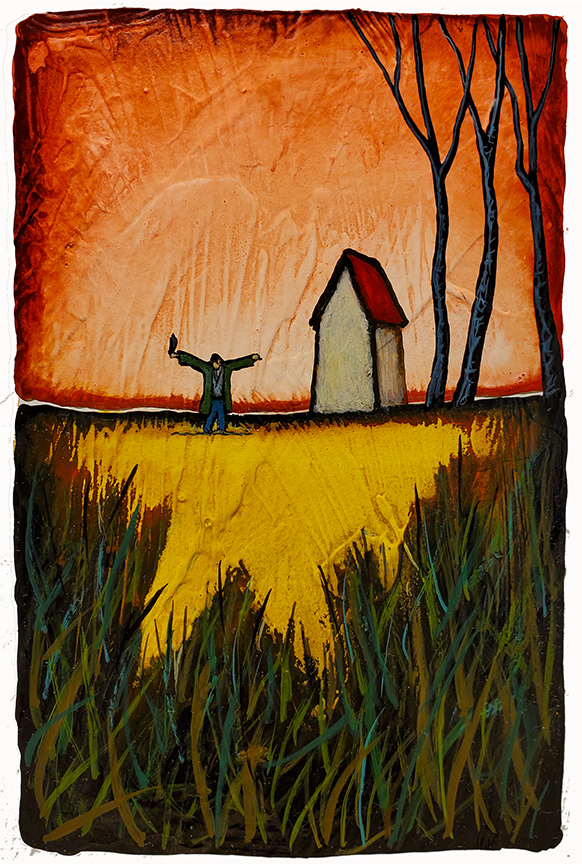
Let’s move on now to the Sunday morning music for this week. I was working on the small painting at the top the page yesterday while listening to the impeachment proceedings. I don’t know what made the idea of a person standing in the field as scarecrow come to mind but it appeared around the time the voting was taking place. I can’t quite put my finger on the feeling I get from it or its origin but it seemed to fit the moment.

Maybe it cam from the quote at the top from L. Frank Baum’s Wizard of Oz? If they only had a brain…

The piece itself reminded me of the old John Cougar Mellencamp song, Rain on the Scarecrow, from 1985. He started his career with the cheesy stage name of Johnny Cougar before attaching his actual Mellencamp last name and eventually getting rid of the Cougar altogether.

In 1985, he was still John Cougar Mellencamp. He had a great trio of albums in the late 1980’s starting with this album, Scarecrow, followed by The Lonesome Jubilee and Big Daddy. They were all strong. complete albums. This song has been a favorite from when I first heard it back then. I also want to note that John Mellencamp is a talented painter as well.

But here’s Rain on the Scarecrow to go along with the new piece at the top which is simply called Scarecrow.

Be careful out there and have a good day.


Read Full Post »


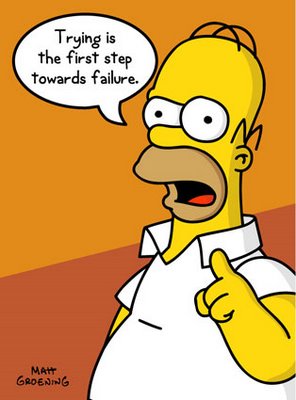
If at first you don’t succeed, try, try again. Then quit. There’s no point in being a damn fool about it.

-W.C. Fields


I wanted to play another song, I Don’t Mind Failing, from the late folksinger Malvina Reynolds and thought a replay of this post from a decade ago would fit well with it. Not much has changed in these past ten years from the standpoint of failure. The post below, from 2011, was titled Failure, of course


In response to yesterday’s post concerning a very large blank canvas that is waiting patiently for me, I received several very interesting questions from my friend, Tom Seltz, concerning the role that failure and the fear of failure plays in my work. He posed a number of great questions, some pragmatic and some esoteric, that I’ll try to address.

On the pragmatic side, he asked if there is a financial risk when I take on large projects like the  4 1/2′ by 7′ canvas of which I wrote. Actually, it’s not something I think about much because every piece, even the smallest, has a certain cost in producing it that, after these many years, I don’t stop to consider. But a project such as this is costlier as a larger canvas is more expensive right from the beginning simply due to the sheer size of it. The canvas is heavier and more expensive and more of it is used. I use a lot more gesso and paint. The framing is much more expensive and the logistics of shipping and transporting become more involved and costly. It’s larger size and price means the audience of potential buyers is much more limited which means more time trucking it around or storing it.

And while these cost of materials and handling are the larger cost, the biggest financial risk comes in the time spent on such a project. It takes longer to prepare such a large canvas, longer to paint and, if it works out, longer to finish and frame. This is time not spent on other projects. Wasted time is by far the biggest risk in facing such a project and that is something I have to take into consideration before embarking on large projects.

He also asked whether I can reuse the materials if I don’t like what I’ve painted. Sure, for the most part.  Especially canvasses. Actually, the piece shown here on the right was once such a piece. There’s a failure lingering still beneath its present surface.

I had a concept in my head that floated around for months and I finally started putting it down on this 30″ square canvas. I spent probably a day and a half worth of time and got quite far into it before I realized that it was a flawed concept, that I was down a path that was way off the route I had envisioned. It was dull and lifeless, even at an early stage.

It was crap and I knew that there was no hope for it. I immediately painted it over, mainly to keep me from wasting even more time by trying to resuscitate it, and the piece shown here emerged, happily for me.

Tom also asked if I ever “crashed and burned” on a piece or if the worst sort of failure was that a piece was simply mediocre. Well, I guess the last few paragraphs say a bit about the “crashed and burned” aspect, although that is a rarer event than one might suspect. The beauty of painting is that it’s results are always subjective. There is almost never total failure.

It’s not like sky-diving and if your parachute doesn’t open you die. At least, that hasn’t been my experience thus far. I’m still here.

Mediocrity is a different story. That is the one thing I probably fear most for my work and would consider a piece a failure if I judged it to be mediocre. I have any  number of examples I could show you in the nooks and crannies of my studio but I won’t. Even flawed and mediocre, these pieces have a purpose for me and some have remaining promise. The purpose is in the lessons learned from painting them. I usually glean some information from  each painting, even something tiny but useful for the future. Each is a rehearsal in a way. But most times, the mediocre pieces teach me what I don’t want to repeat in the future. A wrong line or form here. A flatness of color there. Just simple dullness everywhere.

But, being art, there are few total failures, and many of these somewhat mediocre pieces sit unfinished because there are still stirs of promise in them.  I can’t tell you how many times I’ve come to what I felt was a dead end for a painting, feeling that it was dull and lifeless, and set it aside. Months and months might pass and one day I might pick it up and suddenly see something new in it. A new way to move in it that brings it new life. These paintings often bring the greatest satisfaction when they leave the gallery with a new owner.

Sometimes failure is simply a momentary perception that requires a new perspective.

Sometimes you need to fail in order to succeed later.

Okay, that’s it for now. I’m sure I have more to say about failure but it will have to wait until a later date. I’ve got work waiting for me that doesn’t know the meaning of the word failure and I don’t want to take the risk that it might learn it.

Tom, thanks again for the great questions.  I’m always eager for good questions so keep it up!


Now here’s I Don’t Mind Failing from Malvina Reynolds. It’s from around 1965 and was written after hearing a sermon called The Fine Art of Failing. Lot of great lines in this one:

I don’t mind failing in this world,
Somebody else’s definition
Isn’t going to measure my soul’s condition,
I don’t mind failing in this world.

Give a listen and if you fail today, don’t worry about it. You’re in good company.


Read Full Post »


To live on a day-to-day basis is insufficient for human beings; we need to transcend, transport, escape; we need meaning, understanding, and explanation; we need to see over-all patterns in our lives. We need hope, the sense of a future. And we need freedom (or, at least, the illusion of freedom) to get beyond ourselves, whether with telescopes and microscopes and our ever-burgeoning technology, or in states of mind that allow us to travel to other worlds, to rise above our immediate surroundings.

We may seek, too, a relaxing of inhibitions that makes it easier to bond with each other, or transports that make our consciousness of time and mortality easier to bear. We seek a holiday from our inner and outer restrictions, a more intense sense of the here and now, the beauty and value of the world we live in.

― Oliver Sacks. New Yorker article 2012


I was thinking this morning about how I would describe the painting at the top, Steady As She Goes. It is included in the Little Gems show at the West End Gallery which opens today. 

At first, I was thinking about sailing but I really don’t much about that subject. I can try to imagine the thrill of the open water, the feeling of untiy with the natural world, but I’m pretty sure it’s not the same as the real experience.

I began to wonder what was the underlying appeal of sailing, of open water. All that came to me was the word escape.

That made sense. You’re free from the ties that bind out there, subject, of course, to the whims of Mother Nature. We can never free ourselves from her her apron strings.

Yes, escape. And that representation of escape might be the appeal of these boat paintings even for us non-sailors. 

I searched for  a few words from others to describe that and came across the excerpt from a 2012 article in the New Yorker from the late Oliver Sacks, who wrote about how we need some form of escape from the day-to-day, an outlet where we are free from the restrictions set upon us by others. 

I was torn between the Sacks excerpt and these words from the great Graham Greene:

Writing is a form of therapy; sometimes I wonder how all those who do not write, compose, or paint can manage to escape the madness, melancholia, the panic and fear which is inherent in a human situation.

It seemed a little more pointed at creative types but made great sense to me. My work certainly does provide me with an escape route from the stresses and pains of the real world. 

I wasn’t sure which quote to use but, in the end, I guess I opted for using both.  After all, this is my blog and I can do what I want. I make the rules.

Maybe this is, in itself, a form of escape?

Maybe I should take up sailing. Since it’s about 8° this morning, that seems unlikely anytime soon. So, let’s listen to a favorite song from Lyle Lovett. It’s If I Had a Boat from his epic 1988 album Pontiac. I listened to this album over and over back then and it was a means of escape at times. It still holds up beautifully to this day.

Hope you find your own escape route and have a good day.


Read Full Post »


The impeachment process is not meant to determine criminality leading to statutory charges.

It is by definition a political act.

It is meant to determine whether the impeached elected official should be removed from office or, if the impeached person is no longer in office, be barred from ever holding public office again.

That’s the simple premise of what we are watching right now in this country.

The Republican senators have made it clear that they have no desire to give any weight to the very real evidence presented on the Senate floor, if they listen or watch at all. There are multiple reports of some reading newspapers and playing video games while the proceedings go on. The majority of them will cast a purely partisan vote to acquit, a decision that was made beforehand for many of them.

The Republican senators will cast their votes on the outcome of this impeachment trial not on a determination of what is right or wrong but based on their own political aspirations and loyalties.

As I said, a political act.

But what we are witnessing goes far beyond the political, beyond one’s own desire for power and future offices. 

No, we are seeing actions, both by the terrorists who stormed the Capitol and those who incited and designed the attack, that are anything but political.

It is pure criminality, from the smaller scale of the personal assaults that took place to the grand scheme to overthrow a lawful election and, by extension, the existing government.

This is an existential choice about our nation’s future. An acquittal is future permission for other would-be dictators to do whatever they want to hold on to power, to use the vast tools at hand to serve their own desires.

These Republicans who believe they could be that next dictator or at least a power player under that person are playing with fire. That kind of power is not controllable or predictable. They might be granting permission and setting the stage for a future coup from forces that they might not be able to envision with their limited imaginations.

Who’s to say that the next violent insurrection– and possibly successful based on lessons learned from this failed attempt– won’t be a leftist revolution? One that gains a toehold in legitimacy via the permissions granted by these Republicans who can barely see past the end of their noses into the future. 

All I am saying here is that this trial needs to transcend the political. It needs to uphold our past and our future. It need to provide accountability.

There needs to be accountability for what has happened. Without that, there can be no reconciliation nor unity going forward. How could there be? Why would anyone trust or unite with those who say that overt incitement to violence is allowed in order to hold on to power? How do you trust someone who says it’s okay for their supporters to attempt to kill you?

I am certainly cynical of the Republicans doing anything but that which fits their personal agenda but I remain hopeful.

There. Like it or not, I have had my say for the morning. Let’s have a song, okay?

This morning, I am playing a song from famed folk singer/songwriter Malvina Reynolds, who you might know her best from her song Little Boxes which was used for the opening credits of the series Weeds. This song is No Hole In My Head and it has to do with how we have to be careful about the info with which we fill our heads. There are a lot of folks who want to fill it with trash, as you know. Maybe me, who knows? It might even be the reason we’re where we are as nation today.

I am playing two versions here, the original from Malvina Reynolds (1900-1978) and a brand new, less folksy one from the evergreen Tom Jones. The man is 80 and still wails the hell out of everything he sings. Plus he still looks to push his art, to stay current and not dwell on his past glories. Check out his other new tune Talking Reality Television Blues, which contains a similar message to No Hole In My Head. in how we are shaped by what we see, hear, and read. He’s a marvel. Gives me hope. 

Pay attention today and in the future. We need everyone to participate. And have the best day you can.


Read Full Post »


“The feelings that hurt most, the emotions that sting most, are those that are absurd – The longing for impossible things, precisely because they are impossible; nostalgia for what never was; the desire for what could have been; regret over not being someone else; dissatisfaction with the world’s existence. All these half-tones of the soul’s consciousness create in us a painful landscape, an eternal sunset of what we are.”

― Fernando Pessoa


This is another piece from the Little Gems show that opens Friday at the West End Gallery. Its title is What Might Have Been which comes from the feeling of regret or nostalgia or, at least, retrospection that I feel in it. Those are feelings that I think most of have dealt with in some form. Hopefully, they don’t overwhelm our lives in the present.

For all my psychological foibles, glitches and tics, I don’t live with a lot of regrets. I understand that the consequential decisions– good and bad– that I have made in my life were my decisions and were made with the belief that I had the best information available in making those decisions. Of course, I was wrong in some cases, but that doesn’t change the fact that I accept the blame and responsibility for the results that came from my decisions. 

I am here now and that’s all that matters. 

Spending too much time on what ifs and what might have beens seems like a giant waste of time and energy. And the amount of time and energy I wasted early in my life might be the main regret I have when looking back. So why waste more looking back and fretting over it?

But I have to admit that I do look back. It’s not out of remorse or nostalgia. It’s more out of curiosity, to discover the patterns and flows that brought me to this point. To observe and learn the lessons that are undoubtedly there so that I don’t repeat the mistakes and can possibly build on the successes.

And to try to figure out where I came from and who and what I am.

That is, of course, my perspective on the past and on this painting. It’s based on my own life and experiences.

Your own experiences might draw you closer to the past, might fill you with more regrets and remorse for what has taken place in that past. We all deal with the world and our place in it in our own way and if revisiting your past fills your days, it is not my place to tell you to not do that. That is your decision. 

But I would advise you to try to live at least equally in the present time, trying to leave the traumas behind and to glean some lesson from that past to bring forward with you to make your future days more livable. 

Funny how a small painting can open so many gateways to thought. There’s so much more I could write about what I take from this simple little painting based on the cues it engages within me. And, if it is a successful piece that comes to life, it engages the feeling and minds of others.

Maybe that’s the purpose of art, to create a shorthand of emotion that speaks to a wide variety of people and their own distinct experiences without relying on the specificity of language.

I don’t know. I have work to do so I am not going to dwell on it now. 

Have a good day.


The quote at the top is from the great Portuguese poet Fernando Pessoa, whose work I have only become aware of and a fan of in the past few years. I have written about him a couple of times here, most notably in reference to my Multitudes series a couple of years back.

Read Full Post »


Oh, East is East, and West is West, and never the twain shall meet,
Till Earth and Sky stand presently at God’s great Judgment Seat;
But there is neither East nor West, Border, nor Breed, nor Birth,
When two strong men stand face to face, though they come from the ends of the earth!

The Ballad of East and West, Rudyard Kipling


Showing another new Little Gem from the West End Gallery show, this one titled Across the Divide.

The title refers to the the river that separates the two opposing shores. There is a political commentary implied in the blue and red of the two shores representing the colors of the political divisions here in the US.

There’s a lot of talk about the need for unity, about how we need to come together as a nation, but it seems as though there is a wide and mighty river between us, one that may never be traversed.

Like the opening line from the Kipling poem– and never the twain shall meet.

I would like to think that there is common ground that we share as citizens of this nation but it’s had to see at the moment. That river looks pretty darn wide.

I was about to start on a spiel about the need for compromise but I am going to skip it. Most of you out there who read this are intelligent people who understand compromise and how important its place is in big country with a wide variety of people. You know that everybody doesn’t get exactly what they want all the time, that we all have to sacrifice at some point for the greater good.

Sometimes we give and sometimes we get, depending on our needs and situations. 

And that is a simple, workable concept until you factor in ignorance, racial hatred, and greed.

Then things go awry and you get to this point where we are now, with a wide and deep river running between us. 

I still have hope and I see it in this piece. There’s too many things here that unite us if we only allow to set aside our biases, judgements, and prejudices.

I know that’s asking a lot but is it, really?

Read Full Post »

« Newer Posts - Older Posts »