Feeds:
Posts
Comments

Archive for October, 2021

A Visit With Cousin Walt

Walt Whitman-  Thomas Eakins 1891


….This is what you shall do: Love the earth and sun and the animals, despise riches, give alms to every one that asks, stand up for the stupid and crazy, devote your income and labor to others, hate tyrants, argue not concerning God, have patience and indulgence toward the people, take off your hat to nothing known or unknown or to any man or number of men, go freely with powerful uneducated persons and with the young and with the mothers of families, read these leaves in the open air every season of every year of your life, re-examine all you have been told at school or church or in any book, dismiss whatever insults your own soul, and your very flesh shall be a great poem and have the richest fluency not only in its words but in the silent lines of its lips and face and between the lashes of your eyes and in every motion and joint of your body….

—Walt Whitman, Preface to Leaves of Grass


I am running this post from several years back as a result of some recent genealogy research I have been doing lately. It’s always interesting while I am doing the research. especially when I uncover evidence of distant relations that have long evaded me or uncover bits of what I consider interesting connections to American history. Part of my brain allows me to imagine the lives of these distant ancestors and wonder if I have any of the same characteristics that allowed them to survive– if they did.

For example, I recently found a distant great-grandfather from about 8 or 9 generations back who came here from Scotland as an indentured servant after being captured by Cromwell‘s forces in the English Civil War. After around 8 or 9 years of servitude he gained his freedom and became a prosperous brickmaker and was the progenitor of an entire American family line that has grown exponentially over the centuries and is widespread across this country now. Unfortunately, less than two decades after becoming a free man this ancestor was one of the first deaths in King Philip’s War that took place between the colonists of New England and the Native American tribes in the late 1670’s.

His track record as a warrior has me a bit concerned.

But while interesting, the story of this man’s life has little connection to me and my current life outside of perhaps a few strands of DNA here and there that most likely do little more than determine the length of my big toe or the pattern or ever increasing abundance of the hair growing inside my ears. But every so often you come across an ancestor or distant relative that you hope you share something more than these tenuous mitochondrial bonds and you let your mind wander into that possibility.

Like my Cousin Walt:


I have always been moved and inspired by the writings of the American poet Walt Whitman. I can find something that speaks directly to me in almost everything of his I come across. For me, he remains one of the most intriguing and unique characters in the American experience in so many ways.

This comes across in the photos of him, including the remarkable portrait above that was taken by the great American painter Thomas Eakins, who was also a pioneering figure in photography, in 1891, a year before Whitman’s death. It has a remarkable feeling of earned wisdom and understanding.

I had always felt a familial bond with him anyway, having called him Uncle Walt for as long as I can remember. He seemed like he was the wise old uncle I wanted growing up, someone who watched over me and imparted bits of wizened advice to me from time to time. So with this great reverence for the man, you can imagine how excited I was when my genealogy revealed that we were related.

Not an uncle.

Cousins.

Okay, 6th cousins. We share a grandparent going back to the early 1600’s, five generation before Whitman and nine generations before me. So, that makes us 6th cousins, 5 generations removed.

That’s like being in the furthest reaches of relationship in the game of Six Degrees of Kevin Bacon. Sure, we’re related by these tenuous bonds but it is so far removed that it is academic at best. There are probably several hundred thousand, if not a million or ten million, people with this same bond.

So it is certainly no big deal. Interesting but absolutely meaningless and without value.

But when I read a line from Whitman that makes my heart race a bit, that makes my brain and soul stir, I have to admit that it makes me happy that we share that silly, insignificant bond.

I just call him Cousin Walt now.

Read Full Post »

Revisiting the Old/ Cole

Thomas Cole- Round Top


How I have walked… day after day, and all alone, to see if there was not something among the old things which was new!

— Thomas Cole (1801-1848)


I am not sure if the words above from Thomas Cole refer to revisiting his older paintings to glean inspiration or if they have some other meaning. I immediately took them as meaning he sometimes looked back at his older work to see if there was something in them that could be explored once more and perhaps enhanced with the knowledge and expertise he had gained in the intervening time.

I know that this is my own purpose in periodically going back through the archives. I am looking for the inspiration that might come in seeing past compositions and uses of color or forms that may have changed over the years. Or simply ways of seeing and thinking thatmight have went in different directions and are ripe for a new examination.

If this is what Cole was intending then I am very pleased. I find his work, though worlds away from my own, intriguing. His body of work is pretty impressive, even for someone like me who isn’t always immediately drawn to traditional landscapes. Maybe that is because Cole’s works were not completely traditional. Perhaps it’s that he took such creative license with his subject matter, never being afraid to add his own romantic depth to landscapes that were already boldly dramatic in their own right.

The big got bigger and the wild, even wilder. His paintings and those of  the other painters of the Hudson River School of painting were the face of 19th century America to the rest of the world, creating a romantic vision of a beautiful and wide open nation, one that drew masses to its shores.

I am also intrigued by the fact that he was primarily a self-taught artist and his prodigious productivity. And that he did this all before his death at age 47 at his home in Catskill, NY. Impressive by all accounts.


Thomas Cole distant-view-of-niagara-falls-1830

Thomas Cole- Distant View of Niagara Falls 1830

Thomas Cole Evening in Arcady 1843

Thomas Cole- Evening in Arcady 1843

thomas cole- Sunset

Thomas Cole – Sunset

Thomas Cole- The Clove- Catskills 1827

Thomas Cole- The Clove, Catskills 1827

Thomas-Cole-A-Tornado-in-the-Wilderness-1830-

Thomas Cole- A Tornado in the Wilderness 1830

Read Full Post »

Anthony Bourdain Empathy


I don’t know what your destiny will be, but one thing I know: the only ones among you who will be really happy are those who have sought and found how to serve.

― Albert Schweitzer


The two quotes above are both about the gains of being in service to others though I imagine that Albert Schweitzer was not speaking about schlepping pork chops or pancakes to hungry folks in a restaurant. But maybe he was. And even if he wasn’t, the happiness gained from being in service that he describes goes hand in hand with the words above from late chef Anthony Bourdain.

I have often said that I thought everyone should be required to work as a server in a restaurant for at least a short period of time. There are so many lessons to be learned from the experience.

Empathy, as Bourdain points out, is one. I often dealt with people who were obviously down and out or going through trying times. It was hard to not put yourself in their shoes or at least make their time with you comfortable. 

Humility, for me, was a big one. There was nothing more centering than going from an opening filled with compliments and praise on a Friday evening to pouring coffee for a hungover trucker on a Saturday morning. Puts everything in perspective in quick fashion.

You quickly learn that the world does not revolve around you.

That brings us to restraint. You have to learn to turn a deaf ear to insults and barbs then deliver the same service to that offending person that you give to all. Restraint also keeps you from making a kneejerk reaction. I had a diner one  morning who was as rude and unpleasant as could be, snapping at me with every interaction. I felt like snapping back but retrained myself and just did my job as efficiently as possible so that I wouldn’t have to have any real problems with him.

Later, after he finished his meal and went to the rest room, he called me over to his table and apologized for his behavior. He had just been released that morning from the hospital and was not feeling well at all. He wasn’t sure about the outlook for his future and had taken it ut on me. I told him I understood then we chatted for a bit, me learning that he had been on the beaches of Normandy on D-Day. 

I was glad I hadn’t reacted to our initial interaction.

That brings us to consistency and endurance, two qualities that allow a server to be successful, which is to make a living wage since the base pay was and is well below the minimum wage. There were people who were notorious bad tippers and when you had the misfortune of them ending up in your station, you still had to give them exactly the same level of service as your best tippers. Inconsistency can be contagious, in my opinion, so its easier to just do the same rather than try to alter your routine to deprive someone.

Then there is, of course, teamwork. You learn that even though you might be a highly capable server, you need the assistance of a variety of people– cooks, bus people, dishwashers, and other servers– in order to be successful. 

You also learn that you even if you are exceptionally good at your job, you are not indispensable. The world will go on without you. Food will still emerge from the kitchen and people will enjoy their meals without you. This probably belongs above under the humility label but I am writing off the cuff here and am not going back now.

The main lesson is probably that there is great gratification in serving others. Making a meal pleasant and seamless isn’t life-altering in any way but to make someone else comfortable and at ease for even a short time is something that pleases me.

It’s a small bit of evidence of humanity.

And in these days, when so many folks have lost sight of their humanity and its accompanying empathy, maybe we could all use a reminder that there is happiness to be found in service to others, to paraphrase Mr. Schweitzer.

Read Full Post »

Little Birdie

Little Birdie


I am needing to get to the easel this morning, an urge that hasn’t been around in a long time. I am working on a new piece that has really engaged me, that has a slightly different feel, and I want to try to keep it going. To that end, let’s get to this week’s Sunday morning music.

It’s a song from Rachel Price along with the Punch Brothers, the progressive bluegrass group that features former Nickel Creek wunderkind Chris Thile. I featured them a few weeks back with their powerful version of Can’t Find My Way Home, the Blind Faith classic. This song is titled Little Birdie.

Seems like a good way to kick off what I hope is a productive morning. Probably works just as well for sitting quietly and sipping your coffee. I think I’ll try that first…


Read Full Post »

Upward Over the Mountain


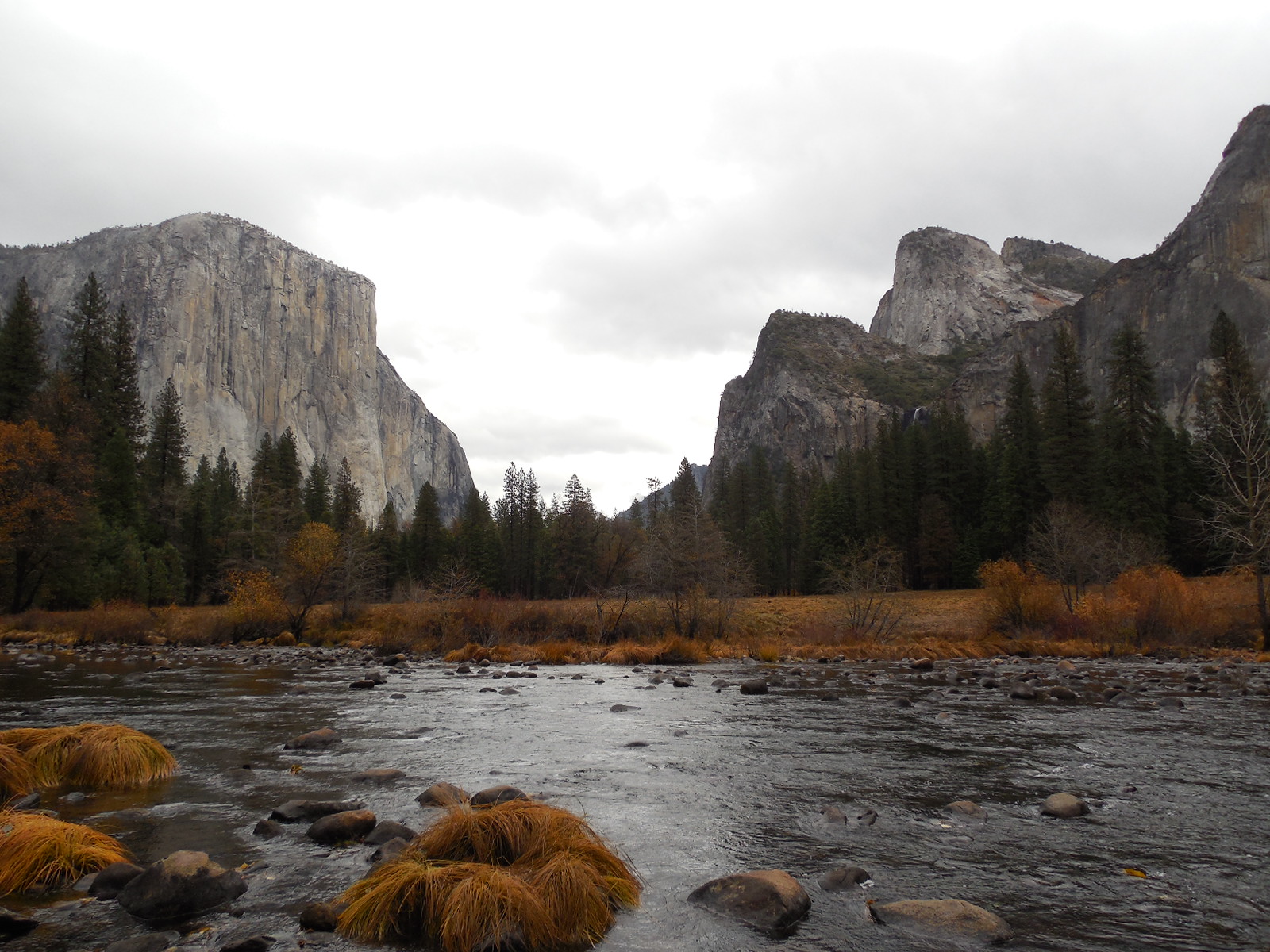
Yosemite Valley with El Capitan


Mother I made it up from the bruise on the floor of this prison
Mother I lost it, all of the fear of the Lord I was given
Mother forget me now that the creek drank the cradle you sang to
Mother forgive me, I sold your car for the shoes that I gave you
So may the sunrise bring hope where it once was forgotten
Sons could be birds, taken broken up to the mountain

Upward Over the Mountain, Iron & Wine


I didn’t have much enthusiasm to write this morning, gray as it is at the beginning of another rainy day. I looked for some music and a version of a song, Upward Over the Mountain, I like very much from Iron & Wine came on. It was a live video of Sam Beam, who is Iron & Wine, performing the song, accompanied by singer/songwriter Andrew Bird, outdoors in the beautiful Yosemite Valley.

The combination of the setting and song really hit home for me. Seeing Yosemite’s charms made me yearn to wander through that place again and the song reminded me of the redemptive power of nature. For me, there is a soothing balm found amidst rock and wood and water.

In those places, I always feel a little less broken.

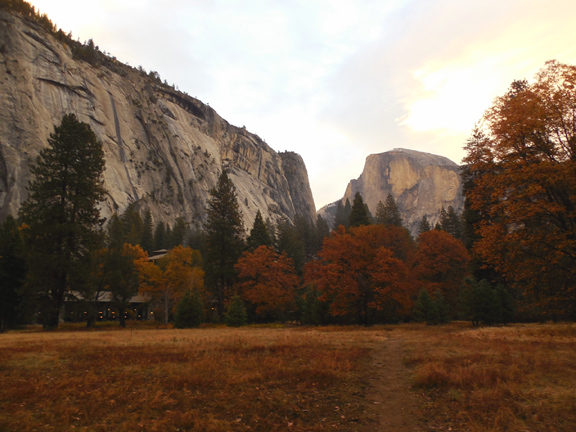
Yosemite Half DomeWhen we visited Yosemite years ago, it was in late November and the place was fairly empty. Getting up early each morning, we seldom encountered anyone else on the trails and it was easy to feel special in that place. Somehow closer to a fullness that we seldom can see in our day to day lives.
Seeing those same locales as shown in this newly released video, which also contains a performance of Iron & Wine’s Call It Dreaming, brought back those feelings. It also renewed my appreciation the setting in which I live now and sometime fail to see for all its familiarity and the shadows in the mind that obscure the charms of the hills and woods and water around me.

It’s worth a watch and a listen, at least in my opinion, for what its worth.


Read Full Post »

Sketches and Rehearsals

GC Myers- Where Memory Rests sm

Where Memory Rests — At the West End Gallery


We can never know what to want, because, living only one life, we can neither compare it with our previous lives nor perfect it in our lives to come.

There is no means of testing which decision is better, because there is no basis for comparison. We live everything as it comes, without warning, like an actor going on cold. And what can life be worth if the first rehearsal for life is life itself? That is why life is always like a sketch. No, “sketch” is not quite the word, because a sketch is an outline of something, the groundwork for a picture, whereas the sketch that is our life is a sketch for nothing, an outline with no picture.

— Milan Kundera, The Unbearable Lightness of Being


This is sort of a continuation of yesterday’s questions: Do we know what we should remember? Do we remember what we should know? 

The passages from author Milan Kundera’s great novel The Unbearable Lightness of Being perhaps provide one answer: We can never know.

Life is, as his character puts it, one and done. No rehearsals. No trying out of new material or making revisions.

Life is, indeed, more of a sketch than a final version of a picture. People in the future, if they care to make the effort, cobble together a final portrait of our lives. That doesn’t mean it’s accurate or completely truthful. It can’t be totally either since it is the work of others and their interpretations that are taken from the sketch we leave behind.

It is beyond the control of the subject of these sketches.

And as Kundera points out, we live — or rather, perform— our lives from moment to moment with little or no context on which we can base our performances. We’re often halfway through our performance before we realize that we have the power to improvise, to use what little knowledge we have gained from observing others, to make our performance going forward better and deeper in meaning.

I guess I am trying to say it is advised that we try, at some point, to make a conscious decision about the sort of character we want to play or what sort of sketch we will finish during the remaining time of our arc of existence here on this planet.

Live with intention.

I know that, for myself, my performance and my sketch has changed in many ways since I realized that doing so was the only true control I had over the arc of my life. I could choose my reactions during my performances so that they didn’t have the same mistakes made in past rehearsals. Or that I could choose how I marked the surface with my sketches, the intensity of the lines and how much of myself I would share.

I think doing so has my rehearsals and sketches better. At least, I like them more now. How they play in the future, how others will critique them, is not for me to say. Or know.

Damn it– my coffee’s cold again! I guess I will have to pay more attention in tomorrow’s rehearsal…


Read Full Post »

Pieces in the Puzzle

GC Myers-The Memory of That Time sm

The Memory of That Time– At the Principle Gallery, Alexandria, VA


There was a long hard time when I kept far from me the remembrance of what I had thrown away when I was quite ignorant of its worth.

― Charles Dickens, Great Expectations


Do we know what we should remember? Do we remember what we should know?

Do we have the ability to recognize the importance of any moment in our lives at the time it occurs? Of course, there are the huge moments that affect the whole of a nation such as the 9/11 attacks which we all remember, most in graphic details from our reactions to the moments of that day.

We certainly immediately knew that the memory of that day would last.

But what about those days and events that affect only ourselves and perhaps a small group of other folks? Do we know in any of those moments that we would or should carry that memory forward?

Sometimes those small moments bring on large consequences for those involved. But do we recognize what part these small, seemingly insignificant moments played in bringing them about?

I don’t know the answer. Perhaps it differs for each of us and maybe it doesn’t even matter in the larger scheme of things.

I ask these questions because I am often baffled by my life and the path it took. There is some gnawing inner need to understand the pattern it followed, to uncover those small moments of importance hidden in the mists of the past.

For the most part, it’s a fool’s errand. But occasionally a forgotten moment from the past will push forward and I will hold it up and examine it as though it were a newly found specimen, letting the light shine on it as I examine it from different perspectives.

Sometimes, these found memories are oddly gratifying, as though I have finally found a missing piece that fits in the billion piece jigsaw puzzle that is a life. Of course, there are still millions of other missing pieces– lost memories of other small but important moments– in that puzzle.

Been writing this and my coffee got cold. Wonder if that should be remembered?

Hmm…

Read Full Post »

Chagall


When I am finishing a picture I hold some God-made object up to it / a rock, a flower, the branch of a tree or my hand / as a kind of final test. If the painting stands up beside a thing man cannot make, the painting is authentic. If there’s a clash between the two, it is bad art.

–Marc Chagall


Below is a post from 2015:

Marc Chagall Sun of ParisI haven’t mentioned Marc Chagall here but once over the 6+ years I have been doing this blog and I very seldom list him as one of my influences or even one of my favorite artists. But somehow he always seems to be sitting prominently there at the end of the day, both as a favorite and an influence.
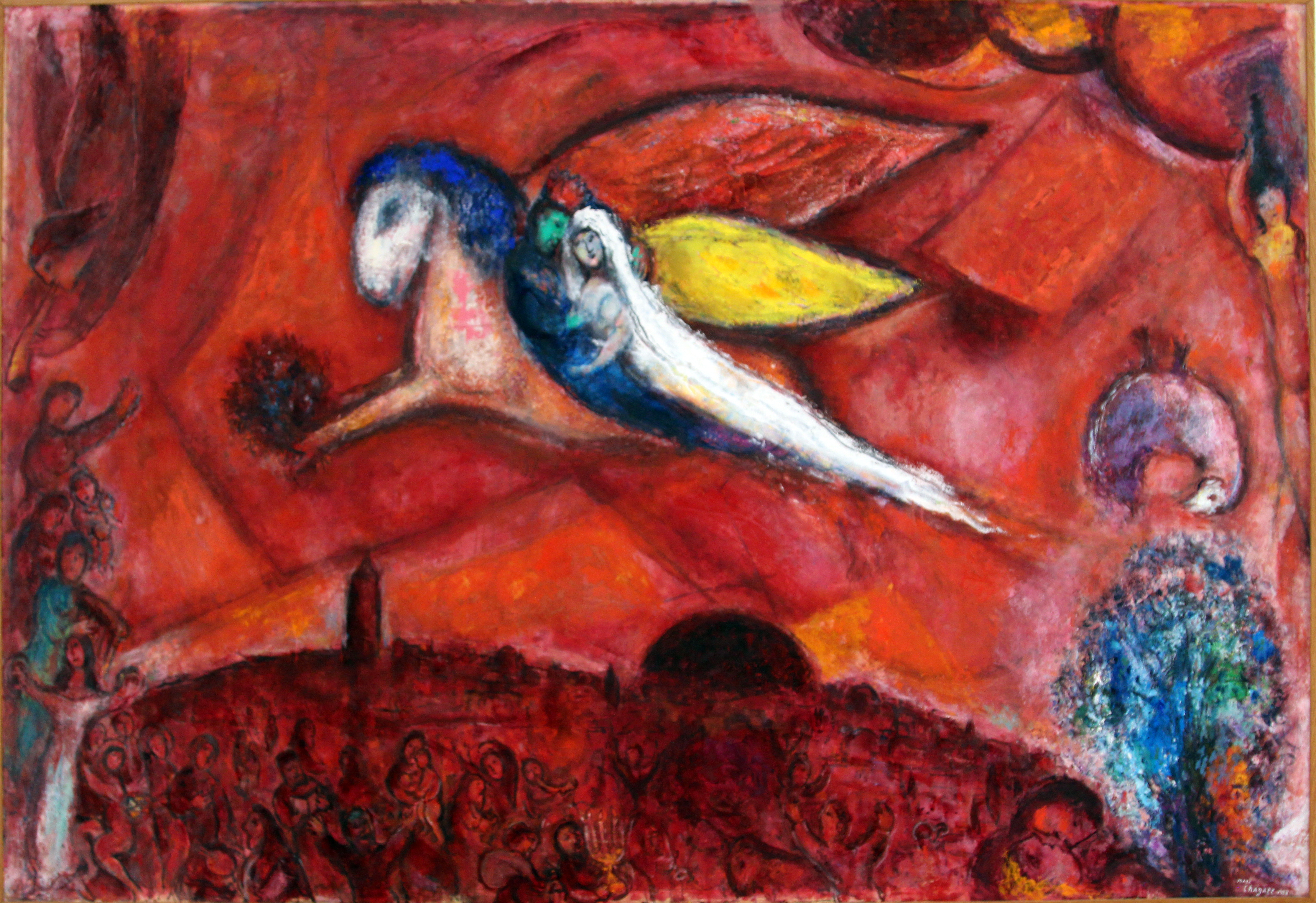
One way in which his influence takes form is in the way in which he created a unique visual vocabulary of symbolism within his work. His soaring people, his goats and horses and angels all seem at once mythic yet vaguely reminiscent of our own dreams, part of each of us but hidden deeply within.

They are mysterious but familiar.

And that’s a quality– mysterious and familiar– that I sought for my own symbols: the Red Chair, the Red Tree and the anonymous houses, for examples. That need to paint familiar objects that could take on other aspects of meaning very much came from Chagall’s paintings.

marc-chagall-fishermans-family-1968He also exerted his influence in the way in which he painted, distinct and as free-flowing as a signature. It was very much what I would call his Native Voice. Not affected or trying to adhere to any standards, just coming off his brush freely and naturally.

An organic expression of himself. And that is something I have sought since I first began painting– my own native voice, one in which I painted as easily and without thought as I would write my signature.

So to read how Chagall judged his work for authenticity makes me consider how I validate my own work.  It’s not that different. I use the term a sense of rightness to describe what I am seeking in the work.

It is very much the same sense one gets when you pick up a stone and consider it. Worn smooth through the ages, untouched for the most part by man, it is precisely what it is. It’s form and feel are natural and organic. There is just an inherent  rightness to it.

I hope for that same sense when I look at my work and I am sure that it is not far from the feeling Chagall sought when he compared his own work to a rock or a flower or his own hand.

Marc Chagall Song of Songs

Read Full Post »

Waiting For Columbus

little_feat-200


Columbus Day 2021.

I have never mentioned this particular holiday in the thirteen plus years of this blog. I’ve always been somewhat indifferent to the holiday. It never made much of a mark in my life and my only early memories of it are of a couple of Columbus Days spent at the horse track. Nothing says holiday like pari mutuel betting.

But the holiday itself meant little to me. Even to the mind of a kid, celebrating the idea that some European explorer “discovered” an entire continent already occupied by indigenous people seemed a little off.

Should it be a holiday? Probably not. I certainly understand the outrage of the Native Americans who oppose it. But at this current point in history, with so many other pressing issues currently shaping our day to day life and future that deserve our absolute focus, depleting our stores of outrage on this issue seems counterproductive. Unless we face up to these current matters, the issue of what this holiday should be or who it should honor will be a moot point.

So, as you can see, I have little interest in celebrating Columbus Day.

It’s just another Monday.

I am willin’ to celebrate that fact by playing a favorite track from the great live album, Waiting For Columbus, from Little Feat released in 1978 with the late Lowell George at the helm. The song is Willin’.

Maybe we should designate today Waiting For Columbus Day. Hmm…


Read Full Post »

You Are My Sunshine

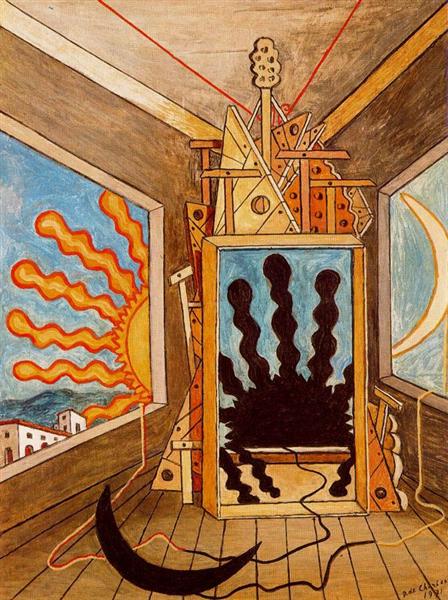
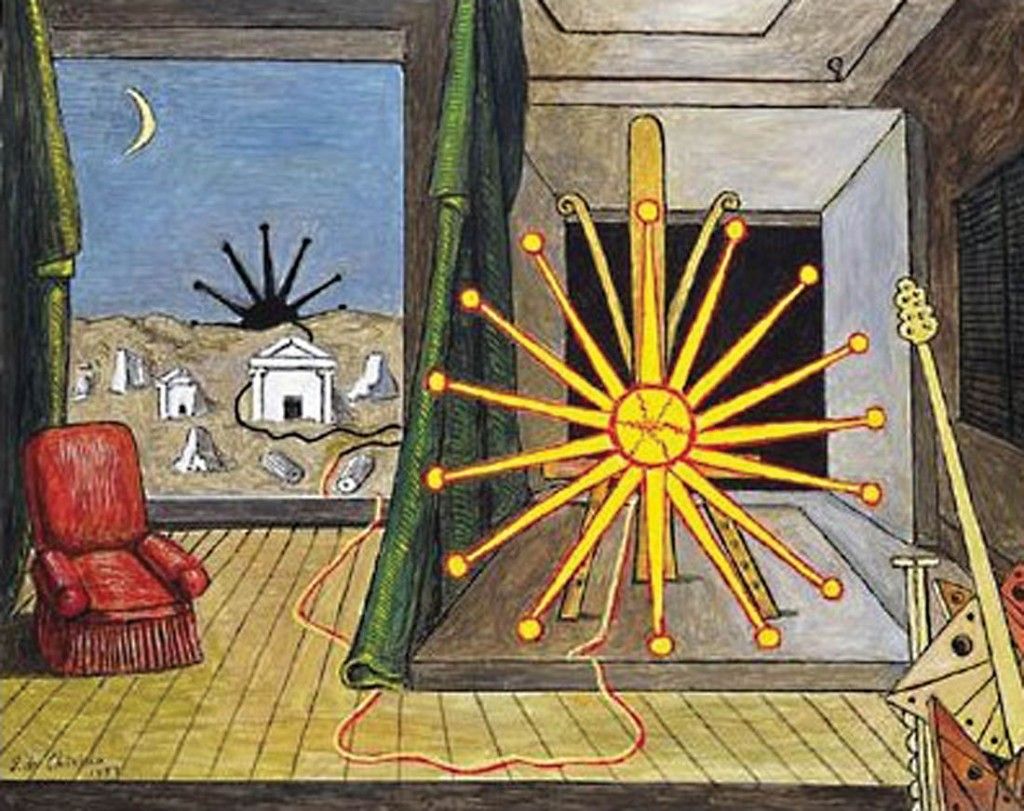
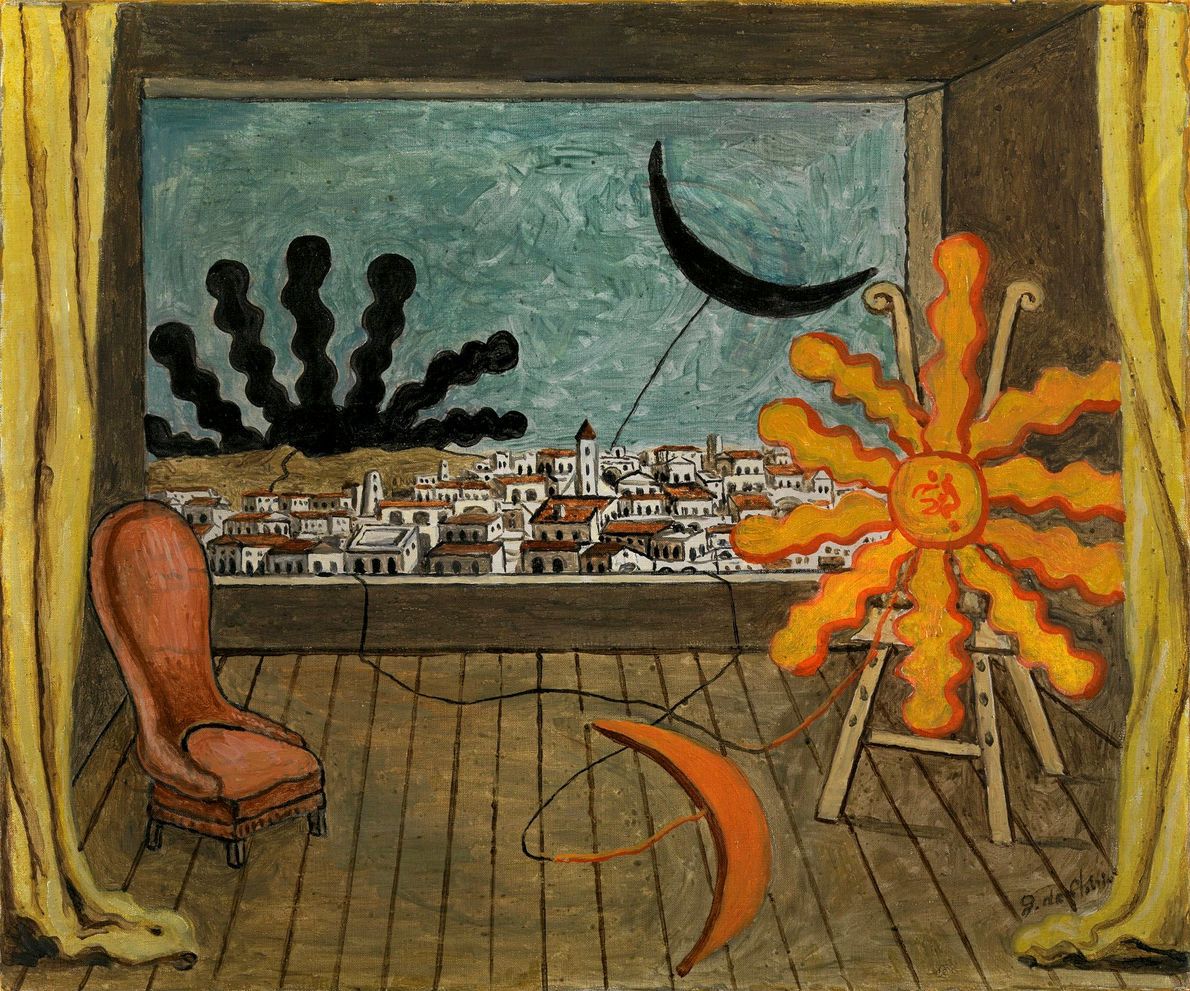
Giorgio de Chirico metaphysical-interior-with-sun-which-dies-1971

Giorgio de Chirico-Metaphysical Interior with Sun Which Dies 1971


I am a fan of painter Giorgio de Chirico (1888-1978) and his early metaphysical paintings. They were strongly colored with a darkness beneath that pushed the colors forward while heightening the sense of de chirico_mysterymystery in each painting. This work was a large influenced on my early work.
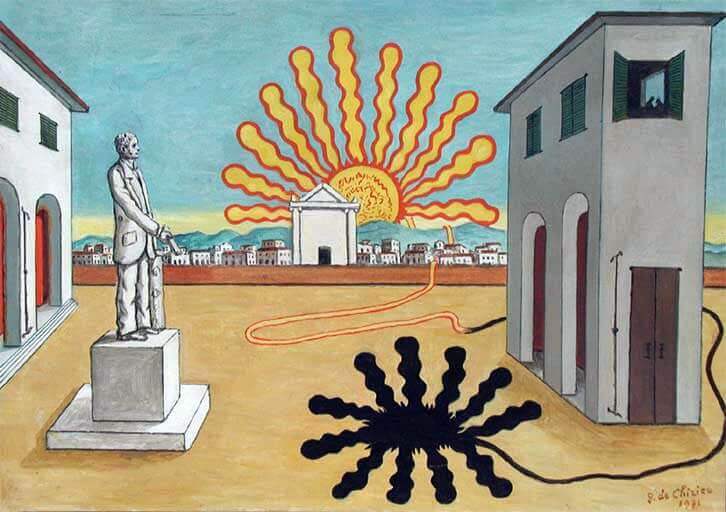
I have described here in the past how de Chirico tried to change the style and look of his paintings to a more traditional and mundane style in mid career, which never garnered the same sort of acclaim as his earlier more surreal work for which he is best known, such as Mystery shown here on the right.

This lack of enthusiasm for his newer non- metaphysical work was a cause of consternation for de Chirico. In response he began to produce self-forgeries in the style of his earlier work and would backdate them so that they appeared to fall into the period where his work garnered the most acclaim, 1909-1919.

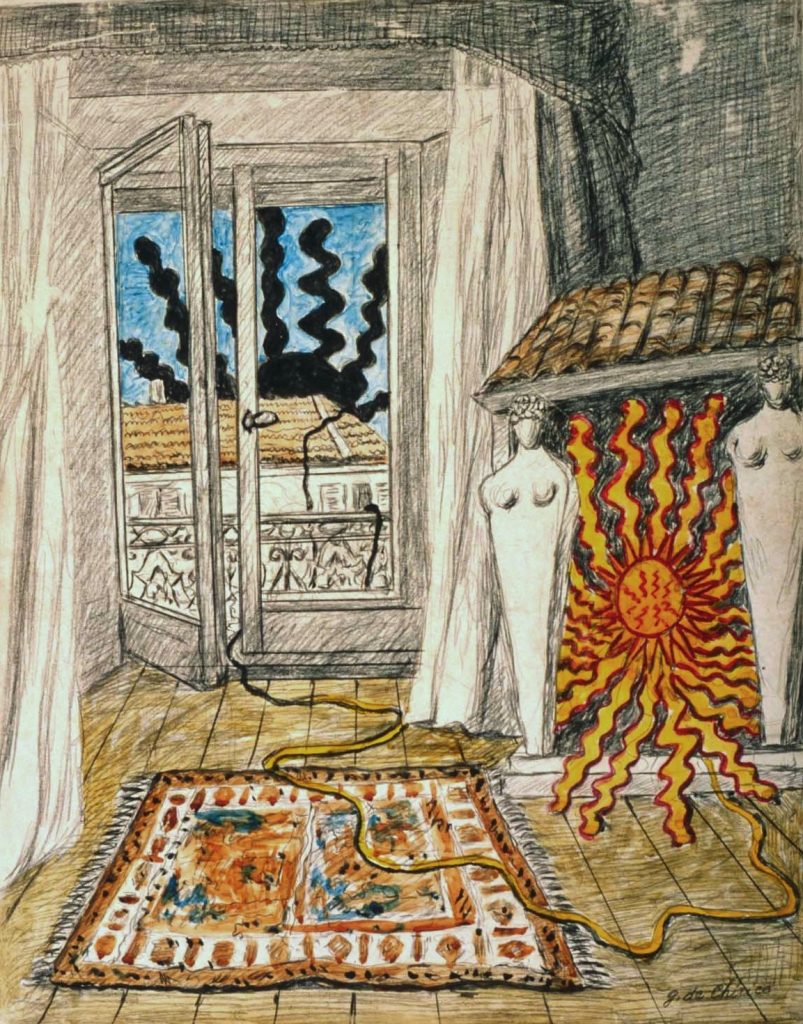
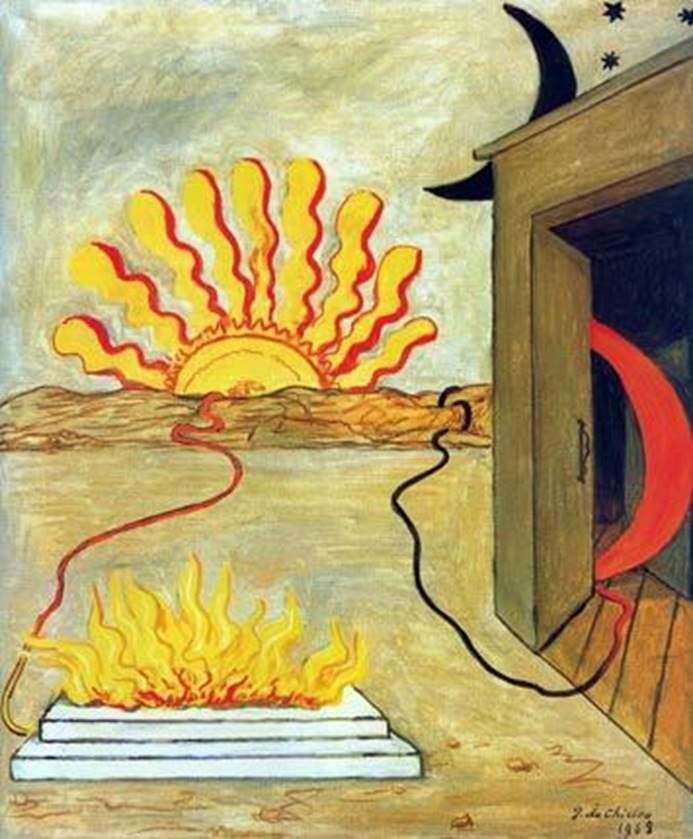
Later in life, in the 1970’s before his death in 1978, he returned to his metaphysical roots using the actual dates. To my eye, the work lacks the depth and style of his early work but it is still interesting, especially in the context of his entire career. I came across this group of sun paintings from this later period that I had never seen before. While they are not my favorites, lacking the same sort of mystery and depth ( and polish) of his earlier work, I thought they deserved to be entered into the conversation.

Plus they sort of line up with this week’s Sunday Morning musical selection which is a song most of us know well, You Are My Sunshine. It is generally performed in an upbeat fashion that makes it seem ike an optimistic tune. But if you listen to the lyrics closely it is about a person who has lost their love to another and is issuing threats in a way, as seen in this verse:

I’ll always love you and make you happy
If you will only say the same
But if you leave me to love another
You’ll regret it all one day

The version selected for this morning is from The Dead South who I featured here in the past with their song In Hell I’ll Be in Good Company. Great song. Their new version of You Are My Sunshine captures the real brooding tone of the song. It certainly made me think about the song in a different way than I had in the past.

Give a listen and see what you think. There are more of de Chirico’s later pieces below the song.


giorgio-de-chirico-piazza-ditaliagiorgio-de-chirico--the-two-sunsGiorgio de Chirico Sun on the EaselGiorgio de Chirico sole-sul-caminetto-1970Giorgio de Chirico Sacrifice to the Sun

Read Full Post »

« Newer Posts - Older Posts »