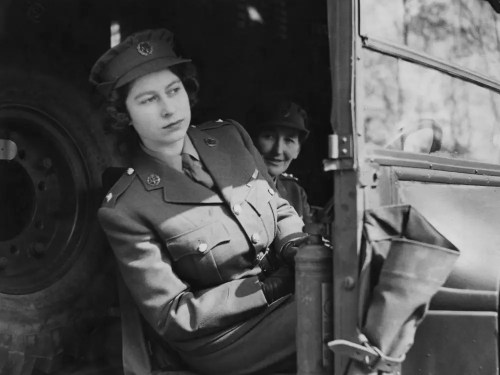
Queen Elizabeth II as a Mechanic During World War II
I don’t have much to add to the coverage of the death of Queen Elizabeth II.
While not a fan of monarchies in general, I have to admit to having real admiration for the Queen, especially the enormous sense of duty and loyalty she possessed for her people. It transformed into a connecting tissue for those people over the many years she reigned, like a grandmother whose strength and representation of familial tradition has held a family together for what seems like forever.
And it has seemed like forever. There are few are left that can consciously recall a time when she wasn’t the Queen of England. And through it all she has been a steadying force for her people and for a lot of the rest of the world. She was nothing if not steady, not like some world rulers who act like a drunk uncle at a picnic.
I worry a bit for England now that this steadying force, this connective tissue, is gone. Every crisis going forward will have a new face, a new symbol, that will try to soothe or stir them. And that giant of a little woman left some big shoes to fill.
Going forward will be a new experience, a new challenge, for that country. I have no doubt they will persevere as they always have before in the face of other challenges.
God save the king…
I thought I’d share a very British and fitting song today, one that was symbol of Bristish resolve in World War II. It is We’ll Meet Again which written by Vera Lynn (along with Ross Parker and Hugh Charles) in 1939 as England became engaged in war with Germany. Princess Elizabeth, of course, trained and served in the British Armed Forces as a mechanic.
The song became one of the most famous of that era and has moved into popular culture, best known for its use during the final scene in the film Doctor Strangelove. I particularly love the version performed by Johnny Cash in has final recordings and have played it here several times before. But for today, let’s go with the British original by Vera Lynn with which the Queen was familiar.
Man’s capacity for justice makes democracy possible, but man’s inclination to injustice makes democracy necessary.
–Reinhold Niebuhr, The Children of Light and the Children of Darkness, 1944
My belief is that we are looking at what may be the most consequential election of our lifetimes in November. Probably more so than the elections of 2020 or 2024. It may determine whether we can maintain the democracy that has defined us for over the past two centuries.
And that is a necessity, as the words above from the late influential theologian Reinhold Niebuhr point out. As a species, we are inclined toward injustice and inequality, toward our own selfish interests at the expense of all others. Democracy is the willed denial of those darker inclinations, a recognition that each of us is ultimately responsible for the other, that we all hold equal stakes in this grand experiment.
My personal perspective is that one party represents, more than ever, the movement towards those darker inclinations and is hellbent on getting us to that dark end. On the other hand, while not perfect, the other party presents a more just and equitable vision for the future.
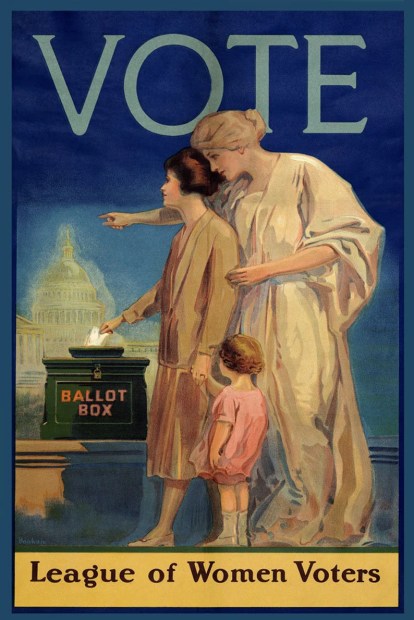
That’s all the politicking I will do this morning. You know the stakes and have your own views on issues and what you wish for our nation’s future. But I will ask that you start now by checking your voter info and registration to make sure you are in the game, that you are taking part in this important election.
You can do that by going to vote.org. It’s a site that checks to see if you are registered, if your current address matches up with the info on file, that allows you to register if you haven’t yet, that tells you where you will be voting and the hours for both early and same day voting.
All this and much more– everything you need to know in order to vote and make your voice heard.
It’s a great resource to help keep democracy alive. Use it– while you still can.
For all is like an ocean, all flows and connects; touch it in one place and it echoes at the other end of the world.
—Fyodor Dostoyevsky, The Brothers Karamazov
I think we’re always listening for echoes.
Echoes of sound, of sight, of every sense. Echoes of history.
Echoes help us determine how we should react in a given situation.
With music, we listen for echoes of the music we know, to see if it rhymes with that music, if it pleases us in the same manner.
We do the same with words and images. When we look at a piece of art, we search for the echoes of past works of art in it. We try to find congruence with works we know that already echo some sort of emotion within us.
I think it’s a matter of comfort, this looking for the familiar, that thing to which we already know our reaction.
That’s probably why the new so disturbs us. It has few, if any, echoes from the past and the echoes that it does carry have been reshaped beyond our senses to the point they are barely discernible.
We can’t rely on echoes in gauging our reactions to the new. The new– the new sound, thought, or artform– has no echo and may not be comfortable, perhaps even shocking us.
We might, at first, dismiss it for that reason alone. But if it has merit, if it speaks to some part of us that has not yet echoed, we come to accept it.
And it creates echoes of its own.
Okay, let’s leave it there for the morning. I will have to read this again later to see if it makes any sense. Sometimes these early morning riffs seem better at first glimpse than they are in reality.
Some echo and some don’t.
I guess we should strive to create echoes. Words to live by.
Let’s fill out this morning triad with a song from Scottish singer/songwriter Paolo Nutini, whose title fits the topic this morning. It’s called Through the Echoes. Good tune.
… wherever you are, you find the sun, a blade of grass, the spirals of the dragonfly. Courage consists of staying at home, close to nature, which could not care less about our disasters. Each grain of dust contains the soul of something marvelous.
–Joan Miró
A little Miró to kick off the post-Labor Day portion of our program.
Here’s a song from Dave Brubeck and his classic album Time Further Out which is subtitled Miró Reflections and featured Miró artwork on its cover. The song is Bru’s Boogie Woogie which I chose after a friend featured the modern Boogie Woogie piano of Henri Herbert in her blog, Lagniappe, yesterday. The title of her post was It’s Time to Boogie into Fall.
She isn’t wrong. And here’s Bru to help you get started.
Give me, for my life, all lives, give me all the pain of everyone, I’m going to turn it into hope. Give me all the joys, even the most secret, because otherwise how will these things be known? I have to tell them, give me the labors of everyday, for that’s what I sing.
― Pablo Neruda, Sublime Blue: Selected Early Odes
Labor Day, 2022. In honor of this day honoring organized labor and workers in general, I am getting to work this morning.
It’s what I do.
It’s my job, my task, my toil, my duty, my purpose, my privilege, my joy.
Maybe my salvation. It certainly has been in the past.
It’s what I do.
I don’t consider my work a prison sentence but here’s a version of an old prison work song, Make’s a Long Time Man Feel Bad, performed by the folk duo Ian & Sylvia. A long time man would be someone with a very long prison sentence to serve. Maybe a life sentence. Or longer.
I recall Gandhi said ultimately all things devolve into the political, but I’d argue that all things devolve into pro-people and anti-people. And I can pose the question: which side are you on?
― Stetson Kennedy
Another Labor Day weekend. I think that this year it is as symbolic as it ever been of the current struggle taking place in this nation. It is very much, as the late activist/ anti-fascist Stetson Kennedy put above, a struggle between forces that are either pro-people or anti-people.
I would actually phrase it as the users versus the used. Or those who control versus those who are controlled. That is the story of Labor Day.
Of course, it was in black and white terms in the early days of the struggle. But the users wised up learning that simple brute force wouldn’t be enough to control the used. They bought political clout to shape the laws to serve them and they bought all manner of spreading information to shape the messaging to serve them, using these new tools to divide the used and destroy the bonds of union that had been formed in the earlier days.
As a result, many of the used came to side with the users using them. The years of being shaped to not recognize their own exploitation and to find blame in created strawmen for their problems has pretty much brought us to where we are at this moment in time.
And it’s a dire time, a point of departure that will decide our fate as a nation. It is a matter of being pro- or anti-people. One side protects the users, the other the used.
The question is: Which side are you on?
I am rerunning a Labor Day post from 2009 below and then a song that asks that same question, Which Side Are You? It was written in 1931 by Florence Reece who lived in Harlan County, Kentucky which was the site of some of the most brutal and deadly labor strikes back in the early 20th century. I am including her singing a short version of the song from her later years, in the 1970’s, and a more refined version from Natalie Merchant that is very moving.
[From 2009]
On this day, Labor Day, I am showing a a painting from the great American folk primitive painter Ralph Fasanella, depicting the famed Bread and Roses strike that took place at the textile plants in Lawrence, Massachusetts in 1912. I thought it fitting that something be shown that is closer to the spirit of this holiday which has faded from the public’s knowledge in recent years.
I was a union member in my first on-the-books job at a Loblaw’s grocery store when I was sixteen years old and a few years later I was a member of the Teamsters Union at the A&P factory where I was employed for several years. I was the union steward in my department ( Cooking and Casting in the Candy department) for the last few years, a position that I took because for some reason nobody else wanted the hassle of it.
By taking it, I was protected from being laid off so long as my department was operating so I thought it might be worth a try. Most days had some sort of small trouble and, on a few days, some major problems to contend with. There was always an argument to be had, either with company supervisors who tried to circumvent or twist the rules to their advantage or with co-workers who felt the union didn’t go far enough or went too far.
All in all, it was a very educational experience.
The most telling thing was the general apathy from many of the workers, the same apathy that has allowed the solidarity of the union to erode and crumble over the years, paralleling the image of labor unions, which has crumbled, perceived now as corrupt and self-serving.
Probably a well-deserved image. But the failings of these unions are the failings of men, the same failings that the company owners possessed that the early unions organized against. Greed and a lack of empathy for their workers. It doesn’t take much research to discover that the work conditions of the last 130 or 140 years were deplorable.
Long hours. Low pay. Incredibly unsafe conditions. Dismissal for any reason. No rights whatsoever.
Today, many view industry as this amiable, father-like figure but don’t realize how much blood was spilled by early union organizers and members to obtain the things we now take for granted as our rights. Industry did not willingly give up anything to the worker without being forced. I can imagine what our world would look like without the efforts of our unions. This very holiday would not exist to have its roots forgotten. The idea of vacations would only exist for the company owners. The pay scale would be similar to those places on the Earth where many of our jobs have migrated, places that allow the avarice of the companies to override the rights and safety of the workers. Places where sweatshops still operate, as they once did here. Places where unschooled children toil in dirty, dank conditions, as they once did here. Places where the health and safety of the workers is secondary to the profit they provide, as it once was here.
You may despise the unions now for their corruption but make no mistake about it- without them our country would look much different. And not in a good way…
[One note of optimism from 2022: According to recent polling, Pro-Union sentiment has risen to its highest level in decades, with 71% of those polled viewing unions in a positive light.]
I think most artists create out of despair…. if labor pain is for physical birth, then there is a psychic pain and spiritual for creation…. The very nature of creation is not a performing glory on the outside, it’s a painful, difficult search within.
–Louise Nevelson, Dawns + Dusks (1976)
I came across the passage above from the late sculptor Louise Nevelson and it hit the mark for me. Despair is often a driving force in creation, at least as I know it. Even the joy that is sometimes reflected in my own work appears as the result of an attempt– the painful, difficult search within, as she puts it– to stave off some form of despair.
I thought coming across this passage would be a good opportunity to share a post from a few years back that featured Nevelson’s works and words.
No matter how individual we humans are, we are a composite of everything we are aware of. We are a mirror of our times.
—Louise Berliawsky Nevelson
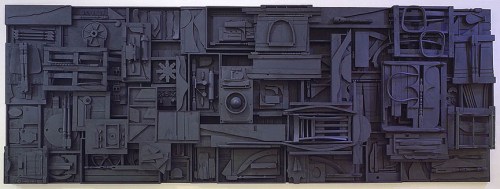
I am always intrigued by the images I see of the work of Louise Berliawsky Nevelson (1899-1988) who emigrated to the US from Ukraine in the early part of the 20th century. She is best known for her sculpture that is comprised of found objects assembled in large, monumental wall pieces that are often painted in monochromatic tones. There is visual excitement provided by the various shapes of the many bits and pieces contained within the sculptures. They are familiar forms, often dissembled furniture elements, that take on a new meaning in the work.
It makes me want to try to do that sort of thing, some kind of monumental assemblage. Something big and odd with inferred meaning hidden in the reimagining of common objects.
But the pull is not strong enough to ever get me to actually try. Nevelson’s art is interesting work that makes me try to see a meaning within it that fits my own vision and needs. But I can never quite see a way where it can do what I need it to do for myself. I take that as a sign that it is not my form of expression.
Plus, from a pragmatic standpoint, it looks like it would be a nightmare to dust.
Nevelson’s words above resonate with me. As humans, we are composites of everything we take in. Likewise, artists express this humanness in their work, mirroring their feelings taken from these influences.
I know this is definitely true for myself. I generally can’t help but reflecting my feelings on the world around me. I would think to try to not do so would make one’s work cold and distant. Inhuman.
And that takes us away from the purpose of art as expressions of our humanity.
So, to my artist friends out there, take in all you can and let the world know how you feel it. It’s the human thing to do.
The dry leaf’s rustle and the squirrel’s laughter.
The cool, fresh air, whence health and vigor spring,
And promise of exceeding joy hereafter.
— George Arnold, September Days
Since I shared an instrumental version of September Song yesterday, I thought I might at least share a version with vocals and the original lyrics. This performance from the great Sarah Vaughan is one of my favorites and has been here more than once before.
Oh, it’s a long, long while from May to December But the days grow short When you reach September When the Autumn weather turns the leaves to flame One hasn’t got time for the waiting game
Oh, the days dwindle down to a precious few September, November And these few precious days I’ll spend with you These precious days I’ll spend with you
— September Song, Kurt Weill/ Maxwell Anderson
The first day of September ii generally one of my favorite days of the year. That’s mainly because it means that I have made it through another dreaded August and that I can let out a sigh of relief and begin that slow walk into autumn.
While all the seasons have their charms, I consider myself an autumn person. The slowing of pace, the coolness of the air, the angle of the light, the colors in the trees, the smell of soil and leaves, and the continued shortening of days– it all combines to blend well with that part of my personality defined by a wistful melancholy.
And this has become even more pronounced as I move through the autumn of my own life, as though that September feeling and my own timeline have finally converged. It feels natural and comfortable.
Another thing that makes September first a favorite day is that it means that will generally listen to several versions of September Song, the great Kurt Weill/ Maxwell Anderson song that was written for and first recorded by Walter Huston, of all people, for the 1938 Broadway play Knickerbocker Holiday in which he plays an aging Peter Stuyvesant, the governor of New Amsterdam (present day New York) in the 1600’s.
Though the show didn’t do well and the fact that the song was written for Huston’s limited vocal range, it has become a standard that has been recorded by countless and widely varied artists through the years. I play a version of September Song every year on this day and have played the better-known versions as well as some that are lesser known. All are pretty darn good.
Today I am sharing an instrumental rendition from the late great jazz trumpeter Chet Baker, who beautifully captures the song.





 Redtree Times