Feeds:
Posts
Comments

Archive for January, 2023

Doubling Back

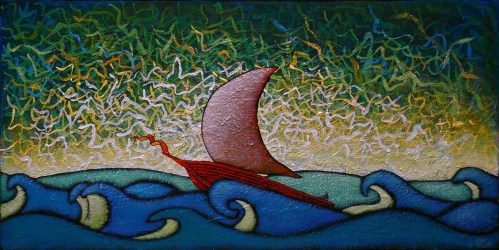
GC Myers- The Sky Is Always the Sky 1995 sm

The Sky Is Always the Sky, 1995


Growth is a spiral process, doubling back on itself, reassessing and regrouping.

–Julia Margaret Cameron (1815-1879)


I have been working in the studio the past week or so, trying to reorganize and clean my workspace. I have a relatively large space here but somehow it has filled and become craped over the 15 years I have been in here. A lot of stuff that I thought might be usable has found its way to the trash and a few things that have been either forgotten or thought lost have emerged from the piles.

It feels good to get things back in order and to rid myself of things that cluttered my life without much purpose.

While reorganizing things, I inevitably end up going through old work here in the studio. I do this most years around this time. I feel like it’s a valuable part of my process, this doubling back. It helps me measure what I perceive is growth in my work. Well, at least what I hope is growth in my work.

The work has changed in many ways and stayed the same in others. The years have changed me as a person in many ways and that is reflected in the newer work. Parts of my skillset– and personality– have grown, some have declined, some have been lost altogether.

Looking back at the earlier work allows me to see where these gains and losses have taken place. In some cases, there are things I want to recapture. I should say try to recapture. Some things are, as I said, lost forever. Technique and materials evolve. The way I perceive things has changed. Eyesight fades a bit, my hand is a bit less steady, and some things are born of emotional moments that can’t be recreated organically.

Things change and there is work that I can’t fully recreate. That makes me a bit sorrowful. It’s like looking at a photo of yourself when you were younger, with more and darker hair and skin that didn’t have quite so many wrinkles or sags. You see yourself as the same but know that that time is past. You can try to go back but the miles are on the odometer and the engine. It will never be quite the same.

I use the word sorrowful, but I am not truly saddened by it. I am actually glad in seeing these pieces from that time, remembering the spirit in which they were created. That spirit is the thing that can be revisited, rediscovered.

It is energy-giving. And that’s a big deal this stage of the game.

Take the piece at the top. It’s called The Sky Is Always the Sky from the middle of 1995. I stumbled across it the other day and it thrilled me, much as it did when I first painted almost 28 years ago. I see things in it that I would struggle in recreating. The colors, the sedimentation of the pigments, and even the organic feel of the linework would be much different.

For some reason, I don’t think this piece ever showed in a gallery. Maybe I knew that its purpose would be in reminding me of that time and emotional feeling some years later. If so, its purpose has been fulfilled.

All I could ask of it.

FYI: The quote at the top, which rings especially true for me, is from Julia Cameron, the great 19th century British photographer. I wrote about some of her photos several times here years ago. Her photos have a freshness and composition that seem distinct and apart from the wok of her contemporaries. They sometimes seem out of their time for me.

Here’s a song about looking back. It’s Reflections on My Life from The Marmalade.


Read Full Post »

Vita et Lux

GC Myers- Vita et Lux sm

Vita et Lux– At Principle Gallery

As far as we can discern, the sole purpose of human existence is to kindle a light of meaning in the darkness of mere being.

–Carl Jung, Memories, Dreams, Reflections (1963)


Could it be that mere being, with all the darkness it entails, is the meaning and purpose of life? Maybe we have no purpose other than to experience being alive, to be little sparks of light that creates an arc that runs from our birth to our death, cutting through the darkness.

Maybe that arc itself is the light of meaning?

I don’t know if that is the case or if I can believe that. It’s a little too hedonistic to my way of thinking, too limited to self-indulgence and lacking concern for the welfare of others.

But it’s only 6 AM on a Monday morning. Maybe in the light of day I will see things differently.

Or maybe not. Who knows?

Since light seems to be the subject of the day, here’s a song dealing with that subject. Kind of. This is Springsteen and his Blinded By the Light performed in the mid-2000’s with the band from his Seeger Sessions album. That album performed many Pete Seeger folk songs with a hybrid folk-Big Band sound. I wasn’t particularly fond of that album at the time but over the years it has grown on me and I think this folk-Big Band sound works really well with this tune. You be the judge.


Read Full Post »

George Gray/ Longing

GC Myers- Riding Rhythm sm

Riding Rhythm– At the West End Gallery


I have studied many times
The marble which was chiseled for me–
A boat with a furled sail at rest in a harbor.
In truth it pictures not my destination
But my life.
For love was offered me and I shrank from its disillusionment;
Sorrow knocked at my door, but I was afraid;
Ambition called to me, but I dreaded the chances.
Yet all the while I hungered for meaning in my life.
And now I know that we must lift the sail
And catch the winds of destiny
Wherever they drive the boat.
To put meaning in one’s life may end in madness,
But life without meaning is the torture
Of restlessness and vague desire–
It is a boat longing for the sea and yet afraid.

–Edgar Lee Masters, George Gray, Spoon River Anthology, 1915


Ah, those last four lines…

I’m not going to say any more this morning. It’s Sunday and we all deserve a break. If there is a common thread here, it’s for you to find if you so choose.

For this Sunday’s song, here’s a longtime favorite from the late Leonard Cohen, Night Comes On.


Read Full Post »

Pertinax

GC Myers- Navigating Chaos  2022

Navigating Chaos– Now at the Principle Gallery


Let chaos storm!
Let cloud shapes swarm!
I wait for form.

–Robert Frost, Pertinax, 1936


There is often what appears to be chaos in this world. That’s a scary thing.

It represents tumult and uncertainty. Change. Destruction.

Creation.

That’s probably the most important aspect of chaos: Creation comes from chaos.

We can fear it. We can fight it. But regardless of our efforts, chaos is always with us. Perhaps we should embrace it with the understanding that life and art and all other creation rises from chaos.

Hmm. Not what I thought I’d write this morning but let’s let it be as it is.

Here’s a favorite song from Willie Nelson, Darkness on the Face of the Earth. It’s the 1998 remake of his 1962 song which was far more traditional country in style. This version is less restrained and much freer in its movement. I thought it fit today’s subject as it’s about a guy trying to find form after his world is shattered.

Creation from chaos.

Hmm…


By the way, pertinax comes from the Latin and means obstinate and persevering. The quality you need to find form beyond chaos.


Read Full Post »

Go Your Way

scan0049 It Was the Oddest Sky 1994

It Was the Oddest Sky, 1994


Tell him to be alone often and get at himself
and above all tell himself no lies about himself
whatever the white lies and protective fronts
he may use amongst other people.
Tell him solitude is creative if he is strong
and the final decisions are made in silent rooms.
Tell him to be different from other people
if it comes natural and easy being different.
Let him have lazy days seeking his deeper motives.
Let him seek deep for where he is a born natural.
      Then he may understand Shakespeare
      and the Wright brothers, Pasteur, Pavlov,
      Michael Faraday and free imaginations
bringing changes into a world resenting change.
      He will be lonely enough
      to have time for the work
      he knows as his own.

–Carl Sandburg, The People, Yes


I wasn’t sure how this was all going to tie together today. Didn’t seem to have a common chord at first and thought it might be a stretch trying to stand my stuff up alongside Amercian icons like Carl Sandburg and Woody Guthrie. But then I thought that it was their idea of individuality, of going your own way, that drove my work. Especially the early work when I was trying to differentiate myself from the art that I knew.

Much like Sandburg’s verse, I seemed to heed the advice given by a father in it. I knew I wanted to be somehow different, to not be constantly compared to the work and words of others. I didn’t want to compete with anyone, just wanted to be left alone with the time to do what I felt I needed to do.

The piece at the top, It Was the Oddest Sky from 1994, represents one of the first efforts where I felt that I could find something in the work that I could call my own. Even as the work has changed, grown, and evolved, the idea of it standing alone as my own has always been the driving force behind it.

Whether it is good or not, I cannot say. It’s just what I do now and when I am gone, what I did in my own way and with my own voice. It might not be the best voice or the sweetest. But like Woody wrote: There ain’t nobody that can sing like me

Here’s the song that that line is from, Way Over Yonder in the Minor Key. It was from a group of unrecorded lyrics that Billy Bragg and Wilco set to music at the behest of the Guthrie family. The result were the Mermaid Avenue albums. I think they’re great works and this song is among my favorites from them.


Read Full Post »

Big Lebowski Nihilists


Free men are aware of the imperfection inherent in human affairs, and they are willing to fight and die for that which is not perfect. They know that basic human problems can have no final solutions, that our freedom, justice, equality, etc. are far from absolute, and that the good life is compounded of half measures, compromises, lesser evils, and gropings toward the perfect. The rejection of approximations and the insistence on absolutes are the manifestation of a nihilism that loathes freedom, tolerance, and equity.

–Eric Hoffer, The Temper of Our Time (1967)


Eric Hoffer died in 1983, before some of the current GOP members in our House of Representatives were even born. But he knew of them already. He knew the type, those people who refuse all compromises and accept only absolutism and control. Those people who would rather burn down the whole shooting match unless all their demands are met.

Those kinds of folks are in every time and place.

Freaking Nihilists.

Fortunately, they seldom coalesce and gain power. And when they do, their reign seldom lasts long unless they transfer their power to a system that totally discards all democratic norms to become an authoritarian regime. In a democratic system, once the Freaking Nihilists take control, they can no longer hide their total lack of knowledge, ideas, policies, or the will to govern. In fact, those are all things for which they hold nothing but total disdain.

Oh, if they somehow take power, they will hold on for a short while, subsisting on a diet of grievance and contrived cultural battles. But after a while people want the boring stability that even an imperfect true democracy offers in its governance.

They want their government to assist them when they have problems, to provide necessary services, to make sure laws and regulations are upheld and that the benefits due to them arrive. They just want the government to work for them. That includes their elected officials, something the Freaking Nihilists oppose on principle.

At that point, when their true aims and lack of expertise become evident, they usually get voted out, leaving nothing but damage behind for the next administration to clean up.

I bet Eric Hoffer, the Longshoreman Philosopher, would be having a field day taking potshots at the current crop of Freaking Nihilists. I have been a fan of his for some time now, having featured him here a few times in blogposts over the years. Hoffer (1902-1983) was a self-taught philosopher/ social commentator/ activist/ thinker with a knack for seeing the tides and patterns that swirl beneath the surface of history. He was a total working-class guy with a natural distrust of bosses and those who wield power over others. My kind of guy.

Like I said, he would have recognized those weasels among us, those Freaking Nihilists. Their corrupted weakness has been around forever. You can’t negotiate with people who believe in nothing but chaos and destruction of norms. And once you allow them into your midst, as the Republican Party did, thinking that you can somehow use and control them, you are forever tied to them. You can’t get rid of them because in doing so they will turn their fire on you. We are seeing that now as the 10% of that party who are Freaking Nihilists wreak havoc in the battle for the Speaker of the House.

I have little doubt that the leaders of the party will give in to their demands. Their own quest for power makes that a likelihood. It might well result in a nightmare for this country and the world because one of the main things these Freaking Nihilists want is to prevent the raising of our debt ceiling and allowing a default on our national debt. This would be beyond terrible, crippling the world economy in a way that would make the worldwide economic problems caused by Covid in 2020 look like the Good Old Days.

It could create pure chaos.

And that is all they desire.

Buckle up, folks. The next couple of years could be a very bumpy ride…


Power corrupts the few, while weakness corrupts the many.  Hatred, malice, rudeness, intolerance and suspicion are the fruits of weakness.

Eric Hoffer, The Ordeal of Courage, 1963


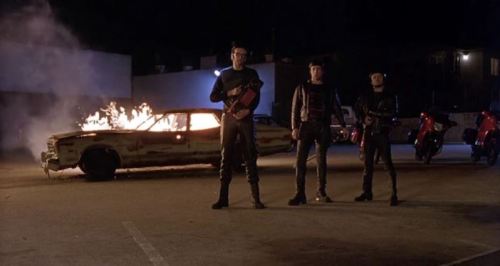
Big Lebowski Nihilists 2This image and the image at the top is, of course, of the German Nihilists from The Big Lebowski. Nihilist #2 was played by Flea, the bassist from the Red Hot Chili Peppers. I am not going to play any RHCP today. Instead, let’s go with something from The Big Lebowski. Here’s Just Dropped In (To See What Condition My Condition Was In) from Kenny Rogers and the First Edition. I think the song and video kind of fits this post pretty well.

But what do I know?


Read Full Post »

Wash Away the Dust…

Pablo Picasso-  The Old Guitarist 1903

Pablo Picasso- The Old Guitarist, 1903


Art is the best possible introduction to the culture of the world. I love it for the buried hopes, the garnered memories, the tender feelings it can summon at a touch. It washes away from the soul the dust of everyday life.

–Pablo Picasso


I chose the song below because I thought Glenn Hansard sort of looked like the old guitarist from the Pablo Picasso painting from his early Blue Period shown above. Maybe the biggest difference is that Glenn’s guitar has a lot more evident wear and tear than the one in the painting.

I hadn’t heard the song and, after listening, realized it was a pretty good fit for today’s triad of words, image, and song. The song is Paying My Way. Maybe it can wash away the dust of everyday life from your soul this morning. Mine is feeling much less dusty after a couple of listens.


Read Full Post »


Noctograph

Early Noctograph ca. 1810


It is a mistake always to contemplate the good and ignore the evil, because by making people neglectful it lets in disaster. There is a dangerous optimism of ignorance and indifference. It is not enough to say that the twentieth century is the best age in the history of mankind, and to take refuge from the evils of the world in skyey dreams of good. How many good men, prosperous and contented, looked around and saw naught but good, while millions of their fellow men were bartered and sold like cattle! No doubt, there were comfortable optimists who thought Wilberforce a meddlesome fanatic when he was working with might and main to free the slaves. I distrust the rash optimism in this country that cries, ” Hurrah, we’re all right ! This is the greatest nation on earth,” when there are grievances that call loudly for redress. That is false optimism. Optimism that does not count the cost is like a house builded on sand. A man must understand evil and be acquainted with sorrow before he can write himself an optimist and expect others to believe that he has reason for the faith that is in him.
      I know what evil is. Once or twice I have wrestled with it, and for a time felt its chilling touch on my life; so I speak with knowledge when I say that evil is of no consequence, except as a sort of mental gymnastic. For the very reason that I have come in contact with it, I am more truly an optimist. I can say with conviction that the struggle which evil necessitates is one of the greatest blessings. It makes us strong, patient, helpful men and women. It lets us into the soul of things and teaches us that although the world is full of suffering, it is full also of the overcoming of it. My optimism, then, does not rest on the absence of evil, but on a glad belief in the preponderance of good and a willing effort always to cooperate with the good, that it may prevail. I try to increase the power God has given me to see the best in everything and everyone and make that Best a part of my life. The world is sown with good; but unless I turn my glad thoughts into practical living and till my own field, I cannot reap a kernel of the good.
       Thus my optimism is grounded in two worlds, myself and what is about me. I demand that the world be good, and lo, it obeys. I proclaim the world good, and facts range themselves to prove my proclamation overwhelmingly true. To what is good I open the doors of my being, and jealously shut them against what is bad. Such is the force of this beautiful and willful conviction, it carries itself in the face of all opposition. I am never discouraged by absence of good. I never can be argued into hopelessness. Doubt and mistrust are the mere panic of timid imagination, which the steadfast heart will conquer, and the large mind transcend.

–Helen Keller, Optimism Within, 1903


After I wrote yesterday’s blog entry, I was thinking that I needed to point out that not all optimism is equal. There is one form that is reckless and lazy, whose adherents believe that things will always work out without any concern or help from them. There is a reciprocal form of pessimism that is equally as reckless and lazy, one that believes that the end is near so why try to stop it. Both are inactive and irresponsible.

I guess what I wanted to add to yesterday’s post is that my optimism is a cautious one, one based on me staying informed, doing research, and trying to do whatever it takes to help others and myself along the way. It is an optimism that tries to be active and participatory. It understands that the path into the future consists of hills and valleys, that it is effort that creates the lasting change that fuels true optimism.

In thinking about this I came across some passages from a short book, Optimism, that Helen Keller wrote in 1903 while still a student at Radcliffe. The passages I read described very much the sort of optimism I had wanted to describe, one that differentiated between the naive and detached Pollyannish sort and that which is more realistic and engaged.

I decided to find the book to make sure I was understanding these passages in their original context. I went to the Internet Archive, one of my favorite sites for researching older books. It allows you to leaf through old volumes and has a great search function. Optimism was there and I quickly found the passages which led me to reading more of the book. It described her optimism in terms that made sense to my way of thinking. It was quite an interesting read and even in these few paragraphs, there are numerous memorable lines, such as:

I distrust the rash optimism in this country that cries, ” Hurrah, we’re all right ! This is the greatest nation on earth,” when there are grievances that call loudly for redress. That is false optimism.

With all that Helen Keller overcame, she, of all people, could write on optimism with authority.

A little added info: The Wilberforce she mentions in the passage above is William Wilberforce (1759-1833), the Member of Parliament who was the driving force in the British movement for the abolition of slavery, which culminated in the Slavery Abolition Act 1833. Wilberforce also founded the British SPCA. the world’s first animal welfare organization.

Also, while doing my research I discovered that before she was introduced to the Braille System of reading and writing for the blind, Helen Keller used a device to actually write with her own hand. As you can see from the image below, from a letter she wrote when only 11 years old, her handwriting in her writings of that time was quite neat and orderly. Much better than my own, that’s for sure. It was made with some form of a device called a noctograph like the one shown at the top. I had never heard of this device so a little research uncovered that it was invented in the early 1800’s so that people with loss of sight or those in the dark could more easily write. I have included a short video below that explains how it worked.

Helen_Keller_ Letter 1891

Helen Keller Letter 1891


Read Full Post »

shel-silverstein-listen-to-the-mustnts


Optimism is a strategy for making a better future. Because unless you believe that the future can be better, you are unlikely to step up and take responsibility for making it so.

― Noam Chomsky


I am running a mashup of two past blog entries today. One is just the illustration above from Shel Silverstein reminding us to reject negativity and remain open to possibility. The other was from last New Year’s Eve when I declared myself a Committed Optimist. I thought it was worth revisiting to see if I had held up my end in upholding that oath. Was I the Committed Optimist I desired to be?

To be honest, I can’t really say.

There were plenty of disappointments, missteps, losses and downright failures that certainly put it to the test. But there were also plenty of good things, revelations, lessons learned, and just enough glints of hope for the future to make me still feel optimistic about that future.

And isn’t having the belief that there is a future for myself and the world evidence enough of one’s optimism?

In that case, I am still, one year in and a little shaky at times, a Committed Optimist. Now, let’s start working on that future..

–January2, 2023


Tonight is New Year’s Eve with the year 2022 beginning at midnight. The last several year’s have been racing with increasing urgency to this moment and it almost feels like we are near the point where all the storylines merge and hopefully come to an end. The threats of pandemic, climate related disasters, potential government overthrow and civil war all hang in the air, all with outcomes that are yet to be determined.

But despite the threats that sometimes haunt my fevered dreams, I have found myself in recent days feeling oddly optimistic.

I am optimistic about the work I will produce but even more than that, I have a feeling of positivity that these more daunting and dangerous matters can be resolved.

Well, maybe not the climate related disasters. That can’t be resolved in short order, if ever. But the optimistic part of me believes that we as a species will find the will to adapt to the coming changes in our environment.

So, call me an optimist this morning. I am proud to wear that label after the last five awful years.

Optimists sometimes get a bad name. Maybe rightfully so.

I mean, they sometimes gloss over glaring and seemingly unsurmountable obstacles. They sometimes overestimate their abilities and potentials. They sometimes forget that others may not have the same forward-looking attitude and, as a result, will not assist in the mission.

And they are sometimes dreadfully wrong and their attempts fail in gloriously awful crashes.

But you know what? They fail only because they have the daring and foresight to start and do things. Big things.

Optimists get things get done. Plain and simple.

Pessimists have never accomplished a thing worth remembering. If they have, it eludes my memory.  Pessimism is easy, without any commitment or acceptance of responsibility. It doesn’t take any daring or effort to criticize, to point out flaws or the doomed outcomes that they believe will come.

No, pessimists do nothing. I know. I have been a part-time pessimist for long stretches of my life and during those periods, I was worthless and miserable.

Any great accomplishment, any breakthrough, anything that has moved or benefitted mankind, came from an optimist. They had a vision, saw a need, and plunged in. They brushed aside the naysayers, the pessimists, and did what needed to be done.

They saw a future.

But optimism is not easy. Not by a long shot.

We’re not talking Pollyanna, rose-colored glasses stuff here. I’m talking hardcore, roll-up-your-sleeves, bare-your-knuckles and show-your-teeth optimism.

The optimism I am talking about requires steely determination and willingness to sweat and bleed to achieve the envisioned future. It requires taking on a responsibility for others besides yourself. It takes the daring to move on even as you know that you could very easily fall flat on your face and outright fail.

Most importantly, it requires absolute, unwavering commitment. This is the real key to everything.

Commitment is a dangerous thing in the hands of the misguided or the more evil among us. We see evidence of this all the time. But in the hands of those who work and struggle for a better future for all people- even those creative sorts who want to leave the world evidence of the grace that resides here– commitment is a force of nature.

Commitment in the hands of an optimist is the engine that makes the world a better place and creates a better future for us all.

Look at the history of human achievement– it gets stuff done. Plain and simple.

I want to see a better future. I want to see it in my work but, more importantly, I need to see it in the world around me. And I am optimistic that it will be done.

So, for this last entry in the year 2021, let me state that I plan to enter the New Year as a Committed Optimist.

Might even put that on my business card, if I had one.

Let’s play one last song for this year. This is When Your Minds Made Up From Glen Hansard, from his creation that became an enchanting movie and stage production, Once. I chose it because this performance is filled with commitment. Its finishing moments are filled with absolute, primal and ethereal commitment.

And that– absolute, primal and ethereal commitment– is my wish for the New Year.

My mind’s made up.


Read Full Post »

New Year’s Day

GC Myers- Chaos & Light sm

Chaos & Light— At the West End Gallery


Like the folds of summer dresses
Like the scent upon my wrist
Like the way you played guitar
Like a boxer punches with his fist
And taken or just lost to me
It’s better now to say
I dwell in possibility
On New Year’s Day

New Year’s Day, Mary Chapin Carpenter


Happy New Year. Let us all dwell in its possibility…


Read Full Post »

« Newer Posts